REVIEW 2 major objections 6 minor 60 references
ResemBrick: Brick Reconstruction from Photographs with Perceptual Fidelity and Buildability
T0 review · 2 major / 6 minor · reviewed 2026-08-11 · deepseek-v4-flash
Pith's one-line read ResemBrick claims that coupling budgeted occupancy completion with buildability-aware assembly lets a photo-to-brick pipeline achieve better perceptual fidelity than prior systems while uniquely producing fully stable assemblies on…
desk verdict Careful, well-scoped brick pipeline with a real co-design idea, but the full-pipeline 'from photographs' claim hinges on an unspecified rendered target that looks like the reconstructed mesh, not the ground-truth object. read the letter →
The pith
A machine-rendered reading of the paper's core claim, the machinery that carries it, and where it could break.
The reading
What carries the argument
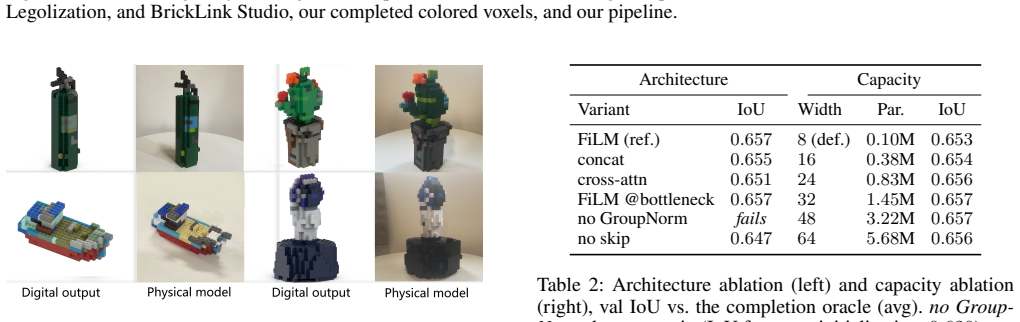
The central mechanism is budgeted occupancy completion: instead of uniform voxelization, the network is asked to allocate a fixed number of occupied voxels among the surface band, the shell of voxels straddling the recovered mesh, and it does so with a fully-convolutional 3D U-Net conditioned on resolution and realized density via feature-wise linear modulation (FiLM) layers, trained in two phases: oracle distillation, then annealed straight-through refinement against rendered depth. The second mechanism is the buildability-aware greedy assembler: a layer-wise merge scores candidate library bricks by support fraction, a rescue bonus for bricks spanning overhangs, importance-rarity color salience, and a look-ahead penalty for stranded cells, followed by a two-tier floating-component repair (zero-deformation recombination, then cap/shelf bridging) that is deterministic and provably terminating.
What would settle it
Re-run the full-pipeline comparison with the ground-truth object (or the original photographs) as the render reference instead of the reconstructed mesh, and see whether ResemBrick still leads on MS-SSIM and LPIPS. Separately, run the pipeline on a held-out set deliberately rich in thin, arch-like, or bridge-like objects and count how often the exact force-balance solver certifies full stability, since the paper's own scope analysis excludes cross-layer support from the guaranteed properties.
Extended reading notes
Core claim
The core discovery is that the fidelity ceiling of a brick model is set by how the occupancy budget is spent, so the voxelizer and the assembler must be coupled. The paper's completion network is distilled from an offline greedy oracle that selects the surface-band voxels whose filling most reduces a geometry-aware perceptual loss, then refined with a straight-through estimator against rendered depth; the same weight set serves resolutions 24, 32, and 48 and generalizes to 13 resolutions. The assembly stage then partitions each layer into library bricks using a greedy score that rewards supported placement, rare-color preservation, and look-ahead, and a two-tier repair with cap and shelf bridges guarantees grounded connectivity by construction. On the held-out 198-object set at resolution 24, ResemBrick reports MS-SSIM 0.955 and LPIPS 0.075 versus 0.940/0.081 for BrickGPT and 0.940/0.082 for Legolization, with 100% of assemblies certified stable by an exact force-balance solver; under a matched occupancy budget, the completion network also beats all geometric voxel selectors on the perceptual metrics.
Load-bearing premise
The full-pipeline fidelity claim assumes the rendered 'target' used for MS-SSIM and LPIPS is the ground-truth object appearance, not the intermediary mesh reconstructed from the photos that the brick model is built from.
Editorial extensions
If this is right
- Because one learned selector spans 13 resolutions, a user can change the brick budget without retraining the discretizer.
- The repair stage is deterministic and provably terminating, so zero floating components is a structural property of the pipeline rather than a statistical outcome.
- Since the completion budget upper-bounds what any downstream assembly can achieve, improvements to the allocator's fidelity directly raise the quality ceiling of brick reconstruction.
- The distilled stability surrogate certifies per-brick stability in milliseconds, which makes it practical to screen candidate assemblies during construction rather than only after completion.
- The four real-world hand-builds show the exported layer-by-layer instructions assemble standing models without manual edits, on the tested objects.
Reading between the lines
- The paper never states whether the rendered reference in the full-pipeline fidelity table is the ground-truth object or the reconstructed mesh; if it is the mesh, the comparison tests brick-model-versus-its-own-source rather than photo-to-brick fidelity, so the reader should check the supplement's evaluation protocol before trusting the headline numbers.
- A natural extension the paper leaves implicit: propagating a differentiable stability or brick-count signal from the assembler back into the occupancy network might push the fidelity ceiling higher, particularly for arch- or bridge-like shapes whose mid-assembly states are currently excluded from the buildability guarantee.
- At the coarsest grids the network trails a sparse SDF shell on MS-SSIM, so a hybrid selector that switches by resolution could dominate both; the paper reports the gap but does not propose the hybrid.
Signed reviews
Editorial analysis
A structured set of objections, weighed in public.
Referee Report
Summary. The paper proposes ResemBrick, a two-stage pipeline that converts a handful of casual photographs into a hand-buildable colored brick model. A pose-free reconstructor (FreeSplatter) first produces a watertight textured mesh; a resolution- and budget-conditioned 3D U-Net then selects which surface voxels to occupy under a user-specified occupied-voxel count; a greedy builder with a two-tier, provably terminating repair stage partitions the resulting grid into library bricks and guarantees grounded connectivity. The paper reports that, under a matched budget, ResemBrick's completion network beats geometric voxel selectors in perceptual fidelity, and that the full pipeline attains the best perceptual fidelity among prior brick-construction systems while uniquely reaching zero floating and zero statically unstable bricks on the held-out OmniObject3D set. Experiments are conducted at R=24 for full-pipeline comparisons, with voxelization-stage comparisons at R in {24,32,48} and a resolution-generalization study across 13 resolutions.
Significance. If the claims hold, the paper makes a useful contribution by reframing coarse voxelization as budget allocation and showing that completion and assembly can be co-designed rather than treated as independent stages. The experimental protocol is unusually careful: matched occupancy budgets are enforced by construction, all voxelization baselines share the same frozen SDF, camera poses, and mesh, the stability numbers are certified by an exact force-balance solver, a separate sweep-validation set is used for building-stage hyperparameters, and the supplement (Sec. H.1) explicitly separates what is guaranteed by construction (grounded connectivity) from what is empirical (static stability and physical hand-buildability). The honest treatment of the lazy-greedy oracle's non-submodularity is also a strength. However, the central full-pipeline claim is currently under-specified because the perceptual evaluation never identifies its reference target, and there is an apparent inconsistency in the reported stability of the colored system across tables. These issues are load-bearing for the abstract's 'from photographs' and 'zero unstable bricks' claims and need to be resolved.
major comments (2)
- [Sec. 4.1, Appendix E.1, Table 1] The rendered-view perceptual metrics never specify what the reference 'target' is. The metric definition in Sec. 4.1 says only 'MS-SSIM and LPIPS ... on rendered views', and Appendix E.1 says 'rendered views of the predicted output and the target' without defining 'target'. If the target is the FreeSplatter-reconstructed mesh M rather than the ground-truth scanned object, then the Table 1 full-pipeline numbers measure mesh-to-brick fidelity only, and the title/abstract claim of reconstruction 'from photographs' is not tested; Section I itself identifies the reconstruction front end as a source of propagated errors, so the distinction matters. Please state the reference object explicitly in Sec. 4.1 and in the Table 1 caption. If it is M, please add an evaluation against the ground-truth object or qualify the abstract and title claims.
- [Table 5 vs. Table 1] The stability numbers for the deployed system appear inconsistent. Table 5 reports 'Ours (col.)' on the 198-object held-out omni set with n_u=0.45 and Stab%=98.0, while Table 1 reports 'Ours' with Stab%=100 on the same set at the same R=24. If the full pipeline includes per-brick color, these two entries cannot both describe the same configuration; the abstract's 'uniquely reaching zero floating and zero unstable bricks' claim is therefore at risk. Please define exactly what 'Ours' and 'Ours (col.)' denote relative to the full pipeline, and report the stability of the exact configuration used in Table 1.
minor comments (6)
- [Abstract and Sec. 4.3] The phrase 'one weight set spanning 13 resolutions' could be read as a training claim; since only three resolutions are trained, please phrase this as 'evaluated on 13 resolutions' or otherwise clarify.
- [Sec. 4.1] The term 'unfiltered held-out objects' should be defined explicitly (e.g., no post-hoc exclusion by reconstruction quality, stability, or category) so that readers understand the scope of the zero-floating/zero-unstable claim.
- [Sec. 3.2, Eq. (1) and Appendix E.1] The oracle loss uses LPIPS on colorless depth renderings while the final perceptual evaluation uses color renderings; please state whether this mismatch is intentional and discuss its effect on the completion network's training signal.
- [Appendix E.1] The names 'uniform' and 'Top-K' are used for the identical selector; please state this equivalence in the main text or in the table captions to avoid confusion.
- [Figure 6] Please report the number of objects and the exact bootstrap resampling procedure used for the shaded 95% confidence bands.
- [Algorithm 1, line 2] The loop 'for all 4-connected components R over all layers' should specify that 4-connectivity is computed within each layer, since walls are connected only through vertical overlap in the subsequent greedy placement.
Circularity Check
No significant circularity: supervised held-out evaluation and algorithmic guarantees; the unspecified perceptual target is an evaluation-validity concern, not a by-construction reduction.
full rationale
This is an empirical systems paper rather than a derivation, so the circularity burden is limited and, on inspection, unmet. The learned completion network is trained by distillation from a greedy oracle that optimizes a perceptual loss, but evaluation is on a held-out 198-object validation split never used for architecture or checkpoint selection, and the matched-budget baselines share the same frozen SDF, mesh, and camera poses by an explicit fairness protocol (Appendix E.1). That is standard supervised benchmarking, not a fitted-input-called-prediction loop. The 'zero floating' claim is an algorithmic invariant of the repair loop in Algorithm 1, which repeatedly reduces the floating-component count until empty and is stated to terminate; it is not a relabeled input or a self-referential metric. Reported stability numbers are certified by the external exact Gurobi force-balance solver, with the distilled message-passing surrogate explicitly relegated to in-loop screening and excluded from reported results (Appendix D.2, E.2), so no stability claim reduces to a self-trained network. The only notable ambiguity is that Section 4.1 and Appendix E.1 do not explicitly identify the 'target' for full-pipeline rendered-view metrics: if the target is the FreeSplatter-reconstructed mesh M rather than ground-truth scans, the photo-to-brick framing overstates what the perceptual numbers establish. However, this is an evaluation-design and claim-scoping concern, not circularity: the brick assembly is not equal to M by construction, resemblance is not guaranteed, and the paper explicitly acknowledges front-end dependence and error propagation in Section I. No load-bearing self-citation chain exists; FreeSplatter is an external, substitutable front end. Therefore no circular step meets the evidentiary bar requiring a quoted reduction of a claimed result to its own inputs.
Assumptions & free parameters
free parameters (5)
- Building-stage greedy scoring weights (w_area, w_support, lambda_int, lambda_edge, w_col, k) =
w_area=15, w_support=20, lambda_int=12, lambda_edge=4, w_col=20, k=2
- Completion-oracle fill levels rho_tgt =
0.4, 0.62, 0.75
- Perceptual loss weights in oracle Q and Phase-2 objective (Eqs. 1 and 3) =
not reported
- Repair gap tolerance d_g (Algorithm 1) =
not reported
- Stability-surrogate decision threshold =
approximately 0.95, calibrated on validation
assumptions (6)
- domain assumption A watertight textured mesh recovered by FreeSplatter and TSDF/Marching Cubes is a faithful enough stand-in for the object for the purpose of voxel budget allocation and perceptual evaluation.
- domain assumption Perceptual metrics (LPIPS, MS-SSIM) on rendered views are acceptable proxies for human-judged fidelity of colored brick models.
- domain assumption StableLego's force-balance MILP, with its clutch capacity and mass constants, correctly certifies real-world LEGO stability.
- domain assumption Held-out OmniObject3D (198 objects, one per category) at R=24 is representative of casual-photo brick reconstruction.
- domain assumption The greedy oracle, despite non-submodularity, provides a supervision target whose suboptimality is negligible.
- domain assumption The surface band S, with the solid core always kept, is the complete set of allocatable cells; no structure thinner than a voxel edge can be recovered.
Cite this review
Pith. "Pith review of ResemBrick: Brick Reconstruction from Photographs with Perceptual Fidelity and Buildability." pith.science (2026). https://pith.science/paper/IUCLJS4N
@misc{pith2026260809597,
  author       = {Pith},
  title        = {Pith review of: ResemBrick: Brick Reconstruction from Photographs with Perceptual Fidelity and Buildability},
  year         = {2026},
  howpublished = {\url{https://pith.science/paper/IUCLJS4N}},
  note         = {Machine review of arXiv:2608.09597}
}
read the original abstract
Producing a hand-buildable, colored brick model of a 3D object from a few casual photographs is a clean testbed for a broader challenge: generating 3D content that meets hard physical-assembly constraints under a discrete, budget-limited voxel grid. On a coarse lattice, visual resemblance and structural stability pull against each other, yet prior brick pipelines address only one side and treat voxelization as fixed preprocessing rather than a variable to optimize. We present ResemBrick, which couples the two. Budgeted occupancy completion reframes discretization as allocation: given a target occupied-voxel count, a single resolution-conditioned network decides in one feed-forward pass which surface voxels to fill for best appearance, one weight set spanning 13 resolutions. Buildability by construction then combines support- and look-ahead-aware greedy placement with a deterministic, provably terminating repair that grounds every floating component. Under a matched budget, ResemBrick surpasses existing voxel selectors in perceptual fidelity while uniquely reaching zero floating and zero unstable bricks on unfiltered held-out objects; as a complete pipeline, it attains the best perceptual fidelity among prior brick-construction systems. Our results point to treating discretization and assembly as tightly coupled stages rather than independent ones.
Figures


Figures from the paper (5 more)



Reference graph
Works this paper leans on
-
[1]
Communication, Simulation, and Intelligent Agents: Implications of Personal Intelligent Machines for Medical Education
Clancey, William J. Communication, Simulation, and Intelligent Agents: Implications of Personal Intelligent Machines for Medical Education. Proceedings of the Eighth International Joint Conference on Artificial Intelligence (IJCAI-83)
-
[2]
Classification Problem Solving
Clancey, William J. Classification Problem Solving. Proceedings of the Fourth National Conference on Artificial Intelligence
-
[3]
, title =
Robinson, Arthur L. , title =. 1980 , doi =. https://science.sciencemag.org/content/208/4447/1019.full.pdf , journal =
1980
-
[4]
New Ways to Make Microcircuits Smaller---Duplicate Entry
Robinson, Arthur L. New Ways to Make Microcircuits Smaller---Duplicate Entry. Science
-
[5]
Clancey and Glenn Rennels , abstract =
Diane Warner Hasling and William J. Clancey and Glenn Rennels , abstract =. Strategic explanations for a diagnostic consultation system , journal =. 1984 , issn =. doi:https://doi.org/10.1016/S0020-7373(84)80003-6 , url =
-
[6]
and Rennels, Glenn R
Hasling, Diane Warner and Clancey, William J. and Rennels, Glenn R. and Test, Thomas. Strategic Explanations in Consultation---Duplicate. The International Journal of Man-Machine Studies
-
[7]
Poligon: A System for Parallel Problem Solving
Rice, James. Poligon: A System for Parallel Problem Solving
-
[8]
Transfer of Rule-Based Expertise through a Tutorial Dialogue
Clancey, William J. Transfer of Rule-Based Expertise through a Tutorial Dialogue
Show all 60 references
-
[9]
The Engineering of Qualitative Models
Clancey, William J. The Engineering of Qualitative Models
-
[10]
2023 , eprint=
Attention Is All You Need , author=. 2023 , eprint=
2023
-
[11]
Pluto: The 'Other' Red Planet
NASA. Pluto: The 'Other' Red Planet
-
[12]
Silva, Luis F. M. S. and Pamplona, Vitor F. and Comba, Jo. Proceedings of the XXII Brazilian Symposium on Computer Graphics and Image Processing , pages =. 2009 , publisher =. doi:10.1109/SIBGRAPI.2009.18 , url =
2009 doi
-
[13]
Computer Graphics Forum , volume =
Testuz, Romain and Schwartzburg, Yuliy and Pauly, Mark , title =. Computer Graphics Forum , volume =. 2013 , doi =
2013
-
[14]
ACM Transactions on Graphics , volume =
Luo, Sheng-Jie and Yue, Yonghao and Huang, Chun-Kai and Chung, Yu-Huan and Imai, Sei and Nishita, Tomoyuki and Chen, Bing-Yu , title =. ACM Transactions on Graphics , volume =. 2015 , doi =
2015
-
[15]
, title =
Peysakhov, Maxim and Regli, William C. , title =. Artificial Intelligence for Engineering Design, Analysis and Manufacturing , volume =. 2003 , doi =
2003
-
[16]
Procedia CIRP , volume =
Bao, Nan and Zhang, Yi and Fan, Yinan and Simeone, Antonio , title =. Procedia CIRP , volume =. 2024 , doi =
2024
-
[17]
and Taylor, Nick K
Lennon, Aidan and Buchanan, William and Lim, Theodore and Reay, David S. and Taylor, Nick K. , title =. The Visual Computer , volume =. 2021 , doi =
2021
-
[18]
Proceedings of Computer Graphics International , year =
Yun, Grim and Park, Cheolseong and Yang, Heekyung and Min, Kyungha , title =. Proceedings of Computer Graphics International , year =. doi:10.1145/3095140.3095180 , url =
-
[19]
Computer Graphics Forum , volume =
Zhou, Jie and Chen, Xuejin and Xu, Ying-Qing , title =. Computer Graphics Forum , volume =. 2019 , doi =
2019
-
[20]
Proceedings of the IEEE/CVF International Conference on Computer Vision (ICCV) , pages =
Pun, Ava and Deng, Kangle and Liu, Ruixuan and Ramanan, Deva and Liu, Changliu and Zhu, Jun-Yan , title =. Proceedings of the IEEE/CVF International Conference on Computer Vision (ICCV) , pages =. 2025 , url =
2025
-
[21]
IEEE Robotics and Automation Letters , volume =
Liu, Ruixuan and Deng, Kangle and Wang, Ziwei and Liu, Changliu , title =. IEEE Robotics and Automation Letters , volume =. 2024 , doi =
2024
-
[22]
2025 , howpublished =
Pun, Ava and Deng, Kangle and Liu, Ruixuan and Ramanan, Deva and Liu, Changliu and Zhu, Jun-Yan , title =. 2025 , howpublished =
2025
-
[23]
Proceedings of the IEEE/CVF Conference on Computer Vision and Pattern Recognition (CVPR) , pages =
Kulits, Peter and Schmid, Cordelia , title =. Proceedings of the IEEE/CVF Conference on Computer Vision and Pattern Recognition (CVPR) , pages =. 2026 , url =
2026
-
[24]
ACM Transactions on Graphics , volume =
Ge, Jiahao and Zhou, Mingjun and Bao, Wenrui and Xu, Hao and Fu, Chi-Wing , title =. ACM Transactions on Graphics , volume =. 2024 , doi =
2024
-
[25]
ACM Transactions on Graphics , volume =
Ge, Jiahao and Zhou, Mingjun and Fu, Chi-Wing , title =. ACM Transactions on Graphics , volume =. 2024 , doi =
2024
- [26]
- [27]
-
[28]
2026 , howpublished =
2026
-
[29]
and Turk, Greg , title =
Nooruddin, Fakir S. and Turk, Greg , title =. IEEE Transactions on Visualization and Computer Graphics , volume =. 2003 , doi =
2003
-
[30]
Proceedings of the IEEE/CVF Conference on Computer Vision and Pattern Recognition , pages =
Mescheder, Lars and Oechsle, Michael and Niemeyer, Michael and Nowozin, Sebastian and Geiger, Andreas , title =. Proceedings of the IEEE/CVF Conference on Computer Vision and Pattern Recognition , pages =. 2019 , url =
2019
-
[31]
and Niessner, Matthias , title =
Dai, Angela and Qi, Charles R. and Niessner, Matthias , title =. Proceedings of the IEEE Conference on Computer Vision and Pattern Recognition , pages =. 2017 , url =
2017
- [32]
- [33]
-
[34]
Proceedings of the 25th Annual Conference on Computer Graphics and Interactive Techniques , series =
Cohen, Jonathan and Olano, Marc and Manocha, Dinesh , title =. Proceedings of the 25th Annual Conference on Computer Graphics and Interactive Techniques , series =. 1998 , publisher =. doi:10.1145/280814.280832 , url =
1998
-
[35]
and Tancik, Matthew and Barron, Jonathan T
Mildenhall, Ben and Srinivasan, Pratul P. and Tancik, Matthew and Barron, Jonathan T. and Ramamoorthi, Ravi and Ng, Ren , title =. Computer Vision -- ECCV 2020 , pages =. 2020 , publisher =. doi:10.1007/978-3-030-58452-8_24 , url =
2020 doi
-
[36]
ACM Transactions on Graphics , volume =
Kerbl, Bernhard and Kopanas, Georgios and Leimk. ACM Transactions on Graphics , volume =. 2023 , doi =
2023
-
[37]
Proceedings of the IEEE/CVF International Conference on Computer Vision (ICCV) , pages =
Xu, Jiale and Gao, Shenghua and Shan, Ying , title =. Proceedings of the IEEE/CVF International Conference on Computer Vision (ICCV) , pages =. 2025 , url =
2025
-
[38]
2023 , eprint =
Wu, Tong and Zhang, Jiarui and Fu, Xiao and Wang, Yuxin and Ren, Jiawei and Pan, Liang and Wu, Wayne and Yang, Lei and Wang, Jiaqi and Qian, Chen and Lin, Dahua and Liu, Ziwei , title =. 2023 , eprint =
2023
-
[39]
Automata, Languages and Programming , series =
Lingas, Andrzej , title =. Automata, Languages and Programming , series =. 1982 , publisher =. doi:10.1007/BFb0012795 , url =
1982 doi
-
[40]
Proceedings of the 23rd Annual Conference on Computer Graphics and Interactive Techniques , series =
Curless, Brian and Levoy, Marc , title =. Proceedings of the 23rd Annual Conference on Computer Graphics and Interactive Techniques , series =. 1996 , publisher =. doi:10.1145/237170.237269 , url =
1996
-
[41]
and Cline, Harvey E
Lorensen, William E. and Cline, Harvey E. , title =. Proceedings of the 14th Annual Conference on Computer Graphics and Interactive Techniques , series =. 1987 , publisher =. doi:10.1145/37401.37422 , url =
1987
-
[42]
and Shechtman, Eli and Wang, Oliver , title =
Zhang, Richard and Isola, Phillip and Efros, Alexei A. and Shechtman, Eli and Wang, Oliver , title =. Proceedings of the IEEE/CVF Conference on Computer Vision and Pattern Recognition , pages =. 2018 , url =
2018
-
[43]
and Bovik, Alan C
Wang, Zhou and Simoncelli, Eero P. and Bovik, Alan C. , title =. The Thirty-Seventh Asilomar Conference on Signals, Systems and Computers , volume =. 2003 , publisher =. doi:10.1109/ACSSC.2003.1292216 , url =
2003 arXiv
-
[44]
and Sheikh, Hamid R
Wang, Zhou and Bovik, Alan C. and Sheikh, Hamid R. and Simoncelli, Eero P. , title =. IEEE Transactions on Image Processing , volume =. 2004 , doi =
2004
-
[45]
Medical Image Computing and Computer-Assisted Intervention -- MICCAI 2015 , series =
Ronneberger, Olaf and Fischer, Philipp and Brox, Thomas , title =. Medical Image Computing and Computer-Assisted Intervention -- MICCAI 2015 , series =. 2015 , publisher =. doi:10.1007/978-3-319-24574-4_28 , url =
2015 doi
-
[46]
Proceedings of the Thirty-Second AAAI Conference on Artificial Intelligence , pages =
Perez, Ethan and Strub, Florian and de Vries, Harm and Dumoulin, Vincent and Courville, Aaron , title =. Proceedings of the Thirty-Second AAAI Conference on Artificial Intelligence , pages =. 2018 , url =
2018
-
[47]
Estimating or Propagating Gradients Through Stochastic Neurons for Conditional Computation , year =
Bengio, Yoshua and L. Estimating or Propagating Gradients Through Stochastic Neurons for Conditional Computation , year =. 1308.3432 , archivePrefix =
-
[48]
, title =
Ding, Keyan and Ma, Kede and Wang, Shiqi and Simoncelli, Eero P. , title =. IEEE Transactions on Pattern Analysis and Machine Intelligence , volume =. 2022 , doi =
2022
-
[49]
Proceedings of the European Conference on Computer Vision (ECCV) , pages =
Wu, Yuxin and He, Kaiming , title =. Proceedings of the European Conference on Computer Vision (ECCV) , pages =. 2018 , doi =
2018
-
[50]
Proceedings of the IEEE/CVF Conference on Computer Vision and Pattern Recognition (CVPR) , pages =
Wang, Shuzhe and Leroy, Vincent and Cabon, Yohann and Chidlovskii, Boris and Revaud, J. Proceedings of the IEEE/CVF Conference on Computer Vision and Pattern Recognition (CVPR) , pages =. 2024 , url =
2024
-
[51]
, title =
Fan, Haoqiang and Su, Hao and Guibas, Leonidas J. , title =. Proceedings of the IEEE Conference on Computer Vision and Pattern Recognition (CVPR) , pages =. 2017 , url =
2017
-
[52]
and Ranftl, Ren
Tatarchenko, Maxim and Richter, Stephan R. and Ranftl, Ren. What Do Single-View. Proceedings of the IEEE/CVF Conference on Computer Vision and Pattern Recognition (CVPR) , pages =. 2019 , url =
2019
-
[53]
2016 , publisher =
Medical Image Computing and Computer-Assisted Intervention -- MICCAI 2016 , series =. 2016 , publisher =. doi:10.1007/978-3-319-46723-8_49 , url =
2016 doi
-
[54]
Proceedings of the IEEE Conference on Computer Vision and Pattern Recognition (CVPR) , year=
Structure-from-Motion Revisited , author=. Proceedings of the IEEE Conference on Computer Vision and Pattern Recognition (CVPR) , year=
-
[55]
Proceedings of the IEEE/CVF Conference on Computer Vision and Pattern Recognition (CVPR) , year=
pixelSplat: 3D Gaussian Splats from Image Pairs for Scalable Generalizable 3D Reconstruction , author=. Proceedings of the IEEE/CVF Conference on Computer Vision and Pattern Recognition (CVPR) , year=
-
[56]
Proceedings of the European Conference on Computer Vision (ECCV) , year=
MVSplat: Efficient 3D Gaussian Splatting from Sparse Multi-View Images , author=. Proceedings of the European Conference on Computer Vision (ECCV) , year=
-
[57]
Proceedings of the European Conference on Computer Vision (ECCV) , year=
Grounding Image Matching in 3D with MASt3R , author=. Proceedings of the European Conference on Computer Vision (ECCV) , year=
-
[58]
arXiv preprint arXiv:2410.24207 , year=
No Pose, No Problem: Surprisingly Simple 3D Gaussian Splats from Sparse Unposed Images , author=. arXiv preprint arXiv:2410.24207 , year=
-
[59]
Proceedings of the 13th ACM SIGKDD International Conference on Knowledge Discovery and Data Mining , pages =
Leskovec, Jure and Krause, Andreas and Guestrin, Carlos and Faloutsos, Christos and VanBriesen, Jeanne and Glance, Natalie , title =. Proceedings of the 13th ACM SIGKDD International Conference on Knowledge Discovery and Data Mining , pages =. 2007 , publisher =. doi:10.1145/1...
2007
-
[60]
, title =
Sharma, Gaurav and Wu, Wencheng and Dalal, Edul N. , title =. Color Research & Application , volume =. 2005 , doi =
2005
Reviewed August 11, 2026 · model on record in the stance chip above.
Discussion (0). Continue with ORCID to comment.