REVIEW 2 major objections 5 minor 55 references
Selective Interactions in the Quantum Rabi Model
T0 review · 2 major / 5 minor · reviewed 2026-08-14 · deepseek-v4-flash
Pith's one-line read Adding a Stark term to the quantum Rabi model makes odd-order k-photon transitions selective, with resonance frequencies controlled by the boson number; the paper derives this from perturbation theory and shows a trapped ion can simulate…
desk verdict The selective k-photon mechanism is convincingly demonstrated for k=1 and k=3 with an honest, well-validated trapped-ion proposal; the general odd-k formula is an unproven ansatz and should be treated as such. read the letter →
The pith
A machine-rendered reading of the paper's core claim, the machinery that carries it, and where it could break.
The reading
What carries the argument
The central machinery is the interaction-picture Hamiltonian $H_I(t)=\sum_n\Omega_n(\sigma_+ e^{i\delta^+_n t}+\sigma_- e^{i\delta^-_n t})|n+1\rangle\langle n|+\mathrm{H.c.}$, with $\Omega_n=g\sqrt{n+1}$ and Stark-shifted detunings $\delta^\pm_n=\omega\pm[\omega_0+\gamma(2n+1)]$. The nonzero $\gamma$ makes these detunings Fock-state-dependent, which is what converts a degenerate multiphoton ladder into a selective one. A Dyson-series expansion of this Hamiltonian produces, at odd order $k$, the effective $k$-photon Hamiltonian of Eq. (5) with amplitudes $\Omega^{(k)}_{n\pm}\propto (g/\omega)^k$ and resonance frequencies $\delta^{(k)}_{n\pm}=(k-1)\omega+\delta^{\pm}_{n+(k-1)/2}$; even-order terms are either diagonal (inducing a small Stark-like shift of the resonance) or average away under the rotating-wave approximation by parity symmetry. This effective-Hamiltonian construction is what carries the argument, because it converts the dynamical phenomenon of selective $k$-photon exchange into a concrete resonance condition and a calculable interaction strength.
What would settle it
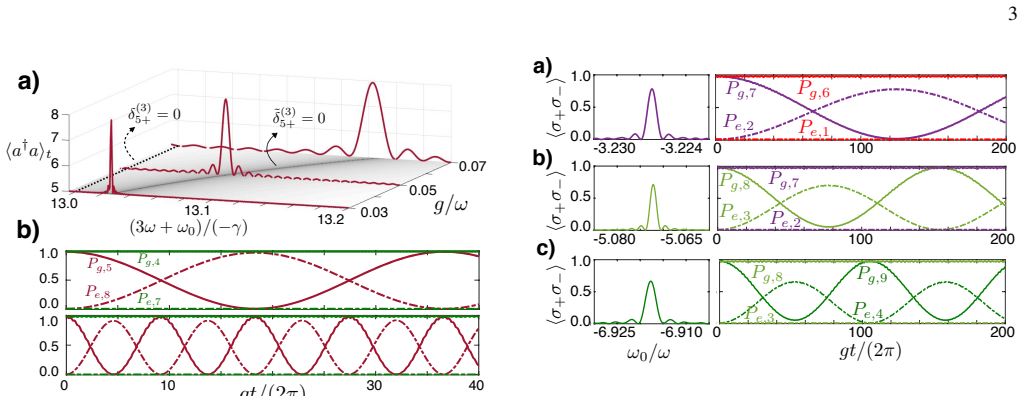
Scan $\omega_0$ in a numerical simulation of the full Rabi–Stark Hamiltonian at $g/\omega=0.1$, $\gamma/\omega=0.9$, with initial state $|g,7\rangle$ and evolution time $t=\pi/(2\Omega^{(5)}_{2-})$. If the population of $|e,2\rangle$ does not peak near $\omega_0/\omega=-3.227$ while $|g,6\rangle$ and $|e,1\rangle$ stay out of resonance, the effective five-photon Hamiltonian is not capturing the dynamics. The paper itself reports that at $g/\omega\approx 0.3$ the simple Jaynes–Cummings-type transfer degrades and population leaks to $|g,N_0\pm1\rangle$, so observing that leakage at modestly larger coupling would mark the regime where the perturbative selective-interaction claim breaks down.
Extended reading notes
Core claim
Adding a diagonal Stark term $\gamma a^\dagger a\sigma_z$ to the quantum Rabi model changes the physical content of the model: for odd $k$, the combined rotating and counter-rotating terms generate effective $k$-photon Jaynes–Cummings/anti-Jaynes–Cummings interactions of the form $H_I^{(k)}(t)=\sum_n(\Omega^{(k)}_{n+}e^{i\delta^{(k)}_{n+}t}\sigma_+ + \Omega^{(k)}_{n-}e^{i\delta^{(k)}_{n-}t}\sigma_-)|n+k\rangle\langle n|+\mathrm{H.c.}$, with $\Omega^{(k)}_{n\pm}\propto (g/\omega)^k$ and with resonance condition $\delta^{(k)}_{n\pm}=(k-1)\omega+\delta^{\pm}_{n+(k-1)/2}=0$, where the index-dependent piece contains $\omega_0+\gamma(2(n+(k-1)/2)+1)$. Consequently a specified initial Fock state $|g,N_0\rangle$ or $|e,N_0\rangle$ can be brought into resonant $k$-photon exchange with $|e,N_0+k\rangle$ or $|g,N_0+k\rangle$ while other Fock states remain far from resonance. Even-$k$ transitions are absent by parity symmetry, and second-order terms act as a Stark-like energy shift that moves the resonance slightly away from its naive value. Numerical evolution of the full Hamiltonian confirms selective three-photon and five-photon population transfer in the strong and ultrastrong regimes, and the trapped-ion derivation shows how this model can be realized with one ion and three laser drivings.
Load-bearing premise
The load-bearing premise is that the expansion in successive interactions, keeping only low orders and discarding fast-oscillating terms, stays accurate at the ultrastrong couplings studied here, so the analytic resonance condition locates the true multiphoton peak.
Editorial extensions
If this is right
- For each odd $k$, the Rabi–Stark model has selective $k$-photon resonances whose frequencies are shifted by the Stark term, so a chosen Fock state can be addressed without disturbing its neighbors.
- The one-photon case inherits the same selectivity: setting $\omega-\omega_0=\gamma(2N_0+1)$ makes only the doublet $\{|e,N_0\rangle,|g,N_0+1\rangle\}$ resonant, recovering earlier selective Jaynes–Cummings physics.
- The strength of $k$-photon processes decreases as $(g/\omega)^k$, so higher-order transitions require longer times; the numerical results show three-photon exchange at $g/\omega=0.1$ and five-photon exchange with partial transfer at the same coupling.
- Even-$k$ multiphoton transitions are suppressed by parity, so the observable multiphoton spectrum of the Rabi–Stark model is organized by odd orders.
- A single trapped ion driven by two sideband fields plus a carrier field reproduces the Rabi–Stark Hamiltonian with independently tunable $\omega_0$, $g$, and $\gamma$, allowing the selective interactions to be observed in the strong and ultrastrong coupling regimes.
Reading between the lines
- If the same selectivity survives with a nonperturbatively corrected resonance condition, the largest practical payoff would be Fock-state-dependent operations: one could prepare, rotate, or read out a specific boson number state by choosing $\gamma$ and $\omega_0$, something the paper motivates through state preparation but does not develop into gates.
- The reported five-photon peaks deviate from the second-order analytic values by roughly $0.1$–$0.2\,\omega$, suggesting the perturbative formulas are a starting point; a resummed or exact-spectrum version of the resonance condition would be needed to predict peak positions as $g/\omega$ grows past $0.1$.
- A clean experimental test suggested by the parity argument is to scan for even-$k$ resonances: observing a two- or four-photon transition at finite $g$ would contradict the parity-based cancellation, while observing only odd orders would support the effective-Hamiltonian picture.
- Since the trapped-ion implementation can choose $\gamma$ of either sign and can reach $g/\omega$ beyond $0.1$, it could also probe where the selective Jaynes–Cummings-type description breaks down, for instance by checking the paper's own expectation that at $g/\omega\approx 0.3$ population leaks to neighboring Fock states.
Signed reviews
Editorial analysis
A structured set of objections, weighed in public.
Referee Report
Summary. The manuscript studies the quantum Rabi model with a Stark coupling term (the Rabi-Stark model), H = (ω0/2)σz + ω a†a + γ a†a σz + g(σ+ + σ−)(a + a†), and claims that the interplay of rotating and counter-rotating terms produces selective k-photon interactions whose resonance frequencies depend on the bosonic Fock state through the Stark shift. The authors derive an interaction-picture Hamiltonian, obtain second- and third-order effective Hamiltonians via time-dependent perturbation theory, and assert a general odd-k formula (Eqs. (5)–(7)). They validate the three-photon dynamics against numerical integration of the full Hamiltonian after including a second-order Stark-shift correction, and report numerical five-photon resonances. The second half proposes a trapped-ion implementation using three laser drivings, derives an effective Rabi-Stark Hamiltonian that includes higher-order carrier corrections, and compares the full ion Hamiltonian with the effective model for one- and three-photon processes.
Significance. The selective multiphoton interactions and the trapped-ion simulation, if fully established, would be a useful contribution to quantum control and quantum simulation in the strong and ultrastrong coupling regimes. The paper has clear strengths: the Dyson-series derivations for the second- and third-order Hamiltonians are explicit and detailed; the numerical validations are performed on the full Hamiltonian (1) with no fitted parameters; the trapped-ion mapping in Appendix C keeps important second-order corrections; and dissipative effects are analyzed in Appendix B. The main weakness is that the general odd-k analytical claim, which is the central result, is asserted rather than derived and is incomplete without the second-order resonance shifts that are essential already at k=3; the five-photon numerical check shows a systematic resonance shift that Eqs. (5)–(7) do not predict.
major comments (2)
- [Section II.B, Eqs. (5)–(7) and Fig. 3] The general odd-k formulas are not supported by the evidence presented. For k=3, the raw resonance condition δ^(3)_5+ = 0 does not locate the resonance in Fig. 2(a); agreement requires shifting to δ̃^(3)_5+ = δ^(3)_5+ + Δ^e_8 − Δ^g_5 from the second-order Hamiltonian (3). Yet Eqs. (5)–(7) contain no analogous shift, and no derivation of the corrected condition for general k is given. For k=5, the predicted qubit frequencies ω0^c/ω = 5 − γ(2N0 + 5) give −3.1, −4.9, and −6.7, while the numerical peaks in Fig. 3 are −3.227, −5.072, and −6.918, a systematic 3–4% shift that grows with N0. This shows that either Eq. (5) is not the complete effective description, or higher-order corrections are required. The claim that Eqs. (5)–(7) describe selective k-photon interactions for arbitrary odd k is therefore not established. The authors should derive the general corrected resonance condition, or explicitly restrict the analytical claim to k=3 and present Fig. 3 as numerical evidence only.
- [Section II.B, Eqs. (5)–(7) and Fig. 3] The paper does not quantify the accuracy or selectivity of the effective Hamiltonian at k=5. In Fig. 3 the population transfer is partial, and the authors themselves note that the remaining population goes to states |g,N0+1⟩ and |g,N0−1⟩. No comparison between the full dynamics of Eq. (1) and the effective Hamiltonian (5) at k=5 is provided, and no fidelity or leakage estimate is given. Since the central claim is selectivity, it is necessary to show quantitatively how well Eq. (5) reproduces the full dynamics and over what parameter range, rather than only locating approximate resonance peaks.
minor comments (5)
- [Eq. (6)] The displayed summation expression for δ^(k)_n± is malformed: it contains the undefined symbol δ±_k and the equality to (k−1)ω + δ±_{n+(k−1)/2} does not follow from the sum as printed. The simplified version is understandable, but the sum should be rewritten correctly.
- [Eq. (7)] The product in Ω^(k)_n± is written as s=1,3,... without an explicit upper limit or step size; it should specify s=1,3,...,k−2, and the notation δ^(s)_n± should be defined.
- [Section II.B, even-k statement] The statement that even-k transitions 'will average out as a consequence of the RWA' is misleading: the absence of even-k transitions follows from the exact parity symmetry of Hamiltonian (1), as the authors note later. The parity argument should be stated explicitly.
- [Appendix C, Eq. (59)] After the RWA, the term involving a†a should be σx rather than σ+, since Eq. (60) and the basis {|+⟩,|−⟩} require σx. Please check this notation.
- [Fig. 2(a) caption] The caption says the dark curve represents 'lower values of log10|δ̃|', but since the log diverges away from zero, the curve should be described as the locus of minima (or approximate zeros) of δ̃.
Circularity Check
No significant circularity: the effective k-photon Hamiltonians are derived from the model and checked against independent numerical integration of the full Rabi-Stark Hamiltonian.
full rationale
The paper's central derivation is self-contained. The interaction-picture Hamiltonian in Eq. (2) follows exactly from the Rabi-Stark Hamiltonian Eq. (1), and the second-order Hamiltonian Eq. (3), the third-order Hamiltonian Eq. (4), and the trapped-ion mapping Eq. (10) are derived explicitly in Appendices A and C. The three-photon resonance shift is not fitted: it is obtained as a higher-order correction from the same Dyson-series expansion, namely moving to an interaction picture with respect to Eq. (3) and using the derived Lamb-shift-like terms Δe_n and Δg_n. The general odd-k formulas in Eqs. (5)-(7) are presented as an extrapolation 'following the same procedure' rather than as a circular identity, and the paper does not claim that the uncorrected resonance condition δ(k)=0 exactly gives the five-photon peaks; instead, it reports approximate values and explicitly acknowledges that the numerically observed peaks deviate from the approximate analytic values, with no fitted parameter adjusted to force agreement. The five-photon peaks are located by numerical integration of the full Hamiltonian Eq. (1), which is an independent check, not a restatement of the perturbative input. Self-citations in the manuscript (e.g., trapped-ion QRM implementations and deep-strong-coupling dynamics) are used as background or as standard techniques and are not load-bearing for the new derivation. The possible concern that the general odd-k formula is asserted without a full derivation, or that higher-order corrections are omitted, is a correctness or rigor issue, not circularity. Consequently, no step reduces by construction to its own input, and the appropriate circularity score is 0.
Assumptions & free parameters
free parameters (3)
- γ/ω =
-0.4, -0.25, 0.9
- g/ω =
0.02, 0.05, 0.1
- N0 =
2, 3, 4, 5
assumptions (5)
- domain assumption Rotating-wave approximation: terms oscillating at δ±_n or 2(ω±γ) average out over the relevant timescales.
- domain assumption Time-dependent perturbation theory (Dyson series) truncated at finite order k accurately describes the dynamics for g/ω < 1.
- standard math Parity conservation in the Rabi-Stark model forbids transitions between |e,n> and |g,n+k> for even k.
- domain assumption Lamb-Dicke approximation (η√<n> ≪ 1) and vibrational RWA for the trapped-ion implementation.
- domain assumption In the trapped-ion derivation, 1/(ν±δ_j) ≈ 1/ν for the second-order terms.
Cite this review
Pith. "Pith review of Selective Interactions in the Quantum Rabi Model." pith.science (2026). https://pith.science/paper/IUG5ILNO
@misc{pith2026190807358,
  author       = {Pith},
  title        = {Pith review of: Selective Interactions in the Quantum Rabi Model},
  year         = {2026},
  howpublished = {\url{https://pith.science/paper/IUG5ILNO}},
  note         = {Machine review of arXiv:1908.07358}
}
abstract
We demonstrate the emergence of selective $k$-photon interactions in the strong and ultrastrong coupling regimes of the quantum Rabi model with a Stark coupling term. In particular, we show that the interplay between the rotating and counter-rotating terms produces multi-photon interactions whose resonance frequencies depend, due to the Stark term, on the state of the bosonic mode. We develop an analytical framework to explain these $k$-photon interactions by using time-dependent perturbation theory. Finally, we propose a method to achieve the quantum simulation of the quantum Rabi model with a Stark term by using the internal and vibrational degrees of freedom of a trapped ion, and demonstrate its performance with numerical simulations considering realistic physical parameters.
Figures


Figures from the paper (1 more)

Reference graph
Works this paper leans on
-
[1]
J. M. Raimond, M. Brune, and S. Haroche, Manipulating quan- tum entanglement with atoms and photons in a cavity, Rev. Mod. Phys. 73, 565 (2001). 10
work page 2001
-
[2]
Leibfried, R
D. Leibfried, R. Blatt, C. Monroe, and D. Wineland, Quan- tum dynamics of single trapped ions, Rev. Mod. Phys. 75, 281 (2003)
2003
-
[3]
Clarke and F
J. Clarke and F. K. Wilhelm, Superconducting quantum bits, Nature 453, 1031 (2008)
2008
-
[4]
E. T. Jaynes and F. W. Cummings, Comparison of quantum and semiclassical radiation theories with application to the beam maser, Proc. IEEE 51, 89 (1963)
work page 1963
-
[5]
G. G ¨unter, A. A. Anappara, J. Hees, A. Sell, G. Biasiol, L. Sorba, S. De Liberato, C. Ciuti, A. Tredicucci, A. Leitenstorfer, and R. Huber, Sub-cycle switch-on of ultrastrong light-matter interaction, Nature 458, 178 (2009)
work page 2009
-
[6]
T. Niemczyk, F. Deppe, H. Huebl, E. P. Menzel, F. Hocke, M. J. Schwarz, J. J. Garc´ıa-Ripoll, D. Zueco, T. H¨ummer, E. Solano, A. Marx, and R. Gross, Circuit quantum electrodynamics in the ultrastrong-coupling regime, Nat. Phys. 6, 772 (2010)
work page 2010
-
[7]
D. Z. Rossatto, C. J. Villas-B ˆoas, M. Sanz, and E. Solano, Spectral classification of coupling regimes in the quantum Rabi model, Phys. Rev. A 96, 013849 (2017)
work page 2017
-
[8]
A. F. Kockum, A. Miranowicz, S. De Liberato, S. Savasta, and F. Nori, Ultrastrong coupling between light and matter, Nat. Rev. Phys. 1, 19 (2019)
2019
Show all 55 references
-
[9]
Forn-D´ıaz, L
P. Forn-D´ıaz, L. Lamata, E. Rico, J. Kono, and E. Solano, Ultra- strong coupling regimes of light-matter interaction, Rev. Mod. Phys. 91, 025005 (2019)
2019
-
[10]
Yoshihara, T
F. Yoshihara, T. Fuse, S. Ashhab, K. Kakuyanagi, S. Saito, and K. Semba, Superconducting qubit-oscillator circuit beyond the ultrastrong-coupling regime, Nat. Phys. 13, 44 (2017)
2017
-
[11]
I. I. Rabi, On the Process of Space Quantization, Phys. Rev. 49, 324 (1936)
1936
-
[12]
Braak, Q.-H
D. Braak, Q.-H. Chen, M. T. Batchelor, and E. Solano, Semi- classical and quantum Rabi models: in celebration of 80 years, J. Phys. A: Math. Theor. 49, 300301 (2016)
2016
-
[13]
Braak, Integrability of the Rabi Model, Phys
D. Braak, Integrability of the Rabi Model, Phys. Rev. Lett. 107, 100401 (2011)
2011
-
[14]
Casanova, G
J. Casanova, G. Romero, I. Lizuain, J. J. Garc ´ıa-Ripoll, and E. Solano, Deep Strong Coupling Regime of the Jaynes- Cummings Model, Phys. Rev. Lett. 105, 263603 (2010)
2010
-
[15]
Eckle and H
H.-P. Eckle and H. Johannesson, A generalization of the quan- tum Rabi model: exact solution and spectral structure, J. Phys. A: Math. Theor. 50, 294004 (2017)
2017
-
[16]
A. L. Grimsmo and S. Parkins, Cavity-QED simulation of qubit-oscillator dynamics in the ultrastrong-coupling regime, Phys. Rev. A 87, 033814 (2013)
2013
-
[17]
A. L. Grimsmo and S. Parkins, Open Rabi model with ultra- strong coupling plus large dispersive-type nonlinearity: Non- classical light via a tailored degeneracy, Phys. Rev. A 89, 033802 (2014)
2014
-
[18]
A. J. Maciejewski, M. Przybylska, and T. Stachowiak, Analyti- cal method of spectra calculations in the Bargmann representa- tion, Phys. Lett. A 378, 3445 (2014)
2014
-
[19]
Y .-F. Xie, L. Duan, and Q.-H. Chen, Quantum Rabi-Stark model: solutions and exotic energy spectra, J. Phys. A: Math. Theor. 52, 245304 (2019)
2019
-
[20]
Chen, Y .-F
X.-Y . Chen, Y .-F. Xie, and Q.-H. Chen, Quantum phase tran- sitions in the Rabi-Stark model at finite frequency ratios, arXiv:2001.04356 (2020)
2020 arXiv
-
[21]
Trav ˇenec, Solvability of the two-photon Rabi Hamiltonian, Phys
I. Trav ˇenec, Solvability of the two-photon Rabi Hamiltonian, Phys. Rev. A 85, 043805 (2012); A. J. Maciejewski, M. Przy- bylska, and T. Stachowiak, ibid. 91, 037801(2015); I.Travˇenec, ibid. 91, 037802 (2015)
2012
-
[22]
Felicetti, D
S. Felicetti, D. Z. Rossatto, E. Rico, E. Solano, and P. Forn- D´ıaz, Two-photon quantum Rabi model with superconducting circuits, Phys. Rev. A 97, 013851 (2018)
2018
-
[23]
Felicetti, M.-J
S. Felicetti, M.-J. Hwang, and A. Le Boit ´e, Ultrastrong- coupling regime of nondipolar light-matter interactions, Phys. Rev. A 98, 053859 (2018)
2018
-
[24]
Cong, X.-M
L. Cong, X.-M. Sun, M. Liu, Z.-J. Ying, and H.-G. Luo, Polaron picture of the two-photon quantum Rabi model, Phys. Rev. A 99, 013815 (2019)
2019
-
[25]
Q. Xie, H. Zhong, M. T. Batchelor, and C. Lee, The quantum Rabi model: solution and dynamics, J. Phys. A 50, 113001 (2017)
2017
- [26]
-
[27]
Q.-T. Xie, S. Cui, J.-P. Cao, L. Amico, and H. Fan, Anisotropic Rabi model, Phys. Rev. X 4, 021046 (2014)
2014
-
[28]
Xie, X.-Y
Y .-F. Xie, X.-Y . Chen, X.-F. Dong, and Q.-H. Chen, Anisotropic quantum Rabi-Stark model, arXiv:1912.10042 (2019)
2019 arXiv
-
[29]
Pellizzari and H
T. Pellizzari and H. Ritsch, Preparation of stationary Fock states in a one-atom Raman laser, Phys. Rev. Lett. 72, 3973 (1994)
1994
-
[30]
Solano, P
E. Solano, P. Milman, R. L. de Matos Filho, and N. Zagury, Manipulating motional states by selective vibronic interaction in two trapped ions, Phys. Rev. A 62, 021401(R) (2000)
2000
-
[31]
Franc ¸a Santos, E
M. Franc ¸a Santos, E. Solano, and R. L. de Matos Filho, Condi- tional Large Fock State Preparation and Field State Reconstruc- tion in Cavity QED, Phys. Rev. Lett. 87, 093601 (2001)
2001
-
[32]
Solano, Selective interactions in trapped ions: State recon- struction and quantum logic, Phys
E. Solano, Selective interactions in trapped ions: State recon- struction and quantum logic, Phys. Rev. A 71, 013813 (2005)
2005
-
[33]
Franc ¸a Santos, Universal and Deterministic Manipulation of the Quantum State of Harmonic Oscillators: A Route to Uni- tary Gates for Fock State Qubits, Phys
M. Franc ¸a Santos, Universal and Deterministic Manipulation of the Quantum State of Harmonic Oscillators: A Route to Uni- tary Gates for Fock State Qubits, Phys. Rev. Lett. 95, 010504 (2005)
2005
-
[34]
F. O. Prado, W. Rosado, A. M. Alcalde and M. H. Y . Moussa, Engineering selective linear and nonlinear Jaynes-Cummings interactions and applications, J. Phys. B: At. Mol. Opt. Phys. 46, 205501 (2013)
2013
-
[35]
K. K. W. Ma and C. K. Law, Three-photon resonance and adi- abatic passage in the large-detuning Rabi model, Phys. Rev. A 92, 023842 (2015)
2015
-
[36]
Garziano, R
L. Garziano, R. Stassi, V . Macr`ı, A. F. Kockum, S. Savasta, and F. Nori, Multiphoton quantum Rabi oscillations in ultrastrong cavity QED, Phys. Rev. A 92, 063830 (2015)
2015
-
[37]
Nha, Y .-T
H. Nha, Y .-T. Chough, and K. An, Single-photon state in a driven Jaynes-Cummings system, Phys. Rev. A 63, 010301(R) (2000)
2000
-
[38]
Chough, H.-J
Y .-T. Chough, H.-J. Moon, H. Nha, and K. An, Single-atom laser based on multiphoton resonances at far-o ff resonance in the Jaynes-Cummings ladder, Phys. Rev. A 63, 013804 (2000)
2000
-
[39]
A. B. Klimov, I. Sainz and C. Saavedra, E ffective resonant in- teractions via a driving field, J. Opt. B: Quantum Semiclass. Opt. 6, 448 (2004)
2004
-
[40]
Casanova, R
J. Casanova, R. Puebla, H. Moya-Cessa, and M. B. Plenio, Connecting nth order generalised quantum Rabi models: Emer- gence of nonlinear spin-boson coupling via spin rotations, npj Quantum Information 4, 47 (2018)
2018
-
[41]
Puebla, J
R. Puebla, J. Casanova, O. Houhou, E. Solano, and M. Pater- nostro, Quantum simulation of multiphoton and nonlinear dis- sipative spin-boson models, Phys. Rev. A 99, 032303 (2019)
2019
-
[42]
Puebla, G
R. Puebla, G. Zicari, I. Arrazola, E. Solano, M. Paternostro, and J. Casanova, Spin-boson model as a simulator of non- Markovian multiphoton Jaynes-Cummings models, Symmetry, 11(5), 695 (2019)
2019
-
[43]
B. W. Shore and P. L. Knight, The Jaynes-Cummings Model, J. Mod. Opt. 40, 1195 (1993)
1993
-
[44]
V ogel and R
W. V ogel and R. L. de Matos Filho, Nonlinear Jaynes- Cummings dynamics of a trapped ion, Phys. Rev. A 52, 4214 (1995). 11
1995
-
[45]
Cheng, I
X.-H. Cheng, I. Arrazola, J. S. Pedernales, L. Lamata, X. Chen, and E. Solano, Nonlinear quantum Rabi model in trapped ions, Phys. Rev. A 97, 023624 (2018)
2018
-
[46]
Macr`ı, F
V . Macr`ı, F. Nori, and A. F. Kockum, Simple preparation of Bell and Greenberger-Horne-Zeilinger states using ultrastrong- coupling circuit QED, Phys. Rev. A 98, 062327 (2018)
2018
-
[47]
C. J. Villas-Boas and D. Z. Rossatto, Multiphoton Jaynes- Cummings model: arbitrary rotations in Fock space and quan- tum filters, Phys. Rev. Lett. 122, 123604 (2019)
2019
-
[48]
Blatt and C
R. Blatt and C. F. Roos, Quantum simulations with trapped ions, Nat. Phys. 8, 277 (2012)
2012
-
[49]
J. S. Pedernales, I. Lizuain, S. Felicetti, G. Romero, L. Lamata, and E. Solano, Quantum Rabi model with trapped ions, Sci. Rep. 5, 15472 (2015)
2015
-
[50]
Puebla, J
R. Puebla, J. Casanova, and M. B. Plenio, A robust scheme for the implementation of the quantum Rabi model in trapped ions, New J. Phys. 18, 113039 (2016)
2016
-
[51]
Lv, S.-M
D.-S. Lv, S.-M. An, Z.-Y . Liu, J.-N. Zhang, J. S. Pedernales, L. Lamata, E. Solano, and K. Kim, Quantum simulation of the quantum Rabi model in a trapped ion, Phys. Rev. X 8, 021027 (2018)
2018
-
[52]
Felicetti, J
S. Felicetti, J. S. Pedernales, I. L. Egusquiza, G. Romero, L. Lamata, D. Braak, and E. Solano, Spectral collapse via two- phonon interactions in trapped ions, Phys. Rev. A 92, 033817 (2015)
2015
-
[53]
Puebla, M.-J
R. Puebla, M.-J. Hwang J. Casanova, and M. B. Plenio, Pro- tected ultrastrong coupling regime of the two-photon quantum Rabi model with trapped ions, Phys. Rev. A95, 063844 (2017)
2017
-
[54]
D. M. Meekhof, C. Monroe, B. E. King, W. M. Itano, and D. J. Wineland, Generation of Nonclassical Motional States of a Trapped Atom, Phys. Rev. Lett. 76, 1796 (1996)
1996
-
[55]
J. J. Sakurai, Modern Quantum Mechanics (Addison-Wesley, Reading, MA, 1994)
1994
Reviewed August 14, 2026 · model on record in the stance chip above.
Discussion (0). Continue with ORCID to comment.