REVIEW 3 major objections 6 minor 57 references
Multifunctional Metasurface Design with a Generative Adversarial Network
T0 review · 3 major / 6 minor · reviewed 2026-08-14 · deepseek-v4-flash
Pith's one-line read A conditional Wasserstein GAN with a prediction-network filter can generate free-form meta-atoms meeting amplitude and phase targets, and assembled metasurfaces verify them in simulation.
desk verdict A real advance for GAN-based metasurface design, with device-level full-wave validation, but the quantitative pass-rate claims rest on an unquantified, out-of-distribution surrogate PNN screening step. read the letter →
The pith
A machine-rendered reading of the paper's core claim, the machinery that carries it, and where it could break.
The reading
What carries the argument
The load-bearing mechanism is the conditional Wasserstein GAN (cWGAN) itself: a generator that turns a condition vector plus noise into a 64 × 64 binary meta-atom image, and a discriminator that enforces fidelity by maximizing the Wasserstein distance between real and generated samples. Two details make it work for optics. First, the condition vector stores the real and imaginary parts of the desired complex transmission coefficient rather than raw amplitude and phase, which avoids the phase-jump discontinuities that plague direct phase conditioning; for multifunctional designs the vector is simply concatenated across polarization channels. Second, a customized geometry-aware gradient penalty replaces numeric interpolation with spatial splicing of real and fake binary images, keeping the interpolated samples physical while enforcing the Lipschitz constraint that stabilizes WGAN training. In deployment a pretrained prediction neural network (PNN) estimates each generated image's transmission spectrum and discards out-of-tolerance candidates before any full-wave simulation is run.
What would settle it
Take a fresh batch of GAN-generated meta-atoms that the prediction network accepts, choose those whose binary images contain features smaller than the 0.1 μm resolution of the training dataset, and compute their amplitude and phase by full-wave simulation; if the error rate is substantially worse than the paper's reported one-in-600, the filter's surrogate predictions—not the GAN's generative accuracy—are carrying the result.
Extended reading notes
Core claim
On the paper's own terms, the discovery is that meta-atom inverse design can be reformulated as conditional image generation: after training, the generator maps a vector of desired transmission coefficients (real and imaginary parts, for one or two orthogonal polarizations) plus random noise directly to a 64 × 64 binary meta-atom pattern, in a single forward pass and without iterative search. In single-target tests the authors report that 599 of 600 generated meta-atoms fell within ±0.1 in amplitude and ±10° in phase when checked by full-wave simulation, and the dual-polarization network produced meta-atoms meeting four simultaneous targets. Assembling those meta-atoms into four distinct device classes showed that this accuracy propagates to the device level: full-wave simulations of the lenses and deflector reproduce the targeted focal lengths, focal shifts, and deflection angles. The authors therefore claim to demonstrate the first free-form all-dielectric meta-atom design network, the first free-form multifunctional metasurface design network, and the first metasurface lens designed by a GAN.
Load-bearing premise
The load-bearing assumption is that the pretrained prediction network correctly estimates the transmission of any shape the GAN produces, including free-form patterns outside the 29,000 needle-drop training examples; if the surrogate is overconfident on novel geometry, the reported pass rates and the claimed time savings would be optimistic.
Editorial extensions
If this is right
- After one training run, a target amplitude-and-phase mask can be populated with hundreds of qualified free-form meta-atoms in seconds, removing per-device iterative optimization from the design loop.
- Because multifunctionality is expressed by enlarging the condition vector, the same trained procedure extends to polarization-multiplexed devices and, in principle, to multi-wavelength, angular, or tunable-material targets without architectural changes.
- The generator produces shapes that were not in the 28 × 28 training data, such as inclined edges and rounded corners, which gives designers a pool of structurally distinct but electromagnetically equivalent options for fabrication-tolerance selection.
- The generated designs can seed local optimizers, offering a route past the initial-guess sensitivity and local-minima problems of evolutionary or gradient-based search.
- Clusters of generated designs with identical electromagnetic responses can be mined for shared geometry, turning the network into a tool for discovering the physical origin of a given response.
Reading between the lines
- The paper does not report how many valid designs the prediction network falsely discards, so the end-to-end efficiency of the GAN alone relative to evolutionary search is unresolved; a fair comparison would count every PNN call, not just the accepted designs.
- If the surrogate's accuracy carries over to out-of-distribution shapes, the same condition-vector construction should extend to wavelength-multiplexed and angle-multiplexed metasurfaces; the paper lists these as possible extensions but does not test them.
- The generator's 64 × 64 output can draw features below the 0.1 μm grid on which the needle-drop training patterns were defined, so practical adoption would require rasterizing or rounding those sub-resolution details and re-checking them, a step the paper does not address.
- If the approach scales to larger apertures, it opens the possibility of real-time re-targetable flat optics, since a new phase mask can be populated immediately after training without simulation or optimization.
Signed reviews
Editorial analysis
A structured set of objections, weighed in public.
Referee Report
Summary. The paper proposes a conditional Wasserstein Generative Adversarial Network (WGAN) with a gradient penalty for inverse design of free-form all-dielectric meta-atoms, conditioned on complex transmission coefficients (amplitude and phase). The generator output is screened by a pre-trained prediction neural network (PNN) before designs are accepted. The authors demonstrate the method by generating meta-atoms for single-target and dual-polarization targets, and by assembling a bifocal metalens, a polarization-multiplexed beam deflector, a polarization-multiplexed metalens, and a polarization-independent metalens. Final devices are validated with independent full-wave simulations.
Significance. If the central claims hold, this would be a noteworthy advance: it extends GAN-based inverse design to free-form all-dielectric meta-atoms with simultaneous amplitude and phase constraints, and it demonstrates multifunctional devices with full-wave verification. The paper is also honest about the training-data generation and provides detailed network architectures. The main weakness is that the quantitative success rates are reported after screening by the authors' own PNN, and the PNN's error is not quantified, while the GAN is credited with generating structures outside the PNN's training distribution. These issues do not invalidate the full-wave-verified device demonstrations, but they weaken the headline claim that the GAN itself is generating on-demand designs and the aggregate accuracy statistics.
major comments (3)
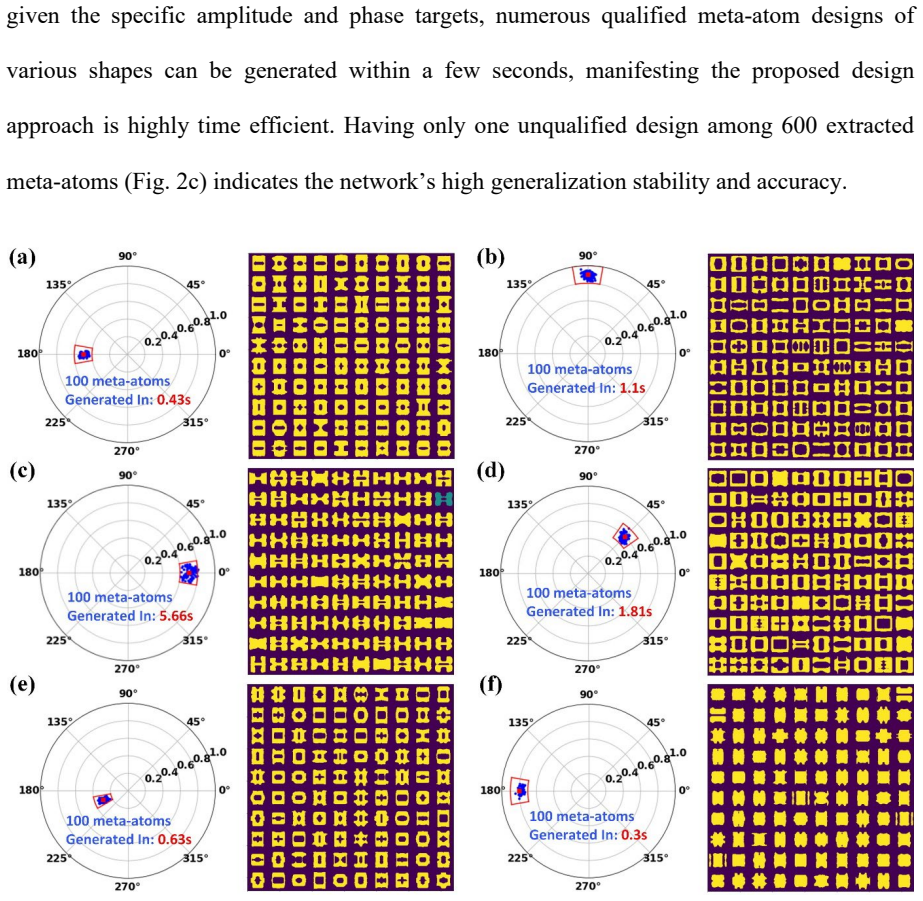
- [Meta-atom design network / Fig. 2] The reported success statistics (e.g., 'one unqualified design among 600') are computed on designs that have already been screened by the PNN, not on the raw outputs of the GAN. The manuscript states that the PNN 'characterizes these output images and eliminates the unqualified meta-atom designs' (p. 7), and it does not report the raw generation success rate or quantify the PNN's prediction error. This matters because the PNN was trained on needle-drop patterns composed of rectangles with 0.1 μm resolution and 4-fold symmetry (SI Section 2), whereas the GAN is credited with generating inclined edges and round corners 'not included in the training data' (p. 17). The PNN is therefore being used to score exactly the structures on which a surrogate is least reliable. To support the central claim that the GAN itself generates on-demand designs, please report raw GAN pass rates before PNN filtering, provide PNN validation accuracy (ideally on held-out and out-of-distribution geometries), and full-wave-verify a random sample of PNN-filtered and PNN-rejected designs.
- [Discussion and conclusion (p. 16)] The claim that the approach is 'much more effective' than trial-and-error or global optimization is not backed by any baseline comparison. Without a quantitative comparison against, e.g., random needle-drop sampling, an evolutionary algorithm, or a direct optimization method evaluated with the same full-wave verification, the advantage over existing approaches is asserted rather than demonstrated. Please add at least one baseline that uses the same data and the same qualification thresholds, reporting success rate per unit time and device-level performance.
- [Figs. 3, 4, 5 and SI Section 5] The device-level validation is qualitative. The text states 'excellent agreement' between targets and simulated masks and shows focal spots, but it does not provide quantitative metrics such as focal-spot efficiency, Strehl ratio, diffraction efficiency for the deflector (Fig. 4g-h), or the ratio of focal intensity to background. Adding these numbers would directly substantiate the paper's accuracy claims and would also make the comparison to future work meaningful.
minor comments (6)
- [p. 5 and SI Section 1] The main text says the generator has 'seven consecutive transposed convolutional layers,' while the SI says 'eight consecutive transposed convolution layers'; please reconcile.
- [p. 8 and SI Table S1] The main text says training stabilized after 1,500 epochs, but the SI reports 3,000 iterations (72 h); please clarify which number corresponds to the models used for Figs. 2–5.
- [Fig. 2 and p. 8] The phrase 'we employed the well trained GAN to consecutively generate 100 qualified designs' is ambiguous; state whether the 100 are raw samples or post-PNN-selected samples.
- [Eq. (4)] There is a typesetting error ('𝑒𝑥𝑒𝑒𝑗2𝜋𝜋/𝜆𝜆 𝑑𝑑1'); the exponential should be written as exp(j2πd1/λ) or similar.
- [p. 7 / SI Section 1] The generator uses a tanh output layer, but binarization of output patterns is not described; please explain how continuous generator outputs are converted to binary meta-atom patterns before PNN evaluation and full-wave simulation.
- [Reference [49]] The PNN is cited as a preprint and is not described in enough detail for independent reproduction; please provide a public repository or complete architectural and training details beyond what is in the SI.
Circularity Check
No significant circularity: full-wave simulations independently validate the GAN-generated devices; the self-cited PNN is a screening surrogate, not the final evidence.
full rationale
The paper's load-bearing demonstrations are validated by independent full-wave simulations, not by the network's own outputs or by the self-cited prediction network. The GAN generates candidate meta-atoms, the PNN (ref. [49]) screens them, and then the electromagnetic responses of the surviving designs are computed with full-wave tools: 'The electromagnetic responses of the generated patterns were computed using full-wave simulation tools and are labeled with blue dots' (Fig. 2). The final devices are likewise verified by CST full-wave simulations, e.g., the bifocal metalens field distribution in Fig. 3f and the polarization-multiplexed metalens fields in Fig. 5e-f. The PNN is used to speed up rejection of unpromising candidates, but the reported 'one unqualified design among 600' and the device-level agreement are based on full-wave data, so the success rates are not determined by construction from the PNN. The self-citation to [49] is real but not load-bearing in a circular way: even if the PNN were imperfect, the full-wave verification of final devices stands independently. The absence of a raw GAN success rate is a reporting/evidence limitation concerning generalization, not a case where a prediction reduces to its fitted input. No equation is shown to equal its own input, no fitted parameter is renamed as a prediction, and no uniqueness claim is imported from prior work to force the design choice.
Assumptions & free parameters
free parameters (3)
- Qualification thresholds for meta-atom pass/fail =
amplitude error +/- 0.1, phase error +/- 10 degrees
- Needle-drop training data generation parameters =
3 to 7 randomly placed needles, 0.4 micron minimum spacing, 0.1 micron feature resolution
- WGAN-GP penalty coefficient lambda =
10
assumptions (4)
- domain assumption Full-wave CST simulations give the ground-truth electromagnetic response for all meta-atoms.
- domain assumption The PNN surrogate (ref. [49], same group) predicts the complex transmission coefficients of arbitrary free-form meta-atoms accurately enough to filter designs.
- ad hoc to paper The custom geometry interpolation in SI Section 3 preserves the 1-Lipschitz constraint and training stability of WGAN-GP.
- domain assumption The 29,000 retained training patterns are representative of the target free-form design space for the demonstrated multifunctional devices.
Cite this review
Pith. "Pith review of Multifunctional Metasurface Design with a Generative Adversarial Network." pith.science (2026). https://pith.science/paper/IUPRDE6S
@misc{pith2026190804851,
  author       = {Pith},
  title        = {Pith review of: Multifunctional Metasurface Design with a Generative Adversarial Network},
  year         = {2026},
  howpublished = {\url{https://pith.science/paper/IUPRDE6S}},
  note         = {Machine review of arXiv:1908.04851}
}
read the original abstract
Metasurfaces have enabled precise electromagnetic wave manipulation with strong potential to obtain unprecedented functionalities and multifunctional behavior in flat optical devices. These advantages in precision and functionality come at the cost of tremendous difficulty in finding individual meta-atom structures based on specific requirements (commonly formulated in terms of electromagnetic responses), which makes the design of multifunctional metasurfaces a key challenge in this field. In this paper, we present a Generative Adversarial Networks (GAN) that can tackle this problem and generate meta-atom/metasurface designs to meet multifunctional design goals. Unlike conventional trial-and-error or iterative optimization design methods, this new methodology produces on-demand free-form structures involving only a single design iteration. More importantly, the network structure and the robust training process are independent of the complexity of design objectives, making this approach ideal for multifunctional device design. Additionally, the ability of the network to generate distinct classes of structures with similar electromagnetic responses but different physical features could provide added latitude to accommodate other considerations such as fabrication constraints and tolerances. We demonstrate the network's ability to produce a variety of multifunctional metasurface designs by presenting a bifocal metalens, a polarization-multiplexed beam deflector, a polarization-multiplexed metalens and a polarization-independent metalens.
Figures


Reference graph
Works this paper leans on
-
[1]
H. C. Hulst, H. C. van de Hulst, Light scattering by small particles, Courier Corporation, 1981
work page 1981
-
[2]
J. D. Jackson, Classical electrodynamics, John Wiley & Sons, 2007
work page 2007
-
[3]
Q. Wang, X. Zhang, Y. Xu, J. Gu, Y. Li, Z. Tian, R. Singh, S. Zhang, J. Han, W. Zhang, Scientific reports 2016, 6, 32867
work page 2016
- [4]
-
[5]
N. Yu, F. Capasso, Nature materials 2014, 13, 139
work page 2014
- [6]
-
[7]
M. Khorasaninejad, Z. Shi, A. Y. Zhu, W.-T. Chen, V. Sanjeev, A. Zaidi, F. Capasso, Nano letters 2017, 17, 1819
work page 2017
-
[8]
X. Wang, J. Ding, B. Zheng, S. An, G. Zhai, H. Zhang, Scientific reports 2018, 8, 1876
work page 2018
Show all 57 references
-
[9]
J. Ding, S. An, B. Zheng, H. Zhang, Advanced Optical Materials 2017, 5, 1700079
2017
-
[10]
T. Wang, R. Xie, S. Zhu, J. Gao, M. Xin, S. An, B. Zheng, H. Li, Y. Lin, H. Zhang, IEEE Access 2019, 7, 58131
2019
-
[11]
L. Liu, X. Zhang, M. Kenney, X. Su, N. Xu, C. Ouyang, Y. Shi, J. Han, W. Zhang, S. Zhang, Advanced materials 2014, 26, 5031
2014
-
[12]
D. Sell, J. Yang, S. Doshay, J. A. Fan, Advanced Optical Materials 2017, 5, 1700645
2017
-
[13]
Cheng, X
H. Cheng, X. Wei, P. Yu, Z. Li, Z. Liu, J. Li, S. Chen, J. Tian, Applied Physics Letters 2017, 110, 171903
2017
-
[14]
Callewaert, V
F. Callewaert, V. Velev, P. Kumar, A. Sahakian, K. Aydin, Scientific reports 2018, 8, 1358
2018
-
[15]
C. H. Chu, M. L. Tseng, J. Chen, P. C. Wu, Y. H. Chen, H. C. Wang, T. Y. Chen, W. T. Hsieh, H. J. Wu, G. Sun, Laser & Photonics Reviews 2016, 10, 986
2016
-
[16]
M. Y. Shalaginov, S. An, Y. Zhang, F. Yang, P. Su, V. Liberman, J. B. Chou, C. M. Roberts, M. Kang, C. Rios, arXiv preprint arXiv:1911.12970 2019
1911 arXiv
-
[17]
Zhang, J
Y. Zhang, J. B. Chou, J. Li, H. Li, Q. Du, A. Yadav, S. Zhou, M. Y. Shalaginov, Z. Fang, H. Zhong, Nature communications 2019, 10, 1
2019
-
[18]
R. C. Devlin, M. Khorasaninejad, W. T. Chen, J. Oh, F. Capasso, Proceedings of the National Academy of Sciences 2016, 113, 10473
2016
-
[19]
Arbabi, A
E. Arbabi, A. Arbabi, S. M. Kamali, Y. Horie, A. Faraon, Optica 2016, 3, 628
2016
-
[20]
D. Z. Zhu, E. B. Whiting, S. D. Campbell, D. B. Burckel, D. H. Werner, ACS Photonics 2019, 6, 2741
2019
-
[21]
High-Performance Metasurfaces Synthesized via Multi-Objective Optimization
S. D. Campbell, E. B. Whiting, D. H. Werner, P. L. Werner, "High-Performance Metasurfaces Synthesized via Multi-Objective Optimization", presented at 2019 International Applied Computational Electromagnetics Society Symposium (ACES), 2019
2019
-
[22]
D. Liu, Y. Tan, E. Khoram, Z. Yu, ACS Photonics 2018, 5, 1365
2018
-
[23]
Z. Liu, D. Zhu, S. P. Rodrigues, K.-T. Lee, W. Cai, Nano letters 2018, 18, 6570
2018
-
[24]
W. Ma, F. Cheng, Y. Liu, ACS nano 2018, 12, 6326
2018
-
[25]
Malkiel, M
I. Malkiel, M. Mrejen, A. Nagler, U. Arieli, L. Wolf, H. Suchowski, Light: Science & Applications 2018, 7, 60
2018
-
[26]
Peurifoy, Y
J. Peurifoy, Y. Shen, L. Jing, Y. Yang, F. Cano-Renteria, B. G. DeLacy, J. D. Joannopoulos, M. Tegmark, M. Soljačić, Science advances 2018, 4, eaar4206
2018
-
[27]
S. An, C. Fowler, B. Zheng, M. Y. Shalaginov, H. Tang, H. Li, L. Zhou, J. Ding, A. M. Agarwal, C. Rivero-Baleine, ACS Photonics 2019, 6, 3196
2019
-
[28]
S. So, J. Mun, J. Rho, ACS applied materials & interfaces 2019
2019
-
[29]
Deep neural network (DNN) surrogate models for the accelerated design of optical devices and systems
R. S. Hegde, "Deep neural network (DNN) surrogate models for the accelerated design of optical devices and systems", presented at Novel Optical Systems, Methods, and Applications XXII, 2019. 19
2019
-
[30]
Z. Liu, Z. Zhu, W. Cai, Optics Express 2020, 28, 4825
2020
-
[31]
Inverse Design of Photonic Crystal Nanobeam Cavity Structure via Deep Neural Network
J. Hao, L. Zheng, D. Yang, Y. Guo, "Inverse Design of Photonic Crystal Nanobeam Cavity Structure via Deep Neural Network", presented at Asia Communications and Photonics Conference, 2019
2019
-
[32]
Lin, C.-C
K.-F. Lin, C.-C. Hsieh, S.-C. Hsin, W.-F. Hsieh, Applied Optics 2019, 58, 8914
2019
-
[33]
X. Han, Z. Fan, C. Li, Z. Liu, L. J. Guo, arXiv preprint arXiv:1912.03696 2019
1912 arXiv
-
[34]
Generative adversarial nets
I. Goodfellow, J. Pouget-Abadie, M. Mirza, B. Xu, D. Warde-Farley, S. Ozair, A. Courville, Y. Bengio, "Generative adversarial nets", presented at Advances in neural information processing systems, 2014
2014
- [35]
- [36]
-
[37]
Jiang, J
J. Jiang, J. A. Fan, Nano letters 2019, 19, 5366
2019
-
[38]
Jiang, D
J. Jiang, D. Sell, S. Hoyer, J. Hickey, J. Yang, J. A. Fan, ACS nano 2019, 13, 8872
2019
-
[39]
W. Ma, F. Cheng, Y. Xu, Q. Wen, Y. Liu, Advanced Materials 2019, 31, 1901111
2019
-
[40]
S. So, J. Rho, Nanophotonics 2019, 8, 1255
2019
-
[41]
Joint multi-layer GAN-based design of tensorial RF metasurfaces
J. A. Hodge, K. V. Mishra, A. I. Zaghloul, "Joint multi-layer GAN-based design of tensorial RF metasurfaces", presented at 2019 IEEE 29th International Workshop on Machine Learning for Signal Processing (MLSP), 2019
2019
-
[42]
Multidiscriminator distributed generative model for multi-layer RF metasurface discovery
J. A. Hodge, K. V. Mishra, A. I. Zaghloul, "Multidiscriminator distributed generative model for multi-layer RF metasurface discovery", presented at IEEE Global Conference on Signal and Information Processing, 2019
2019
-
[43]
Sajedian, J
I. Sajedian, J. Kim, J. Rho, Microsystems & nanoengineering 2019, 5, 1
2019
-
[44]
Z. Liu, D. Zhu, K.-T. Lee, A. S. Kim, L. Raju, W. Cai, arXiv preprint arXiv:1907.03366 2019
1907 arXiv
-
[45]
Wasserstein generative adversarial networks
M. Arjovsky, S. Chintala, L. Bottou, "Wasserstein generative adversarial networks", presented at International conference on machine learning, 2017
2017
-
[46]
Improved training of wasserstein gans
I. Gulrajani, F. Ahmed, M. Arjovsky, V. Dumoulin, A. C. Courville, "Improved training of wasserstein gans", presented at Advances in neural information processing systems, 2017
2017
-
[47]
Delving deep into rectifiers: Surpassing human- level performance on imagenet classification
K. He, X. Zhang, S. Ren, J. Sun, "Delving deep into rectifiers: Surpassing human- level performance on imagenet classification", presented at Proceedings of the IEEE international conference on computer vision, 2015
2015
- [48]
-
[49]
S. An, B. Zheng, M. Y. Shalaginov, H. Tang, H. Li, L. Zhou, J. Ding, A. M. Agarwal, C. Rivero-Baleine, M. Kang, arXiv preprint arXiv:2001.00121 2020
2001 arXiv
-
[50]
J. Ding, N. Xu, H. Ren, Y. Lin, W. Zhang, H. Zhang, Scientific reports 2016, 6, 1
2016
-
[51]
Kiarashinejad, S
Y. Kiarashinejad, S. Abdollahramezani, M. Zandehshahvar, O. Hemmatyar, A. Adibi, arXiv preprint arXiv:1905.06889 2019
1905 arXiv
-
[52]
Kiarashinejad, M
Y. Kiarashinejad, M. Zandehshahvar, S. Abdollahramezani, O. Hemmatyar, R. Pourabolghasem, A. Adibi, arXiv preprint arXiv:1909.07330 2019. 20 Supporting Information Title: Multifunctional Metasurface Design with a Generative Adversarial Network Sensong An 1, Bowen Zheng1, Hong ...
1909 arXiv
-
[53]
S1 illustrates the network architecture of the proposed neural network, with the data flow details included
Detailed network architecture Fig. S1 illustrates the network architecture of the proposed neural network, with the data flow details included. Input conditions, such as frequency-dependent amplitude and phase responses, polarization- dependence, and/or material states ( e.g. ...
-
[54]
needle d rop
Training data collection Without loss of generality, the all -dielectric meta-atom consists of a 1 μm thick dielectric component (preferably with a high refractive index, n1. In this case n1 = 5) sitting on a dielectric substrate (preferably with a low refractive index, n2. In...
-
[55]
1” and black represents “0
Customized gradient-penalty method The Wasserstein distance is only accurate when the discriminator is a 1-Lipschitz function.[45] To enforce this constraint, the original WGAN applied a simple, but rough, value clipping to restrict the maximum weight value in each layer of th...
-
[56]
Hyperparameters used in the training of GANs and PNNs
Hyperparameters and training curves Table S1. Hyperparameters used in the training of GANs and PNNs. Hyperparameters Meta-atom design network Dual-polarization meta-atom design network PNN for real part PNN for imaginary part Training set size 29,000 29,000 69,000 69,000 Optim...
-
[57]
A polarization -independent focusing lens designed with the dual -polarization meta -atom generative network
Polarization-independent metalens design Figure S7 . A polarization -independent focusing lens designed with the dual -polarization meta -atom generative network. (a) Metasurface pattern designed with the dual -polarization meta-atom generative network. Part of the metasurface...
Reviewed August 14, 2026 · model on record in the stance chip above.
Discussion (0). Continue with ORCID to comment.