REVIEW 4 major objections 5 minor 39 references
Image Synthesis From Reconfigurable Layout and Style
T0 review · 4 major / 5 minor · reviewed 2026-08-14 · deepseek-v4-flash
Pith's one-line read A layout- and style-conditioned GAN that learns per-object masks without pixel supervision reaches state-of-the-art image synthesis from labeled bounding boxes on COCO-Stuff and Visual Genome.
desk verdict Solid layout-to-image GAN with a genuinely new normalization layer, but the claimed contribution is not ablated — the numbers are defensible, the mechanism is not. read the letter →
The pith
A machine-rendered reading of the paper's core claim, the machinery that carries it, and where it could break.
The reading
What carries the argument
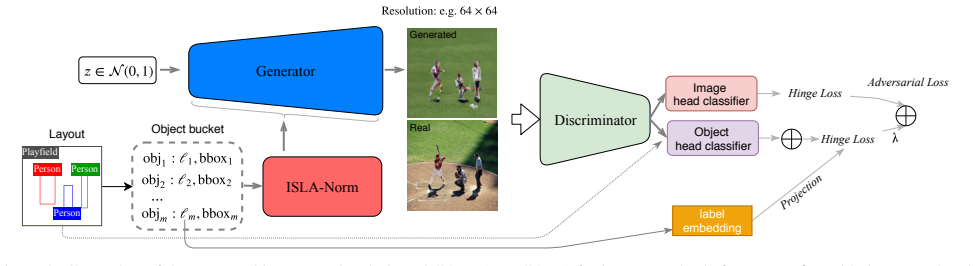
The load-bearing mechanism is ISLA-Norm (object instance-specific, layout-aware feature normalization). After batch-normalizing the generator's feature maps, ISLA-Norm recalibrates each spatial location with per-object $\gamma$ and $\beta$ parameters that are computed from the object's label embedding and its style latent code. Those per-object parameters are scattered into their bounding boxes, weighted by soft masks predicted by a small sub-network with no pixel-level supervision, and averaged where boxes overlap. This is what carries the argument: the masks are the bridge that turns a box into a rough object shape, and the affine parameters are what let a single generator modulate different objects' appearances independently.
What would settle it
Run the same LostGAN training with the predicted masks replaced by uniform masks over each bounding box (or by hard box indicators), keeping all other components identical; if inception score, FID, and object placement consistency do not degrade on held-out layouts, then the learned masks are not doing the load-bearing work. Separately, compute the IoU of the predicted masks against ground-truth instance masks on COCO-Stuff: near-chance IoU with good generation would show that fine-grained mask accuracy is not the mechanism.
Extended reading notes
Core claim
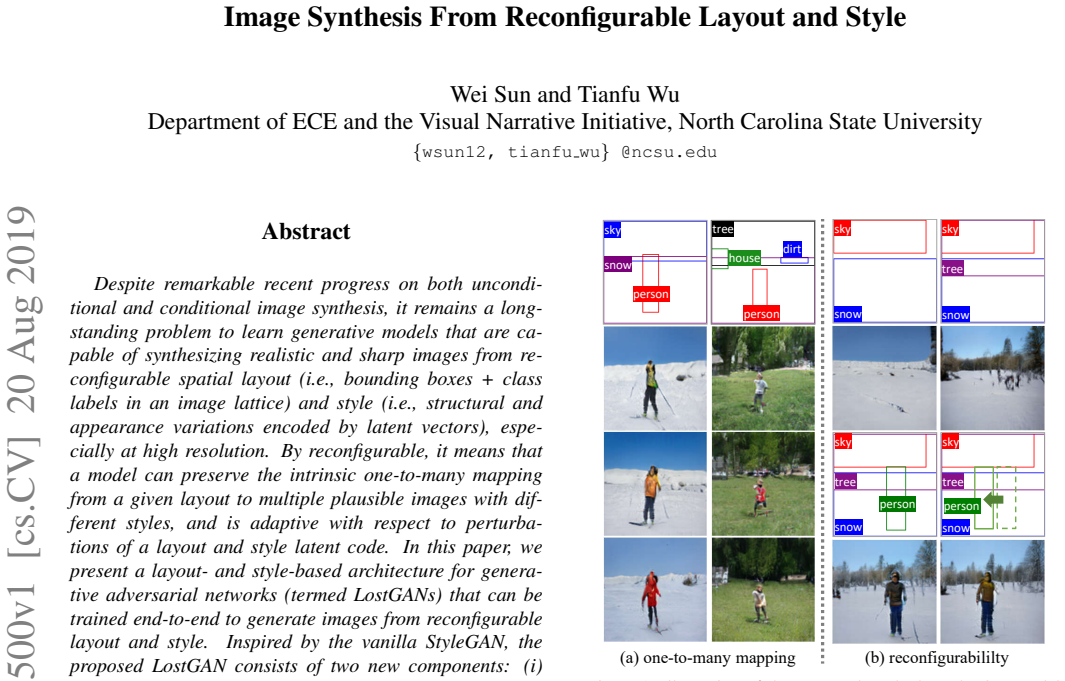
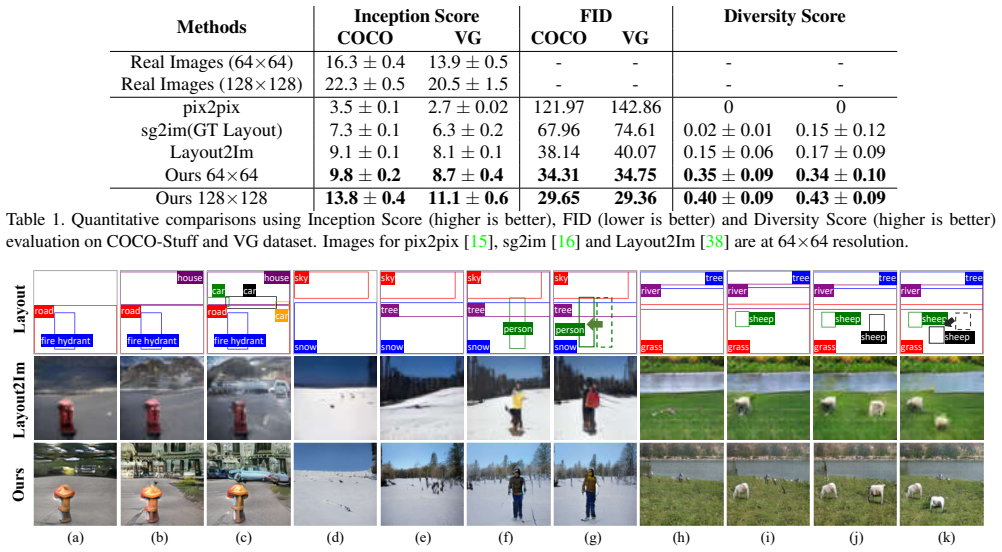
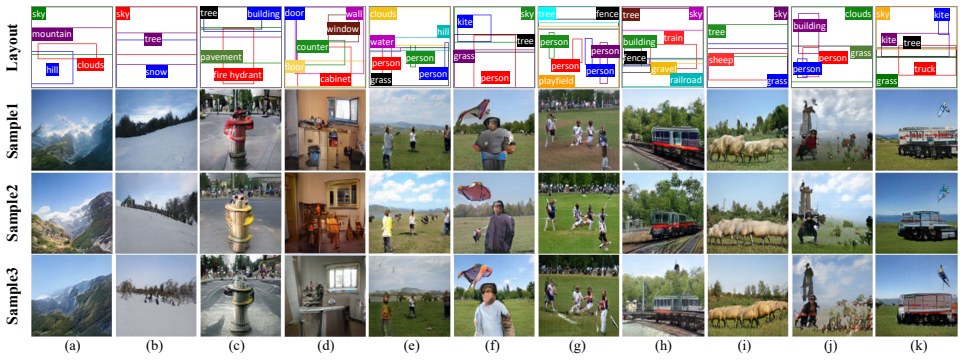
The paper's central claim is that layout-to-image synthesis improves when the generator predicts a soft mask for every bounding box and uses it to place object-specific affine parameters inside an adaptive normalization layer. It calls this layout-to-mask-to-image generation, and it is what distinguishes the approach from methods that inject layout only as a global condition. The paper reports state-of-the-art results on COCO-Stuff and Visual Genome, including an inception score of 13.8 at 128x128 on COCO-Stuff and a diversity score of 0.40, compared with 9.1 and 0.15 for the Layout2Im baseline at 64x64. It also demonstrates qualitative reconfigurability: adding boxes, moving boxes, resampling image-level style, and morphing instance-level style while keeping other objects consistent.
Load-bearing premise
The whole fine-grained placement claim rests on the mask prediction sub-network learning accurate soft masks from the adversarial loss alone, with no pixel-level supervision; if those masks are noisy, the per-object affine parameters are routed to the wrong places and the claimed geometric control is not supported.
Editorial extensions
If this is right
- Layout-to-image generation can work from boxes plus latent codes, removing the need for expensive pixel-level instance segmentation annotation.
- Spatially adaptive normalization can be conditioned on coarse layout, not just dense semantic maps, so per-object style control scales to settings where dense labels are unavailable.
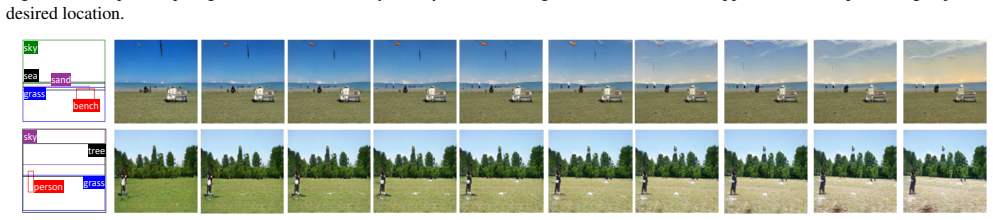
- The same trained model supports one-to-many sampling, object-level style morphing, and layout edits such as adding or moving objects while keeping the rest of the scene stable.
- The roughly doubled diversity score over Layout2Im suggests the one-to-many mapping is preserved rather than collapsed into a deterministic output.
- Generating at 128x128 with improved FID points to a path toward higher-resolution synthesis from layout conditions.
Reading between the lines
- The paper leaves mask quality unmeasured; if predicted masks were evaluated against ground-truth instance masks, mask IoU should track generation fidelity for the mask-routing claim to hold. This is a testable corollary, not something the paper establishes.
- The weakly supervised masks are themselves a by-product that could serve as a layout-to-instance-segmentation predictor, which would be useful beyond generation, but the paper does not test this.
- The reconfigurability results suggest an 'edit locality' stress test: move one box and measure whether pixel changes are confined to the affected region; the paper shows this qualitatively but provides no quantitative locality metric.
- Because per-object style is routed through masks, semantic style transfer across scenes (taking one object's appearance from one image and applying it to the same class in another layout) should be possible; the paper does not explore this.
Signed reviews
Editorial analysis
A structured set of objections, weighed in public.
Referee Report
Summary. The paper proposes LostGAN, a GAN architecture for image synthesis from reconfigurable layout (bounding boxes with class labels) and style (latent codes). The generator predicts soft object masks in a weakly supervised manner and uses object instance-specific layout-aware feature normalization (ISLA-Norm), a StyleGAN-inspired affine modulation routed through the predicted masks. The discriminator combines an image head and an object head with projection-based conditioning. Experiments on COCO-Stuff and Visual Genome report Inception Score, FID, Diversity Score, and Classification Accuracy at 64x64 and 128x128, claiming state-of-the-art performance over Layout2Im, sg2im, and pix2pix. Qualitative results illustrate layout reconfigurability, style diversity, and learned masks.
Significance. If the empirical results hold, LostGAN is a practical step toward multi-object layout-to-image generation with instance-level style control, avoiding pixel-level mask supervision. The paper's strengths include end-to-end training, public code and pretrained models, evaluation on two datasets with multiple metrics, and a clear extension of StyleGAN-style normalization to spatially distributed objects. The main mechanism claims, however, are not yet supported by controlled experiments: ISLA-Norm is never ablated, and the predicted masks are never quantitatively validated. The comparison to baselines is useful and suggests the overall architecture is competitive, but attributing the gains to the proposed components requires additional evidence.
major comments (4)
- [Section 4.3 and Table 1] The contribution-level claim that ISLA-Norm and weakly supervised masks are responsible for the improvements is not supported by the current experiments, because Table 1 compares only the full LostGAN against external baselines. The architecture also includes a ResNet backbone, a projection discriminator, object adversarial hinge loss, and higher-resolution training (Section 3.2). An ablation study is needed, at least on COCO-Stuff at 64x64, with variants that (a) remove ISLA-Norm or replace it with layout-agnostic normalization, (b) replace predicted masks with binary box masks, and (c) remove the object adversarial loss. Without such ablations, the reported gains cannot be attributed to the proposed mechanism.
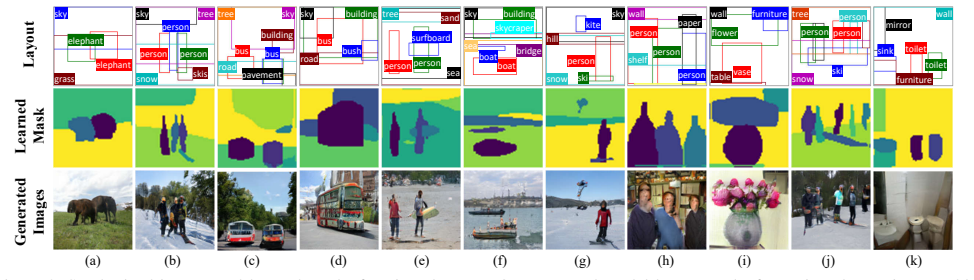
- [Section 3.2.2(iii) and Figure 8] The weakly supervised mask prediction sub-network is never quantitatively evaluated. Since per-object affine parameters are routed through predicted masks in steps (iii) and (iv), the claim of fine-grained geometric control depends on mask quality, yet the paper provides no mask IoU, no segmentation metric, and no comparison against box-shaped masks. If the learned masks are approximately boxes, the method reduces to bounding-box conditioning and the 'fine-grained mask' claim is unsupported. Please report quantitative mask quality (e.g., IoU against COCO thing instance masks) or, alternatively, compare generation metrics when using predicted masks versus binary box masks.
- [Table 1] FID is reported without error bars or significance testing, although Inception Score and Diversity Score are given with standard deviations. The FID gaps over Layout2Im (34.31 vs 38.14 on COCO-Stuff; 34.75 vs 40.07 on Visual Genome) could be meaningful, but without repeated runs or a significance test the claim of outperforming the baseline is not fully established. Please provide FID variance over multiple training seeds or a bootstrap confidence interval for the main comparisons.
- [Section 4.4] The text states that 'we also conduct some ablation studies on the three aspects of reconfigurability and mask prediction,' but these are qualitative demonstrations rather than controlled ablations. Because reconfigurability is part of the title and the stated objective (Section 1.1), a quantitative evaluation would strengthen the paper. For example, measure the perceptual or pixel difference between generated images before and after a layout perturbation outside the edited bounding box, or evaluate object classification accuracy for added or moved boxes.
minor comments (5)
- [Section 3.1] The problem formulation uses 'n labeled bounding boxes' but then uses m as the count throughout; please use a single symbol consistently for the number of objects.
- [Sections 1.2, 2, and Figure 3(b)] The spelling 'ILSA-Norm' appears instead of 'ISLA-Norm' in several places; these typos should be corrected.
- [Table 2 caption] The caption says 'resnet-101'; this should be 'ResNet-101' for consistency with standard notation.
- [Section 4.3] The text does not specify how many images are used for FID computation; please state the sample count and the protocol (e.g., number of generated samples per layout).
- [Figure 8] Consider overlaying the predicted masks on the generated images rather than showing them in separate panels, which would make the spatial alignment and mask quality easier to assess.
Circularity Check
No circularity: the paper's claims rest on external benchmark comparisons and standard metrics, not on definitional or self-referential reductions.
full rationale
The paper's central claims are empirical: LostGAN is compared against external baselines (pix2pix, sg2im, Layout2Im) on COCO-Stuff and Visual Genome using standard metrics (Inception Score, FID, Diversity Score, Classification Accuracy). No parameter in the method is fitted to these target metrics, and no result from the authors' own prior work is used as a load-bearing input. The two proposed components, weakly supervised mask prediction and ISLA-Norm, are architecture choices trained end-to-end with adversarial losses; their effectiveness is asserted through the same external comparisons. The mask sub-network is only qualitatively evaluated and no mask-free ablation is provided, but this is a lack of mechanistic evidence or a correctness risk, not circularity: the reported numbers do not reduce by construction to the method's definitions or to any self-citation. References to StyleGAN, BigGAN, and the projection discriminator are external published methods and are not invoked to forbid alternatives. Therefore the derivation chain is self-contained with respect to circularity, and the appropriate finding is no significant circularity.
Assumptions & free parameters
free parameters (5)
- dnoise =
128
- de (label embedding dimension) =
128
- ch (generator width) =
64
- s (predicted mask side length) =
16
- lambda (loss trade-off) =
1
assumptions (4)
- domain assumption The adversarial objective with hinge losses and a projection discriminator can be optimized to a useful equilibrium.
- ad hoc to paper The mask prediction subnetwork can learn semantically meaningful object shapes without mask supervision.
- ad hoc to paper Weighting per-object affine parameters by predicted masks and averaging overlapping regions preserves multi-object consistency.
- domain assumption Object instance styles can be represented by i.i.d. standard normal latent vectors concatenated with label embeddings.
Cite this review
Pith. "Pith review of Image Synthesis From Reconfigurable Layout and Style." pith.science (2026). https://pith.science/paper/IUR5YOUO
@misc{pith2026190807500,
  author       = {Pith},
  title        = {Pith review of: Image Synthesis From Reconfigurable Layout and Style},
  year         = {2026},
  howpublished = {\url{https://pith.science/paper/IUR5YOUO}},
  note         = {Machine review of arXiv:1908.07500}
}
read the original abstract
Despite remarkable recent progress on both unconditional and conditional image synthesis, it remains a long-standing problem to learn generative models that are capable of synthesizing realistic and sharp images from reconfigurable spatial layout (i.e., bounding boxes + class labels in an image lattice) and style (i.e., structural and appearance variations encoded by latent vectors), especially at high resolution. By reconfigurable, it means that a model can preserve the intrinsic one-to-many mapping from a given layout to multiple plausible images with different styles, and is adaptive with respect to perturbations of a layout and style latent code. In this paper, we present a layout- and style-based architecture for generative adversarial networks (termed LostGANs) that can be trained end-to-end to generate images from reconfigurable layout and style. Inspired by the vanilla StyleGAN, the proposed LostGAN consists of two new components: (i) learning fine-grained mask maps in a weakly-supervised manner to bridge the gap between layouts and images, and (ii) learning object instance-specific layout-aware feature normalization (ISLA-Norm) in the generator to realize multi-object style generation. In experiments, the proposed method is tested on the COCO-Stuff dataset and the Visual Genome dataset with state-of-the-art performance obtained. The code and pretrained models are available at \url{https://github.com/iVMCL/LostGANs}.
Figures

Figures from the paper (5 more)

Reference graph
Works this paper leans on
-
[1]
Large scale gan training for high fidelity natural image synthesis
Andrew Brock, Jeff Donahue, and Karen Simonyan. Large scale gan training for high fidelity natural image synthesis. arXiv preprint arXiv:1809.11096, 2018. 1, 2, 3, 4, 5
arXiv 2018
-
[2]
Coco- stuff: Thing and stuff classes in context
Holger Caesar, Jasper Uijlings, and Vittorio Ferrari. Coco- stuff: Thing and stuff classes in context. In Proceedings of the IEEE Conference on Computer Vision and Pattern Recognition, pages 1209–1218, 2018. 3, 5
work page 2018
-
[3]
Mod- ulating early visual processing by language
Harm De Vries, Florian Strub, J ´er´emie Mary, Hugo Larochelle, Olivier Pietquin, and Aaron C Courville. Mod- ulating early visual processing by language. In Advances in Neural Information Processing Systems , pages 6594–6604,
-
[4]
Adversarially learned inference
Vincent Dumoulin, Ishmael Belghazi, Ben Poole, Olivier Mastropietro, Alex Lamb, Martin Arjovsky, and Aaron Courville. Adversarially learned inference. arXiv preprint arXiv:1606.00704, 2016. 3
arXiv 2016
-
[5]
A learned representation for artistic style
Vincent Dumoulin, Jonathon Shlens, and Manjunath Kudlur. A learned representation for artistic style. Proc. of ICLR, 2,
-
[6]
Generative adversarial nets
Ian Goodfellow, Jean Pouget-Abadie, Mehdi Mirza, Bing Xu, David Warde-Farley, Sherjil Ozair, Aaron Courville, and Yoshua Bengio. Generative adversarial nets. In Advances in neural information processing systems, pages 2672–2680,
-
[7]
Mask r-cnn
Kaiming He, Georgia Gkioxari, Piotr Doll ´ar, and Ross Gir- shick. Mask r-cnn. In Proceedings of the IEEE international conference on computer vision, pages 2961–2969, 2017. 5
2017
-
[8]
Deep residual learning for image recognition
Kaiming He, Xiangyu Zhang, Shaoqing Ren, and Jian Sun. Deep residual learning for image recognition. In Proceed- ings of the IEEE conference on computer vision and pattern recognition, pages 770–778, 2016. 2, 4
2016
Show all 39 references
-
[9]
GANs trained by a two time-scale update rule converge to a local nash equi- librium
Martin Heusel, Hubert Ramsauer, Thomas Unterthiner, Bernhard Nessler, and Sepp Hochreiter. GANs trained by a two time-scale update rule converge to a local nash equi- librium. In NIPS, 2017. 3
2017
-
[10]
Gans trained by a two time-scale update rule converge to a local nash equilib- rium
Martin Heusel, Hubert Ramsauer, Thomas Unterthiner, Bernhard Nessler, and Sepp Hochreiter. Gans trained by a two time-scale update rule converge to a local nash equilib- rium. In Advances in Neural Information Processing Sys- tems, pages 6626–6637, 2017. 5
2017
-
[11]
Gener- ating multiple objects at spatially distinct locations
Tobias Hinz, Stefan Heinrich, and Stefan Wermter. Gener- ating multiple objects at spatially distinct locations. arXiv preprint arXiv:1901.00686, 2019. 3
1901 arXiv
-
[12]
Inferring semantic layout for hierarchical text- to-image synthesis
Seunghoon Hong, Dingdong Yang, Jongwook Choi, and Honglak Lee. Inferring semantic layout for hierarchical text- to-image synthesis. In Proceedings of the IEEE Conference on Computer Vision and Pattern Recognition , pages 7986– 7994, 2018. 2, 3, 8
2018
-
[13]
Multimodal unsupervised image-to-image translation
Xun Huang, Ming-Yu Liu, Serge Belongie, and Jan Kautz. Multimodal unsupervised image-to-image translation. In Proceedings of the European Conference on Computer Vi- sion (ECCV), pages 172–189, 2018. 3
2018
-
[14]
Batch normalization: Accelerating deep network training by reducing internal co- variate shift
Sergey Ioffe and Christian Szegedy. Batch normalization: Accelerating deep network training by reducing internal co- variate shift. arXiv preprint arXiv:1502.03167, 2015. 3, 4
2015 arXiv
-
[15]
Image-to-image translation with conditional adver- sarial networks
Phillip Isola, Jun-Yan Zhu, Tinghui Zhou, and Alexei A Efros. Image-to-image translation with conditional adver- sarial networks. In Proceedings of the IEEE conference on computer vision and pattern recognition, pages 1125–1134,
-
[16]
Image gener- ation from scene graphs
Justin Johnson, Agrim Gupta, and Li Fei-Fei. Image gener- ation from scene graphs. In Proceedings of the IEEE Con- ference on Computer Vision and Pattern Recognition, pages 1219–1228, 2018. 2, 3, 5, 7
2018
-
[17]
Progressive growing of gans for improved quality, stability, and variation
Tero Karras, Timo Aila, Samuli Laine, and Jaakko Lehtinen. Progressive growing of gans for improved quality, stability, and variation. arXiv preprint arXiv:1710.10196, 2017. 1
2017 arXiv
-
[18]
A style-based generator architecture for generative adversarial networks
Tero Karras, Samuli Laine, and Timo Aila. A style-based generator architecture for generative adversarial networks. arXiv preprint arXiv:1812.04948, 2018. 1, 2, 3, 4
2018 arXiv
-
[19]
Learning to discover cross-domain relations with generative adversarial networks
Taeksoo Kim, Moonsu Cha, Hyunsoo Kim, Jung Kwon Lee, and Jiwon Kim. Learning to discover cross-domain relations with generative adversarial networks. In Proceedings of the 34th International Conference on Machine Learning-Volume 70, pages 1857–1865. JMLR. org, 2017. 3
2017
-
[20]
Visual genome: Connecting language and vision using crowdsourced dense image annotations
Ranjay Krishna, Yuke Zhu, Oliver Groth, Justin Johnson, Kenji Hata, Joshua Kravitz, Stephanie Chen, Yannis Kalan- tidis, Li-Jia Li, David A Shamma, et al. Visual genome: Connecting language and vision using crowdsourced dense image annotations. International Journal of Compute...
2017
-
[21]
Object- driven text-to-image synthesis via adversarial training.arXiv preprint arXiv:1902.10740, 2019
Wenbo Li, Pengchuan Zhang, Lei Zhang, Qiuyuan Huang, Xiaodong He, Siwei Lyu, and Jianfeng Gao. Object- driven text-to-image synthesis via adversarial training.arXiv preprint arXiv:1902.10740, 2019. 3, 8
1902 arXiv
-
[22]
Geometric gan
Jae Hyun Lim and Jong Chul Ye. Geometric gan. arXiv preprint arXiv:1705.02894, 2017. 3, 5
2017 arXiv
-
[23]
Spectral normalization for generative ad- versarial networks
Takeru Miyato, Toshiki Kataoka, Masanori Koyama, and Yuichi Yoshida. Spectral normalization for generative ad- versarial networks. arXiv preprint arXiv:1802.05957, 2018. 1, 3
2018 arXiv
-
[24]
cgans with projection discriminator
Takeru Miyato and Masanori Koyama. cgans with projection discriminator. arXiv preprint arXiv:1802.05637, 2018. 1, 2, 3, 4, 5
2018 arXiv
-
[25]
Conditional image synthesis with auxiliary classifier gans
Augustus Odena, Christopher Olah, and Jonathon Shlens. Conditional image synthesis with auxiliary classifier gans. In Proceedings of the 34th International Conference on Ma- chine Learning-Volume 70 , pages 2642–2651. JMLR. org,
-
[26]
Semantic image synthesis with spatially-adaptive nor- malization
Taesung Park, Ming-Yu Liu, Ting-Chun Wang, and Jun-Yan Zhu. Semantic image synthesis with spatially-adaptive nor- malization. In Proceedings of the IEEE Conference on Com- puter Vision and Pattern Recognition , pages 2337–2346,
-
[27]
Un- supervised representation learning with deep convolu- tional generative adversarial networks
Alec Radford, Luke Metz, and Soumith Chintala. Un- supervised representation learning with deep convolu- tional generative adversarial networks. arXiv preprint arXiv:1511.06434, 2015. 1
2015 arXiv
-
[28]
Classification accuracy score for conditional generative models
Suman Ravuri and Oriol Vinyals. Classification accuracy score for conditional generative models. arXiv preprint arXiv:1905.10887, 2019. 3, 5
1905 arXiv
-
[29]
Genera- tive adversarial text to image synthesis
Scott Reed, Zeynep Akata, Xinchen Yan, Lajanugen Lo- geswaran, Bernt Schiele, and Honglak Lee. Genera- tive adversarial text to image synthesis. arXiv preprint arXiv:1605.05396, 2016. 3
2016 arXiv
-
[30]
Improved techniques for training gans
Tim Salimans, Ian Goodfellow, Wojciech Zaremba, Vicki Cheung, Alec Radford, and Xi Chen. Improved techniques for training gans. In Advances in neural information pro- cessing systems, pages 2234–2242, 2016. 3, 5
2016
-
[31]
Going deeper with convolutions
Christian Szegedy, Wei Liu, Yangqing Jia, Pierre Sermanet, Scott Reed, Dragomir Anguelov, Dumitru Erhan, Vincent Vanhoucke, and Andrew Rabinovich. Going deeper with convolutions. In Proceedings of the IEEE conference on computer vision and pattern recognition , pages 1–9, 2015. 5
2015
-
[32]
Deep and hierarchical implicit models
Dustin Tran, Rajesh Ranganath, and David M Blei. Deep and hierarchical implicit models. arXiv preprint arXiv:1702.08896, 7, 2017. 3, 5
2017 arXiv
-
[33]
High-resolution image syn- thesis and semantic manipulation with conditional gans
Ting-Chun Wang, Ming-Yu Liu, Jun-Yan Zhu, Andrew Tao, Jan Kautz, and Bryan Catanzaro. High-resolution image syn- thesis and semantic manipulation with conditional gans. In Proceedings of the IEEE Conference on Computer Vision and Pattern Recognition, pages 8798–8807, 2018. 2, 3
2018
-
[34]
Attngan: Fine- grained text to image generation with attentional generative adversarial networks
Tao Xu, Pengchuan Zhang, Qiuyuan Huang, Han Zhang, Zhe Gan, Xiaolei Huang, and Xiaodong He. Attngan: Fine- grained text to image generation with attentional generative adversarial networks. In Proceedings of the IEEE Confer- ence on Computer Vision and Pattern Recognition , pa...
2018
-
[35]
Self-attention generative adversarial networks
Han Zhang, Ian Goodfellow, Dimitris Metaxas, and Augus- tus Odena. Self-attention generative adversarial networks. arXiv preprint arXiv:1805.08318, 2018. 1, 3
2018 arXiv
-
[36]
Stack- gan: Text to photo-realistic image synthesis with stacked generative adversarial networks
Han Zhang, Tao Xu, Hongsheng Li, Shaoting Zhang, Xiao- gang Wang, Xiaolei Huang, and Dimitris N Metaxas. Stack- gan: Text to photo-realistic image synthesis with stacked generative adversarial networks. In Proceedings of the IEEE International Conference on Computer Vision, pa...
2017
-
[37]
The unreasonable effectiveness of deep features as a perceptual metric
Richard Zhang, Phillip Isola, Alexei A Efros, Eli Shecht- man, and Oliver Wang. The unreasonable effectiveness of deep features as a perceptual metric. In Proceedings of the IEEE Conference on Computer Vision and Pattern Recogni- tion, pages 586–595, 2018. 3, 5
2018
-
[38]
Image generation from layout
Bo Zhao, Lili Meng, Weidong Yin, and Leonid Sigal. Image generation from layout. arXiv preprint arXiv:1811.11389 ,
-
[39]
Unpaired image-to-image translation using cycle- consistent adversarial networks
Jun-Yan Zhu, Taesung Park, Phillip Isola, and Alexei A Efros. Unpaired image-to-image translation using cycle- consistent adversarial networks. In Proceedings of the IEEE International Conference on Computer Vision, pages 2223– 2232, 2017. 3
2017
Reviewed August 14, 2026 · model on record in the stance chip above.
Discussion (0). Continue with ORCID to comment.