REVIEW 6 major objections 5 minor 28 references
EfficientVITON: An Efficient Virtual Try-On Model using Optimized Diffusion Process
T0 review · 6 major / 5 minor · reviewed 2026-08-10 · deepseek-v4-flash
Pith's one-line read EfficientVITON claims a diffusion-based virtual try-on system that beats prior methods on VITON-HD while cutting inference time by 72.4% and training time by 45.3%.
desk verdict The headline claim—SOTA quality plus a 72.4% speedup—is unsupported because the best metrics come from a RePaint configuration whose inference time is never reported, while the speedup applies only to the base model. read the letter →
The pith
A machine-rendered reading of the paper's core claim, the machinery that carries it, and where it could break.
The reading
What carries the argument
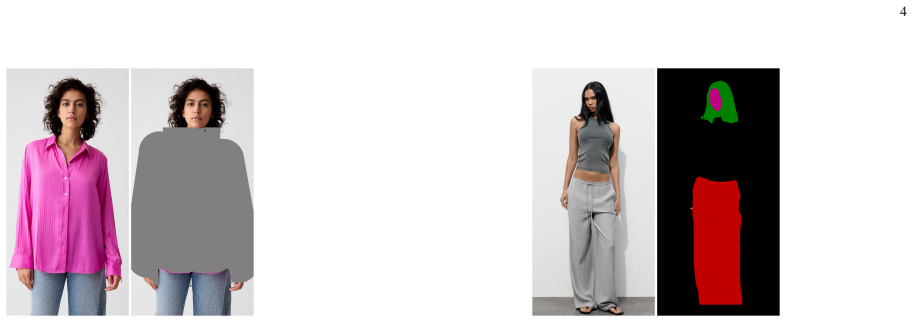
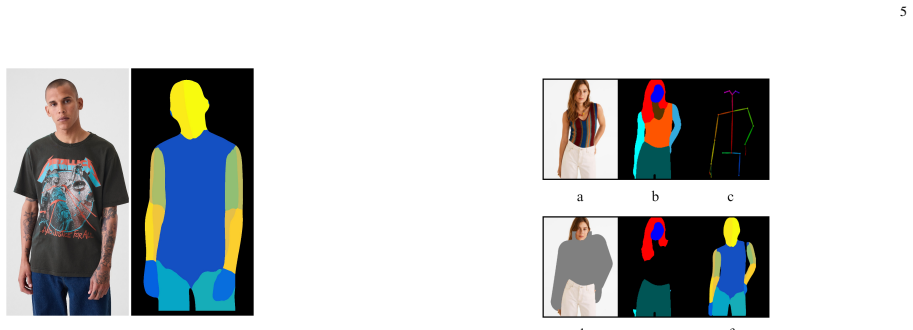
The load-bearing mechanism is the non-uniform timestep schedule, which replaces a long chain of uniformly spaced denoising steps with a small set of strategically selected steps and is what produces the claimed speedups. Around it sits an architecture built for detail transfer: a spatial encoder initialized with U-Net weights extracts multi-resolution clothing features, and zero cross-attention blocks (cross-attention layers whose linear projection is zero-initialized) let the U-Net decoder query those clothing features, performing warping directly in latent space. The training objective is $L_{total}=L_{LDM}+\lambda_{ATV}L_{ATV}$, where $L_{ATV}=\|\nabla(FM)\|_1$ is an attention total variation loss that is meant to suppress noisy attention maps.
What would settle it
Run EfficientVITON at the same reduced step count with a uniform timestep schedule, keeping all other components fixed, and measure FID and LPIPS on VITON-HD; if uniform sampling matches or beats the non-uniform row, the schedule is not the mechanism behind the efficiency claim. Also rerun the non-uniform model without the RePaint refinement pass to check whether the headline FID of 8.433 is carried by the extra refinement rather than by the model itself.
Extended reading notes
Core claim
On the paper's own terms, the central discovery is that a diffusion-based virtual try-on pipeline can deliver sharper measured realism than the GAN and diffusion baselines it compares against while costing much less to train and run. EfficientVITON fine-tunes Stable Diffusion with a spatial encoder initialized from U-Net weights and zero cross-attention blocks, so clothing features act as keys and values for patch-wise warping in latent space. Training runs in two stages and combines the latent diffusion loss with an attention total variation loss. With non-uniform timestep sampling, the paper reports FID 8.703 and LPIPS 0.0842 on VITON-HD, improving to 8.433 and 0.0762 when a RePaint refinement pass is added, with inference time falling from 58 seconds to 16 seconds and training time from 1570 hours to 859 hours.
Load-bearing premise
The claim that speed can be gained without quality loss rests on the untested assumption that non-uniform timestep sampling at the reduced step count preserves generation quality in this try-on setting, since the paper never compares its own model against a uniform schedule at the same step count.
Editorial extensions
If this is right
- On the paper's reported hardware, inference drops from 58 seconds to 16 seconds per image, which moves diffusion-based try-on into the range of interactive use.
- The non-uniform timestep recipe is independent of the try-on-specific encoders, so the paper's conclusion states it can be carried over to other image synthesis tasks built on latent diffusion.
- The two-stage fine-tuning and attention total variation loss are claimed to keep attention maps clean enough to preserve sharp garment logos, text, and folds across poses and body types.
- A model with this speed and this FID on VITON-HD becomes a plausible drop-in for e-commerce try-on features, the application context the paper motivates.
Reading between the lines
- If the non-uniform schedule is the true source of the speed gain, it should be ablatable: the same model at the same step count with uniform spacing should look worse, and testing that directly would measure the contribution independently.
- The gap between 'Ours' (8.703 FID) and 'Ours (RePaint)' (8.433 FID) suggests the headline quality number depends partly on a refinement pass, so a reader should separate the model's own output from the model-plus-refinement output.
- A natural next test is to apply the same spatial-encoder and timestep-schedule combination to unpaired or video try-on, which the paper lists as an unresolved limitation of the field.
Editorial analysis
A structured set of objections, weighed in public.
Referee Report
Summary. EfficientVITON adapts Stable Diffusion for image-based virtual try-on by combining a spatial encoder and zero cross-attention blocks with a pre-trained VAE/U-Net, using two-stage fine-tuning with an attention total variation loss and a non-uniform timestep sampling schedule borrowed from Fast-DDPM. On VITON-HD, the authors report FID 8.703/8.433 and LPIPS 0.0842/0.0762 for the base and RePaint-augmented variants, and claim 72.4% inference and 45.3% training time reductions. The central claim is that these gains are achieved without sacrificing visual quality, yielding state-of-the-art results. The manuscript provides qualitative examples and compares against several published baselines, but the experimental evidence does not currently support the headline claim.
Significance. If fully supported, a diffusion-based virtual try-on model that is simultaneously faster and better than existing baselines would be practically valuable, particularly for e-commerce and real-time applications, and the VITON-HD benchmark makes the quantitative claim measurable. The paper is also transparent about the provenance of its main components: it attributes the zero cross-attention design to StableVITON [3] and the non-uniform timestep schedule to Fast-DDPM [23]. However, the most relevant baseline is omitted from the main table, the best quality numbers are obtained in a configuration different from the one used for the speedup numbers, and no ablation isolates the proposed schedule or loss. These gaps prevent the paper from establishing its contribution as stated. The authors also do not provide code, checkpoints, or a full description of the timestep schedule, which further limits reproducibility.
major comments (6)
- [§IV-C, Table II vs. §III-D] The efficiency and quality claims are never demonstrated in a single configuration. The 16 s inference time and 72.4% reduction apply to the base 'Ours' model, while the best FID/LPIPS values in Table I belong to 'Ours (RePaint)', a resampling-based refinement whose wall-clock time and step count are not reported. RePaint is not a free lunch; its computational cost must be quantified before the paper can claim simultaneous state-of-the-art quality and near-real-time speed.
- [§IV-B, Table I] The state-of-the-art claim is not assessable because StableVITON [3], the closest baseline and the source of the architecture's spatial encoder and zero cross-attention blocks, is absent from Table I. In addition, no error bars, evaluation protocol, or number of FID/LPIPS samples are reported, so the small differences between Ours and DCI-VTON are not shown to be significant.
- [§III-D] No ablation isolates the non-uniform timestep schedule from the reduction in total step count. Since the schedule is adopted from Fast-DDPM [23], the paper should compare, at the same number of denoising steps, the non-uniform schedule against the uniform schedule, and should also report the quality metrics for the 'Before' configuration whose timings appear in Table II. Without this, the 72.4% inference improvement cannot be attributed to the proposed schedule rather than to a simple decrease in the number of steps.
- [§IV-B, Table I] The 'Ours (RePaint)' row applies an additional refinement procedure only for the proposed method; the baseline rows are not given this paired-evaluation treatment. This is an asymmetric comparison, and for LPIPS it is material: the base 'Ours' value (0.0842) is worse than DCI-VTON (0.0804), so the reported LPIPS advantage comes from RePaint rather than from the proposed architecture.
- [§III-D, Eq. (3)] The contribution of the attention total variation loss and the two-stage fine-tuning is not tested by any ablation. Since LATV is an added term with a free weighting coefficient λATV, the paper should quantify how FID/LPIPS and training time change when this loss and the second training stage are removed; otherwise these components cannot be credited as contributions.
- [§III-D] The non-uniform timestep schedule is not specified beyond a conceptual description. No formula, list of timesteps, or step-count hyperparameter is given, and the PLMS/RePaint variants are not tied to the reported timings. This prevents independent reproduction of the efficiency result and should be corrected.
minor comments (5)
- [§III-D, Eq. (2)] The symbols F and M in L_ATV = ||∇(F M)||_1 are undefined; the reader cannot tell which tensors are being regularized.
- [§II, Related Work] There is a broken sentence in the diffusion-models paragraph: 'They have proven highly effective at managing complex textur [9] and Stable-VITON [3] are diffusion-based models...' This should be rewritten.
- [§IV-C, Table II] Table II is ambiguous: the rows and columns do not clearly distinguish the training-time values from the inference-time values for the 'Before' and 'After' configurations, so the reader has to guess which number is which.
- [References [15] and [16]] The cited papers do not match the described systems: reference [15] is titled 'Cloth Interactive Transformer for Virtual Try-On', not 'Text2Cloth', and reference [16] is titled 'Towards Scalable Unpaired Virtual Try-On via Patch-Routed Spatially-Adaptive GAN', not 'Sketch2TryOn'.
- [§IV-A, Fig. 13] The qualitative results in Fig. 13 do not state which inference configuration (base PLMS or base PLMS plus RePaint) produced the images; this should be reported for reproducibility and fair comparison.
Circularity Check
No significant circularity: the paper's benchmark numbers and speedup measurements are direct empirical results, and its borrowed components are cited from external prior work rather than derived from the claims themselves.
full rationale
EfficientVITON's central claims are (1) state-of-the-art FID/LPIPS on VITON-HD and (2) reduced training and inference time via non-uniform timestep sampling. Neither reduces by construction to the paper's inputs. The FID and LPIPS values in Table I are direct measurements against an external benchmark, not outputs of a fitted parameter that is later renamed a prediction. The 'Ours (RePaint)' row uses an additional refinement step whose compute is not reported, and the efficiency table reports no uniform-timestep ablation at the same step count; these are evidentiary gaps affecting the support for the combined claim, but they are not cases of a result being equivalent to its premise by definition. The spatial encoder and zero cross-attention blocks are attributed to StableVITON [3], and the non-uniform timestep schedule is attributed to Fast-DDPM [23]; those are external prior works, and the authors do not present them as derived inside this paper. There are no self-citations invoked as load-bearing evidence, no uniqueness theorem imported from the authors' own prior work, and no equation in Section III-D that defines the efficiency gain in terms of the final FID score. The paper is derivative and under-ablated, but not circular.
Assumptions & free parameters
free parameters (2)
- lambda_ATV =
not reported
- non-uniform timestep schedule =
not reported
assumptions (3)
- domain assumption Pre-trained Stable Diffusion contains sufficient priors for human and clothing appearance so that fine-tuning alone adapts it to virtual try-on.
- domain assumption OpenPose, LIP parsing, and DensePose preprocessing provide accurate pose, parsing, and UV maps.
- domain assumption RePaint refinement is an acceptable component for paired evaluation and does not give an unfair advantage.
Cite this review
Pith. "Pith review of EfficientVITON: An Efficient Virtual Try-On Model using Optimized Diffusion Process." pith.science (2026). https://pith.science/paper/IUSJ4RQ6
@misc{pith2026250111776,
  author       = {Pith},
  title        = {Pith review of: EfficientVITON: An Efficient Virtual Try-On Model using Optimized Diffusion Process},
  year         = {2026},
  howpublished = {\url{https://pith.science/paper/IUSJ4RQ6}},
  note         = {Machine review of arXiv:2501.11776}
}
read the original abstract
Would not it be much more convenient for everybody to try on clothes by only looking into a mirror ? The answer to that problem is virtual try-on, enabling users to digitally experiment with outfits. The core challenge lies in realistic image-to-image translation, where clothing must fit diverse human forms, poses, and figures. Early methods, which used 2D transformations, offered speed, but image quality was often disappointing and lacked the nuance of deep learning. Though GAN-based techniques enhanced realism, their dependence on paired data proved limiting. More adaptable methods offered great visuals but demanded significant computing power and time. Recent advances in diffusion models have shown promise for high-fidelity translation, yet the current crop of virtual try-on tools still struggle with detail loss and warping issues. To tackle these challenges, this paper proposes EfficientVITON, a new virtual try-on system leveraging the impressive pre-trained Stable Diffusion model for better images and deployment feasibility. The system includes a spatial encoder to maintain clothings finer details and zero cross-attention blocks to capture the subtleties of how clothes fit a human body. Input images are carefully prepared, and the diffusion process has been tweaked to significantly cut generation time without image quality loss. The training process involves two distinct stages of fine-tuning, carefully incorporating a balance of loss functions to ensure both accurate try-on results and high-quality visuals. Rigorous testing on the VITON-HD dataset, supplemented with real-world examples, has demonstrated that EfficientVITON achieves state-of-the-art results.
Figures


Figures from the paper (5 more)



Reference graph
Works this paper leans on
-
[3]
Stableviton: Learning semantic correspondence with latent diffusion model for virtual try-on,
J. Kim, G. Gu, M. Park, S. Park, and J. Choo, “Stableviton: Learning semantic correspondence with latent diffusion model for virtual try-on,” in Proceedings of the IEEE/CVF Conference on Computer Vision and Pattern Recognition, 2024, pp. 8176–8185
work page 2024
-
[23]
Fast-ddpm: Fast denoising diffusion probabilistic models for medical image-to-image generation,
H. Jiang, M. Imran, L. Ma, T. Zhang, Y . Zhou, M. Liang, K. Gong, and W. Shao, “Fast-ddpm: Fast denoising diffusion probabilistic models for medical image-to-image generation,” arXiv preprint arXiv:2405.14802 , 2024
arXiv 2024
-
[1]
Viton-hd: High-resolution virtual try-on via misalignment-aware normalization,
S. Choi, S. Park, M. Lee, and J. Choo, “Viton-hd: High-resolution virtual try-on via misalignment-aware normalization,” in Proceedings of the IEEE/CVF Conference on Computer Vision and Pattern Recognition , 2021, pp. 14 131–14 140. Fig. 12: Efficient Diffusion vs. Standard Diffusion
work page 2021
-
[2]
Laion-5b: an open large-scale dataset for training next generation image-text models,
C. Schuhmann, R. Beaumont, R. Vencu, C. Gordon, R. Wight- man, M. Cherti, T. Coombes, A. Katta, C. Mullis, M. Wortsman, P. Schramowski, S. Kundurthy, K. Crowson, L. Schmidt, R. Kacz- marczyk, and J. Jitsev, “Laion-5b: an open large-scale dataset for training next generation image-text models,” in Proceedings of the 36th International Conference on Neural ...
work page 2024
-
[4]
High-resolution virtual try-on network with coarse-to-fine strategy,
Q. Lyu, Q. Wang, and K. Huang, “High-resolution virtual try-on network with coarse-to-fine strategy,” Journal of Physics: Conference Series, vol. 1880, p. 012009, 04 2021
work page 2021
-
[5]
High-resolution image synthesis with latent diffusion models,
R. Rombach, A. Blattmann, D. Lorenz, P. Esser, and B. Ommer, “High-resolution image synthesis with latent diffusion models,” 2022 IEEE/CVF Conference on Computer Vision and Pattern Recognition (CVPR) , pp. 10 674–10 685, 2021. [Online]. Available: https://api.semanticscholar.org/CorpusID:245335280
work page 2022
-
[6]
Parser-free virtual try-on via distilling appearance flows,
Y . Ge, Y . Song, R. Zhang, C. Ge, W. Liu, and P. Luo, “Parser-free virtual try-on via distilling appearance flows,” in Proceedings of the IEEE/CVF Conference on Computer Vision and Pattern Recognition (CVPR), 2021, pp. 8485–8493. 7 Fig. 13: Qualitative Results on VITON-HD
work page 2021
-
[7]
High-resolution virtual try- on with misalignment and occlusion-handled conditions,
S. Lee, G. Gu, S. Park, S. Choi, and J. Choo, “High-resolution virtual try- on with misalignment and occlusion-handled conditions,” inProceedings of the European Conference on Computer Vision (ECCV) . Springer, 2022, pp. 204–219
work page 2022
Show all 28 references
-
[8]
Adding conditional control to text-to-image diffusion models,
L. Zhang, A. Rao, and M. Agrawala, “Adding conditional control to text-to-image diffusion models,” in Proceedings of the IEEE/CVF International Conference on Computer Vision (ICCV) , 2023, pp. 3836– 3847
2023
-
[9]
Tryondiffusion: A tale of two unets,
L. Zhu, D. Yang, T. Zhu, F. Reda, W. Chan, C. Saharia, M. Norouzi, and I. Kemelmacher-Shlizerman, “Tryondiffusion: A tale of two unets,” in Proceedings of the IEEE/CVF Conference on Computer Vision and Pattern Recognition (CVPR), June 2023, pp. 4606–4615
2023
-
[10]
Taming the power of diffusion models for high-quality virtual try-on with appearance flow,
J. Gou, S. Sun, J. Zhang, J. Si, C. Qian, and L. Zhang, “Taming the power of diffusion models for high-quality virtual try-on with appearance flow,” arXiv preprint arXiv:2308.06101 , 2023
2023 arXiv
-
[11]
Ladi-vton: Latent diffusion textual-inversion enhanced virtual try-on,
D. Morelli, A. Baldrati, G. Cartella, M. Cornia, M. Bertini, and R. Cuc- chiara, “Ladi-vton: Latent diffusion textual-inversion enhanced virtual try-on,” arXiv preprint arXiv:2305.13501 , 2023
2023 arXiv
-
[12]
Viton: An image-based virtual try-on network,
X. Han, Z. Wu, Z. Wu et al. , “Viton: An image-based virtual try-on network,” in Proceedings of the IEEE Conference on Computer Vision and Pattern Recognition (CVPR) , 2018, pp. 7543–7552
2018
-
[13]
Toward characteristic-preserving image-based virtual try-on network,
B. Wang, H. Zheng, X. Liang et al., “Toward characteristic-preserving image-based virtual try-on network,” in Proceedings of the European Conference on Computer Vision (ECCV) , 2018, pp. 589–604
2018
-
[14]
Do not mask what you do not need to mask: A parser-free virtual try-on,
T. Issenhuth, J. Mary, and C. Calauzenes, “Do not mask what you do not need to mask: A parser-free virtual try-on,” in Proceedings of the European Conference on Computer Vision (ECCV) , 2020, pp. 619–635
2020
-
[15]
Cloth interactive transformer for virtual try-on,
B. Ren, H. Tang, F. Meng et al., “Cloth interactive transformer for virtual try-on,” arXiv preprint arXiv:2104.05519 , 2021
2021 arXiv
-
[16]
Towards scalable unpaired virtual try-on via patch-routed spatially-adaptive gan,
Z. Xie, Z. Huang, F. Zhao et al. , “Towards scalable unpaired virtual try-on via patch-routed spatially-adaptive gan,” in Advances in Neural Information Processing Systems (NeurIPS) , 2021, pp. 2598–2610
2021
-
[17]
Densepose: Dense human pose estimation in the wild,
R. A. G ¨uler, N. Neverova, and I. Kokkinos, “Densepose: Dense human pose estimation in the wild,” in Proceedings of the IEEE Conference on Computer Vision and Pattern Recognition , 2018, pp. 7297–7306
2018
-
[18]
Openpose: Realtime multi-person 2d pose estimation using part affinity fields,
Z. Cao, G. Hidalgo Martinez, T. Simon, S. Wei, and Y . A. Sheikh, “Openpose: Realtime multi-person 2d pose estimation using part affinity fields,” IEEE Transactions on Pattern Analysis and Machine Intelligence, 2019
2019
-
[19]
Hand keypoint detection in single images using multiview bootstrapping,
T. Simon, H. Joo, I. Matthews, and Y . Sheikh, “Hand keypoint detection in single images using multiview bootstrapping,” in CVPR, 2017
2017
-
[20]
Realtime multi-person 2d pose estimation using part affinity fields,
Z. Cao, T. Simon, S.-E. Wei, and Y . Sheikh, “Realtime multi-person 2d pose estimation using part affinity fields,” in CVPR, 2017
2017
-
[21]
Convolutional pose machines,
S.-E. Wei, V . Ramakrishna, T. Kanade, and Y . Sheikh, “Convolutional pose machines,” in CVPR, 2016
2016
-
[22]
Look into person: Self-supervised structure-sensitive learning and a new benchmark for human parsing,
K. Gong, X. Liang, D. Zhang, X. Shen, and L. Lin, “Look into person: Self-supervised structure-sensitive learning and a new benchmark for human parsing,” in 2017 IEEE Conference on Computer Vision and Pattern Recognition (CVPR), 2017, pp. 6757–6765
2017
-
[24]
Repaint: Inpainting using denoising diffusion probabilistic models,
A. Lugmayr, M. Danelljan, A. Romero, F. Yu, R. Timofte, and L. V . Gool, “Repaint: Inpainting using denoising diffusion probabilistic models,” 2022 IEEE/CVF Conference on Computer Vision and Pattern Recognition (CVPR) , pp. 11 451–11 461, 2022. [Online]. Available: https://api...
2022
-
[25]
Gans trained by a two time-scale update rule converge to a nash equilibrium,
M. Heusel, H. Ramsauer, T. Unterthiner, B. Nessler, G. Klambauer, and S. Hochreiter, “Gans trained by a two time-scale update rule converge to a nash equilibrium,” ArXiv, vol. abs/1706.08500, 2017. [Online]. Available: https://api.semanticscholar.org/CorpusID:231697514
2017 arXiv
-
[26]
The unreasonable effectiveness of deep features as a perceptual metric,
R. Zhang, P. Isola, A. A. Efros, E. Shechtman, and O. Wang, “The unreasonable effectiveness of deep features as a perceptual metric,” 2018 IEEE/CVF Conference on Computer Vision and Pattern Recognition , pp. 586–595, 2018. [Online]. Available: https: //api.semanticscholar.org/...
2018
-
[27]
Paint by example: Exemplar-based image editing with diffusion models,
B. Yang, S. Gu, B. Zhang, T. Zhang, X. Chen, X. Sun, D. Chen, and F. Wen, “Paint by example: Exemplar-based image editing with diffusion models,” 2023 IEEE/CVF Conference on Computer Vision and Pattern Recognition (CVPR) , pp. 18 381–18 391, 2022. [Online]. Available: https://...
2023
-
[28]
Gp-vton: Towards general purpose virtual try-on via collaborative local-flow global-parsing learning,
Z. Xie, Z. Huang, X. Dong, F. Zhao, H. Dong, X. Zhang, F. Zhu, and X. Liang, “Gp-vton: Towards general purpose virtual try-on via collaborative local-flow global-parsing learning,” 2023 IEEE/CVF Conference on Computer Vision and Pattern Recognition (CVPR) , pp. 23 550–23 559, ...
2023
Reviewed August 10, 2026 · model on record in the stance chip above.
Discussion (0). Continue with ORCID to comment.