REVIEW 3 major objections 5 minor 72 references
Parametrically Constrained Geometry Relaxations for High-Throughput Materials Science
T0 review · 3 major / 5 minor · reviewed 2026-08-14 · deepseek-v4-flash
Pith's one-line read Parametrically constrained relaxations map atomic and lattice degrees of freedom onto a lower-dimensional space derived from crystal prototypes, cutting DFT relaxation steps by an average of 33% (PBE) and 52% (PBEsol), and by 96% for a…
desk verdict A clean, useful constrained-relaxation scheme with honest benchmarks, but the headline step-count savings may be inflated by comparing projected-force stopping with full-force stopping. read the letter →
The pith
A machine-rendered reading of the paper's core claim, the machinery that carries it, and where it could break.
The reading
What carries the argument
The central object is a linear map between the full set of fractional atomic coordinates and lattice vectors and a small vector of parameters, defined through Jacobian matrices $J_R$ and $J_L$. Coordinates are mapped into the reduced space using the generalized left inverse $A^{-1,L}=(A^TA)^{-1}A^T$, and forces and stresses are pulled back with the transposed Jacobians, $F_r=J_R^T F_R$ and $F_l=J_L^T F_L$. The Hessian is likewise transformed blockwise into reduced space so the BFGS/truncated-Newton optimizer runs entirely on the parameters. The parameter sets themselves come from the AFLOW crystallographic prototype definitions, so the procedure is automated for any structure class; additional parameters can be added to capture local distortions such as Jahn-Teller modes.
What would settle it
Take a material with a known equilibrium distortion that lies outside the prototype parameter space, such as a strong Jahn-Teller mode in a defective supercell, constrain the relaxation to the prototype's reduced set, and compare the final energy against an unconstrained relaxation; if the constrained minimum sits more than the target convergence tolerance above the free minimum, the subspace was too small and the scheme's savings come at an unacceptable accuracy cost.
Extended reading notes
Core claim
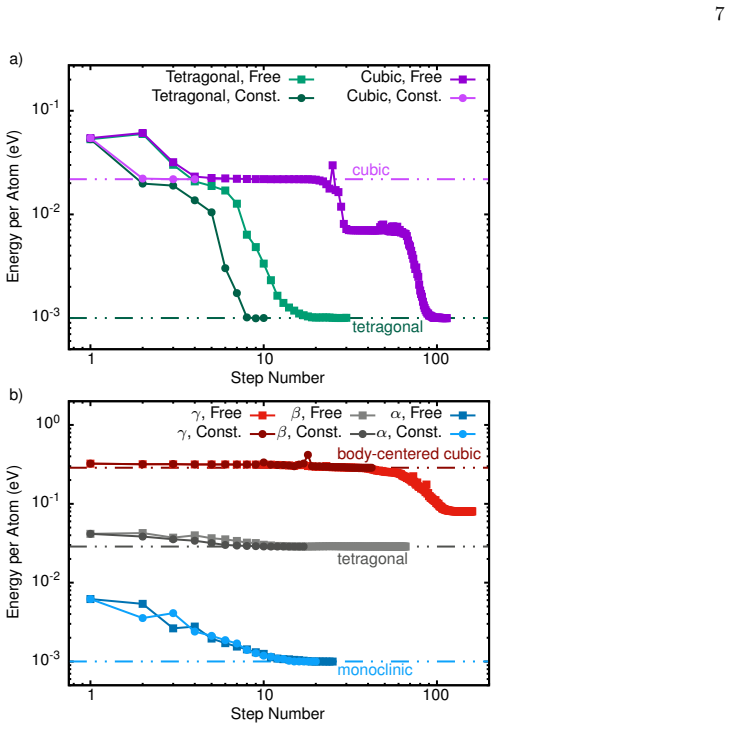
The paper claims that parametrically constrained relaxations, which map atomic positions and lattice vectors onto a reduced parameter set defined by crystallographic prototypes, preserve the target symmetry exactly while substantially lowering the number of relaxation steps. The mapping is linear: fractional coordinates and lattice vectors are expressed through Jacobians, forces and stresses are pulled back into the reduced space via the transposed Jacobians, and the optimizer acts only on the few parameters. The scheme is general because the parameter sets are generated automatically from the AFLOW prototype library, and it can be extended to local distortions by adding parameters along known soft modes. The authors demonstrate that this approach converges metastable phases (e.g., cubic ZrO2 and γ-Bi2O3) that free relaxations would lose, and that it cuts the step count for relaxing a large polaronic supercell by an order of magnitude. The cost is a small energy bias when the true minimum lies outside the chosen parameter subspace, quantified as 69–78 meV for the MgO polaron tests.
Load-bearing premise
The true relaxed structure must lie within the linear subspace spanned by the chosen parameters; otherwise the constrained relaxation converges to a slightly higher-energy, biased geometry.
Editorial extensions
If this is right
- Symmetry is preserved exactly during relaxation, eliminating the small symmetry drift that free relaxations introduce and that would otherwise corrupt symmetry-based downstream calculations like finite-difference phonons.
- Dynamically stabilized and metastable phases become routinely accessible in high-throughput searches because the optimizer can be confined to the intended polymorph.
- Large supercell defect relaxations, such as polarons, can be converged in an order of magnitude fewer steps when the dominant distortion mode is known.
- The method requires no change to the underlying optimizer, so it can be dropped into existing electronic-structure codes and relaxation workflows.
- The step-count savings grow as the number of free parameters shrinks relative to the full degrees of freedom, making the biggest gains in highly symmetric or tightly constrained systems.
Reading between the lines
- The same parameter mapping could double as a coordinate system for transition-state searches along soft modes, since the reduced space already encodes the relevant distortion direction.
- Comparing the full forces with the back-transformed reduced forces at each step would give a per-structure diagnostic for whether the chosen parameter subspace is rich enough; large residuals would flag materials needing extra parameters.
- The linear-subspace restriction suggests a natural generalization: piecewise-affine or curvilinear parameterizations built from phonon eigenvectors could recover the true minimum while retaining most of the step savings.
- If the speedups transfer to denser k-point grids and larger basis sets, symmetry-exact constrained relaxation could make phonon calculations on defective supercells practical at scales where free relaxations currently dominate the cost.
Signed reviews
Editorial analysis
A structured set of objections, weighed in public.
Referee Report
Summary. The paper introduces a parametrically constrained geometry-relaxation scheme for DFT, in which fractional atomic coordinates and lattice vectors are mapped through linear Jacobians onto a low-dimensional parameter space derived from AFLOW crystal prototypes, with forces and stresses transformed to generalized forces in that space. The authors implement the scheme in FHI-aims, demonstrate it on metastable ZrO2 and Bi2O3 polymorphs, benchmark it on 359 materials across 13 prototypes, and apply it to a polaronic distortion in MgO. The central claims are that the constraints exactly preserve symmetry, reduce the number of relaxation steps by about 33% (PBE) and 52% (PBEsol) for converging cases, and cut the steps for a 216-atom polaron supercell by 96% relative to free relaxation, at the cost of a small (69-78 meV) energy bias in the MgO case.
Significance. If the quantitative claims are sound, the method is a useful and general tool for high-throughput materials screening and for defect and metastable-phase calculations, because it automates symmetry-preserving or symmetry-breaking constraints and couples them with existing optimizers. The paper's data and code availability are concrete strengths: the complete input/output files are deposited in NOMAD (DOI:10.17172/NOMAD/2019.10.19-1), the implementation is in a released version of FHI-aims, and an ASE implementation is referenced. The central issue is whether the reported step-count savings are a fair comparison of equivalently converged calculations; this must be resolved before the headline numbers can be accepted.
major comments (3)
- [III.B, Eq. (12), and Fig. 2] The claimed average savings compare free relaxations stopped on full Cartesian force components with constrained relaxations stopped on generalized forces in the reduced parameter space. In the workflow of Fig. 2, the convergence check is applied to the forces on the active degrees of freedom, and in Section III.C the MgO runs explicitly stop when 'the total forces on the free parameters' are below threshold. Because the generalized forces in Eqs. (5c)-(5d) are projections, components of the physical forces and stress orthogonal to the constraint subspace are never monitored; at the same threshold value, a constrained endpoint may therefore have large full-space residuals that a free relaxation would continue to reduce. The MgO results, where the constrained minima are 69.1-78.4 meV above the free minima (Section III.C), show that this bias can be numerically significant. The authors should report the full-space force/stress residuals at the constrained endpoints for the benchmark set (the NOMAD archive makes this possible) and should quote step savings only for cases where the endpoints are equivalently converged under the full-space criterion.
- [III.B, Eq. (12)] Equation (12) defines S = (N_free - N_constrained)/N_constrained x 100%, but the text interprets S as a percentage reduction in relaxation steps. This is internally inconsistent: for the 216-atom MgO case, Section III.C reports a 96% reduction, which corresponds to (234-10)/234 = 95.7% with the free count in the denominator, whereas Eq. (12) gives 2240%. With Eq. (12), the reported averages of 33.11% and 52.43% correspond to conventional reductions of only 24.9% and 34.4% relative to the free relaxation. The savings definition should be changed to use N_free in the denominator, or explicitly relabeled as a speedup factor minus one, and all reported values in the abstract, Section III.B, and Table IV should be recomputed consistently.
- [III.B, Table IV and Fig. 5] The 'same final structure' classification relies on AFLOW-XTAL-MATCH with the loose tolerance m <= 0.1, which permits finite deviations in lattice vectors and atomic positions. Since the constrained stopping criterion only controls reduced-space forces, structures classified as matching can still differ substantially in their full-space force residuals: the free endpoint is fully converged, whereas the constrained one may not be. The discussion of negative-savings cases such as PtS2 (Fig. 5) attributes the extra steps to 'unproductive' or near-threshold behavior, but without full-force residuals the comparison remains ambiguous. Please provide the distribution of maximum full-space atomic forces and stress residuals at the constrained endpoints for the 359 materials, or restart each constrained endpoint unconstrained to demonstrate that no significant relaxation remains.
minor comments (5)
- [Abstract and Section III.B] The abstract and conclusions state that the method reduces the number of relaxation steps by about 50%, but the actual reported averages are 33.11% and 52.43% for the converging subset; the conclusions should reflect the range and the dependence on the functional and prototype.
- [III.B, Eq. (12) and Table IV] The column 'Average Savings' in Table IV uses the nonstandard denominator of Eq. (12); the text and tables should make the metric definition explicit and avoid terms like 'percent reduction' when the denominator is the constrained step count.
- [III.C] The sentence 'the structures were relaxed until the total forces on the free parameters were below 10^-4 eV/A' should be clarified to state explicitly that this is a projected-force criterion and to give the corresponding full-space force residuals at the reported endpoints.
- [II, Eq. (7)] The generalized left inverse in Eq. (7) is defined with (A^T A)^(-1), which requires A to have full column rank; the paper should state this rank condition and comment on how rank-deficient parameterizations are handled in practice.
- [IV, Data Availability] The paper cites AFLOW-XTAL-MATCH as 'in preperation' (Ref. [59]); since this tool is used in the benchmark to define structural matches, the authors should state which version was used and provide the matching parameters in the archive, so that the classification is reproducible.
Circularity Check
No significant circularity: the central relaxations are benchmarked against independent free relaxations; step-count savings are empirical comparisons rather than quantities defined by the constraints.
full rationale
The paper's chain of claims is self-contained. The constrained relaxation is defined by the linear maps in Eqs. (5a)-(5d), and all claimed benefits are measured against independent, unconstrained relaxations of the same initial geometries. The average step savings in Section III.B are computed from recorded Nfree and Nconstrained values via Eq. (12); nothing in the savings definition is fitted from, or defined in terms of, the constraints themselves. The symmetry preservation statement is a consequence of the constraint construction rather than a predicted output, and the paper explicitly reports the energy penalty of the MgO constrained minima (69-78 meV), so the constrained result is not claimed to reproduce the free minimum by fiat. The self-citations to the AFLOW prototype library and AFLOW-XTAL-MATCH are tooling and matching citations, not uniqueness theorems or fitted inputs; the 'in preparation' status of XTAL-MATCH is a caveat for reproducibility, but the benchmark data are archived in NOMAD and the central comparison does not reduce to an unverified self-citation. The concern that constrained and free runs may use different stopping criteria is a benchmarking-fairness issue, not a circularity: it does not make any derived quantity identical to an input by construction.
Assumptions & free parameters
assumptions (7)
- standard math Hellmann-Feynman theorem and its corrections provide analytic forces and stresses for each SCF geometry.
- domain assumption The exchange-correlation functionals PBE, PBEsol, and HSE describe the potential-energy surfaces well enough for benchmarking.
- ad hoc to paper The reduced parameters are linearly related to fractional atomic coordinates and to each non-zero lattice vector component.
- standard math The Jacobian matrices have full column rank so the generalized left inverse exists.
- domain assumption AFLOW prototype definitions and Wyckoff positions correctly describe the symmetry of each material in the test set.
- domain assumption The imaginary phonon eigenvector of cubic ZrO2 at the X point is the correct soft mode for the cubic-to-tetragonal distortion.
- ad hoc to paper For the MgO polaron, the dominant lattice relaxation is along a line through the center of the supercell, described by one parameter per atom.
Cite this review
Pith. "Pith review of Parametrically Constrained Geometry Relaxations for High-Throughput Materials Science." pith.science (2026). https://pith.science/paper/IUXX6ZG6
@misc{pith2026190801610,
  author       = {Pith},
  title        = {Pith review of: Parametrically Constrained Geometry Relaxations for High-Throughput Materials Science},
  year         = {2026},
  howpublished = {\url{https://pith.science/paper/IUXX6ZG6}},
  note         = {Machine review of arXiv:1908.01610}
}
read the original abstract
Reducing parameter spaces via exploiting symmetries has greatly accelerated and increased the quality of electronic-structure calculations. Unfortunately, many of the traditional methods fail when the global crystal symmetry is broken, even when the distortion is only a slight perturbation (e.g. Jahn-Teller like distortions). Here we introduce a flexible and generalizable parametric relaxation scheme, and implement it in the all-electron code FHI-aims. This approach utilizes parametric constraints to maintain symmetry at any level. After demonstrating the method's ability to relax metastable structures, we highlight its adaptability and performance over a test set of 359 materials, across thirteen lattice prototypes. Finally we show how these constraints can reduce the number of steps needed to relax local lattice distortions by an order of magnitude. The flexibility of these constraints enables a significant acceleration of the high-throughput searches for novel materials for numerous applications.
Figures


Figures from the paper (3 more)


Reference graph
Works this paper leans on
-
[1]
Review: Environmental friendly lead- free piezoelectric materials
P K Panda. Review: Environmental friendly lead- free piezoelectric materials. Journal of Materials Science, 44(19):5049–5062, 2009
work page 2009
-
[2]
Progress in piezotronics and piezo- phototronics
Zhong Lin Wang. Progress in piezotronics and piezo- phototronics. Advanced Materials , 24(34):4632– 4646, 2012
work page 2012
-
[3]
Kang Min Ok. Toward the Rational Design of Novel Noncentrosymmetric Materials: Factors Influencing the Framework Structures. Accounts of Chemical Research, 49(12):2774–2785, 2016
work page 2016
-
[4]
Nguyen, Sheng Mao, Yao Wen Yeh, Prashant K
Thanh D. Nguyen, Sheng Mao, Yao Wen Yeh, Prashant K. Purohit, and Michael C. McAlpine. Nanoscale flexoelectricity. Advanced Materials , 25(7):946–974, 2013
work page 2013
-
[5]
Recent advances in perovskites: Processing and properties
Carlos Moure and Octavio Pe˜ na. Recent advances in perovskites: Processing and properties. Progress in Solid State Chemistry , 43(4):123–148, 2015
work page 2015
-
[6]
L. I. Isaenko, A. P. Yelisseyev, S. I. Lobanov, P. G. Krinitsin, and M. S. Molokeev. Structure and opti- cal properties of Li2Ga2GeS6 nonlinear crystal. Op- tical Materials, 47:413–419, 2015
work page 2015
-
[7]
Ferroelectric, dielectric and piezoelectric properties of ferroelectric thin films and ceramics
Dragan Damjanovic. Ferroelectric, dielectric and piezoelectric properties of ferroelectric thin films and ceramics. Rep. Prog. Phys, 61:1267, 1998
work page 1998
-
[8]
Metal-organic complex ferroelectrics
Tian Hang, Wen Zhang, Heng Yun Ye, and Ren Gen Xiong. Metal-organic complex ferroelectrics. Chem- ical Society Reviews, 40(7):3577–3598, 2011
work page 2011
Show all 72 references
-
[9]
Relaxor-based ferro- electric single crystals: Growth, domain engineer- ing, characterization and applications
Enwei Sun and Wenwu Cao. Relaxor-based ferro- electric single crystals: Growth, domain engineer- ing, characterization and applications. Progress in Materials Science, 65:124–210, 2014
2014
-
[10]
Symmetry breaking in molecular ferroelectrics
Ping Ping Shi, Yuan Yuan Tang, Peng Fei Li, Wei Qiang Liao, Zhong Xia Wang, Qiong Ye, and Ren Gen Xiong. Symmetry breaking in molecular ferroelectrics. Chemical Society Reviews, 45(14):3811–3827, 2016
2016
-
[11]
R. J. Cava, Huiwen Ji, M. K. Fuccillo, Q. D. Gibson, and Y. S. Hor. Crystal structure and chemistry of topological insulators. Journal of Materials Chem- istry C, 1(19):3176–3189, 2013
2013
-
[12]
Gregory A. Fiete. Topological insulators: Crys- talline protection. Nature Materials , 11(12):1003– 1004, 2012
2012
-
[13]
Crystal engineer- ing of NLO materials based on metal-organic coor- dination networks
Owen R Evans and Wenbin Lin. Crystal engineer- ing of NLO materials based on metal-organic coor- dination networks. Accounts of Chemical Research, 35(7):511–522, 2002
2002
-
[14]
A review on structure- performance relationship toward the optimal de- sign of infrared nonlinear optical materials with bal- anced performances
Kui Wu and Shilie Pan. A review on structure- performance relationship toward the optimal de- sign of infrared nonlinear optical materials with bal- anced performances. Coordination Chemistry Re- views, 377:191–208, 2018
2018
-
[15]
Halide Perovskites for Nonlinear Optics
Jialiang Xu, Xinyue Li, Jianbo Xiong, Chunqing Yuan, Sergey Semin, Theo Rasing, and Xian-He Bu. Halide Perovskites for Nonlinear Optics. Advanced Materials, page 1806736, 2019
2019
-
[16]
The role of defects in the tensile properties of silicene
Minh Quy Le and Danh Truong Nguyen. The role of defects in the tensile properties of silicene. Ap- plied Physics A: Materials Science and Processing , 118(4):1437–1445, 2014
2014
-
[17]
Sayle, Beverley J Inkson, Ajay Karakoti, Amit Kumar, Marco Molinari, G¨ unter M¨ obus, Stephen C Parker, Sudipta Seal, and Dean C Sayle
Thi X.T. Sayle, Beverley J Inkson, Ajay Karakoti, Amit Kumar, Marco Molinari, G¨ unter M¨ obus, Stephen C Parker, Sudipta Seal, and Dean C Sayle. Mechanical properties of ceria nanorods and nanochains; The effect of dislocations, grain- boundaries and oriented attachment. Nanos...
2011
-
[18]
Defective TiO2 with oxygen vacancies: Synthesis, properties and photocatalytic applications
Xiaoyang Pan, Min Quan Yang, Xianzhi Fu, Nan Zhang, and Yi Jun Xu. Defective TiO2 with oxygen vacancies: Synthesis, properties and photocatalytic applications. Nanoscale, 5(9):3601–3614, 2013. 13
2013
-
[19]
Intrinsic ”vacancy Point Defect” Induced Electrochemiluminescence from Coreless Supertetrahedral Chalcogenide Nanoclus- ter
Feng Wang, Jian Lin, Tingbi Zhao, Dandan Hu, Tao Wu, and Yang Liu. Intrinsic ”vacancy Point Defect” Induced Electrochemiluminescence from Coreless Supertetrahedral Chalcogenide Nanoclus- ter. Journal of the American Chemical Society , 138(24):7718–7724, 2016
2016
-
[20]
Point defect-assisted doping mechanism and re- lated thermoelectric transport properties in Pb- doped BiCuOTe
Tae Ho An, Young Soo Lim, Hyoung Seuk Choi, Won Seon Seo, Cheol Hee Park, Gwi Rang Kim, Chan Park, Chang Hoon Lee, and Ji Hoon Shim. Point defect-assisted doping mechanism and re- lated thermoelectric transport properties in Pb- doped BiCuOTe. Journal of Materials Chemistry A,...
2014
-
[21]
H. Anno, K. Matsubara, Y. Notohara, T. Sakak- ibara, and H. Tashiro. Effects of doping on the transport properties of CoSb3. Journal of Applied Physics, 86(7):3780–3786, 1999
1999
-
[22]
Senanayak, Bingyan Yang, Tudor H
Satyaprasad P. Senanayak, Bingyan Yang, Tudor H. Thomas, Nadja Giesbrecht, Wenchao Huang, Eliot Gann, Bhaskaran Nair, Karl Goedel, Suchi Guha, Xavier Moya, Christopher R. McNeill, Pablo Do- campo, Aditya Sadhanala, Richard H. Friend, and Henning Sirringhaus. Understanding char...
2017
-
[23]
Heat and charge transport in bulk semiconductors with interstitial defects
Vitaly S Proshchenko, Pratik P Dholabhai, Tyler C Sterling, and Sanghamitra Neogi. Heat and charge transport in bulk semiconductors with interstitial defects. Physical Review B, 99(1), 2019
2019
-
[24]
Zintl chemistry for designing high efficiency thermoelectric materials
Eric S Toberer, Andrew F May, and G Jeffrey Sny- der. Zintl chemistry for designing high efficiency thermoelectric materials. Chemistry of Materials , 22(3):624–634, 2010
2010
-
[25]
Jeffrey Snyder, Xinbing Zhao, and Tiejun Zhu
Hanhui Xie, Heng Wang, Yanzhong Pei, Chenguang Fu, Xiaohua Liu, G. Jeffrey Snyder, Xinbing Zhao, and Tiejun Zhu. Beneficial Contribution of Alloy Disorder to Electron and Phonon Transport in Half- Heusler Thermoelectric Materials. Advanced Func- tional Materials, 23(41):5123–5130, 2013
2013
-
[26]
Miller, Qibin Zhou, Mohan Chen, Ho Nyung Lee, Karin M
Hongwei Wang, Jianguo Wen, Dean J. Miller, Qibin Zhou, Mohan Chen, Ho Nyung Lee, Karin M. Rabe, and Xifan Wu. Stabilization of Highly Polar BiFeO 3 -like Structure: A New Interface Design Route for Enhanced Ferroelectricity in Artificial Perovskite Superlattices. Physical Revie...
2016
-
[27]
Improper ferroelectricity in perovskite oxide artifi- cial superlattices
Eric Bousquet, Matthew Dawber, Nicolas Stucki, C´ eline Lichtensteiger, Patrick Hermet, Stefano Gariglio, Jean-Marc Triscone, and Philippe Ghosez. Improper ferroelectricity in perovskite oxide artifi- cial superlattices. Nature, 452(7188):732–736, 2008
2008
-
[28]
Jef- frey Snyder, Gian Marco Rignanese, Anubhav Jain, and Geoffroy Hautier
Francesco Ricci, Wei Chen, Umut Aydemir, G. Jef- frey Snyder, Gian Marco Rignanese, Anubhav Jain, and Geoffroy Hautier. Data descriptor: An ab initio electronic transport database for inorganic materi- als. Scientific Data, 4(1):170085, 2017
2017
-
[29]
Zim- mermann, Guodong Yu, Andrew Canning, Maciej Haranczyk, Mark Asta, and Geoffroy Hautier
Danny Broberg, Bharat Medasani, Nils E.R. Zim- mermann, Guodong Yu, Andrew Canning, Maciej Haranczyk, Mark Asta, and Geoffroy Hautier. Py- CDT: A Python toolkit for modeling point defects in semiconductors and insulators. Computer Physics Communications, 226:165–179, 2018
2018
-
[30]
Plata, Pinku Nath, Demet Usanmaz, Jes´ us Carrete, Cormac Toher, Maarten De Jong, Mark Asta, Marco Fornari, Marco Buongiorno Nardelli, and Stefano Curtarolo
Jose J. Plata, Pinku Nath, Demet Usanmaz, Jes´ us Carrete, Cormac Toher, Maarten De Jong, Mark Asta, Marco Fornari, Marco Buongiorno Nardelli, and Stefano Curtarolo. An efficient and accurate framework for calculating lattice thermal conduc- tivity of solids: AFLOW - AAPL Automa...
2017
-
[31]
Comprehensive search for topolog- ical materials using symmetry indicators
Feng Tang, Hoi Chun Po, Ashvin Vishwanath, and Xiangang Wan. Comprehensive search for topolog- ical materials using symmetry indicators. Nature, 566(7745):486–489, 2019
2019
-
[32]
Maghirang, Zhi-Quan Huang, Rovi An- gelo B
Aniceto B. Maghirang, Zhi-Quan Huang, Rovi An- gelo B. Villaos, Chia-Hsiu Hsu, Liang-Ying Feng, Emmanuel Florido, Hsin Lin, Arun Bansil, and Feng-Chuan Chuang. Predicting two-dimensional topological phases in Janus materials by substi- tutional doping in transition metal dicha...
2019
-
[33]
Half-Heusler Semiconduc- tors as Piezoelectrics
Anindya Roy, Joseph W Bennett, Karin M Rabe, and David Vanderbilt. Half-Heusler Semiconduc- tors as Piezoelectrics. Physical Review Letters , 109(3):037602, 2012
2012
-
[34]
Stochastic replica voting machine pre- diction of stable cubic and double perovskite mate- rials and binary alloys
T Mazaheri, Bo Sun, J Scher-Zagier, A S Thind, D Magee, P Ronhovde, T Lookman, R Mishra, and Z Nussinov. Stochastic replica voting machine pre- diction of stable cubic and double perovskite mate- rials and binary alloys. Physical Review Materials , 3(6), 2019
2019
-
[35]
Ghiringhelli, Takenori Yamamoto, Yury Lysogorskiy, Lars Blumenthal, Thomas Hammerschmidt, Jacek Golebiowski, Xi- angyue Liu, Angelo Ziletti, and Matthias Scheffler
Christopher Sutton, Luca M. Ghiringhelli, Takenori Yamamoto, Yury Lysogorskiy, Lars Blumenthal, Thomas Hammerschmidt, Jacek Golebiowski, Xi- angyue Liu, Angelo Ziletti, and Matthias Scheffler. NOMAD 2018 Kaggle Competition: Solving Mate- rials Science Challenges Through Crowd So...
2018
-
[36]
Mehl, David Hicks, Cormac Toher, Ohad Levy, Robert M
Michael J. Mehl, David Hicks, Cormac Toher, Ohad Levy, Robert M. Hanson, Gus Hart, and Stefano Curtarolo. The AFLOW Library of Crystallo- graphic Prototypes: Part 1. Computational Materi- als Science, 136:S1–S828, 2017
2017
-
[37]
Mehl, Eric Gossett, Cor- mac Toher, Ohad Levy, Robert M
David Hicks, Michael J. Mehl, Eric Gossett, Cor- mac Toher, Ohad Levy, Robert M. Hanson, Gus Hart, and Stefano Curtarolo. The AFLOW Library of Crystallographic Prototypes: Part 2. Computa- tional Materials Science , 161:S1–S1011, 2019
2019
-
[38]
Ab-initio simulations of materials using VASP: Density-functional theory and beyond
J¨ urgen Hafner. Ab-initio simulations of materials using VASP: Density-functional theory and beyond. Journal of Computational Chemistry , 29(13):2044– 2078, 2008
2008
-
[39]
Tiago, M
Leeor Kronik, Adi Makmal, Murilo L. Tiago, M. M.G. Alemany, Manish Jain, Xiangyang Huang, Yousef Saad, and James R. Chelikowsky. PAR- SEC - The pseudopotential algorithm for real-space electronic structure calculations: Recent advances and novel applications to nano-structures...
2006
-
[40]
Practical methods of optimiza- tion
R (Roger) Fletcher. Practical methods of optimiza- tion. Wiley, 1987
1987
-
[41]
Numerical Optimization
Jorge Nocedal and Stephen J Wright. Numerical Optimization. Springer, New York, NY, USA, sec- ond edition, 2006
2006
-
[42]
On-the-fly parameterization of internal coordinate force constants for quasi- Newton geometry optimization in atomistic calcula- tions
Christoph Freysoldt. On-the-fly parameterization of internal coordinate force constants for quasi- Newton geometry optimization in atomistic calcula- tions. Computational Materials Science , 133:71–81, 2017
2017
-
[43]
14 Global Materials Structure Search with Chemically Motivated Coordinates
Chiara Panosetti, Konstantin Krautgasser, Dennis Palagin, Karsten Reuter, and Reinhard J Maurer. 14 Global Materials Structure Search with Chemically Motivated Coordinates. Nano Letters, 15(12):8044– 8048, 2015
2015
-
[44]
QUANTUM ESPRESSO: a modular and open-source software project for quantum simula- tions of materials
Paolo Giannozzi, Stefano Baroni, Nicola Bonini, Matteo Calandra, Roberto Car, Carlo Cavazzoni, Davide Ceresoli, Guido L Chiarotti, Matteo Co- coccioni, Ismaila Dabo, Andrea Dal Corso, Stefano de Gironcoli, Stefano Fabris, Guido Fratesi, Ralph Gebauer, Uwe Gerstmann, Christos G...
2009
-
[45]
Ab initio molecular simu- lations with numeric atom-centered orbitals
Volker Blum, Ralf Gehrke, Felix Hanke, Paula Havu, Ville Havu, Xinguo Ren, Karsten Reuter, and Matthias Scheffler. Ab initio molecular simu- lations with numeric atom-centered orbitals. Com- puter Physics Communications, 180(11):2175–2196, 2009
2009
-
[46]
All-electron formalism for total energy strain derivatives and stress tensor components for numeric atom-centered orbitals
Franz Knuth, Christian Carbogno, Viktor Atalla, Volker Blum, and Matthias Scheffler. All-electron formalism for total energy strain derivatives and stress tensor components for numeric atom-centered orbitals. Computer Physics Communications , 190:33–50, 2015
2015
-
[47]
Phase transitions in zirconium dioxide and related materials for high performance engineering ceram- ics
M H Bocanegra-Bernal and S D´ ıaz de la Torre. Phase transitions in zirconium dioxide and related materials for high performance engineering ceram- ics. Journal of Materials Science, 37(23):4947–4971, 2002
2002
-
[48]
Ferroelastic switch- ing of doped zirconia: Modeling and understanding from first principles
Christian Carbogno, Carlos G Levi, Chris G Van De Walle, and Matthias Scheffler. Ferroelastic switch- ing of doped zirconia: Modeling and understanding from first principles. Physical Review B - Condensed Matter and Materials Physics , 90(14):144109, 2014
2014
-
[49]
First- principles determination of the soft mode in cubic ZrO2
K Parlinski, Z Q Li, and Y Kawazoe. First- principles determination of the soft mode in cubic ZrO2. Physical Review Letters , 78(21):4063–4066, 1997
1997
-
[50]
Structures and energetics of Bi 2O3 poly- morphs in a defective fluorite family derived by systematic first-principles lattice dynamics calcula- tions
Akifumi Matsumoto, Yukinori Koyama, and Isao Tanaka. Structures and energetics of Bi 2O3 poly- morphs in a defective fluorite family derived by systematic first-principles lattice dynamics calcula- tions. Physical Review B, 81(9):94117, 2010
2010
-
[51]
Structures and Oxide Mobility in Bi- Ln-O Materials: Heritage of Bi 2O3
Michel Drache, Pascal Roussel, and Jean-Pierre Wignacourt. Structures and Oxide Mobility in Bi- Ln-O Materials: Heritage of Bi 2O3. Chemical Re- views, 107(1):80–96, 2007
2007
-
[52]
Taylor, Cormac Toher, Michael J
David Hicks, Corey Oses, Eric Gossett, Geena Gomez, Richard H. Taylor, Cormac Toher, Michael J. Mehl, Ohad Levy, and Stefano Curtarolo. AFLOW-SYM: Platform for the complete, auto- matic and self-consistent symmetry analysis of crys- tals. Acta Crystallographica Section A Found...
2018
-
[53]
Beuken, R Caracas, F Detraux, M Fuchs, G.-M
X Gonze, J.-M. Beuken, R Caracas, F Detraux, M Fuchs, G.-M. Rignanese, L Sindic, M Verstraete, G Zerah, F Jollet, M Torrent, A Roy, M Mikami, Ph. Ghosez, J.-Y. Raty, and D C Allan. First- principles computation of material properties: the ABINIT software project. Computational...
2002
-
[54]
Analytical stress tensor and pressure calcu- lations with the CRYSTAL code.Molecular Physics, 108(3-4):223–227, 2010
K Doll. Analytical stress tensor and pressure calcu- lations with the CRYSTAL code.Molecular Physics, 108(3-4):223–227, 2010
2010
-
[55]
Gen- eralized inverse of a matrix and its applications
C Radhakrishna Rao and Sujit Kumar Mitra. Gen- eralized inverse of a matrix and its applications. In Proceedings of the Sixth Berkeley Symposium on Mathematical Statistics and Probability, Volume 1: Theory of Statistics, pages 601–620, Berkeley, Calif.,
-
[56]
Taylor, Lance J
Stefano Curtarolo, Wahyu Setyawan, Shidong Wang, Junkai Xue, Kesong Yang, Richard H. Taylor, Lance J. Nelson, Gus L.W. Hart, Ste- fano Sanvito, Marco Buongiorno-Nardelli, Natalio Mingo, and Ohad Levy. AFLOWLIB.ORG: A dis- tributed materials properties repository from high- thr...
2012
-
[57]
Anubhav Jain, Shyue Ping Ong, Geoffroy Hautier, Wei Chen, William Davidson Richards, Stephen Dacek, Shreyas Cholia, Dan Gunter, David Skinner, Gerbrand Ceder, and Kristin A. Persson. Commen- tary: The materials project: A materials genome approach to accelerating materials inno...
2013
-
[58]
The atomic simulation environment - A Python library for working with atoms
Ask Hjorth Larsen, Jens JØrgen Mortensen, Jakob Blomqvist, Ivano E Castelli, Rune Christensen, Marcin Du lak, Jesper Friis, Michael N Groves, Bjørk Hammer, Cory Hargus, Eric D Hermes, Paul C Jen- nings, Peter Bjerre Jensen, James Kermode, John R Kitchin, Esben Leonhard Kolsbje...
2017
-
[59]
Mehl, and Stefano Curtarolo
David Hicks, Cormac Toher, Denise Ford, Frisco Rose, Carlo De Santo, Ohad Levy, Michael J. Mehl, and Stefano Curtarolo. AFLOW-XTAL-MATCH: Automated method for quantifying the structural similarity of materials and identifying unique crys- tal prototypes. in preperation, 2019
2019
-
[60]
A Procedure for the Clasification of Non-Organic Crystal Struc- tures
H Burzlaff and Y Malinovsky. A Procedure for the Clasification of Non-Organic Crystal Struc- tures. I. Theoretical Background. Acta Crystallo- graphica Section A Foundations of Crystallography , 53(2):217–224, 1997
1997
-
[61]
spglib: a software library for crystal symmetry search
Atsushi Togo and Isao Tanaka. spglib: a software library for crystal symmetry search. 2018
2018
-
[62]
First principles phonon cal- culations in materials science
A Togo and I Tanaka. First principles phonon cal- culations in materials science. Scr. Mater., 108:1–5, 2015
2015
-
[63]
P´ erez-Cappe, Yodalgis Mosqueda Laffita, Ar- mando Ch´ avez Ardanza, Jaime Santoyo Salazar, Manuel ´Avila Santos, Miguel A
Renier Arabolla Rodr´ ıguez, Eduardo L. P´ erez-Cappe, Yodalgis Mosqueda Laffita, Ar- mando Ch´ avez Ardanza, Jaime Santoyo Salazar, Manuel ´Avila Santos, Miguel A. Aguilar Frutis, Nelcy Della Santina Mohalem, and Oswaldo Luiz Alves. Structural defects in LiMn2O4 induced by gamm...
2018
-
[64]
Prentice, Bartomeu Monserrat, and R J Needs
Joseph C.A. Prentice, Bartomeu Monserrat, and R J Needs. First-principles study of the dynamic Jahn- Teller distortion of the neutral vacancy in diamond. Physical Review B, 95(1):14108, 2017
2017
-
[65]
Jahn-Teller effect in the phonon properties of defective SrTiO 3 from first principles
Robert Evarestov, Evgeny Blokhin, Denis Gryaznov, Eugene A Kotomin, Rotraut Merkle, and Joachim Maier. Jahn-Teller effect in the phonon properties of defective SrTiO 3 from first principles. Physical Review B - Condensed Matter and Materials Physics , 85(17):174303, 2012
2012
-
[66]
First-principles su- percell calculations of small polarons with proper ac- count for long-range polarization effects
Sebastian Kokott, Sergey V Levchenko, Patrick Rinke, and Matthias Scheffler. First-principles su- percell calculations of small polarons with proper ac- count for long-range polarization effects. New Jour- nal of Physics , 20(3):033023, 2018
2018
-
[67]
Oxide thermoelectric materials: A structure-property relationship
Abanti Nag and V Shubha. Oxide thermoelectric materials: A structure-property relationship. Jour- nal of Electronic Materials , 43(4):962–977, 2014
2014
-
[68]
Thermally-driven processes on rutile TiO2(1 1 0)-(1 × 1): A direct view at the atomic scale
Zdenek Dohn´ alek, Igor Lyubinetsky, and Roger Rousseau. Thermally-driven processes on rutile TiO2(1 1 0)-(1 × 1): A direct view at the atomic scale. Progress in Surface Science, 85(5-8):161–205, 2010
2010
-
[69]
A surface science perspective on TiO2 photocatalysis
Michael A Henderson. A surface science perspective on TiO2 photocatalysis. Surface Science Reports , 66(6-7):185–297, 2011
2011
-
[70]
Rettie, William D Chemelewski, David Emin, and C Buddie Mullins
Alexander J.E. Rettie, William D Chemelewski, David Emin, and C Buddie Mullins. Unravelling Small-Polaron Transport in Metal Oxide Photo- electrodes. Journal of Physical Chemistry Letters , 7(3):471–479, 2016
2016
-
[71]
Purcell, David Hicks, Stefano Curtarolo, Matthias Scheffler, and Christian Carbogno
Maja-Olivia Lenz, Thomas A.R. Purcell, David Hicks, Stefano Curtarolo, Matthias Scheffler, and Christian Carbogno. Constrained Geometry Relax- ations: Dataset, 2019
2019
-
[1972]
University of California Press
Reviewed August 14, 2026 · model on record in the stance chip above.
Discussion (0). Continue with ORCID to comment.