REVIEW 4 major objections 5 minor 19 references
This paper claims that the time a fluid antenna spends moving between ports should be treated as usable transmission time, not dead overhead, and that online conformal calibration makes Bayesian optimization robust enough to improve long-te
Reviewed by Pith at T0; open to challenge. T0 means a machine referee read the full paper against a public rubric. the ladder, T0–T4 →
T0 review · deepseek-v4-flash
2026-08-01 13:35 UTC pith:IVCW4N2P
load-bearing objection Novel cost-aware FAS-ISAC switching formulation with a clean conformal-BO wrapper; the load-bearing approximation in Prop. 1/Lemma 1 is unvalidated at the paper's own simulation parameters, so treat the results as a promising proof-of-concept. the 4 major comments →
Stay or Switch: Online Conformal Bayesian Optimization Guided Fluid Antenna Configuration
The pith
A machine-rendered reading of the paper's core claim, the machinery that carries it, and where it could break.
Core claim
The central claim is that a stay-or-switch decision for a fluid antenna should be based on a slot-level, cost-aware ISAC metric that explicitly includes the switching stage as a usable interval rather than ignoring it. The paper derives this metric by approximating the continuous switching-stage communication rate and sensing mutual information as equally weighted averages of instantaneous values at ports along the movement path (Proposition 1 and Lemma 1), justified by high port density and Bessel-function spatial correlation. It then formulates the port-selection problem as a multi-objective optimization over switching pairs, learns the gray-box objectives with Gaussian process surrogates,
What carries the argument
The load-bearing construction is the slot-level cost-aware utility, which splits each time slot into a switching stage and a dwell stage and weights the communication and sensing objectives by their respective time fractions; the switching-stage terms are replaced by port-averaged instantaneous values under the high-port-density approximation. Around this metric, the algorithm pairs a Gaussian process surrogate over switching pairs (a_{t-1}, a) with an online conformal calibration factor q_{t,m}—the empirical quantile of recent normalized residuals—that rescales the GP uncertainty before sampling for expected hypervolume improvement, and then subtracts a linearly weighted switching-energy pe
Load-bearing premise
The entire slot-level utility rests on the approximation that switching-stage communication rate and sensing mutual information equal the equally weighted average of values at discrete ports along the movement path, which holds only if port spacing is small and the channel varies smoothly between ports.
What would settle it
Compute the exact continuous integral of the communication rate along a switching trajectory in a channel that has a deep fade between two adjacent ports; if the port-averaged approximation differs substantially from the true integral, the cost-aware metric can misrank a switch versus a stay, and the algorithm would optimize the wrong objective.
If this is right
- If the slot-level utility is accurate, fluid-antenna systems should evaluate port switches by their slot-long effect, not by the instantaneous dwell-stage gain, which would prevent overly greedy switching.
- Modeling the switching stage as usable means operators can harvest extra communication and sensing throughput during antenna movement instead of discarding those signals.
- Conformal calibration of GP uncertainty should make online port selection more robust to user mobility and environmental drift than uncalibrated Bayesian optimization, as shown by the widening gap over time.
- Including an explicit switching-energy penalty in the acquisition function reduces unnecessary port movements, which is increasingly valuable as mechanical switching power grows.
- The framework extends naturally to slower fluid-antenna movement speeds, where the switching stage occupies a larger fraction of the slot and cost-aware modeling matters most.
Where Pith is reading between the lines
- The same slot-level averaging idea could be transferred to other movable-antenna architectures (e.g., movable antennas with continuous position control), where the switching trajectory is even less structured and the port-sampling approximation would need reinterpretation.
- A testable extension is to vary port spacing systematically and compare the OCBO decision quality against an oracle that computes the exact switching-stage integral; the benefit should decay as port spacing grows, directly probing the high-port-density assumption.
- The residual-buffer conformal calibration is a generic uncertainty fix and could be replaced by other online calibration schemes, but the paper's evidence suggests the quantile-based rescaling is sufficient for the tested dynamics.
- If the claimed gains hold in hardware trials, the result implies that FAS-ISAC performance can be improved by software-level switching policies alone, without increasing port density or actuation speed.
Editorial analysis
A structured set of objections, weighed in public.
Referee Report
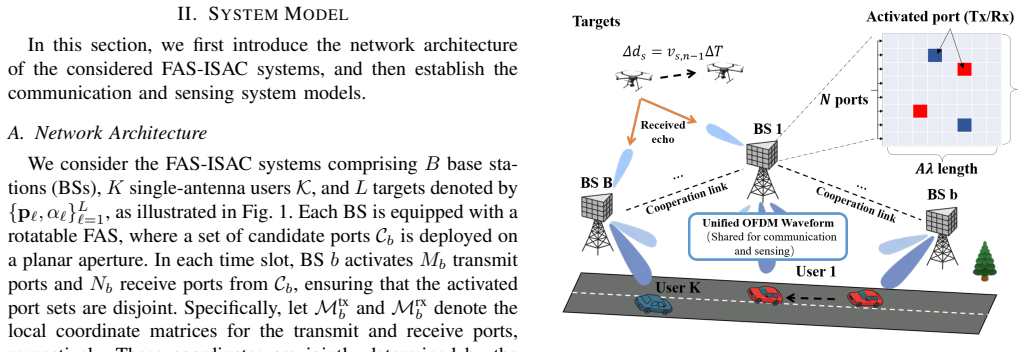
Summary. The manuscript considers a fluid antenna system (FAS) for integrated sensing and communication (ISAC). It models the port-switching interval as a usable time during which the antenna passes through intermediate positions; it defines slot-level communication and sensing utilities as time-weighted averages of switching-stage and dwell-stage performance, with the switching-stage terms approximated by averages over ports along the movement path (Prop. 1, Lemma 1). It formulates a multi-objective port-switching problem and proposes OCBO, which uses two GP surrogates over switching pairs, online conformal calibration of GP variance using a residual buffer, and an expected hypervolume improvement acquisition with an energy penalty. Simulations against Random, Fixed, MOBO, and Dwell-only baselines claim substantially improved long-term utility.
Significance. If the approximations and simulations hold, the paper addresses a real and under-modeled issue in FAS-ISAC: the switching stage is usually either ignored or treated purely as an overhead. Treating it as a usable interval and explicitly penalizing switching energy are sensible design choices, and online conformal calibration is an appropriate tool for dynamic GP model mismatch. The manuscript is clearly written and the proposed architecture is plausible. However, the main contributions rest on two approximations that are not quantified and on comparisons that are not fully specified or statistically supported. With the additions below, this could be a useful contribution to the FAS-ISAC literature.
major comments (4)
- [§III-A, Prop. 1 / Lemma 1 (Eqs. (9), (12), (13))] The low-pass/quadrature approximation of the switching-stage integrals by equal-weight port averages is load-bearing because R_mv and I_mv enter the slot-level metrics (8), (14) and the observed feedback y_t in (18). The proof relies on the Bessel expansion J0(x)=1−x^2/4+O(x^4), which is only valid as d/λ→0. The simulations use port spacing 0.25λ (Section IV); for the first adjacent port d/λ=0.25, J0(π/2)≈0.47, i.e., the channel is not strongly correlated, and the Rician K=10 dB LoS component changes phase by 90° between ports. Under these conditions the instantaneous rate/MI can vary non-monotonically on the port grid, and the quadrature error is uncontrolled. Because all algorithms are simulated on the approximate objective, the reported gains may be artifacts of the approximation. Please provide an error bound for the quadrature or validate against exact trajectory integration with th
- [§IV, Eq. (16), Figs. 3-5] P1 is a multi-objective problem with reward vector F=[R_c,I_s,−E_sw]^T, but the plotted 'average online cost-aware utility' is never defined. A scalarization (e.g., weighted sum with weights, normalization, reference point for hypervolume) is required to interpret the curves and to compare methods. Without it, the stated numerical values (e.g., 'approximately 23.5') are not reproducible. Please specify the scalarization or report the three objectives separately (or Pareto hypervolume).
- [§IV, baseline list] MOBO is introduced only as 'standard multi-objective Bayesian optimization without conformal calibration.' It is unclear whether MOBO also uses the cost-aware acquisition Q_t of Eq. (23) (including the energy penalty and the switching-stage metrics) or only the uncalibrated EHI. If the former, the comparison isolates conformal calibration; if the latter, the gap may be due to the energy penalty or the switching-stage model rather than to conformal calibration. Moreover, 'dwell-only MOBO' and 'dwell-only OCBO' appear in Fig. 5 but are not defined in the baselines. Specify the exact objective and acquisition for each baseline and add the missing ablations.
- [§IV, Figs. 3-5] All curves appear to be from a single scenario realization. The algorithm involves random initial evaluations, stochastic user/UA V trajectories, measurement noise in Eq. (18), and randomized BO acquisition; the baselines are also stochastic. Single runs cannot support the abstract's claim of 'substantially improved long-term ISAC performance.' Please report means and error bars/confidence intervals over multiple random seeds and state the number of runs.
minor comments (5)
- [§III-C, Eq. (23)] The acquisition function uses E_mv(a|a_{t-1}) but the switching energy is defined as E_sw in Eq. (15); align the notation or define E_mv explicitly.
- [§II-A] Typos: 'Bbase', 'Ksingle-antenna usersK', and 'Ltargets denoted by{p_l, alpha_l}^L_{l=1}' should use math mode and proper spacing.
- [§III-D, Eq. (22)] Sensitivity of results to the conformal miscoverage level α, buffer length W, and energy penalty η_e is not reported; these are inputs to Algorithm 1. Please state the nominal values used and ideally include a short sensitivity study for η_e.
- [Prop. 1 proof, Eqs. (11)-(12)] The notation switches between P and P(a_{t-1},a_t); use one consistent symbol.
- [§IV] The computational cost of enumerating the candidate set C_t for a 16×16 port grid and performing GP inference over switching pairs is not discussed. A complexity statement would help assess practical deployability.
Circularity Check
No significant circularity: the OCBO optimization target is a defined physical objective, and the two self-citations are background only.
full rationale
The paper's central claim is that the proposed cost-aware framework with OCBO improves long-term ISAC performance. The derivation chain is self-contained: slot-level communication and sensing utilities are defined in Eqs. (8) and (14) from switching-stage and dwell-stage quantities; the switching-stage approximations in Prop. 1 and Lemma 1 are derived via a Bessel-correlation argument with explicitly stated high-port-density assumptions, not fitted to the final performance. The GP surrogates, online conformal calibration, and expected hypervolume improvement acquisition are standard tools cited from external works ([17], [18], [19]). The feedback model in Eq. (18) is the same cost-aware objective the optimizer targets, which is a coherent optimization loop, not a prediction that reduces to its inputs by construction. Baselines are evaluated on the same online cost-aware utility, so no fitted parameter is renamed as a predicted result. The two self-citations ([2], [13]) are used only to motivate background and the need for robust decision-making; they are not load-bearing for the algorithm's derivation. A real concern, but not a circularity, is that the switching-stage quadrature in Prop. 1/Lemma 1 is unvalidated under the paper's simulation parameters (port spacing 0.25λ gives J0(π/2)≈0.47, not close to 1, and Rician K=10 dB introduces strong LoS phase variation), making the optimized objective potentially inaccurate relative to the true continuous-time performance. This is a correctness/validation risk, not a self-referential reduction.
Axiom & Free-Parameter Ledger
free parameters (4)
- η_e (energy penalty weight) =
not specified
- α (miscoverage level) =
not specified
- W (calibration buffer window) =
not specified
- GP kernel hyperparameters =
not specified
axioms (4)
- domain assumption In the high-port-density regime, continuous switching-stage rate/MI can be represented by the equally weighted average of port-sampled values (Prop. 1, Lemma 1).
- domain assumption The slot-level objectives can be modeled as independent Gaussian processes over switching pairs (a_{t-1}, a) with additive Gaussian noise (Eqs. 18-19).
- domain assumption Residual scores are sufficiently stationary/exchangeable within the calibration window for the empirical quantile to provide valid coverage (Eqs. 21-22).
- domain assumption The scalarization of the multi-objective problem via EHI and a fixed energy-penalty weight η_e yields the correct Pareto-relevant decisions.
read the original abstract
Fluid antenna systems (FAS) introduce additional spatial degrees of freedom to enable integrated sensing and communication (ISAC) in air-ground networks. However, conventional studies often overlook or simplify the physical overheads and switching costs of FAS. In practice, port switching incurs non-negligible time, during which communication and sensing may continue but with potentially degraded slot-level performance. This leads to two key challenges: (1) the characterization of a slot-level, cost-aware ISAC metric is difficult, and (2) the large port space and accompanying abrupt environmental variations demand more reliable online decision-making. To address these challenges, a cost-aware multi-objective FAS switching problem is formulated, jointly considering slot-level ISAC performance and switching energy. The online conformal Bayesian optimization (OCBO) algorithm is then proposed to learn the unknown gray-box ISAC objectives and calibrate surrogate uncertainty for robust stay-or-switch decisions. Simulation results demonstrate that the proposed cost-aware optimization framework achieves substantially improved long-term ISAC performance compared to existing baselines.
Figures


Reference graph
Works this paper leans on
-
[1]
The Integrated Sensing and Communication Revolution for 6G: Vision, Techniques, and Applications,
N. Gonz ´alez-Prelcicet al., “The Integrated Sensing and Communication Revolution for 6G: Vision, Techniques, and Applications,”Proceedings of the IEEE, vol. 112, no. 7, pp. 676–723, Jul. 2024
2024
-
[2]
Integrated Sensing, Communication, and Computation for Low-Altitude Networks Towards Seamless Connectivity and Connected Intelligence,
S. Gaoet al., “Integrated Sensing, Communication, and Computation for Low-Altitude Networks Towards Seamless Connectivity and Connected Intelligence,”IEEE Internet of Things Magazine, pp. 1–9, Mar. 2026
2026
-
[3]
Integrated Sensing and Communications: Recent Advances and Ten Open Challenges,
S. Luet al., “Integrated Sensing and Communications: Recent Advances and Ten Open Challenges,”IEEE Internet of Things Journal, vol. 11, no. 11, pp. 19 094–19 120, Jun. 2024
2024
-
[4]
A Tutorial On Fluid Antenna System For 6G Networks: Encompassing Communication Theory, Optimization Methods And Hardware Designs,
W. K. Newet al., “A Tutorial On Fluid Antenna System For 6G Networks: Encompassing Communication Theory, Optimization Methods And Hardware Designs,”IEEE Communications Surveys & Tutorials, vol. 27, no. 4, pp. 2325–2377, Aug. 2025
2025
-
[5]
Fluid Antenna Systems Enabling 6G: Principles, Appli- cations, and Research Directions,
T. Wuet al., “Fluid Antenna Systems Enabling 6G: Principles, Appli- cations, and Research Directions,”IEEE Wireless Communications, pp. 1–9, Dec. 2025, early Access
2025
-
[6]
On fundamental limits for fluid antenna-assisted integrated sensing and communications for unsourced random access,
Z. Zhang, K.-K. Wong, J. Dang, Z. Zhang, and C.-B. Chae, “On fundamental limits for fluid antenna-assisted integrated sensing and communications for unsourced random access,”IEEE Journal on Selected Areas in Communications, vol. 44, pp. 136–149, Jan. 2026
2026
-
[7]
Movable Antenna Enhanced Multiuser Communication via Antenna Position Optimization,
L. Zhuet al., “Movable Antenna Enhanced Multiuser Communication via Antenna Position Optimization,”IEEE Transactions on Wireless Communications, vol. 23, no. 9, pp. 11 814–11 830, Sep. 2024
2024
-
[8]
Shifting the isac trade-off with fluid antenna systems,
J. Zou, H. Xu, C. Wang, L. Xu, S. Sun, and K. T. Meng, “Shifting the isac trade-off with fluid antenna systems,”IEEE Wireless Communications Letters, vol. 13, no. 12, pp. 3479–3483, Dec. 2024
2024
-
[9]
Switching-Cost-Aware Deep Reinforcement Learning for Dynamic Port Selection in Fluid Antenna Systems,
J. Liuet al., “Switching-Cost-Aware Deep Reinforcement Learning for Dynamic Port Selection in Fluid Antenna Systems,”IEEE Communica- tions Letters, vol. 30, pp. 1548–1552, Mar. 2026
2026
-
[10]
Spatio-Temporal Port Selection in Fluid An- tennas Under Switching Delays,
D. Dinis and R. Wichman, “Spatio-Temporal Port Selection in Fluid An- tennas Under Switching Delays,”IEEE Communications Letters, vol. PP, no. 99, pp. 1–1, Jan. 2026
2026
-
[11]
Energy-Efficient Port Selection and Beamforming Design for Integrated Data and Energy Transfer Assisted by Fluid Antennas,
L. Zhang, Y . Zhao, H. Yang, G. Liang, and J. Hu, “Energy-Efficient Port Selection and Beamforming Design for Integrated Data and Energy Transfer Assisted by Fluid Antennas,”IEEE Journal on Selected Areas in Communications, vol. 44, pp. 1480–1494, Sep. 2025
2025
-
[12]
Fundamental Tradeoff in Movable Antenna Systems: How Long to Move Before Transmission?
G. Huet al., “Fundamental Tradeoff in Movable Antenna Systems: How Long to Move Before Transmission?”arXiv preprint arXiv:2604.20386, 2026
Pith/arXiv arXiv 2026
-
[13]
Synesthesia Of Machines (SoM)-Enhanced ISAC Precoding For Vehicular Networks With Double Dynamics,
Z. Yang, S. Gao, X. Cheng, and L. Yang, “Synesthesia Of Machines (SoM)-Enhanced ISAC Precoding For Vehicular Networks With Double Dynamics,”IEEE Transactions on Communications, vol. 73, no. 9, pp. 7967–7984, Sep. 2025
2025
-
[14]
Rotatable Antenna Enabled Wireless Communication and Sensing: Opportunities and Challenges,
B. Zhenget al., “Rotatable Antenna Enabled Wireless Communication and Sensing: Opportunities and Challenges,”IEEE Wireless Communica- tions, pp. 1–8, Oct. 2025, early Access
2025
-
[15]
Energy-efficient velocity profile optimization for movable antenna-enabled sensing systems,
J. Wang, Y . Mao, X. Yu, and Y .-J. A. Zhang, “Energy-efficient velocity profile optimization for movable antenna-enabled sensing systems,”arXiv preprint arXiv:2603.27540, 2026
arXiv 2026
-
[16]
Improved Joint Transmit and Receive Port Selection for Capacity Maximization in Fluid- MIMO Systems,
J.-C. Chen, T.-L. Cheng, K.-K. Wong, and H. Shin, “Improved Joint Transmit and Receive Port Selection for Capacity Maximization in Fluid- MIMO Systems,”IEEE Wireless Communications Letters, vol. 14, no. 6, pp. 1693–1697, Jun. 2025
2025
-
[17]
Multi-Objective Bayesian Optimization over High-Dimensional Search Spaces,
S. Daulton, D. Eriksson, M. Balandat, and E. Bakshy, “Multi-Objective Bayesian Optimization over High-Dimensional Search Spaces,” inPro- ceedings of the 38th Conference on Uncertainty in Artificial Intelligence, vol. 180. Eindhoven: PMLR, Aug. 2022, pp. 507–517
2022
-
[18]
Bayesian Optimization with Conformal Prediction Sets,
S. Stanton, W. Maddox, and A. G. Wilson, “Bayesian Optimization with Conformal Prediction Sets,” inProceedings of the 26th International Conference on Artificial Intelligence and Statistics, vol. 206. Valencia: PMLR, Apr. 2023, pp. 959–986
2023
-
[19]
Parallel bayesian optimization of multiple noisy objectives with expected hypervolume improvement,
S. Daulton, M. Balandat, and E. Bakshy, “Parallel bayesian optimization of multiple noisy objectives with expected hypervolume improvement,” inAdvances in Neural Information Processing Systems, vol. 34. Curran Associates, Inc., 2021, pp. 2187–2200
2021
discussion (0)
Sign in with ORCID, Apple, or X to comment. Anyone can read and Pith papers without signing in.