REVIEW 3 major objections 5 minor 48 references
Drive-specific adaptation in disordered mechanical networks of bistable springs
T0 review · 3 major / 5 minor · reviewed 2026-08-14 · deepseek-v4-flash
Pith's one-line read Driven disordered networks of bistable springs settle into attractor states that absorb unusually little work from the drive, and these states are more stable than expected.
desk verdict A credible numerical demonstration that driven disordered mechanical networks fine-tune normal-mode couplings to reduce work absorption, but the key permutation control in Fig. 3 conflates transient response with steady-state adaptation and needs fixing. read the letter →
The pith
A machine-rendered reading of the paper's core claim, the machinery that carries it, and where it could break.
The reading
What carries the argument
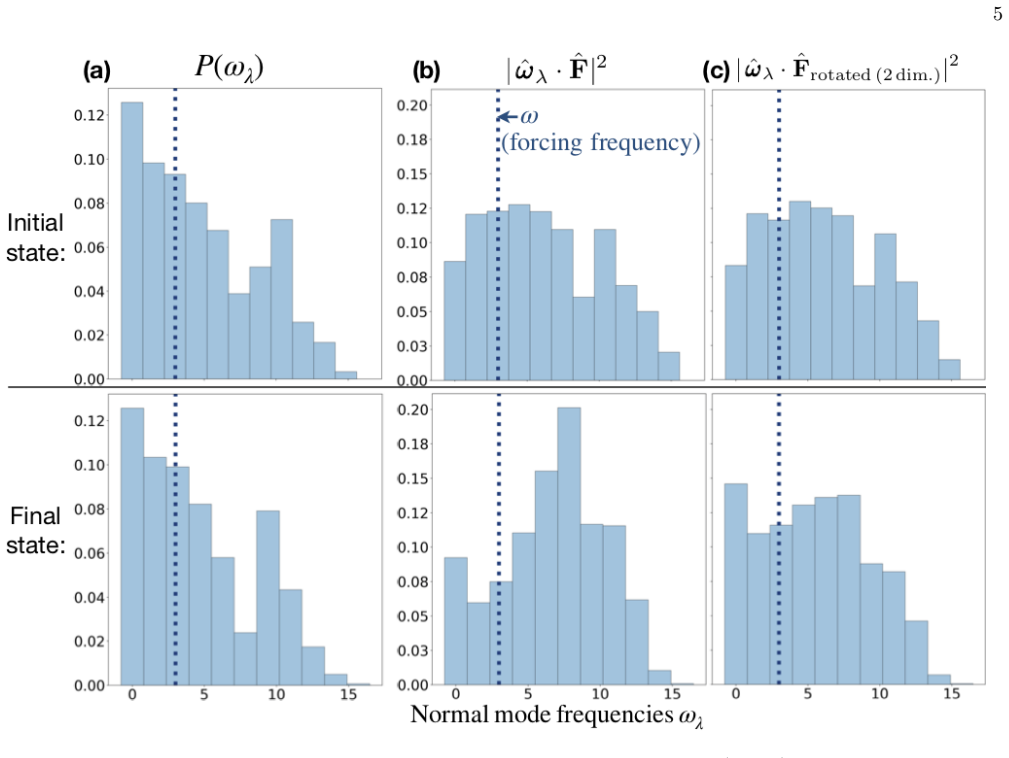
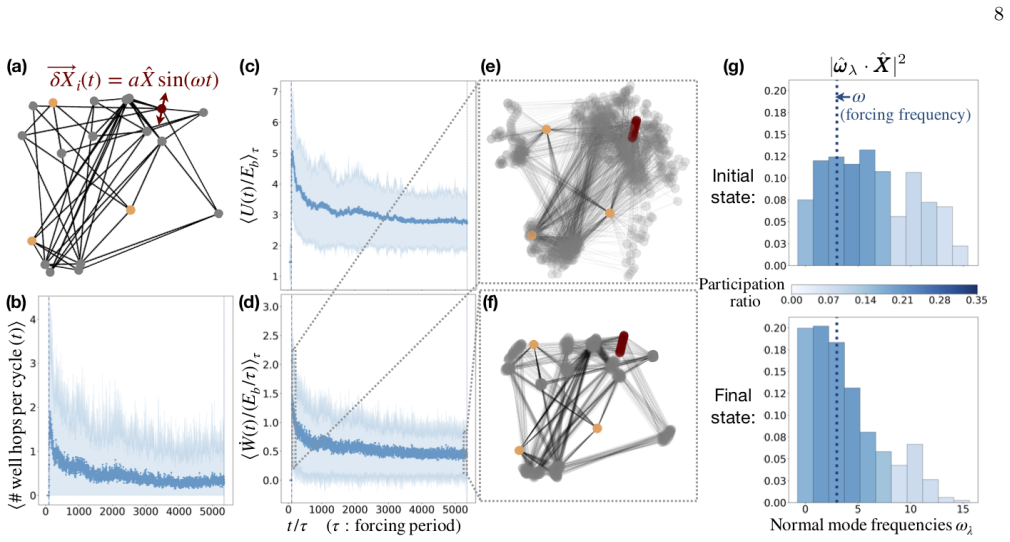
The load-bearing object is the cycle-averaged work absorption rate of a metastable configuration in the linear-response regime, $\langle F \cdot V \rangle_\tau = \frac{\gamma A^2 \omega^2}{2} \sum_{\lambda} \frac{(\hat{F}\cdot\hat{\omega}_\lambda)^2}{m^2(\omega_\lambda^2 - \omega^2)^2 + \gamma^2 \omega^2}$, where $\hat{\omega}_\lambda$ and $\omega_\lambda$ are the normal modes and natural frequencies of the dynamical matrix of the configuration. A configuration absorbs work efficiently when a normal mode lies near the drive frequency $\omega$ and the forcing $\hat{F}$ couples strongly to it. The simulations show that over time the network changes its configuration so that the coupling $(\hat{F}\cdot\hat{\omega}_\lambda)^2$ of modes near resonance drops significantly, while the mode density near resonance is unchanged. The second piece of machinery is contraction analysis, which shows that within a concave-up potential well the damped driven dynamics converge to a single one-dimensional periodic trajectory; this is what makes the discovered state more stable than its work-absorption level alone would predict.
What would settle it
Run the drive-permutation experiment of Fig. 3 on a large ensemble: if the distribution of maximum work absorption rates in the second half is statistically indistinguishable between unchanged-drive and permuted-drive conditions, the attractor states are not drive-specific; likewise, in the Fig. 9 stability protocol, if the original drive does not show a lower escape probability than drives matched in linear-response work absorption, the extra-stability claim fails.
Extended reading notes
Core claim
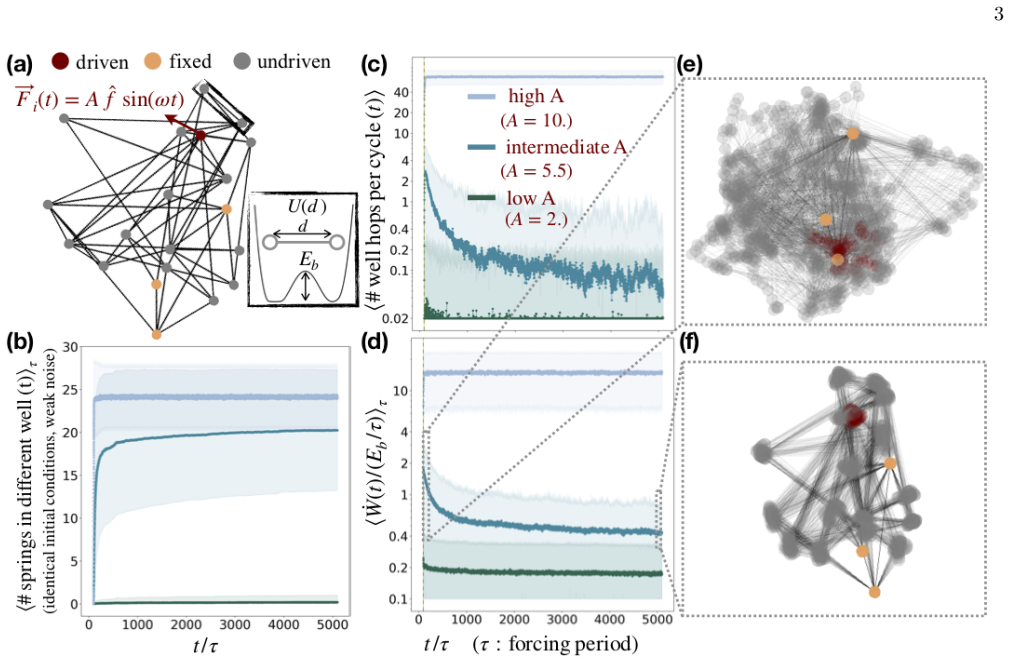
The central discovery is that driven disordered multistable mechanical networks settle into attractor states that are fine-tuned to the external forcing to have low work absorption from it, and these states are even more stable than expected for that level of work absorption. The mechanism is resonant destabilization: configurations with normal modes strongly excited by the drive absorb work efficiently and become unstable, causing the network to hop over energy barriers until it finds a configuration whose normal modes near the drive frequency have weak coupling to the forcing. A normal-mode analysis shows the density of modes near resonance does not change, but the coupling of those modes to the forcing is significantly reduced in the final configuration. In addition, contraction analysis shows that within a potential well the driven motion converges to a one-dimensional periodic orbit, and experiments with drives of equal linear-response work absorption show that the drive that discovered the well is atypically stable because the shape of the trajectory matters, not just the amount of work absorbed.
Load-bearing premise
The claim that the system is permanently trapped in a fine-tuned state rests on the observation that barrier crossings vanish over a few thousand drive cycles, leaving open the possibility that the state would escape on much longer timescales or under a different noise realization.
Editorial extensions
If this is right
- For intermediate forcing amplitudes, the same network with the same initial condition and same drive can settle into different attractors depending on noise, but nearly all have low work absorption from that drive.
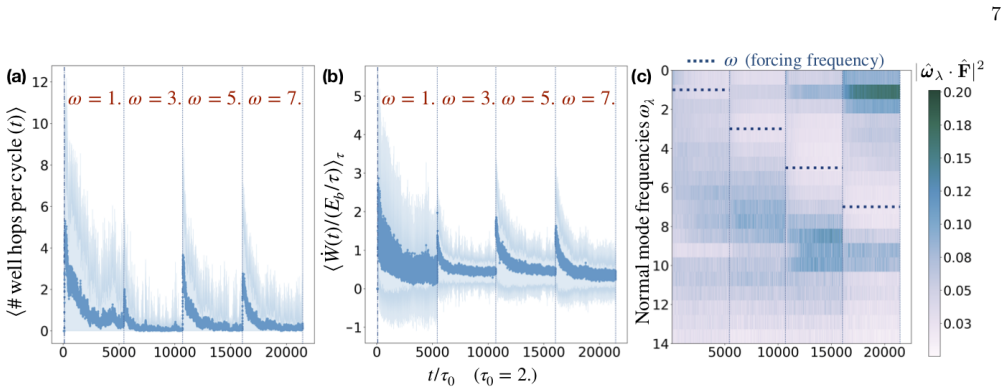
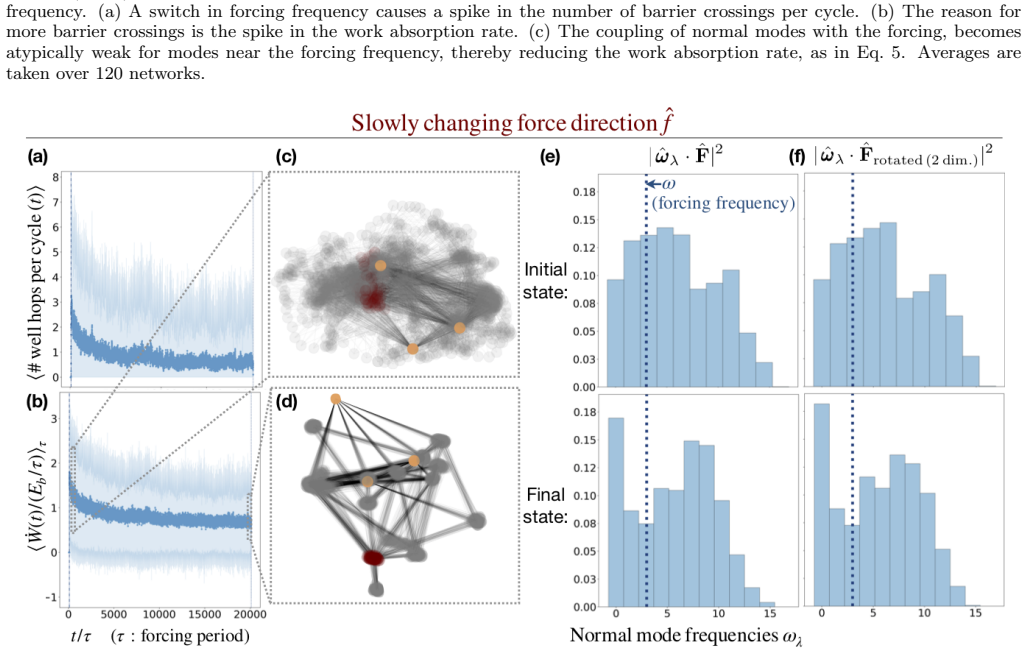
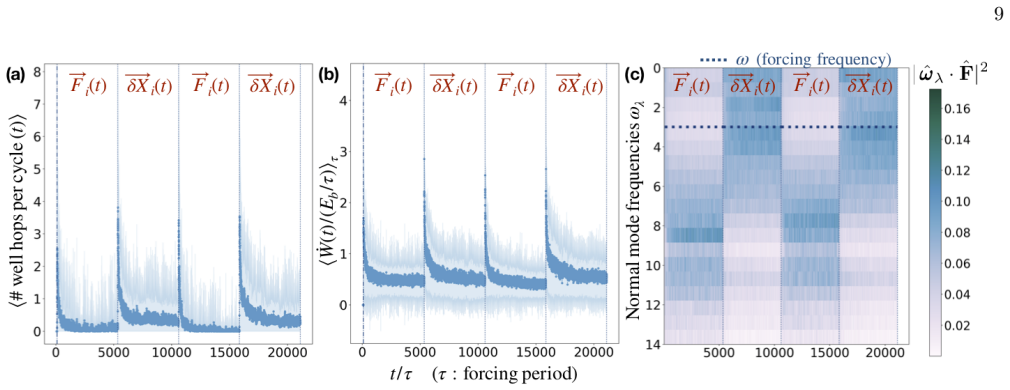
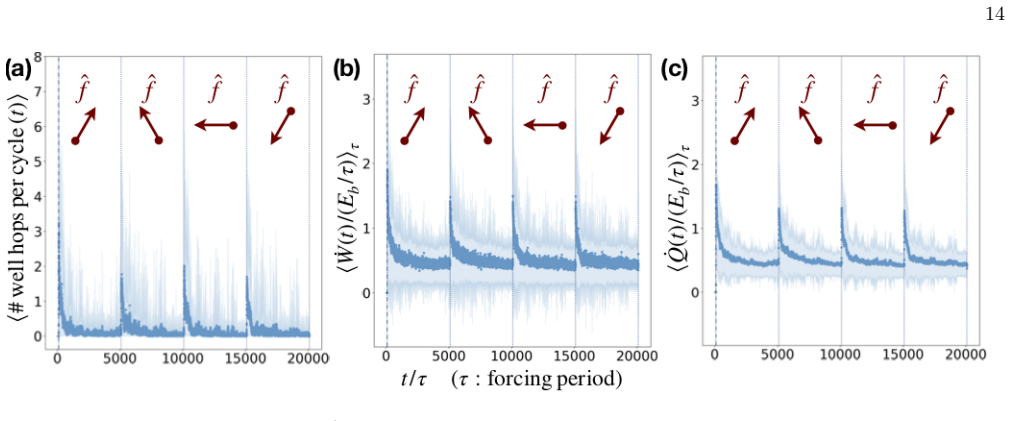
- Switching the drive frequency, direction, or protocol (force versus displacement) causes a spike in work absorption and renewed exploration, ending in a new low-work-absorbing configuration, so the adaptation is reversible and repeatable.
- The final configuration is fine-tuned not only to the drive frequency but also to its direction; a rotated forcing couples more strongly to resonant modes.
- The low-work configurations are more stable than expected for their work-absorption level: at matched work absorption, the original drive escapes the potential well less often than perturbed drives or a thermal bath.
- The mechanism uses generic ingredients (many particles, a rugged landscape, and a diversity of response properties), and the qualitative behavior is reported to be similar across different network topologies.
Reading between the lines
- Inference: A testable extension is to ramp the drive amplitude in small steps after the system settles, which might reveal a cascade of drive-specific states, each stable over a range of amplitudes; the paper does not study amplitude ramps.
- Inference: The mechanism implies a form of 'drive-specific immunity': a network adapted to one drive should be comparatively resistant to that drive but not to other drives of the same power, which could be used to design materials with tunable vibrational response by pre-cycling them under a chosen drive.
- Inference: The normal-mode coupling signature (reduced projection onto resonant modes) could serve as an experimental diagnostic, since measuring the vibrational eigenmodes of a material before and after a period of driving should show the same reduction in coupling near the drive frequency.
Signed reviews
Editorial analysis
A structured set of objections, weighed in public.
Referee Report
Summary. The manuscript studies numerically driven disordered mechanical networks of 20 particles connected by 50 bistable springs, each spring having two stable rest lengths described by a double-well potential. For an intermediate range of forcing amplitudes, the authors observe that after an initial period of barrier crossings the network settles into a metastable configuration with a low cycle-averaged work absorption rate. They argue that this low absorption is drive-specific: permuting drives after half the simulation increases the maximum later-half work absorption (Fig. 3), changing the forcing frequency or direction produces absorption spikes and renewed exploration (Fig. 5 and Appendix Fig. 12), and normal-mode analysis shows reduced coupling between the forcing and near-resonant modes in the selected configurations (Fig. 4). They also report that the selected configurations are more stable against escape under the original drive than under perturbed drives with comparable or higher work absorption (Fig. 9), and they interpret the results as a form of dissipative adaptation: driven exploration of configuration space is biased toward states with atypically low work absorption from the specific drive.
Significance. If the central claim holds, the paper provides a clear numerical demonstration in a generic classical many-body system that drive-specific selection can produce states with atypically low work absorption, extending earlier ideas about dissipative adaptation to deterministic, low-noise, strongly driven multistable mechanical networks. The main strengths are the use of direct control comparisons (unchanged vs. permuted drives, frequency/direction switches) and the normal-mode analysis that identifies a concrete linear-response mechanism (reduced coupling to resonant modes) consistent with Eq. (5). The qualitative conclusion is plausible, and the evidence in Figs. 2, 4, 5, 6, 7, and 9 is mutually consistent. The paper is not circular: work absorption is measured, not defined into the conclusion, and the comparison with permuted drives provides an independent control. The main weakness is that the key quantitative evidence for atypicality rests on a control that may conflate transient response with steady-state attractor selection, and the manuscript omits several simulation parameters needed for reproducibility.
major comments (3)
- [Section III, Fig. 3] The main quantitative evidence for the claim that the selected configurations have atypically low work absorption is the permutation control in Fig. 3. The comparison uses the maximum of the cycle-averaged work absorption rate over the later half of the trajectory, with drives permuted at the midpoint. Because the permutation is a sudden change in forcing frequency and direction, the later half begins with a transient; the paper itself shows in Fig. 5 and Appendix Fig. 12 that such switches produce a large spike in the work absorption rate. The maximum over the entire later half is therefore likely dominated by this transient, so the comparison conflates the transient response to a drive switch with the steady-state absorption of the putative attractor. To support the headline claim, the authors should either discard an initial transient after the permutation and compare late-time average work absorption, or allow the permuted systems to settle into their new attractors before measuring. As it stands, Fig. 3 establishes that a sudden drive change causes a transient absorption increase, but not that the selected states are atypically low absorbers.
- [Sections II and III] The numerical study is not reproducible as written because the double-well potential U(d) is only described by a figure (Fig. 1(a)) and no analytic form is given, and the simulation parameters (mass m, damping gamma, noise strength k_B T, forcing amplitude A, integration timestep, number of drive cycles, and the precise relaxation/ramping protocols used in Section III.B and Fig. 9) are not specified in the text. These details are needed to check the reported results and to understand the claimed range of intermediate amplitudes. The authors should add a complete model specification, including all parameter values and the Verlet integrator settings.
- [Section III (attractor inference)] The inference that the network has reached a stable attractor is based on observing that barrier crossings vanish over a simulation of a few thousand drive cycles (Fig. 2(c) and Fig. 3 caption). The paper does not provide an estimate of the escape time from the selected configurations or a test of their stability under longer runs or different noise realizations. If the low-work-absorbing states are only long-lived metastable states that would eventually escape, the central claim of permanent selection would need to be qualified. The authors should either report escape-time statistics or soften the terminology from 'attractors' to 'long-lived metastable states' where appropriate.
minor comments (5)
- [Fig. 4 caption] The caption phrase 'Density of normal modes, stays unchanged' is ungrammatical; it should be 'Density of normal modes is unchanged'.
- [Eq. (5)] The notation in Eq. (5) is not fully defined in the text; in particular, the relationship between F(t), the 2N-dimensional force vector, and the scalar forcing amplitude A is implicit and should be stated explicitly.
- [Section IV] There is a typo in 'classical many-body systenm' (should be 'system').
- [General] No data or code availability statement is included; for a purely numerical study, providing the code or a clear statement of availability would improve reproducibility.
- [Fig. 3 caption] The caption says 'a few thousand drive cycles' without giving the exact simulation duration; the precise number of cycles is important for assessing the convergence of the trajectories.
Circularity Check
No circularity: the central low-work-absorption result is directly simulated and compared against independent controls.
full rationale
No significant circularity. The central empirical result—that long-time attractors of driven bistable-spring networks absorb atypically little work—is obtained by direct simulation and compared against controls that are not defined into the conclusion: unchanged drives versus drives permuted at the midpoint (Fig. 3), and original drives versus perturbed drives with matched linear-response absorption (Fig. 9(e)). Equation (5), used to interpret the low absorption in terms of normal-mode couplings, is derived from the linearized equations of motion rather than assumed. The paper's own caveat that the transient search is nonlinear and has no linear analog further shows Eq. (5) is an explanatory diagnostic, not the selection mechanism. Citations to prior dissipative-adaptation work by the corresponding author are motivational framing, and the contraction-analysis theorem [44] is an external mathematical result used to describe convergence within a well, not to force the reported attractor statistics. The permutation-control design may contain a transient confound (the second half of a permuted run begins with a sudden drive switch), but that is a validity concern about the control, not a reduction of the prediction to its inputs. No step in the derivation chain is definitionally equivalent to the conclusion.
Assumptions & free parameters
free parameters (4)
- Intermediate forcing amplitude A =
5.5
- Double-well potential U(d) parameters =
not specified
- Damping gamma and noise strength kBT =
not specified
- Drive ensemble (frequencies, directions) =
omega in [1,7]; directions uniform in [0,2pi]
assumptions (5)
- domain assumption Newtonian dynamics with weak damping, weak noise and sinusoidal forcing (Eq. 2) is a faithful model of driven multistable mechanical systems.
- domain assumption The double-well spring potential has two equal-energy minima with different curvatures.
- domain assumption The linear response formula Eq. 5 accurately gives the work absorption rate of the terminal attractor states.
- standard math Contraction analysis guarantees convergence to a single periodic orbit within each potential well (Lohmiller and Slotine, ref 44).
- domain assumption Quenched disorder from Erdos-Renyi connectivity is representative of disordered mechanical networks generally.
Cite this review
Pith. "Pith review of Drive-specific adaptation in disordered mechanical networks of bistable springs." pith.science (2026). https://pith.science/paper/IWFYLNTR
@misc{pith2026190809332,
  author       = {Pith},
  title        = {Pith review of: Drive-specific adaptation in disordered mechanical networks of bistable springs},
  year         = {2026},
  howpublished = {\url{https://pith.science/paper/IWFYLNTR}},
  note         = {Machine review of arXiv:1908.09332}
}
read the original abstract
Systems with many stable configurations abound in nature, both in living and inanimate matter. Their inherent nonlinearity and sensitivity to small perturbations make them challenging to study, particularly in the presence of external driving, which can alter the relative stability of different attractors. Under such circumstances, one may ask whether any clear relationship holds between the specific pattern of external driving and the particular attractor states selected by a driven multistable system. To gain insight into this question, we numerically study driven disordered mechanical networks of bistable springs which possess a vast number of stable configurations arising from the two stable rest lengths of each spring, thereby capturing the essential physical properties of a broad class of multistable systems. We find that the attractor states of driven disordered multistable mechanical networks are fine-tuned with respect to the pattern of external forcing to have low work absorption from it. Furthermore, we find that these drive-specific attractor states are even more stable than expected for a given level of work absorption. Our results suggest that the driven exploration of the vast configuration space of these systems is biased towards states with exceptional relationship to the driving environment, and could therefore be used to `discover' states with desired response properties in systems with a vast landscape of diverse configurations.
Figures


Figures from the paper (11 more)




Reference graph
Works this paper leans on
- [1]
-
[2]
W. Henderson, E. Y. Andrei, M. J. Higgins, and S. Bhat- 13 FIG. 10. Supplement to Fig. 2 of main text. Two-dimensional disordered mechanical networks of bistable springs, generated from Erd¨ os-R` enyi graphs with 20 nodes and 50 edges as in Fig. 2, showing qualitatively different behavior for different forcing amplitudes: low (green), intermediate (blue), ...
-
[3]
Non-equilibrium glass transitions in driven and active matter
Ludovic Berthier and Jorge Kurchan. Non-equilibrium glass transitions in driven and active matter. Nature Physics, 9(5):310–314, May 2013
work page 2013
-
[4]
Nathan C. Keim and Sidney R. Nagel. Generic Transient Memory Formation in Disordered Systems with Noise. Physical Review Letters , 107(1):010603, June 2011
work page 2011
-
[5]
Nathan C. Keim, Joseph D. Paulsen, and Sidney R. Nagel. Multiple transient memories in sheared suspen- sions: Robustness, structure, and routes to plasticity. Physical Review E , 88(3):032306, September 2013
work page 2013
-
[6]
Joseph D. Paulsen, Nathan C. Keim, and Sidney R. Nagel. Multiple Transient Memories in Experiments on Sheared Non-Brownian Suspensions. Physical Review Letters, 113(6):068301, August 2014
work page 2014
-
[7]
R. L. Harne, Z. Wu, and K. W. Wang. Designing and Harnessing the Metastable States of a Modular Metas- tructure for Programmable Mechanical Properties Adap- tation. Journal of Mechanical Design , 138(2):021402– 021402–9, December 2015
work page 2015
-
[8]
John Hertz, Anders Krogh, and Richard G. Palmer. Introduction to the Theory of Neural Computation . Addison-Wesley Longman Publishing Co., Inc., Boston, MA, USA, 1991
work page 1991
Show all 48 references
-
[9]
Stern, H
M. Stern, H. Sompolinsky, and L. F. Abbott. Dynamics of random neural networks with bistable units. Physical Review E, 90(6):062710, December 2014
2014
-
[10]
Multistability in Recurrent Neural Networks
Chang-Yuan Cheng, Kuang-Hui Lin, and Chih-Wen Shih. Multistability in Recurrent Neural Networks. SIAM Journal on Applied Mathematics , 66(4):1301– 1320, 2006
2006
-
[11]
Bacot, S
V. Bacot, S. Perrard, M. Labousse, Y. Couder, and E. Fort. Multistable Free States of an Active Particle from a Coherent Memory Dynamics. Physical Review Letters, 122(10):104303, March 2019
2019
-
[12]
A. N. Pisarchik, Yu. O. Barmenkov, and A. V. Kiryanov. Experimental demonstration of attractor annihilation in a multistable fiber laser. Physical Review E , 68(6):066211, December 2003
2003
-
[13]
A. N. Pisarchik and B. F. Kuntsevich. Control of multi- stability in a directly modulated diode laser. IEEE Jour- nal of Quantum Electronics , 38(12):1594–1598, Decem- ber 2002
2002
-
[14]
The Energy Landscape for the Self-Assembly of a Two- Dimensional DNA Origami Complex
Joshua Fern, Jennifer Lu, and Rebecca Schulman. The Energy Landscape for the Self-Assembly of a Two- Dimensional DNA Origami Complex. ACS Nano , 10(2):1836–1844, February 2016
2016
-
[15]
Multistability and Memory Effect in a Highly Turbulent Flow: Experimental Evidence for a Global Bifurcation
Florent Ravelet, Louis Mari, Arnaud Chiffaudel, and Franois Daviaud. Multistability and Memory Effect in a Highly Turbulent Flow: Experimental Evidence for a Global Bifurcation. Physical Review Letters , 93(16):164501, October 2004
2004
-
[16]
S. B. Power and R. Kleeman. Multiple Equilibria in a Global Ocean General Circulation Model. Journal of Physical Oceanography, 23(8):1670–1681, August 1993
1993
-
[17]
Multiple Convection Patterns and Thermohaline Flow in an Idealized OGCM
Stefan Rahmstorf. Multiple Convection Patterns and Thermohaline Flow in an Idealized OGCM. Journal of Climate, 8(12):3028–3039, December 1995
1995
-
[18]
Attractors and noise: Twin drivers of decisions and multistability
Jochen Braun and Maurizio Mattia. Attractors and noise: Twin drivers of decisions and multistability. Neu- roImage, 52(3):740–751, September 2010
2010
-
[19]
Barnett, Anca Doloc-Mihu, Ronald L
Bris Marin, William H. Barnett, Anca Doloc-Mihu, Ronald L. Calabrese, and Gennady S. Cymbalyuk. High Prevalence of Multistability of Rest States and Bursting in a Database of a Model Neuron. PLOS Computational Biology, 9(3):e1002930, March 2013
2013
-
[20]
Goldberg, C
Aaron D. Goldberg, C. David Allis, and Emily Bern- stein. Epigenetics: A Landscape Takes Shape. Cell, 128(4):635–638, February 2007
2007
-
[21]
Multistability: a major means of differentiation and evolution in biologi- cal systems
Michel Laurent and Nicolas Kellershohn. Multistability: a major means of differentiation and evolution in biologi- cal systems. Trends in Biochemical Sciences, 24(11):418– 422, November 1999
1999
-
[22]
Quan- tifying the Waddington landscape and biological paths for development and differentiation
Jin Wang, Kun Zhang, Li Xu, and Erkang Wang. Quan- tifying the Waddington landscape and biological paths for development and differentiation. Proceedings of the National Academy of Sciences , 108(20):8257–8262, May 2011
2011
-
[23]
Perspective: Identi- fication of collective variables and metastable states of 15 protein dynamics
Florian Sittel and Gerhard Stock. Perspective: Identi- fication of collective variables and metastable states of 15 protein dynamics. The Journal of Chemical Physics , 149(15):150901, October 2018
2018
-
[24]
Thresholds and Multiple Stable States in Coral Reef Community Dynamics
Nancy Knowlton. Thresholds and Multiple Stable States in Coral Reef Community Dynamics. Integrative and Comparative Biology, 32(6):674–682, December 1992
1992
-
[25]
Foley, Carl Folke, and Brian Walker
Marten Scheffer, Steve Carpenter, Jonathan A. Foley, Carl Folke, and Brian Walker. Catastrophic shifts in ecosystems. Nature, 413(6856):591–596, October 2001
2001
-
[26]
Complex dynamics in multistable sys- tems
Ulrike Feudel. Complex dynamics in multistable sys- tems. International Journal of Bifurcation and Chaos , 18(06):1607–1626, June 2008
2008
-
[27]
J. J. Hopfield. Neural networks and physical systems with emergent collective computational abilities. Proceedings of the National Academy of Sciences , 79(8):2554–2558, April 1982
1982
-
[28]
C. C. Canavier, D. A. Baxter, J. W. Clark, and J. H. Byrne. Nonlinear dynamics in a model neuron provide a novel mechanism for transient synaptic inputs to produce long-term alterations of postsynaptic activity. Journal of Neurophysiology, 69(6):2252–2257, June 1993
1993
-
[29]
Keim, Joseph D
Nathan C. Keim, Joseph D. Paulsen, Zorana Zeravcic, Srikanth Sastry, and Sidney R. Nagel. Memory formation in matter. Reviews of Modern Physics, 91(3):035002, July 2019
2019
-
[30]
Adaptive Response of a Gene Network to Environmental Changes by Fitness-Induced Attractor Selection
Akiko Kashiwagi, Itaru Urabe, Kunihiko Kaneko, and Tetsuya Yomo. Adaptive Response of a Gene Network to Environmental Changes by Fitness-Induced Attractor Selection. PLOS ONE , 1(1):e49, December 2006
2006
-
[31]
Fletcher, and R
Peter Bieling, Tai-De Li, Julian Weichsel, Ryan McGorty, Pamela Jreij, Bo Huang, Daniel A. Fletcher, and R. Dy- che Mullins. Force Feedback Controls Motor Activity and Mechanical Properties of Self-Assembling Branched Actin Networks. Cell, 164(1):115–127, January 2016
2016
-
[32]
Mechanical hysteresis in actin networks
Sayantan Majumdar, Louis C.Foucard, Alex J.Levine, and Margaret L.Gardel. Mechanical hysteresis in actin networks. Soft Matter , 14(11):2052–2058, 2018
2018
-
[33]
Liu, and Sid- ney R
Nidhi Pashine, Daniel Hexner, Andrea J. Liu, and Sid- ney R. Nagel. Directed aging, memory and Nature’s greed. arXiv:1903.05776 [cond-mat], March 2019. arXiv: 1903.05776
1903 arXiv
-
[34]
Jeremy L. England. Dissipative adaptation in driven self-assembly. Nature Nanotechnology , 10(11):919–923, November 2015
2015
-
[35]
Marsland, and Jeremy L
Nikolay Perunov, Robert A. Marsland, and Jeremy L. England. Statistical Physics of Adaptation. Physical Re- view X , 6(2):021036, June 2016
2016
-
[36]
Why glass elasticity affects the thermodynamics and fragility of su- percooled liquids
Le Yan, Gustavo Dring, and Matthieu Wyart. Why glass elasticity affects the thermodynamics and fragility of su- percooled liquids. Proceedings of the National Academy of Sciences, 110(16):6307–6312, April 2013
2013
-
[37]
A. N. Pisarchik and B. K. Goswami. Annihilation of One of the Coexisting Attractors in a Bistable System. Phys- ical Review Letters , 84(7):1423–1426, February 2000
2000
-
[38]
A. N. Pisarchik. Controlling the multistability of nonlin- ear systems with coexisting attractors. Physical Review E, 64(4):046203, September 2001
2001
-
[39]
Pisarchik and Ulrike Feudel
Alexander N. Pisarchik and Ulrike Feudel. Control of multistability. Physics Reports , 540(4):167–218, July 2014
2014
-
[40]
B. K. Goswami, S. Euzzor, K. Al Naimee, A. Geltrude, R. Meucci, and F. T. Arecchi. Control of stochastic mul- tistable systems: Experimental demonstration. Physical Review E, 80(1):016211, July 2009
2009
-
[41]
B. K. Goswami. Controlled destruction of chaos in the multistable regime. Physical Review E , 76(1):016219, July 2007
2007
-
[42]
A simple and effective Verlet-type algorithm for simulating Langevin dynamics
Niels Grønbech-Jensen and Oded Farago. A simple and effective Verlet-type algorithm for simulating Langevin dynamics. Molecular Physics , 111(8):983–991, April 2013
2013
-
[43]
Prigogine
I. Prigogine. Etude thermodynamique des phnomnes ir- rversibles. PhD thesis, Brussels Univ, Bruxelles, 1947
1947
-
[44]
Winfried Lohmiller and Jean-Jacques E. Slotine. On Contraction Analysis for Non-linear Systems. Automat- ica, 34(6):683–696, June 1998
1998
-
[45]
End- directed evolution and the emergence of energy-seeking behavior in a complex system
Dilip Kondepudi, Bruce Kay, and James Dixon. End- directed evolution and the emergence of energy-seeking behavior in a complex system. Physical Review E , 91(5):050902(R), May 2015
2015
-
[46]
Owen, and Jeremy L
Tal Kachman, Jeremy A. Owen, and Jeremy L. England. Self-Organized Resonance during Search of a Diverse Chemical Space. Physical Review Letters, 119(3):038001, July 2017
2017
-
[47]
Least-rattling feed- back from strong time-scale separation
Pavel Chvykov and Jeremy England. Least-rattling feed- back from strong time-scale separation. Physical Review E, 97(3):032115, March 2018
2018
-
[48]
Hole-Burning Spectroscopy
Silvia V¨ olker. Hole-Burning Spectroscopy. Annual Re- view of Physical Chemistry , 40(1):499–530, 1989
1989
Reviewed August 14, 2026 · model on record in the stance chip above.
Discussion (0). Continue with ORCID to comment.