REVIEW 3 major objections 6 minor 60 references
A Machine Learning Approach to Generate Residual Stress Distributions using Sparse Characterization Data in Friction-Stir Processed Parts
T0 review · 3 major / 6 minor · reviewed 2026-08-07 · deepseek-v4-flash
Pith's one-line read A U-Net trained on process simulations can reconstruct the full-field residual stress distribution in a friction-stir processed part from only nine measured stress locations.
desk verdict A promising demonstration that U-Net can map sparse stress measurements to full-field residual stress maps, but the experimental error metrics likely include the nine input points, so the central 10x-reduction claim is not yet rigorously quantified. read the letter →
The pith
A machine-rendered reading of the paper's core claim, the machinery that carries it, and where it could break.
The reading
What carries the argument
The carrying object is the Residual Stress Generator: a U-Net with three encoder and three decoder blocks, skip connections, and a final 1×1 convolution, trained on 400 input-output pairs from Thermal Pseudo-Mechanical (TPM) simulations. The input is a 128×128 grid divided into nine sub-regions, each filled with the measured stress value at a predefined sampling location; the output is the 128×128 full residual stress map. The TPM training data come from a moving heat-flux model, $q(r,T)=\zeta\omega r\,\sigma_{\mathrm{yield}}(T)/\sqrt{3}$, with tool speed, rotation speed, and calibration factor $\zeta$ varied over wide ranges, and simulations outside roughly 400–500 °C excluded. The U-Net's encoder-decoder structure with skip connections is what lets a few point values expand into a coherent full field.
What would settle it
Run the trained RSG on a fresh friction-stir sample whose full residual stress field is measured densely, feed only the nine predefined point values, and compare predicted and measured stresses everywhere; the claim fails if overall error is not in the reported range (MAE around 10 MPa, $R^2$ near 0.6) or if systematic overprediction at plunge/exit and 5 mm outside the process zone persists.
Extended reading notes
Core claim
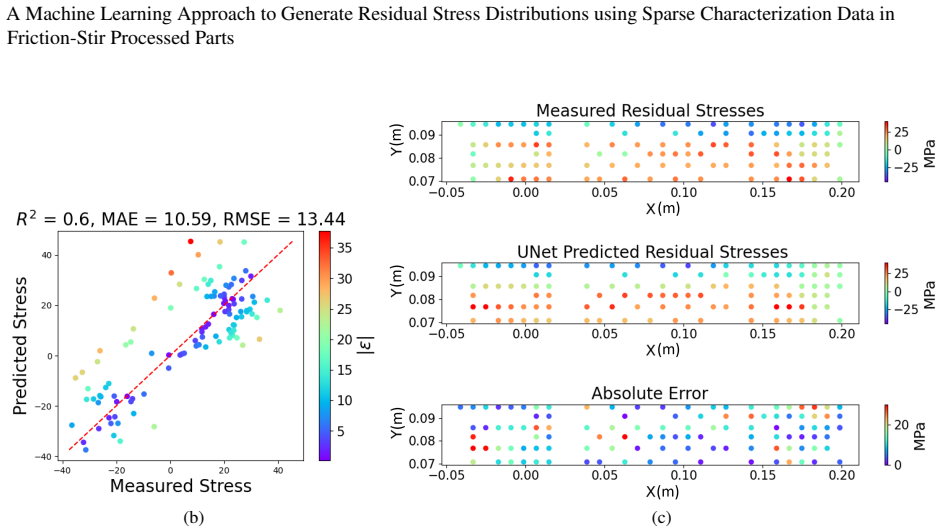
The central claim is that a single U-Net, trained only on simulated friction-stir residual stress fields, can act as a residual stress generator: given the thickness-averaged longitudinal stress at nine predefined locations, it outputs a 128×128 full-field map that matches the true stress field closely enough to replace dense experimental characterization. On simulated test data the generator achieves average RMSE 0.92 MPa and SSI 0.981; on an unseen simulation set it averages RMSE 4.43 MPa; and on an experimental two-pass A380.0 sample it reaches $R^2=0.6$ with $\mathrm{MAE}=10.59$ MPa using only nine input points instead of the 120 measured locations. The paper interprets this as evidence that the model has learned the latent structure of friction-stir residual stress distributions, and that the approach can cut characterization effort by more than an order of magnitude.
Load-bearing premise
The load-bearing premise is that the single-pass Thermal Pseudo-Mechanical simulations, with their fitted calibration factor and steady-state heat-flux assumption, produce residual stress fields faithful enough to the real two-pass friction-stir process that a network trained only on those simulations can generalize to experimental data.
Editorial extensions
If this is right
- Full-field residual stress maps for friction-stir processed sheets can be obtained from nine characterization points rather than roughly 120, a more than 10x reduction in experimental effort.
- The RSG reproduces the qualitative features known for FSP residual stress fields: tensile stresses inside and near the processed zone, highest values at the zone edges, and compressive stresses away from the processed zone.
- On unseen simulation parameter sets the model degrades only moderately (average RMSE 4.43 MPa, SSI 0.85), indicating that the learned mapping generalizes beyond the training parameter grid.
- Experimental prediction errors concentrate in three identifiable regions—plunge/exit, the second-pass start, and 5 mm outside the processed zone—so improving the TPM model in those regions is a direct route to higher accuracy.
Reading between the lines
- The fixed nine-point input grid is an assumption, not a result: a natural next test is whether adaptive or random sensor placements, or fewer than nine points, preserve the reported accuracy.
- Because the network learns the latent structure of a particular simulation family, the same architecture should transfer to other manufacturing processes (welding, casting, additive) provided a comparable set of process simulations exists; the paper does not test this.
- The reported experimental error is computed after nearest-neighbor interpolation from the 128×128 grid to measurement points, so evaluating predictions directly at element centroids could change the error statistics.
- Training on multi-pass simulations or adding plunge/exit-aware heat-source terms would likely remove the largest systematic overpredictions and improve on the experimental $R^2=0.6$.
Editorial analysis
A structured set of objections, weighed in public.
Referee Report
Summary. This paper proposes a U-Net-based Residual Stress Generator (RSG) that maps sparse residual stress measurements at nine predefined locations to a full 128x128 field of thickness-averaged longitudinal residual stress in friction-stir processed aluminum sheets. The model is trained on 400 Thermal Pseudo-Mechanical (TPM) finite-element simulations covering a range of process parameters, tested on 40 held-out simulations, evaluated for generalization on 149 additional simulations outside the training parameter range, and finally applied to a two-pass experimental A380.0 sample on which 120 ESPI hole-drilling measurements were taken. The authors report low errors on simulated fields and MAE=10.59 MPa, RMSE=13.44 MPa, and R2=0.6 on the experimental sample, and conclude that the RSG can replace 120 characterization locations with 9, a more-than-10x reduction in experimental effort.
Significance. If the central claim survives a masked re-evaluation, the approach is practically valuable: it offers a route to full-field residual stress maps from sparse hole-drilling measurements, and the experimental generalization from single-pass simulations to a two-pass sample is a demanding and meaningful test. The paper has clear strengths: a clean supervised learning setup, a separate generalization set, an independent experimental benchmark, and a candid discussion of the sources of the largest errors (plunge/exit modeling, single-pass versus two-pass differences, clamping conditions, and suspected measurement anomalies). However, the quantitative support for the headline 'more than 10x reduction' claim is currently undermined by the evaluation protocol, so the significance is conditional on the requested re-analysis with the input locations excluded from the error metrics.
major comments (3)
- [§3.4, §2.2.3, Table 2] The experimental validation statistics include the nine input locations. The input to the RSG is a 128x128 array in which nine sub-regions are populated with the measured stresses at the predefined sampling locations (Section 2.2.3), and Section 3.4 then reports MAE=10.59 MPa, RMSE=13.44 MPa, and R2=0.6 over the 120 characterized locations without stating that these nine input locations were excluded. Because the model is given the answer at those locations, including them in the error computation conflates memorized input values with genuine predictions. The paper's central claim that 9 measurements replace 120 requires the error on the 111 truly unmeasured locations, and that number is not reported. The same masking issue affects the simulated test metrics in Table 2, where the reference output contains the input sub-regions. Please recompute all reported metrics after excluding the nine input sub-regions, for both the simulated and experimental datasets, and report the errors separately for the input and non-input locations.
- [§3.4, §4] The experimental evaluation does not report measurement uncertainty for the ESPI hole-drilling technique, and it provides no baseline comparison. Without error bars on the measured stresses or repeated measurements, it is difficult to judge whether MAE=10.59 MPa is acceptable predictive accuracy or within experimental noise. In addition, the paper motivates the ML approach by contrasting it with eigenstrain inversion and other sparse-reconstruction methods, but it does not compare the RSG against a simple interpolation baseline (for example, inverse-distance or kriging using the same nine points) or against an eigenstrain inversion on this dataset. Adding measurement uncertainty and at least one baseline would substantially strengthen the claim that the approach significantly reduces experimental effort.
- [§2.1, §3.4, §4] The assumption that a one-pass simulation captures all essential features needed to train the RSG is load-bearing, because the experimental validation is performed on a two-pass sample. Section 2.1 asserts this without supporting evidence, and Section 4 later attributes part of the experimental error to the single-pass versus two-pass difference. Please provide a quantitative assessment of this mismatch, for example by simulating the two-pass configuration or comparing one-pass and two-pass stress fields, or explicitly temper the claim that the RSG predicts the experimental field with the stated accuracy.
minor comments (6)
- [§2.1] The text says 'Two 8-node cuboid temperature-displacement (DC2D4) mesh elements' but DC2D4 is a 4-node two-dimensional element; please correct the element type and description.
- [§3.4] In the sentence describing stress variation in the transverse direction, 'up to 5 m beyond it' should read 'up to 5 mm beyond it'.
- [Table 2] The header 'RSME' should be 'RMSE'.
- [Abstract and keywords] The phrase 'Friction Weld Processing (FSW)' appears to be a typo for 'Friction Stir Welding (FSW)'; please correct it.
- [§3.4] The error percentages are stated twice in slightly different forms ('over 55% of locations' with 'approximately 70% of these' below 6 MPa, later '38.5% of the locations' below 6 MPa); please present the breakdown once, with the base percentages explicit.
- [Data Availability] The data availability statement says data will be made available upon request; providing the trained model and preprocessing code as well would improve reproducibility.
Circularity Check
No significant circularity: the RSG is a learned map from sparse measurements to full fields; the reported experimental error may include input locations, but no prediction is forced by construction.
full rationale
Step-by-step, the claimed chain is: (1) TPM simulations generate residual-stress fields; (2) each field is subsampled at nine points to form the input, with the full field as target; (3) a U-Net is trained to minimize MSE between predicted and reference fields; (4) the trained network is applied to nine measured ESPI values from an independent two-pass A380.0 sample; (5) the full predicted field is compared to 120 measured locations. No equation in the paper defines the output as equal to the input, and no parameter is fitted to the experimental sample. The input is a coarse, nine-block version of the field, and the output is the synthesized high-resolution field; that is the intended inpainting task, not a tautology. The simulation training data do rely on the TPM model and the zeta calibration factor from prior co-author work [1][39], and the one-pass-versus-two-pass mismatch is a fidelity limitation; however, these are not circular because the experimental test is external and the reported degradation (Table 3 versus Table 2, and the Section 4 outlier analysis) shows the model is not memorizing the experiment. The one substantive caveat is that Section 3.4 reports MAE=10.59 MPa, RMSE=13.44 MPa, R2=0.6 over 'the characterization locations' without stating that the nine input locations were excluded; because those nine values are placed directly into the input array, their error contribution is not a pure prediction. This is a test-protocol/statistical limitation that weakens the quantitative 10x-reduction claim, but it is not a circular derivation: the other 111 locations and the full spatial structure are still synthesized by the network. No self-citation chain or uniqueness argument forces the result. Accordingly, no significant circularity is present.
Assumptions & free parameters
free parameters (3)
- Calibration factor zeta (TPM heat flux model) =
0.1 to 0.5 in increments of 0.05 in training simulations; calibrated in prior work
- Film coefficient at backing plate =
1000 W/m^2.C
- Sparse sampling locations (9 coordinates) =
(0.074,0.010), (0.074,0.080), (0.074,0.170), (0.082,0.010), (0.082,0.080), (0.082,0.170), (0.092,0.010)…
assumptions (5)
- domain assumption The Thermal Pseudo-Mechanical (TPM) heat-source model with Equation (1) adequately represents friction stir processing for residual stress simulation.
- domain assumption A single-pass simulation captures the essential features of the two-pass experimental sample's residual stress distribution.
- standard math Grid interpolation of 2839 point-stresses onto a 128x128 grid faithfully preserves the fields.
- domain assumption Symmetry across the processing line allows a half-plate model.
- domain assumption Yield stress values in the Appendix for A380 are accurate inputs.
Cite this review
Pith. "Pith review of A Machine Learning Approach to Generate Residual Stress Distributions using Sparse Characterization Data in Friction-Stir Processed Parts." pith.science (2026). https://pith.science/paper/IWKQVW7F
@misc{pith2026250608205,
  author       = {Pith},
  title        = {Pith review of: A Machine Learning Approach to Generate Residual Stress Distributions using Sparse Characterization Data in Friction-Stir Processed Parts},
  year         = {2026},
  howpublished = {\url{https://pith.science/paper/IWKQVW7F}},
  note         = {Machine review of arXiv:2506.08205}
}
read the original abstract
Residual stresses, which remain within a component after processing, can deteriorate performance. Accurately determining their full-field distributions is essential for optimizing the structural integrity and longevity. However, the experimental effort required for full-field characterization is impractical. Given these challenges, this work proposes a machine learning (ML) based Residual Stress Generator (RSG) to infer full-field stresses from limited measurements. An extensive dataset was initially constructed by performing numerous process simulations with a diverse parameter set. A ML model based on U-Net architecture was then trained to learn the underlying structure through systematic hyperparameter tuning. Then, the model's ability to generate simulated stresses was evaluated, and it was ultimately tested on actual characterization data to validate its effectiveness. The model's prediction of simulated stresses shows that it achieved excellent predictive accuracy and exhibited a significant degree of generalization, indicating that it successfully learnt the latent structure of residual stress distribution. The RSG's performance in predicting experimentally characterized data highlights the feasibility of the proposed approach in providing a comprehensive understanding of residual stress distributions from limited measurements, thereby significantly reducing experimental efforts.
Figures


Figures from the paper (8 more)


Reference graph
Works this paper leans on
- [60]
-
[1]
Kranthi Balusu, Kyoo Sil Choi, Hrishikesh Das, Avik Samanta, Piyush Upadhyay, Saumyadeep Jana, and Ayoub Soulami. On the Utility of the Thermal-Pseudo Mechanical Model’s Residual Stress Prediction Capability for the Development of Friction Stir Processing.The International Journal of Advanced Manufacturing Technology, (0123456789), mar 2023
work page 2023
-
[2]
Baumann, Nilesh Kumar, and Rajiv S
John A. Baumann, Nilesh Kumar, and Rajiv S. Mishra. Residual stresses in friction stir welding residual stresses in friction stir welding. 2014
work page 2014
-
[3]
Carlos Alexandre Pereira De Moraes et al. Residual stress evaluation in api 5l x65 girth welded pipes joined by friction welding and gas tungsten arc welding.Journal of Materials Research and Technology, 8(1):988–95, 2019
work page 2019
-
[4]
R. John, K. V . Jata, and K. Sadananda. Residual stress effects on near-threshold fatigue crack growth in friction stir welds in aerospace alloys.International Journal of Fatigue, 25(9-11):939–48, 2003. 17 A Machine Learning Approach to Generate Residual Stress Distributions using Sparse Characterization Data in Friction-Stir Processed Parts
work page 2003
-
[5]
Vinay Kumar Yadav, Vidit Gaur, and I. V . Singh. Combined effect of residual and mean stresses on fatigue behavior of welded aluminum 2024 alloy.International Journal of Fatigue, 155:2021, September 2022
work page 2024
-
[6]
P. Chantikul, B. R. Lawn, and D. B. Marshall. Micromechanics of flaw growth in static fatigue: Influence of residual contact stresses.Journal of the American Ceramic Society, 64(6):322–25, 1981
work page 1981
-
[7]
W. Woo, Z. Feng, X. L. Wang, and S. A. David. Neutron diffraction measurements of residual stresses in friction stir welding: A review.Science and Technology of Welding and Joining, 16(1):23–32, 2011
work page 2011
Show all 60 references
-
[8]
Angular distortion and through-thickness residual stress distribution in the friction-stir processed 6061-t6 aluminum alloy.Materials Science and Engineering A, 437(1):64–69, 2006
Wanchuck Woo et al. Angular distortion and through-thickness residual stress distribution in the friction-stir processed 6061-t6 aluminum alloy.Materials Science and Engineering A, 437(1):64–69, 2006
2006
-
[9]
Kranthi Balusu, Avik Samanta, Shivakant Shukla, Hrishikesh Das, Piyush Upadhyay, and Saumyadeep Jana. A comparative analysis of residual stresses from friction stir processing of aluminum cast 380 and wrought 7075 alloy sheets : experimental characterization and modeling.The I...
2024
-
[10]
McDowell
Yan Wang and David L. McDowell. Uncertainty quantification in materials modeling. InUncertainty Quantifica- tion in Multiscale Materials Modeling, pages 1–40. Elsevier, 2020
2020
-
[11]
Material flow visualization during friction stir welding using high-speed x-ray imaging
Hemant Agiwal et al. Material flow visualization during friction stir welding using high-speed x-ray imaging. Manufacturing Letters, 34:62–66, 2022
2022
-
[12]
Yuh J. Chao, X. Qi, and W. Tang. Heat transfer in friction stir welding - experimental and numerical studies. Journal of Manufacturing Science and Engineering, Transactions of the ASME, 125(1):138–45, 2003
2003
-
[13]
H. B. Schmidt and J. H. Hattel. Thermal modelling of friction stir welding.Scripta Materialia, 58(5):332–37, 2008
2008
-
[14]
Song and R
M. Song and R. Kovacevic. Thermal modeling of friction stir welding in a moving coordinate system and its validation.International Journal of Machine Tools and Manufacture, 43(6):605–15, 2003
2003
-
[15]
Coupling Smoothed Particle Hydrodynamics With Finite Element Method to Simulate Residual Stresses From Friction Stir Processing
Kranthi Balusu, Lei Li, Kyoo Sil Choi, and Ayoub Soulami. Coupling Smoothed Particle Hydrodynamics With Finite Element Method to Simulate Residual Stresses From Friction Stir Processing. InVolume 9: Mechanics of Solids, Structures, and Fluids; Micro- and Nano-Systems Engineeri...
2022
-
[16]
Escobar, Hrishikesh Das, Shivakant Shukla, Benjamin J
Lei Li, Julian D. Escobar, Hrishikesh Das, Shivakant Shukla, Benjamin J. Schuessler, Nicole R. Overman, Glenn J. Grant, Suveen N. Mathaudhu, Jorge F. Dos Santos, Cynthia A. Powell, and Ayoub Soulami. A dislocation density-based meshfree computational framework for solid phase ...
2024
-
[17]
P. J. Withers and H. K.D.H. Bhadeshia. Residual stress part 1 - Measurement techniques.Materials Science and Technology, 17(4):355–365, 2001
2001
-
[18]
Paul S. Prevey. X-ray diffraction residual stress techniques. InMaterials Characterization. ASM International, 01 1986
1986
-
[19]
The measurement of residual stresses by the incremental hole drilling technique
P V Grant, J D Lord, and P S* Whitehead. The measurement of residual stresses by the incremental hole drilling technique. Measurement good practice guide, National Physical Laboratory (NPL), Teddington, 2006
2006
-
[20]
G. S. Schajer and M. Steinzig. Full-field calculation of hole drilling residual stresses from electronic speckle pattern interferometry data.Experimental Mechanics, 45(6):526–32, 2005
2005
-
[21]
Micromechanics of defects in solids, 1987
Tanaka Mura. Micromechanics of defects in solids, 1987
1987
-
[22]
Jazeel Rahman Chukkan et al. An iterative technique for the reconstruction of residual stress fields in a butt-welded plate from experimental measurement, and comparison with welding process simulation.International Journal of Mechanical Sciences, 160:421–28, July 2019
2019
-
[23]
A. M. Korsunsky. Residual elastic strain due to laser shock peening: Modelling by eigenstrain distribution.The Journal of Strain Analysis for Engineering Design, 41(3):195–204, 2006
2006
-
[24]
Korsunsky
Tea Sung Jun and Alexander M. Korsunsky. Evaluation of residual stresses and strains using the eigenstrain reconstruction method.International Journal of Solids and Structures, 47(13):1678–86, 2010
2010
-
[25]
Finite element analysis and machine learning guided design of carbon fiber organosheet-based battery enclosures for crashworthiness.Applied Composite Materials, 0123456789, 2024
Shadab Anwar Shaikh et al. Finite element analysis and machine learning guided design of carbon fiber organosheet-based battery enclosures for crashworthiness.Applied Composite Materials, 0123456789, 2024
2024
-
[26]
Probabilistic surrogate model for accelerating the design of electric vehicle battery enclosures for crash performance.arXiv preprint arXiv:2408.03450, 2024
Shadab Anwar Shaikh, Harish Cherukuri, Kranthi Balusu, Ram Devanathan, and Ayoub Soulami. Probabilistic surrogate model for accelerating the design of electric vehicle battery enclosures for crash performance.arXiv preprint arXiv:2408.03450, 2024. 18 A Machine Learning Approac...
2024 arXiv
-
[27]
Prediction of composite microstructure stress- strain curves using convolutional neural networks.Materials & Design, 189:108509, 2020
Charles Yang, Youngsoo Kim, Seunghwa Ryu, and Grace X Gu. Prediction of composite microstructure stress- strain curves using convolutional neural networks.Materials & Design, 189:108509, 2020
2020
-
[28]
Stress field prediction in fiber-reinforced composite materials using a deep learning approach.Composites Part B: Engineering, 238:109879, 2022
Anindya Bhaduri, Ashwini Gupta, and Lori Graham-Brady. Stress field prediction in fiber-reinforced composite materials using a deep learning approach.Composites Part B: Engineering, 238:109879, 2022
2022
-
[29]
Data-driven methods for stress field predictions in random heterogeneous materials.Engineering Applications of Artificial Intelligence, 123:106267, 2023
Enjamamul Hoq, Osama Aljarrah, Jun Li, Jing Bi, Alfa Heryudono, and Wenzhen Huang. Data-driven methods for stress field predictions in random heterogeneous materials.Engineering Applications of Artificial Intelligence, 123:106267, 2023
2023
-
[30]
Improved deep learning method for accurate flow field reconstruction from sparse data.Ocean Engineering, 280:114902, 2023
Jinsong Zhang, Jian Liu, and Zhenwei Huang. Improved deep learning method for accurate flow field reconstruction from sparse data.Ocean Engineering, 280:114902, 2023
2023
-
[31]
Robust flow reconstruction from limited measurements via sparse representation.Physical Review Fluids, 4(10):103907, 2019
Jared L Callaham, Kazuki Maeda, and Steven L Brunton. Robust flow reconstruction from limited measurements via sparse representation.Physical Review Fluids, 4(10):103907, 2019
2019
-
[32]
A practical approach to flow field reconstruction with sparse or incomplete data through physics informed neural network.Acta Mechanica Sinica, 39(3):322302, 2023
Shengfeng Xu, Zhenxu Sun, Renfang Huang, Dilong Guo, Guowei Yang, and Shengjun Ju. A practical approach to flow field reconstruction with sparse or incomplete data through physics informed neural network.Acta Mechanica Sinica, 39(3):322302, 2023
2023
-
[33]
Fully convolutional networks for semantic segmentation
Evan Shelhamer, Jonathan Long, and Trevor Darrell. Fully convolutional networks for semantic segmentation. IEEE Transactions on Pattern Analysis and Machine Intelligence, 39(4):640–51, 2017
2017
-
[34]
U-net: Convolutional networks for biomedical image segmentation
Olaf Ronneberger, Philipp Fischer, and Thomas Brox. U-net: Convolutional networks for biomedical image segmentation. InMedical image computing and computer-assisted intervention–MICCAI 2015: 18th international conference, Munich, Germany, October 5-9, 2015, proceedings, part I...
2015
-
[35]
High-resolution image synthesis with latent diffusion models
Robin Rombach, Andreas Blattmann, Dominik Lorenz, Patrick Esser, and Björn Ommer. High-resolution image synthesis with latent diffusion models. InProceedings of the IEEE/CVF conference on computer vision and pattern recognition, pages 10684–10695, 2022
2022
-
[36]
Schmidt and J
H. Schmidt and J. Hattel. A local model for the thermomechanical conditions in friction stir welding.Modelling and Simulation in Materials Science and Engineering, 13(1):77–93, 2005
2005
-
[37]
H. B. Schmidt and J. H. Hattel. Thermal modelling of friction stir welding.Scripta Materialia, 58(5):332–337, 2008
2008
-
[38]
Abaqus 6.14 CAE User Guide
Dassault Systèmes Simulia. Abaqus 6.14 CAE User Guide. page 1146, 2014
2014
-
[39]
On the utility of the thermal-pseudo mechanical model ’ s residual stress prediction capability for the development of friction stir processing on the utility of the thermal
Kranthi Balusu et al. On the utility of the thermal-pseudo mechanical model ’ s residual stress prediction capability for the development of friction stir processing on the utility of the thermal. 2022
2022
-
[40]
P. L. Threadgilll, A. J. Leonard, H. R. Shercliff, and P. J. Withers. Friction stir welding of aluminium alloys. International Materials Reviews, 54(2):49–93, 2009
2009
-
[41]
Denseunet: densely connected unet for electron microscopy image segmentation.IET Image Processing, 14(12):2682–2689, 2020
Yue Cao, Shigang Liu, Yali Peng, and Jun Li. Denseunet: densely connected unet for electron microscopy image segmentation.IET Image Processing, 14(12):2682–2689, 2020
2020
-
[42]
Visual geometry group-unet: deep learning ultrasonic image reconstruction for curved parts.The Journal of the Acoustical Society of America, 149(5):2997–3009, 2021
Yujian Mei, Haoran Jin, Bei Yu, Eryong Wu, and Keji Yang. Visual geometry group-unet: deep learning ultrasonic image reconstruction for curved parts.The Journal of the Acoustical Society of America, 149(5):2997–3009, 2021
2021
-
[43]
Oliphant, Matt Haberland, Tyler Reddy, David Cournapeau, Evgeni Burovski, Pearu Peterson, Warren Weckesser, Jonathan Bright, Stéfan J
Pauli Virtanen, Ralf Gommers, Travis E. Oliphant, Matt Haberland, Tyler Reddy, David Cournapeau, Evgeni Burovski, Pearu Peterson, Warren Weckesser, Jonathan Bright, Stéfan J. van der Walt, Matthew Brett, Joshua Wilson, K. Jarrod Millman, Nikolay Mayorov, Andrew R. J. Nelson, E...
2020
-
[44]
Seth T Strayer, William J Frieden Templeton, Florian X Dugast, Sneha P Narra, and Albert C To. Accelerating high-fidelity thermal process simulation of laser powder bed fusion via the computational fluid dynamics imposed finite element method (cifem).Additive Manufacturing Let...
2022
-
[45]
A deep learning approach for the velocity field prediction in a scramjet isolator.Physics of Fluids, 33(2), 2021
Chen Kong, Juntao Chang, Yunfei Li, and Ziao Wang. A deep learning approach for the velocity field prediction in a scramjet isolator.Physics of Fluids, 33(2), 2021
2021
-
[46]
Topology optimization using super- resolution image reconstruction methods.Advances in Engineering Software, 177:103413, 2023
Seunghye Lee, Qui X Lieu, Thuc P V o, Joowon Kang, and Jaehong Lee. Topology optimization using super- resolution image reconstruction methods.Advances in Engineering Software, 177:103413, 2023
2023
-
[47]
Image quality metrics: Psnr vs
Alain Hore and Djemel Ziou. Image quality metrics: Psnr vs. ssim. In2010 20th international conference on pattern recognition, pages 2366–2369. IEEE, 2010. 19 A Machine Learning Approach to Generate Residual Stress Distributions using Sparse Characterization Data in Friction-S...
2010
-
[48]
Multiscale structural similarity for image quality assessment
Zhou Wang, Eero P Simoncelli, and Alan C Bovik. Multiscale structural similarity for image quality assessment. InThe Thrity-Seventh Asilomar Conference on Signals, Systems & Computers, 2003, volume 2, pages 1398–1402. Ieee, 2003
2003
-
[49]
Martín Abadi, Ashish Agarwal, Paul Barham, Eugene Brevdo, Zhifeng Chen, Craig Citro, Greg S. Corrado, Andy Davis, Jeffrey Dean, Matthieu Devin, Sanjay Ghemawat, Ian Goodfellow, Andrew Harp, Geoffrey Irving, Michael Isard, Yangqing Jia, Rafal Jozefowicz, Lukasz Kaiser, Manjunat...
2015
-
[50]
Ma- chine learning–accelerated computational fluid dynamics.Proceedings of the National Academy of Sciences, 118(21):e2101784118, 2021
Dmitrii Kochkov, Jamie A Smith, Ayya Alieva, Qing Wang, Michael P Brenner, and Stephan Hoyer. Ma- chine learning–accelerated computational fluid dynamics.Proceedings of the National Academy of Sciences, 118(21):e2101784118, 2021
2021
-
[51]
Grant, and Saumyadeep Jana
Avik Samanta, Hrishikesh Das, Glenn J. Grant, and Saumyadeep Jana. Effect of tool design and pass strategy on defect elimination and uniform, enhanced tensile properties of friction stir processed high-pressure die-cast A380 alloy.Materials Science and Engineering: A, 861(Octo...
2022
-
[52]
Residual Stress Measurement by ESPI Hole-Drilling.Procedia CIRP, 45:203–206, 2016
Theo Rickert. Residual Stress Measurement by ESPI Hole-Drilling.Procedia CIRP, 45:203–206, 2016
2016
-
[53]
Steinzig and T
M. Steinzig and T. Takahashi. Residual stress measurement using the hole drilling method and laser speckle interferometry part III: Analysis Technique.Experimental Techniques, 27(6):59–63, 2003
2003
-
[54]
G. S. Schajer. Application of Finite Element Calculations to Residual Stress Measurements.Journal of Engineering Materials and Technology, 103(2):157–163, apr 1981
1981
-
[55]
G. S. Schajer. Full-field Calculation of Hole Drilling Residual Stresses from Electronic Speckle Pattern Interfer- ometry Data.Experimental Mechanics, 45(6):526–532, dec 2005
2005
-
[56]
Steinzig and E
M. Steinzig and E. Ponslet. RESIDUAL STRESS MEASUREMENT USING THE HOLE DRILLING METHOD AND LASER SPECKLE INTERFEROMETRY: PART 1.Experimental Techniques, 27(3):43–46, may 2003
2003
-
[57]
Schönberger, Juan Nunez-Iglesias, François Boulogne, Joshua D
Stéfan van der Walt, Johannes L. Schönberger, Juan Nunez-Iglesias, François Boulogne, Joshua D. Warner, Neil Yager, Emmanuelle Gouillart, Tony Yu, and the scikit-image contributors. scikit-image: image processing in Python.PeerJ, 2:e453, 6 2014
2014
-
[58]
Kranthi Balusu, Hrishikesh Das, Shivakant Shukla, Ayoub Soulami, and Piyush Upadhyay. Investigating strength increasing modifications to a friction stir welded AA7075 T-peel joint’s exit location: a modeling led study.The International Journal of Advanced Manufacturing Technol...
2024
-
[59]
Reinforcing the Exit Hole from Friction Stir Welding and Processing.SSRN Electronic Journal, 26(August):101611, 2022
Tianhao Wang, Tingkun Liu, Timothy Roosendaal, and Piyush Upadhyay. Reinforcing the Exit Hole from Friction Stir Welding and Processing.SSRN Electronic Journal, 26(August):101611, 2022
2022
Reviewed August 7, 2026 · model on record in the stance chip above.
Discussion (0). Sign in to comment.