REVIEW 3 major objections 5 minor 163 references
Properties of a kaon-condensed phase in hyperon-mixed matter with three-baryon forces
T0 review · 3 major / 5 minor · reviewed 2026-08-12 · deepseek-v4-flash
Pith's one-line read A hadronic phase containing both a kaon condensate and hyperons can still support neutron stars as massive as 2.2 solar masses, provided a universal three-baryon repulsion stiffens the high-density equation of state.
desk verdict Careful extension of the group's earlier kaon-hyperon EOS work, but the abstract's 2.1–2.2 Msun consistency claim partly rests on acausal Mmax branches and should be reined in. read the letter →
The pith
A machine-rendered reading of the paper's core claim, the machinery that carries it, and where it could break.
The reading
What carries the argument
The central machinery is the coupled field theory for the ($Y$+$K$) phase: an effective chiral $SU(3)_L \times SU(3)_R$ Lagrangian with a classical kaon field $K^\pm = (f/\sqrt{2})\theta e^{\pm i\mu_K t}$, where $\theta$ is the chiral angle and $\mu_K$ the kaon chemical potential, joined to a minimal relativistic mean-field baryon sector with $\sigma$, $\sigma^*$, $\omega$, $\rho$, and $\phi$ meson exchanges. Three-baryon forces enter as density-dependent effective two-body potentials: the universal three-baryon repulsion in the SJM2 string-junction form $U_{\rm SJM2}(r;\rho_B)=V_r\rho_B(1+c_r\rho_B/\rho_0)\exp[-(r/\lambda_r)^2]$ and a phenomenological three-nucleon attraction. Kaon condensation sets in where the lowest $K^-$ energy $\omega_K(\rho_B)$ equals the charge chemical potential $\mu$, and the competition between kaons and hyperons is carried by the $V$-spin charge combination $X_0 = (2f^2)^{-1}(\rho_p + \rho_n/2 - \rho_{\Sigma^-}/2 - \rho_{\Xi^-})$ that controls the $s$-wave vector attraction and by the kaon-baryon $\sigma$ terms $\Sigma_{Kb}$ that control the scalar attraction.
What would settle it
Re-solve the TOV equations with the same model but with the three-baryon repulsion computed from lattice QCD or chiral effective field theory rather than assumed universal; if the maximum gravitational mass drops below 2.08 solar masses, the paper's central claim fails.
Extended reading notes
Core claim
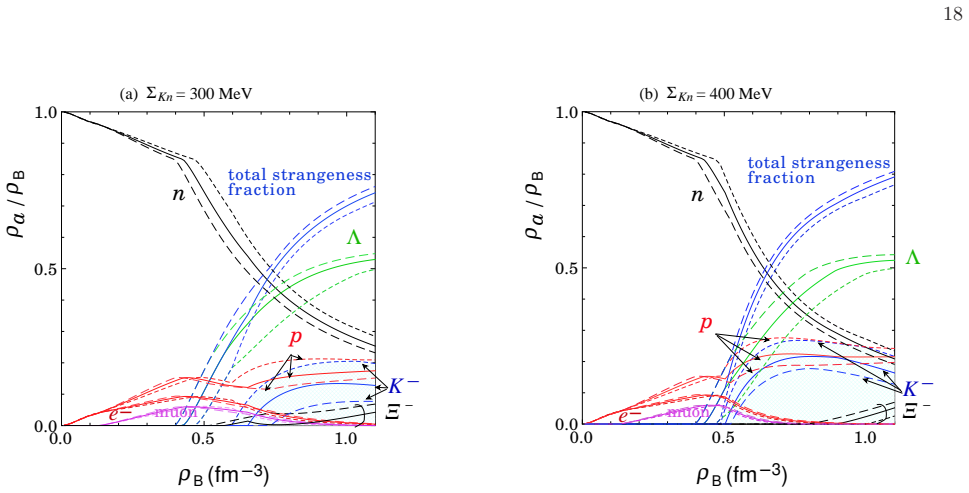
On the paper's own terms, the central claim is that the long-expected softening from kaon condensation and hyperon mixing can be compensated by two repulsive mechanisms acting together: the slope $L$ of the symmetry energy controls the two-baryon repulsion from vector-meson exchange beyond saturation, and the universal three-baryon repulsion adds a strong, flavor-blind repulsion at high baryon densities. In the resulting ($Y$+$K$) phase, $\Lambda$ hyperons always appear before kaon condensation, and their presence weakens the kaon-nucleon vector attraction; as a consequence the onset density of kaon condensation rises with $L$, and the $s$-wave kaon-baryon scalar attraction is self-suppressed as baryon effective masses drop. Once these effects are included, the equation of state stays stiff enough that for $L=65$ and $70$ MeV the maximum neutron-star mass reaches 2.12 to 2.20 solar masses, and the mass-radius branches are compatible with the massive-pulsar observations. The author also finds that a 2.0-solar-mass star can have a substantial ($Y$+$K$) core, while a 1.4-solar-mass star's core contains only nucleons and leptons.
Load-bearing premise
The load-bearing premise is that the three-baryon repulsion acts with equal strength among all baryon species, with the specific SJM2 form and parameters ($V_r=95$ MeV fm$^3$, $c_r=0.024$, $\lambda_r=0.86$ fm), so that if this repulsion is weaker or flavor-dependent, the high-density softening from hyperons and kaons may not be compensated and the two-solar-mass conclusion fails.
Editorial extensions
If this is right
- For $L=65$ and $70$ MeV, the ($Y$+$K$)-phase equation of state gives maximum neutron-star masses of 2.12 and 2.20 solar masses for $\Sigma_{Kn}=300$ MeV, and 2.08 and 2.16 solar masses for $\Sigma_{Kn}=400$ MeV.
- The mass-radius curves for these cases pass through the observed constraints on PSR J0740+6620 and PSR J1810+1744, so the phase is compatible with the most massive known pulsars.
- In all cases $\Lambda$ hyperons appear before kaon condensation, and a larger symmetry-energy slope $L$ raises the kaon-condensation onset density because abundant hyperons suppress the kaon-nucleon vector attraction.
- A 2.0-solar-mass neutron star can contain a sizable ($Y$+$K$) core with radius up to about 6.8 km for $L=65$ MeV and $\Sigma_{Kn}=400$ MeV, while a 1.4-solar-mass star's core contains only nucleons and leptons.
- The model's equation of state violates causality above $\rho_B \approx 1.03$ fm$^{-3}$ for $L=60$ and $65$ MeV before the maximum mass is reached, indicating the need for an improved Lorentz-scalar three-baryon repulsion or a transition to quark matter at high density.
Reading between the lines
- If the universality of the three-baryon repulsion is not confirmed by microscopic calculations, the same framework with flavor-dependent three-body forces would likely bring the maximum mass back below 2 solar masses, making the coexistence claim testable against lattice QCD and chiral effective field theory.
- The predicted nearly lepton-free ($Y$+$K$) core and the kaon-induced Urca process imply distinctive rapid cooling; comparing predicted cooling curves with surface temperatures of massive neutron stars could indirectly confirm or exclude the phase.
- The self-suppression of the kaon-baryon scalar attraction suggests that kaon condensation develops gradually rather than as a strong first-order transition, so future gravitational-wave tidal-deformability measurements could distinguish this scenario from models with abrupt phase transitions.
- Because the causal limit coincides with the density at which baryon repulsive cores touch, a natural completion of the model is a smooth crossover to quark matter near $\rho_B \sim 5\rho_0$, which would preserve the two-solar-mass result while restoring causality.
Editorial analysis
A structured set of objections, weighed in public.
Referee Report
Summary. This paper studies the coexistence of kaon condensates and hyperons (the (Y+K) phase) in beta-equilibrated, charge-neutral neutron-star matter, using an effective chiral Lagrangian for kaon-baryon and kaon-kaon interactions combined with a minimal relativistic mean-field baryon interaction, a universal three-baryon repulsion (UTBR), and a phenomenological three-nucleon attraction (TNA). The author derives the mean-field ground-state equations, fixes the meson couplings to nuclear saturation properties and hypernuclear potential depths, and scans the symmetry-energy slope L=60, 65, 70 MeV and the kaon-nucleon sigma term Sigma_Kn=300, 400 MeV. The resulting equations of state are used to compute particle compositions, onset densities, sound speeds, mass-radius relations, and density profiles. The central claim is that the (Y+K) EOS becomes stiff enough for L=65 and 70 MeV to be consistent with massive pulsar and NICER constraints, with maximum masses of about 2.08-2.20 solar masses.
Significance. The paper is a serious, falsifiable phenomenological construction: it states the full mean-field and ground-state equations, includes both electrons and muons, compares the UTBR+TNA saturation mechanism with the NLSI alternative, and gives concrete M-R and density-profile predictions. The explicit self-criticism in Sec. IX concerning the universality of the UTBR and the causality limit is a strength. However, the headline claim is currently oversold: for L=60 and L=65 MeV the quoted maximum masses are reached after the model's own sound speed has exceeded the speed of light, so those Table IV entries cannot be used as evidence for the two-solar-mass statement. Only the L=70 cases are causal at the maximum-mass point, and they do support the claim; the L=65 cases need to be re-evaluated by truncating the TOV integration at the causal limit.
major comments (3)
- [Sec. VII C; Tables III and IV] Section VII C states that the sound speed exceeds c beyond rho_B = 1.03 fm^-3 and that for L=60 and L=65 MeV this happens before the maximum mass is reached. Nevertheless Table III reports rho_B,center(Mmax)=1.07 fm^-3 (L=65, Sigma_Kn=300) and 1.16 fm^-3 (L=65, Sigma_Kn=400), and Table IV lists Mmax=2.124 and 2.076 Msun for those configurations. An EOS with v_s>c cannot be integrated through the acausal region, so these Mmax entries are not admissible evidence for compatibility with PSR J0740+6620 or PSR J1810+1744. Please compute the TOV mass evaluated at the highest central density where the causality condition is satisfied, report that truncated mass for every L and Sigma_Kn, mark the acausal entries in Table IV, and use the truncated values in the abstract and in the Sec. VIII A compatibility statements. The L=65 truncated masses may still clear 2.08 Msun, but that must be shown explicitly.
- [Sec. III B, Eq. (23); Sec. IX] The high-density stiffening that drives the conclusion that the (Y+K) phase supports roughly 2.1 Msun stars is dominated by the UTBR potential USJM2 of Eq. (23), with V_r=95 MeV fm^3, c_r=0.024, and lambda_r=0.86 fm, and by the assumption that this repulsion acts universally among NNN, YNN, and YYY triplets. Since Sec. IX itself states that the universality should be tested against chiral effective field theory, quark models, and lattice QCD, the manuscript needs a sensitivity study that varies the UTBR strength (or suppresses the hyperonic three-baryon components) and reports the resulting changes in Mmax and in the NICER compatibility. Without such a test, the quantitative two-solar-mass claim is contingent on an unquantified and explicitly acknowledged model assumption.
- [Abstract and Sec. VIII A] The abstract's unconditional statement that the EOS with the (Y+K) phase 'becomes stiff enough to be consistent with recent observations of massive neutron stars' is too strong given the paper's own causality analysis. The causal part of the L=70 branch is sufficient to support the claim, but the L=65 branch is not presented in a way that separates the causal and acausal parts of the M-R and M-rho_B,center curves. Please restrict all mass consistency statements to the causal portion of each branch or add an explicit statement that the quoted Mmax for L=65 and L=60 are formal maxima of an acausal extension and are not observational evidence.
minor comments (5)
- [Table III] In the row for L=70 MeV and Sigma_Kn=400 MeV, the value of rho_c_B(Xi^- in Lambda) is given as "(0.516)" in parentheses; this convention is not explained and should be defined in the caption or removed.
- [Sec. VII C] The word "chracteristic" in the discussion of oscillation modes should read "characteristic".
- [Eq. (43)] The chemical equilibrium relations are written with mu_e throughout; because muons are included, the paper should state explicitly that mu_e = mu_mu in beta equilibrium, or write the muon relations separately.
- [Reference [54]] Reference [54] gives Phys. Rev. D 100, 02315 (2019); the standard article number appears to be 023015 and should be corrected.
- [Fig. 14] The asterisk marking the direct Urca threshold is described only in the text; adding a legend entry would make the figure self-contained.
Circularity Check
No circularity: model parameters are fixed by external nuclear/hypernuclear inputs, and the neutron-star predictions are checked against independent NICER and pulsar observations.
full rationale
The derivation is self-contained and non-circular. The baryon-interaction parameters are fixed by saturation properties (B0 = 16.3 MeV, K0 = 240 MeV, S0 = 31.5 MeV) and chosen values of L in its empirical range; hyperon couplings follow from hypernuclear potential depths (V_Y^N); kaon parameters are fixed by on-shell K-N scattering lengths (Appendix X B). The UTBR and TNA are adopted from independent phenomenological models (SJM2 and NTH/LP), not fitted to neutron-star masses. The resulting EOS is then integrated with the TOV equation and compared with external NICER and pulsar constraints, which were not used to determine the model constants. The paper's admitted causal-limit violation for L = 60 and 65 MeV is a physical consistency caveat, not a circular step, and the abstract's strongest claim should be read as restricted to the causal part of the branch. Self-citations to previous works by the author are present, but they are historical or provide details of coupling estimation; the load-bearing equations and comparisons are given in this paper and rest on external data and observations.
Assumptions & free parameters
free parameters (7)
- TNA parameters gamma_a and eta_a =
gamma_a = -1662.63, -1597.67, -1585.48 MeV fm^6 and eta_a = 17.18, 18.25, 19.82 fm^3 for L = 60, 65, 70 MeV
- Meson-nucleon coupling constants g_sigmaN, g_omegaN, g_rhoN =
For L = 60, 65, 70 MeV: g_sigmaN = 5.27, 5.71, 6.07; g_omegaN = 8.16, 9.07, 9.77; g_rhoN = 3.29, 3.35, 3.41
- K-neutron sigma term Sigma_Kn =
300 MeV and 400 MeV
- UTBR parameters V_r, c_r, lambda_r =
V_r = 95 MeV fm^3, c_r = 0.024, lambda_r = 0.86 fm
- Hyperon scalar couplings via potential depths =
V_N(Lambda) = -27 MeV, V_N(Sigma-) = 23.5 MeV, V_N(Xi-) = -14 MeV
- g_sigma*Lambda, g_sigma*Xi-, g_sigma*Sigma- =
7.2, 4.0, 0
- K-N range and Lambda(1405) parameters =
g_Lambda* = 0.583, gamma_Lambda* = 12.4 MeV, d_p = 0.351 - Sigma_Kp/m_K, d_n = 0.130 - Sigma_Kn/m_K
assumptions (8)
- domain assumption The kaon-baryon and kaon-kaon interactions are described by the effective chiral SU(3)_L x SU(3)_R Lagrangian in the mean-field approximation.
- domain assumption The kaon condensate is spatially uniform with spatial momentum k = 0.
- domain assumption Baryon-baryon interactions are described by minimal relativistic mean-field theory with only sigma, sigma*, omega, rho, and phi exchange, without nonlinear self-interacting meson terms.
- ad hoc to paper The universal three-baryon repulsion acts identically among nucleons and hyperons with the SJM2 density-dependent potential.
- domain assumption The three-nucleon attraction has the Nishizaki-Takatsuka-Hiura density-dependent form with isospin dependence.
- domain assumption The ground state is in beta equilibrium with neutrinos free, with charge neutrality and baryon number conservation imposed.
- domain assumption Meson mean fields and the classical kaon field are uniform and depend only on total baryon density.
- standard math Neutron star structure follows the Tolman-Oppenheimer-Volkoff equations with a low-density crust from Baym-Pethick-Sutherland.
invented entities (1)
-
Universal three-baryon repulsion (UTBR), SJM2 form
Cite this review
Pith. "Pith review of Properties of a kaon-condensed phase in hyperon-mixed matter with three-baryon forces." pith.science (2026). https://pith.science/paper/IWOK4V54
@misc{pith2026241109967,
  author       = {Pith},
  title        = {Pith review of: Properties of a kaon-condensed phase in hyperon-mixed matter with three-baryon forces},
  year         = {2026},
  howpublished = {\url{https://pith.science/paper/IWOK4V54}},
  note         = {Machine review of arXiv:2411.09967}
}
abstract
Coexistent phase of kaon condensates and hyperons [($Y$+$K$) phase] in beta equilibrium with electrons and muons is investigated as a possible form of dense hadronic phase with multi-strangeness. The effective chiral Lagrangian for kaon-baryon and kaon-kaon interactions is utilized within chiral symmetry approach in combination with the interaction model between baryons. For the baryon-baryon interactions, we adopt the minimal relativistic mean-field theory with exchange of scalar mesons and vector mesons between baryons without including the nonlinear self-interacting meson field terms. In addition, the universal three-baryon repulsion and the phenomenological three-nucleon attraction are introduced as density-dependent effective two-body potentials. The repulsive effects leading to stiff equation of state at high densities consist of both the two-baryon repulsion via the vector-meson exchange and the universal three-baryon repulsion. Interplay of kaon condensates with hyperons through chiral dynamics in dense matter is clarified, and resulting onset mechanisms of kaon condensation in hyperon-mixed matter and the equation of state with the ($Y$+$K$) phase and characteristic features of the system are presented. It is shown that the slope $L$ of the symmetry energy controls the two-baryon repulsion beyond the saturation density and resulting stiffness of the equation of state. The stiffness of the equation of state in turn controls admixture of hyperons and the onset and development of kaon condensates as a result of competing effect between kaon condensates and hyperons. The equation of state with the ($Y$+$K$) phase becomes stiff enough to be consistent with recent observations of massive neutron stars. Static properties of neutron stars with the ($Y$+$K$) phase are discussed.
Figures


Figures from the paper (14 more)




Reference graph
Works this paper leans on
-
[57]
T. E. Riley et al., Astrophys. J. L. 918 L27 (2021), arXiv : 2105.06980 [astro-ph. HE]
arXiv 2021
-
[1]
Incompressibility K0 K0 = 9 ρ0 ( ∂2E/∂ρ2 B ) ρ B=ρ 0 = K (kin) 0 +K (σ ) 0 +K (ω ) 0 +K (UTBR) 0 +K (TNA) 0 ,(67) where K (kin) 0 = 9 ρ0 π2 2 1 pF~E(pF ) , (68a) K (σ ) 0 = − (gσNM ∗ N/~E(pF ))2 m2 σ +g2 σNI (pF ) , (68b) K (ω ) 0 = (gωN mω )2 , (68c) K (UTBR) 0 = (2688 .12)π3/ 2(~λr)3ρ2 0 , (68d) K (TNA) 0 = 27 γaρ2 0e−η aρ 0 (6 − 6ηaρ0 +η2 aρ2
-
[2]
13 and 14
MeV in the case of Σ Kn = 300 MeV, and (1.45, 1.74, 1.92)M⊙ forL = (60, 65, 70) MeV in the case of Σ Kn = 400 MeV, as is also seen from Figs. 13 and 14. Constraints on mass and radius from recent observa- tions of some neutron stars are indicated in Fig. 13. 22 400 600 800 1000 1200 1400 (MeV fm−3 ) P (MeV fm−3 ) L = 60 MeV (a) Σ Kn = 300 MeV L = 65 MeV L...
-
[3]
K-baryon sigma term
MeV. Thus the effects of muons on the onset of KC and structure of compact stars are small. B. Density distribution in the core for typical masses 2.0 M⊙ and 1.4 M⊙ The density profiles of a compact star with M = 2.0 M⊙ and M = 1.4 M⊙, as a function of the radial distancer from the center, are shown in Figs. 15 and 16. The former is for L = 65 MeV with (a) ...
-
[4]
Baym and D
G. Baym and D. K. Campbell, Mesons and Nuclei , ed. M. Rho and D. H. Wilkinson (North Holland, Am- sterdam, 1979),Vol. III, p.1031
1979
-
[5]
The integral I (pF ) in Eq
(68e) with ~E(pF ) ≡ √ p2 F +M ∗2 N ,M ∗ N ( =MN −gσN ⟨σ⟩0) be- ing the effective nucleon mass at ρ0. The integral I (pF ) in Eq. (68b) is given by I (pF ) ≡ 2 π2 ∫ pF 0 dp p4 (p2 +M ∗2 N )3/ 2 = 3 ( ρS 0 M ∗ N − ρ0 ~E(pF ) ) (69) with ρS 0 being the nuclear scalar density at ρ0 in SNM (ρS 0 ≡ρS p +ρS n with ρS p = ρS n for SNM)
-
[6]
Symmetry energy S0 S0 = 1 8 (∂2E ∂x2 p ) ρ B =ρ 0 = S(kin) 0 +S(ρ) 0 +S(TNA) 0 , (70) where S(kin) 0 = p2 F 6~E(pF ) , (71a) S(ρ) 0 = 1 2 (gρN mρ )2 ρ0 , (71b) S(TNA) 0 = −2γaρ2 0e−η aρ 0 . (71c)
-
[7]
Slope L of the symmetry energy L ≡ 3ρ0 (dS(ρB) dρB ) ρ B =ρ 0 = 3 ρ0 PPNM(ρ0) = L(kin) +L(ρ) +L(TNA) , (72) where L(kin) = p2 F 6~E(pF ) [ 2 − ( pF ~E(pF ) )2 (73a) + 2 π2 (gσNM ∗ N )2(pF/~E(pF ))3 m2 σ +g2 σNI(pF ) ] , (73b) L(ρ) = 3 2 (gρN mρ )2 ρ0 , (73c) L(TNA) = 6 γaρ2 0(ηaρ0 − 2)e−η aρ 0 . (73d) D. The relativistic mean-field model with the nonlinear...
Show all 163 references
-
[8]
G. Baym, T. Hatsuda, T. Kojo, P. D. Powell, Y. Song, and T. Takatsuka, Rept. Prog. Phys. 81, 056902 (2018)
2018
-
[9]
R. F. Sawyer, Phys. Rev. Lett. 29,382 (1972). 30 0.0 0.1 0.2 0.3 0.4 0.5−50 −40 −30 −20 −10 0 10 20 30 40 50 E(TNR) E (total) E (TNA) E (two−body) ρ B (fm− 3) (MeV) L = 65 MeV ρ0 E(NLSI) FIG. 17. The result for the energy contributions with the use of the (MRMF+NLSI) model in ...
1972
-
[10]
A. B. Migdal, Rev. Mod. Phys. 50, 107 (1978). A. B. Migdal, E. E. Saperstein, M. A. Troitsky, and D. N. Voskresensky, Phys. Rep. 192, 179 (1990)
1978
-
[11]
Thorsson, M
V. Thorsson, M. Prakash, and J. M. Lattimer, Nucl. Phys. A 572 , 693 (1994); Nucl. Phys. A 574, 851 (1994) (E)
1994
-
[12]
Kunihiro, T
T. Kunihiro, T. Muto, T. Takatsuka, R. Tamagaki, and T. Tatsumi, Prog. Theor. Phys. Suppl. 112,1 (1993)
1993
-
[13]
D. B. Kaplan and A. E. Nelson, Phys. Lett. B 175, 57 (1986)
1986
-
[14]
Tatsumi, Prog
T. Tatsumi, Prog. Theor. Phys. 80, 22 (1988)
1988
-
[15]
Muto and T
T. Muto and T. Tatsumi, Phys. Lett. B 283, 165 (1992)
1992
-
[16]
Muto, Prog
T. Muto, Prog. Theor. Phys. 89, 415 (1993)
1993
-
[17]
T. Muto, R. Tamagaki, and T. Tatsumi, Prog. Theor. Phys. Suppl. 112, 159 (1993). T. Muto, T. Takatsuka, R. Tamagaki, and T. Tatsumi, Prog. Theor. Phys. Suppl. 112, 221 (1993)
1993
-
[18]
O. V. Maxwell et al., Astrophys. J. 216, 77 (1977)
1977
-
[19]
E. E. Kolomeitsev, D. N. Voskresensky, B. K¨ ampfer, Nucl. Phys. A 588 (1995) 889
1995
-
[20]
C. -H. Lee, G. E. Brown, D. -P. Min, and M. Rho, Nucl. Phys. A 585 , 401 (1995)
1995
-
[21]
C. -H. Lee, Phys. Rep. 275, 255 (1996)
1996
-
[22]
Prakash, I
M. Prakash, I. Bombaci, M. Prakash, P. J. Ellis, J. M. Lattimer, and Knorren, Phys. Rep. 280, 1 (1997)
1997
-
[23]
Tsushima, K
K. Tsushima, K. Saito, A. W. Thomas, and S. V. Wright, Phys. Lett. B 429 , 239 (1998); ibid. 436, 453 (1998) (E)
1998
-
[24]
Fujii, T
H. Fujii, T. Maruyama, T. Muto, and T. Tatsumi, Nucl. Phys. A 597 , 645 (1996)
1996
-
[25]
X. -R. Zhou and H. -J. Schulze, Nucl. Phys. A 914, 332 (2013)
2013
-
[26]
G. E. Brown, K. Kubodera, D. Page, and P. Pizzecherro, Phys. Rev. D37 (1988) 2042
1988
-
[27]
Fujii, T
H. Fujii, T. Muto, T. Tatsumi and R. Tamagaki, Nucl. Phys. A571, 758 (1994); Phys. Rev. C50, 3140 (1994)
1994
-
[28]
Akaishi and T
Y. Akaishi and T. Yamazaki, Phys. Rev. C 65, 044005 (2002); T. Yamazaki and Y. Akaishi, Phys. Lett. B 535 , 70 (2002)
2002
-
[29]
Yamazaki, A
T. Yamazaki, A. Dote, and Y. Akaishi, Phys. Lett. B 587, 167 (2004)
2004
-
[30]
Yamagata, H
J. Yamagata, H. Nagahiro, Y. Okumura, and S. Hiren- zaki, Prog. Theor. Phys. 114, 301 (2005). J. Yamagata, H. Nagahiro, and S. Hirenzaki, Phys. Rev. C 74 , 014604 (2006)
2005
-
[31]
Agnello et al., Phys
M. Agnello et al., Phys. Rev. Lett. 94, 212303 (2005)
2005
-
[32]
Tolos and L
L. Tolos and L. Fabbietti, Prog. Part. Nucl. Phys.112, 103770 (2020)
2020
-
[33]
Botta, T
E. Botta, T. Bressani, and G. Garbarino, Eur. Phys. J. A 48 (2012) 41
2012
-
[34]
As a review, A. Gal, E. V.Hungerford, and D. J. Mil- lener, Rev. Mod. Phys. 88, 035004 (2016)
2016
-
[35]
T. Muto, T. Maruyama, and T. Tatsumi, Phys. Rev. C 79, 035207 (2009)
2009
-
[36]
T. Muto, T. Maruyama, and T. Tatsumi, JPS Conf. Proc. 1, 013081 (2014); EPJ Web of Confer- ences 73, 05007 (2014)
2014
-
[37]
Gazda, E
D. Gazda, E. Friedman, A. Gal, and J. Mares, Phys. Rev. C 76 , 055204 (2007); Phys. Rev. C 77, 045206 (2008); Phys. Rev. C 80 , 035205 (2009); Nucl. Phys. A 835 , 287 (2010)
2007
-
[38]
Hyodo and D
T. Hyodo and D. Jido, Prog. Part. Nucl. Phys. 67, 55 (2012)
2012
-
[39]
N. K. Glendenning and J. Schaffner-Bielich, Phys. Rev. C 60 , 025803 (1999). N. K. Glendenning, Phys. Rep. 342, 393 (2001)
1999
-
[40]
T. Song, L. Tolos, J. Wirth, J. Aichelin, and E. Bratkovskaya, Phys. Rev. C 103 , 044901 (2021)
2021
-
[41]
Ichikawa et al., Prog
Y. Ichikawa et al., Prog. Theor. Exp. Phys. 2015, 021D01 (2015)
2015
-
[42]
Sada et al., Prog
Y. Sada et al., Prog. Theor. Exp. Phys. 2016, 051D01 (2016)
2016
-
[43]
Ajimura et al., Phys
S. Ajimura et al., Phys. Lett. B 789 , 620 (2019)
2019
-
[44]
Yamaga et al., Phys
T. Yamaga et al., Phys. Rev. C102, 044002 (2020)
2020
-
[45]
Sekihara, E
T. Sekihara, E. Oset, and A. Ramos, Prog. Theor. Exp. Phys. 2016, 123D03 (2016)
2016
-
[46]
H. T. Cromartie et al., Nat. Astron. 4, 72 (2020); E. Fonseca, H. T. Cromartie, T. T. Pen- 31 nucci, et al.,Astrophys. J. L. 915, L12 (2021), arXiv:2104.00880 [astro-ph.HE]
2020 arXiv
-
[47]
Maruyama, T
T. Maruyama, T. Tatsumi, D. N. Voskresenky, and T. Tanigawa, Phys. Rev. C 73 , 035802 (2006)
2006
-
[48]
G. E. Brown and H. A. Bethe, Astro- phys. J. 423, 659 (1994)
1994
-
[49]
Tatsumi and M
T. Tatsumi and M. Yasuhira, Phys. Lett. B 441, 9 (1998); Nucl. Phys. A 653 , 133 (1999)
1998
-
[50]
J. A. Pons et al., Phys. Rev. C 62 , 035803 (2000); As- trophys. J. 553, 382 (2001)
2000
-
[51]
P. B. Demorest, T. Pennucci, S. M. Ransom, M. S. E. Roberts, and J. W. T. Hessels, Na- ture 467, 1081 (2010); E. Fonseca, T. T. Pennucci et al., Astrophys. J 832, 167 (2016)
2010
-
[52]
Antoniadis et al., Science 340, 448 (2013)
J. Antoniadis et al., Science 340, 448 (2013)
2013
-
[53]
F. J. Fattoyev, J. Piekarewicz, and C. J. Horowitz, Phys. Rev. Lett. 120, 172702 (2018)
2018
-
[54]
T. E. Riley et al., Astrophys. J. L. 887, L21 (2019)
2019
-
[55]
M. C. Miller et al., Astrophys. J. L. 887, L24 (2019)
2019
-
[56]
M. C. Miller et al., Astrophys. J. L. 918 L28 (2021), arXiv : 2105.06979 v1 [astro-ph. HE]
2021 arXiv
-
[58]
B. P. Abbott et al., Phys. Rev. Lett. 119, 161101 (2017); Phys. Rev. Lett. 121, 161101 (2018)
2017
-
[59]
Margalit and B
B. Margalit and B. D. Metzger, Astro- phys. J. L. 850, L19 (2017)
2017
-
[60]
Knorren, M
R. Knorren, M. Prakash, and P. J. Ellis, Phys. Rev. C52, 3470 (1995)
1995
-
[61]
Shibata, E
M. Shibata, E. Zhou, K. Kiuchi, and S. Fujibayashi, Phys. Rev. D 100 , 02315 (2019)
2019
-
[62]
Muto, Phys
T. Muto, Phys. Rev. C 77 , 015810 (2008), and refer- ences cited therein
2008
-
[63]
T. Muto, T. Maruyama, T. Tatsumi, and T. Takatsuka, JPS Conf. Proc. 26, 024019 (2019)
2019
-
[64]
T. Muto, T. Maruyama, and T. Tatsumi, Phys. Lett. B 820 , 136587 (2021)
2021
-
[65]
Nishizaki, Y
S. Nishizaki, Y. Yamamoto, and T. Takatsuka, Prog. Theor. Phys. 108, 703 (2002)
2002
-
[66]
P. J. Ellis, R. Knorren, and M. Prakash, Phys. Lett. B349, 11 (1995)
1995
-
[67]
G. F. Burgio, H. -J. Schulze, I. Vida˜ na, and J. -B. Wei, Prog. Part. Nucl. Phys. 120, 103879 (2021)
2021
-
[68]
Schaffner and I
J. Schaffner and I. N. Mishustin, Phys. Rev. C53, 1416 (1996)
1996
-
[69]
Char and S
P. Char and S. Banik, Phys. Rev. C 90 , 015801 (2014)
2014
-
[70]
two-body
MeV. In Fig. 14, the gravitational mass M is shown as functions of baryon number density at the center of the star,ρB, center. They are obtained by solving the Tolman- Oppenheimer-Volkoff equation with the EOS including the (Y +K) phase. For low density region ρB < 0.10 fm−3 be...
-
[71]
V. B. Thapa and M. Sinha, Phys. Rev. D 102, 123007 (2020)
2020
-
[72]
Malik, S
T. Malik, S. Banik, and D. Bandyopadhyay, Astro- phys. J. 910, No. 2, 96 (2021)
2021
-
[73]
W. Zuo, A. Li, Z. H. Li, and U. Lombardo, Phys. Rev. C 70, 055802 (2004)
2004
-
[74]
A. Li, G. F. Burgio, U. Lombardo, and W. Zuo, Phys. Rev. C 74 , 055801 (2006)
2006
-
[75]
Yamamoto, T
Y. Yamamoto, T. Furumoto, N. Yasutake, and Th. A. Rijken, Phys. Rev. C 90 , 045805 (2014)
2014
-
[76]
Yamamoto, H
Y. Yamamoto, H. Togashi, T. Tamagawa, T. Furu- moto, N. Yasutake, and Th. A. Rijken, Phys. Rev. C 96, 065804 (2017)
2017
-
[77]
Tsubakihara and A
K. Tsubakihara and A. Ohnishi, Nucl. Phys. A 914, 438 (2013).; arXiv:1211.7208
2013 arXiv
-
[78]
Lonardoni, A
D. Lonardoni, A. Lovato, S. Gandolfi, and F. Pederiva, Phys. Rev. Lett. 114, 092301 (2015)
2015
-
[79]
Petschauer, J
S. Petschauer, J. Haidenbauer, N. Kaiser, Ulf-G. Meißner, and W. Weise, Frontiers in Physics 8, 12 (2020), and references cited therein
2020
-
[80]
Kohno, Phys
M. Kohno, Phys. Rev. C 97 , 035206 (2018)
2018
-
[81]
Gerstung, N
D. Gerstung, N. Kaiser, and W. Weise, Eur. Phys. J. A 56,175 (2020)
2020
-
[82]
Jinno, K
A. Jinno, K. Murase, Y. Nara, and A. Ohnishi, Phys. Rev. C 108 , 065803 (2023)
2023
-
[83]
Y. Nara, A. Jinno, K. Murase, and A. Ohnishi, Phys. Rev. C 106 , 044902 (2022)
2022
-
[84]
Aoki et al., Extension Project of the J-PARC Hadron Experimental Facility - Third White Paper - (2022), arXiv:2110.04462v1 [nucl-ex]
K. Aoki et al., Extension Project of the J-PARC Hadron Experimental Facility - Third White Paper - (2022), arXiv:2110.04462v1 [nucl-ex]
2022 arXiv
-
[85]
T. Muto, T. Maruyama, and T. Tatsumi, Prog. Theor. Exp. Phys. 2022 093D03 (2022)
2022
-
[86]
Boguta and A
J. Boguta and A. R. Bodmer, Nucl. Phys. A 292, 413 (1977)
1977
-
[87]
B. D. Serot and J. D. Walecka, Int. J. Mod. Phys. E6, 515 (1997)
1997
-
[88]
I. E. Lagaris and V. R. Pandharipande, Nucl. Phys. A 359,349 (1981)
1981
-
[89]
R. B. Wiringa, V. Fiks, and A. Fabrocini, Phys. Rev. C 38, 1010 (1988)
1988
-
[90]
Akmal, V
A. Akmal, V. R. Pandharipande, and D. G. Ravenhall, Phys. Rev. C 58 , 1804 (1998)
1998
-
[91]
Tamagaki, Prog
R. Tamagaki, Prog. Theor. Phys. 119, 965 (2008)
2008
-
[92]
Takatsuka, S
T. Takatsuka, S. Nishizaki, and R. Tamagaki, AIP Conf. Proc. 1011, 209 (2008)
2008
-
[93]
A. D. Martin, Nucl. Phys. B 179 , 33 (1981)
1981
-
[94]
Bazzi et al.(SIDDHARTA Collaboration), Phys
M. Bazzi et al.(SIDDHARTA Collaboration), Phys. Lett. B 704 , 113 (2011)
2011
-
[95]
Kaiser, P
N. Kaiser, P. B. Siegel, and W. Weise, Nucl. Phys. A594,325 (1995)
1995
-
[96]
Oset and A
E. Oset and A. Ramos, Nucl. Phys. A 635 , 99 (1998)
1998
-
[97]
M. F. M. Lutz and E. E. Kolomeitsev, Nucl. Phys. A 700, 193 (2002)
2002
-
[98]
Ikeda, T
Y. Ikeda, T. Hyodo, and W. Weise, Phys. Lett. B 706, 63 (2011); Nucl. Phys. A 881 , 98 (2012)
2011
-
[99]
Ramos and E
A. Ramos and E. Oset, Nucl. Phys. A 671 , 481 (2000)
2000
-
[100]
J. A. Oller and U. -G. Meißner, Phy. Lett. B 500, 263 (2001)
2001
-
[101]
D. Jido, A. Oller, E. Oset, A. Ramos, and U. - G. Meißner, Nucl. Phys. A 725 , 181 (2003)
2003
-
[102]
Ohki et al.(JLQCD Collaboration), Phys
H. Ohki et al.(JLQCD Collaboration), Phys. Rev. D 78, 054502 (2008)
2008
-
[103]
S. Durr, Z. Fodor, C. Hoelbling et al., Phys. Rev. Lett. 116, 172001 (2016)
2016
-
[104]
Alexandrou, S
C. Alexandrou, S. Bacchio, M. Constantinou et al., Phys. Rev. D 102 , 054517 (2020)
2020
-
[105]
Gasser, H
J. Gasser, H. Leutwyler, and M. E. Sainio, Phys. Lett. B 253, 260 (1991)
1991
-
[106]
For a review, J. M. Alarc´ on, Eur. Phys. J. Spec. Top. 230, 1609 (2021)
2021
-
[107]
R. L. Jaffe and C. L. Korpa, Comm. Nucl. Part. Phys. 17, 163 (1987)
1987
-
[108]
Hatsuda and T
T. Hatsuda and T. Kunihiro, Z. Phys. C 51 , 49 (1991)
1991
-
[109]
P. A. Zyla et al. (Particle Data Group), Prog. Theor. Exp. Phys. 2020, 083C01 (2020)
2020
-
[110]
P. E. Shanahan, A. W. Thomas, and R. D. Young, Phys. Rev. D 87 , 074503 (2013)
2013
-
[111]
M. F. M. Lutz, R. Bavontaweepanya, C. Kobadaj, and K. Schwarz, Phys. Rev. D 90 , 054505 (2014)
2014
-
[112]
Nishizaki, T
S. Nishizaki, T. Takatsuka and J. Hiura, Prog. Theor. Phys. 92, 93 (1994)
1994
-
[113]
Garg and G
U. Garg and G. Col` o, Prog. Part. Nucl. Phys. 101, 55 (2018)
2018
-
[114]
Bao-An Li and X.Han, Phys. Lett. B 727 (2013), 276
2013
-
[115]
J. M. Lattimer and M. Prakash, Phys. Rep. 621, 127 (2016)
2016
-
[116]
Oertel, M
M. Oertel, M. Hempel, T. K¨ ahn, and S. Typel, Rev. Mod. Phys. 89, 015007 (2017)
2017
-
[117]
C. -J. Xia, T. Maruyama, N. Yasutake, T. Tatsumi, and Y. -X. Zhang, Phys. Rev. C 103 , 055812 (2021)
2021
-
[118]
Adhikari et al., Phys
D. Adhikari et al., Phys. Rev. Lett. 126, 172502 (2021); arXiv: 2102. 10767 [nucl-ex]
2021
-
[119]
Adhikari et al., Phys
D. Adhikari et al., Phys. Rev. Lett. 129, 042501 (2022); arXiv: 2205. 11593 [nucl-ex]
2022
-
[120]
B. T. Reed, F. J. Fattoyev, C. J. Horowitz, and J. Piekarewicz, Phys. Rev. Lett. 126, 172503 (2021). 32
2021
-
[121]
Reinhard, X
Paul-G. Reinhard, X. Roca-Maza, and W. Nazarewicz, Phys. Rev. Lett. 127, 232501 (2021)
2021
-
[122]
B. T. Reed, F. J. Fattoyev, C. J. Horowitz, and J. Piekarewicz, Phys. Rev. C 109 , 035803 (2024)
2024
-
[123]
Estee et al., Phys
J. Estee et al., Phys. Rev. Lett. 126, 162701 (2021)
2021
-
[124]
Sotani, K
H. Sotani, K. Iida, and K. Oyamatsu, Mon. Not. Roy. Astron. Soc. 479, 4735 (2018); Mon. Not. Roy. Astron. Soc. 489, 3022 (2019)
2018
-
[125]
N. K. Glendenning, Compact Stars (Second Edi- tion, Springer 2000)
2000
-
[126]
Danielewicz, R
P. Danielewicz, R. Lacey, and W. G. Lynch, Sci- ence 298, 1592 (2002)
2002
-
[127]
Schaffner, C
J. Schaffner, C. B. Dover, A. Gal, C. Greiner, D. J. Mil- lener, and H. St¨ ocker, Ann. Phys. 235, 35 (1994)
1994
-
[128]
Nakazawa et al., Prog
K. Nakazawa et al., Prog. Theor. Exp. Phys. (2015) 033D 02
2015
-
[129]
S. H. Hayakawa et al., Phys. Rev. Lett. 126, 062501 (2021)
2021
-
[130]
T. Muto, T. Tatsumi, and N. Iwamoto, Phys. Rev. D 61, 063001 (2000); Phys. Rev. D 61 , 083002 (2000)
2000
-
[131]
Thorsson and A
V. Thorsson and A. Wirzba, Nucl. Phys. A 589, 633 (1995)
1995
-
[132]
Ichikawa et al., Prog
Y. Ichikawa et al., Prog. Theor. Exp. Phys. 2020,123D01 (2020)
2020
-
[133]
V. R. Pandharipande, C. J. Pethick, and V. Thorsson, Phys. Rev. Lett. 75, 4567 (1995)
1995
-
[134]
Carlson, H
J. Carlson, H. Heiselberg, and V. R. Pandharipande, Phys. Rev. C 63 , 017603 (2000)
2000
-
[135]
T. Waas, M. Rho, and W. Weise, Nucl. Phys. A 617, 449 (1997)
1997
-
[136]
Waas and W
T. Waas and W. Weise, Nucl. Phys. A 625 , 287 (1997)
1997
-
[137]
Kheto and P
A. Kheto and P. Char, Eur. Phys. J. A (2023) 59: 201
2023
-
[138]
Muto, Nucl
T. Muto, Nucl. Phys. Rev. 41 (3), 828 (2024), Spe- cial Issue of the 4th Workshop on Quarks and Compact Stars (QCS2023)
2024
-
[139]
G. Baym, S. Furusawa, T. Hatsuda, T. Kojo, and H. To- gashi, Astrophys. J. 885, 42 (2019)
2019
-
[140]
Kojo, Phys
T. Kojo, Phys. Rev. D 104 , 074005 (2021)
2021
-
[141]
Fujimoto, K
Y. Fujimoto, K. Fukushima, L. D. McLerran, and M. Praszalowicz, Phys. Rev. Lett. 129, 252702 (2022)
2022
-
[142]
G. Baym, C. Pethick, and P. Sutherland, Astro- phys. J. 170, 299 (1971)
1971
-
[143]
R. W. Romani, D. Kandel, A. V. Filippenko et al., As- trophys. J. L. 908, L46 (2021)
2021
-
[144]
Salmi et al., Astrophys
T. Salmi et al., Astrophys. J. 974, 294 (2024), arXiv : 2406.14466v2 [astro-ph. HE]
2024 arXiv
-
[145]
A. J. Dittmann et al., Astrophys. J. 974, 295 (2024), arXiv : 2406.14467v2 [astro-ph. HE]
2024 arXiv
-
[146]
D. J. Reardon et al., Astrophys. J. L. 971, L18 (2024), arXiv: 2407.07132v2 [astro-ph. HE]
2024 arXiv
-
[147]
Choudhury et al., Astrophys
D. Choudhury et al., Astrophys. J. L. 971, L20 (2024), arXiv: 2407.06789v1 [astro-ph. HE]
2024 arXiv
-
[148]
J. M. Lattimer, M. Prakash, C. J. Pethick, and P. Haensel, Phys. Rev. Lett. 66, 2701 (1991)
1991
-
[149]
Prakash, J
M. Prakash, J. M. Lattimer, and C. J. Pethick, Astro- phys. J. 390, L77 (1992)
1992
-
[150]
Oka, Nucl
M. Oka, Nucl. Phys. A 881 , 6 (2012)
2012
-
[151]
Nakamoto, Y
C. Nakamoto, Y. Suzuki, Phys. Rev. C 94, 035803 (2016)
2016
-
[152]
Inoue for Hal QCD, AIP Conf
T. Inoue for Hal QCD, AIP Conf. Proc. 2130, 020002 (2019)
2019
-
[153]
Tatsumi, Prog
T. Tatsumi, Prog. Theor. Phys. 68,1231 (1982)
1982
-
[154]
Muto, Nucl
T. Muto, Nucl. Phys. A 697 , 225 (2002)
2002
-
[155]
Masuda, T
K. Masuda, T. Hatsuda, and T. Takatsuka, Astrophys. J. 764, 12 (2013); PTEP 2016. No. 2, 021D01 (2016)
2013
-
[156]
Yue and H
P. Yue and H. Shen, Phys. Rev. C 77 , 045804 (2008)
2008
-
[157]
P. K. Panda, D. P. Menezes, and C. Providˆ encia, Phys. Rev. C 89 , 045803 (2014)
2014
-
[158]
Tsuruta, Phys
S. Tsuruta, Phys. Rep. 292, 1 (1998)
1998
-
[159]
A. Dohi, K. Nakazato, M. Hashimoto, Y. Matsuo, and T. Noda, Prog. Theor. Exp. Phys. 2019, 113E01 (2019)
2019
-
[160]
A. Dohi, H. Liu, T. Noda, and M. Hashimoto, Int. J. Mod. Phys. E 31 , 2250006 (2022)
2022
-
[161]
Marino, C
A. Marino, C. Dehman, K. Kovlakas, N. Rea, J. A. Pons, and D. Vigan` o, Nature As- tron. 8, 1020 (2024), arXiv: 2404.05371v1 [astro- ph. HE]
2024
-
[162]
Bhavnesh, A
B. Bhavnesh, A. Dohi, T. Muto, and T. Noda, in prepa- ration
-
[163]
Sugahara and H
Y. Sugahara and H. Toki, Nucl. Phys. A 579, 557 (1994)
1994
Reviewed August 12, 2026 · model on record in the stance chip above.
Discussion (0). Continue with ORCID to comment.