REVIEW 2 major objections 6 minor 300 references
Multi-wavelength Constraints on the Transient EP250905a
T0 review · 2 major / 6 minor · reviewed 2026-07-10 · grok-4.5
Pith's one-line read EP250905a is best explained as a mildly off-axis structured-jet afterglow at redshift 2.714, with possible weak lensing by a foreground galaxy.
desk verdict Solid multi-wavelength package on a new EP FXT; the high-z structured-jet story is the cleanest reading of the data once G2 is adopted, but that host choice remains statistical and the afterglow fit is under-constrained. read the letter →
The pith
A machine-rendered reading of the paper's core claim, the machinery that carries it, and where it could break.
The reading
What carries the argument
A Gaussian structured-jet afterglow model (fitted with redback at fixed z=2.714, electron index p=2.6 and standard microphysical parameters) that returns a mildly off-axis viewing angle together with a singular-isothermal-sphere lens estimate for the foreground galaxy that yields moderate magnification μ≈3.9.
What would settle it
A secure spectroscopic redshift of the optical counterpart itself, or a later detection of a supernova or radio afterglow that is only consistent with one of the two candidate host redshifts.
Extended reading notes
Core claim
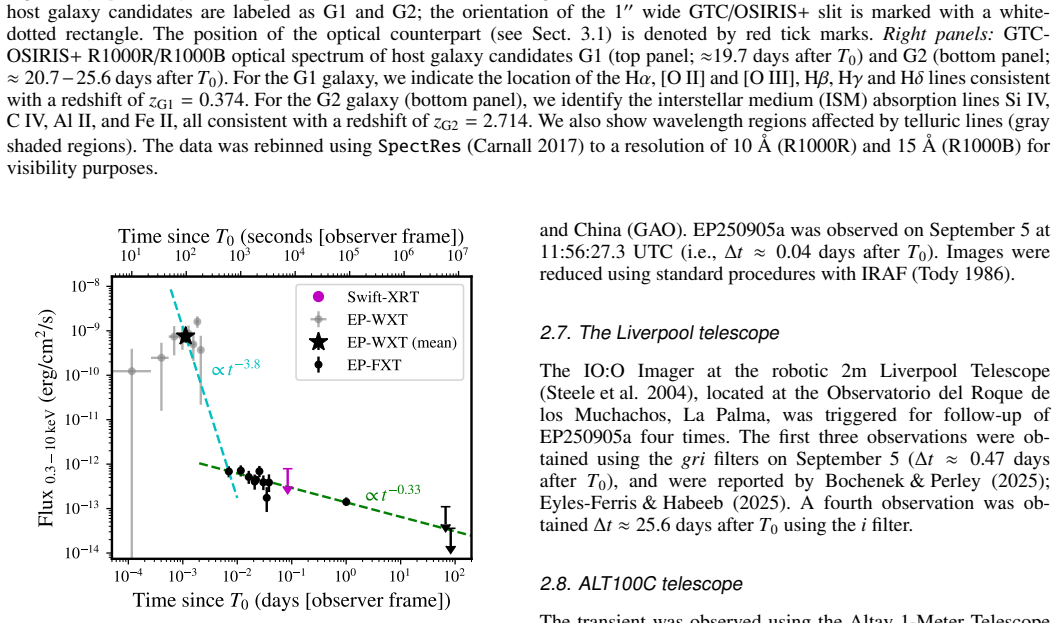
The multi-wavelength properties of EP250905a are best explained as afterglow emission from a mildly off-axis structured jet at redshift z=2.714. That single interpretation simultaneously accounts for the steep-then-shallow X-ray decay, the early optical detection that fades below later limits, the non-detections in the near-infrared and radio, and the possibility of weak lensing by the foreground galaxy G1.
Load-bearing premise
That the fainter, higher-redshift galaxy is the true host, based mainly on a lower chance of random alignment and the fact that the resulting luminosities then look normal for a jet afterglow.
Signed reviews
Editorial analysis
A structured set of objections, weighed in public.
Referee Report
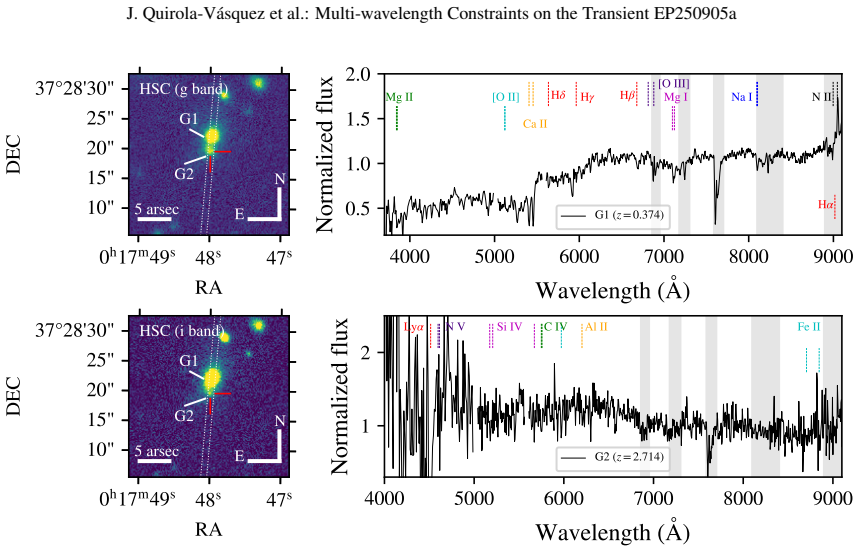
Summary. The paper presents multi-wavelength observations (EP-WXT/FXT, Swift-XRT, GTC/OSIRIS+, NOT, LCO, Liverpool, ALT100C, VLT/X-shooter, MeerKAT, Fermi-GBM) of the Einstein Probe fast X-ray transient EP250905a. An early optical counterpart is detected at mi = 23.23 ± 0.18 (GTC E1) and fades rapidly; no NIR or radio counterpart is found. Two nearby galaxies are spectroscopically redshifted (G1 at z = 0.374; G2 at z = 2.714). Chance-alignment probabilities and multi-wavelength consistency lead the authors to adopt G2 as the host. At z = 2.714 the X-ray light curve shows a steep early decay followed by a shallow phase, β_OX ≈ −0.8, and a redback Gaussian structured-jet afterglow model yields a mildly off-axis solution (θ_observer ≈ 5.7°, θ_core ≈ 3.4°). Weak lensing by G1 (θ_E ≈ 1.9″, μ ≈ 3.9) is considered but not required. The low-z (G1) solution is disfavored because the luminosities become anomalously faint and standard transient classes are excluded.
Significance. EP is delivering ~100 FXTs per year; secure multi-wavelength classifications remain rare. This work supplies carefully reduced photometry, spectra, and upper limits (Tables F.1–F.3), a clear temporal break, and a broadband SED, and places EP250905a in the context of long-GRB afterglows at moderate redshift. The explicit comparison of both host candidates and the quantitative (if uncertain) lensing estimate are useful. The afterglow modeling uses a public library (redback) with documented priors and posteriors (Table D.1, Fig. D.1). If the high-z host association holds, the event adds a well-observed, possibly weakly lensed, mildly off-axis afterglow to the growing EP sample.
major comments (2)
- Sect. 3.2 and 4.1: Host association with G2 rests on P_ch ≈ (3–6)×10⁻⁴ versus 6×10⁻³ for G1 and a 0.27″ offset; no absorption or emission feature is detected at the transient position itself. The central claim (mildly off-axis structured jet at z = 2.714) is viable only once this redshift is adopted. At z_G1 = 0.374 the same data become anomalously faint and most standard classes are ruled out (Sect. 4.2). The manuscript should state more explicitly that the physical classification is conditional on the statistical host preference, quantify the residual probability that G1 is the host, and present the low-z solution as a fully developed alternative rather than a brief dismissal.
- Sect. 4.2, Fig. 10 and Table D.1: The redback Gaussian-jet fit freezes p = 2.6, log ε_e = −0.66, log ε_B = −2.0 and ξ_N = 1, leaving only a handful of free parameters against a sparse detection set (one optical point, two X-ray detections, many upper limits). The resulting θ_observer and θ_core are consistent with both mildly off-axis and on-axis geometries within the quoted uncertainties. The paper already notes the limited constraints; it should either (i) explore a modest grid over the frozen microphysical parameters or (ii) rephrase the conclusion as “consistent with a structured-jet afterglow” rather than “best explained as a mildly off-axis structured jet,” so that the claim does not outrun the data.
minor comments (6)
- Abstract and Introduction: “high-energy suggested origins” is ungrammatical; rephrase to “high-energy events with suggested origins ranging from…”.
- Fig. 1 caption and text: T90 is reported as a lower limit because the observation was interrupted; make this explicit in the abstract/results summary as well.
- Sect. 2.1.2: The boresight-corrected EP-FXT position and the ~6.58″ offset relative to Wang et al. (2025) are important; a short note on how this affects earlier optical candidate claims would help the reader.
- Sect. 4.3: The SIS lensing calculation yields μ = 3.9+5.7−1.4; the large asymmetric uncertainty should be carried into any statement that the emission “might be moderately magnified.”
- Table F.1: Several upper limits are listed without specifying the aperture or PSF-matching details used after HOTPANTS subtraction; a one-sentence note would aid reproducibility.
- Fig. 6–8: Rest-frame comparisons assume z = 2.714; a parenthetical reminder in each caption would avoid confusion if a reader is still considering the low-z solution.
Circularity Check
No load-bearing circularity; host choice is statistical plus consistency check, and the redback afterglow fit is ordinary parameter estimation on new data.
full rationale
The paper's central claim (mildly off-axis structured-jet afterglow at z=2.714) rests on two independent inputs: (i) the Bloom et al. (2002) chance-alignment probabilities that already favor G2 by ~1 dex, and (ii) a standard external afterglow library (redback Gaussian-jet model) whose free parameters are sampled against the new multi-wavelength photometry while several microphysical parameters are fixed to literature values or to the observed β_OX. Neither step reduces by construction to its own output. The low-z alternative is examined and disfavored on energetic grounds, which is ordinary model comparison rather than a circular loop. Self-citations to prior EP papers supply context only and are not invoked as uniqueness theorems that force the present interpretation. Lensing magnification is presented as optional and non-decisive. Consequently the derivation chain is self-contained against external benchmarks and scores at most 1.
Assumptions & free parameters
free parameters (5)
- θ_observer (viewing angle) =
5.7^{+1.7}_{-1.1} deg
- log E_K,iso =
52.02^{+0.13}_{-0.14}
- θ_core, θ_edge =
θ_core=3.4±1.1 deg, θ_edge=6.9^{+2.9}_{-2.3} deg
- log n_ISM, Γ_0 =
log n ≈ −0.07, Γ_0 ≈ 346
- σ (G1 velocity dispersion) =
300±50 km s^{-1}
assumptions (4)
- domain assumption ΛCDM cosmology with H0=67.66 km s^{-1} Mpc^{-1}, Ω_Λ=0.69
- domain assumption Standard external-shock synchrotron afterglow in the slow-cooling regime with fixed microphysical parameters p=2.6, log ε_e=−0.66, log ε_B=−2.0, ξ_N=1
- domain assumption Singular isothermal sphere mass profile for the foreground galaxy G1
- domain assumption Chance-alignment probability formalism of Bloom et al. (2002)
Cite this review
Pith. "Pith review of Multi-wavelength Constraints on the Transient EP250905a." pith.science (2026). https://pith.science/paper/IWOU6HWZ
@misc{pith2026260708090,
  author       = {Pith},
  title        = {Pith review of: Multi-wavelength Constraints on the Transient EP250905a},
  year         = {2026},
  howpublished = {\url{https://pith.science/paper/IWOU6HWZ}},
  note         = {Machine review of arXiv:2607.08090}
}
abstract
Fast X-ray transients (FXTs) are a diverse class of high-energy suggested origins, ranging from stellar explosions to compact object mergers. The Einstein Probe (EP) satellite discovers approximately 100 FXTs per year. We aim to constrain the physical origin of EP250905a. We analyze X-ray, optical, near-infrared (NIR), and radio temporal and spectral properties of EP250905a. In addition, we assess the possible role of weak gravitational lensing in shaping its observed characteristics. EP250905a fades rapidly in X-rays, and we detect no NIR or radio emission, but we detect early optical emission that rapidly fades beyond the detection limits. Two nearby galaxies are identified for which we derive spectroscopic redshifts of $z=0.374$ (G1) and $z=2.714$ (G2). Our analysis favors G2 as the host of the FXT EP250905a. The angular separation of 2.56\arcsec\, between the FXT's optical counterpart and the center of the G1 galaxy suggests the emission of the FXT might be moderately magnified by lensing effects ($\mu\approx3.9$) given the inferred Einstein radius of G1 ($\theta_E\approx1.9$ arcsec). The data are best explained as an afterglow from a mildly off-axis structured jet at $z=2.714$, providing a consistent broadband interpretation that also allows for weakly lensed emission of EP250905a.
Figures


Figures from the paper (7 more)


Reference graph
Works this paper leans on
-
[1]
Late-time Evolution of Afterglows from Off-Axis Neutron-Star Mergers
Late-time evolution of afterglows from off-axis neutron star mergers. , keywords =. doi:10.1093/mnras/sty2196 , archivePrefix =. 1806.03843 , primaryClass =
-
[2]
Astronomical Data Analysis Software and Systems XVI , year = 2007, editor =
CASA Architecture and Applications. Astronomical Data Analysis Software and Systems XVI , year = 2007, editor =
work page 2007
-
[3]
CASA, the Common Astronomy Software Applications for Radio Astronomy
CASA, the Common Astronomy Software Applications for Radio Astronomy. , keywords =. doi:10.1088/1538-3873/ac9642 , archivePrefix =. 2210.02276 , primaryClass =
-
[4]
CubiCal - Fast radio interferometric calibration suite exploiting complex optimisation
CUBICAL - fast radio interferometric calibration suite exploiting complex optimization. , keywords =. doi:10.1093/mnras/sty1221 , archivePrefix =. 1805.03410 , primaryClass =
-
[5]
Radio Monitoring of the Tidal Disruption Event Swift J164449.3+573451. II. The Relativistic Jet Shuts Off and a Transition to Forward Shock X-Ray/Radio Emission. , keywords =. doi:10.1088/0004-637X/767/2/152 , archivePrefix =. 1212.1173 , primaryClass =
-
[6]
Discovery of an outflow from radio observations of the tidal disruption event ASASSN-14li
Discovery of an Outflow from Radio Observations of the Tidal Disruption Event ASASSN-14li. , keywords =. doi:10.3847/2041-8205/819/2/L25 , archivePrefix =. 1510.01226 , primaryClass =
-
[7]
Radio Monitoring of the Tidal Disruption Event Swift J164449.3+573451. III. Late-time Jet Energetics and a Deviation from Equipartition. , keywords =. doi:10.3847/1538-4357/aaa8e0 , archivePrefix =. 1710.07289 , primaryClass =
-
[8]
Strongly Lensed Transient Sources: A Review
Strongly Lensed Transient Sources: A Review. Chinese Physics Letters , keywords =. doi:10.1088/0256-307X/39/11/119801 , archivePrefix =. 2207.13489 , primaryClass =
work page Pith review arXiv doi:10.1088/0256-307x/39/11/119801
Show all 300 references
- [9]
-
[10]
doi:10.1007/978-3-662-03758-4 , adsurl =
Gravitational Lenses. doi:10.1007/978-3-662-03758-4 , adsurl =
- [11]
- [12]
- [13]
-
[14]
Philosophical Transactions of the Royal Society of London Series A , keywords =
Gravitational lensing in gamma-ray bursts. Philosophical Transactions of the Royal Society of London Series A , keywords =. doi:10.1098/rsta.2024.0122 , archivePrefix =. 2503.19977 , primaryClass =
2024 doi
-
[15]
Software and Cyberinfrastructure for Astronomy V , year = 2018, editor =
Real-time processing of the imaging data from the network of Las Cumbres Observatory Telescopes using BANZAI. Software and Cyberinfrastructure for Astronomy V , year = 2018, editor =. doi:10.1117/12.2314340 , archivePrefix =. 1811.04163 , primaryClass =
-
[16]
Ground-based Telescopes , year = 2004, editor =
The Liverpool Telescope: performance and first results. Ground-based Telescopes , year = 2004, editor =. doi:10.1117/12.551456 , adsurl =
2004 doi
-
[17]
nessai: Nested sampling with artificial intelligence
- [18]
-
[19]
Radiation Detection Technology and Methods , keywords =
Data reduction and processing for the Follow-up X-ray Telescope onboard Einstein Probe. Radiation Detection Technology and Methods , keywords =. doi:10.1007/s41605-025-00526-8 , adsurl =
- [20]
- [21]
- [22]
- [23]
- [24]
- [25]
- [26]
- [27]
-
[28]
, keywords =
Gamma-ray burst efficiency and possible physical processes shaping the early afterglow. , keywords =. doi:10.1111/j.1365-2966.2006.10280.x , archivePrefix =. astro-ph/0601054 , primaryClass =
2006 doi
- [29]
-
[30]
, keywords =
Evidence for chromatic X-ray light-curve breaks in Swift gamma-ray burst afterglows and their theoretical implications. , keywords =. doi:10.1111/j.1365-2966.2006.10453.x , archivePrefix =. astro-ph/0604105 , primaryClass =
2006 doi
-
[31]
Lucas and Zhang, Bing and Hascoët, Romain and Daigne, Frédéric and Mochkovitch, Robert and Park, Il H
Uhm, Z. Lucas and Zhang, Bing and Hascoët, Romain and Daigne, Frédéric and Mochkovitch, Robert and Park, Il H. , title =. 2012 , month =. doi:10.1088/0004-637X/761/2/147 , url =
2012 doi
-
[32]
HEAsoft: Unified Release of FTOOLS and XANADU
- [33]
- [34]
-
[35]
GRB Coordinates Network , year = 2025, month = mar, volume =
EP250321a: VLT/X-shooter redshift z = 4.368. GRB Coordinates Network , year = 2025, month = mar, volume =
2025
-
[36]
GRB Coordinates Network , year = 2026, month = jan, volume =
EP260119A: GTC/OSIRIS+ spectroscopic redshift z = 5.47. GRB Coordinates Network , year = 2026, month = jan, volume =
2026
-
[37]
Science Bulletin , keywords =
A fast powerful X-ray transient from possible tidal disruption of a white dwarf. Science Bulletin , keywords =. doi:10.1016/j.scib.2025.12.050 , archivePrefix =. 2509.25877 , primaryClass =
2025 doi
- [38]
-
[39]
, keywords =
JWST and HST Observations of the Host Galaxy and Supernova SN 2024aihh in EP240801a at z = 1.67. , keywords =. doi:10.3847/2041-8213/ae28db , archivePrefix =. 2512.11572 , primaryClass =
-
[40]
GRB Coordinates Network , year = 2025, month = mar, volume =
EP250304a: TRT optical counterpart detection. GRB Coordinates Network , year = 2025, month = mar, volume =
2025
-
[41]
GRB Coordinates Network , year = 2025, month = jan, volume =
EP250108a: Liverpool Telescope likely optical counterpart. GRB Coordinates Network , year = 2025, month = jan, volume =
2025
-
[42]
GRB Coordinates Network , year = 2024, month = aug, volume =
EP240806a: GSP optical counterpart detection. GRB Coordinates Network , year = 2024, month = aug, volume =
2024
-
[43]
GRB Coordinates Network , year = 2024, month = apr, volume =
EP240414a: Kinder optical counterpart candidate possibly associated with the galaxy SDSS J124601.99-094309.3. GRB Coordinates Network , year = 2024, month = apr, volume =
2024
-
[44]
GRB Coordinates Network , year = 2024, month = mar, volume =
AT2024eju: followup observations with Liverpool Telescope suggest a fading transient. GRB Coordinates Network , year = 2024, month = mar, volume =
2024
- [45]
- [46]
- [47]
-
[48]
, keywords =
JWST Spectroscopy of GRB 250702B: An Extremely Rare and Exceptionally Energetic Burst in a Dusty, Massive Galaxy at z = 1.036. , keywords =. doi:10.3847/2041-8213/ae2ed9 , archivePrefix =. 2509.22778 , primaryClass =
- [49]
-
[50]
, year = 1998, month = oct, volume =
Radio emission from the unusual supernova 1998bw and its association with the -ray burst of 25 April 1998. , year = 1998, month = oct, volume =. doi:10.1038/27139 , adsurl =
1998 doi
- [51]
- [52]
-
[53]
GRB Coordinates Network , year = 2012, month = jan, volume =
GRB111209A: ATCA detection at 5.5, 9, and 18GHz. GRB Coordinates Network , year = 2012, month = jan, volume =
2012
- [54]
- [55]
- [56]
-
[57]
Observatory Operations: Strategies, Processes, and Systems III , year = 2010, editor =
The X-shooter pipeline. Observatory Operations: Strategies, Processes, and Systems III , year = 2010, editor =. doi:10.1117/12.857211 , adsurl =
2010 doi
- [58]
-
[59]
BATSE Observations of Gamma-Ray Burst Spectra. I. Spectral Diversity. , keywords =. doi:10.1086/172995 , adsurl =
-
[60]
, keywords =
Properties of Relativistic Jets in Gamma-Ray Burst Afterglows. , keywords =. doi:10.1086/340094 , adsurl =
- [61]
- [62]
- [63]
-
[64]
oxkat: Semi-automated imaging of MeerKAT observations
- [65]
-
[66]
HOTPANTS: High Order Transform of PSF ANd Template Subtraction
-
[67]
, keywords =
Unveiling the nature of the Einstein Probe transient EP241021a. , keywords =. doi:10.1093/mnras/staf2064 , archivePrefix =. 2511.13314 , primaryClass =
-
[68]
GRB Coordinates Network , year = 2025, month = sep, volume =
EP250905a: refined analysis of the EP-WXT and EP-FXT observations. GRB Coordinates Network , year = 2025, month = sep, volume =
2025
-
[69]
GRB Coordinates Network , year = 2025, month = sep, volume =
EP250905a: Liverpool Telescope i-band upper limits. GRB Coordinates Network , year = 2025, month = sep, volume =
2025
-
[70]
GRB Coordinates Network , year = 2025, month = sep, volume =
EP250905a: Liverpool Telescope observations. GRB Coordinates Network , year = 2025, month = sep, volume =
2025
-
[71]
GRB Coordinates Network , year = 2025, month = sep, volume =
EP250905a: FTW one optical and multiple NIR counterpart candidates. GRB Coordinates Network , year = 2025, month = sep, volume =
2025
-
[72]
GRB Coordinates Network , year = 2025, month = sep, volume =
EP250905a: Global MASTER-Net observations report. GRB Coordinates Network , year = 2025, month = sep, volume =
2025
-
[73]
GRB Coordinates Network , year = 2025, month = sep, volume =
EP250905a: JinShan likely optical counterpart detection. GRB Coordinates Network , year = 2025, month = sep, volume =
2025
-
[74]
GRB Coordinates Network , year = 2025, month = sep, volume =
EP250905a: Einstein Probe detection of an X-ray transient. GRB Coordinates Network , year = 2025, month = sep, volume =
2025
- [75]
- [76]
- [77]
- [78]
-
[79]
GRB Coordinates Network , year = 2024, month = oct, volume =
EP241021a: TRT optical observations. GRB Coordinates Network , year = 2024, month = oct, volume =
2024
-
[80]
GRB Coordinates Network , year = 2024, month = oct, volume =
EP241021a: EP-FXT follow-up observation update. GRB Coordinates Network , year = 2024, month = oct, volume =
2024
-
[81]
GRB Coordinates Network , year = 2024, month = oct, volume =
EP241021a: NOT likely optical counterpart. GRB Coordinates Network , year = 2024, month = oct, volume =
2024
-
[82]
GRB Coordinates Network , year = 2024, month = oct, volume =
EP241021a: VLT/FORS2 redshift z = 0.75. GRB Coordinates Network , year = 2024, month = oct, volume =
2024
-
[83]
American Astronomical Society Meeting Abstracts \#190 , year = 1997, series =
AXAF CCD Imaging Spectrometer (ACIS). American Astronomical Society Meeting Abstracts \#190 , year = 1997, series =
1997
-
[84]
Greenbelt, MD: NASA/GSFC HEASARC , year=
The Xselect User’s Guide , author=. Greenbelt, MD: NASA/GSFC HEASARC , year=
-
[85]
GRB Coordinates Network , year = 2024, month = oct, volume =
EP241021a: 1.3m DFOT Optical observations. GRB Coordinates Network , year = 2024, month = oct, volume =
2024
-
[86]
GRB Coordinates Network , year = 2024, month = oct, volume =
EP241021a: GSP detects optical candidate counterpart. GRB Coordinates Network , year = 2024, month = oct, volume =
2024
-
[87]
The ESO Reflex environment
Automated data reduction workflows for astronomy. The ESO Reflex environment. , archivePrefix = "arXiv", eprint =. doi:10.1051/0004-6361/201322494 , adsurl =
-
[88]
, keywords =
The Radio Counterpart to the Fast X-Ray Transient EP240414a. , keywords =. doi:10.3847/1538-4357/adaaef , archivePrefix =. 2409.19055 , primaryClass =
- [89]
- [90]
-
[91]
Massive Stars as Cosmic Engines , year = 2008, editor =
Metallicities at the Sites of Nearby SN and Implications for the SN-GRB Connection. Massive Stars as Cosmic Engines , year = 2008, editor =. doi:10.1017/S1743921308020887 , adsurl =
2008 doi
- [92]
- [93]
- [94]
-
[95]
Is it due to a binary compact object merger?
EP250207b is not a collapsar fast X-ray transient. Is it due to a binary compact object merger?. , keywords =. doi:10.1093/mnras/staf2021 , archivePrefix =. 2508.13039 , primaryClass =
- [96]
-
[97]
, keywords =
The Chemical Composition of the Sun. , keywords =. doi:10.1146/annurev.astro.46.060407.145222 , archivePrefix =. 0909.0948 , primaryClass =
- [98]
- [99]
-
[100]
arXiv e-prints , keywords =
An extremely soft and weak fast X-ray transient associated with a luminous supernova. arXiv e-prints , keywords =. doi:10.48550/arXiv.2504.17034 , archivePrefix =. 2504.17034 , primaryClass =
- [101]
-
[102]
GRB Coordinates Network , year = 2024, month = oct, volume =
EP241021a: Optical counterpart observations with the Liverpool Telescope. GRB Coordinates Network , year = 2024, month = oct, volume =
2024
-
[103]
Ground-based and Airborne Instrumentation for Astronomy III , year = 2010, editor =
The multi-object double spectrographs for the Large Binocular Telescope. Ground-based and Airborne Instrumentation for Astronomy III , year = 2010, editor =. doi:10.1117/12.857215 , adsurl =
2010 doi
-
[104]
GRB Coordinates Network , year = 2024, month = nov, volume =
EP241021a and EP241026b: Keck/LRIS spectroscopic observations. GRB Coordinates Network , year = 2024, month = nov, volume =
2024
- [105]
- [106]
-
[107]
GRB Coordinates Network , year = 2007, month = jan, volume =
GRB 070411: TLS data shows plateau, flares. GRB Coordinates Network , year = 2007, month = jan, volume =
2007
- [108]
-
[109]
GRB Coordinates Network , year = 2024, month = oct, volume =
EP241021a: KAIT optical observations. GRB Coordinates Network , year = 2024, month = oct, volume =
2024
- [110]
- [111]
- [112]
- [113]
-
[114]
The Astronomer's Telegram , keywords =
A fast X-ray transient EP240331a detected by Einstein Probe. The Astronomer's Telegram , keywords =
-
[115]
GRB Coordinates Network , year = 2024, month = mar, volume =
Einstein Probe detected of a fast X-ray transient EP240315a. GRB Coordinates Network , year = 2024, month = mar, volume =
2024
-
[116]
GRB Coordinates Network , year = 2024, month = jun, volume =
EP240626a: EP-WXT detection of a fast X-ray transient. GRB Coordinates Network , year = 2024, month = jun, volume =
2024
-
[117]
GRB Coordinates Network , year = 2024, month = jun, volume =
EP240625a: EP-WXT detection of a fast X-ray transient. GRB Coordinates Network , year = 2024, month = jun, volume =
2024
-
[118]
GRB Coordinates Network , year = 2024, month = jun, volume =
EP240617a: EP-WXT detection of a fast X-ray transient. GRB Coordinates Network , year = 2024, month = jun, volume =
2024
-
[119]
GRB Coordinates Network , year = 2024, month = jun, volume =
EP240618a: EP-WXT detection of a fast X-ray transient and EP-FXT quick follow-up. GRB Coordinates Network , year = 2024, month = jun, volume =
2024
-
[120]
GRB Coordinates Network , year = 2024, month = may, volume =
EP240506a: EP-WXT detection of a new fast X-ray transient. GRB Coordinates Network , year = 2024, month = may, volume =
2024
-
[121]
GRB Coordinates Network , year = 2024, month = apr, volume =
EP240426b: EP-WXT detection of a new fast X-ray transient. GRB Coordinates Network , year = 2024, month = apr, volume =
2024
-
[122]
GRB Coordinates Network , year = 2024, month = apr, volume =
EP240420a: EP-WXT detection of a fast X-ray transient. GRB Coordinates Network , year = 2024, month = apr, volume =
2024
-
[123]
GRB Coordinates Network , year = 2024, month = apr, volume =
EP240417a: EP-WXT detection of a fast X-ray transient. GRB Coordinates Network , year = 2024, month = apr, volume =
2024
-
[124]
GRB Coordinates Network , year = 2024, month = apr, volume =
EP240416a: EP-WXT detection of a fast X-ray transient. GRB Coordinates Network , year = 2024, month = apr, volume =
2024
-
[125]
GRB Coordinates Network , year = 2024, month = apr, volume =
EP240414a: EP-WXT detection of a fast X-ray transient. GRB Coordinates Network , year = 2024, month = apr, volume =
2024
-
[126]
GRB Coordinates Network , year = 2024, month = apr, volume =
X-ray transient EP240414a: Detection of associated supernova. GRB Coordinates Network , year = 2024, month = apr, volume =
2024
-
[127]
GRB Coordinates Network , year = 2024, month = apr, volume =
X-ray transient EP 240414a - GTC spectroscopic observations. GRB Coordinates Network , year = 2024, month = apr, volume =
2024
-
[128]
GRB Coordinates Network , year = 2024, month = apr, volume =
EP240413a: EP-WXT detection of a fast X-ray transient. GRB Coordinates Network , year = 2024, month = apr, volume =
2024
-
[129]
GRB Coordinates Network , year = 2024, month = apr, volume =
EP240408a: EP-WXT detection of a fast X-ray transient. GRB Coordinates Network , year = 2024, month = apr, volume =
2024
-
[130]
GRB Coordinates Network , year = 2024, month = aug, volume =
EP240801a: EP-WXT detection and EP-FXT follow-up observation of a fast X-ray transient. GRB Coordinates Network , year = 2024, month = aug, volume =
2024
- [131]
- [132]
-
[133]
, keywords =
Information criteria for astrophysical model selection. , keywords =. doi:10.1111/j.1745-3933.2007.00306.x , archivePrefix =. astro-ph/0701113 , primaryClass =
2007 doi
- [134]
-
[135]
GRB Coordinates Network , year = 2024, month = aug, volume =
EP240801a: GTC spectroscopy and absorption redshift. GRB Coordinates Network , year = 2024, month = aug, volume =
2024
- [136]
- [137]
- [138]
- [139]
- [140]
- [141]
-
[142]
GRB Coordinates Network , year = 2024, month = oct, volume =
EP241021a: Gemini-South detection of optical rebrightening. GRB Coordinates Network , year = 2024, month = oct, volume =
2024
-
[143]
Ground-based and Airborne Instrumentation for Astronomy , year = 2006, editor =
Data reduction software of the X-shooter spectrograph. Ground-based and Airborne Instrumentation for Astronomy , year = 2006, editor =. doi:10.1117/12.669986 , adsurl =
2006 doi
-
[144]
, keywords =
Can GRB 250702B be explained as the tidal disruption of a white dwarf by an intermediate mass black hole? Yes. , keywords =. doi:10.1093/mnras/stag005 , archivePrefix =. 2509.22843 , primaryClass =
-
[145]
GRB Coordinates Network , year = 2026, month = mar, volume =
EP260321a: refined analysis of the EP-WXT and EP-FXT observations, implying a possible supernova shock breakout candidate. GRB Coordinates Network , year = 2026, month = mar, volume =
2026
-
[146]
Nature Astronomy , keywords =
A fast X-ray transient from a weak relativistic jet associated with a type Ic-BL supernova. Nature Astronomy , keywords =. doi:10.1038/s41550-025-02571-1 , archivePrefix =. 2410.02315 , primaryClass =
-
[147]
Astronomical Data Analysis Software and Systems IV , year = 1995, editor =
FTOOLS: A FITS Data Processing and Analysis Software Package. Astronomical Data Analysis Software and Systems IV , year = 1995, editor =
1995
- [148]
- [149]
-
[150]
GRB Coordinates Network , year = 2024, month = oct, volume =
EP241021a: GTC OSIRIS+ spectroscopy of the optical counterpart. GRB Coordinates Network , year = 2024, month = oct, volume =
2024
-
[151]
GRB Coordinates Network , year = 2024, month = oct, volume =
EP241021a: Optical and NIR observations of counterpart with the Fraunhofer Telescope at Wendelstein Observatory. GRB Coordinates Network , year = 2024, month = oct, volume =
2024
-
[152]
GRB Coordinates Network , year = 2024, month = oct, volume =
EP241021a: SOAR observations of the optical counterpart. GRB Coordinates Network , year = 2024, month = oct, volume =
2024
-
[153]
GRB Coordinates Network , year = 2024, month = oct, volume =
EP241021a: further SAO RAS optical observations. GRB Coordinates Network , year = 2024, month = oct, volume =
2024
-
[154]
GRB Coordinates Network , year = 2024, month = oct, volume =
EP241021a: Optical rebrightening observations with Mephisto. GRB Coordinates Network , year = 2024, month = oct, volume =
2024
-
[155]
GRB Coordinates Network , year = 2024, month = oct, volume =
EP241021a: SAO RAS observations of rebrightening. GRB Coordinates Network , year = 2024, month = oct, volume =
2024
-
[156]
GRB Coordinates Network , year = 2024, month = nov, volume =
EP241021a: OHP/T193 optical observations. GRB Coordinates Network , year = 2024, month = nov, volume =
2024
- [157]
-
[158]
2002 , edition=
Accretion Power in Astrophysics , author=. 2002 , edition=
2002
- [159]
-
[160]
Astronomical Data Analysis Software and Systems XXVII , year = 2019, editor =
Rectification and Wavelength Calibration of EMIR Spectroscopic Data with Python. Astronomical Data Analysis Software and Systems XXVII , year = 2019, editor =
2019
-
[161]
Astronomical Data Analysis Software and Systems XIX , year = 2010, editor =
PyEmir: Data Reduction Pipeline for EMIR, the GTC Near-IR Multi-Object Spectrograph. Astronomical Data Analysis Software and Systems XIX , year = 2010, editor =
2010
-
[162]
European Southern Observatory Conference and Workshop Proceedings , year = 1992, editor =
Active Optics on the Nordic Optical Telescope. European Southern Observatory Conference and Workshop Proceedings , year = 1992, editor =
1992
- [163]
- [164]
-
[165]
arXiv e-prints , keywords =
Radio observations point to a moderately relativistic outflow in the fast X-ray transient EP241021a. arXiv e-prints , keywords =. doi:10.48550/arXiv.2505.08781 , archivePrefix =. 2505.08781 , primaryClass =
-
[166]
arXiv e-prints , keywords =
The soft X-ray transient EP241021a: a cosmic explosion with a complex off-axis jet and cocoon from a massive progenitor. arXiv e-prints , keywords =. doi:10.48550/arXiv.2505.05444 , archivePrefix =. 2505.05444 , primaryClass =
- [167]
-
[168]
, keywords =
The curious case of EP241021a: Unraveling the mystery of its exceptional rebrightening. , keywords =. doi:10.1051/0004-6361/202554626 , archivePrefix =. 2503.14588 , primaryClass =
- [169]
- [170]
-
[171]
Transient Name Server AstroNote , keywords =
ePESSTO+ spectroscopic classification of optical transients. Transient Name Server AstroNote , keywords =
- [172]
- [173]
- [174]
-
[175]
, keywords =
Minutes-duration optical flares with supernova luminosities. , keywords =. doi:10.1038/s41586-023-06673-6 , archivePrefix =. 2311.10195 , primaryClass =
- [176]
- [177]
-
[178]
GRB Coordinates Network , year = 2024, month = nov, volume =
EP241021a: Liverpool Telescope optical follow-up observations. GRB Coordinates Network , year = 2024, month = nov, volume =
2024
-
[179]
GRB Coordinates Network , year = 2024, month = oct, volume =
EP241021a: optical follow-up observations with the Liverpool Telescope. GRB Coordinates Network , year = 2024, month = oct, volume =
2024
-
[180]
GRB Coordinates Network , year = 2024, month = oct, volume =
EP241021a: Liverpool Telescope optical follow-up observations. GRB Coordinates Network , year = 2024, month = oct, volume =
2024
-
[181]
GRB Coordinates Network , year = 2024, month = oct, volume =
EP241021a: SAO RAS optical observations. GRB Coordinates Network , year = 2024, month = oct, volume =
2024
-
[182]
, keywords =
The complex light curve of the afterglow of GRB071010A. , keywords =. doi:10.1111/j.1365-2966.2008.13393.x , archivePrefix =. 0804.4367 , primaryClass =
2008 doi
-
[183]
Ground-based Instrumentation for Astronomy , year = 2004, editor =
HAWK-I: A new wide-field 1- to 2.5- m imager for the VLT. Ground-based Instrumentation for Astronomy , year = 2004, editor =. doi:10.1117/12.578293 , adsurl =
2004 doi
-
[184]
, keywords =
HAWK-I: the high-acuity wide-field K-band imager for the ESO Very Large Telescope. , keywords =. doi:10.1051/0004-6361:200809910 , adsurl =
-
[185]
GRB Coordinates Network , year = 2024, month = oct, volume =
EP241021a: optical follow-up observations with Xinglong Observatory. GRB Coordinates Network , year = 2024, month = oct, volume =
2024
- [186]
-
[187]
EsoRex: ESO Recipe Execution Tool
- [188]
- [189]
-
[190]
Ground-based Instrumentation for Astronomy , year = 2004, editor =
The Goodman spectrograph. Ground-based Instrumentation for Astronomy , year = 2004, editor =. doi:10.1117/12.550069 , adsurl =
2004 doi
-
[191]
PyRAF: Python alternative for IRAF
-
[192]
, keywords =
The Gemini-North Multi-Object Spectrograph: Performance in Imaging, Long-Slit, and Multi-Object Spectroscopic Modes. , keywords =. doi:10.1086/383624 , adsurl =
-
[193]
Ground-based and Airborne Instrumentation for Astronomy VI , year = 2016, editor =
On-sky commissioning of Hamamatsu CCDs in GMOS-S. Ground-based and Airborne Instrumentation for Astronomy VI , year = 2016, editor =. doi:10.1117/12.2233883 , adsurl =
2016 doi
-
[194]
doi:10.5281/zenodo.7776065 , url =
Kathleen Labrie and Chris Simpson and James Turner and Bruno Quint and Simon Conseil and Oliver Oberdorf and Monika Soraisam and Vinicius Placco and Olesja Smirnova and Daniel Berke and William Vacca , title =. doi:10.5281/zenodo.7776065 , url =
-
[195]
Labrie and C
K. Labrie and C. Simpson and R. Cardenes and J. Turner and M. Soraisam and B. Quint and O. Oberdorf and V. M. Placco and D. Berke and O. Smirnova and S. Conseil and W. D. Vacca and J. Thomas-Osip , title =. 2023 , month =. doi:10.3847/2515-5172/ad0044 , url =
2023 doi
-
[196]
Optical and IR Telescope Instrumentation and Detectors , year = 2000, editor =
OSIRIS tunable imager and spectrograph. Optical and IR Telescope Instrumentation and Detectors , year = 2000, editor =. doi:10.1117/12.395520 , adsurl =
2000 doi
- [197]
- [198]
- [199]
- [200]
- [201]
- [202]
- [203]
-
[204]
GRB Coordinates Network , year = 2024, month = oct, volume =
EP241021a: EP detection of a fast X-ray transient. GRB Coordinates Network , year = 2024, month = oct, volume =
2024
-
[205]
Ground-based and Airborne Instrumentation for Astronomy IV , year = 2012, editor =
MOSFIRE, the multi-object spectrometer for infra-red exploration at the Keck Observatory. Ground-based and Airborne Instrumentation for Astronomy IV , year = 2012, editor =. doi:10.1117/12.924794 , adsurl =
2012 doi
- [206]
- [207]
- [208]
- [209]
- [210]
- [211]
- [212]
-
[213]
B. P. Abbott and R. Abbott and T. D. Abbott and F. Acernese and K. Ackley and C. Adams and T. Adams and P. Addesso and R. X. Adhikari and V. B. Adya , title =. doi:10.3847/2041-8213/aa91c9 , url =
-
[214]
Goldstein and P
A. Goldstein and P. Veres and E. Burns and M. S. Briggs and R. Hamburg and D. Kocevski and C. A. Wilson-Hodge and R. D. Preece and S. Poolakkil and O. J. Roberts and C. M. Hui and V. Connaughton and J. Racusin and A. von Kienlin and T. Dal Canton and N. Christensen and T. Litt...
- [215]
-
[216]
GW170817: Observation of Gravitational Waves from a Binary Neutron Star Inspiral , author =. Phys. Rev. Lett. , volume =. 2017 , month =. doi:10.1103/PhysRevLett.119.161101 , url =
2017 doi
-
[217]
Abbott and T
R. Abbott and T. D. Abbott and S. Abraham and F. Acernese and K. Ackley and C. Adams and R. X. Adhikari and V. B. Adya and C. Affeldt and M. Agathos and K. Agatsuma and N. Aggarwal and O. D. Aguiar and A. Aich and L. Aiello and A. Ain and P. Ajith and S. Akcay and G. Allen and...
- [218]
-
[219]
arXiv e-prints , keywords =
Population Properties of Compact Objects from the Second LIGO-Virgo Gravitational-Wave Transient Catalog. arXiv e-prints , keywords =
- [220]
- [221]
- [222]
- [223]
-
[224]
, keywords =
The 16th Data Release of the Sloan Digital Sky Surveys: First Release from the APOGEE-2 Southern Survey and Full Release of eBOSS Spectra. , keywords =. doi:10.3847/1538-4365/ab929e , archivePrefix =. 1912.02905 , primaryClass =
1912 doi
- [225]
- [226]
- [227]
- [228]
- [229]
- [230]
- [231]
- [232]
-
[233]
arXiv e-prints , keywords =
Observational constraints on the optical and near-infrared emission from the neutron star-black hole binary merger S190814bv. arXiv e-prints , keywords =
- [234]
-
[235]
Integral Field Spectroscopy with the Gemini Multiobject Spectrograph. I. Design, Construction, and Testing. , keywords =. doi:10.1086/341712 , adsurl =
- [236]
-
[237]
, keywords =
The HEAO A-1 all-sky survey of fast X-ray transients. , keywords =. doi:10.1086/164769 , adsurl =
- [238]
-
[239]
, keywords =
Progenitor mass constraints for core-collapse supernovae from correlations with host galaxy star formation. , keywords =. doi:10.1111/j.1365-2966.2012.21324.x , archivePrefix =. 1205.3802 , primaryClass =
2012 doi
- [240]
-
[241]
The Astronomer's Telegram , keywords =
ZTF optical non-detection of Chandra Fast X-ray Transient XRT 210423. The Astronomer's Telegram , keywords =
-
[242]
The Astronomer's Telegram , keywords =
Keck+LRIS spectroscopy of the apparently closest galaxy to Chandra Fast X-ray Transient XRT 210423. The Astronomer's Telegram , keywords =
-
[243]
The Astronomer's Telegram , keywords =
P200+WaSP observations of Chandra Fast X-ray Transient XRT 210423. The Astronomer's Telegram , keywords =
- [244]
-
[245]
The Astrophysical Journal Supplement Series , volume=
Konus catalog of soft gamma repeater activity: 1978 to 2000 , author=. The Astrophysical Journal Supplement Series , volume=. 2001 , publisher=
1978
- [246]
- [247]
- [248]
- [249]
-
[250]
Astronomical Data Analysis Software and Systems V , year = 1996, editor =
XSPEC: The First Ten Years. Astronomical Data Analysis Software and Systems V , year = 1996, editor =
1996
- [251]
- [252]
-
[253]
SEP: Source Extraction and Photometry
- [254]
- [255]
- [256]
- [257]
- [258]
- [259]
-
[260]
astropy/photutils: 1.8.0 , month = may, year = 2023, publisher =
Larry Bradley and Brigitta Sip. astropy/photutils: 1.8.0 , month = may, year = 2023, publisher =. doi:10.5281/zenodo.7946442 , url =
2023 doi
- [261]
- [262]
- [263]
-
[264]
1934", month =
Cosmic Rays from Super-novae. Proceedings of the National Academy of Science , year = "1934", month = "May", volume =. doi:10.1073/pnas.20.5.259 , adsurl =
1934 doi
- [265]
-
[266]
, keywords =
Supernova shock breakout through a wind. , keywords =. doi:10.1111/j.1365-2966.2011.18505.x , archivePrefix =. 1101.1489 , primaryClass =
2011 doi
- [267]
- [268]
- [269]
-
[270]
SF2A-2013: Proceedings of the Annual meeting of the French Society of Astronomy and Astrophysics , year = 2013, editor =
Athena+: The first Deep Universe X-ray Observatory. SF2A-2013: Proceedings of the Annual meeting of the French Society of Astronomy and Astrophysics , year = 2013, editor =
2013
- [271]
- [272]
- [273]
- [274]
- [275]
- [276]
- [277]
-
[278]
Bell and Daniel H
Eric F. Bell and Daniel H. McIntosh and Neal Katz and Martin D. Weinberg , title =. doi:10.1086/378847 , url =
- [279]
- [280]
- [281]
- [282]
- [283]
- [284]
- [285]
- [286]
- [287]
-
[288]
, keywords =
SExtractor: Software for source extraction. , keywords =. doi:10.1051/aas:1996164 , adsurl =
-
[289]
, keywords =
GALEX catalogs of UV sources: statistical properties and sample science applications: hot white dwarfs in the Milky Way. , keywords =. doi:10.1007/s10509-010-0581-x , adsurl =
- [290]
- [291]
-
[292]
, keywords =
The physical properties of star-forming galaxies in the low-redshift Universe. , keywords =. doi:10.1111/j.1365-2966.2004.07881.x , archivePrefix =. astro-ph/0311060 , primaryClass =
2004 doi
-
[293]
, keywords =
Electromagnetic extraction of energy from Kerr black holes. , keywords =. doi:10.1093/mnras/179.3.433 , adsurl =
- [294]
- [295]
- [296]
- [297]
-
[298]
Supernova Explosions. 2017. doi:10.1007/978-3-662-55054-0 , adsurl =
2017 doi
- [299]
- [300]
Reviewed July 10, 2026 · model on record in the stance chip above.
Discussion (0). Continue with ORCID to comment.