REVIEW 3 major objections 7 minor 61 references
AllTracker: Efficient Dense Point Tracking at High Resolution
T0 review · 3 major / 7 minor · reviewed 2026-08-07 · deepseek-v4-flash
Pith's one-line read AllTracker claims that long-range point tracking is best solved as dense multi-frame optical flow, delivering state-of-the-art accuracy at 768×1024 while running at optical-flow speed with only 16 million parameters.
desk verdict Solid dense point tracker with real practical gains, but the reported SOTA margin rests on an untested evaluation shortcut that could flip the ranking. read the letter →
The pith
A machine-rendered reading of the paper's core claim, the machinery that carries it, and where it could break.
The reading
What carries the argument
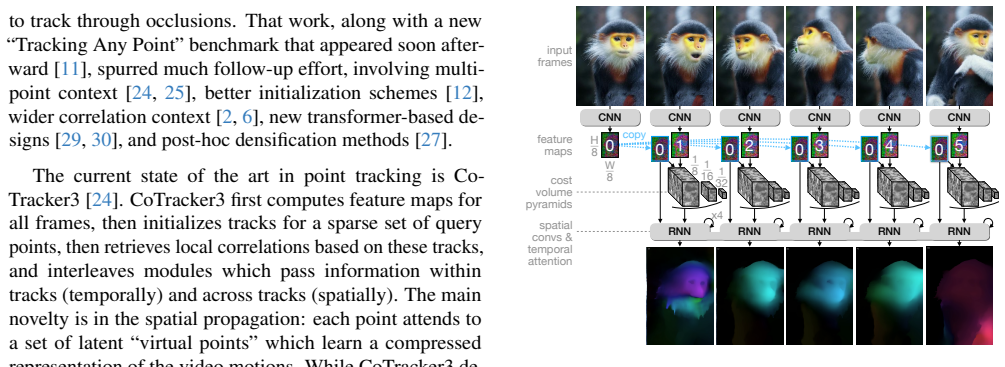
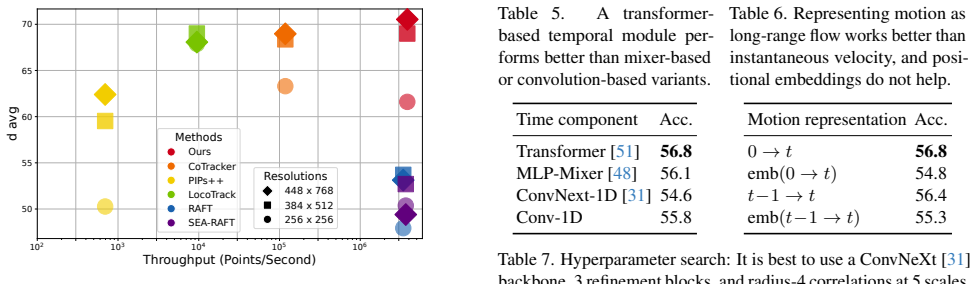
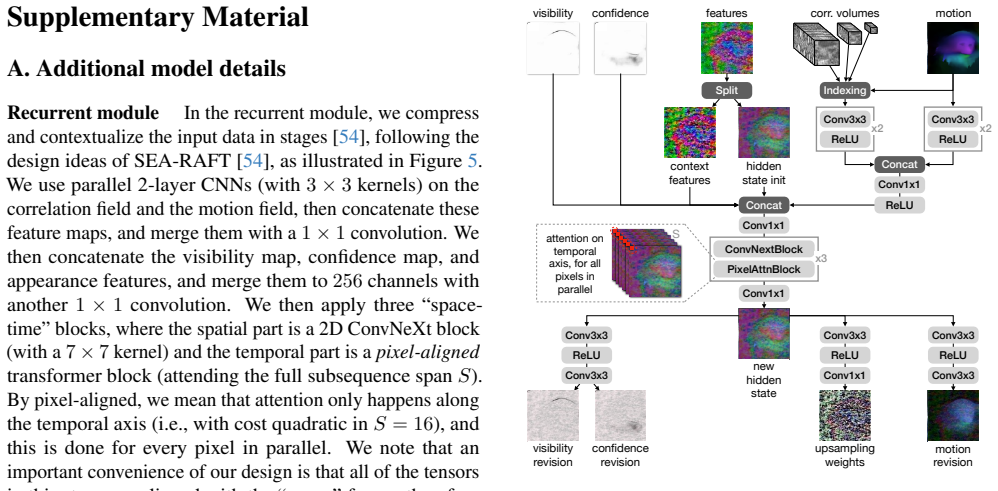
The load-bearing component is a recurrent refinement module that operates on low-resolution grids (spatial stride 8) and iterates four times with shared weights. It builds multi-scale 4D correlation volumes between a copy of the query frame's feature map and each timestep's feature pyramid, then, for every pixel and timestep, extracts local correlation patches centered at the current position estimate and interleaves 2D ConvNeXt spatial blocks with pixel-aligned temporal attention (attention along the temporal axis for corresponding pixels only). The module decodes explicit revisions to motion, visibility, and confidence, and learns the weights of a pixel-shuffle upsampling layer that restores full resolution. A sliding window of length 16 with stride 8 carries estimates forward between windows, which is what allows inference on long videos. This machinery borrows the low-resolution iterative refinement and upsampling of optical flow models and the per-pixel temporal attention of point trackers, and the ablation study shows that both the transformer temporal module and the query-relative motion representation contribute to the accuracy.
What would settle it
Run the nine-benchmark evaluation under the full protocol — tracking points from every available query frame and keeping full video lengths — and recompute average δavg; if AllTracker's lead over CoTracker3 disappears or reverses, the state-of-the-art claim is falsified. A cheaper check: the paper reports a 3.5-point gap between realtime streaming and offline inference at 512×512, so measuring that gap on the same benchmarks gives a direct bound on the protocol's influence.
Extended reading notes
Core claim
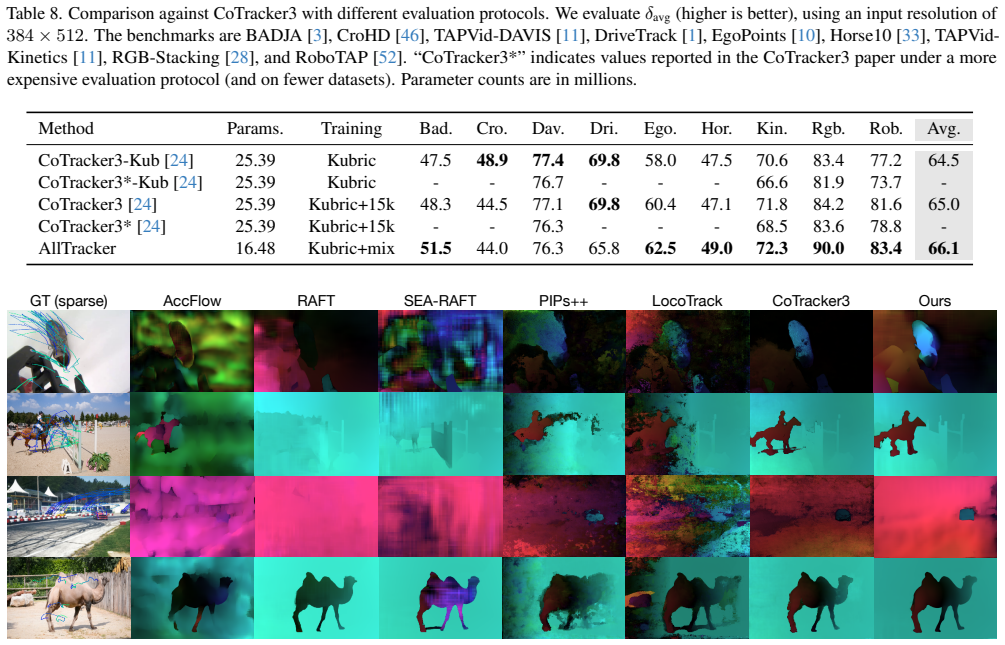
The paper's central claim is that AllTracker is a state-of-the-art point tracker at high resolution and full density. On nine point-tracking benchmarks it reports an average δavg of 66.1 at 384×512 and 69.5 at 768×1024, versus 65.0 and 66.9 for CoTracker3, the previous state of the art, and it produces 786,432 tracks at once on a 40G GPU. The method's distinctive move is to represent point tracking as long-range flow: the model outputs, for every pixel of the query frame, a flow map to each of hundreds of later frames, plus visibility and confidence maps. This makes the task a direct generalization of optical flow rather than a separate sparse-tracking problem, and it lets the same weights be trained on both flow and tracking supervision.
Load-bearing premise
The paper's leading claim rests on the assumption that evaluating large benchmarks with only the first available query frame and videos trimmed to 600 frames matches the full protocol (all queries, full length); this is asserted without a demonstrated comparison, and since the reported margin over CoTracker3 is only about 1 point at 384×512, a stricter protocol could shift the ranking.
Editorial extensions
If this is right
- Sparse point trackers of similar speed and accuracy are made redundant: any subset of pixels can be tracked by sampling from dense output, with no per-query cost.
- Dense all-pixel tracks at 768×1024 become practical on one 40G GPU, a resolution where the strongest sparse baseline required a 96G GPU.
- Joint training on optical flow and point tracking data gives accuracy comparable to CoTracker3's 15,000-video bootstrapping, without pseudo-labels.
- Streaming inference enables realtime tracking at about 58 FPS at 512×512, with a modest accuracy penalty (62.6 vs. 66.1 δavg).
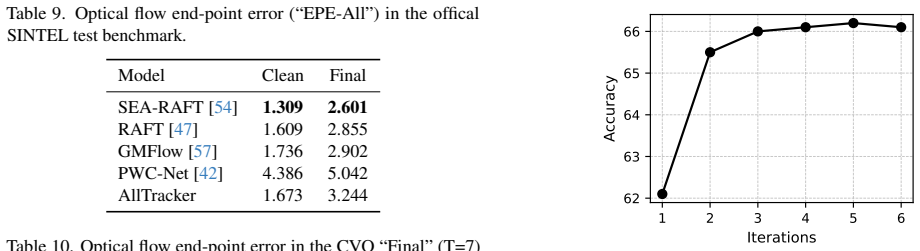
- The model underfits short-range optical flow (SINTEL EPE 1.673 clean vs. SEA-RAFT 1.309), so the same design with more compute should improve further.
Reading between the lines
- Beyond the paper: since temporal attention is pixel-aligned, widening the window S (possible with larger GPUs) should directly extend the occlusion horizon without changing the architecture.
- Beyond the paper: the dense output could serve as a cheap pseudo-label source for training other video models, complementing the bootstrapping approach the paper compares against.
- Beyond the paper: the negative result on sinusoidal positional embeddings and the preference for query-relative motion suggest that absolute timeline information is unhelpful for windows of this length, which may simplify future designs.
Editorial analysis
A structured set of objections, weighed in public.
Referee Report
Summary. The paper introduces AllTracker, a dense point tracker that reformulates long-range point tracking as multi-frame optical flow from a query frame to every other frame. The architecture combines a ConvNeXt encoder, multi-scale correlation volumes, and a recurrent refinement module that interleaves 2D convolutions with pixel-aligned temporal attention, operating on low-resolution grids and upsampling to full resolution. The model is trained jointly on optical flow and point tracking datasets, and the paper reports state-of-the-art δavg results on nine point-tracking benchmarks at 384×512 as well as at higher resolutions (448×768 and 768×1024), with 16.48M parameters and optical-flow-scale throughput. The paper also presents ablations of temporal modules, motion representations, backbones, and hyperparameters, and releases code and model weights.
Significance. If the reported results hold, AllTracker is a valuable practical contribution: it provides dense all-pixel long-range tracking at high resolution with a memory footprint and speed that sparse point trackers do not offer, and it demonstrates that joint training on optical flow and point tracking data is beneficial. The paper is an empirical systems paper with no circularity in its evaluation design: the model is trained on synthetic data and evaluated on held-out real benchmarks, and the ablations are genuine architecture comparisons. Strengths include the breadth of the evaluation (nine benchmarks, including high-resolution comparisons), the extensive ablation study, the clear disclosure of evaluation-protocol choices, and the promise of released code and weights. However, the central state-of-the-art claim currently rests on an unvalidated evaluation simplification and on small margins over the main baseline, so the significance is conditional on resolving those concerns.
major comments (3)
- [Section 4, Evaluation protocol; Table 1; Table 8] The paper states that on larger datasets it tracks only points from the first available query frame and trims videos to 600 frames because this 'gives similar results to using all possible queries and full video lengths,' but no comparison supporting this assertion is provided. This is load-bearing for the central claim: the average margin over CoTracker3 in Table 1 is only 1.1 δavg (66.1 vs. 65.0), so a differential effect of the protocol choice between AllTracker and CoTracker3 larger than 1.1 would flip the ranking. Table 8 only compares query-grouping protocols for CoTracker3 on four datasets and does not isolate the first-query/600-frame-truncation simplification, nor does it test AllTracker under the full protocol. The authors should provide a per-dataset comparison on a subset of benchmarks (or on one or two full benchmarks) between the simplified and full protocols for both AllTracker and CoTracker3, and report the resulting differences.
- [Appendix E, Validation dataset; Section 4.2; Tables 5-7] The ablation validation set is constructed from six of the nine main evaluation benchmarks (BADJA, CroHD, TAPVid-DAVIS, DriveTrack, Horse10, RoboTAP), and the design choices validated on it (temporal module, motion representation, backbone, refinement blocks, correlation radius/scales, loss type, frame ordering) are used in the final model whose numbers are reported on the same benchmarks in Table 1. This overlap means the main benchmark results are not an independent test of the architecture choices: the model's hyperparameters have effectively been selected using labels from the evaluation datasets. Please either report main results on benchmarks that were not used in any form for model selection, or provide evidence that the selected choices are not tuned to these particular test labels, for example by showing that the relative ranking of the ablated variants is stable across a disjoint validation set.
- [Tables 1, 2, and 3; Section 4.1] All reported results are single evaluation runs without error bars, confidence intervals, or any measure of run-to-run or protocol-induced variability. This is particularly important because the state-of-the-art margin in Table 1 is small (1.1 δavg over CoTracker3) and because the CoTracker3 baseline is evaluated under a protocol that the authors themselves state over-estimates its accuracy. The authors should report variance across at least a few runs of the main comparisons, or otherwise quantify the sensitivity of the rankings to the evaluation protocol, so that the reader can assess whether the claimed advantage is robust.
minor comments (7)
- [Section 3.1] The notation 't ∈ T' in the problem formulation is imprecise; it should be something like 't ∈ {0, ..., T−1}'.
- [Section 4.2, 'Temporal module'] The phrase 'learning tempral priors' contains a typo; it should read 'temporal priors'.
- [Section 2, Related Work] The sentence 'The introduction of the concept of optic flow can attributed to Gibson' is missing a 'be'; it should read 'can be attributed to Gibson'.
- [Table 9 caption] The caption contains a typo: 'offical' should be 'official'.
- [Section 1, Introduction] The phrase 'we solve awindow of flow problems simultaneously' is missing a space and possibly an article; it should be 'a window of flow problems'.
- [Figure 3] The throughput measurements in Figure 3 would benefit from specifying the hardware, batch size, and input resolution used for the throughput axis, since these details are not given in the main text.
- [Reference [18]] The reference 'TAG: Tracking at any granularity' appears without a venue or year; if it is a preprint, this should be stated.
Circularity Check
No significant circularity: AllTracker's claims are empirical, evaluated on held-out benchmarks; the protocol simplification is an unverified assumption, not a circular reduction.
full rationale
This paper is an empirical systems paper. The central claim—state-of-the-art dense point tracking at high resolution—is established by training on synthetic datasets (Kubric, FlyingThings++, PointOdyssey, optical flow mixes) and evaluating on held-out real benchmarks (BADJA, CroHD, TAPVid, DriveTrack, EgoPoints, Horse10, Kinetics, RGB-Stacking, RoboTAP). No metric, loss, or architecture component is defined in terms of the evaluation benchmarks, and no parameter is fitted to the test set. The architecture ablations are genuine controlled experiments, and the SOTA comparison against CoTracker3 is made transparent: the paper discloses that its cheaper CoTracker3 protocol (all queries at once) over-estimates CoTracker3 accuracy, which is a conservative choice. The one load-bearing assumption is the Section 4 statement that on large datasets tracking only points from the first available query frame and trimming to 600 frames 'gives similar results to using all possible queries and full video lengths.' This is an unverified empirical assertion that could affect the ranking if it interacts differently across methods, but it is not circular: it does not define AllTracker's output in terms of a fitted parameter, nor does it reduce the result to its own inputs by construction. The paper's self-citations (e.g., PIPs, PointOdyssey, CoTracker) are used as prior techniques and data sources, not as loaded uniqueness theorems that force the conclusion. Accordingly, the circularity score is 0; the protocol-equivalence concern belongs to correctness risk, not circularity.
Assumptions & free parameters
free parameters (7)
- alpha (trajectory loss scale) =
0.05
- gamma (refinement step weighting) =
0.8
- window size S =
16
- correlation radius R =
4
- correlation pyramid scales =
5
- refinement iterations at inference =
4
- number of space-time blocks =
3
assumptions (4)
- domain assumption Ground-truth point annotations in the nine benchmarks are accurate enough that a difference of about 1 point in delta-avg reflects a real performance difference.
- domain assumption Tracking only the first available query frame and trimming video lengths yields similar results to the full evaluation protocol.
- domain assumption Training on synthetic datasets transfers to real-world videos.
- domain assumption Pixel-shuffle upsampling from 1/8-resolution estimates preserves the spatial precision needed for full-resolution dense tracking.
Cite this review
Pith. "Pith review of AllTracker: Efficient Dense Point Tracking at High Resolution." pith.science (2026). https://pith.science/paper/IWSMCL4B
@misc{pith2026250607310,
  author       = {Pith},
  title        = {Pith review of: AllTracker: Efficient Dense Point Tracking at High Resolution},
  year         = {2026},
  howpublished = {\url{https://pith.science/paper/IWSMCL4B}},
  note         = {Machine review of arXiv:2506.07310}
}
read the original abstract
We introduce AllTracker: a model that estimates long-range point tracks by way of estimating the flow field between a query frame and every other frame of a video. Unlike existing point tracking methods, our approach delivers high-resolution and dense (all-pixel) correspondence fields, which can be visualized as flow maps. Unlike existing optical flow methods, our approach corresponds one frame to hundreds of subsequent frames, rather than just the next frame. We develop a new architecture for this task, blending techniques from existing work in optical flow and point tracking: the model performs iterative inference on low-resolution grids of correspondence estimates, propagating information spatially via 2D convolution layers, and propagating information temporally via pixel-aligned attention layers. The model is fast and parameter-efficient (16 million parameters), and delivers state-of-the-art point tracking accuracy at high resolution (i.e., tracking 768x1024 pixels, on a 40G GPU). A benefit of our design is that we can train jointly on optical flow datasets and point tracking datasets, and we find that doing so is crucial for top performance. We provide an extensive ablation study on our architecture details and training recipe, making it clear which details matter most. Our code and model weights are available at https://alltracker.github.io
Figures

Figures from the paper (4 more)

Reference graph
Works this paper leans on
-
[1]
Drivetrack: A benchmark for long-range point tracking in real-world videos
Arjun Balasingam, Joseph Chandler, Chenning Li, Zhoutong Zhang, and Hari Balakrishnan. Drivetrack: A benchmark for long-range point tracking in real-world videos. In CVPR,
-
[2]
Context-pips: Persistent inde- pendent particles demands context features
Weikang Bian, Zhaoyang Huang, Xiaoyu Shi, Yitong Dong, Yijin Li, and Hongsheng Li. Context-pips: Persistent inde- pendent particles demands context features. NeurIPS, 2024. 3
work page 2024
-
[3]
Creatures great and SMAL: Recovering the shape and motion of animals from video
Benjamin Biggs, Thomas Roddick, Andrew Fitzgibbon, and Roberto Cipolla. Creatures great and SMAL: Recovering the shape and motion of animals from video. In ACCV, 2018. 5, 6, 8, 12, 13
work page 2018
-
[4]
Large displacement optical flow: descriptor matching in variational motion estimation
Thomas Brox and Jitendra Malik. Large displacement optical flow: descriptor matching in variational motion estimation. TPAMI, 33(3):500–513, 2010. 2
work page 2010
-
[5]
Flowtrack: Revisiting optical flow for long-range dense tracking
Seokju Cho, Jiahui Huang, Seungryong Kim, and Joon-Young Lee. Flowtrack: Revisiting optical flow for long-range dense tracking. In CVPR, 2024. 2
work page 2024
-
[6]
Local all-pair correspondence for point tracking
Seokju Cho, Jiahui Huang, Jisu Nam, Honggyu An, Seungry- ong Kim, and Joon-Young Lee. Local all-pair correspondence for point tracking. In ECCV, 2025. 3, 5, 6
work page 2025
-
[7]
Dense long-term motion estimation via statistical multi-step flow
Pierre-Henri Conze, Philippe Robert, Tomas Crivelli, and Luce Morin. Dense long-term motion estimation via statistical multi-step flow. In VISAPP, 2014. 2
work page 2014
-
[8]
Multi-reference combinatorial strategy towards longer long-term dense motion estimation
Pierre-Henri Conze, Philippe Robert, Tomas Crivelli, and Luce Morin. Multi-reference combinatorial strategy towards longer long-term dense motion estimation. Computer Vision and Image Understanding, 150:66–80, 2016
work page 2016
Show all 61 references
-
[9]
From optical flow to dense long term correspon- dences
Tomas Crivelli, Pierre-Henri Conze, Philippe Robert, and Patrick Pérez. From optical flow to dense long term correspon- dences. In International Conference on Image Processing,
-
[10]
Egopoints: Advancing point tracking for ego- centric videos
Ahmad Darkhalil, Rhodri Guerrier, Adam W Harley, and Dima Damen. Egopoints: Advancing point tracking for ego- centric videos. arXiv:2412.04592, 2024. 5, 6, 12
2024 arXiv
-
[11]
TAP-Vid: A benchmark for tracking any point in a video
Carl Doersch, Ankush Gupta, Larisa Markeeva, Adrià Re- casens, Lucas Smaira, Yusuf Aytar, João Carreira, Andrew Zisserman, and Yi Yang. TAP-Vid: A benchmark for tracking any point in a video. In NeurIPS Datasets and Benchmarks,
-
[12]
TAPIR: Tracking any point with per-frame initialization and temporal refinement
Carl Doersch, Yi Yang, Mel Vecerik, Dilara Gokay, Ankush Gupta, Yusuf Aytar, Joao Carreira, and Andrew Zisserman. TAPIR: Tracking any point with per-frame initialization and temporal refinement. In ICCV, 2023. 1, 3, 4, 8
2023
-
[13]
Bootstap: Bootstrapped training for tracking-any-point
Carl Doersch, Pauline Luc, Yi Yang, Dilara Gokay, Skanda Koppula, Ankush Gupta, Joseph Heyward, Ignacio Rocco, Ross Goroshin, João Carreira, et al. Bootstap: Bootstrapped training for tracking-any-point. In ACCV, 2024. 3, 5, 6, 7
2024
-
[14]
Flownet: Learning optical flow with convolutional networks
Alexey Dosovitskiy, Philipp Fischer, Eddy Ilg, Philip Hausser, Caner Hazirbas, Vladimir Golkov, Patrick Van Der Smagt, Daniel Cremers, and Thomas Brox. Flownet: Learning optical flow with convolutional networks. In ICCV, 2015. 2, 3, 5
2015
-
[15]
Vision meets robotics: The kitti dataset
Andreas Geiger, Philip Lenz, Christoph Stiller, and Raquel Urtasun. Vision meets robotics: The kitti dataset. Interna- tional Journal of Robotics Research, 2013. 3, 5
2013
-
[16]
The perception of the visual world
James J Gibson. The perception of the visual world. 1950. 1, 2
1950
-
[17]
Kubric: A scalable dataset generator
Klaus Greff, Francois Belletti, Lucas Beyer, Carl Doersch, Yilun Du, Daniel Duckworth, David J Fleet, Dan Gnanapra- gasam, Florian Golemo, Charles Herrmann, et al. Kubric: A scalable dataset generator. In CVPR, 2022. 3, 5
2022
-
[18]
TAG: Tracking at any granularity
Adam Harley, Yang You, Yang Zheng, Xinglong Sun, Nikhil Raghuraman, Sheldon Liang, Wen-Hsuan Chu, Suya You, Achal Dave, Pavel Tokmakov, et al. TAG: Tracking at any granularity. 2024. 8
2024
-
[19]
Particle video revisited: Tracking through occlusions using point trajectories
Adam W Harley, Zhaoyuan Fang, and Katerina Fragkiadaki. Particle video revisited: Tracking through occlusions using point trajectories. In ECCV, 2022. 1, 2, 3, 5, 8
2022
-
[20]
Deep residual learning for image recognition
Kaiming He, Xiangyu Zhang, Shaoqing Ren, and Jian Sun. Deep residual learning for image recognition. In CVPR, 2016. 2
2016
-
[21]
Determining optical flow
Berthold KP Horn and Brian G Schunck. Determining optical flow. Artificial intelligence, 17(1-3):185–203, 1981. 2
1981
-
[22]
Flownet 2.0: Evolu- tion of optical flow estimation with deep networks
Eddy Ilg, Nikolaus Mayer, Tonmoy Saikia, Margret Keuper, Alexey Dosovitskiy, and Thomas Brox. Flownet 2.0: Evolu- tion of optical flow estimation with deep networks. In CVPR,
-
[23]
Dy- namicstereo: Consistent dynamic depth from stereo videos
Nikita Karaev, Ignacio Rocco, Benjamin Graham, Natalia Neverova, Andrea Vedaldi, and Christian Rupprecht. Dy- namicstereo: Consistent dynamic depth from stereo videos. CVPR, 2023. 5
2023
-
[24]
Co- tracker3: Simpler and better point tracking by pseudo- labelling real videos
Nikita Karaev, Iurii Makarov, Jianyuan Wang, Natalia Neverova, Andrea Vedaldi, and Christian Rupprecht. Co- tracker3: Simpler and better point tracking by pseudo- labelling real videos. arXiv:2410.11831, 2024. 1, 3, 4, 5, 6, 8, 12
2024 arXiv
-
[25]
Co- Tracker: It is better to track together
Nikita Karaev, Ignacio Rocco, Benjamin Graham, Natalia Neverova, Andrea Vedaldi, and Christian Rupprecht. Co- Tracker: It is better to track together. In ECCV, 2024. 1, 2, 3, 5, 6, 8
2024
-
[26]
The HCI benchmark suite: Stereo and flow ground truth with uncertainties for urban autonomous driving
Daniel Kondermann, Rahul Nair, Katrin Honauer, Karsten Krispin, Jonas Andrulis, Alexander Brock, Burkhard Gusse- feld, Mohsen Rahimimoghaddam, Sabine Hofmann, Claus Brenner, et al. The HCI benchmark suite: Stereo and flow ground truth with uncertainties for urban autonomous dr...
2016
-
[27]
Dense optical tracking: connecting the dots
Guillaume Le Moing, Jean Ponce, and Cordelia Schmid. Dense optical tracking: connecting the dots. In CVPR, 2024. 1, 3, 13
2024
-
[28]
Beyond pick-and-place: Tackling robotic stacking of diverse shapes
Alex X Lee, Coline Manon Devin, Yuxiang Zhou, Thomas Lampe, Konstantinos Bousmalis, Jost Tobias Springenberg, Arunkumar Byravan, Abbas Abdolmaleki, Nimrod Gileadi, David Khosid, et al. Beyond pick-and-place: Tackling robotic stacking of diverse shapes. In CoRL, 2021. 5, 6, 12
2021
-
[29]
TAPTRv2: Attention-based position update improves tracking any point
Hongyang Li, Hao Zhang, Shilong Liu, Zhaoyang Zeng, Feng Li, Tianhe Ren, Bohan Li, and Lei Zhang. TAPTRv2: Attention-based position update improves tracking any point. In NeurIPS, 2024. 3
2024
-
[30]
TAPTR: Tracking any point with transformers as detection
Hongyang Li, Hao Zhang, Shilong Liu, Zhaoyang Zeng, Tianhe Ren, Feng Li, and Lei Zhang. TAPTR: Tracking any point with transformers as detection. In ECCV, 2024. 3 9
2024
-
[31]
A convnet for the 2020s
Zhuang Liu, Hanzi Mao, Chao-Yuan Wu, Christoph Feicht- enhofer, Trevor Darrell, and Saining Xie. A convnet for the 2020s. In CVPR, 2022. 4, 5, 7, 8
2022
-
[32]
An iterative image registration technique with an application to stereo vision
Bruce D Lucas, Takeo Kanade, et al. An iterative image registration technique with an application to stereo vision. In IJCAI, 1981. 2
1981
-
[33]
Pretraining boosts out-of-domain robustness for pose estimation
Alexander Mathis, Thomas Biasi, Steffen Schneider, Mert Yuksekgonul, Byron Rogers, Matthias Bethge, and Macken- zie W Mathis. Pretraining boosts out-of-domain robustness for pose estimation. In WACV, 2021. 5, 6, 8, 12, 13
2021
-
[34]
A large dataset to train convolutional networks for disparity, optical flow, and scene flow estimation
Nikolaus Mayer, Eddy Ilg, Philip Hausser, Philipp Fischer, Daniel Cremers, Alexey Dosovitskiy, and Thomas Brox. A large dataset to train convolutional networks for disparity, optical flow, and scene flow estimation. In CVPR, 2016. 3, 5
2016
-
[35]
Spring: A high-resolution high- detail dataset and benchmark for scene flow, optical flow and stereo
Lukas Mehl, Jenny Schmalfuss, Azin Jahedi, Yaroslava Nali- vayko, and Andrés Bruhn. Spring: A high-resolution high- detail dataset and benchmark for scene flow, optical flow and stereo. In CVPR, 2023. 3, 5
2023
-
[36]
Mft: Long-term tracking of every pixel
Michal Neoral, Jonáš Šer`ych, and Jiˇrí Matas. Mft: Long-term tracking of every pixel. In WACV, 2024. 2
2024
-
[37]
DELTA: Dense efficient long-range 3d tracking for any video
Tuan Duc Ngo, Peiye Zhuang, Chuang Gan, Evangelos Kalogerakis, Sergey Tulyakov, Hsin-Ying Lee, and Chaoyang Wang. DELTA: Dense efficient long-range 3d tracking for any video. In ICLR, 2025. 1, 2, 5, 6, 8
2025
-
[38]
Optic flow: a history
Diederick C Niehorster. Optic flow: a history. i-Perception, 12(6):20416695211055766, 2021. 2
2021
-
[39]
Playing for benchmarks
Stephan R Richter, Zeeshan Hayder, and Vladlen Koltun. Playing for benchmarks. In ICCV, 2017. 3, 5
2017
-
[40]
Sand and S
P. Sand and S. Teller. Particle video: Long-range motion estimation using point trajectories. In CVPR, 2006. 1, 2
2006
-
[41]
Real-time single image and video super-resolution using an efficient sub-pixel convolutional neural network
Wenzhe Shi, Jose Caballero, Ferenc Huszár, Johannes Totz, Andrew P Aitken, Rob Bishop, Daniel Rueckert, and Zehan Wang. Real-time single image and video super-resolution using an efficient sub-pixel convolutional neural network. In CVPR, 2016. 2, 3, 4
2016
-
[42]
PWC-Net: CNNs for optical flow using pyramid, warping, and cost volume
Deqing Sun, Xiaodong Yang, Ming-Yu Liu, and Jan Kautz. PWC-Net: CNNs for optical flow using pyramid, warping, and cost volume. In CVPR, 2018. 2, 13
2018
-
[43]
Autoflow: Learning a better training set for optical flow
Deqing Sun, Daniel Vlasic, Charles Herrmann, Varun Jampani, Michael Krainin, Huiwen Chang, Ramin Zabih, William T Freeman, and Ce Liu. Autoflow: Learning a better training set for optical flow. In CVPR, 2021. 3, 5
2021
-
[44]
Re- fining pre-trained motion models
Xinglong Sun, Adam W Harley, and Leonidas J Guibas. Re- fining pre-trained motion models. In ICRA, 2024. 3
2024
-
[45]
Dense point trajectories by GPU-accelerated large displace- ment optical flow
Narayanan Sundaram, Thomas Brox, and Kurt Keutzer. Dense point trajectories by GPU-accelerated large displace- ment optical flow. In ECCV, 2010. 2
2010
-
[46]
Tracking pedestrian heads in dense crowd
Ramana Sundararaman, Cedric De Almeida Braga, Eric Marc- hand, and Julien Pettre. Tracking pedestrian heads in dense crowd. In CVPR, 2021. 5, 6, 8, 12, 13
2021
-
[47]
RAFT: Recurrent all-pairs field transforms for optical flow
Zachary Teed and Jia Deng. RAFT: Recurrent all-pairs field transforms for optical flow. In ECCV, 2020. 2, 4, 5, 6, 8, 13
2020
-
[48]
Tolstikhin, Neil Houlsby, Alexander Kolesnikov, Lu- cas Beyer, Xiaohua Zhai, Thomas Unterthiner, Jessica Yung, Daniel Keysers, Jakob Uszkoreit, Mario Lucic, and Alexey Dosovitskiy
Ilya O. Tolstikhin, Neil Houlsby, Alexander Kolesnikov, Lu- cas Beyer, Xiaohua Zhai, Thomas Unterthiner, Jessica Yung, Daniel Keysers, Jakob Uszkoreit, Mario Lucic, and Alexey Dosovitskiy. MLP-mixer: An all-mlp architecture for vision. arXiv:2105.01601, 2021. 7, 8
2021 arXiv
-
[49]
Detection and tracking of point
Carlo Tomasi and Takeo Kanade. Detection and tracking of point. IJCV, 9:137–154, 1991. 2
1991
-
[50]
Dense trajectory fields: Consistent and efficient spatio-temporal pixel tracking
Marc Tournadre, Catherine Soladié, Nicolas Stoiber, and Pierre-Yves Richard. Dense trajectory fields: Consistent and efficient spatio-temporal pixel tracking. In ACCV, 2024. 1, 2
2024
-
[51]
Attention is all you need
Ashish Vaswani, Noam Shazeer, Niki Parmar, Jakob Uszko- reit, Llion Jones, Aidan N Gomez, Łukasz Kaiser, and Illia Polosukhin. Attention is all you need. In NeurIPS, 2017. 7, 8
2017
-
[52]
RoboTAP: Tracking arbitrary points for few-shot visual imitation
Mel Vecerik, Carl Doersch, Yi Yang, Todor Davchev, Yusuf Aytar, Guangyao Zhou, Raia Hadsell, Lourdes Agapito, and Jon Scholz. RoboTAP: Tracking arbitrary points for few-shot visual imitation. In ICRA, 2024. 5, 6, 8, 12, 13
2024
-
[53]
TartanAir: A dataset to push the limits of visual slam
Wenshan Wang, Delong Zhu, Xiangwei Wang, Yaoyu Hu, Yuheng Qiu, Chen Wang, Yafei Hu, Ashish Kapoor, and Sebastian Scherer. TartanAir: A dataset to push the limits of visual slam. In IROS, 2020. 3, 5
2020
-
[54]
Sea-raft: Simple, efficient, accurate raft for optical flow
Yihan Wang, Lahav Lipson, and Jia Deng. Sea-raft: Simple, efficient, accurate raft for optical flow. In ECCV, 2024. 2, 3, 5, 6, 7, 11, 13
2024
-
[55]
Accflow: Backward accumulation for long-range optical flow
Guangyang Wu, Xiaohong Liu, Kunming Luo, Xi Liu, Qingqing Zheng, Shuaicheng Liu, Xinyang Jiang, Guangtao Zhai, and Wenyi Wang. Accflow: Backward accumulation for long-range optical flow. In ICCV, 2023. 5, 6, 13
2023
-
[56]
Spatialtracker: Tracking any 2d pixels in 3d space
Yuxi Xiao, Qianqian Wang, Shangzhan Zhang, Nan Xue, Sida Peng, Yujun Shen, and Xiaowei Zhou. Spatialtracker: Tracking any 2d pixels in 3d space. In CVPR, 2024. 8
2024
-
[57]
Gmflow: Learning optical flow via global matching
Haofei Xu, Jing Zhang, Jianfei Cai, Hamid Rezatofighi, and Dacheng Tao. Gmflow: Learning optical flow via global matching. In CVPR, 2022. 7, 13
2022
-
[58]
Accurate optical flow via direct cost volume processing
Jia Xu, René Ranftl, and Vladlen Koltun. Accurate optical flow via direct cost volume processing. In CVPR, 2017. 2
2017
-
[59]
Harley, Bokui Shen, Gordon Wet- zstein, and Leonidas J
Yang Zheng, Adam W. Harley, Bokui Shen, Gordon Wet- zstein, and Leonidas J. Guibas. Pointodyssey: A large-scale synthetic dataset for long-term point tracking. In ICCV, 2023. 1, 3, 5, 6, 8
2023
-
[60]
TAPNext: Tracking any point (TAP) as next token prediction
Artem Zholus, Carl Doersch, Yi Yang, Skanda Koppula, Vior- ica Patraucean, Xu Owen He, Ignacio Rocco, Mehdi SM Saj- jadi, Sarath Chandar, and Ross Goroshin. TAPNext: Tracking any point (TAP) as next token prediction. arXiv:2504.05579,
-
[2025]
space- time
8 10 Supplementary Material A. Additional model details Recurrent module In the recurrent module, we compress and contextualize the input data in stages [54], following the design ideas of SEA-RAFT [54], as illustrated in Figure 5. We use parallel 2-layer CNNs (with 3 × 3 kern...
Reviewed August 7, 2026 · model on record in the stance chip above.
Discussion (0). Sign in to comment.