REVIEW 4 major objections 6 minor 44 references
UniFuse: A Unified All-in-One Framework for Multi-Modal Medical Image Fusion Under Diverse Degradations and Misalignments
T0 review · 4 major / 6 minor · reviewed 2026-08-06 · deepseek-v4-flash
Pith's one-line read UniFuse shows that misaligned, degraded multimodal medical images can be aligned, restored, and fused by one end-to-end network, outperforming staged pipelines on every reported metric.
desk verdict A plausible single-stage fusion framework whose empirical claims currently rest on a Qssim metric that exceeds its theoretical max — fix the metrics before trusting the tables. read the letter →
The pith
A machine-rendered reading of the paper's core claim, the machinery that carries it, and where it could break.
The reading
What carries the argument
The load-bearing mechanism is the degradation-aware prompt: a shared prompt matrix selected from a learnable prompt set by the classification of the degradation type, and used by both the Feature Alignment module and the restoration-fusion module. Because the same prompt feeds both tasks, alignment and restoration are trained to reinforce each other rather than being optimized independently. Two supporting mechanisms carry the details: Spatial Mamba, which encodes features in multiple directions to reduce modality differences before alignment, and the Adaptive LoRA Synergistic Network (ALSN), which applies degradation-selected low-rank branches on top of a base network so different degradations are handled without a large parameter increase.
What would settle it
Train and run UniFuse on real, naturally misaligned clinical scans with artifacts or low-dose noise (with expert-aligned references), and compare PSNR/SSIM and deformation fields to the synthetic-test results; a substantial drop, or alignment errors beyond those of a registration-only baseline, would show the synthetic-degradation assumption does not transfer.
Extended reading notes
Core claim
The central discovery is that degradation information can act as the shared currency between alignment and restoration. UniFuse extracts multi-directional features from the degraded and reference images, classifies the degradation type, and uses the resulting prompt both to guide the alignment of cross-modal features and to steer the restoration-fusion network. With the Omni Unified Feature Representation, Spatial Mamba encodes features so that modality differences are reduced before alignment; with the Adaptive LoRA Synergistic Network, a low-rank base network plus degradation-selected LoRA branches adapts to different degradation types. The result is a single network that predicts a deformation field, removes artifacts or noise, and produces the fused image, trained end-to-end with classification, contrastive, registration, and fusion losses.
Load-bearing premise
The evaluation rests on the assumption, which the authors acknowledge in Section 10, that synthetically degraded and synthetically misaligned volumes faithfully represent real clinical images and that real inputs are only mildly distorted and roughly consistent in resolution.
Editorial extensions
If this is right
- Staged pipelines for medical image fusion can be replaced by a single network, eliminating error accumulation between separately trained restoration, registration, and fusion models.
- A unified network can handle three distinct degradation types—motion artifacts in MRI, metal artifacts and noise in CT, and low-dose PET noise—with one set of parameters, because degradation prompts and LoRA branches specialize per type.
- Computational cost drops by orders of magnitude: the paper reports 395 G FLOPs against tens of thousands of G for the staged combinations on the same tasks.
- The design can be extended to other degradation types, such as blur or missing data, by adding categories to the prompt set and training with corresponding synthetic degradations.
- Alignment benefits from restoration: because the same prompt guides both, features are matched after artifact suppression, and the supplementary alignment comparison shows improved deformation-field accuracy over registration-only baselines.
Reading between the lines
- Beyond the paper, the same shared-prompt design could be applied to non-medical multimodal fusion (e.g., infrared-visible or RGB-depth) where misalignment and degradation co-occur, since the modules make no modality-specific assumptions.
- The reliance on synthetic degradations implies a testable prediction: if real motion, metal artifacts, or low-dose noise differ in distribution from the simulators, UniFuse's gains should shrink; measuring that gap on real clinical pairs would quantify the transfer.
- Because ALSN keeps parameter growth low, the architecture is a candidate for on-device deployment; a natural extension is to measure inference latency and memory footprint on clinical workstations or edge hardware.
- The classification head in DAPL could be turned into an open-set estimator, flagging inputs whose degradation is unknown so a clinician knows when the restoration is unreliable.
Editorial analysis
A structured set of objections, weighed in public.
Referee Report
Summary. The paper proposes UniFuse, a single-stage framework for multimodal medical image fusion that jointly performs feature alignment, restoration, and fusion for inputs affected by degradations and spatial misalignment. The architecture combines a degradation-aware prompt learning module (DAPL), an Omni Unified Feature Representation (OUFR) using Spatial Mamba, a feature alignment module (FA), and a Universal Feature Restoration & Fusion module (UFR&F) with an Adaptive LoRA Synergistic Network (ALSN). Experiments on three datasets (BraTS2020, SynthRAD2023, FDG-PET/CT) with synthetic degradations and misalignments compare UniFuse against staged restoration-registration-fusion baselines, reporting six fusion metrics and FLOPs. The authors report the best scores on nearly all metrics and dramatically lower computational cost, and release code.
Significance. If the quantitative validation were sound, the single-stage joint formulation would be a practically valuable contribution to medical image fusion, and the use of degradation prompts plus LoRA branches to keep parameter growth low is an interesting design. The paper also ships code, which is a strength. However, the empirical claims as reported are undermined by internal metric inconsistencies (Qssim values above the theoretical maximum of standard SSIM and mutually inconsistent Qmse/Qpsnr), absence of error bars and significance tests, and a mismatch between the 'general/diverse degradations' claim and the synthetic-only evaluation. These issues affect the headline quantitative superiority claim, so the current version does not support the paper's central empirical conclusions.
major comments (4)
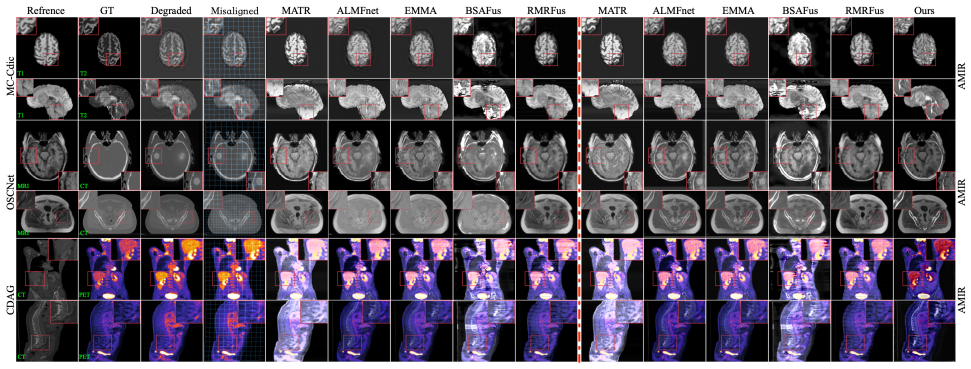
- [Section 4.3, Tables 1-5] Qssim values exceed the theoretical maximum of standard SSIM: e.g., Table 1 reports Ours Qssim=1.5288, Table 2 reports 1.2414, and Table 4 lists 1.5288, 1.3128, 1.2021, 1.1594, 1.4548, and 1.4400, all greater than 1. Since Qssim is stated to be the Structural Similarity Index from [31], these numbers are impossible for standard SSIM, so either the metric is not SSIM and its formula is not given, or the reported results are invalid. In the same table, Qmse=0.0125 and Qpsnr=23.0727 are mutually inconsistent with the standard relation PSNR = -10 log10(MSE), which gives about 19.0 dB for normalized intensities. Because the 'best on all metrics' claim and the ablation conclusions (Tables 4 and 5) rely on this metric, the quantitative evidence must be recomputed and re-reported with standard metrics or with an explicit non-standard definition.
- [Section 4.4, Tables 1-6] No error bars, confidence intervals, or significance tests are reported for any quantitative comparison. Several between-method differences are small (e.g., Qcc 0.9082 vs 0.8970 and Qmse 0.0125 vs 0.0188 in Table 1), so the claim of 'significant advantages' in the Conclusion is not statistically substantiated. Please report per-test-set statistics and paired significance tests for all metrics.
- [Section 4.1 and Section 10] The evaluation is limited to synthetic degradations added to aligned datasets (motion artifacts via [26], metal artifacts/noise via [39], PET noise via [44]) with synthetic rigid/non-rigid misalignments. Section 10 explicitly concedes that the method assumes inputs are not severely distorted, may be sensitive to extreme misalignments, and may not generalize to all degradation scenarios or unseen modalities. The abstract and introduction claim a 'general' framework for 'diverse degradations,' which is broader than the current evidence supports. Please either add experiments on real degraded/misaligned data or temper the generalization claims.
- [Section 4.3 and Figure 13] The FLOPs comparison (Qf) is reported without stating the input size used for Tables 1-3 or whether the staged baselines include all component models (restoration + registration + fusion) in the FLOPs count. Figure 13 uses 256^3 inputs while training uses 160^3 per Section 4.2. Please specify the protocol so the claimed computational advantage can be verified.
minor comments (6)
- [Section 3.3] The text states 'For ¯F_D and ¯F'_D, we use Lmoda', but Eq. (4) uses Lcont(¯F_D, ¯F_R) and Lcont(¯F'_R, ¯F'_D); please correct the text or equation.
- [Section 3.4, Eq. (6)] The deformation field label ϕgt in Eq. (6) is not defined; please explain how it is derived from the synthetic transformations.
- [Eq. (5)] The notation f_i, f_j^+, and f_j^- in the contrastive loss is not fully defined before the equation; please clarify the sampling procedure.
- [Section 4.3] Reference [1] is cited for Qmse, but its title is 'A new image quality metric for image fusion: The sum of the correlations of differences', not Mean Squared Error; if Qmse is actually SCD, rename the metric accordingly.
- [Table 4] The value '1.667' in the Setting C row has only three decimals whereas other entries have four; please unify the formatting.
- [Figure 1 caption] The caption for Figure 1 is incomplete; it describes the difference between the proposed and existing methods but does not explain what each panel contains.
Circularity Check
No load-bearing circularity: UniFuse's contributions are validated by external benchmarks and ablations, not by definitional or self-citational reduction.
full rationale
UniFuse is an empirical deep-learning paper; it contains no analytic derivation in which an output quantity is defined in terms of the very quantity it is claimed to predict. The fusion and alignment outputs are trained with supervised losses (Lce, Lmoda, Lreg, Lrf) defined on ground-truth labels, deformation fields, and clean reference images, and then evaluated on held-out test splits of BraTS2020, SynthRAD2023, and FDG-PET/CT against independently published restoration, registration, and fusion methods. The design components (DAPL, OUFR, FA, UFR&F) are validated by ablations that remove or replace the module, which is a direct empirical test rather than a tautology. The only self-citations, most notably BSAFusion [16], appear in the related-work discussion and as one of the staged fusion baselines; they are not used as a justification for the central claim, and no author-specific 'uniqueness theorem' is invoked. The quantitative anomalies noted elsewhere (Qssim values exceeding 1, and the Qmse/Qpsnr inconsistency in Table 1) indicate an evaluation-code or metric-implementation problem, not a circular dependency in the method's derivation. Consequently, no circular step can be quoted with a specific Eq.-to-Eq. or parameter-to-prediction reduction.
Assumptions & free parameters
free parameters (4)
- Temperature tau in contrastive loss =
0.1
- Number of RegBLKs in FA =
4
- Loss weights for Lce, Lmoda, Lreg, Lrf =
all 1 (implicit)
- Patch size Q and Spatial Mamba dimensions =
not reported
assumptions (3)
- domain assumption Synthetic degradation models from [26], [39], [44] are faithful proxies for real motion artifacts, metal artifacts, and low-dose PET noise.
- domain assumption Clean high-quality labels and ground-truth deformation fields exist for every pair.
- domain assumption One modality is always a high-quality reference while the other is degraded.
Cite this review
Pith. "Pith review of UniFuse: A Unified All-in-One Framework for Multi-Modal Medical Image Fusion Under Diverse Degradations and Misalignments." pith.science (2026). https://pith.science/paper/IXQALNGQ
@misc{pith2026250622736,
  author       = {Pith},
  title        = {Pith review of: UniFuse: A Unified All-in-One Framework for Multi-Modal Medical Image Fusion Under Diverse Degradations and Misalignments},
  year         = {2026},
  howpublished = {\url{https://pith.science/paper/IXQALNGQ}},
  note         = {Machine review of arXiv:2506.22736}
}
read the original abstract
Current multimodal medical image fusion typically assumes that source images are of high quality and perfectly aligned at the pixel level. Its effectiveness heavily relies on these conditions and often deteriorates when handling misaligned or degraded medical images. To address this, we propose UniFuse, a general fusion framework. By embedding a degradation-aware prompt learning module, UniFuse seamlessly integrates multi-directional information from input images and correlates cross-modal alignment with restoration, enabling joint optimization of both tasks within a unified framework. Additionally, we design an Omni Unified Feature Representation scheme, which leverages Spatial Mamba to encode multi-directional features and mitigate modality differences in feature alignment. To enable simultaneous restoration and fusion within an All-in-One configuration, we propose a Universal Feature Restoration & Fusion module, incorporating the Adaptive LoRA Synergistic Network (ALSN) based on LoRA principles. By leveraging ALSN's adaptive feature representation along with degradation-type guidance, we enable joint restoration and fusion within a single-stage framework. Compared to staged approaches, UniFuse unifies alignment, restoration, and fusion within a single framework. Experimental results across multiple datasets demonstrate the method's effectiveness and significant advantages over existing approaches.
Figures


Figures from the paper (9 more)


Reference graph
Works this paper leans on
-
[31]
Image quality assessment: from error visibility to structural similarity
Zhou Wang, Alan C Bovik, Hamid R Sheikh, and Eero P Si- moncelli. Image quality assessment: from error visibility to structural similarity. IEEE transactions on image processing, 13(4):600–612, 2004. 7
2004
-
[26]
Richard Shaw, Carole H Sudre, Thomas Varsavsky, S´ebastien Ourselin, and M Jorge Cardoso. A k-space model of movement artefacts: application to segmentation augmen- tation and artefact removal. IEEE transactions on medical imaging, 39(9):2881–2892, 2020. 6
work page 2020
-
[39]
Jianjia Zhang, Haiyang Mao, Dingyue Chang, Hengyong Yu, Weiwen Wu, and Dinggang Shen. Adaptive and itera- tive learning with multi-perspective regularizations for metal artifact reduction. IEEE Transactions on Medical Imaging ,
-
[44]
Bo Zhou, Tianshun Miao, Niloufar Mirian, Xiongchao Chen, Huidong Xie, Zhicheng Feng, Xueqi Guo, Xiaoxiao Li, S Kevin Zhou, James S Duncan, et al. Federated transfer learning for low-dose pet denoising: a pilot study with sim- ulated heterogeneous data. IEEE transactions on radiation and plasma medical sciences, 7(3):284–295, 2022. 6
work page 2022
-
[1]
A new image quality met- ric for image fusion: The sum of the correlations of differ- ences
V Aslantas and Emre Bendes. A new image quality met- ric for image fusion: The sum of the correlations of differ- ences. Aeu-international Journal of electronics and commu- nications, 69(12):1890–1896, 2015. 7
work page 2015
-
[2]
V oxelmorph: a learning framework for deformable medical image registration
Guha Balakrishnan, Amy Zhao, Mert R Sabuncu, John Gut- tag, and Adrian V Dalca. V oxelmorph: a learning framework for deformable medical image registration. IEEE transac- tions on medical imaging, 38(8):1788–1800, 2019. 1
work page 2019
-
[3]
Transmorph: Transformer for unsuper- vised medical image registration
Junyu Chen, Eric C Frey, Yufan He, William P Segars, Ye Li, and Yong Du. Transmorph: Transformer for unsuper- vised medical image registration. Medical image analysis , 82:102615, 2022. 1
work page 2022
-
[4]
Ammnet: A multimodal medical image fusion method based on an attention mechanism and mobilenetv3
Jing Di, Wenqing Guo, Jizhao Liu, Li Ren, and Jing Lian. Ammnet: A multimodal medical image fusion method based on an attention mechanism and mobilenetv3. Biomedical Signal Processing and Control, 96:106561, 2024. 1, 2
work page 2024
Show all 44 references
-
[5]
Learning federated visual prompt in null space for mri reconstruction
Chun-Mei Feng, Bangjun Li, Xinxing Xu, Yong Liu, Huazhu Fu, and Wangmeng Zuo. Learning federated visual prompt in null space for mri reconstruction. In Proceedings of the IEEE/CVF Conference on Computer Vision and Pattern Recognition (CVPR), pages 8064–8073, 2023. 2
2023
-
[6]
A whole-body fdg-pet/ct dataset with manu- ally annotated tumor lesions.Scientific Data, 9(1):601, 2022
Sergios Gatidis, Tobias Hepp, Marcel Fr ¨uh, Christian La Foug `ere, Konstantin Nikolaou, Christina Pfannenberg, Bernhard Sch ¨olkopf, Thomas K ¨ustner, Clemens Cyran, and Daniel Rubin. A whole-body fdg-pet/ct dataset with manu- ally annotated tumor lesions.Scientific Data, 9(...
2022
-
[7]
Adaptive spatial and frequency experts fusion network for medical image fusion.Biomedical Signal Processing and Control, 96:106478, 2024
Xianming Gu, Lihui Wang, Zeyu Deng, Ying Cao, Xingyu Huang, and Yue-min Zhu. Adaptive spatial and frequency experts fusion network for medical image fusion.Biomedical Signal Processing and Control, 96:106478, 2024. 2
2024
-
[8]
Adaptive diffusion priors for accelerated mri reconstruction
Alper G ¨ung¨or, Salman UH Dar, S ¸aban¨Ozt¨urk, Yilmaz Kork- maz, Hasan A Bedel, Gokberk Elmas, Muzaffer Ozbey, and Tolga C ¸ ukur. Adaptive diffusion priors for accelerated mri reconstruction. Medical image analysis, 88:102872, 2023. 2
2023
-
[9]
A new im- age fusion performance metric based on visual information fidelity
Yu Han, Yunze Cai, Yin Cao, and Xiaoming Xu. A new im- age fusion performance metric based on visual information fidelity. Information fusion, 14(2):127–135, 2013. 7
2013
-
[10]
Contrastive diffusion model with auxiliary guidance for coarse-to-fine pet reconstruction
Zeyu Han, Yuhan Wang, Luping Zhou, Peng Wang, Binyu Yan, Jiliu Zhou, Yan Wang, and Dinggang Shen. Contrastive diffusion model with auxiliary guidance for coarse-to-fine pet reconstruction. In International Conference on Medi- cal Image Computing and Computer-Assisted Intervent...
2023
-
[11]
Reconet: Recurrent correction network for fast and efficient multi-modality image fusion
Zhanbo Huang, Jinyuan Liu, Xin Fan, Risheng Liu, Wei Zhong, and Zhongxuan Luo. Reconet: Recurrent correction network for fast and efficient multi-modality image fusion. In European Conference on Computer Vision (ECCV), pages 539–555. Springer, 2022. 3
2022
-
[12]
Peak signal-to-noise ratio revisited: Is simple beautiful? In 2012 Fourth international workshop on quality of multimedia experience, pages 37–38
Jari Korhonen and Junyong You. Peak signal-to-noise ratio revisited: Is simple beautiful? In 2012 Fourth international workshop on quality of multimedia experience, pages 37–38. IEEE, 2012. 7
2012
-
[13]
Deep unfolding convolutional dictionary model for multi- contrast mri super-resolution and reconstruction
Pengcheng Lei, Faming Fang, Guixu Zhang, and Ming Xu. Deep unfolding convolutional dictionary model for multi- contrast mri super-resolution and reconstruction. InProceed- ings of the Thirty-Second International Joint Conference on Artificial Intelligence (IJCAI), pages 1008–1...
2023
-
[14]
Feature dynamic alignment and refinement for infrared–visible image fusion: Translation robust fusion
Huafeng Li, Junzhi Zhao, Jinxing Li, Zhengtao Yu, and Guangming Lu. Feature dynamic alignment and refinement for infrared–visible image fusion: Translation robust fusion. Information Fusion, 95:26–41, 2023. 3
2023
-
[15]
A deep learning framework for infrared and visible image fusion without strict registration
Huafeng Li, Junyu Liu, Yafei Zhang, and Yu Liu. A deep learning framework for infrared and visible image fusion without strict registration. International Journal of Com- puter Vision, 132:1625–1644, 2024. 3
2024
-
[16]
Bsafu- sion: A bidirectional stepwise feature alignment network for unaligned medical image fusion
Huafeng Li, Dayong Su, Qing Cai, and Yafei Zhang. Bsafu- sion: A bidirectional stepwise feature alignment network for unaligned medical image fusion. In Proceedings of the AAAI Conference on Artificial Intelligence, 2025. 3, 7
2025
-
[17]
Mulfs-cap: Multimodal fusion- supervised cross-modality alignment perception for unreg- istered infrared-visible image fusion
Huafeng Li, Zengyi Yang, Yafei Zhang, Wei Jia, Zheng- tao Yu, and Yu Liu. Mulfs-cap: Multimodal fusion- supervised cross-modality alignment perception for unreg- istered infrared-visible image fusion. IEEE Transactions on Pattern Analysis and Machine Intelligence, 2025. 3
2025
-
[18]
Dfenet: A dual-branch feature enhanced network integrating transformers and convolutional feature learning for multimodal medical image fusion
Weisheng Li, Yin Zhang, Guofen Wang, Yuping Huang, and Ruyue Li. Dfenet: A dual-branch feature enhanced network integrating transformers and convolutional feature learning for multimodal medical image fusion. Biomedical Signal Processing and Control, 80:104402, 2023. 2
2023
-
[19]
Quad-net: Quad-domain network for ct metal artifact reduction
Zilong Li, Qi Gao, Yaping Wu, Chuang Niu, Junping Zhang, Meiyun Wang, Ge Wang, and Hongming Shan. Quad-net: Quad-domain network for ct metal artifact reduction. IEEE Transactions on Medical Imaging, 2024. 2
2024
-
[20]
Swinir: Image restoration us- ing swin transformer
Jingyun Liang, Jiezhang Cao, Guolei Sun, Kai Zhang, Luc Van Gool, and Radu Timofte. Swinir: Image restoration us- ing swin transformer. InProceedings of the IEEE/CVF inter- national conference on computer vision , pages 1833–1844,
-
[21]
Correlation-aware coarse-to-fine mlps for deformable med- ical image registration
Mingyuan Meng, Dagan Feng, Lei Bi, and Jinman Kim. Correlation-aware coarse-to-fine mlps for deformable med- ical image registration. In Proceedings of the IEEE/CVF Conference on Computer Vision and Pattern Recognition (CVPR), pages 9645–9654, 2024. 7
2024
-
[22]
Correlation-aware coarse-to-fine mlps for deformable medi- cal image registration
Mingyuan Meng, Dagan Feng, Lei Bi, and Jinman Kim. Correlation-aware coarse-to-fine mlps for deformable medi- cal image registration. InProceedings of the IEEE/CVF Con- ference on Computer Vision and Pattern Recognition, pages 9645–9654, 2024. 1
2024
-
[23]
Comparing correlated correlation coefficients
Xiao-Li Meng, Robert Rosenthal, and Donald B Rubin. Comparing correlated correlation coefficients. Psychologi- cal bulletin, 111(1):172, 1992. 7
1992
-
[24]
The multimodal brain tumor image segmentation benchmark (brats)
Bjoern H Menze, Andras Jakab, Stefan Bauer, Jayashree Kalpathy-Cramer, Keyvan Farahani, Justin Kirby, Yuliya Burren, Nicole Porz, Johannes Slotboom, Roland Wiest, et al. The multimodal brain tumor image segmentation benchmark (brats). IEEE transactions on medical imaging , 34(...
1993
-
[25]
Learning to search a lightweight general- ized network for medical image fusion
Pan Mu, Guanyao Wu, Jinyuan Liu, Yuduo Zhang, Xin Fan, and Risheng Liu. Learning to search a lightweight general- ized network for medical image fusion. IEEE Transactions on Circuits and Systems for Video Technology, 34(7):5921– 5934, 2023. 7
2023
-
[27]
Destrans: A medical image fusion method based on trans- former and improved densenet
Yumeng Song, Yin Dai, Weibin Liu, Yue Liu, Xinpeng Liu, Qiming Yu, Xinghan Liu, Ningfeng Que, and Mingzhe Li. Destrans: A medical image fusion method based on trans- former and improved densenet. Computers in Biology and Medicine, 174:108463, 2024. 2
2024
-
[28]
Matr: Mul- timodal medical image fusion via multiscale adaptive trans- former
Wei Tang, Fazhi He, Yu Liu, and Yansong Duan. Matr: Mul- timodal medical image fusion via multiscale adaptive trans- former. IEEE Transactions on Image Processing, 31:5134– 5149, 2022. 1, 2, 7
2022
-
[29]
Syn- thrad2023 grand challenge dataset: Generating synthetic ct for radiotherapy
Adrian Thummerer, Erik van der Bijl, Arthur Galapon Jr, Joost JC Verhoeff, Johannes A Langendijk, Stefan Both, Cornelis (Nico) AT van den Berg, and Matteo Maspero. Syn- thrad2023 grand challenge dataset: Generating synthetic ct for radiotherapy. Medical physics, 50(7):4664–467...
2023
-
[30]
Oscnet: Orientation-shared convolu- tional network for ct metal artifact learning
Hong Wang, Qi Xie, Dong Zeng, Jianhua Ma, Deyu Meng, and Yefeng Zheng. Oscnet: Orientation-shared convolu- tional network for ct metal artifact learning. IEEE Trans- actions on Medical Imaging, 2023. 2, 7
2023
-
[32]
Pnd-net: Physics-inspired non-local dual- domain network for metal artifact reduction
Jinqiu Xia, Yiwen Zhou, Wenxin Deng, Jing Kang, Wangjiang Wu, Mengke Qi, Linghong Zhou, Jianhui Ma, and Yuan Xu. Pnd-net: Physics-inspired non-local dual- domain network for metal artifact reduction. IEEE Trans- actions on Medical Imaging, 2024. 2
2024
-
[33]
Fusionmamba: Dynamic feature enhancement for mul- timodal image fusion with mamba
Xinyu Xie, Yawen Cui, Tao Tan, Xubin Zheng, and Zitong Yu. Fusionmamba: Dynamic feature enhancement for mul- timodal image fusion with mamba. Visual Intelligence, 2(1): 37, 2024. 1, 3
2024
-
[34]
Murf: Mutually re- inforcing multi-modal image registration and fusion
Han Xu, Jiteng Yuan, and Jiayi Ma. Murf: Mutually re- inforcing multi-modal image registration and fusion. IEEE Transactions on Pattern Analysis and Machine Intelligence, 45(10):12148–12166, 2023. 3
2023
-
[35]
All- in-one medical image restoration via task-adaptive routing
Zhiwen Yang, Haowei Chen, Ziniu Qian, Yang Yi, Hui Zhang, Dan Zhao, Bingzheng Wei, and Yan Xu. All- in-one medical image restoration via task-adaptive routing. In International Conference on Medical Image Computing and Computer-Assisted Intervention, pages 67–77. Springer,
-
[36]
Restore-rwkv: Efficient and effective medical im- age restoration with rwkv
Zhiwen Yang, Hui Zhang, Dan Zhao, Bingzheng Wei, and Yan Xu. Restore-rwkv: Efficient and effective medical im- age restoration with rwkv. arXiv preprint arXiv:2407.11087,
-
[37]
F-darts: Foveated differentiable architecture search based multimodal medical image fusion
Shaozhuang Ye, Tuo Wang, Mingyue Ding, and Xuming Zhang. F-darts: Foveated differentiable architecture search based multimodal medical image fusion. IEEE Transactions on Medical Imaging, 42(11):3348–3361, 2023. 1, 2
2023
-
[38]
A robust mutual-reinforcing framework for 3d multi- modal medical image fusion based on visual-semantic con- sistency
Hao Zhang, Xuhui Zuo, Huabing Zhou, Tao Lu, and Jiayi Ma. A robust mutual-reinforcing framework for 3d multi- modal medical image fusion based on visual-semantic con- sistency. InProceedings of the AAAI Conference on Artificial Intelligence, pages 7087–7095, 2024. 2, 7
2024
-
[40]
Self-supervised deep learning for joint 3d low-dose pet/ct image denoising
Feixiang Zhao, Dongfen Li, Rui Luo, Mingzhe Liu, Xin Jiang, and Junjie Hu. Self-supervised deep learning for joint 3d low-dose pet/ct image denoising. Computers in Biology and Medicine, 165:107391, 2023. 2
2023
-
[41]
Equivariant multi-modality image fusion
Zixiang Zhao, Haowen Bai, Jiangshe Zhang, Yulun Zhang, Kai Zhang, Shuang Xu, Dongdong Chen, Radu Timofte, and Luc Van Gool. Equivariant multi-modality image fusion. In Proceedings of the IEEE/CVF Conference on Computer Vi- sion and Pattern Recognition, pages 25912–25921, 2024. 2, 7
2024
-
[42]
Unsupervised fusion of misaligned pat and mri images via mutually reinforcing cross-modality image generation and registration
Yutian Zhong, Shuangyang Zhang, Zhenyang Liu, Xiaom- ing Zhang, Zongxin Mo, Yizhe Zhang, Haoyu Hu, Wufan Chen, and Li Qi. Unsupervised fusion of misaligned pat and mri images via mutually reinforcing cross-modality image generation and registration. IEEE Transactions on Medica...
2023
-
[43]
Dudoufnet: dual-domain under-to-fully-complete progressive restoration network for simultaneous metal artifact reduction and low-dose ct recon- struction
Bo Zhou, Xiongchao Chen, Huidong Xie, S Kevin Zhou, James S Duncan, and Chi Liu. Dudoufnet: dual-domain under-to-fully-complete progressive restoration network for simultaneous metal artifact reduction and low-dose ct recon- struction. IEEE transactions on medical imaging , 41...
2022
Reviewed August 6, 2026 · model on record in the stance chip above.
Discussion (0). Continue with ORCID to comment.