REVIEW 4 major objections 5 minor 38 references
JT-Math: A Multi-Stage Framework for Advanced Mathematical Reasoning in Large Language Models
T0 review · 4 major / 5 minor · reviewed 2026-08-06 · deepseek-v4-flash
Pith's one-line read A multi-stage training pipeline lets an 8B open model outperform o1-mini and GPT-4o on competition mathematics.
desk verdict Plausible recipe, unverified numbers: the 8B SOTA claim hinges on a one-sentence decontamination note and no released artifacts. read the letter →
The pith
A machine-rendered reading of the paper's core claim, the machinery that carries it, and where it could break.
The reading
What carries the argument
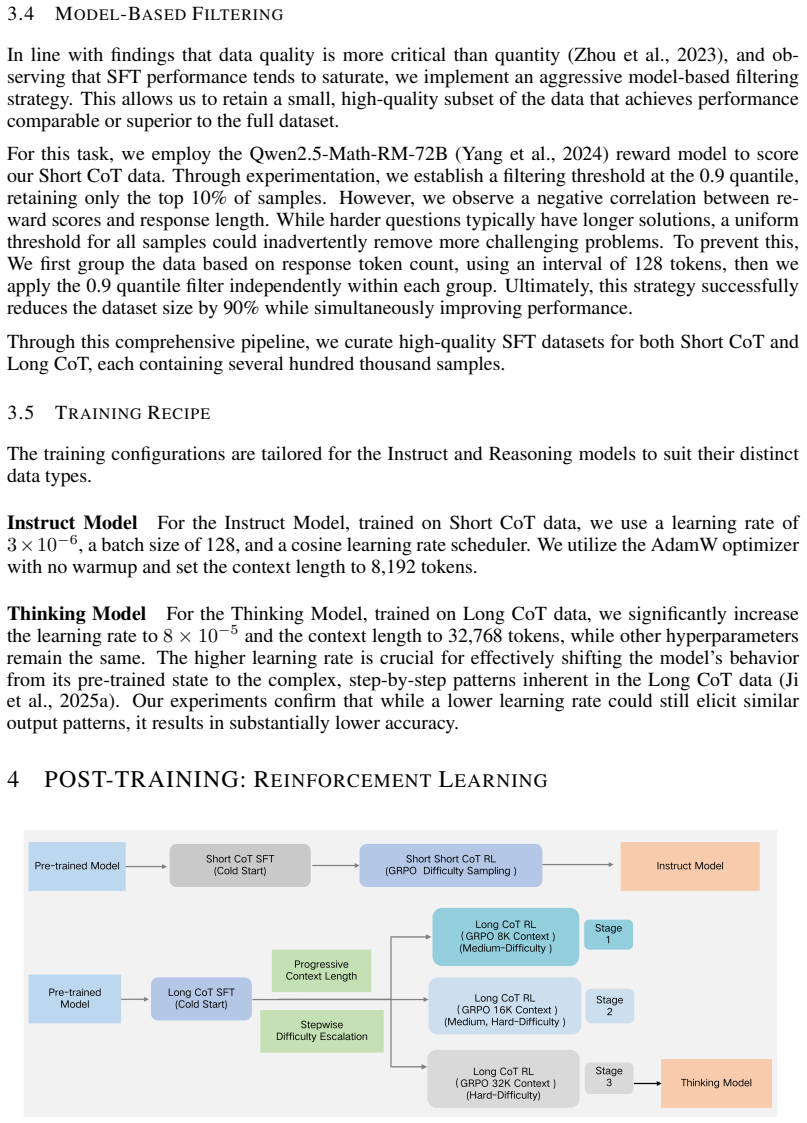
The load-bearing mechanism is a curriculum. Pre-training is staged into general math knowledge, reasoning-and-thinking, and a 32K-token long-context extension, on a corpus of 210B tokens whose quality is validated by small-scale ablation models. Post-training splits into two paths: a Short CoT path that yields the Instruct model, and a Long CoT path that yields the Thinking model. Both use GRPO (Group Relative Policy Optimization), a reinforcement-learning update that assigns rewards relative to a group of sampled answers; the Thinking path adds a multi-stage RL curriculum that starts at 8K context, expands to 16K, then 32K, and removes queries at the extremes of estimated difficulty. The curriculum is what the paper credits for stable policy updates and for teaching long, exploratory reasoning.
What would settle it
Evaluate the released JT-Math models on olympiad-style problems written after July 2025 under the same sampling protocol used for the baselines; if the reported margin over o1-mini shrinks or disappears, the central claim would be shown to depend on benchmark familiarity rather than a general capability.
Extended reading notes
Core claim
On the paper's own terms, the central discovery is empirical: an 8B model can be brought to state-of-the-art performance on advanced mathematics by optimizing each stage of its lifecycle rather than by scaling the model. Table 3 reports JT-Math-8B-Thinking averaging 77.68 on MATH-500, AIME 2024, AIME 2025, OlympiadBench, AMC 23, CNMO 2024, and CMath, against 69.61 for DeepSeek-R1-Distill-Qwen-7B and 69.40 for o1-mini-128k, with its largest leads on CNMO 2024 and AIME 2025. The Instruct variant averages 63.74, more than 16 points above the next-best open instruct baseline and far above GPT-4o's 39.62 in the same table. The paper attributes these results to the pretraining corpus's quality vetting, the separation of short and long chain-of-thought post-training, and the multi-stage RL curriculum with progressive context extension.
Load-bearing premise
The load-bearing premise is that the benchmark margins reflect genuine reasoning rather than accidental overlap with training data, since the only decontamination described is removal of exact ten-word sequence matches and the evaluation settings are not sensitivity-tested.
Editorial extensions
If this is right
- An 8B open model can match or beat a proprietary reasoning model like o1-mini on competition math, lowering the compute bar for reproducing strong mathematical reasoning.
- The progressive 8K-to-32K RL curriculum is claimed to be more resource-efficient than starting RL at the full context length, so the recipe can be copied by teams with limited GPU budgets.
- Splitting post-training into Instruct and Thinking paths lets a single base model serve both fast direct answers and slow deliberative reasoning.
- Reward-model filtering at the 0.9 quantile within response-length groups cuts SFT data by 90% while improving benchmark scores, suggesting data curation can substitute for data volume.
- Competition-level mathematics (AIME, OlympiadBench, CNMO) is now a domain where open 8B models can outscore general-purpose frontier models.
Reading between the lines
- The paper leaves untested whether the same RL curriculum would work without the math-specialized pretraining corpus; running it on a general-pretrained 8B model would isolate the source of the gains.
- Because the Thinking model's largest leads are on Chinese benchmarks (CNMO 2024, CMath), a reasonable extension is to check whether the margin reflects stronger Chinese-data curation or genuinely better mathematical reasoning.
- A natural extension of the paper's evaluation would be a paraphrase-level leakage check on AIME and OlympiadBench, since the reported decontamination uses exact 10-gram matching only.
- If the recipe transfers to other verifiable domains, the same staged pipeline (curriculum RL with difficulty filtering and progressive context) could accelerate open-source progress in code and theorem proving.
Editorial analysis
A structured set of objections, weighed in public.
Referee Report
Summary. The paper introduces JT-Math-8B, a family of three models (base, instruct, and thinking) trained from scratch on a 210B-token mathematical corpus, followed by SFT and GRPO-based RL with a multi-stage curriculum that progressively increases task difficulty and context length to 32K tokens. The central claim is that JT-Math-8B achieves state-of-the-art results among open-source models of similar size and surpasses OpenAI's o1-mini and GPT-4o on competition-level mathematics. Tables 1-3 report large margins on seven benchmarks, with Table 3 showing JT-Math-8B-Thinking averaging 77.68 versus 69.61 for DeepSeek-R1-Distill-Qwen-7B and 69.40 for o1-mini-128k.
Significance. If the reported results are robust, the paper demonstrates that a carefully curated math corpus combined with curriculum RL can produce competition-level performance at 8B scale, which would be a valuable contribution to the open-source community. The paper is transparent about many training details: data mixing ablations, quality filtering thresholds, GRPO modifications, and the context-length curriculum are all described. However, the current evidence is weakened by the absence of released artifacts, a one-sentence decontamination protocol, missing strong baselines, and evaluation settings that are not sensitivity-tested; these gaps currently limit confidence in the headline SOTA claim.
major comments (4)
- [§5; §2.1.1; §3.2] The decontamination described in §5 is a single sentence stating that an 'established 10-gram filtering methodology' was applied to all pre-training and post-training data, with no citation and no leakage statistics. Since the data pipeline includes LLM-based translation (§2.1.1) and rewriting/condensing of solutions (§3.2), public competition problems can appear in the training corpus as near-duplicates that share no exact 10-gram. The largest margins in Table 3 over DeepSeek-R1-Distill-Qwen-7B are on AIME 2025 (+17.45), AIME 2024 (+14.53), and CNMO 2024 (+6.77), exactly the most public, high-stakes sets. Please provide per-benchmark overlap statistics, a paraphrase-tolerant contamination audit (e.g., normalized n-gram hashing or embedding-based near-duplicate detection), and an explicit statement of whether the translated and rewritten data were included in the audit.
- [Table 3; §6.5] The headline Thinking-model comparisons are reported as average@8 scores without error bars or per-problem breakdowns. AIME 2024 and AIME 2025 each contain 30 problems, so a 14-17 point gap can be driven by a small number of problems; no confidence intervals or significance tests are given. The evaluation settings also differ across models (temperature 0.65 for JT-Math-8B-Thinking, 0.6 for DeepSeek-R1-Distill-Qwen-7B, and default for o1-mini-128k) with no sensitivity analysis, and only average@8 is reported rather than pass@1 or a distribution over samples. These choices are load-bearing because the central claim is an average-score superiority over the comparison models.
- [Table 3; §6.2] The claim of state-of-the-art among open-source models of similar size is not fully supported by the baseline selection. Table 3 includes only one open 7-8B reasoning model (DeepSeek-R1-Distill-Qwen-7B); Qwen2.5-Math-7B-Instruct, which appears in Table 2, is not evaluated in the Thinking comparison, and other contemporary open models of comparable scale (e.g., Qwen3-8B) are absent. Without these baselines, the SOTA claim over open-source models is not established, even if the closed-model comparison is valid.
- [§2.1.2; §3.1; §6] The data-quality validation in Section 2.1.2 and the SFT source selection in Section 3.1 are described as using 'downstream performance on mathematical benchmarks' and 'multiple test benchmarks', but the manuscript never states which benchmarks were used in these selections or whether they were disjoint from the evaluation suite in Section 6. Since the reported suite includes AIME, OlympiadBench, and CNMO, validation on any of these would constitute selection on the evaluation metric. Please disclose the validation benchmark sets and describe a held-out protocol that prevents benchmark-driven data choices.
minor comments (5)
- [§2.1.2; §4.1.2; §4.1.4] There are several typos and grammar errors: 'we ensur that' in §2.1.2, 'are are' in §4.1.2, and 'we implement and evaluated' in §4.1.4; these should be corrected.
- [References; §5] The references for AMC 23 and CNMO 2024 are incomplete (no author or venue information), and §5 gives no citation for the 'established 10-gram filtering methodology'; please add proper references.
- [§1; Abstract] The paper claims to release the entire JT-Math series to the public, but no URLs, model card links, or repository information appear anywhere in the manuscript; please add the artifact links or state where they will be hosted.
- [Figure 6; §4.1.1] Figure 6 is referenced to demonstrate RL-ZERO improvements, but no quantitative training-curve values are reported in the text, so the claim of 'clear improvements' cannot be evaluated; please include the exact numbers or a table.
- [§6.1] Benchmark names are used inconsistently ('MATH-500' vs. 'Math-500' and 'Olympiad Bench' vs. 'OlympiadBench'); please standardize throughout the paper.
Circularity Check
Benchmark-based data selection is presented as benchmark prediction: pretraining and SFT corpora are chosen by downstream math-benchmark scores, then the same benchmark suite is reported as SOTA; Section 5's uncited 10-gram filter is a separate leakage risk.
-
fitted input called prediction
[Section 2.1.2 (Data Ingredients); results in Section 6.3, Table 1]
"This stage involves replacing data of the same type, training small-scale models, and comparing the downstream performance between the base model and the validation model. This directly measures the data’s impact on downstream performance, which in turn guides iterative data optimization. ... We then compare the downstream performance differences of the validation model with the base model on the mathematical benchmark."
The pretraining corpus composition is selected by comparing validation models on 'the mathematical benchmark'; the final JT-Math-8B-Base is then reported on the same benchmarks (Table 1: GSM8K, MATH, CMath). The reported Base scores are the objective used to admit or reject data, so they are not independent evidence of the pipeline's quality. This is selection on the evaluation metric rather than a definitional identity, but it fits the 'fitted input called prediction' pattern because the benchmark numbers are optimized targets, not held-out forecasts.
-
fitted input called prediction
[Section 3.1 (Data Sources and Quality Assessment); results in Sections 6.4-6.5, Tables 2-3]
"The quality of each dataset is estimated by measuring the average performance across multiple test benchmarks at several final training checkpoints. Based on these results, we select the top-performing datasets as the foundation for our subsequent data processing and synthesis efforts."
The SFT data sources are chosen to maximize 'average performance across multiple test benchmarks'; the final Instruct and Thinking models are then evaluated on the same benchmark suite reported in Tables 2 and 3 (MATH-500, AIME 2024/2025, OlympiadBench, AMC 23, CNMO 24, CMath). The reported SOTA averages are therefore the fitted objective of data selection, not a fresh prediction of the framework. No separate held-out validation protocol is described, so the final tables do not independently validate the data-curation choices.
full rationale
The paper contains no equations and no self-citation chains; the central claim is empirical. The main circularity is a benchmark-selection loop: Section 2.1.2 chooses pretraining data by downstream 'mathematical benchmark' performance and Section 3.1 chooses SFT sources by 'average performance across multiple test benchmarks', while Sections 6.3-6.5 report exactly that kind of benchmark suite as the model's SOTA results. The scores are thus influenced by the same objective used to curate and select the data; they are not clean held-out predictions. The circularity is only partial because the final 8B models are not literally defined by those scores, and a genuinely stronger model could still transfer to unseen variants. Separately, Section 5's decontamination is a single uncited '10-gram filtering methodology' that cannot detect rewritten or LLM-translated near-duplicates from the pipeline in Sections 2.1.1 and 3.2; that is a validity/leakage concern rather than a circularity. Weighing these, a moderate score of 4 is appropriate: some 'predictions' reduce to the metric used for selection, but the central framework has independent content and the paper is not a definitional tautology.
Assumptions & free parameters
free parameters (6)
- Reward-model filtering quantile =
0.9
- Curriculum context lengths =
8K, 16K, 32K
- KL divergence coefficient =
1e-3
- Rollouts per query =
16
- Sampling temperature for RL =
1.2
- Evaluation average@8 samples =
8 samples, temp 0.65 Thinking
assumptions (4)
- domain assumption 10-gram decontamination eliminates training/test overlap
- domain assumption 1.5B proxy model performance predicts 8B data quality
- domain assumption Qwen2.5-Math-RM-72B reward scores correlate with true solution quality after length-binning
- domain assumption Benchmark answer extraction and math_verify parsing are correct for all reported problems
Cite this review
Pith. "Pith review of JT-Math: A Multi-Stage Framework for Advanced Mathematical Reasoning in Large Language Models." pith.science (2026). https://pith.science/paper/IYJ5CTHS
@misc{pith2026250719748,
  author       = {Pith},
  title        = {Pith review of: JT-Math: A Multi-Stage Framework for Advanced Mathematical Reasoning in Large Language Models},
  year         = {2026},
  howpublished = {\url{https://pith.science/paper/IYJ5CTHS}},
  note         = {Machine review of arXiv:2507.19748}
}
read the original abstract
Mathematical reasoning is a cornerstone of artificial general intelligence and a primary benchmark for evaluating the capabilities of Large Language Models (LLMs). While state-of-the-art models show promise, they often falter when faced with complex problems that demand deep conceptual understanding and intricate, multi-step deliberation. To address this challenge, we introduce JT-Math-8B, a series of open-source models comprising base, instruct, and thinking versions, built upon a systematic, multi-stage optimization framework. Our pre-training corpus is a high-quality, 210B-token dataset curated through a dedicated data pipeline that uses model-based validation to ensure quality and diversity. The Instruct Model is optimized for direct, concise answers through Supervised Fine-Tuning (SFT) and a GRPO-based reinforcement learning (RL) method. The Thinking Model is trained for complex problem-solving using a Long Chain-of-Thought (Long CoT) approach, combining SFT with a novel, multi-stage RL curriculum that progressively increases task difficulty and context length up to 32K tokens. JT-Math-8B achieves state-of-the-art results among open-source models of similar size, surpassing prominent models like OpenAI's O1-mini and GPT-4o , and demonstrating superior performance on competition-level mathematics.
Figures


Figures from the paper (3 more)


Reference graph
Works this paper leans on
-
[1]
write newline
" write newline "" before.all 'output.state := FUNCTION n.dashify 't := "" t empty not t #1 #1 substring "-" = t #1 #2 substring "--" = not "--" * t #2 global.max substring 't := t #1 #1 substring "-" = "-" * t #2 global.max substring 't := while if t #1 #1 substring * t #2 global.max substring 't := if while FUNCTION format.date year duplicate empty "emp...
-
[2]
American invitational mathematics examination - aime
AIME . American invitational mathematics examination - aime. In American Invitational Mathematics Examination - AIME 2024, February 2024. [23]
work page 2024
-
[3]
American invitational mathematics examination - aime
AIME . American invitational mathematics examination - aime. In American Invitational Mathematics Examination - AIME 2025, February 2025. [24]
work page 2025
-
[4]
Llama 3 model card
AI@Meta. Llama 3 model card. 2024. URL https://github.com/meta-llama/llama3/blob/main/MODEL_CARD.md
2024
-
[5]
Smollm2: When smol goes big -- data-centric training of a small language model, 2025
Loubna Ben Allal, Anton Lozhkov, Elie Bakouch, Gabriel Martín Blázquez, Guilherme Penedo, Lewis Tunstall, Andrés Marafioti, Hynek Kydlíček, Agustín Piqueres Lajarín, Vaibhav Srivastav, Joshua Lochner, Caleb Fahlgren, Xuan-Son Nguyen, Clémentine Fourrier, Ben Burtenshaw, Hugo Larcher, Haojun Zhao, Cyril Zakka, Mathieu Morlon, Colin Raffel, Leandro von Werr...
arXiv 2025
-
[6]
American mathematics competition - amc
AMC 23 . American mathematics competition - amc. In American Mathematics Competition AMC
-
[7]
Acereason-nemotron: Advancing math and code reasoning through reinforcement learning
Yang Chen, Zhuolin Yang, Zihan Liu, Chankyu Lee, Peng Xu, Mohammad Shoeybi, Bryan Catanzaro, and Wei Ping. Acereason-nemotron: Advancing math and code reasoning through reinforcement learning. arXiv preprint arXiv:2505.16400, 2025
arXiv 2025
-
[8]
The chinese national mathematics olympiad (cnmo), 2024
CNMO . The chinese national mathematics olympiad (cnmo), 2024. Event/Organization Reference
work page 2024
Show all 38 references
-
[9]
Training verifiers to solve math word problems
Karl Cobbe, Vineet Kosaraju, Mohammad Bavarian, Mark Chen, Heewoo Jun, Lukasz Kaiser, Matthias Plappert, Jerry Tworek, Jacob Hilton, Reiichiro Nakano, et al. Training verifiers to solve math word problems. arXiv preprint arXiv:2110.14168, 2021
-
[10]
Deepseek-r1: Incentivizing reasoning capability in llms via reinforcement learning, 2025
DeepSeek-AI. Deepseek-r1: Incentivizing reasoning capability in llms via reinforcement learning, 2025. URL https://arxiv.org/abs/2501.12948
2025 arXiv
-
[11]
DeepSeek-AI, Qihao Zhu, Daya Guo, Zhihong Shao, Dejian Yang, Peiyi Wang, Runxin Xu, Y. Wu, Yukun Li, Huazuo Gao, Shirong Ma, Wangding Zeng, Xiao Bi, Zihui Gu, Hanwei Xu, Damai Dai, Kai Dong, Liyue Zhang, Yishi Piao, Zhibin Gou, Zhenda Xie, Zhewen Hao, Bingxuan Wang, Junxiao So...
2024 arXiv
-
[12]
Unleashing reasoning capability of llms via scalable question synthesis from scratch
Yuyang Ding, Xinyu Shi, Xiaobo Liang, Juntao Li, Qiaoming Zhu, and Min Zhang. Unleashing reasoning capability of llms via scalable question synthesis from scratch. arXiv preprint arXiv:2410.18693, 2024
2024 arXiv
-
[13]
Open r1: A fully open reproduction of deepseek-r1, January 2025
Hugging Face. Open r1: A fully open reproduction of deepseek-r1, January 2025. URL https://github.com/huggingface/open-r1
2025
-
[14]
Merrill, Tatsunori Hashimoto, Yejin Choi, Jenia Jitsev, Reinhard Heckel, Maheswaran Sathiamoorthy, Alexandros G
Etash Guha, Ryan Marten, Sedrick Keh, Negin Raoof, Georgios Smyrnis, Hritik Bansal, Marianna Nezhurina, Jean Mercat, Trung Vu, Zayne Sprague, Ashima Suvarna, Benjamin Feuer, Liangyu Chen, Zaid Khan, Eric Frankel, Sachin Grover, Caroline Choi, Niklas Muennighoff, Shiye Su, Wanj...
2025 arXiv
-
[15]
Olympiadbench: A challenging benchmark for promoting agi with olympiad-level bilingual multimodal scientific problems
Chaoqun He, Renjie Luo, Yuzhuo Bai, Shengding Hu, Zhen Leng Thai, Junhao Shen, Jinyi Hu, Xu Han, Yujie Huang, Yuxiang Zhang, et al. Olympiadbench: A challenging benchmark for promoting agi with olympiad-level bilingual multimodal scientific problems. arXiv preprint arXiv:2402....
2024 arXiv
-
[16]
Deepmath-103k: A large-scale, challenging, decontaminated, and verifiable mathematical dataset for advancing reasoning
Zhiwei He, Tian Liang, Jiahao Xu, Qiuzhi Liu, Xingyu Chen, Yue Wang, Linfeng Song, Dian Yu, Zhenwen Liang, Wenxuan Wang, et al. Deepmath-103k: A large-scale, challenging, decontaminated, and verifiable mathematical dataset for advancing reasoning. arXiv preprint arXiv:2504.11456, 2025
2025 arXiv
-
[17]
finemath-classifier, 2025
HuggingFaceTB. finemath-classifier, 2025. URL https://huggingface.co/HuggingFaceTB/finemath-classifier
2025
-
[18]
Am-thinking-v1: Advancing the frontier of reasoning at 32b scale, 2025 a
Yunjie Ji, Xiaoyu Tian, Sitong Zhao, Haotian Wang, Shuaiting Chen, Yiping Peng, Han Zhao, and Xiangang Li. Am-thinking-v1: Advancing the frontier of reasoning at 32b scale, 2025 a . URL https://arxiv.org/abs/2505.08311
2025 arXiv
-
[19]
How difficulty-aware staged reinforcement learning enhances llms' reasoning capabilities: A preliminary experimental study, 2025 b
Yunjie Ji, Sitong Zhao, Xiaoyu Tian, Haotian Wang, Shuaiting Chen, Yiping Peng, Han Zhao, and Xiangang Li. How difficulty-aware staged reinforcement learning enhances llms' reasoning capabilities: A preliminary experimental study, 2025 b . URL https://huggingface.co/datasets/a...
2025
-
[20]
Math-Verify: Math Verification Library , 2025
Hynek Kydlíček. Math-Verify: Math Verification Library , 2025. URL https://github.com/huggingface/math-verify
2025
-
[21]
Numinamath
Jia LI, Edward Beeching, Lewis Tunstall, Ben Lipkin, Roman Soletskyi, Shengyi Costa Huang, Kashif Rasul, Longhui Yu, Albert Jiang, Ziju Shen, Zihan Qin, Bin Dong, Li Zhou, Yann Fleureau, Guillaume Lample, and Stanislas Polu. Numinamath. [https://huggingface.co/AI-MO/NuminaMath...
2024
-
[22]
Let's verify step by step
Hunter Lightman, Vineet Kosaraju, Yuri Burda, Harrison Edwards, Bowen Baker, Teddy Lee, Jan Leike, John Schulman, Ilya Sutskever, and Karl Cobbe. Let's verify step by step. In The Twelfth International Conference on Learning Representations, 2023
2023
-
[23]
Acemath: Advancing frontier math reasoning with post-training and reward modeling
Zihan Liu, Yang Chen, Mohammad Shoeybi, Bryan Catanzaro, and Wei Ping. Acemath: Advancing frontier math reasoning with post-training and reward modeling. arXiv preprint arXiv:2412.15084, 2024
2024 arXiv
-
[24]
Aimo-2 winning solution: Building state-of-the-art mathematical reasoning models with openmathreasoning dataset
Ivan Moshkov, Darragh Hanley, Ivan Sorokin, Shubham Toshniwal, Christof Henkel, Benedikt Schifferer, Wei Du, and Igor Gitman. Aimo-2 winning solution: Building state-of-the-art mathematical reasoning models with openmathreasoning dataset. arXiv preprint arXiv:2504.16891, 2025
2025 arXiv
-
[25]
OpenAI, :, Aaron Hurst, Adam Lerer, Adam P. Goucher, Adam Perelman, Aditya Ramesh, Aidan Clark, AJ Ostrow, Akila Welihinda, Alan Hayes, Alec Radford, Aleksander Mądry, Alex Baker-Whitcomb, Alex Beutel, Alex Borzunov, Alex Carney, Alex Chow, Alex Kirillov, Alex Nichol, Alex Pai...
2024 arXiv
-
[26]
OpenAI, :, Aaron Jaech, Adam Kalai, Adam Lerer, Adam Richardson, Ahmed El-Kishky, Aiden Low, Alec Helyar, Aleksander Madry, Alex Beutel, Alex Carney, Alex Iftimie, Alex Karpenko, Alex Tachard Passos, Alexander Neitz, Alexander Prokofiev, Alexander Wei, Allison Tam, Ally Bennet...
2024 arXiv
-
[27]
Qwen2.5 technical report, 2025
Qwen, :, An Yang, Baosong Yang, Beichen Zhang, Binyuan Hui, Bo Zheng, Bowen Yu, Chengyuan Li, Dayiheng Liu, Fei Huang, Haoran Wei, Huan Lin, Jian Yang, Jianhong Tu, Jianwei Zhang, Jianxin Yang, Jiaxi Yang, Jingren Zhou, Junyang Lin, Kai Dang, Keming Lu, Keqin Bao, Kexin Yang, ...
2025 arXiv
-
[28]
Zhihong Shao, Peiyi Wang, Qihao Zhu, Runxin Xu, Junxiao Song, Xiao Bi, Haowei Zhang, Mingchuan Zhang, Y. K. Li, Y. Wu, and Daya Guo. Deepseekmath: Pushing the limits of mathematical reasoning in open language models, 2024. URL https://arxiv.org/abs/2402.03300
2024 arXiv
-
[29]
Deepdistill: Enhancing llm reasoning capabilities via large-scale difficulty-graded data training, 2025
Xiaoyu Tian, Sitong Zhao, Haotian Wang, Shuaiting Chen, Yiping Peng, Yunjie Ji, Han Zhao, and Xiangang Li. Deepdistill: Enhancing llm reasoning capabilities via large-scale difficulty-graded data training, 2025. URL https://arxiv.org/abs/2504.17565
2025 arXiv
-
[30]
Cmath: Can your language model pass chinese elementary school math test? CoRR, abs/2306.16636, 2023
Tianwen Wei, Jian Luan, Wei Liu, Shuang Dong, and Bin Wang. Cmath: Can your language model pass chinese elementary school math test? CoRR, abs/2306.16636, 2023
2023 arXiv
-
[31]
Qwen2.5-math technical report: Toward mathematical expert model via self-improvement
An Yang, Beichen Zhang, Binyuan Hui, Bofei Gao, Bowen Yu, Chengpeng Li, Dayiheng Liu, Jianhong Tu, Jingren Zhou, Junyang Lin, Keming Lu, Mingfeng Xue, Runji Lin, Tianyu Liu, Xingzhang Ren, and Zhenru Zhang. Qwen2.5-math technical report: Toward mathematical expert model via se...
2024 arXiv
-
[32]
Autonomous data selection with zero-shot generative classifiers for mathematical texts
Yifan Zhang, Yifan Luo, Yang Yuan, and Andrew C Yao. Autonomous data selection with zero-shot generative classifiers for mathematical texts. 2024
2024
-
[33]
Lima: Less is more for alignment, 2023
Chunting Zhou, Pengfei Liu, Puxin Xu, Srini Iyer, Jiao Sun, Yuning Mao, Xuezhe Ma, Avia Efrat, Ping Yu, Lili Yu, Susan Zhang, Gargi Ghosh, Mike Lewis, Luke Zettlemoyer, and Omer Levy. Lima: Less is more for alignment, 2023. URL https://arxiv.org/abs/2305.11206
2023 arXiv
-
[34]
Fan Zhou, Zengzhi Wang, Nikhil Ranjan, Zhoujun Cheng, Liping Tang, Guowei He, Zhengzhong Liu, and Eric P. Xing. Megamath: Pushing the limits of open math corpora. arXiv preprint arXiv:2504.02807, 2025. Preprint
2025 arXiv
-
[35]
Jiuzhang3.0: Efficiently improving mathematical reasoning by training small data synthesis models
Kun Zhou, Beichen Zhang, Jiapeng Wang, Zhipeng Chen, Wayne Xin Zhao, Jing Sha, Zhichao Sheng, Shijin Wang, and Ji-Rong Wen. Jiuzhang3.0: Efficiently improving mathematical reasoning by training small data synthesis models. In A. Globerson, L. Mackey, D. Belgrave, A. Fan, U. Pa...
2024
-
[36]
@esa (Ref
\@ifxundefined[1] #1\@undefined \@firstoftwo \@secondoftwo \@ifnum[1] #1 \@firstoftwo \@secondoftwo \@ifx[1] #1 \@firstoftwo \@secondoftwo [2] @ #1 \@temptokena #2 #1 @ \@temptokena \@ifclassloaded agu2001 natbib The agu2001 class already includes natbib coding, so you should ...
-
[37]
\@lbibitem[] @bibitem@first@sw\@secondoftwo \@lbibitem[#1]#2 \@extra@b@citeb \@ifundefined br@#2\@extra@b@citeb \@namedef br@#2 \@nameuse br@#2\@extra@b@citeb \@ifundefined b@#2\@extra@b@citeb @num @parse #2 @tmp #1 NAT@b@open@#2 NAT@b@shut@#2 \@ifnum @merge>\@ne @bibitem@firs...
-
[38]
eo @I4iNڴ i?3|so RSS= T*GLL ƍ nj n E jž&=Fw[ 6wYM4 AAAv \ ]T K :th ^Gqq1Ґ^z <V# UsW ,@6mp]w5wu o ? <m ??殎 NkZ 6 P Ν;jJ( m 鈊raȚ3gb faoߎ4DGG[O E RI|sܹs Ld>rqZ Q x:D[F
@open @close @open @close and [1] URL: #1 \@ifundefined chapter * \@mkboth \@ifxundefined @sectionbib * \@mkboth * \@mkboth\@gobbletwo \@ifclassloaded amsart * \@ifclassloaded amsbook * \@ifxundefined @heading @heading NAT@ctr thebibliography [1] @ \@biblabel @NAT@ctr \@bibset...
2024
Reviewed August 6, 2026 · model on record in the stance chip above.
Discussion (0). Sign in to comment.