REVIEW 4 major objections 4 minor 1 cited by
The strategy of survival for a competition between normal and anomalous diffusion
T0 review · 4 major / 4 minor · reviewed 2026-08-14 · deepseek-v4-flash
Pith's one-line read By resetting its memory at the moment its market share peaks, a weaker competitor can postpone its decline and survive longer than constant memory would allow.
desk verdict A coherent fractional-competition model with a plausible but unproven restart-at-peak strategy; the survival claim needs a restart-time scan or a proof before it can be taken literally. read the letter →
The pith
A machine-rendered reading of the paper's core claim, the machinery that carries it, and where it could break.
The reading
What carries the argument
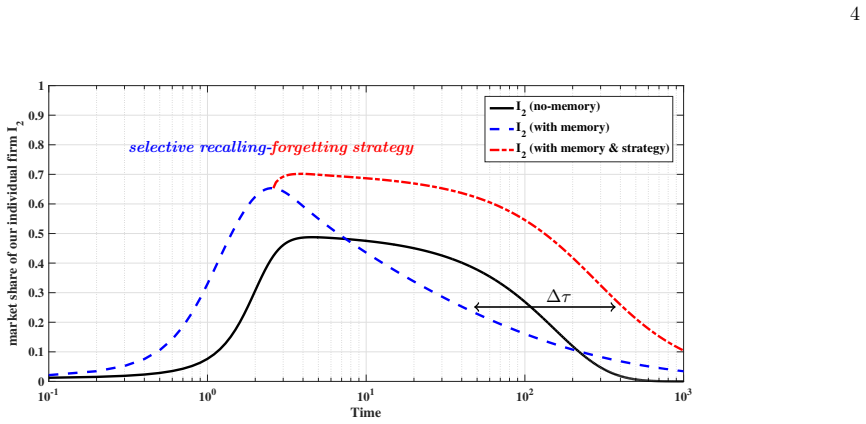
The load-bearing mechanism is a piecewise restart of the Caputo fractional derivative in the equation for the weaker competitor. The Caputo derivative of order $\alpha$ replaces the ordinary time derivative with an integral over the whole past weighted by a power-law kernel, so it carries memory of previous states; the paper uses $\alpha=0.5$ for long-lasting memory. The strategy is implemented by splitting the fractional operator at the peak time $t^*$: $c_0 D_t^\alpha$ before $t^*$ and $c_{t^*} D_t^\alpha$ after it. At $t^*$ the accumulated history is discarded, and the past no longer pulls the declining trajectory downward. This reset, localized at the peak of the memory curve, is the mechanism the paper credits for the extra survival time.
What would settle it
Run the same competition model with the memory restart applied at a different time, before or after the peak, and compare the survival time $\Delta\tau$ and cumulative share of $I_2$ with the peak-restart values; if any other restart time consistently outperforms the peak, the central claim that the peak is the right restart point fails. A second check is numerical: the claim relies on the fractional solver being accurate at $\alpha=0.5$ and $\gamma=0.995$, so a convergence test over decreasing step sizes would settle whether the reported peak exists in the continuous system at all.
Extended reading notes
Core claim
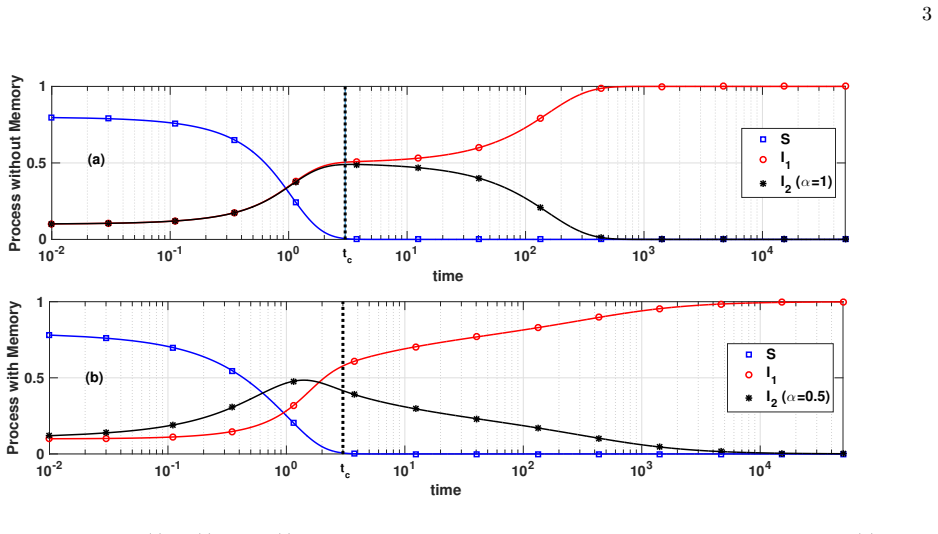
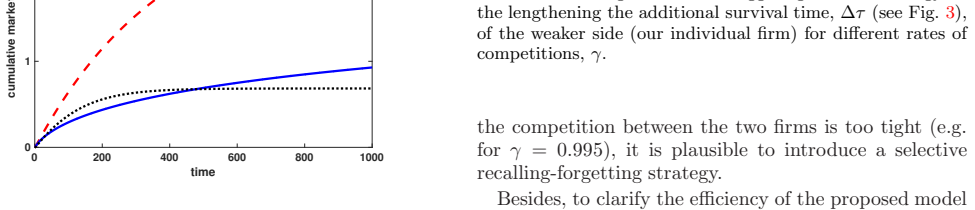
The discovery, stated on the paper's own terms, is that the weaker competitor can use its memory as a survival resource. The competition is modeled by three coupled equations: the normal diffuser $I_1$ grows with rate $1$, the anomalous diffuser $I_2$ grows with rate $\gamma < 1$ and follows a Caputo fractional derivative of order $\alpha = 0.5$, and a shared source $S$ feeds both until it is exhausted at the critical time $t_c$. Without memory, $I_2$ peaks at $t_c$ and then decays to zero. With constant memory, the decline is slower but still terminal. The paper's result is that restarting the memory at the peak $t^*$—forgetting everything before that moment and running a new fractional process from the peak—extends the lifetime $\Delta\tau$ of $I_2$ and raises its cumulative share, most clearly when $\gamma$ is close to $1$. The same mechanism is cast as a business proof of concept in which a small firm preserves a minimum market share for longer.
Load-bearing premise
The paper assumes that restarting the memory at the peak is the best possible restart time, but it chooses that moment because the simulated curve peaks there rather than proving it is optimal.
Editorial extensions
If this is right
- In a tight competition with $\gamma$ close to $1$, restarting the memory at the peak lengthens the interval $\Delta\tau$ over which the weaker diffuser holds a minimum share and raises its cumulative share above both the no-memory and constant-memory cases.
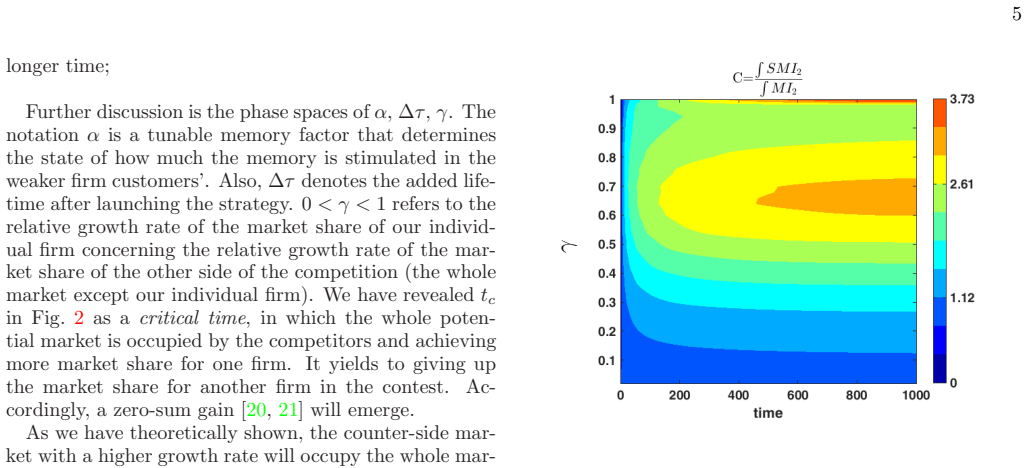
- For relative growth rates in roughly $0.6 < \gamma < 0.7$ and near $\gamma \simeq 1$, the cumulative-share ratio of strategy-with-memory to memory-only exceeds $1$, so the paper recommends running the strategy in those regimes.
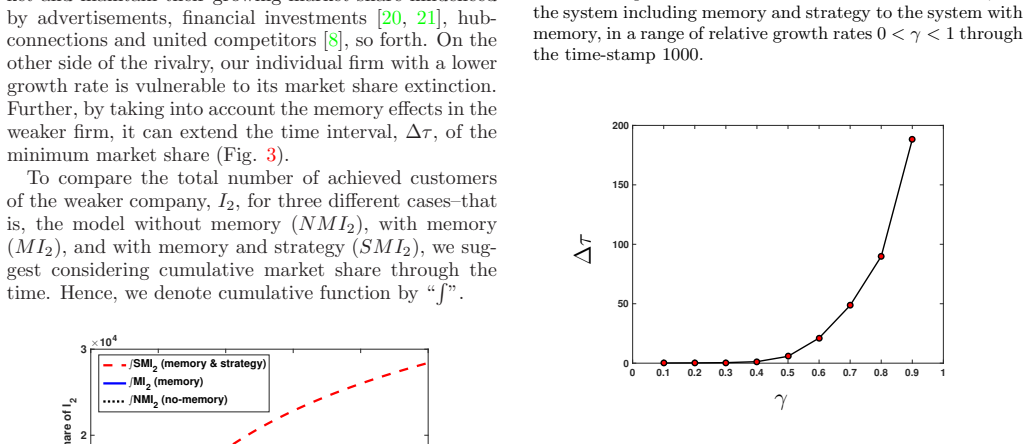
- As $\gamma$ approaches $0$, the added survival time $\Delta\tau$ approaches $0$, so the strategy offers almost nothing when the rival is overwhelmingly stronger.
- With $\alpha = 1$, the fractional system reduces to the integer-order memoryless competition, so the standard model is a special case of the generalized one.
- In the business interpretation, a smaller firm facing a dominant market can treat the memory reset at the peak as a concrete policy for prolonging the lifetime of a minimum market share.
Reading between the lines
- Inference: the peak-restart rule is chosen from the simulated curve, not derived; optimizing the restart time for each pair $(\gamma, \alpha)$ would show whether the peak is truly the best reset point, which is a direct testable extension.
- Inference: the reset mechanism resembles restart protocols in stochastic search, where resetting a process to a favorable state can shorten hitting times; reading the peak as a favorable restart state connects this deterministic model to a broader class of restart problems, a connection the paper does not draw.
- Inference: if one reset helps, repeating it at each successive peak could extend survival even further; the paper tests only a single reset, so a periodic memory-reset strategy is an unexamined corollary of its logic.
- Inference: the strategy assumes a diffuser can deliberately wipe its own memory, which in a market setting means a firm can erase accumulated customer history; the practical benefit would depend on how cleanly such a reset can actually be executed.
Signed reviews
Editorial analysis
A structured set of objections, weighed in public.
Referee Report
Summary. The paper proposes a deterministic competition model between a normal diffuser with higher growth rate I1 and an anomalous diffuser with lower growth rate I2, where I2 evolves under a fractional-order (Caputo-type) memory. For a memory order alpha=0.5 and relative growth rate gamma=0.995, the numerical solution shows that memory delays the decline of I2. The authors then introduce a 'selective recalling-forgetting strategy' in which the memory is reset at the peak of the I2 curve, and present numerical evidence that this restart extends the survival time of I2 above a threshold. The paper frames this as a general strategy for weaker competitors, with a business interpretation and a sweep over gamma for the added survival time. The central claim that this strategy achieves maximum survival is asserted rather than proven.
Significance. If the maximum-survival claim were rigorously established, the paper would offer a novel and practically relevant control strategy for weaker competitors in social, economic, or epidemiological competition models. The model is transparent, the fractional-order memory mechanism connects to a substantial prior literature, and the numerical implementation via the fractional Adams scheme is reproducible in principle. The gamma-sweep figures (Figs. 5 and 6) provide a useful predictive map for when the strategy is beneficial. The main weaknesses are that the optimality of the peak restart is not proven, only one memory order is demonstrated, the survival threshold is not specified, and no numerical convergence checks are reported. These are load-bearing for the paper's central promise but appear addressable within the scope of a revision.
major comments (4)
- [Sec. IV, Fig. 3] The central claim that restarting the memory at the peak t* = argmax I2 yields 'maximum survival' is not established. The paper does not scan over restart times, nor does it provide an analytic argument that this t* maximizes the time spent above a given threshold. Because the post-restart trajectory is governed by a new Caputo initial-value problem starting at t*, with state (I1(t*), S(t*), I2(t*)), a restart later than the peak might produce longer survival even if it starts from a lower I2. The selection of the peak in Fig. 3 is therefore an ansatz based on the same simulated curve that serves as the baseline, and the abstract's promise of maximum survival exceeds what is demonstrated. At minimum, the authors should compare survival times over a grid of restart times, or prove a condition under which the peak is optimal.
- [Sec. V, Figs. 5 and 6] The strategy is tested numerically for only one memory order (alpha=0.5) and, in the illustrative comparison of Fig. 3, one growth rate (gamma=0.995). Figure 6 varies gamma but not alpha, and the heatmap in Fig. 5 uses the same alpha. The paper therefore does not show that the peak-restart strategy remains beneficial or near-optimal for other memory strengths, even though alpha is presented as a tunable parameter of the model. A scan over alpha (and over the survival threshold) is needed to support the general claims made in Sections I and VI.
- [Appendix, Eqs. (13)-(14)] No numerical convergence study is reported. The step size h is not stated, and the reported improvements in survival time (e.g., Delta tau in Fig. 6) could be affected by discretization error in the fractional Adams scheme. The authors should report h, the error tolerance, and a convergence check (e.g., Delta tau versus h, or a Richardson estimate) to demonstrate that the observed strategy gains are not numerical artifacts.
- [Sec. III, Eq. (8)] Equation (8) is not the standard Caputo fractional derivative as written: for 0<alpha<1 the prefactor should be 1/Gamma(1-alpha) and the kernel should be (t-tau)^{-alpha}, not Gamma(alpha-1) with (t-tau)^{alpha-2}. Because Eq. (7) is used in the derivation and Eq. (11) is implemented numerically with Eqs. (13)-(14), this may be a typographical error, but as written it makes the model inconsistent: for alpha=0.5 the specified kernel is negative, which would reverse the sign of the memory forcing in Eq. (5). Please correct the definition or state explicitly which fractional derivative is used.
minor comments (4)
- [Eq. (1)] The intersection term (I1 ∩ I2) appears in the normalization condition Eq. (1) but is never used in the subsequent equations; please define it and state whether it is negligible or remove it to avoid confusion.
- [Title and Sec. II] The model is an ODE system without spatial derivatives, so the terms 'diffusion' and 'reaction-diffusion' may mislead readers; please clarify that the competition is temporal, with spatial language used only as a metaphor.
- [Sec. IV] The notation c t* D^alpha 103 is unclear; the terminal time appears as '103' and the starting and ending points of the fractional derivative are ambiguous. Please define the piecewise operators explicitly with proper limits.
- [Fig. 3 and Sec. V] The parameter Delta tau is described in the caption as the added lifetime for a predefined minimum proportion, but the threshold is never specified in the text or figure; please state the threshold used to compute survival time in Figs. 3 and 6.
Circularity Check
The strategy's restart time is selected as the peak of the same simulated I2 curve whose survival it is claimed to maximize; the reported Δτ is an in-sample consequence of that selection, not an independent prediction.
-
fitted input called prediction
[Section IV (Strategy), Fig. 3 and Fig. 6; piecewise operator definition with c_0 D^α_{t*} and c_{t*} D^α_{10^3}]
"To extend the survival time of diffusion with a lower growth rate, the anomalous diffusion should continue until the peak point with recalling the past states, then, the process restarts by forgetting past experiences, and a new anomalous diffusion continues the process with considering memory effects from the last peak."
The restart time t* is not derived from an independent optimization; it is chosen as the peak of the no-strategy memory trajectory I2(t), i.e., the maximum of the very curve whose survival the strategy is meant to improve. The added lifetime Δτ is then read from the same simulation after restarting at this selected point, and Fig. 6 labels this 'Predicting the effect of triggering the new strategy on the lengthening the additional survival time.' Because t* is selected from the same curve used to evaluate the strategy, the reported survival extension is an in-sample consequence of the selection rather than an independent prediction.
full rationale
The core differential model (Eqs. 9–11) is self-contained: it is a deterministic Lotka–Volterra-type system with a Caputo fractional derivative, and the memory formalism is standard fractional calculus cited to Podlubny and Kilbas et al., so the self-citations to Refs. [1,7,16] are not load-bearing circularity. The circularity is confined to the strategy. The strategy's restart time t* is defined as the peak of the no-strategy memory solution I2(t), i.e., the maximum of the very trajectory whose survival the strategy is claimed to maximize. The improvement Δτ is then computed from the same simulation and presented as a 'prediction' (Fig. 6). No comparison over other restart times, nor an analytic optimality argument, is provided, so the assertion that this strategy yields 'maximum survival' is not independently derived; it follows from selecting the best-looking point on the simulated curve. This is a fitted-input-called-prediction pattern, making the central strategic claim partially circular even though the underlying fractional differential model is not circular.
Assumptions & free parameters
free parameters (4)
- Relative growth rate gamma =
0.995 (also scanned over 0<gamma<1)
- Fractional derivative order alpha =
0.5 (with alpha=1 for the memoryless case)
- Initial conditions =
S(0)=0.8, I1(0)=I2(0)=0.1 in Fig 2; I2(0)=0.01 in Fig 3
- Restart time t* (peak of I2) =
Determined from the simulation
assumptions (3)
- domain assumption The competition dynamics are described by the coupled system (2)-(4) with constant total S+I1+I2=1.
- domain assumption The Caputo fractional derivative with constant order alpha adequately represents memory in the anomalous diffuser.
- standard math The fractional Adams numerical scheme converges for the chosen parameters.
Cite this review
Pith. "Pith review of The strategy of survival for a competition between normal and anomalous diffusion." pith.science (2026). https://pith.science/paper/IYNOTBWV
@misc{pith2026190803076,
  author       = {Pith},
  title        = {Pith review of: The strategy of survival for a competition between normal and anomalous diffusion},
  year         = {2026},
  howpublished = {\url{https://pith.science/paper/IYNOTBWV}},
  note         = {Machine review of arXiv:1908.03076}
}
read the original abstract
In this paper, we study the competition of two diffusion processes for achieving the maximum possible diffusion in an area. This competition, however, does not occur in the same circumstance; one of these processes is a normal diffusion with a higher growth rate, and another one is an anomalous diffusion with a lower growth rate. The trivial solution of the proposed model suggests that the winner is the one with the higher growth rate. But, the question is: what characteristics and strategies should the second diffusion include to prolong the survival in such a competition? The studied diffusion equations correspond to the SI model such that the anomalous diffusion has memory described by a fractional order derivative. The strategy promise that anomalous diffusion reaches maximum survival in case of forgetting some parts of the memory. This model can represent some of real phenomena, such as the contest of two companies in a market share, the spreading of two epidemic diseases, the diffusion of two species, or any reaction-diffusion related to real-world competition.
Figures

Figures from the paper (3 more)
Forward citations
Cited by 1 Pith paper
-
Growth Dynamics of Value and Cost Trade-off in Temporal Networks
A modified preferential-attachment model with a linear link cost predicts that networks stop growing when the cost parameter exceeds the link-creation rate, with a trade-off boundary at α=3m.
Reference graph
Works this paper leans on
-
[1]
The normal diffusion with a higher growth rate will occupy the more region of the system and maintain its growth. The counter-side of the rivalry, the one with a lower growth rate, is vulnerable to van- ishing. However, by taking into account the memory ef- fects [ 1, 6, 7] in the anomalous diffusion, it is promising to extend the time interval of maintaini...
-
[2]
Memory effects on epidemic evolution: The susceptible-infected-recovered epidemic model,
M. Saeedian, M. Khalighi, N. Azimi-Tafreshi, G. R. Jafari, and M. Ausloos, “Memory effects on epidemic evolution: The susceptible-infected-recovered epidemic model,” Physical Review E , vol. 95, Feb. 2017
work page 2017
-
[3]
Gossip: Identifying central individuals in a so- cial network,
A. Banerjee, A. G. Chandrasekhar, E. Duflo, and M. O. Jackson, “Gossip: Identifying central individuals in a so- cial network,” tech. rep., National Bureau of Economic Research, 2014. 7
work page 2014
-
[4]
Lotka-volterra equation and replicator dy- namics: new issues in classification,
I. M. Bomze, “Lotka-volterra equation and replicator dy- namics: new issues in classification,” Biological cybernet- ics, vol. 72, no. 5, pp. 447–453, 1995
work page 1995
-
[5]
An analytical formulation for pollutant dispersion simulati on in the atmospheric boundary layer,
G. A. Gon¸ calves, R. S. de Quadros, and D. Buske, “An analytical formulation for pollutant dispersion simulati on in the atmospheric boundary layer,” Journal of Environ- mental Protection, vol. 4, no. 08, p. 57, 2013
work page 2013
-
[6]
E. L. Cussler and E. L. Cussler, Diffusion: mass transfer in fluid systems . Cambridge university press, 2009
work page 2009
-
[7]
H. Ebadi, M. Saeedian, M. Ausloos, and G. R. Ja- fari, “Effect of memory in non-markovian boolean net- works illustrated with a case study: A cell cycling pro- cess,” EPL (Europhysics Letters) , vol. 116, p. 30004, Nov. 2016
work page 2016
-
[8]
Fractional dynamics of net- work growth constrained by aging node interactions,
H. Safdari, M. Zare Kamali, A. Shirazi, M. Khalighi, G. Jafari, and M. Ausloos, “Fractional dynamics of net- work growth constrained by aging node interactions,” PLOS One , vol. 11, pp. 1–13, 05 2016
work page 2016
Show all 33 references
-
[9]
Competi- tion among networks highlights the power of the weak,
J. Iranzo, J. M. Buld´ u, and J. Aguirre, “Competi- tion among networks highlights the power of the weak,” Nature Communications, vol. 7, Nov 2016
2016
-
[10]
Networked relationships in the e-MID interbank market: A trading model with memory,
G. Iori, R. N. Mantegna, L. Marotta, S. Miccich` e, J. Porter, and M. Tumminello, “Networked relationships in the e-MID interbank market: A trading model with memory,” Journal of Economic Dynamics and Control , vol. 50, pp. 98–116, jan 2015
2015
-
[11]
Enhancing promotional strategies within so- cial marketing programs: Use of web 2.0 social media,
R. Thackeray, B. L. Neiger, C. L. Hanson, and J. F. McKenzie, “Enhancing promotional strategies within so- cial marketing programs: Use of web 2.0 social media,” Health Promotion Practice , vol. 9, pp. 338–343, Mar. 2008
2008
-
[12]
Creative strategies in social media marketing: An exploratory study of branded social content and consumer engagement,
C. Ashley and T. Tuten, “Creative strategies in social media marketing: An exploratory study of branded social content and consumer engagement,” Psychology & Marketing , vol. 32, pp. 15–27, Dec. 2014
2014
-
[13]
Study on re- cent trends in sales promotion in india,
P. Kaushik and N. Kukreja, “Study on re- cent trends in sales promotion in india,” NOLEGEIN- Journal of Information Technology and Managemen t, pp. 26–30, 2019
2019
-
[14]
Crowd-funding: Cash on demand,
K. Kaplan, “Crowd-funding: Cash on demand,” Nature, vol. 497, pp. 147–149, May 2013
2013
-
[15]
Fractional differential equations, acad,
I. Podlubny, “Fractional differential equations, acad,” Press, London, p. E2, 1999
1999
-
[16]
A. A. A. Kilbas, H. M. Srivastava, and J. J. Trujillo, The- ory and applications of fractional differential equations , vol. 204. Elsevier Science Limited, 2006
2006
-
[17]
Glassy states of aging social net- works,
F. Hassanibesheli, L. Hedayatifar, H. Safdari, M. Aus- loos, and G. Jafari, “Glassy states of aging social net- works,” Entropy, vol. 19, p. 246, May 2017
2017
-
[18]
S. G. Samko, A. A. Kilbas, O. I. Marichev, et al. , Frac- tional integrals and derivatives , vol. 1993. Gordon and Breach Science Publishers, Yverdon Yverdon-les-Bains, Switzerland, 1993
1993
-
[19]
A new definition of fractional derivative without singular kernel,
M. Caputo and M. Fabrizio, “A new definition of fractional derivative without singular kernel,” Progr. Fract. Differ. Appl , vol. 1, no. 2, pp. 1–13, 2015
2015
-
[20]
Chaos in a simple non- linear system with atangana–baleanu derivatives with fractional order,
A. Atangana and I. Koca, “Chaos in a simple non- linear system with atangana–baleanu derivatives with fractional order,” Chaos, Solitons & Fractals , vol. 89, pp. 447–454, 2016
2016
-
[21]
Opti- mal pricing and advertising in a durable-good duopoly,
A. Krishnamoorthy, A. Prasad, and S. P. Sethi, “Opti- mal pricing and advertising in a durable-good duopoly,” European Journal of Operational Research , vol. 200, pp. 486–497, Jan. 2010
2010
-
[22]
Do market share and efficiency matter for each other? an application of the zero-sum gains data envelopment analysis,
J.-L. Hu and C.-Y. Fang, “Do market share and efficiency matter for each other? an application of the zero-sum gains data envelopment analysis,” Journal of the Operational Research Society , vol. 61, pp. 647–657, Apr. 2010
2010
-
[23]
Multiscale features of cross correlation of price and trad - ing volume,
J. Ardalankia, M. Osoolian, E. Haven, and G. Jafari, “Multiscale features of cross correlation of price and trad - ing volume,” Arxiv, no. 1903.01744, 2019
1903 arXiv
-
[24]
Competition between collective and individual dynam- ics,
S. Grauwin, E. Bertin, R. Lemoy, and P. Jensen, “Competition between collective and individual dynam- ics,” Proceedings of the National Academy of Sciences , vol. 106, pp. 20622–20626, nov 2009
2009
-
[25]
The diffusion of microfinance,
A. Banerjee, A. G. Chandrasekhar, E. Duflo, and M. O. Jackson, “The diffusion of microfinance,” Science, vol. 341, pp. 1236498–1236498, July 2013
2013
-
[26]
Clustering and preferential attach- ment in growing networks,
M. E. J. Newman, “Clustering and preferential attach- ment in growing networks,” Physical Review E , vol. 64, jul 2001
2001
-
[27]
The structure and function of com- plex networks,
M. E. J. Newman, “The structure and function of com- plex networks,” SIAM Review , vol. 45, pp. 167–256, jan 2003
2003
-
[28]
Mean- field theory for scale-free random networks,
A.-L. Barab´ asi, R. Albert, and H. Jeong, “Mean- field theory for scale-free random networks,” Physica A: Statistical Mechanics and its Applications , vol. 272, pp. 173–187, oct 1999
1999
-
[29]
Emergence of scaling in random networks,
A.-L. Barab´ asi and R. Albert, “Emergence of scaling in random networks,” Science, vol. 286, pp. 509–512, oct 1999
1999
-
[30]
Com- petition and evolution in restricted space,
F. L. Forgerini and N. Crokidakis, “Com- petition and evolution in restricted space,” Journal of Statistical Mechanics: Theory and Experiment , vol. 2014, p. P07016, jul 2014
2014
-
[31]
Resilience of the internet to random breakdowns,
R. Cohen, K. Erez, D. ben Avraham, and S. Havlin, “Resilience of the internet to random breakdowns,” Physical Review Letters , vol. 85, pp. 4626–4628, nov 2000
2000
-
[32]
Detailed er- ror analysis for a fractional adams method,
K. Diethelm, N. J. Ford, and A. D. Freed, “Detailed er- ror analysis for a fractional adams method,” Numerical Algorithms, vol. 36, pp. 31–52, May 2004
2004
-
[33]
On linear stability of predictor–corrector algorithms for fractional differential equations,
R. Garrappa, “On linear stability of predictor–corrector algorithms for fractional differential equations,” Interna- tional Journal of Computer Mathematics , vol. 87, no. 10, pp. 2281–2290, 2010. Appendix Numerical solution Incommensurate fractional differential equations 9-11 c...
2010
Reviewed August 14, 2026 · model on record in the stance chip above.
Discussion (0). Continue with ORCID to comment.