Shubnikov-de Haas Characterization of Superconductor-Semiconductor Heterostructures
Pith reviewed 2026-05-14 17:44 UTC · model grok-4.3
The pith
Shubnikov-de Haas analysis in superconductor-semiconductor stacks extracts scattering times that reflect the proximity-induced gap.
A machine-rendered reading of the paper's core claim, the machinery that carries it, and where it could break.
Core claim
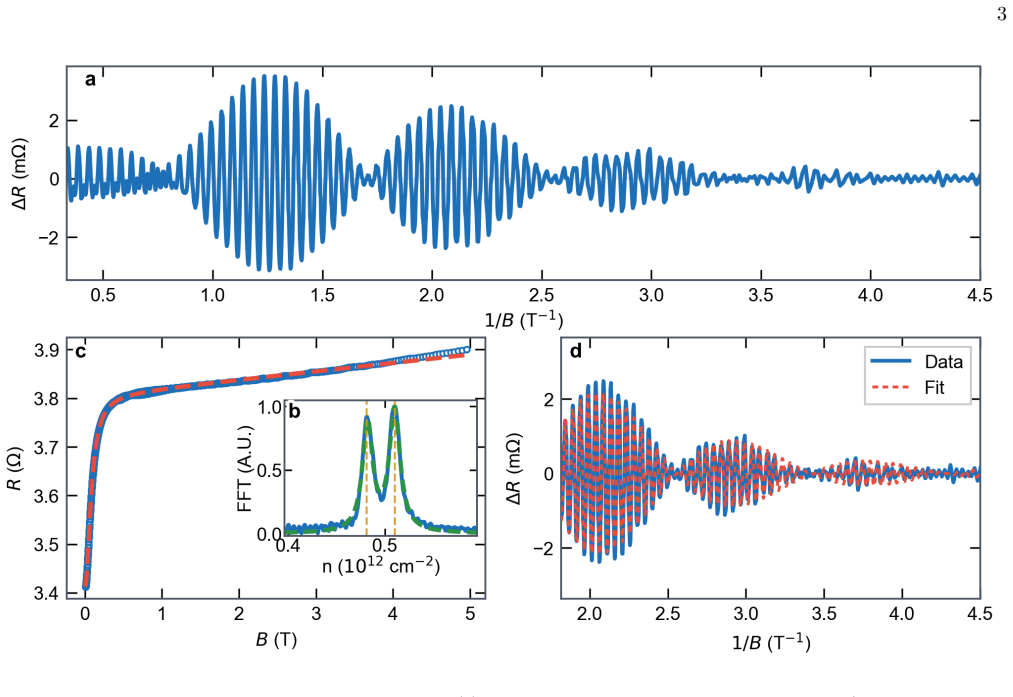
Proper analysis of the full magnetoresistance data from Shubnikov-de Haas oscillations in aluminum-on-InAs quantum well heterostructures allows extraction of the two-dimensional electron gas carrier density, spin-orbit coupling strength, transport scattering time, and quantum scattering time. These scattering times are affected by the metal-semiconductor coupling strength, which permits inference of the proximity-induced superconducting gap from measurements that do not require millikelvin temperatures or additional device processing.
What carries the argument
The full magnetoresistance curve in Shubnikov-de Haas measurements, where the modulation of quantum and transport scattering times by the proximity coupling serves as the indicator for the induced gap.
Load-bearing premise
That the scattering times extracted from standard SdH fitting change in a direct and calibratable way due to the proximity-induced gap, without needing independent confirmation from millikelvin measurements.
What would settle it
Compare the SdH-derived scattering times to independently measured superconducting gap values from tunneling spectroscopy or similar low-temperature techniques on the same samples to check for quantitative correlation.
Figures



read the original abstract
Hybrid superconductor-semiconductor nanostructures are a central component for research spanning condensed matter physics and quantum information processing. Continued progress relies critically on the ability to characterize, control, and optimize several intrinsic material properties including spin-orbit coupling, band offsets, and disorder in a device-relevant stack that necessarily couples the electronic states of a superconducting metal film and a semiconductor. Here we report a new method to extract fundamental material parameters utilizing simple Shubnikov-de Haas (SdH) oscillation measurements in heterostructures in which metallic electronic states are coupled to a two-dimensional electron gas (2DEG) residing in an InAs quantum well beneath an aluminum thin film. Proper analysis of the full magnetoresistance data facilitates extraction of the quantum well carrier density, spin-orbit coupling strength, and both transport and quantum scattering times. Most importantly, the extracted scattering times in the 2DEG are impacted by the metal-semiconductor coupling strength allowing us to quickly gain information on proximity-induced superconducting gap without any fabrication or mK measurements. The wealth of information that is accessed with these simple measurements positions this methodology as an important tool for hybrid materials optimization.
Editorial analysis
A structured set of objections, weighed in public.
Referee Report
Summary. The manuscript claims that analysis of full magnetoresistance data from Shubnikov-de Haas oscillations in Al/InAs heterostructures allows extraction of the 2DEG carrier density, spin-orbit coupling strength, and both transport and quantum scattering times. It further asserts that the extracted scattering times are modulated by the metal-semiconductor coupling strength, enabling inference of the proximity-induced superconducting gap without mK measurements or additional fabrication steps.
Significance. If validated with appropriate modeling, the approach would offer a practical, accessible-temperature tool for rapid characterization and optimization of hybrid superconductor-semiconductor devices, linking standard SdH observables directly to the induced gap and thereby complementing more resource-intensive low-temperature probes.
major comments (2)
- [SdH analysis and fitting procedure] The central claim that scattering times extracted via standard SdH fits are quantitatively modulated by the proximity gap (and can be interpreted without independent gap measurements) lacks a derived or cited expression for the modified density of states or Dingle damping that incorporates the minigap and Andreev processes. Standard Lifshitz-Kosevich and Dingle formulas are implicitly assumed, which presuppose an ungapped 2DEG spectrum.
- [Results and discussion of scattering times] No validation data, error analysis, or comparison to independent gap measurements (e.g., tunneling spectroscopy) is supplied to demonstrate that the extracted τ_q and τ_tr map to Δ in a model-independent, calibratable manner; this is load-bearing for the advertised fabrication-free inference.
minor comments (2)
- [Methods] Notation for the spin-orbit term and the precise definition of the coupling strength parameter should be clarified with an explicit equation.
- Figure captions for magnetoresistance traces should explicitly state the temperature range and field sweep direction used for the fits.
Simulated Author's Rebuttal
We thank the referee for the careful reading of our manuscript and the constructive comments. We appreciate the positive assessment of the potential significance of the SdH-based characterization method. Below we respond point-by-point to the major comments. We will revise the manuscript to incorporate additional theoretical discussion and expanded error analysis while preserving the core claim that the approach provides a practical, fabrication-free route to infer proximity-gap information from accessible-temperature measurements.
read point-by-point responses
-
Referee: [SdH analysis and fitting procedure] The central claim that scattering times extracted via standard SdH fits are quantitatively modulated by the proximity gap (and can be interpreted without independent gap measurements) lacks a derived or cited expression for the modified density of states or Dingle damping that incorporates the minigap and Andreev processes. Standard Lifshitz-Kosevich and Dingle formulas are implicitly assumed, which presuppose an ungapped 2DEG spectrum.
Authors: We agree that an explicit derivation or citation would strengthen the presentation. In the weak-coupling regime relevant to our devices, the minigap primarily enters through interface Andreev processes that shorten the quantum lifetime; this effect is captured phenomenologically by the extracted τ_q without requiring a full re-derivation of the oscillatory DOS for the modest gaps and field ranges accessed. To address the comment directly, we will add a concise theoretical subsection (with supporting references to prior work on proximitized 2DEGs) that shows how a small minigap modifies the Dingle damping factor while leaving the standard Lifshitz-Kosevich envelope a good approximation. This addition will make the applicability of the fitting procedure transparent. revision: yes
-
Referee: [Results and discussion of scattering times] No validation data, error analysis, or comparison to independent gap measurements (e.g., tunneling spectroscopy) is supplied to demonstrate that the extracted τ_q and τ_tr map to Δ in a model-independent, calibratable manner; this is load-bearing for the advertised fabrication-free inference.
Authors: We acknowledge that direct, device-by-device comparison to tunneling spectroscopy would provide the strongest calibration. Such measurements are outside the scope of the present work precisely because the method is intended to avoid additional fabrication and mK infrastructure. The manuscript already contains fitting uncertainties and consistency checks across multiple heterostructures with varying coupling strengths; we will expand the supplementary material with explicit error propagation from the SdH fits to the inferred gap and add a calibration discussion that references literature values of Δ for comparable Al/InAs interfaces. This will make the mapping more quantitative while retaining the practical advantage of the technique. revision: partial
Circularity Check
No circularity: standard SdH formulas applied to data with interpretive link to gap
full rationale
The derivation applies unmodified Lifshitz-Kosevich and Dingle damping formulas to extract carrier density from oscillation frequency, spin-orbit strength from beating, and scattering times from amplitude decay. These quantities are then observed to vary with metal-semiconductor coupling, from which proximity-gap information is inferred empirically. No equation reduces to a tautology, no fitted parameter is relabeled as a prediction, and no self-citation chain supplies a load-bearing uniqueness theorem or ansatz. The chain remains externally anchored in established SdH phenomenology rather than closing on its own inputs.
Axiom & Free-Parameter Ledger
axioms (1)
- domain assumption Standard Shubnikov-de Haas analysis applies to the 2DEG even when coupled to a superconducting metal film
Lean theorems connected to this paper
-
IndisputableMonolith/Cost/FunctionalEquation.leanwashburn_uniqueness_aczel unclear?
unclearRelation between the paper passage and the cited Recognition theorem.
1/τ_t(q) = 1/τ_t(q)_semi + 2Γ/ℏ; ρ_S fit to two-band model; full SdH waveform fit with Dingle factor e^{-π/ω_c τ_q}
What do these tags mean?
- matches
- The paper's claim is directly supported by a theorem in the formal canon.
- supports
- The theorem supports part of the paper's argument, but the paper may add assumptions or extra steps.
- extends
- The paper goes beyond the formal theorem; the theorem is a base layer rather than the whole result.
- uses
- The paper appears to rely on the theorem as machinery.
- contradicts
- The paper's claim conflicts with a theorem or certificate in the canon.
- unclear
- Pith found a possible connection, but the passage is too broad, indirect, or ambiguous to say the theorem truly supports the claim.
Reference graph
Works this paper leans on
-
[1]
Ihn, Thomas , title =
-
[2]
Aghaee, Morteza and Alcaraz Ramirez, Alejandro and Alam, Zulfi and Ali, Rizwan and Andrzejczuk, Mariusz and Antipov, Andrey and Astafev, Mikhail and Barzegar, Amin and Bauer, Bela and Becker, Jonathan and Bhaskar, Umesh Kumar and Bocharov, Alex and Boddapati, Srini and Bohn, David and Bommer, Jouri and Bourdet, Leo and Bousquet, Arnaud and Boutin, Samuel ...
work page 2025
-
[3]
Aghaee, Morteza and Akkala, Arun and Alam, Zulfi and Ali, Rizwan and Alcaraz Ramirez, Alejandro and Andrzejczuk, Mariusz and Antipov, Andrey E. and Aseev, Pavel and Astafev, Mikhail and Bauer, Bela and Becker, Jonathan and Boddapati, Srini and Boekhout, Frenk and Bommer, Jouri and Bosma, Tom and Bourdet, Leo and Boutin, Samuel and Caroff, Philippe and Cas...
-
[4]
Morteza Aghaee and Zulfi Alam and Rikke Andersen and Mariusz Andrzejczuk and Andrey Antipov and Mikhail Astafev and Lukas Avilovas and Ahmad Azizimanesh and Eric Banek and Bela Bauer and Jonathan Becker and Umesh Kumar Bhaskar and Andrea G. Boa and Srini Boddapati and Nichlaus Bohac and Jouri D. S. Bommer and Jan Borovsky and Leo Bourdet and Samuel Boutin...
-
[5]
Ando, Tsuneya and Fowler, Alan B. and Stern, Frank , title =. Rev. Mod. Phys. , volume =. 1982 , doi =
work page 1982
-
[6]
Superconducting, insulating and anomalous metallic regimes in a gated two-dimensional semiconductor--superconductor array , author =. Nat. Phys. , volume =. 2018 , doi =
work page 2018
-
[7]
Dynamical vortex transitions in a gate-tunable two-dimensional
B. Dynamical vortex transitions in a gate-tunable two-dimensional. Phys. Rev. B , volume =. 2023 , month =. doi:10.1103/PhysRevB.108.134517 , url =
-
[8]
and Kjaergaard, Morten and Pearson, Natalie J
Casparis, Lucas and Connolly, Malcolm R. and Kjaergaard, Morten and Pearson, Natalie J. and Kringh. Superconducting gatemon qubit based on a proximitized two-dimensional electron gas , journal =. 2018 , volume =. doi:10.1038/s41565-018-0207-y , url =
-
[9]
Coleridge, P. T. and Stoner, R. and Fletcher, R. , title =. Phys. Rev. B , volume =. 1989 , doi =
work page 1989
-
[10]
and Mayer, William and Yuan, Joseph and Wickramasinghe, Kaushini S
Dartiailh, Matthieu C. and Mayer, William and Yuan, Joseph and Wickramasinghe, Kaushini S. and Matos-Abiague, Alex and. Phase Signature of Topological Transition in. Phys. Rev. Lett. , volume =. 2021 , doi =
work page 2021
-
[11]
S. Das Sarma and E. H. Hwang , title =. Phys. Rev. B , volume =. 2014 , doi =
work page 2014
-
[12]
and Pekerten, Baris and Lee, Jaewoo and Strickland, William M
Elfeky, Bassel Heiba and Dindial, Krishna and Brandao, David S. and Pekerten, Baris and Lee, Jaewoo and Strickland, William M. and Strohbeen, Patrick J. and Danilenko, Alisa and Baker, Lukas and Mikalsen, Melissa and Schiela, William and Liang, Zixuan and Issokson, Jacob and Levy, Ido and Zutic, Igor and Shabani, Javad , title =. Phys. Rev. Res. , year =
-
[13]
Fornieri, Antonio and Whiticar, Alexander M. and Setiawan, F. and Portol. Evidence of Topological Superconductivity in Planar. Nature , volume =. 2019 , doi =
work page 2019
-
[14]
Hao, Zhuoqun and Shaw, T. and Hatefipour, M. and Strickland, William M. and Elfeky, Bassel H. and Langone, D. and Shabani, Javad and Shankar, Shyam , title =. Appl. Phys. Lett. , volume =. 2024 , doi =
work page 2024
-
[15]
and Coraiola, Marco and Sabonis, Deividas and Hinderling, Manuel and ten Kate, Sofieke C
Haxell, Daniel Z. and Coraiola, Marco and Sabonis, Deividas and Hinderling, Manuel and ten Kate, Sofieke C. and Cheah, Erik and Krizek, Filip and Schott, R\"udiger and Wegscheider, Werner and Belzig, Wolfgang and Cuevas, Juan Carlos and Nichele, Fabrizio , title =. Nat. Commun. , year =
-
[16]
Hwang, E. H. and Das Sarma, S. , title =. Phys. Rev. B , volume =. 2008 , doi =
work page 2008
-
[17]
Kjaergaard, M. and Nichele, F. and Suominen, H. J. and Nowak, M. P. and Wimmer, M. and Akhmerov, A. R. and Folk, J. A. and Flensberg, K. and Shabani, J. and Palmstr. Quantized conductance doubling and hard gap in a two-dimensional semiconductor--superconductor heterostructure , journal =. 2016 , volume =
work page 2016
-
[18]
Kjaergaard, Morten and Suominen, Henri J. and Nowak, Michal P. and Akhmerov, Anton R. and Shabani, Javad and Palmstr. Transparent Semiconductor-Superconductor Interface and Induced Gap in an Epitaxial Heterostructure. Phys. Rev. Appl. , volume =. 2017 , doi =
work page 2017
-
[19]
and Shabani, Javad and Manucharyan, Vladimir E
Liu, Shukai and Bordoloi, Arunav and Issokson, Jacob and Levy, Ido and Vavilov, Maxim G. and Shabani, Javad and Manucharyan, Vladimir E. , title =. Nat. Commun. , volume =. 2025 , doi =
work page 2025
-
[20]
Kitaev, A. Yu. , title =. Physics-Uspekhi , volume =. 2001 , doi =
work page 2001
-
[21]
Lutchyn, Roman M. and Sau, Jay D. and Das Sarma, S. , title =. Phys. Rev. Lett. , volume =. 2010 , doi =
work page 2010
-
[22]
Christian M. Moehle and Chung Ting Ke and Qingzhen Wang and Candice Thomas and Di Xiao and Saurabh Karwal and Mario Lodari and Vincent van de Kerkhof and Ruben Termaat and Geoffrey C. Gardner and Giordano Scappucci and Michael J. Manfra and Srijit Goswami , title =. Nano Lett. , year =
-
[23]
Oreg, Yuval and Refael, Gil and von Oppen, Felix , title =. Phys. Rev. Lett. , volume =. 2010 , doi =
work page 2010
-
[24]
Phan, D. T. and Falthansl-Scheinecker, P. and Mishra, U. and Strickland, W. M. and Langone, D. and Shabani, J. and Higginbotham, A. P. , title =. Phys. Rev. Appl. , year =
-
[25]
Sagi, Oliver and Crippa, Alessandro and Valentini, Marco and Janik, Marian and Baghumyan, Levon and Fabris, Giorgio and Kapoor, Lucky and Hassani, Farid and Fink, Johannes and Calcaterra, Stefano and Chrastina, Daniel and Isella, Giovanni and Katsaros, Georgios , title =. Nat. Commun. , volume =. 2024 , doi =
work page 2024
-
[26]
Shabani, Javad and Kjaergaard, Morten and Suominen, Henri J. and Kim, Younghyun and Nichele, Fabrizio and Pakrouski, Kaveh and Stankevic, Tomas and Lutchyn, Roman M. and Krogstrup, Peter and Feidenhans'l, Rasmus and Kraemer, Sven and Nayak, Chetan and Troyer, Matthias and Marcus, Charles M. and Palmstr. Two-dimensional epitaxial superconductor-semiconduct...
work page 2016
-
[27]
Luo, J. and Munekata, H. and Fang, F. F. and Stiles, P. J. , title =. Phys. Rev. B , volume =. 1990 , doi =
work page 1990
-
[28]
and Nakosai, Sho and Tanaka, Yukio and Manfra, Michael J
Matsuo, Sadashige and Imoto, Takaya and Yokoyama, Tomohiro and Sato, Yosuke and Lindemann, Tyler and Gronin, Sergei and Gardner, Geoffrey C. and Nakosai, Sho and Tanaka, Yukio and Manfra, Michael J. and Tarucha, Seigo , title =. Nat. Commun. , year =
-
[29]
Nitta, Junsaku and Akazaki, Tatsushi and Takayanagi, Hideaki and Enoki, Takatomo , title =. Phys. Rev. Lett. , volume =. 1997 , doi =
work page 1997
- [30]
-
[31]
Harrang, J. P. and Higgins, R. J. and Goodall, R. K. and Jay, P. R. and Laviron, M. and Delescluse, P. , title =. Phys. Rev. B , volume =. 1985 , doi =
work page 1985
-
[32]
Das Sarma, S. and Stern, Frank , title =. Phys. Rev. B , volume =. 1985 , doi =
work page 1985
-
[33]
van Heck, Bernard and Lutchyn, Roman M. and Glazman, Leonid I. , title =. Phys. Rev. B , volume =. 2016 , doi =
work page 2016
-
[34]
Lifshitz, I. M. and Kosevich, A. M. , title =. Soviet Physics JETP , volume =
- [35]
- [36]
-
[37]
Lutchyn, Roman M. and Stanescu, Tudor D. and Das Sarma, S. , title =. Phys. Rev. B , volume =. 2012 , doi =
work page 2012
-
[38]
Potter, Andrew C. and Lee, Patrick A. , title =. Phys. Rev. B , volume =. 2011 , doi =
work page 2011
-
[39]
and Wu, QuanSheng and Troyer, Matthias and Krogstrup, Peter and Soluyanov, Alexey A
Winkler, Georg W. and Wu, QuanSheng and Troyer, Matthias and Krogstrup, Peter and Soluyanov, Alexey A. , title =. Phys. Rev. Lett. , volume =. 2016 , doi =
work page 2016
-
[40]
Engels, G. and Lange, J. and Sch. Experimental and theoretical approach to spin splitting in modulation-doped. Phys. Rev. B , volume =. 1997 , doi =
work page 1997
discussion (0)
Sign in with ORCID, Apple, or X to comment. Anyone can read and Pith papers without signing in.