REVIEW 2 major objections 5 minor 20 references
Resolving the 11B(p, ${\alpha_0}$) Cross Section Discrepancies between 0.5 and 3.5 MeV
T0 review · 2 major / 5 minor · reviewed 2026-08-14 · deepseek-v4-flash
Pith's one-line read A new measurement of the $^{11}$B(p,$\alpha_0$) cross section from 0.5 to 3.5 MeV resolves discrepancies of up to 70% among six earlier datasets and provides a reference normalization consistent with Becker (1987) and an energy scale…
desk verdict A useful new 11B(p,α0) measurement with a clean energy check; the 'resolved' conclusion is a bit stronger than the ratio analysis supports. read the letter →
The pith
A machine-rendered reading of the paper's core claim, the machinery that carries it, and where it could break.
The reading
What carries the argument
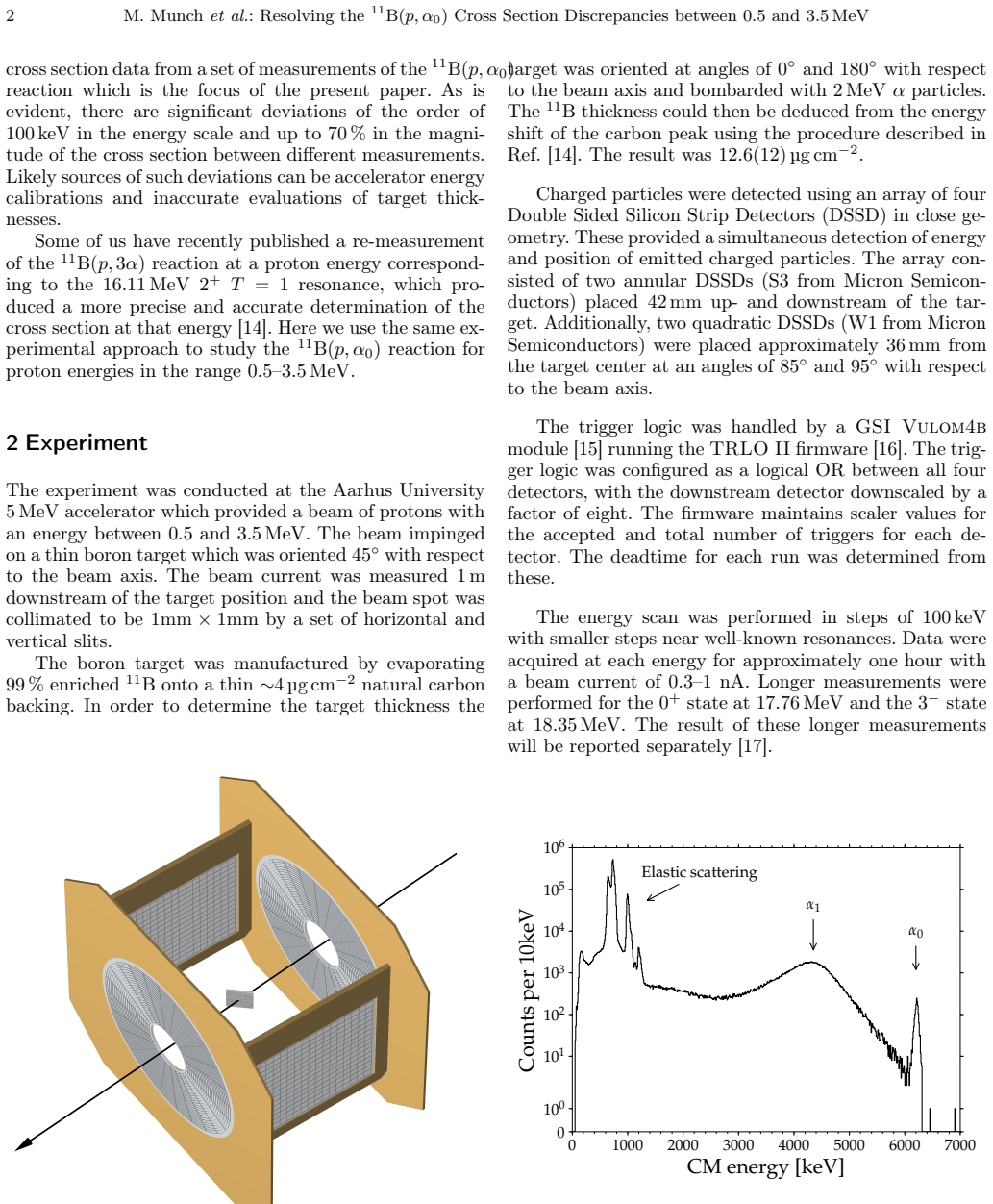
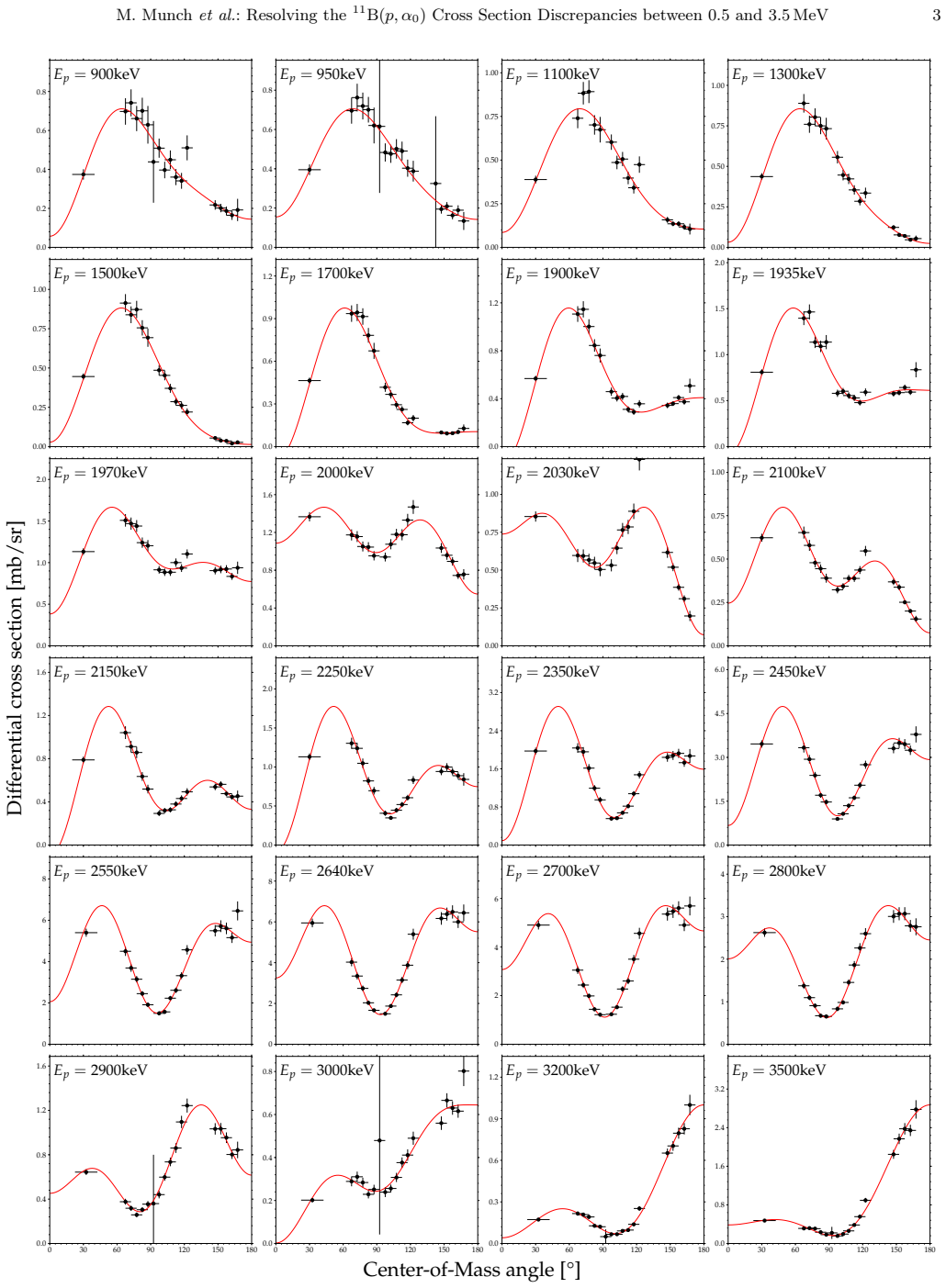
The argument is carried by four pieces of apparatus, in the broad sense: a thin, isotopically enriched $^{11}$B target whose areal density ($12.6(12)\,\mu$g/cm$^2$) was deduced from the energy shift of a carbon peak using the calibration procedure of Ref. [14]; a close-geometry array of four double-sided silicon strip detectors (DSSDs) that recorded energy and position of the emitted $\alpha$ particles over a large solid angle; a Monte Carlo simulation (simX) that used SRIM stopping-power tables to compute the detector solid angle and to correct particle energies for losses in the target and dead layers; and a Legendre-polynomial decomposition of the angular distributions, $d\sigma/d\Omega(\theta)=\sigma/(4\pi)[1+\sum_{i=1}^4 a_i P_i(\cos\theta)]$, which yields both the angle-integrated cross section and its shape coefficients. The solid angle is normalized by simulation-to-data ratios, and the older datasets are reconciled by computing their median ratios to a linear interpolation of the new dataset.
What would settle it
Measure the areal density of the same $^{11}$B target by an independent method, such as Rutherford backscattering spectrometry or weighing a known area, and compare it with $12.6(12)\,\mu$g/cm$^2$; a discrepancy larger than the quoted 10% would scale the cross section proportionally and invalidate the normalization claim. Alternatively, repeat the 0.5–3.5 MeV scan on a second target with a different thickness and check that the deduced cross section is unchanged.
Extended reading notes
Core claim
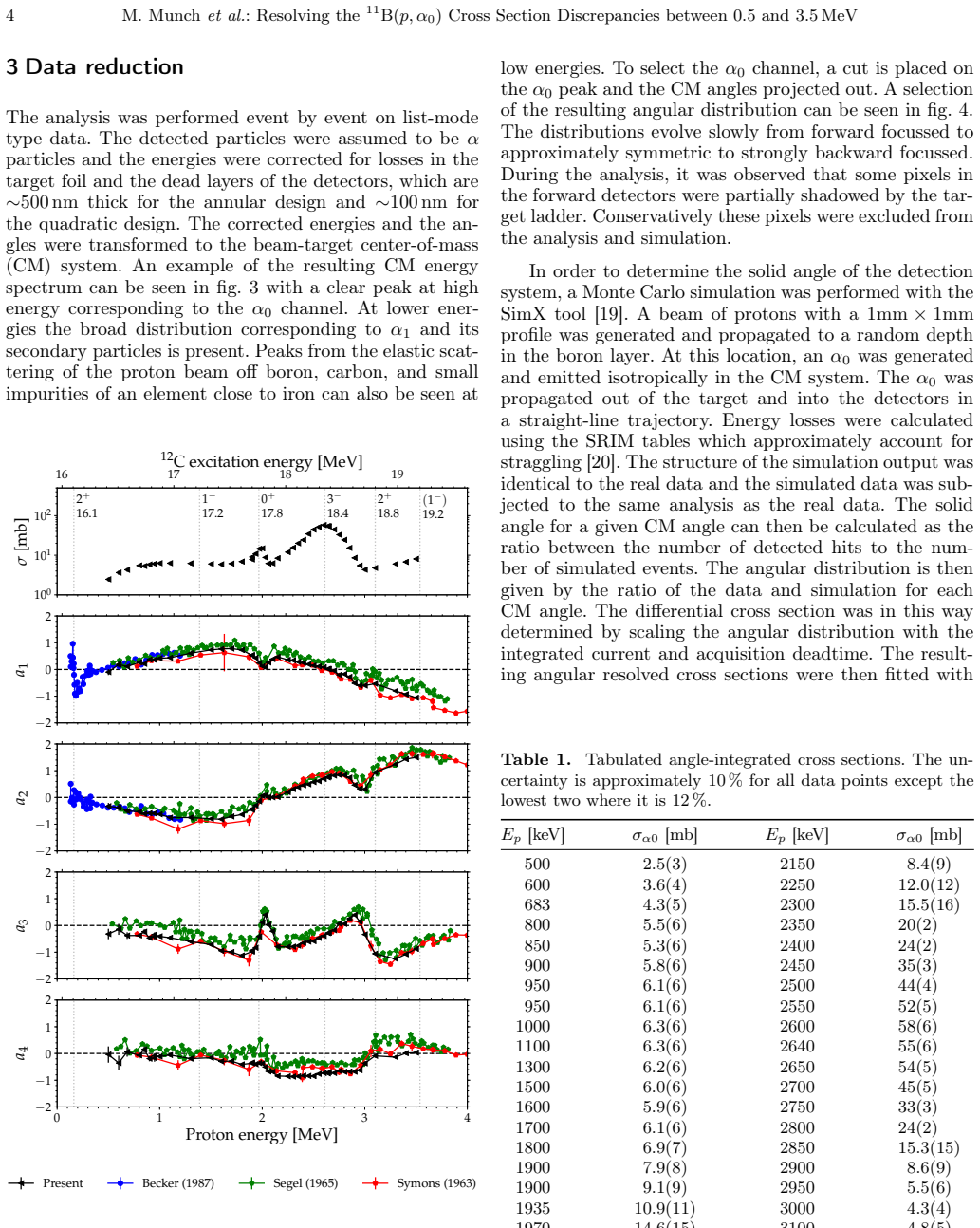
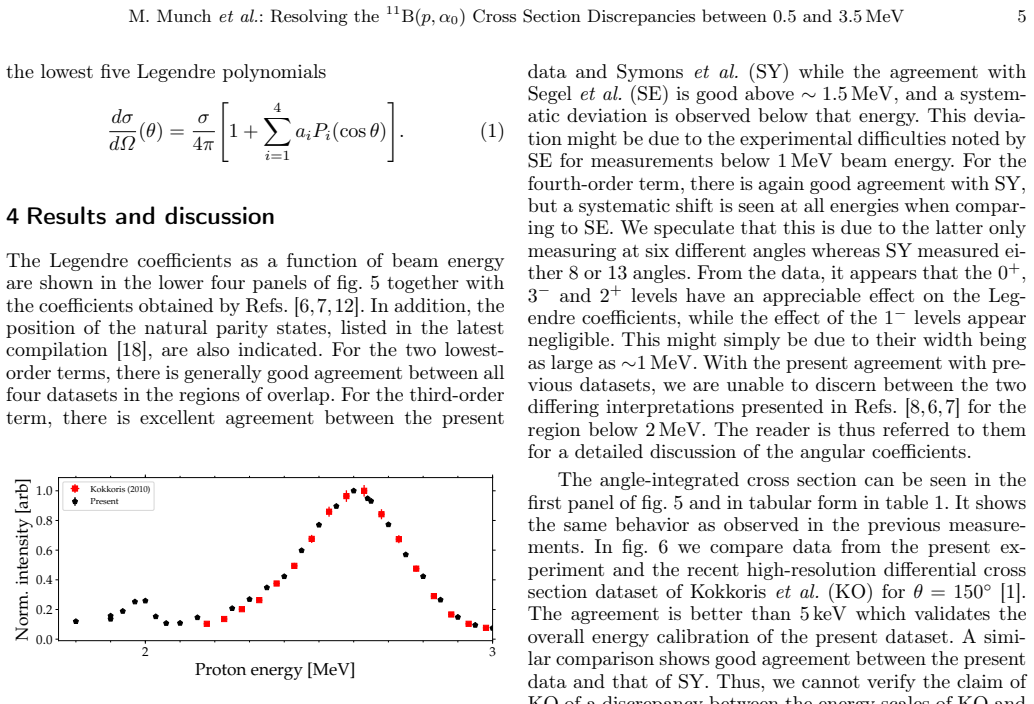
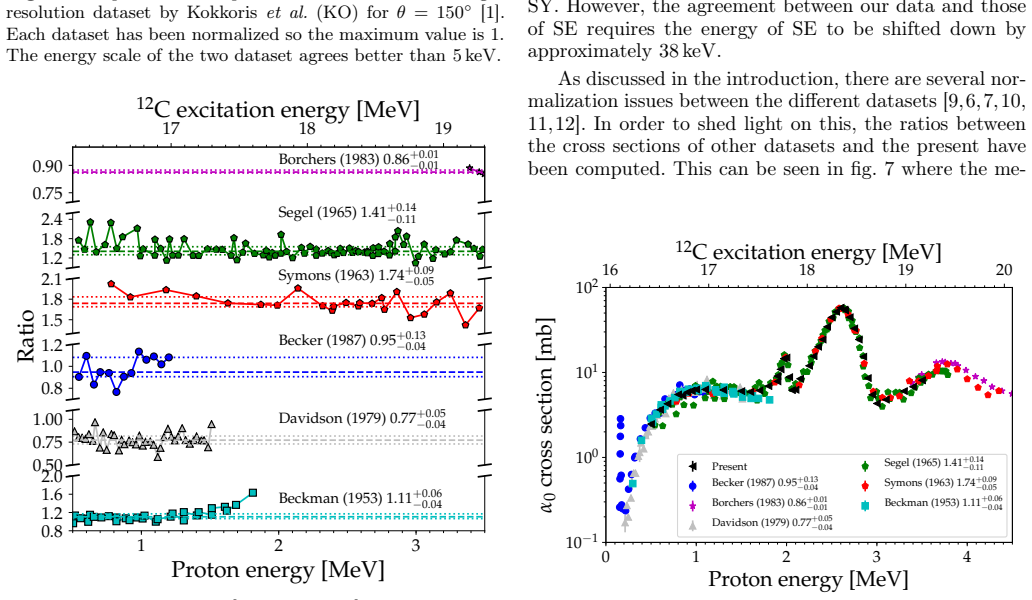
The central result is a self-consistent angle-integrated cross section for $^{11}$B(p,$\alpha_0$) between 0.5 and 3.5 MeV, extracted from fine energy steps (100 keV, with smaller steps near known resonances) and from Legendre-polynomial fits to the angular distributions recorded by four double-sided silicon strip detectors. When the present data are compared with the six earlier publications, the authors find that every old dataset can be reconciled by a constant multiplicative factor: the Becker (1987) normalization already agrees, Borchers (1983) agrees within $2\sigma$ where the ranges overlap, and Beckman (1953), Davidson (1979), Segel (1965), and Symons (1963) require scaling by 1.11, 0.77, 1.41, and 1.74, respectively. The energy scale agrees with the recent high-resolution dataset of Kokkoris et al. (2010) to better than 5 keV, while Segel's data appear to need a downward shift of about 38 keV. The paper concludes that the overall normalization is now known to better than 15%, while noting that the $\alpha_0$ channel alone cannot decide between competing interpretations of the resonance structure below 2 MeV; that question is left to a future $\alpha_1$ measurement.
Load-bearing premise
The cross-section normalization is directly proportional to the target thickness of $12.6(12)\,\mu$g/cm$^2$, deduced from the carbon-peak energy shift using SRIM stopping-power tables; if that thickness or the stopping-power conversion is wrong, every cross-section value and every scaling factor used to reconcile older datasets shifts by the same proportion.
Editorial extensions
If this is right
- The new table can serve as the reference cross section for $^{11}$B(p,$\alpha_0$) from 0.5 to 3.5 MeV, with per-point uncertainties around 10–12% and a dataset-level normalization stated as better than 15%.
- The six earlier measurements, once rescaled by the reported factors, no longer disagree in shape; this removes the need to choose or average conflicting absolute normalizations when using the reaction for depth profiling or yield estimates.
- Because the energy scale matches Kokkoris et al. to better than 5 keV, applications that rely on resonance positions near 16.1–19.2 MeV excitation in $^{12}$C can trust the present energy calibration, and the claimed discrepancy between Kokkoris and Symons is not reproduced.
- The unresolved sub-2 MeV resonance interpretation is explicitly outside what this dataset settles; settling it requires measuring the $\alpha_1$ channel and its three-alpha Dalitz distribution, feeding a new R-matrix analysis.
Reading between the lines
- If the thickness-normalization assumption holds, the 12% uncertainty on the target thickness is the dominant systematic in the final cross section; any future use of this dataset at the stated precision inherits that uncertainty, so an independent, non-destructive thickness measurement would be the most direct upgrade.
- The constant scaling factors (e.g., 1.41 for Segel and 1.74 for Symons) suggest that those experiments carried systematic normalization errors of tens of percent, most plausibly in beam-current integration or target stoichiometry; re-examining their original run conditions could identify the cause.
- The same detector-plus-simulation approach could be applied to the $\alpha_1$ channel, and the paper's own conclusion implies that a Dalitz-plot analysis of that channel would discriminate between the ghost-resonance and broad-$1^-$ interpretations of the region below 2 MeV.
- Because the reconciliation is achieved with constant scaling factors over the overlapping energy ranges, the data imply that the energy dependence was already approximately correct in the old measurements and that only absolute normalizations and energy offsets were wrong; if true, renormalized old angular distributions can be combined with the new dataset for improved Legendre coefficients.
Signed reviews
Editorial analysis
A structured set of objections, weighed in public.
Referee Report
Summary. The paper reports a new measurement of the 11B(p,α0) cross section for proton energies between 0.5 and 3.5 MeV using four double-sided silicon strip detectors on a thin isotopically enriched 11B target. Angular distributions, Legendre coefficients, and angle-integrated cross sections are extracted, and the energy scale is checked against the high-resolution dataset of Kokkoris et al. to better than 5 keV (Fig. 6). The authors compare their data with six older datasets using constant scaling factors (Fig. 7) and conclude that the previous discrepancies in both magnitude and energy dependence have been resolved, with an overall normalization better than 15%.
Significance. If the dataset is accepted, it provides a valuable reference cross section for applications in nuclear reaction analysis, pB fusion studies, and R-matrix analyses of 12C. The experiment has several clear strengths: the energy calibration is independently tested against an external dataset, the angular distributions are fitted with Legendre polynomials in a standard parameterization, the data are tabulated and made available through EXFOR, and the comparison with earlier measurements is quantitative rather than qualitative. The main caveat is that the absolute normalization rests on a single target-thickness determination, 12.6 ± 1.2 µg/cm², which propagates linearly into all reported cross sections.
major comments (2)
- [Sec. 4 and Sec. 5, Fig. 7] The concluding claim that disagreements with previous measurements on both magnitude and energy dependence "have been resolved" overstates the evidence. As the text states, simple constant scaling of the older data works only for Beckman below about 1.3 MeV and for Segel and Symons in the range 1.5–2.75 MeV, with larger deviations outside these ranges; the comparison with Segel additionally requires a 38 keV energy shift, and a systematic offset in the a4 Legendre coefficient remains at all energies. The conclusion should be qualified to say that the present dataset provides a consistent reference scale and reconciles the older datasets only within the stated energy windows, rather than claiming a full resolution of the energy dependence across 0.5–3.5 MeV.
- [Sec. 2 and Sec. 3, Table 1] The absolute normalization is directly proportional to the target thickness of 12.6(12) µg/cm², whose 9.5% relative uncertainty nearly saturates the quoted 10–12% total uncertainties. The paper does not give a detailed uncertainty budget showing how the target-thickness systematic, the dead-layer corrections, the integrated-charge measurement, and the simulation-derived solid angles are propagated into the final cross sections. This budget, or an independent normalization check, is needed to justify the statement that the overall normalization is better than 15%.
minor comments (5)
- [Sec. 4, Fig. 6] The comparison with Kokkoris et al. is made after normalizing both datasets to their maxima, so it validates the relative energy scale but not the absolute normalization; this distinction should be stated explicitly in the text.
- [Sec. 5] The sentence beginning "Considering the good agreement..." defines the 15% normalization claim only by agreement with two datasets; please specify whether this figure includes the target-thickness systematic and the simulation efficiency uncertainty.
- [Table 1] The table contains two entries at Ep = 950 keV and two at Ep = 1900 keV with slightly different cross sections; please label these as repeat runs or duplicate points to avoid confusion.
- [Fig. 4 caption] The caption contains the typo "evulotion"; it should read "evolution".
- [Title page] The placeholder PACS line "PACS-key discribing text of that key" should be removed or replaced with actual PACS codes.
Circularity Check
No significant circularity: the paper reports a new measured cross section and compares it with earlier independent datasets; no fitted input is relabeled as a prediction.
full rationale
This is an experimental nuclear-physics paper, not a derivation from first principles, so the circularity patterns are largely inapplicable. The central result, the angle-integrated 11B(p, alpha0) cross section, is obtained directly from measured particle yields, deadtime-corrected integrated current, Monte Carlo solid-angle simulation, and a target thickness inferred from a carbon-peak energy shift. The target-thickness procedure is taken from the same group's earlier publication (Ref. [14]), but it is an experimental calibration method, not a theoretical claim that presupposes the present cross-section values; a self-citation describing a measurement technique is not load-bearing in the sense of circular reasoning. The comparison with older datasets (Becker, Borchers, Davidson, Segel, Symons, Beckman) is done by forming ratios to the present dataset and then applying constant scaling factors to bring the older data into visual agreement. This is a legitimate use of a new independent measurement as a reference; the scaling factors are descriptive fits to the comparison, not predictions derived from the data in a way that would make the agreement tautological. The paper does not fit parameters to a subset and then claim to predict that same subset, nor does it invoke a uniqueness theorem or an ansatz from prior work to force its normalization. The only caveat is that the conclusion that disagreements are 'resolved' over the full 0.5-3.5 MeV range is stronger than the scaling evidence, since the simple scaling relations are stated to hold only in limited energy windows (Beckman below ~1.3 MeV; Segel and Symons in 1.5-2.75 MeV). That is an evidentiary/correctness concern about the breadth of the claim, not a circularity. Accordingly, no circular steps are identified and the score is 0.
Assumptions & free parameters
assumptions (4)
- domain assumption SRIM stopping-power tables accurately model energy loss and straggling of alpha particles in the boron target and detector dead layers.
- domain assumption The target thickness of 12.6(12) µg/cm² deduced from the carbon-peak energy shift following Ref. [14] is accurate.
- domain assumption The α0 reaction products are cleanly separated by a cut on the CM energy spectrum.
- standard math The Legendre-polynomial expansion (Equation 1) truncated at 4th order is adequate for the angular distributions.
Cite this review
Pith. "Pith review of Resolving the 11B(p, ${\alpha_0}$) Cross Section Discrepancies between 0.5 and 3.5 MeV." pith.science (2026). https://pith.science/paper/IYUENJJP
@misc{pith2026190804064,
  author       = {Pith},
  title        = {Pith review of: Resolving the 11B(p, $\alpha_0$) Cross Section Discrepancies between 0.5 and 3.5 MeV},
  year         = {2026},
  howpublished = {\url{https://pith.science/paper/IYUENJJP}},
  note         = {Machine review of arXiv:1908.04064}
}
abstract
The reaction 11B(p, 3${\alpha}$) is relevant for fields as diverse as material science, nuclear structure, nuclear astrophysics, and fusion science. However, for the channel proceeding via the ground state of 8Be, the available cross-section data shows large discrepancies of both normalization and energy scale. The present paper reports on a measurement of the 11B(p, ${\alpha_0}$) cross section using an array of modern large area segmented silicon detectors and low beam current on an enriched thin target with the aim of resolving the discrepancies amongst previous measurements.
Figures

Figures from the paper (3 more)
Reference graph
Works this paper leans on
-
[1]
M. Kokkoris, A. Kafkarkou, V. Paneta, R. Vlastou, P. Mis- aelides, A. Lagoyannis, Nuclear Instruments and Methods in Physics Research, Section B: Beam Interactions with Materials and Atoms268, 3539 (2010)
work page 2010
-
[2]
A.M. Boesgaard, C.P. Deliyannis, A. Steinhauer, The As- trophysical Journal 621, 991 (2005)
work page 2005
- [3]
- [4]
- [5]
- [6]
- [7]
-
[8]
Barker, Nuclear Physics A707, 277 (2002)
F.C. Barker, Nuclear Physics A707, 277 (2002)
work page 2002
Show all 20 references
-
[9]
Beckman, T
O. Beckman, T. Huus, Č. Zupančič, Physical Review91, 606 (1953)
1953
-
[10]
Davidson, H.L
J.M. Davidson, H.L. Berg, M.M. Lowry, M.R. Dwarakanath, A.J. Sierk, P. Batay-Csorba, Nuclear Physics, Section A315, 253 (1979)
1979
-
[11]
Börchers, H
F. Börchers, H. De Jong, J. Krug, E. Kuhlmann, Nuclear Physics A 405, 141 (1983)
1983
-
[12]
Becker, C
H.W. Becker, C. Rolfs, H.P. Trautvetter, Zeitschrift für Physik A Atomic Nuclei327, 341 (1987)
1987
-
[13]
Otuka, E
N. Otuka, E. Dupont, V. Semkova, B. Pritychenko, A.I. Blokhin, M. Aikawa, S. Babykina, M. Bossant, G. Chen, S. Dunaeva et al., Nuclear Data Sheets120, 272 (2014)
2014
-
[14]
Munch, H.O
M. Munch, H.O. Uldall Fynbo, The European Physical Journal A 54, 138 (2018),1805.10924
2018 arXiv
-
[15]
Hoffman, VULOM4b data sheet (2013), accessed: 2017-05-10, http://www.gsi.de/fileadmin/EE/Module/VULOM/vulom4B_3.pdf
J. Hoffman, VULOM4b data sheet (2013), accessed: 2017-05-10, http://www.gsi.de/fileadmin/EE/Module/VULOM/vulom4B_3.pdf
2013
-
[16]
Johansson, M
H.T. Johansson, M. Heil, B. Löher, H. Si- mon, H. Törnqvist, Tech. rep. (2013), http://repository.gsi.de/record/68045
2013
-
[17]
Kirsebom, M
O.S. Kirsebom, M. Munch, H.O.U. Fynbo, in prep
-
[18]
Kelley, J
J. Kelley, J. Purcell, C. Sheu, Nuclear Physics A968, 71 (2017)
2017
-
[19]
Munch, J.H
M. Munch, J.H. Jensen, O.S. Kirsebom,simX (2018)
2018
-
[20]
Ziegler, M.D
J.F. Ziegler, M.D. Ziegler, J.P. Biersack, Nuclear Instru- ments and Methods in Physics Research B 268, 1818 (2010)
2010
Reviewed August 14, 2026 · model on record in the stance chip above.
Discussion (0). Continue with ORCID to comment.