REVIEW 4 major objections 5 minor 41 references
RadioDUN: A Physics-Inspired Deep Unfolding Network for Radio Map Estimation
T0 review · 4 major / 5 minor · reviewed 2026-08-07 · deepseek-v4-flash
Pith's one-line read RadioDUN, a deep unfolding network that factorizes radio maps into physical propagation factors—distance plus obstacle-induced shadowing—reconstructs dense signal-strength maps from sparse measurements and reports the best RMSE on two…
desk verdict Solid physics-inspired unrolling for radio map estimation with real gains, but the unknown-transmitter evaluation is unfair as reported and the SOTA claim outruns the tables. read the letter →
The pith
A machine-rendered reading of the paper's core claim, the machinery that carries it, and where it could break.
The reading
What carries the argument
The load-bearing object is the factorized propagation model $X = \sum_{i=0}^m s_i$, a reformulation of the statistical path-loss relation $X - I = 10\alpha\log_{10}(d) + \eta + X_\delta$. The iterative algorithm alternates gradient updates on each factor $s_i$ followed by soft-thresholding, and RadioDUN unfolds each iteration into a block containing three modules: a gradient descent module with learnable step sizes and thresholds, a dynamic reweighting module that uses convolutional attention to weight each factor's contribution, and a proximal mapping module—a U-shaped encoder-decoder with channel attention—that acts as a learned regularizer. A shadowing loss $L_\sigma$ supervises the obstacle-factor sum against the statistical model's residual, providing a complementary training signal that the ablation study shows works only when combined with the dynamic reweighting module.
What would settle it
Take a trained RadioDUN model and evaluate it on the DPM or IRT4 test set with the transmitter coordinate in Eq. 8 shifted by a known offset (e.g., 10, 25, or 50 pixels) from the true position; if RMSE degrades sharply with offset, the claimed physics-inspired advantage depends on an input the method cannot obtain in transmitter-unknown scenarios.
Extended reading notes
Core claim
The central claim is that a physics-inspired factorization turns sparse radio map reconstruction into a tractable, learnable optimization. Instead of learning a direct mapping from inputs to maps, the paper defines the radio map as $X = \sum_{i=0}^m s_i$, where $s_0$ captures distance-dependent path loss and $s_1,\dots,s_m$ capture obstacle-induced shadowing, and derives an alternating optimization with gradient descent and soft-thresholding updates. Each iteration is unfolded into a network block, so the whole pipeline is differentiable and trainable end to end. On the RadioMapSeer benchmarks the paper reports that this design outperforms existing deep learning and compressive sensing baselines on DPM and IRT4 under both known and unknown transmitter conditions, with the largest gains (40.19% RMSE reduction) on IRT4 when the transmitter position is treated as unknown.
Load-bearing premise
The load-bearing premise is that the transmitter position used to build the initial distance map $P_0$ is accurate, since the transmitter-unknown experiments only test the trivial $(0,0)$ assumption and never measure what happens when the assumed position is wrong.
Editorial extensions
If this is right
- Radio map estimation can be solved as sparse signal recovery even at extremely low sampling ratios, because the physical factorization reduces the recovery complexity.
- The deep unfolding design makes hyperparameter selection and prior fitting adaptive, removing manual tuning of step sizes, thresholds, and regularization strength.
- Obstacle distributions used as learnable shadowing factors improve accuracy compared to feeding environmental maps directly to a network.
- The method degrades more gracefully than direct-learning baselines when training data is scarce, and transfers across propagation models (DPM to IRT4) better than the compared methods.
- The number of unfolding blocks $K$ trades off capacity against data requirement; the paper finds $K=3$ optimal in its setup.
Reading between the lines
- A natural stress test the paper leaves open: perturb the assumed transmitter location away from $(0,0)$ and measure RMSE degradation; if sensitivity is high, the distance-map initialization becomes a practical limitation in deployments without reliable transmitter positions.
- The factorized structure suggests an interpretability check the paper does not perform—quantifying how much of the reconstruction error is attributable to the distance factor versus the shadowing factors.
- The shadowing-loss recipe could generalize to other physics-derived auxiliary variables (e.g., interference or multipath indicators) as supplementary supervision for factorized unfolding networks.
Editorial analysis
A structured set of objections, weighed in public.
Referee Report
Summary. The paper proposes RadioDUN, a deep unfolding network for radio map estimation (RME) from sparse measurements. The method casts RME as a sparse signal recovery problem and decomposes the radio map into a sum of physical factors (distance, obstacles, etc.) inspired by a log-distance shadowing model. The architecture alternates gradient descent modules, a dynamic reweighting module, and a proximal mapping module across K unfolding blocks, with an additional shadowing loss derived from the statistical propagation model. Experiments on the RadioMapSeer dataset (DPM and IRT4) compare against RadioUNet, PMNet, RME-GAN, and OCTUF under transmitter-known and transmitter-unknown conditions, with additional studies on training-data size, sample count, transferability, and ablations. The paper claims state-of-the-art performance in RMSE, SSIM, and PSNR across most settings.
Significance. If the claims hold, RadioDUN would be a useful step toward integrating physical propagation models with deep unfolding for RME, and the dynamic reweighting module is a plausible contribution. The paper is also commendable for including extensive experiments: training-data sensitivity, sample-count sensitivity, transferability, and ablations of the proposed modules. However, the headline performance claim is compromised by an evaluation protocol that gives RadioDUN an additional distance-map input in the 'transmitter-unknown' condition while the comparison methods do not receive that input, and by the absence of an ablation that isolates this input. The claimed optimality across all three metrics is also contradicted by the paper's own tables. The significance is therefore real but not yet fully established.
major comments (4)
- [§IV-B, Eq. (8)] The transmitter-unknown evaluation is not a fair comparison. The paper states that 'we assume the transmitter is at (0,0) to generate the distance map,' and Eq. (8) shows that this distance map P0 is fed into RadioDUN. The baseline methods (RadioUNet, PMNet, RME-GAN, OCTUF) do not receive this extra input channel. P0 is a smooth spatial prior, so the reported gains in the transmitter-unknown condition—6.87% RMSE improvement on DPM and 40.19% on IRT4—could reflect the additional input information rather than the physics-inspired factorization or deep unfolding. The manuscript provides no ablation without P0, no sensitivity analysis for the assumed transmitter location, and no comparison in which the baselines receive the same P0. The term 'transmitter-unknown' is also misleading because the method always uses a fixed assumed position. This issue is load-bearing for the central SOTA claim and should be addressed with additional experiments removing or varying P0.
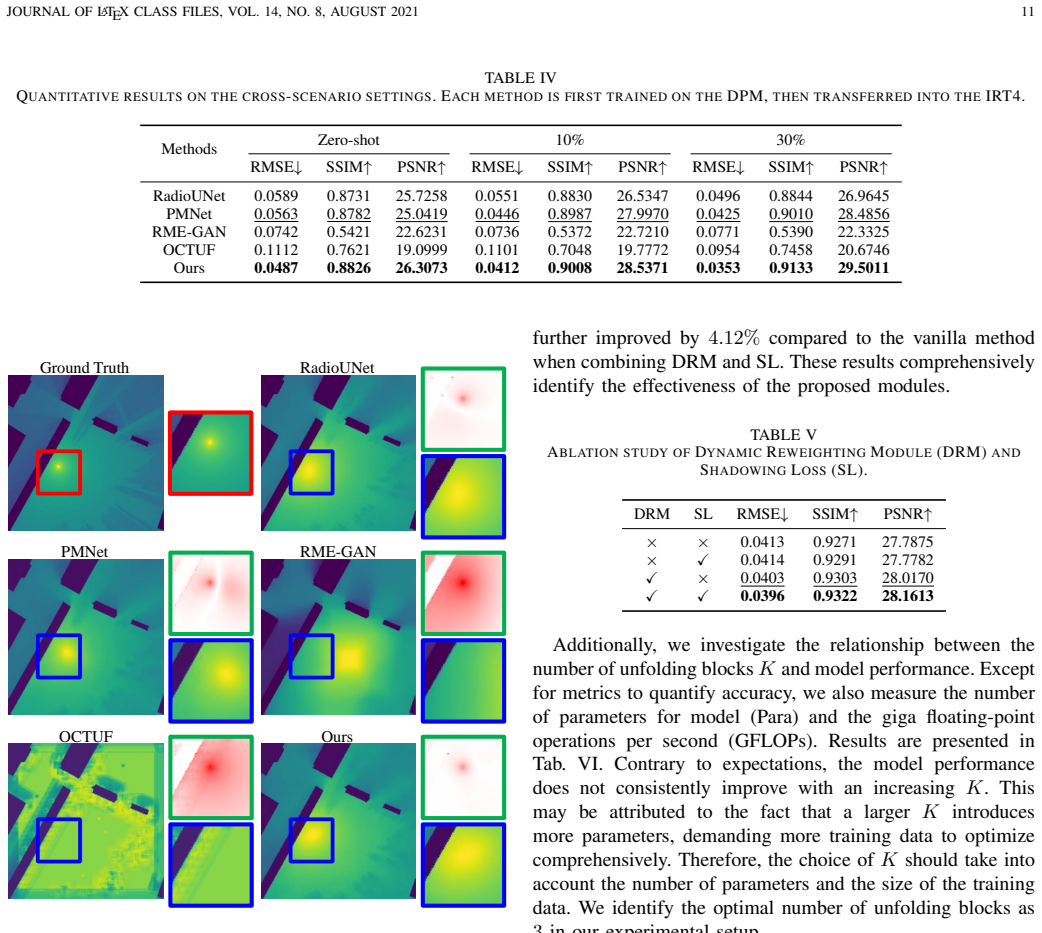
- [§III-E, Eqs. (19)–(21)] The shadowing loss derivation has a logical gap. Eq. (20) defines σ_Xδ as the root-mean-square residual sqrt(Σ(E − αF − η)^2 / N), which would be a reasonable empirical estimate if the mean of the shadowing factor were zero. However, the actual loss Lσ in Eq. (21) is not obtained from Eq. (20): the first term is the variance of the predicted shadowing factor X̂σ around its mean, and the second term mixes X_GT − X̂ with X̂σ − X̄̂σ without a clear derivation. The paper claims that minimizing σ_Xδ is equivalent to minimizing the fitting error, but Lσ as written is not shown to be equivalent. Moreover, the ablation in Table V shows that the shadowing loss alone leaves RMSE essentially unchanged (0.0413 vs. 0.0414) and slightly worsens PSNR (27.7875 vs. 27.7782), which contradicts the statement that the shadowing loss 'enhances the performance' of RadioDUN. The authors should either provide a rigorous derivation connecting Eq. (20) to Eq. (21) or temper the claim about this loss's contribution.
- [§IV-B, Table I and §IV-D, Table III] The statement that 'the proposed method achieves the optimal results in terms of RMSE, SSIM, and PSNR' is contradicted by the paper's own numbers. In Table I, PMNet has higher SSIM than RadioDUN on DPM under the transmitter-unknown condition (0.9498 vs. 0.9478), and RadioUNet has higher SSIM on DPM under the transmitter-known condition (0.9803 vs. 0.9798). In Table III, at 25 samples PMNet has lower RMSE than RadioDUN (0.0232 vs. 0.0235) and higher SSIM (0.9530 vs. 0.9528). The claim should be revised to state that RadioDUN shows the best overall performance or to explicitly report the exceptions. This is a factual overstatement that should be corrected in the abstract, introduction, and conclusion.
- [§III-A to §III-D] The connection between the alternating optimization and the proposed network is looser than the text suggests. The paper says the unfolding blocks are 'strictly equivalent to an iteration in AO' (Section III-B), but Eq. (6) defines an alternating gradient update without a threshold, while Eq. (11) introduces soft-thresholding per factor; Eq. (13) defines a combined sum for all factors. The GDM, DRM, and PMM are then largely learned network modules, and the paper does not show how the DRM's dynamic reweighting or the PMM's U-Net proximal operator correspond to any term in the objective of Eq. (5). This does not invalidate the architecture, but the 'physics-inspired unfolding' framing should be made precise: the authors should clarify which steps are exact unfoldings and which are learned heuristics inserted by design.
minor comments (5)
- [§III-B] In the second paragraph of Section III-B, the phrase 'the predicted radio map ˆX and is acquired' appears to be a typo; it should read 'the predicted radio map ˆX is acquired.'
- [Eq. (9)] The variable y is defined in Eq. (1) as an N×1 vector, but Eq. (9) concatenates y with spatial maps s0_i and P_i to form a 2D feature. The authors should specify how y is reshaped or interpolated to the spatial resolution H×W before concatenation.
- [§IV-A and Table V] The manuscript does not report error bars, standard deviations, or multiple random seeds. Since some differences are small (e.g., RMSE 0.0396 vs. 0.0403 in the ablation study), the statistical significance of the reported improvements is unclear.
- [§IV-D, Table III] The RME-GAN results at 81 and 100 samples are anomalous: RMSE drops from 0.2266 to 0.0584 between 81 and 100 samples, and SSIM jumps from 0.8482 to 0.8596. The authors should comment on this behavior, as it may indicate training instability that is not discussed.
- [Eq. (24)] The total loss is LT = Lσ + µLMSE with µ set to 1 by default, but the paper provides no sensitivity analysis for µ. Since the shadowing loss is a claimed contribution, a brief study of µ would strengthen the presentation.
Circularity Check
No significant circularity: the physical model is an architectural prior and the radio map is supervised by ground truth; the only overlapping-author citation is not load-bearing.
full rationale
RadioDUN's derivation is not circular. The sparse-signal recovery objective (Eq. 2) and the log-distance propagation factorization (Eq. 3) come from standard external formulations; Eq. 4 is an algebraic decomposition used to reorganize the optimization, not an identity that defines the output in terms of the training target. The network is trained with explicit ground-truth supervision through the MSE fidelity term (Eq. 23) and the shadowing loss (Eq. 21), so the predicted radio map is not, by construction, a function of the benchmark metric. Learnable step sizes, thresholds, and network weights are internal parameters of the unfolding network, not quantities fitted to a subset of data and then renamed as predictions. The only overlapping-author citation, Ref. [14], supports a general statement that environmental inputs such as building distribution are useful for radio map estimation; it does not carry the SOTA claim, and no uniqueness theorem or physical ansatz is imported from the authors' prior work to force the architecture. The transmitter-unknown protocol in Section IV-B assumes the transmitter is at (0,0) to generate the distance map P0; this is a validity/fairness concern about an input prior, not a circularity, because P0 is generated from an assumption rather than from the ground-truth radio map or from the reported RMSE values. No equation in the paper reduces to its own output by definition, and the empirical claims are benchmarked against independent baselines on RadioMapSeer.
Assumptions & free parameters
free parameters (4)
- Learnable gradient step sizes β_i =
learned per block
- Soft-threshold parameter ε =
learned per block
- Loss weight µ =
1
- Number of unfolding blocks K =
3
assumptions (5)
- domain assumption The statistical log-distance propagation model with Gaussian shadowing (Eq. 3) describes the radio maps in the datasets.
- ad hoc to paper The radio map can be expressed as a sum of independent factor maps, X = Σ s_i (Eq. 4).
- ad hoc to paper The factors are sparse in the pixel domain, so soft-thresholding is applied after each gradient step (Eq. 12).
- domain assumption The alternating optimization over the factors converges to a useful solution (Eqs. 6-7).
- domain assumption The shadowing factor follows a zero-mean Gaussian distribution (Eq. 3), used to design the shadowing loss.
Cite this review
Pith. "Pith review of RadioDUN: A Physics-Inspired Deep Unfolding Network for Radio Map Estimation." pith.science (2026). https://pith.science/paper/IYWUJWNX
@misc{pith2026250608418,
  author       = {Pith},
  title        = {Pith review of: RadioDUN: A Physics-Inspired Deep Unfolding Network for Radio Map Estimation},
  year         = {2026},
  howpublished = {\url{https://pith.science/paper/IYWUJWNX}},
  note         = {Machine review of arXiv:2506.08418}
}
read the original abstract
The radio map represents the spatial distribution of spectrum resources within a region, supporting efficient resource allocation and interference mitigation. However, it is difficult to construct a dense radio map as a limited number of samples can be measured in practical scenarios. While existing works have used deep learning to estimate dense radio maps from sparse samples, they are hard to integrate with the physical characteristics of the radio map. To address this challenge, we cast radio map estimation as the sparse signal recovery problem. A physical propagation model is further incorporated to decompose the problem into multiple factor optimization sub-problems, thereby reducing recovery complexity. Inspired by the existing compressive sensing methods, we propose the Radio Deep Unfolding Network (RadioDUN) to unfold the optimization process, achieving adaptive parameter adjusting and prior fitting in a learnable manner. To account for the radio propagation characteristics, we develop a dynamic reweighting module (DRM) to adaptively model the importance of each factor for the radio map. Inspired by the shadowing factor in the physical propagation model, we integrate obstacle-related factors to express the obstacle-induced signal stochastic decay. The shadowing loss is further designed to constrain the factor prediction and act as a supplementary supervised objective, which enhances the performance of RadioDUN. Extensive experiments have been conducted to demonstrate that the proposed method outperforms the state-of-the-art methods. Our code will be made publicly available upon publication.
Figures


Figures from the paper (4 more)



Reference graph
Works this paper leans on
-
[1]
Radio map estimation: A data-driven approach to spectrum cartography,
D. Romero and S.-J. Kim, “Radio map estimation: A data-driven approach to spectrum cartography,” IEEE Signal Processing Magazine , vol. 39, no. 6, pp. 53–72, 2022
2022
-
[2]
M. Z. Chowdhury, M. Shahjalal, S. Ahmed, and Y . M. Jang, “6g wireless communication systems: Applications, requirements, technolo- gies, challenges, and research directions,” IEEE Open Journal of the Communications Society, vol. 1, pp. 957–975, 2020
work page 2020
-
[3]
Theoretical analysis of the radio map estimation problem,
D. Romero, T. N. Ha, R. Shrestha, and M. Franceschetti, “Theoretical analysis of the radio map estimation problem,” IEEE Transactions on Wireless Communications, 2024
work page 2024
-
[4]
Overview of the first pathloss radio map prediction challenge,
C ¸ . Yapar, F. Jaensch, R. Levie, G. Kutyniok, and G. Caire, “Overview of the first pathloss radio map prediction challenge,” IEEE Open Journal of Signal Processing , 2024
work page 2024
-
[5]
A survey of wireless path loss prediction and coverage mapping methods,
C. Phillips, D. Sicker, and D. Grunwald, “A survey of wireless path loss prediction and coverage mapping methods,” IEEE Communications Surveys & Tutorials, vol. 15, no. 1, pp. 255–270, 2012
work page 2012
-
[6]
S. Sun, T. S. Rappaport, T. A. Thomas, A. Ghosh, H. C. Nguyen, I. Z. Kovacs, I. Rodriguez, O. Koymen, and A. Partyka, “Investigation of prediction accuracy, sensitivity, and parameter stability of large-scale propagation path loss models for 5g wireless communications,” IEEE transactions on vehicular technology , vol. 65, no. 5, pp. 2843–2860, 2016
work page 2016
-
[7]
Ray tracing for radio propagation modeling: Principles and applications,
Z. Yun and M. F. Iskander, “Ray tracing for radio propagation modeling: Principles and applications,” IEEE access, vol. 3, pp. 1089–1100, 2015
2015
-
[8]
Finite-difference modeling of very-low-frequency propagation in the earth-ionosphere waveguide,
R. A. Marshall, T. Wallace, and M. Turbe, “Finite-difference modeling of very-low-frequency propagation in the earth-ionosphere waveguide,” IEEE Transactions on Antennas and Propagation , vol. 65, no. 12, pp. 7185–7197, 2017
work page 2017
Show all 41 references
-
[9]
A scalable and generalizable pathloss map prediction,
J.-H. Lee and A. F. Molisch, “A scalable and generalizable pathloss map prediction,” IEEE Transactions on Wireless Communications , 2024
2024
-
[10]
Radiounet: Fast radio map estimation with convolutional neural networks,
R. Levie, C ¸ . Yapar, G. Kutyniok, and G. Caire, “Radiounet: Fast radio map estimation with convolutional neural networks,” IEEE Transactions on Wireless Communications, vol. 20, no. 6, pp. 4001–4015, 2021
2021
-
[11]
Rme-gan: A learning framework for radio map estimation based on conditional generative adversarial network,
S. Zhang, A. Wijesinghe, and Z. Ding, “Rme-gan: A learning framework for radio map estimation based on conditional generative adversarial network,” IEEE Internet of Things Journal , vol. 10, no. 20, pp. 18 016– 18 027, 2023
2023
-
[12]
Deep learning for visual understanding: A review,
Y . Guo, Y . Liu, A. Oerlemans, S. Lao, S. Wu, and M. S. Lew, “Deep learning for visual understanding: A review,” Neurocomputing, vol. 187, pp. 27–48, 2016
2016
-
[13]
A survey of the usages of deep learning for natural language processing,
D. W. Otter, J. R. Medina, and J. K. Kalita, “A survey of the usages of deep learning for natural language processing,” IEEE transactions on neural networks and learning systems , vol. 32, no. 2, pp. 604–624, 2020
2020
-
[14]
Generative ai on spectrumnet: An open benchmark of multiband 3d radio maps,
S. Zhang, S. Jiang, W. Lin, Z. Fang, K. Liu, H. Zhang, and K. Chen, “Generative ai on spectrumnet: An open benchmark of multiband 3d radio maps,” IEEE Transactions on Cognitive Communications and Networking, 2024
2024
-
[15]
D 3 c 2-net: Dual-domain deep convolutional coding network for compressive sensing,
W. Li, B. Chen, S. Liu, S. Zhao, B. Du, Y . Zhang, and J. Zhang, “D 3 c 2-net: Dual-domain deep convolutional coding network for compressive sensing,” IEEE Transactions on Circuits and Systems for Video Technology, 2024
2024
-
[16]
Sparse bayesian learning-based 3d radio environment map construction—sampling optimization, scenario-dependent dictio- nary construction and sparse recovery,
J. Wang, Q. Zhu, Z. Lin, Q. Wu, Y . Huang, X. Cai, W. Zhong, and Y . Zhao, “Sparse bayesian learning-based 3d radio environment map construction—sampling optimization, scenario-dependent dictio- nary construction and sparse recovery,” IEEE transactions on cognitive communicati...
2023
-
[17]
Sparse bayesian learning-based hierarchical construction for 3d radio environment maps incorporating channel shadowing,
J. Wang, Q. Zhu, Z. Lin, J. Chen, G. Ding, Q. Wu, G. Gu, and Q. Gao, “Sparse bayesian learning-based hierarchical construction for 3d radio environment maps incorporating channel shadowing,” IEEE Transactions on Wireless Communications , 2024
2024
-
[18]
Ista-net: Interpretable optimization-inspired deep network for image compressive sensing,
J. Zhang and B. Ghanem, “Ista-net: Interpretable optimization-inspired deep network for image compressive sensing,” in Proceedings of the IEEE conference on computer vision and pattern recognition , 2018, pp. 1828–1837
2018
-
[19]
Application of compressive sensing in cognitive radio communications: A survey,
S. K. Sharma, E. Lagunas, S. Chatzinotas, and B. Ottersten, “Application of compressive sensing in cognitive radio communications: A survey,” IEEE communications surveys & tutorials, vol. 18, no. 3, pp. 1838–1860, 2016
2016
-
[20]
Progressive content-aware coded hyperspectral snapshot compressive imaging,
X. Zhang, B. Chen, W. Zou, S. Liu, Y . Zhang, R. Xiong, and J. Zhang, “Progressive content-aware coded hyperspectral snapshot compressive imaging,” IEEE Transactions on Circuits and Systems for Video Tech- nology, 2024
2024
-
[21]
Puert: Probabilistic under- sampling and explicable reconstruction network for cs-mri,
J. Xie, J. Zhang, Y . Zhang, and X. Ji, “Puert: Probabilistic under- sampling and explicable reconstruction network for cs-mri,” IEEE Jour- nal of Selected Topics in Signal Processing, vol. 16, no. 4, pp. 737–749, 2022
2022
-
[22]
Convergence of alternating opti- mization,
J. C. Bezdek and R. J. Hathaway, “Convergence of alternating opti- mization,” Neural, Parallel & Scientific Computations , vol. 11, no. 4, pp. 351–368, 2003
2003
-
[23]
Multi-scale context aggregation by dilated convolutions,
F. Yu and V . Koltun, “Multi-scale context aggregation by dilated convolutions,” arXiv preprint arXiv:1511.07122 , 2015
2015 arXiv
-
[24]
Physics-inspired machine learning for radiomap estimation: Integration of radio propagation mod- els and artificial intelligence,
S. Zhang, B. Choi, F. Ouyang, and Z. Ding, “Physics-inspired machine learning for radiomap estimation: Integration of radio propagation mod- els and artificial intelligence,” IEEE communications magazine, vol. 62, no. 8, pp. 155–161, 2024
2024
-
[25]
Optimization-inspired cross-attention transformer for compressive sensing,
J. Song, C. Mou, S. Wang, S. Ma, and J. Zhang, “Optimization-inspired cross-attention transformer for compressive sensing,” in Proceedings of the IEEE/CVF conference on computer vision and pattern recognition , 2023, pp. 6174–6184
2023
-
[26]
Cpp-net: Embracing multi-scale feature fusion into deep unfolding cp-ppa network for compressive sensing,
Z. Guo and H. Gan, “Cpp-net: Embracing multi-scale feature fusion into deep unfolding cp-ppa network for compressive sensing,” in Pro- ceedings of the IEEE/CVF Conference on Computer Vision and Pattern Recognition, 2024, pp. 25 086–25 095
2024
-
[27]
Physics-inspired com- pressive sensing: Beyond deep unrolling,
J. Zhang, B. Chen, R. Xiong, and Y . Zhang, “Physics-inspired com- pressive sensing: Beyond deep unrolling,” IEEE Signal Processing Magazine, vol. 40, no. 1, pp. 58–72, 2023
2023
-
[28]
Video-rate hyperspectral camera based on a cmos-compatible random array of fabry–p´erot filters,
M. Yako, Y . Yamaoka, T. Kiyohara, C. Hosokawa, A. Noda, K. Tack, N. Spooren, T. Hirasawa, and A. Ishikawa, “Video-rate hyperspectral camera based on a cmos-compatible random array of fabry–p´erot filters,” Nature Photonics, vol. 17, no. 3, pp. 218–223, 2023
2023
-
[29]
Propagation path loss models for 5g urban micro-and macro-cellular scenarios,
S. Sun, T. S. Rappaport, S. Rangan, T. A. Thomas, A. Ghosh, I. Z. Kovacs, I. Rodriguez, O. Koymen, A. Partyka, and J. Jarvelainen, “Propagation path loss models for 5g urban micro-and macro-cellular scenarios,” in 2016 IEEE 83rd Vehicular Technology Conference (VTC Spring). IE...
2016
-
[30]
A. F. Molisch, Wireless communications. John Wiley & Sons, 2012, vol. 34
2012
-
[31]
Mask-guided spectral-wise transformer for efficient hyperspectral image reconstruction,
Y . Cai, J. Lin, X. Hu, H. Wang, X. Yuan, Y . Zhang, R. Timofte, and L. Van Gool, “Mask-guided spectral-wise transformer for efficient hyperspectral image reconstruction,” in Proceedings of the IEEE/CVF conference on computer vision and pattern recognition , 2022, pp. 17 502–17 511
2022
-
[32]
Ista-net++: Flexible deep unfolding net- work for compressive sensing,
D. You, J. Xie, and J. Zhang, “Ista-net++: Flexible deep unfolding net- work for compressive sensing,” in 2021 IEEE International Conference on Multimedia and Expo (ICME) . IEEE, 2021, pp. 1–6
2021
-
[33]
Cbam: Convolutional block attention module,
S. Woo, J. Park, J.-Y . Lee, and I. S. Kweon, “Cbam: Convolutional block attention module,” in Proceedings of the European conference on computer vision (ECCV) , 2018, pp. 3–19
2018
-
[34]
Xception: Deep learning with depthwise separable convolu- tions,
F. Chollet, “Xception: Deep learning with depthwise separable convolu- tions,” in Proceedings of the IEEE conference on computer vision and pattern recognition, 2017, pp. 1251–1258
2017
-
[35]
Plug-and-play admm for image restoration: Fixed-point convergence and applications,
S. H. Chan, X. Wang, and O. A. Elgendy, “Plug-and-play admm for image restoration: Fixed-point convergence and applications,” IEEE Transactions on Computational Imaging, vol. 3, no. 1, pp. 84–98, 2016
2016
-
[36]
U-net: Convolutional networks for biomedical image segmentation,
O. Ronneberger, P. Fischer, and T. Brox, “U-net: Convolutional networks for biomedical image segmentation,” in Medical image computing and computer-assisted intervention–MICCAI 2015: 18th international con- ference, Munich, Germany, October 5-9, 2015, proceedings, part III 18 ...
2015
-
[37]
Hybrid cnn-transformer ar- chitecture for efficient large-scale video snapshot compressive imaging,
M. Cao, L. Wang, M. Zhu, and X. Yuan, “Hybrid cnn-transformer ar- chitecture for efficient large-scale video snapshot compressive imaging,” International Journal of Computer Vision , vol. 132, no. 10, pp. 4521– 4540, 2024
2024
-
[38]
Dominant path prediction model for urban scenarios,
R. Wahl, G. W ¨olfle, P. Wertz, P. Wildbolz, and F. Landstorfer, “Dominant path prediction model for urban scenarios,” in 14th IST mobile and wireless communications summit , 2005, pp. 1–5. JOURNAL OF LATEX CLASS FILES, VOL. 14, NO. 8, AUGUST 2021 13
2005
-
[39]
Verifying path loss and delay spread predictions of a 3d ray tracing propagation model in urban environment,
T. Rautiainen, G. Wolfle, and R. Hoppe, “Verifying path loss and delay spread predictions of a 3d ray tracing propagation model in urban environment,” in Proceedings IEEE 56th Vehicular Technology Conference, vol. 4. IEEE, 2002, pp. 2470–2474
2002
-
[40]
Mtc-csnet: Marrying transformer and convolution for image compressed sensing,
M. Shen, H. Gan, C. Ma, C. Ning, H. Li, and F. Liu, “Mtc-csnet: Marrying transformer and convolution for image compressed sensing,” IEEE Transactions on Cybernetics , 2024
2024
-
[41]
A comprehensive survey on transfer learning,
F. Zhuang, Z. Qi, K. Duan, D. Xi, Y . Zhu, H. Zhu, H. Xiong, and Q. He, “A comprehensive survey on transfer learning,” Proceedings of the IEEE, vol. 109, no. 1, pp. 43–76, 2020
2020
Reviewed August 7, 2026 · model on record in the stance chip above.
Discussion (0). Continue with ORCID to comment.