Polar Decoding Tree Pruning Based on Soft Output Extraction
Pith reviewed 2026-06-27 05:52 UTC · model grok-4.3
The pith
Blockwise soft-output extraction from SCL decoding of polar codes approximates path reliability accurately enough to prune low-probability paths without changing the decoder output.
A machine-rendered reading of the paper's core claim, the machinery that carries it, and where it could break.
Core claim
The blockwise soft-output extraction process supplies an accurate enough approximation of the probability that a decoding path is correct, allowing paths below a pre-defined reliability threshold to be pruned from the list without altering the final decoded output or degrading error-correction performance.
What carries the argument
Blockwise soft-output extraction that converts path metrics into an approximation of the probability a path is correct, enabling threshold-based pruning inside the SCL tree.
If this is right
- Sorting and path-metric update operations drop proportionally to the number of pruned paths.
- The same pruning rule applies unchanged to both conventional and fast SCL variants.
- Error-rate curves remain identical to those of the unpruned reference decoders across the tested SNR range.
- The resulting decoders require fewer resources than previously published pruned polar decoders.
Where Pith is reading between the lines
- The same soft-output signal could be reused to adapt the list size dynamically rather than using a fixed threshold.
- Hardware implementations could gate entire sub-trees once a path is pruned, lowering power in addition to latency.
- The pruning criterion may transfer to list decoding of other codes that already compute soft outputs, such as LDPC or turbo codes.
Load-bearing premise
The soft-output probability approximation is accurate enough that any path it would prune would never have been chosen as the final output anyway.
What would settle it
A Monte-Carlo simulation over the same noise realizations showing that the pruned decoder ever outputs a different codeword than the full SCL decoder on at least one frame.
Figures
read the original abstract
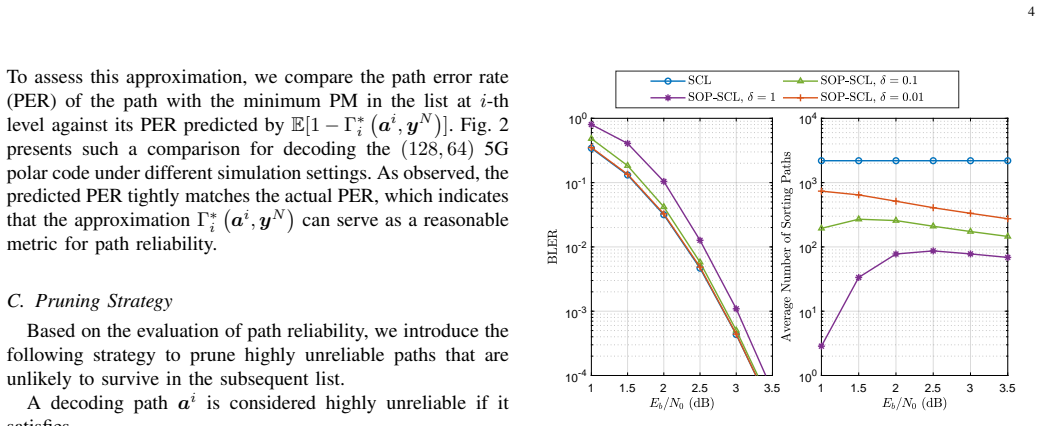
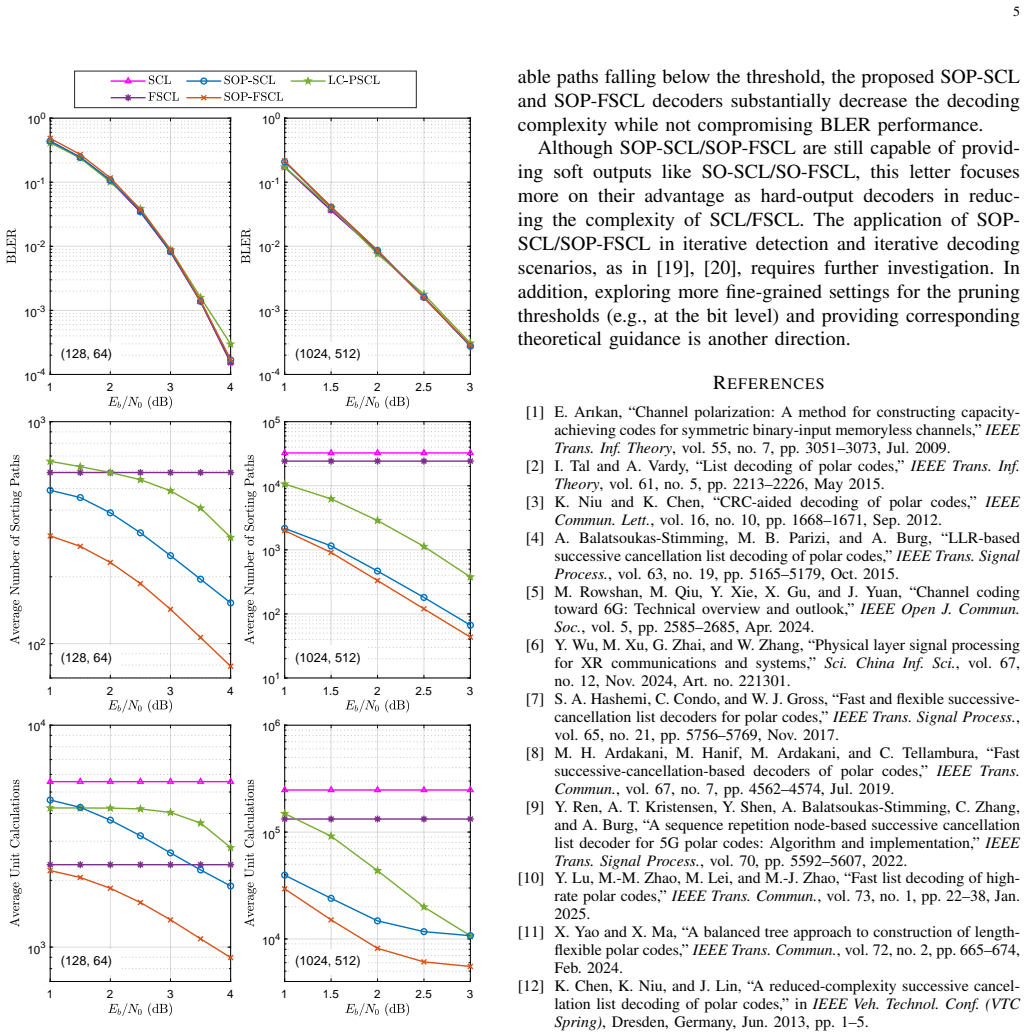
Although the successive cancellation list (SCL) decoding of polar codes exhibits excellent performance, it retains many decoding paths in the list with negligible contribution to the final output, resulting in high sorting and computational complexity. In this letter, we propose a novel pruning strategy to mitigate the decoding complexity. By leveraging the blockwise soft output extraction process of soft-output SCL and soft-output fast SCL decoding, we provide an accurate approximation of the probability that a decoding path is correct, and thus accordingly prune the paths failing to meet a pre-defined reliability threshold. The complexity reduction achieved by the proposed soft-output-based pruned SCL (SOP-SCL) decoder and its fast version, SOP-FSCL decoder, is significant, without any compromise in error-correction performance. Meanwhile, they also prove to be more efficient than state-of-the-art pruned polar decoders.
Editorial analysis
A structured set of objections, weighed in public.
Referee Report
Summary. The manuscript proposes a pruning strategy for successive cancellation list (SCL) decoding of polar codes. It leverages blockwise soft-output extraction in soft-output SCL (SO-SCL) and soft-output fast SCL (SO-FSCL) to approximate the probability that a given decoding path is correct, then discards paths below a pre-defined reliability threshold. The resulting SOP-SCL and SOP-FSCL decoders are claimed to achieve substantial complexity reduction with no loss in error-correction performance while outperforming prior pruned polar decoders.
Significance. If the zero-performance-loss claim is substantiated, the approach would offer a practical, low-overhead method to reduce sorting and path-management costs in list decoding of polar codes without requiring new fitted parameters. The reuse of already-computed soft outputs for pruning is conceptually clean and could be relevant for hardware implementations where soft outputs are already available.
major comments (2)
- [Abstract] Abstract: the headline claim of 'significant' complexity reduction 'without any compromise in error-correction performance' is load-bearing yet unsupported by any simulation parameters, threshold-selection procedure, or verification that the blockwise approximation never discards the ultimately correct path.
- The pruning rule (derived from blockwise soft outputs) treats the extracted values as a sufficiently accurate proxy for path correctness probability. No analytic bound on the approximation error introduced by blockwise processing is supplied; any systematic underestimation on the correct path would produce undetected errors outside simulated regimes, directly undermining the identical-output guarantee.
Simulated Author's Rebuttal
We thank the referee for the constructive comments on our manuscript. We address each major comment below, providing clarifications based on the content of the full paper and indicating planned revisions where appropriate.
read point-by-point responses
-
Referee: [Abstract] Abstract: the headline claim of 'significant' complexity reduction 'without any compromise in error-correction performance' is load-bearing yet unsupported by any simulation parameters, threshold-selection procedure, or verification that the blockwise approximation never discards the ultimately correct path.
Authors: The full manuscript reports extensive Monte Carlo simulations for polar codes with lengths N = 256, 512 and 1024, rates 1/2 and 1/4, and list sizes L = 4, 8, 16. These results demonstrate identical block-error-rate curves between the proposed SOP-SCL/SOP-FSCL decoders and their unpruned counterparts, confirming that the correct path is retained for the selected reliability thresholds. The threshold is chosen empirically to ensure this equivalence while maximizing pruning. We will revise the abstract to include a brief reference to the simulation parameters and the empirical verification of identical performance. revision: partial
-
Referee: The pruning rule (derived from blockwise soft outputs) treats the extracted values as a sufficiently accurate proxy for path correctness probability. No analytic bound on the approximation error introduced by blockwise processing is supplied; any systematic underestimation on the correct path would produce undetected errors outside simulated regimes, directly undermining the identical-output guarantee.
Authors: We agree that the manuscript supplies no analytic bound on the blockwise approximation error. The pruning relies on the blockwise soft outputs as a practical proxy for path reliability, and the paper validates the approach solely through the aforementioned simulations, which show no observable performance loss. While a theoretical error bound would be desirable, it lies outside the scope of this concise letter; the contribution centers on the observed complexity reduction with maintained empirical performance. We will add a short clarifying sentence noting the empirical nature of the identical-output claim. revision: partial
Circularity Check
Pruning rule derived from existing soft outputs without definitional reduction or fitted prediction
full rationale
The paper's central derivation uses blockwise soft-output values already generated during SCL/FSCL decoding to approximate path-correctness probability and apply a fixed reliability threshold for pruning. This step does not define the approximation in terms of the pruning outcome, nor does it fit a parameter on one data subset and rename the result a prediction on related data. No load-bearing self-citation, uniqueness theorem, or ansatz smuggling is visible in the abstract or described chain; the performance claim rests on the independent accuracy of the soft-output proxy rather than reducing to the pruning rule by construction. The derivation is therefore self-contained against external benchmarks.
Axiom & Free-Parameter Ledger
Reference graph
Works this paper leans on
-
[1]
Channel polarization: A method for constructing capacity- achieving codes for symmetric binary-input memoryless channels,
E. Arıkan, “Channel polarization: A method for constructing capacity- achieving codes for symmetric binary-input memoryless channels,”IEEE Trans. Inf. Theory, vol. 55, no. 7, pp. 3051–3073, Jul. 2009
2009
-
[2]
List decoding of polar codes,
I. Tal and A. Vardy, “List decoding of polar codes,”IEEE Trans. Inf. Theory, vol. 61, no. 5, pp. 2213–2226, May 2015
2015
-
[3]
CRC-aided decoding of polar codes,
K. Niu and K. Chen, “CRC-aided decoding of polar codes,”IEEE Commun. Lett., vol. 16, no. 10, pp. 1668–1671, Sep. 2012
2012
-
[4]
LLR-based successive cancellation list decoding of polar codes,
A. Balatsoukas-Stimming, M. B. Parizi, and A. Burg, “LLR-based successive cancellation list decoding of polar codes,”IEEE Trans. Signal Process., vol. 63, no. 19, pp. 5165–5179, Oct. 2015
2015
-
[5]
Channel coding toward 6G: Technical overview and outlook,
M. Rowshan, M. Qiu, Y . Xie, X. Gu, and J. Yuan, “Channel coding toward 6G: Technical overview and outlook,”IEEE Open J. Commun. Soc., vol. 5, pp. 2585–2685, Apr. 2024
2024
-
[6]
Physical layer signal processing for XR communications and systems,
Y . Wu, M. Xu, G. Zhai, and W. Zhang, “Physical layer signal processing for XR communications and systems,”Sci. China Inf. Sci., vol. 67, no. 12, Nov. 2024, Art. no. 221301
2024
-
[7]
Fast and flexible successive- cancellation list decoders for polar codes,
S. A. Hashemi, C. Condo, and W. J. Gross, “Fast and flexible successive- cancellation list decoders for polar codes,”IEEE Trans. Signal Process., vol. 65, no. 21, pp. 5756–5769, Nov. 2017
2017
-
[8]
Fast successive-cancellation-based decoders of polar codes,
M. H. Ardakani, M. Hanif, M. Ardakani, and C. Tellambura, “Fast successive-cancellation-based decoders of polar codes,”IEEE Trans. Commun., vol. 67, no. 7, pp. 4562–4574, Jul. 2019
2019
-
[9]
A sequence repetition node-based successive cancellation list decoder for 5G polar codes: Algorithm and implementation,
Y . Ren, A. T. Kristensen, Y . Shen, A. Balatsoukas-Stimming, C. Zhang, and A. Burg, “A sequence repetition node-based successive cancellation list decoder for 5G polar codes: Algorithm and implementation,”IEEE Trans. Signal Process., vol. 70, pp. 5592–5607, 2022
2022
-
[10]
Fast list decoding of high- rate polar codes,
Y . Lu, M.-M. Zhao, M. Lei, and M.-J. Zhao, “Fast list decoding of high- rate polar codes,”IEEE Trans. Commun., vol. 73, no. 1, pp. 22–38, Jan. 2025
2025
-
[11]
A balanced tree approach to construction of length- flexible polar codes,
X. Yao and X. Ma, “A balanced tree approach to construction of length- flexible polar codes,”IEEE Trans. Commun., vol. 72, no. 2, pp. 665–674, Feb. 2024
2024
-
[12]
A reduced-complexity successive cancel- lation list decoding of polar codes,
K. Chen, K. Niu, and J. Lin, “A reduced-complexity successive cancel- lation list decoding of polar codes,” inIEEE Veh. Technol. Conf. (VTC Spring), Dresden, Germany, Jun. 2013, pp. 1–5
2013
-
[13]
Reduce the complexity of list decoding of polar codes by tree-pruning,
K. Chen, B. Li, H. Shen, J. Jin, and D. Tse, “Reduce the complexity of list decoding of polar codes by tree-pruning,”IEEE Commun. Lett., vol. 20, no. 2, pp. 204–207, Feb. 2016
2016
-
[14]
A split- reduced successive cancellation list decoder for polar codes,
Z. Zhang, L. Zhang, X. Wang, C. Zhong, and H. V . Poor, “A split- reduced successive cancellation list decoder for polar codes,”IEEE J. Sel. Areas Commun., vol. 34, no. 2, pp. 292–302, Feb. 2016
2016
-
[15]
Path splitting selecting strategy- aided successive cancellation list algorithm for polar codes,
C. Gao, R. Liu, B. Dai, and X. Han, “Path splitting selecting strategy- aided successive cancellation list algorithm for polar codes,”IEEE Commun. Lett., vol. 23, no. 3, pp. 422–425, Mar 2019
2019
-
[16]
An improved path splitting decision-aided SCL decoding algorithm for polar codes,
X. Wang, H. Zhang, J. Li, X. Bao, and K. Xie, “An improved path splitting decision-aided SCL decoding algorithm for polar codes,”IEEE Commun. Lett., vol. 25, no. 11, pp. 3463–3467, Nov. 2021
2021
-
[17]
A tree pruning technique for decoding complexity reduction of polar codes and PAC codes,
M. Moradi and A. Mozammel, “A tree pruning technique for decoding complexity reduction of polar codes and PAC codes,”IEEE Trans. Commun., vol. 71, no. 5, pp. 2576–2586, May 2023
2023
-
[18]
Low-complexity PSCL decoding of polar codes,
X. Yao and X. Ma, “Low-complexity PSCL decoding of polar codes,” IEEE Trans. Commun., vol. 73, no. 9, pp. 7021–7031, Sep. 2025
2025
-
[19]
Soft-output successive can- cellation list decoding,
P. Yuan, K. R. Duffy, and M. M ´edard, “Soft-output successive can- cellation list decoding,”IEEE Trans. Inf. Theory, vol. 71, no. 2, pp. 1007–1017, Feb. 2025
2025
-
[20]
Node-based soft-output fast successive cancellation list decoding of polar codes,
L. Shen, Y . Wu, Z. Gao, Y . Xu, X. You, X. Gao, and W. Zhang, “Node-based soft-output fast successive cancellation list decoding of polar codes,”IEEE Trans. Commun., vol. 74, pp. 8500–8516, May 2026
2026
discussion (0)
Sign in with ORCID, Apple, or X to comment. Anyone can read and Pith papers without signing in.