Learned Memory Attenuation in Sage-Husa Kalman Filters for Robust UAV State Estimation
Pith reviewed 2026-05-20 08:08 UTC · model grok-4.3
The pith
A hierarchical recurrent network learns a vector memory attenuation policy to replace the fixed forgetting factor in Sage-Husa Kalman filters for UAVs.
A machine-rendered reading of the paper's core claim, the machinery that carries it, and where it could break.
Core claim
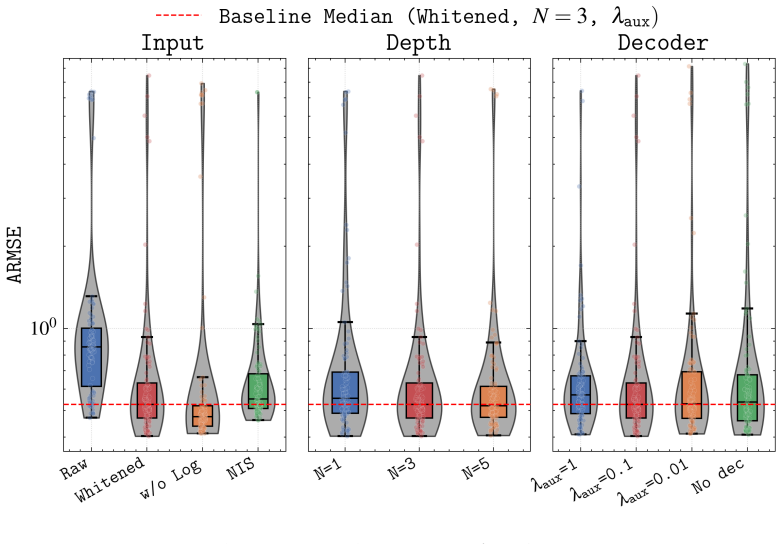
The N-Deep Recurrent Sage-Husa Filter replaces the static scalar forgetting factor of the Sage-Husa Kalman Filter with a vector-valued memory attenuation policy produced by a bifurcated recurrent network operating on whitened innovation sequences. Shallow recurrent states capture instantaneous sensor anomalies while deeper states encode sustained dynamic trends; an auxiliary reconstruction objective prevents feature collapse. The complete filter, including its recursive covariance updates, is trained end-to-end through backpropagation through time to minimize state estimation error.
What carries the argument
The N-Deep Recurrent Sage-Husa Filter (NDR-SHKF), a bifurcated recurrent network that generates a learned vector memory attenuation policy for online noise-statistic estimation inside the Sage-Husa recursion.
If this is right
- The learned policy generalizes across topologically distinct chaotic attractors where purely data-driven estimators diverge.
- The filter maintains accuracy during transitions to proprioceptive dead reckoning when external sensors are lost.
- It outperforms classical adaptive estimators on recorded real-world UAV datasets during sensor outages.
- End-to-end differentiability allows the covariance recursion to remain stable while the attenuation policy adapts.
Where Pith is reading between the lines
- The same learned-attenuation idea could be inserted into other adaptive filters that rely on a forgetting factor.
- Training on a wider variety of flight regimes might further reduce the need for manual tuning of process-noise models.
- The whitened-innovation input representation may transfer to estimation tasks outside UAVs, such as robot arm tracking under vibration.
Load-bearing premise
The bifurcated recurrent architecture together with the auxiliary reconstruction objective produces a memory attenuation policy that improves accuracy without causing instability in the recursive covariance updates.
What would settle it
Observation of covariance-matrix divergence or higher state estimation error than the classical Sage-Husa filter on additional UAV flight segments containing similar telemetry outages would falsify the claim.
Figures




read the original abstract
Unmanned Aerial Vehicles in dynamic environments face telemetry outages, structural vibrations, and regime-dependent noise that invalidate the stationary covariance assumptions of classical Kalman filters. The Sage-Husa Kalman Filter (SHKF) estimates noise statistics online, but its reliance on a static, scalar forgetting factor forces a strict compromise between steady-state stability and transient responsiveness. We introduce the N-Deep Recurrent Sage-Husa Filter (NDR-SHKF), which replaces this scalar parameter with a vector-valued memory attenuation policy learned by a hierarchical recurrent network operating on whitened innovation sequences. A bifurcated architecture routes shallow recurrent states to capture instantaneous sensor anomalies and deep states to encode sustained dynamic trends, while an auxiliary reconstruction objective prevents feature collapse. The complete filter, including recursive covariance updates, is trained end-to-end via backpropagation through time to directly minimize state estimation error. Evaluations on topologically distinct chaotic attractors demonstrate cross-domain generalization, outperforming purely data-driven baselines that diverge under out-of-distribution dynamics. Furthermore, evaluations on recorded real-world UAV flight datasets validate the framework's practical viability, demonstrating its capacity to bridge transitions into proprioceptive dead reckoning and outperform classical adaptive estimators during sensor outages.
Editorial analysis
A structured set of objections, weighed in public.
Referee Report
Summary. The manuscript proposes the N-Deep Recurrent Sage-Husa Filter (NDR-SHKF) for robust UAV state estimation under non-stationary noise, telemetry outages, and vibrations. It replaces the scalar forgetting factor of the classical Sage-Husa Kalman filter with a vector-valued memory attenuation policy produced by a bifurcated hierarchical recurrent network operating on whitened innovation sequences. Shallow recurrent states capture instantaneous anomalies while deep states encode sustained trends; an auxiliary reconstruction objective is added to avoid feature collapse. The full filter, including the recursive covariance updates, is trained end-to-end via backpropagation through time to minimize state estimation error. Evaluations are reported on topologically distinct chaotic attractors (claiming cross-domain generalization) and on recorded real-world UAV flight data (claiming improved bridging to dead reckoning and outperformance versus classical adaptive estimators during outages).
Significance. If the stability and generalization claims hold, the work would demonstrate a practical integration of recurrent learning with recursive Bayesian estimation, potentially improving adaptability of Kalman-type filters in regimes where stationary noise assumptions fail. The end-to-end training directly on estimation error and the attempt to evaluate across chaotic systems and real UAV traces are positive features that could influence future hybrid learned-classical estimators.
major comments (1)
- [Recursive covariance updates] Recursive covariance updates (methods description of NDR-SHKF): the vector attenuation weights produced by the bifurcated recurrent network are inserted directly into the Sage-Husa recursions for the process and measurement noise covariances Q and R. No projection, clipping, or other explicit constraint is stated to guarantee that the resulting matrices remain positive definite or that their traces remain bounded. Because the central robustness claims concern performance precisely when innovation statistics shift (sensor outages, OOD UAV regimes), the absence of such safeguards is load-bearing; a policy optimized on training attractors can still produce unstable updates under distribution shift.
minor comments (2)
- [Abstract] Abstract: performance advantages are asserted on chaotic attractors and real UAV data, yet no numerical metrics, baseline descriptions, or statistical tests are supplied, making the magnitude of improvement difficult to gauge from the summary alone.
- Notation: the precise mapping from the network outputs to the per-component attenuation factors applied inside the Sage-Husa update equations should be written explicitly (e.g., as a diagonal matrix or element-wise multiplication) to allow reproduction of the covariance recursion.
Simulated Author's Rebuttal
We thank the referee for the constructive feedback and for recognizing the potential of hybrid recurrent-recursive estimators. We address the single major comment below.
read point-by-point responses
-
Referee: [Recursive covariance updates] Recursive covariance updates (methods description of NDR-SHKF): the vector attenuation weights produced by the bifurcated recurrent network are inserted directly into the Sage-Husa recursions for the process and measurement noise covariances Q and R. No projection, clipping, or other explicit constraint is stated to guarantee that the resulting matrices remain positive definite or that their traces remain bounded. Because the central robustness claims concern performance precisely when innovation statistics shift (sensor outages, OOD UAV regimes), the absence of such safeguards is load-bearing; a policy optimized on training attractors can still produce unstable updates under distribution shift.
Authors: We acknowledge that the manuscript does not describe any explicit projection, clipping, or other constraint to enforce positive definiteness or bounded traces on the updated Q and R matrices. The present implementation relies on end-to-end training that directly minimizes state estimation error; empirical results on both topologically distinct chaotic attractors and recorded UAV flights show stable behavior without observed divergence. To strengthen the robustness argument under distribution shift, we will revise the methods section to incorporate a lightweight projection step: after each Sage-Husa update we add a small diagonal loading if any eigenvalue falls below a threshold and clip the matrix trace to a conservative upper bound derived from the maximum expected innovation norm. These safeguards will be stated explicitly and their effect on training will be reported in the revised manuscript. revision: yes
Circularity Check
No circularity: learned policy optimized end-to-end against estimation error
full rationale
The paper replaces the scalar forgetting factor with a vector policy produced by a bifurcated recurrent network trained via BPTT to minimize state estimation error on innovation sequences. This is an empirical optimization procedure whose outputs are not equivalent to its inputs by construction; the architecture, auxiliary reconstruction loss, and recursive covariance updates are explicitly defined and differentiated through the training loop. No self-citations, uniqueness theorems, or ansatzes from prior author work are invoked to justify the core mechanism, and the derivation chain consists of standard differentiable filtering equations plus a data-driven training objective. Performance claims rest on empirical generalization across attractors and UAV datasets rather than tautological reduction.
Axiom & Free-Parameter Ledger
free parameters (1)
- Recurrent network weights
axioms (1)
- domain assumption Whitened innovation sequences are suitable inputs for capturing both instantaneous sensor anomalies and sustained dynamic trends
invented entities (1)
-
Bifurcated hierarchical recurrent network for memory attenuation
no independent evidence
Lean theorems connected to this paper
-
IndisputableMonolith/Cost/FunctionalEquation.leanwashburn_uniqueness_aczel unclear?
unclearRelation between the paper passage and the cited Recognition theorem.
replaces this scalar parameter with a vector-valued memory attenuation policy learned by a hierarchical recurrent network... bifurcated architecture routes shallow recurrent states to capture instantaneous sensor anomalies and deep states to encode sustained dynamic trends
What do these tags mean?
- matches
- The paper's claim is directly supported by a theorem in the formal canon.
- supports
- The theorem supports part of the paper's argument, but the paper may add assumptions or extra steps.
- extends
- The paper goes beyond the formal theorem; the theorem is a base layer rather than the whole result.
- uses
- The paper appears to rely on the theorem as machinery.
- contradicts
- The paper's claim conflicts with a theorem or certificate in the canon.
- unclear
- Pith found a possible connection, but the passage is too broad, indirect, or ambiguous to say the theorem truly supports the claim.
Reference graph
Works this paper leans on
-
[1]
M. L. Ireland, D. Anderson, Development of navigation algorithms for nap-of-the-earth UAV flight in a constrained urban environment, 2012
work page 2012
-
[2]
M. Wahbah, M. Chehadeh, M. Hamandi, L. Seneviratne, Y. Zweiri, Real-time adaptive dynamics based state estimation scheme for un- manned aircrafts, IEEE Sensors Journal 22 (14) (2022) 14397–14414. doi:10.1109/JSEN.2022.3183187
-
[3]
B. Yang, E. Yang, H. Shi, L. Yu, C. Niu, Adaptive square-root cubature Kalman filter based low cost UAV positioning in dark and GPS-denied environments, IEEE Transactions on Intelligent Vehicles 10 (5) (2025) 3587–3599. doi:10.1109/TIV.2024.3457678
-
[4]
X. Wang, X. Yan, Q. Luo, Adaptive square-root extended cu- bature Kalman filter based on Huber M-estimation for multi- AUV cooperative navigation, Measurement 249 (2025) 117035. doi:https://doi.org/10.1016/j.measurement.2025.117035
-
[5]
C. Hajiyev, H. E. Soken, Robust adaptive Kalman filter for es- timation of UAV dynamics in the presence of sensor/actuator faults, Aerospace Science and Technology 28 (1) (2013) 376–383. doi:https://doi.org/10.1016/j.ast.2012.12.003
-
[6]
Y.Bar-Shalom, X.R.Li, T.Kirubarajan, StateEstimationforNonlinear Dynamic Systems, John Wiley & Sons, Ltd, 2002, Ch. 10, pp. 371–420. doi:https://doi.org/10.1002/0471221279.ch10
-
[7]
P. Foehn, E. Kaufmann, A. Romero, R. Penicka, S. Sun, L. Bauers- feld, T. Laengle, G. Cioffi, Y. Song, A. Loquercio, D. Scara- muzza, Agilicious: Open-source and open-hardware agile quadrotor for vision-based flight, Science Robotics 7 (67) (2022) eabl6259. arXiv:https://www.science.org/doi/pdf/10.1126/scirobotics.abl6259, doi:10.1126/scirobotics.abl6259. 42
-
[8]
E. Kaufmann, L. Bauersfeld, A. Loquercio, M. Müller, V. Koltun, D. Scaramuzza, Champion-level drone racing using deep reinforcement learning, Nature 620 (7976) (2023) 982–987. doi:10.1038/s41586-023- 06419-4. URLhttps://doi.org/10.1038/s41586-023-06419-4
-
[9]
M. Brossard, A. Barrau, S. Bonnabel, AI-IMU dead-reckoning, IEEE Transactions on Intelligent Vehicles 5 (4) (2020) 585–595. doi:10.1109/TIV.2020.2980758
-
[10]
T. Qin, P. Li, S. Shen, VINS-Mono: A robust and versatile monocular visual-inertial state estimator, IEEE Transactions on Robotics 34 (4) (2018) 1004–1020. doi:10.1109/TRO.2018.2853729
-
[11]
R. Mehra, Approaches to adaptive filtering, IEEE Transactions on Au- tomatic Control 17 (5) (1972) 693–698. doi:10.1109/TAC.1972.1100100
-
[12]
J. Duník, O. Straka, O. Kost, J. Havlík, Noise covariance ma- trices in state-space models: A survey and comparison of estimation methods—part I, International Journal of Adap- tive Control and Signal Processing 31 (11) (2017) 1505–1543. arXiv:https://onlinelibrary.wiley.com/doi/pdf/10.1002/acs.2783, doi:https://doi.org/10.1002/acs.2783
-
[13]
A. P. Sage, G. W. Husa, Adaptive filtering with unknown prior statistics, 1969, pp. 760–769
work page 1969
-
[14]
Analysis and Modeling of Inertial Sensors Using Allan Variance,
N. El-Sheimy, H. Hou, X. Niu, Analysis and modeling of inertial sen- sors using allan variance, IEEE Transactions on Instrumentation and Measurement 57 (1) (2008) 140–149. doi:10.1109/TIM.2007.908635
-
[15]
R. C. Leishman, J. C. Macdonald, R. W. Beard, T. W. McLain, Quadrotors and accelerometers: State estimation with an improved dy- namic model, IEEE Control Systems Magazine 34 (1) (2014) 28–41. doi:10.1109/MCS.2013.2287362
-
[16]
A.H.Mohamed, K.P.Schwarz, AdaptiveKalmanfilteringforINS/GPS, Journal of Geodesy 73 (4) (1999) 193–203. doi:10.1007/s001900050236. URLhttps://doi.org/10.1007/s001900050236 43
-
[17]
M. Juston, S. Gupta, S. Mathur, W. R. Norris, D. Nottage, A. Soyle- mezoglu, Robust error state Sage-Husa adaptive Kalman filter for UWB localization, IEEE Sensors Journal 25 (9) (2025) 16034–16049. doi:10.1109/JSEN.2025.3549315
-
[18]
X. Wang, A. Wang, D. Wang, Y. Xiong, B. Liang, Y. Qi, A mod- ified Sage-Husa adaptive Kalman filter for state estimation of elec- tric vehicle servo control system, Energy Reports 8 (2022) 20–27, iCPE 2021 - The 2nd International Conference on Power Engineering. doi:https://doi.org/10.1016/j.egyr.2022.02.105
-
[19]
Y. Fan, S. Qiao, G. Wang, H. Zhang, An improved Sage- Husa variational robust adaptive Kalman filter with uncertain noise covariances, IEEE Sensors Journal 24 (18) (2024) 28921–28930. doi:10.1109/JSEN.2024.3421271
-
[20]
P. Abbeel, A. Coates, M. Montemerlo, A. Ng, S. Thrun, Discriminative training of Kalman filters, 2005, pp. 289–296. doi:10.15607/RSS.2005.I.038
-
[21]
Q. Xia, M. Rao, Y. Ying, X. Shen, Adaptive fading Kalman filter with an application, Automatica 30 (8) (1994) 1333–1338. doi:https://doi.org/10.1016/0005-1098(94)90112-0
-
[22]
Backprop KF: Learning Discriminative Deterministic State Estimators
T. Haarnoja, A. Ajay, S. Levine, P. Abbeel, Backprop KF: Learning Dis- criminative Deterministic State Estimators (2017). arXiv:1605.07148. URLhttps://arxiv.org/abs/1605.07148
work page internal anchor Pith review Pith/arXiv arXiv 2017
-
[23]
Differentiable Particle Filters: End-to-End Learning with Algorithmic Priors
R. Jonschkowski, D. Rastogi, O. Brock, Differentiable particle filters: End-to-end learning with algorithmic priors (2018). arXiv:1805.11122. URLhttps://arxiv.org/abs/1805.11122
work page internal anchor Pith review Pith/arXiv arXiv 2018
-
[24]
H. Wen, X. Chen, G. Papagiannis, C. Hu, Y. Li, End-to-end semi- supervised learning for differentiable particle filters, in: 2021 IEEE In- ternational Conference on Robotics and Automation (ICRA), 2021, pp. 5825–5831. doi:10.1109/ICRA48506.2021.9561889
-
[25]
N. Cohen, I. Klein, Inertial navigation meets deep learning: A survey of current trends and future directions, Results in Engineering 24 (2024) 103565. doi:https://doi.org/10.1016/j.rineng.2024.103565. 44
-
[26]
N. Shlezinger, G. Revach, A. Ghosh, S. Chatterjee, S. Tang, T. Im- biriba, J. Dunik, O. Straka, P. Closas, Y. C. Eldar, Artificial intelligence-aided kalman filters: AI-augmented designs for Kalman- type algorithms, IEEE Signal Processing Magazine 42 (3) (2025) 52–76. doi:10.1109/MSP.2025.3569395
-
[27]
G. Revach, N. Shlezinger, X. Ni, A. L. Escoriza, R. J. G. van Sloun, Y. C. Eldar, KalmanNet: Neural network aided kalman filtering for partially known dynamics, IEEE Transactions on Signal Processing 70 (2022) 1532–1547. doi:10.1109/TSP.2022.3158588
-
[28]
URL http://dx.doi.org/10.23919/ EUSIPCO63237.2025.11226601
H. Mortada, C. Falcon, Y. Kahil, M. Clavaud, J.-P. Michel, Recursive KalmanNet: Deep learning-augmented kalman filtering for state esti- mation with consistent uncertainty quantification, in: 2025 33rd Eu- ropean Signal Processing Conference (EUSIPCO), 2025, pp. 885–889. doi:10.23919/EUSIPCO63237.2025.11226444
-
[29]
T. Zheng, Y. Yao, F. He, X. Zhang, An RNN-based learn- able extended Kalman filter design and application, in: 2019 18th European Control Conference (ECC), 2019, pp. 3304–3309. doi:10.23919/ECC.2019.8796088
-
[30]
Z. Song, Z. Zhang, F. Zhang, W. Bao, RG-ESKF: Residual-gated error-state extended Kalman filter for learning-based spacecraft motion state estimation, Aerospace Science and Technology 176 (2026) 112090. doi:https://doi.org/10.1016/j.ast.2026.112090
-
[31]
X. Gao, D. You, S. Katayama, Seam tracking monitoring based on adap- tive Kalman filter embedded Elman neural network during high-power fiber laser welding, IEEE Transactions on Industrial Electronics 59 (11) (2012) 4315–4325. doi:10.1109/TIE.2012.2193854
-
[32]
E. Kim, S. Kim, S. Jung, Battery SOC and SOH estima- tion based on Sage-Husa extended Kalman filter and feedfor- ward neural network, IEEE Access 13 (2025) 174044–174056. doi:10.1109/ACCESS.2025.3617967
-
[33]
X. Meng, H. Tan, P. Yan, Q. Zheng, G. Chen, J. Jiang, A GNSS/INS integrated navigation compensation method based on CNN–GRU + IRAKF hybrid model during GNSS outages, IEEE 45 Transactions on Instrumentation and Measurement 73 (2024) 1–15. doi:10.1109/TIM.2024.3369131
-
[34]
J. Li, Z. Zhang, H. Zhao, H. Li, C. Zhai, ROV localization in the nuclear reactor pressure vessel using LSTM and an im- proved adaptive Kalman filter, Measurement 242 (2025) 116206. doi:https://doi.org/10.1016/j.measurement.2024.116206
-
[35]
S. M. Hosseini, M. Jalili, An online incremental learning support vector regression for INS/GPS integrated navigation system during long-time gps outage, GPS Solutions 29 (4) (2025) 164. doi:10.1007/s10291-025- 01900-1
-
[36]
URL https: //doi.org/10.1109/TPAMI.2021.3079209
T. Hospedales, A. Antoniou, P. Micaelli, A. Storkey, Meta- learning in neural networks: A survey, IEEE Transactions on Pat- tern Analysis and Machine Intelligence 44 (9) (2022) 5149–5169. doi:10.1109/TPAMI.2021.3079209
-
[37]
C. Finn, P. Abbeel, S. Levine, Model-agnostic meta-learning for fast adaptation of deep networks (2017). arXiv:1703.03400. URLhttps://arxiv.org/abs/1703.03400
work page internal anchor Pith review Pith/arXiv arXiv 2017
-
[38]
K. Cho, B. van Merrienboer, C. Gulcehre, D. Bahdanau, F. Bougares, H. Schwenk, Y. Bengio, Learning phrase representations using RNN encoder-decoder for statistical machine translation (2014). arXiv:1406.1078. URLhttps://arxiv.org/abs/1406.1078
work page internal anchor Pith review Pith/arXiv arXiv 2014
-
[39]
J. X. Wang, Z. Kurth-Nelson, D. Tirumala, H. Soyer, J. Z. Leibo, R. Munos, C. Blundell, D. Kumaran, M. Botvinick, Learning to re- inforcement learn (2017). arXiv:1611.05763. URLhttps://arxiv.org/abs/1611.05763
work page internal anchor Pith review Pith/arXiv arXiv 2017
-
[40]
Z. Chen, C. Heckman, S. Julier, N. Ahmed, Weak in the NEES?: Auto- tuning Kalman filters with bayesian optimization, in: 2018 21st Inter- national Conference on Information Fusion (FUSION), 2018, pp. 1072–
work page 2018
-
[41]
doi:10.23919/ICIF.2018.8454982
-
[42]
P. Werbos, Backpropagation through time: what it does and how to do it, Proceedings of the IEEE 78 (10) (1990) 1550–1560. doi:10.1109/5.58337. 46
-
[43]
Differentiation of the Cholesky decomposition
I. Murray, Differentiation of the Cholesky decomposition (2016). arXiv:1602.07527. URLhttps://arxiv.org/abs/1602.07527
work page internal anchor Pith review Pith/arXiv arXiv 2016
-
[44]
J. Cheng, H. Chen, Z. Xue, Y. Huang, Y. Zhang, An online ex- ploratory maximum likelihood estimation approach to adaptive Kalman filtering, IEEE/CAA Journal of Automatica Sinica PP (2025) 1–27. doi:10.1109/JAS.2024.125001
-
[45]
E. N. Lorenz, Deterministic nonperiodic flow, Journal of the Atmo- spheric Sciences 20 (2) (1963) 130–141
work page 1963
-
[46]
S. Strogatz, Nonlinear Dynamics and Chaos: With Applications to Physics, Biology, Chemistry, and Engineering, CRC Press, 2018. URLhttps://books.google.pl/books?id=A0paDwAAQBAJ
work page 2018
- [47]
-
[48]
D. P. Kingma, J. Ba, Adam: A method for stochastic optimization (2017). arXiv:1412.6980. URLhttps://arxiv.org/abs/1412.6980
work page internal anchor Pith review Pith/arXiv arXiv 2017
-
[49]
Rössler, An equation for continuous chaos, Physics Letters A 57 (5) (1976) 397–398
O. Rössler, An equation for continuous chaos, Physics Letters A 57 (5) (1976) 397–398. doi:https://doi.org/10.1016/0375-9601(76)90101-8
- [50]
-
[51]
doi:10.1109/TAC.2017.2730480
-
[52]
NaturalPoint, Inc., OptiTrack motion capture systems, https://optitrack.com, accessed: 2026-04-15 (2025)
work page 2026
-
[53]
URLhttps://www.quanser.com/products/qdrone/ 47
Quanser Inc., Physical System Parameters Drone Parametrization v0.4, accessed: 2026-04-10 (2024). URLhttps://www.quanser.com/products/qdrone/ 47
work page 2026
-
[54]
A. Yu, I. Kolotylo, H. A. Hashim, A. E. E. Eltoukhy, Electronic warfare cyberattacks, countermeasures, and modern defensive strate- gies of uav avionics: A survey, IEEE Access 13 (2025) 68660–68681. doi:10.1109/ACCESS.2025.3561068
-
[55]
F. R. Matzke, T. J. Barot, S. Sridharan, N. Ammann, C. Kessler, H.- G. Maas, F. H. P. Fitzek, A. Eltner, Addressing GNSS vulnerabilities in AAM: A multi-modal UAV testbed for redundant and reliable nav- igation, The International Archives of the Photogrammetry, Remote Sensing and Spatial Information Sciences XLVIII-2/W11-2025 (2025) 211–218. doi:10.5194/i...
work page doi:10.5194/isprs-archives-xlviii-2-w11-2025-211-2025 2025
-
[56]
H. A. Hashim, Advances in UAV avionics systems architec- ture, classification and integration: A comprehensive review and future perspectives, Results in Engineering 25 (2025) 103786. doi:https://doi.org/10.1016/j.rineng.2024.103786
-
[57]
D. Silveria, K. Cabral, P. Jardine, S. Givigi, Lie group control architec- tures for UAVs: a comparison of se2(3)-based approaches in simulation and hardware (2025). arXiv:2511.15023. URLhttps://arxiv.org/abs/2511.15023
-
[58]
P. J. Huber, Robust estimation of a location parameter, Springer, 1992, pp. 492–518. doi:10.1007/978-1-4612-4380-9_35
-
[59]
M. Roth, E. Özkan, F. Gustafsson, A student’s t filter for heavy tailed process and measurement noise, in: 2013 IEEE International Confer- ence on Acoustics, Speech and Signal Processing, 2013, pp. 5770–5774. doi:10.1109/ICASSP.2013.6638770
-
[60]
Strapdown Inertial Navigation Technology,
D. Titterton, J. Weston, Strapdown Inertial Navigation Technology, 2nd Edition, The Institution of Engineering and Technology, 2004. arXiv:https://digital-library.theiet.org/doi/pdf/10.1049/PBRA017E, doi:10.1049/PBRA017E
-
[61]
O. J. Woodman, An introduction to inertial navigation, Tech. rep., University of Cambridge, Computer Laboratory (2007). URLhttps://www.cl.cam.ac.uk/techreports/UCAM-CL-TR-696.pdf 48
work page 2007
-
[62]
L. Lai, N. Suda, V. Chandra, CMSIS-NN: Efficient neural network ker- nels for arm cortex-M CPUs (2018). arXiv:1801.06601. URLhttps://arxiv.org/abs/1801.06601
work page internal anchor Pith review Pith/arXiv arXiv 2018
- [63]
discussion (0)
Sign in with ORCID, Apple, or X to comment. Anyone can read and Pith papers without signing in.