Toward Human-Centered Multi-Agent Systems: Integrating Cognition, Culture, Values, and Cooperation in AI Agents
Pith reviewed 2026-06-27 18:46 UTC · model grok-4.3
The pith
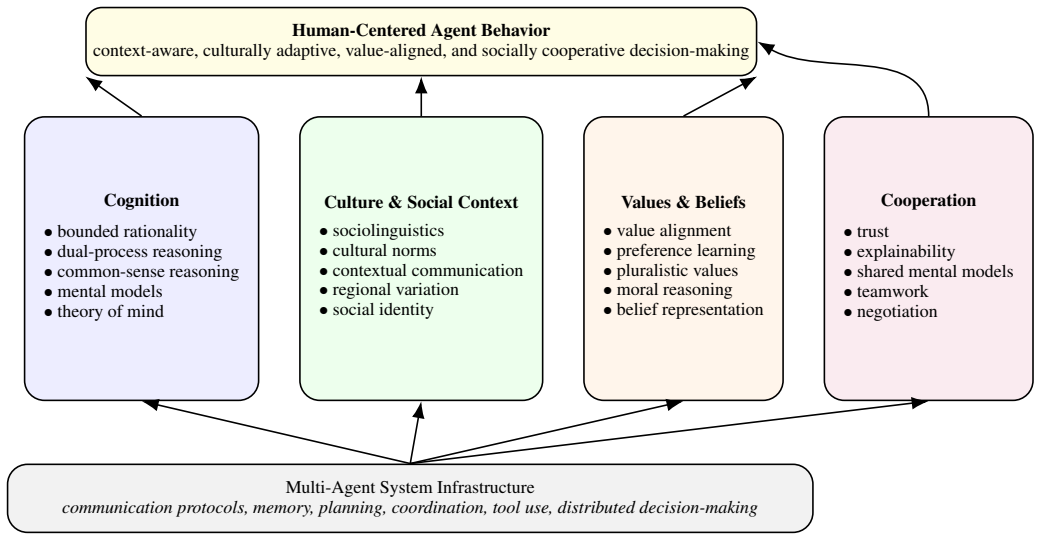
Existing LLM-based multi-agent systems lack a unified framework integrating cognition, culture, values, and social behavior for agents acting on behalf of humans.
A machine-rendered reading of the paper's core claim, the machinery that carries it, and where it could break.
Core claim
The paper claims that future AI agents, especially those acting on behalf of humans, must move beyond task competence toward human-centered capabilities. It reviews research across six areas and identifies that existing LLM-based multi-agent systems do not provide a unified framework integrating cognition, culture, values, and social behavior into autonomous agents.
What carries the argument
Synthesis of six research areas that reveals the missing unified framework for culturally aware, value-aligned, cognitively grounded, and cooperative multi-agent systems.
If this is right
- Agents will need to incorporate models of bounded rationality for realistic decision-making.
- Cultural alignment benchmarks and sociolinguistic methods will be required for effective communication.
- Value and preference learning techniques must be embedded directly into coordination mechanisms.
- Explainability and human-agent collaboration methods will become necessary for trust and cooperation.
- Multi-agent societies will need explicit modeling of human characteristics to improve collective behavior.
Where Pith is reading between the lines
- Deployment in domains involving ethical or cultural nuance may require new evaluation metrics that test combined cognitive and social performance.
- Trade-offs between computational efficiency and normative alignment could shape which application areas adopt such frameworks first.
- Progress may depend on creating shared test environments that simultaneously probe cognition, culture, values, and cooperation.
- Long-term agent societies could evolve different norms depending on which human characteristics are prioritized in the initial design.
Load-bearing premise
Research from cognitive science, sociolinguistics, computational social science, and AI alignment can be combined into one operational framework for agents without fundamental incompatibilities between their approaches.
What would settle it
A working prototype that successfully combines bounded-rationality modeling, culturally situated language, value alignment, and multi-agent coordination into one agent architecture without major performance trade-offs.
Figures
read the original abstract
The emergence of large language model (LLM)-based agents and multi-agent systems has enabled a shift from narrow task automation to more autonomous decision-making. Despite progress in language generation, planning, tool use, and coordination, most agents still treat intelligence as prediction, optimization, and task completion. Human environments are social and normative, where people reason under bounded rationality, communicate in culturally situated language, and make decisions guided by values, beliefs, trust, and social norms. This survey argues that future AI agents, especially those acting on behalf of humans, must move beyond task competence toward human-centered capabilities. We review research across six areas: (1) evolution of intelligent agents, (2) human cognition and decision-making, (3) language, culture, and social context, (4) human values and belief systems, (5) human-agent collaboration, and (6) multi-agent coordination and modeling of human characteristics. We synthesize work from cognitive science, sociolinguistics, computational social science, and AI alignment, along with recent advances in LLM agents, cultural alignment benchmarks, preference learning, explainability, and agent societies. We identify a key gap: existing systems do not provide a unified framework integrating cognition, culture, values, and social behavior into autonomous agents. We conclude with directions for building culturally aware, value-aligned, cognitively grounded, and cooperative multi-agent systems.
Editorial analysis
A structured set of objections, weighed in public.
Referee Report
Summary. This survey reviews literature across six areas—(1) evolution of intelligent agents, (2) human cognition and decision-making, (3) language, culture, and social context, (4) human values and belief systems, (5) human-agent collaboration, and (6) multi-agent coordination and modeling of human characteristics—drawing from cognitive science, sociolinguistics, computational social science, and AI alignment. It argues that existing LLM-based multi-agent systems treat intelligence primarily as prediction and task completion and therefore lack a unified framework integrating cognition, culture, values, and social behavior into autonomous agents that act on behalf of humans. The manuscript synthesizes recent advances in cultural alignment benchmarks, preference learning, explainability, and agent societies, identifies the gap, and outlines directions for culturally aware, value-aligned, cognitively grounded, and cooperative systems.
Significance. If the gap identification is accurate, the survey could usefully direct research toward more human-centered agent architectures as autonomy increases. The interdisciplinary synthesis across the six areas is a constructive contribution, and the explicit framing of future agents as acting on behalf of humans correctly highlights normative and social dimensions that current task-oriented systems often omit.
Simulated Author's Rebuttal
We thank the referee for their positive evaluation of the survey, recognition of its interdisciplinary synthesis across cognitive science, sociolinguistics, and AI alignment, and recommendation to accept. The comments correctly note the manuscript's focus on the gap in unified frameworks for human-centered multi-agent LLM systems.
Circularity Check
No significant circularity: literature survey without derivations or self-referential reductions
full rationale
This is a survey paper whose central claim is the documented absence of any existing unified framework integrating the six reviewed areas into LLM-based multi-agent systems. It performs a literature synthesis across cognitive science, sociolinguistics, and AI alignment to identify the gap and offers future directions, without advancing equations, fitted parameters, predictions, or models. No load-bearing steps reduce by construction to the paper's own inputs, self-citations, or ansatzes; the argument rests on external reviewed work rather than self-definition or imported uniqueness theorems. The derivation chain is therefore self-contained as a gap analysis.
Axiom & Free-Parameter Ledger
Reference graph
Works this paper leans on
-
[1]
1980 , publisher=
Principles of Artificial Intelligence , author=. 1980 , publisher=
1980
-
[2]
2021 , publisher=
Artificial Intelligence: A Modern Approach , author=. 2021 , publisher=
2021
-
[3]
2006 , publisher=
Pattern Recognition and Machine Learning , author=. 2006 , publisher=
2006
-
[4]
Advances in Neural Information Processing Systems , year=
Language Models are Few-Shot Learners , author=. Advances in Neural Information Processing Systems , year=
-
[5]
Frontiers of Computer Science , year=
A Survey on Large Language Model based Autonomous Agents , author=. Frontiers of Computer Science , year=
-
[6]
The Rise and Potential of Large Language Model Based Agents: A Survey
The Rise and Potential of Large Language Model Based Agents: A Survey , author=. arXiv preprint arXiv:2309.07864 , year=
work page internal anchor Pith review Pith/arXiv arXiv
-
[7]
Large Language Model based Multi-Agents: A Survey of Progress and Challenges
Large Language Model based Multi-Agents: A Survey of Progress and Challenges , author=. arXiv preprint arXiv:2402.01680 , year=
work page internal anchor Pith review Pith/arXiv arXiv
-
[8]
arXiv preprint arXiv:2412.17481 , year=
A Survey on LLM-based Multi-Agent System: Recent Advances and New Frontiers in Application , author=. arXiv preprint arXiv:2412.17481 , year=
-
[9]
Multi-Agent Collaboration Mechanisms: A Survey of LLMs
Multi-Agent Collaboration Mechanisms: A Survey of LLMs , author=. arXiv preprint arXiv:2501.06322 , year=
work page internal anchor Pith review Pith/arXiv arXiv
-
[10]
1957 , publisher=
Models of Man: Social and Rational , author=. 1957 , publisher=
1957
-
[11]
Science , volume=
Judgment under Uncertainty: Heuristics and Biases , author=. Science , volume=
-
[12]
2011 , publisher=
Thinking, Fast and Slow , author=. 2011 , publisher=
2011
-
[13]
Annual Review of Psychology , volume=
Dual-Processing Accounts of Reasoning, Judgment, and Social Cognition , author=. Annual Review of Psychology , volume=
-
[14]
Advances in Neural Information Processing Systems , year=
Chain-of-Thought Prompting Elicits Reasoning in Large Language Models , author=. Advances in Neural Information Processing Systems , year=
-
[15]
Large Language Models are Zero-Shot Reasoners
Large Language Models are Zero-Shot Reasoners , author=. arXiv preprint arXiv:2205.11916 , year=
work page internal anchor Pith review Pith/arXiv arXiv
-
[16]
Findings of ACL , year=
Towards Reasoning in Large Language Models: A Survey , author=. Findings of ACL , year=
-
[17]
Proceedings of the Teddington Conference on the Mechanization of Thought Processes , year=
Programs with Common Sense , author=. Proceedings of the Teddington Conference on the Mechanization of Thought Processes , year=
-
[18]
Behavioral and Brain Sciences , volume=
Does the Chimpanzee Have a Theory of Mind? , author=. Behavioral and Brain Sciences , volume=
-
[19]
arXiv preprint arXiv:2502.06470 , year=
A Survey of Theory of Mind in Large Language Models: Evaluations, Representations, and Safety Risks , author=. arXiv preprint arXiv:2502.06470 , year=
-
[20]
arXiv preprint arXiv:2505.00026 , year=
Theory of Mind in Large Language Models: Assessment and Enhancement , author=. arXiv preprint arXiv:2505.00026 , year=
-
[21]
Small Group Research , volume=
Is There a ``Big Five'' in Teamwork? , author=. Small Group Research , volume=
-
[22]
1976 , publisher=
Beyond Culture , author=. 1976 , publisher=
1976
-
[23]
2001 , publisher=
Culture's Consequences: Comparing Values, Behaviors, Institutions and Organizations Across Nations , author=. 2001 , publisher=
2001
-
[24]
Proceedings of the First Workshop on Cross-Cultural Considerations in NLP , year=
Assessing Cross-Cultural Alignment between ChatGPT and Human Societies: An Empirical Study , author=. Proceedings of the First Workshop on Cross-Cultural Considerations in NLP , year=
-
[25]
Proceedings of ACL , year=
Investigating Cultural Alignment of Large Language Models , author=. Proceedings of ACL , year=
-
[26]
Proceedings of the 2nd Workshop on Cross-Cultural Considerations in NLP , year=
CDEval: A Benchmark for Measuring the Cultural Dimensions of Large Language Models , author=. Proceedings of the 2nd Workshop on Cross-Cultural Considerations in NLP , year=
-
[27]
Proceedings of COLING , year=
Cultural Alignment in Large Language Models: An Explanatory Analysis Based on Hofstede's Cultural Dimensions , author=. Proceedings of COLING , year=
-
[28]
2019 , publisher=
Human Compatible: Artificial Intelligence and the Problem of Control , author=. 2019 , publisher=
2019
-
[29]
AI Alignment: A Comprehensive Survey
AI Alignment: A Comprehensive Survey , author=. arXiv preprint arXiv:2310.19852 , year=
work page internal anchor Pith review Pith/arXiv arXiv
-
[30]
Concrete Problems in AI Safety
Concrete Problems in AI Safety , author=. arXiv preprint arXiv:1606.06565 , year=
work page internal anchor Pith review Pith/arXiv arXiv
-
[31]
Proceedings of ICML , year=
Algorithms for Inverse Reinforcement Learning , author=. Proceedings of ICML , year=
-
[32]
Advances in Neural Information Processing Systems , year=
Training Language Models to Follow Instructions with Human Feedback , author=. Advances in Neural Information Processing Systems , year=
-
[33]
arXiv preprint arXiv:2406.11191 , year=
A Survey on Human Preference Learning for Large Language Models , author=. arXiv preprint arXiv:2406.11191 , year=
-
[34]
arXiv preprint arXiv:2409.02795 , year=
Towards a Unified View of Preference Learning for Large Language Models: A Survey , author=. arXiv preprint arXiv:2409.02795 , year=
-
[35]
https://arxiv.org/abs/2504.07070
A Survey on Personalized and Pluralistic Preference Alignment in Large Language Models , author=. arXiv preprint arXiv:2504.07070 , year=
-
[36]
https://arxiv.org/abs/2503.17003
A Survey on Personalized Alignment -- The Missing Piece for Large Language Models in Real-World Applications , author=. arXiv preprint arXiv:2503.17003 , year=
-
[37]
Proceedings of COLING , year=
PERSONA: A Reproducible Testbed for Pluralistic Alignment , author=. Proceedings of COLING , year=
-
[38]
Proceedings of COLING , year=
Aligning Large Language Models with Human Opinions through Persona Selection and Value--Belief--Norm Reasoning , author=. Proceedings of COLING , year=
-
[39]
2009 , publisher=
Moral Machines: Teaching Robots Right from Wrong , author=. 2009 , publisher=
2009
-
[40]
Towards A Rigorous Science of Interpretable Machine Learning
Towards A Rigorous Science of Interpretable Machine Learning , author=. arXiv preprint arXiv:1702.08608 , year=
work page internal anchor Pith review Pith/arXiv arXiv
-
[41]
arXiv preprint arXiv:2407.15248 , year=
XAI Meets LLMs: A Survey of the Relation between Explainable AI and Large Language Models , author=. arXiv preprint arXiv:2407.15248 , year=
-
[42]
arXiv preprint arXiv:2506.21812 , year=
Towards Transparent AI: A Survey on Explainable Large Language Models , author=. arXiv preprint arXiv:2506.21812 , year=
-
[43]
Proceedings of ACL Tutorial Abstracts , year=
Human-AI Collaboration: How AIs Augment Human Teammates , author=. Proceedings of ACL Tutorial Abstracts , year=
-
[44]
Proceedings of NAACL Tutorial Abstracts , year=
Human-AI Interaction in the Age of LLMs , author=. Proceedings of NAACL Tutorial Abstracts , year=
-
[45]
Transactions of the Association for Computational Linguistics , volume=
Decision-Oriented Dialogue for Human-AI Collaboration , author=. Transactions of the Association for Computational Linguistics , volume=
-
[46]
Findings of EMNLP , year=
Large Language Model-based Human-Agent Collaboration for Complex Task Solving , author=. Findings of EMNLP , year=
-
[47]
2009 , publisher=
An Introduction to MultiAgent Systems , author=. 2009 , publisher=
2009
-
[48]
Proceedings of the 2nd Workshop on Cross-Cultural Considerations in NLP , year=
Conformity, Confabulation, and Impersonation: Persona Inconstancy in Multi-Agent LLM Collaboration , author=. Proceedings of the 2nd Workshop on Cross-Cultural Considerations in NLP , year=
-
[49]
arXiv preprint arXiv:2506.01080 , year=
The Coming Crisis of Multi-Agent Misalignment: AI Alignment Must Be a Dynamic and Social Process , author=. arXiv preprint arXiv:2506.01080 , year=
-
[50]
Human-Computer Interaction , volume=
ACT-R: A Theory of Higher Level Cognition and Its Relation to Visual Attention , author=. Human-Computer Interaction , volume=
-
[51]
1990 , publisher=
Unified Theories of Cognition , author=. 1990 , publisher=
1990
-
[52]
The Oxford Handbook of Cognitive Engineering , year=
The ACT-R Cognitive Architecture: Principles and Applications , author=. The Oxford Handbook of Cognitive Engineering , year=
-
[53]
arXiv preprint arXiv:2408.09176 , year=
Cognitive LLMs: Towards Integrating Cognitive Architectures and Large Language Models for Manufacturing Decision-making , author=. arXiv preprint arXiv:2408.09176 , year=
-
[54]
Proceedings of the National Academy of Sciences , volume=
Agent-based Modeling: Methods and Techniques for Simulating Human Systems , author=. Proceedings of the National Academy of Sciences , volume=
-
[55]
Proceedings of UIST , year=
Generative Agents: Interactive Simulacra of Human Behavior , author=. Proceedings of UIST , year=
-
[56]
Proceedings of EMNLP System Demonstrations , year=
Humanoid Agents: Platform for Simulating Human-like Generative Agents , author=. Proceedings of EMNLP System Demonstrations , year=
-
[57]
Proceedings of EMNLP , year=
Character-LLM: A Trainable Agent for Role-Playing , author=. Proceedings of EMNLP , year=
-
[58]
Proceedings of ACL , year=
Quantifying the Persona Effect in LLM Simulations , author=. Proceedings of ACL , year=
-
[59]
Findings of EMNLP , year=
Modeling Human Subjectivity in LLMs Using Explicit and Implicit Human Factors in Personas , author=. Findings of EMNLP , year=
-
[60]
Findings of EMNLP , year=
The Prompt Makes the Person(a): A Systematic Evaluation of Sociodemographic Persona Prompting for Large Language Models , author=. Findings of EMNLP , year=
-
[61]
Proceedings of ACL , year=
DEEPER Insight into Your User: Directed Persona Refinement for Dynamic Persona Modeling , author=. Proceedings of ACL , year=
-
[62]
Findings of ACL , year=
PersonaX: A Recommendation Agent-Oriented User Modeling Framework for Long Behavior Sequence , author=. Findings of ACL , year=
discussion (0)
Sign in with ORCID, Apple, or X to comment. Anyone can read and Pith papers without signing in.