Spin Hall effect in two-dimensional materials with inverted bands and Mexican-hat dispersion
Pith reviewed 2026-06-28 21:34 UTC · model grok-4.3
The pith
Extrinsic spin-Hall current from skew scattering exceeds intrinsic Berry curvature contribution in Mexican-hat dispersion materials and can change sign with Fermi energy.
A machine-rendered reading of the paper's core claim, the machinery that carries it, and where it could break.
Core claim
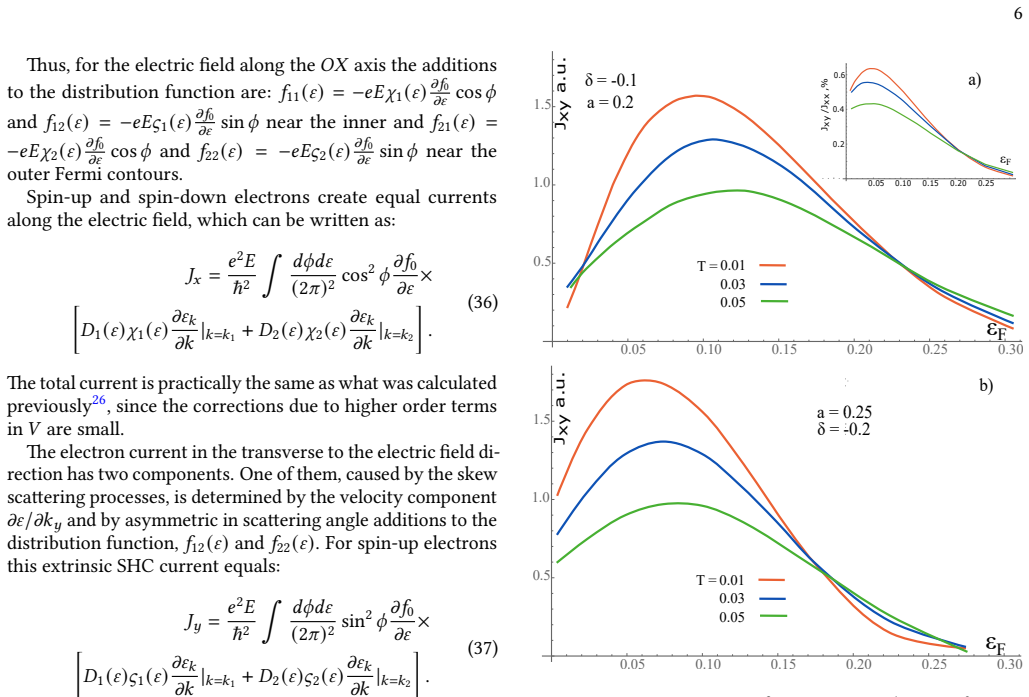
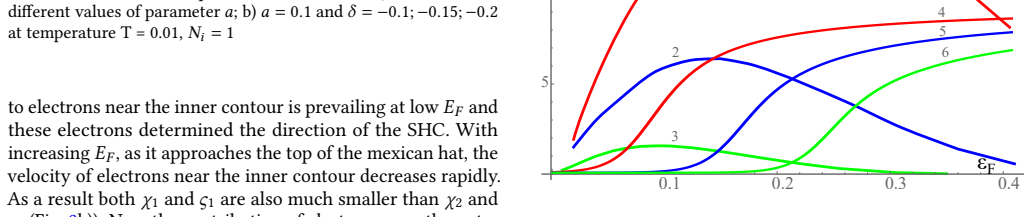
In materials with Mexican-hat dispersion, the extrinsic spin-Hall current generated by second-order skew scattering significantly exceeds the intrinsic spin-Hall current from Berry curvature; moreover, the extrinsic current reaches a maximum at intermediate Fermi energy, decreases thereafter, and can change sign, due to the interplay of inter- and intra-contour transition probabilities and differing electron velocities.
What carries the argument
Spin-dependent skew scattering arising from second-order scattering processes, determined by the quantum metric and transitions between different isoenergetic contours in the Mexican-hat band structure.
Load-bearing premise
That the extrinsic spin-Hall current is controlled by second-order scattering processes whose probabilities are set solely by the quantum metric and inter-contour transitions, without higher-order effects or disorder details altering the sign change.
What would settle it
A plot of spin-Hall conductivity versus Fermi energy in a Mexican-hat dispersion sample that lacks a maximum followed by decrease and sign change would contradict the prediction; observation of this sequence would confirm it.
Figures

read the original abstract
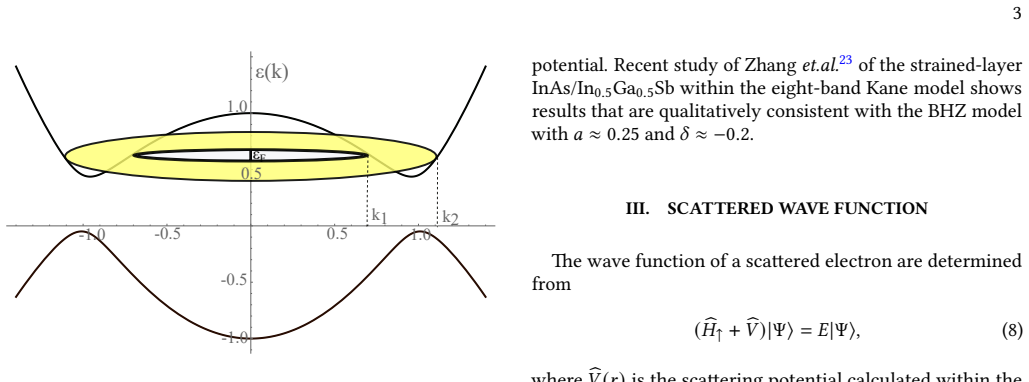
We study the spin Hall effect in two-dimensional topological insulators with "Mexican hat" dispersion and a ring-shaped Fermi surface which are formed due to the band inversion. Electron transitions between different isoenergetic contours and the quantum metric of band states play an important role in the transport properties of such materials, since they largely determine the spatial distribution of the electron charges screening the impurity potential and the scattering probability [Phys.B, 719, 417942 (2025)]. Here we study a spin-dependent skew scattering, which is enabled by the second-order scattering processes, and show that the extrinsic spin-Hall current (SHC) can significantly exceed the intrinsic SHC arising from the Berry curvature. Furthermore, due to Mexican-hat dispersion, the SHC exhibits a very unusual dependence on the Fermi energy ($E_F$). The extrinsic SHC reaches a maximum at some $E_F$, then decreases with increasing $E_F$ and can even change a sign. This complicated behavior reflects an interplay of energy dependencies of such important factors as probabilities of inter- and intra-contour transitions, as well as different electron velocities in two contours.
Editorial analysis
A structured set of objections, weighed in public.
Referee Report
Summary. The manuscript examines the spin Hall effect in 2D topological insulators featuring Mexican-hat dispersion and a ring-shaped Fermi surface arising from band inversion. It focuses on extrinsic spin-Hall conductivity (SHC) generated by spin-dependent skew scattering via second-order processes, where inter-contour electron transitions and the quantum metric determine screening and scattering rates (referencing the authors' prior Phys. B 719, 417942 (2025) work). The central claims are that this extrinsic SHC can substantially exceed the intrinsic contribution from Berry curvature, and that the total SHC displays a non-monotonic Fermi-energy dependence—reaching a maximum, then declining and potentially changing sign—due to the competing energy dependencies of inter- versus intra-contour scattering probabilities and the distinct velocities on the two contours.
Significance. If the perturbative treatment and resulting E_F dependence hold, the work demonstrates how Mexican-hat band structures can make extrinsic mechanisms dominant and produce testable, non-standard energy scaling in the spin Hall effect. This provides a concrete example of quantum-metric-enabled skew scattering controlling transport beyond conventional semiclassical expectations, with potential implications for doping-tuned spin currents in inverted-band 2D materials.
major comments (2)
- [Method / Results (scattering probabilities section)] The central claim of non-monotonic E_F dependence (including possible sign change) and extrinsic dominance rests on scattering probabilities and velocities derived in the referenced prior Phys. B paper. The manuscript should reproduce the key expressions for the inter- and intra-contour transition rates (or at minimum the resulting energy-dependent factors entering the skew-scattering term) to allow independent verification of how they produce the reported maximum and sign reversal.
- [Results (SHC vs E_F)] The abstract and introduction assert that extrinsic SHC 'can significantly exceed' the intrinsic Berry-curvature contribution, yet no explicit numerical comparison, ratio plot, or table of SHC values versus E_F is referenced. A figure or table quantifying the ratio (extrinsic/intrinsic) across the relevant E_F range is needed to substantiate the 'significantly exceed' statement.
minor comments (2)
- [Introduction / Model] Notation for the two isoenergetic contours (inner/outer ring) and the quantum-metric tensor components should be defined explicitly at first use, with a brief reminder of how they enter the second-order scattering amplitude.
- [Model] The manuscript would benefit from a short schematic (or reference to one) illustrating the Mexican-hat dispersion, the ring Fermi surface, and the inter-contour transitions that enable the skew scattering.
Simulated Author's Rebuttal
We thank the referee for the careful reading of our manuscript and the constructive suggestions. We address each major comment below and will revise the manuscript accordingly to improve clarity and verifiability.
read point-by-point responses
-
Referee: [Method / Results (scattering probabilities section)] The central claim of non-monotonic E_F dependence (including possible sign change) and extrinsic dominance rests on scattering probabilities and velocities derived in the referenced prior Phys. B paper. The manuscript should reproduce the key expressions for the inter- and intra-contour transition rates (or at minimum the resulting energy-dependent factors entering the skew-scattering term) to allow independent verification of how they produce the reported maximum and sign reversal.
Authors: We agree that reproducing the key expressions will facilitate independent verification. In the revised manuscript we will add a dedicated subsection (or appendix) that explicitly states the inter- and intra-contour transition rates and the resulting energy-dependent factors that enter the skew-scattering spin Hall conductivity. These expressions are taken directly from our prior Phys. B 719, 417942 (2025) work; we will highlight the competing E_F scalings that produce the maximum and possible sign change without requiring the reader to consult the earlier paper. revision: yes
-
Referee: [Results (SHC vs E_F)] The abstract and introduction assert that extrinsic SHC 'can significantly exceed' the intrinsic Berry-curvature contribution, yet no explicit numerical comparison, ratio plot, or table of SHC values versus E_F is referenced. A figure or table quantifying the ratio (extrinsic/intrinsic) across the relevant E_F range is needed to substantiate the 'significantly exceed' statement.
Authors: We accept the point. The revised manuscript will include a new figure (or inset panel) that plots the ratio of extrinsic to intrinsic SHC versus Fermi energy over the full range of interest, together with a brief table of representative values. This will make the statement that the extrinsic contribution can significantly exceed the intrinsic one quantitatively explicit and directly testable against the non-monotonic behavior already shown in the existing figures. revision: yes
Circularity Check
No significant circularity identified
full rationale
The derivation relies on a self-citation only for supporting details on screening and scattering probabilities in the Mexican-hat system, but this serves as independent prior input rather than causing the central extrinsic SHC result or its E_F dependence to reduce by construction to the paper's own fitted parameters or definitions. The claimed unusual energy dependence arises from applying standard second-order skew scattering to inter/intra-contour transitions and velocity differences in the given band structure, without any quoted equations showing self-definitional equivalence, fitted inputs renamed as predictions, or load-bearing uniqueness imported solely via overlapping-author citations. The approach remains self-contained within semiclassical transport theory applied to the inverted-band dispersion.
Axiom & Free-Parameter Ledger
axioms (2)
- domain assumption Band inversion produces Mexican-hat dispersion with ring-shaped Fermi surface having two isoenergetic contours
- domain assumption Quantum metric of band states largely determines spatial distribution of screening charges and scattering probability
Reference graph
Works this paper leans on
-
[1]
author author J. Sinova , author S. O. \ Valenzuela , author J. Wunderlich , author C. H. \ Back , \ and\ author T. Jungwirth ,\ 10.1103/RevModPhys.87.1213 journal journal Rev. Mod. Phys. \ volume 87 ,\ pages 1213 ( year 2015 ) NoStop
-
[2]
author author N. A. \ Sinitsyn ,\ 10.1088/0953-8984/20/02/023201 journal journal Journal of Physics: Condensed Matter \ volume 20 ,\ pages 023201 ( year 2007 ) NoStop
-
[3]
author author C.-Z. \ Chang , author C.-X. \ Liu , \ and\ author A. H. \ MacDonald ,\ 10.1103/RevModPhys.95.011002 journal journal Rev. Mod. Phys. \ volume 95 ,\ pages 011002 ( year 2023 ) NoStop
-
[4]
author author C. Niu , author H. Wang , author N. Mao , author B. Huang , author Y. Mokrousov , \ and\ author Y. Dai ,\ 10.1103/PhysRevLett.124.066401 journal journal Phys. Rev. Lett. \ volume 124 ,\ pages 066401 ( year 2020 ) NoStop
-
[5]
author author H. Wang , author H. Liu , author X. Feng , author J. Cao , author W. Wu , author S. Lai , author W. Gao , author C. Xiao , \ and\ author S. A. \ Yang ,\ 10.1103/PhysRevLett.134.056301 journal journal Phys. Rev. Lett. \ volume 134 ,\ pages 056301 ( year 2025 ) NoStop
-
[6]
author author S. Hayami , author M. Yatsushiro , \ and\ author H. Kusunose ,\ 10.1103/PhysRevB.106.024405 journal journal Phys. Rev. B \ volume 106 ,\ pages 024405 ( year 2022 ) NoStop
-
[7]
author author A. Manchon , author J. Z Z elezn\'y , author I. M. \ Miron , author T. Jungwirth , author J. Sinova , author A. Thiaville , author K. Garello , \ and\ author P. Gambardella ,\ 10.1103/RevModPhys.91.035004 journal journal Rev. Mod. Phys. \ volume 91 ,\ pages 035004 ( year 2019 ) NoStop
-
[8]
author author Y. Bai , author B. Yuan , author Z. Chen , author Y. Dai , author B. Huang , author X. Wang , \ and\ author C. Niu ,\ 10.1103/588c-z8cy journal journal Phys. Rev. Lett. \ volume 136 ,\ pages 046602 ( year 2026 ) NoStop
-
[9]
author author B. A. \ Bernevig \ and\ author S.-C. \ Zhang ,\ 10.1103/PhysRevLett.96.106802 journal journal Phys. Rev. Lett. \ volume 96 ,\ pages 106802 ( year 2006 ) NoStop
-
[10]
author author Y. Jiabin , author Q. R. \ Bernevig B. Andrei , author T. P. \ Rossi Enrico , \ and\ author Y. Bohm-Jung ,\ 10.1038/s41535-025-00801-3 journal journal Quantum Materials \ volume 10 ,\ pages 1 ( year 2025 ) NoStop
-
[11]
author author J. E. \ Hirsch ,\ 10.1103/PhysRevLett.83.1834 journal journal Phys. Rev. Lett. \ volume 83 ,\ pages 1834 ( year 1999 ) NoStop
-
[12]
author author M. A. \ R , author M. P. J. \ Lee J. S. , Richardella A.and Grab J. L. , author V. A. \ Fischer M. H. , \ and\ author R. D. C. \ Manchon A. , Kim E.-A.and Samarth N. ,\ 10.1038/nature13534 journal journal Nature \ volume 511 ,\ pages 449 ( year 2014 ) NoStop
-
[13]
author author S. S. \ Krishtopenko ,\ 10.1038/s41598-021-00577-z journal journal Scientific Reports \ volume 11 ,\ pages 21060 ( year 2021 ) NoStop
-
[14]
author author T. Stauber , author N. M. R. \ Peres , author F. Guinea , \ and\ author A. H. \ Castro Neto ,\ 10.1103/PhysRevB.75.115425 journal journal Phys. Rev. B \ volume 75 ,\ pages 115425 ( year 2007 ) NoStop
-
[15]
author author D. Wickramaratne , author F. Zahid , \ and\ author R. K. \ Lake ,\ 10.1063/1.4928559 journal journal Journal of Applied Physics \ volume 118 ,\ pages 075101 ( year 2015 ) ,\ http://arxiv.org/abs/https://pubs.aip.org/aip/jap/article-pdf/doi/10.1063/1.4928559/14743158/075101\_1\_online.pdf https://pubs.aip.org/aip/jap/article-pdf/doi/10.1063/1...
-
[16]
author author G. Kremer , author A. Mahmoudi , author M. Bouaziz , author M. Rahimi , author F. Bertran , author J.-F. \ Dayen , author M. L. D. \ Rocca , author M. Pala , author A. Naitabdi , author J. Chaste , author F. Oehler , \ and\ author A. Ouerghi ,\ https://arxiv.org/abs/2509.06488 title Mexican hat-like valence band dispersion and quantum confin...
arXiv 2025
-
[17]
author author Y. Jiang , author S. Thapa , author G. D. \ Sanders , author C. J. \ Stanton , author Q. Zhang , author J. Kono , author W. K. \ Lou , author K. Chang , author S. D. \ Hawkins , author J. F. \ Klem , author W. Pan , author D. Smirnov , \ and\ author Z. Jiang ,\ 10.1103/PhysRevB.95.045116 journal journal Phys. Rev. B \ volume 95 ,\ pages 0451...
-
[18]
author author L. Du , author T. Li , author W. Lou , author X. Wu , author X. Liu , author Z. Han , author C. Zhang , author G. Sullivan , author A. Ikhlassi , author K. Chang , \ and\ author R.-R. \ Du ,\ 10.1103/PhysRevLett.119.056803 journal journal Phys. Rev. Lett. \ volume 119 ,\ pages 056803 ( year 2017 ) NoStop
-
[19]
author author M. Meyer , author J. Baumbach , author S. Krishtopenko , author A. Wolf , author M. Emmerling , author S. Schmid , author M. Kamp , author B. Jouault , author J.-B. \ Rodriguez , author E. Tournie , author T. Müller , author R. Thomale , author G. Bastard , author F. Teppe , author F. Hartmann , \ and\ author S. Höfling ,\ 10.1126/sciadv.adz...
-
[20]
author author Y.-N. \ Hou , author B.-J. \ Wang , author C.-D. \ Jin , author H. Zhang , author J.-L. \ Wang , author P.-L. \ Gong , author R.-Q. \ Lian , author X.-Q. \ Shi , \ and\ author R.-N. \ Wang ,\ 10.1063/5.0237686 journal journal Journal of Applied Physics \ volume 137 ,\ pages 064302 ( year 2025 ) ,\ http://arxiv.org/abs/https://pubs.aip.org/ai...
-
[21]
author author W. Jiang , author B. Li , author X. Wang , author G. Chen , author T. Chen , author Y. Xiang , author W. Xie , author Y. Dai , author X. Zhu , author H. Yang , author J. Sun , \ and\ author H.-H. \ Wen ,\ 10.1103/PhysRevB.101.121115 journal journal Phys. Rev. B \ volume 101 ,\ pages 121115 ( year 2020 ) NoStop
-
[22]
Rukelj , author Željana Bonačić Lošić , author I
author author Z. Rukelj , author Željana Bonačić Lošić , author I. Kupčić , \ and\ author A. Akrap ,\ https://doi.org/10.1016/j.physb.2024.416590 journal journal Physica B: Condensed Matter \ volume 695 ,\ pages 416590 ( year 2024 ) NoStop
-
[23]
author author W. Zhang , author P. Jia , author W. kai Lou , author X. Wang , author S. Su , author K. Chang , \ and\ author R.-R. \ Du ,\ 10.1088/0256-307X/43/1/010704 journal journal Chin. Phys. Lett. \ volume 43 ,\ pages 010704 ( year 2026 ) NoStop
-
[24]
author author V. A. \ Sablikov ,\ https://doi.org/10.1016/j.physe.2025.116213 journal journal Physica E: Low-dimensional Systems and Nanostructures \ volume 170 ,\ pages 116213 ( year 2025 ) NoStop
-
[25]
author author P. Das , author D. Wickramaratne , author B. Debnath , author G. Yin , \ and\ author R. K. \ Lake ,\ 10.1103/PhysRevB.99.085409 journal journal Phys. Rev. B \ volume 99 ,\ pages 085409 ( year 2019 ) NoStop
-
[26]
author author B. S. \ Shchamkhalova \ and\ author V. A. \ Sablikov ,\ https://doi.org/10.1016/j.physb.2025.417942 journal journal Physica B: Condensed Matter \ volume 719 ,\ pages 417942 ( year 2025 ) NoStop
-
[27]
author author V. A. \ Sablikov \ and\ author A. A. \ Sukhanov ,\ https://doi.org/10.1016/j.physe.2022.115492 journal journal Physica E: Low-dim.Systems and Nanostructures \ volume 145 ,\ pages 115492 ( year 2023 a ) NoStop
-
[28]
author author V. A. \ Sablikov \ and\ author A. A. \ Sukhanov ,\ https://doi.org/10.1016/j.physleta.2023.129006 journal journal Physics Letters A \ volume 481 ,\ pages 129006 ( year 2023 b ) NoStop
-
[29]
author author B. A. \ Bernevig , author T. L. \ Hughes , \ and\ author S.-C. \ Zhang ,\ 10.1126/science.1133734 journal journal Science \ volume 314 ,\ pages 1757 ( year 2006 ) NoStop
-
[30]
author author M. K\" o nig , author H. Buhmann , author L. W. Molenkamp , author T. Hughes , author C.-X. \ Liu , author X.-L. \ Qi , \ and\ author S.-C. \ Zhang ,\ 10.1143/JPSJ.77.031007 journal journal J. Phys. Society of Japan \ volume 77 ,\ pages 031007 ( year 2008 ) ,\ http://arxiv.org/abs/https://doi.org/10.1143/JPSJ.77.031007 https://doi.org/10.114...
-
[31]
author author J. Schliemann \ and\ author D. Loss ,\ 10.1103/PhysRevB.68.165311 journal journal Phys. Rev. B \ volume 68 ,\ pages 165311 ( year 2003 ) NoStop
-
[32]
author author D. Culcer ,\ https://doi.org/10.1016/j.physe.2011.11.003 journal journal Physica E: Low-dimensional Systems and Nanostructures \ volume 44 ,\ pages 860 ( year 2012 ) ,\ note sI:Topological Insulators NoStop
-
[33]
author author A. Bandyopadhyay , author N. B. \ Joseph , \ and\ author A. Narayan ,\ https://doi.org/10.1016/j.mtelec.2024.100101 journal journal Materials Today Electronics \ volume 8 ,\ pages 100101 ( year 2024 ) NoStop
discussion (0)
Sign in with ORCID, Apple, or X to comment. Anyone can read and Pith papers without signing in.