REVIEW 4 major objections 5 minor 70 references
Expanding the SPISEA Stellar Population Synthesis Software to the Substellar Regime
T0 review · 4 major / 5 minor · reviewed 2026-08-02 · deepseek-v4-flash
Pith's one-line read SPISEA now models brown dwarfs and stars in one physically consistent framework, making it the first simple stellar population code to cover the full range.
desk verdict A useful, honest SPISEA extension to brown dwarfs, but the 'physically consistent' claim rests on an explicitly non-physical interpolation across the stellar/substellar boundary. read the letter →
The pith
A machine-rendered reading of the paper's core claim, the machinery that carries it, and where it could break.
The reading
What carries the argument
The load-bearing pieces are three merged grids. First, a broken power-law initial mass function extends to 0.01 solar masses with slopes constrained by a 2024 census of thousands of stars and brown dwarfs, producing a turnover in object production near 0.05 solar masses. Second, a unified evolutionary track grid combines substellar, very-low-mass stellar, and massive-star tracks, with the 0.075–0.2 solar-mass gap filled by Gaussian-process regression (for luminosity, temperature, and gravity) and Hermite splines (for the older-age mass–luminosity relation). Third, a merged atmospheric grid with weighted interpolation over the 1000–1200 K overlap guarantees continuous spectra across the trans
What would settle it
A future evolutionary model or a deep photometric census (e.g., with JWST) of brown dwarfs in the 0.075–0.2 solar-mass range would directly test whether the interpolated mass–luminosity and mass–temperature relations are correct; if the true relations in that gap differ from the GP/Hermite interpolation, the synthetic color-magnitude diagrams near the hydrogen-burning limit would be systematically offset.
Extended reading notes
Core claim
The central claim is that the SPISEA framework can now generate physically consistent populations from high-mass stars through the brown dwarf range, and it is the first simple stellar population code capable of doing so. This is achieved by adding a substellar initial mass function with slopes that turn over near 0.05 solar masses, merging atmospheric grids to smoothly transition between the stellar and substellar temperature regimes, and constructing a unified evolutionary grid spanning 0.01 to 120 solar masses by interpolating across the 0.075 to 0.2 solar-mass gap using Gaussian process regression and Hermite splines. The authors validate that the new substellar extensions do not degrade
Load-bearing premise
The merged evolutionary grid fills the 0.075–0.2 solar-mass gap with Gaussian-process regression and Hermite splines rather than a physical model, so the synthetic isochrones at the stellar–substellar boundary depend on a mathematical interpolation the paper itself flags as needing future revision.
Editorial extensions
If this is right
- Synthetic clusters generated with SPISEA now include brown dwarf populations with observationally motivated number counts and mass distributions, enabling direct comparisons to infrared surveys of young clusters.
- Microlensing survey simulations can now include realistic populations of brown dwarf lenses and sources, which the paper identifies as a key science application.
- The same machinery provides a foundation for future incorporation of planetary-mass objects and non-solar metallicity model grids as they become available.
- Users of the code can identify which isochrone values in the 0.075–0.2 solar-mass region come from the regression-based interpolation rather than direct physical models, because those values are flagged in the output.
- The validation against Pleiades and Upper Scorpius indicates that the merged isochrones reproduce the observed shape of the sequence across the hydrogen-burning limit, so existing stellar-mass models are not degraded.
Reading between the lines
- If a physically motivated evolutionary model for the 0.075–0.2 solar-mass gap becomes available, the current isochrones in that region may shift in luminosity and color; users should treat the interpolated values as provisional, especially for young ages where the gap spans the pre-main-sequence turn-on.
- The framework could be used to test the substellar IMF directly by comparing simulated star counts with deep JWST or Roman observations of very low-mass cluster members, a test the paper does not itself perform.
- Restricting to chemical-equilibrium atmospheres and solar metallicity leaves open the possibility that the systematic low-mass deviations seen in Upper Sco and the Pleiades are partly due to missing non-equilibrium chemistry; newer atmosphere grids could be dropped into the same merging machinery to test this.
- The imposed multiplicity rules—brown dwarf companions are rare, tight, and near-equal-mass—are concrete predictions that can be checked against high-resolution imaging surveys of nearby young clusters.
Signed reviews
Editorial analysis
A structured set of objections, weighed in public.
Referee Report
Summary. The paper describes an extension of the open-source SPISEA stellar population synthesis code to include brown dwarfs. The main updates are: (1) a new substellar IMF (SalpeterKirkpatrick 2024) with slopes from Kirkpatrick et al. (2024); (2) a unified evolutionary grid, MergedPhillipsBaraffePisaEkstromParsec, combining Phillips et al. (2020) substellar tracks with Baraffe, Pisa, Geneva, and PARSEC stellar models, with Gaussian-process and Hermite-spline interpolation across the 0.075–0.2 M_Sun gap; (3) a merged BT-Settl/Meisner atmospheric grid; and (4) mass-dependent multiplicity and orbital-separation prescriptions for substellar binaries. The updated code is validated by eye against CMDs of the Pleiades, Upper Scorpius, and M44. The paper claims this makes SPISEA the first SSP code to enable physically consistent population synthesis from high-mass stars through the brown dwarf regime.
Significance. If the claims are supported, this would be a valuable community resource: an open-source, modular SSP code with substellar coverage, testable and extensible. The new IMF and atmospheric merges reflect current observational constraints, and the explicit flagging of interpolated evolutionary quantities is good practice. The validation with real clusters is a useful sanity check. However, the central 'physically consistent' claim rests on an interpolation across the very mass range defining the substellar boundary, and the validation is entirely qualitative. These issues, while addressable, currently limit the strength of the claims.
major comments (4)
- [Section 2.4, Table 2] The central claim of 'physically consistent modeling' is undermined by the interpolation used to bridge 0.075–0.2 M_Sun. This gap contains the hydrogen-burning limit, so the photometry of the lowest-mass stars and highest-mass brown dwarfs—the paper's stated region of interest—is set by GP/Hermite smoothing rather than by a physical evolutionary model. The authors acknowledge this and flag the values, but they provide no estimate of the interpolation uncertainty and no sensitivity test comparing the smoothing to independent constraints (e.g., eclipsing binaries, dynamical masses, or other model grids). Please either temper the 'physically consistent' claim throughout (Abstract, Section 1, Section 4) or supply a quantitative uncertainty budget and validation in this mass range.
- [Section 3, Figures 6–9] The validation is qualitative. The text reports 'modest deviations' and 'does not precisely match the curvature' but provides no residuals, uncertainties, or goodness-of-fit statistics. Since the paper's central claim is that the extended code reproduces observed cluster populations, the validation should include quantitative measures (e.g., chi-square or RMS residuals in magnitude/color bins), a statement of which model component (IMF, atmospheres, evolution, interpolation) dominates the deviations, and an account of cluster parameter uncertainties. The current by-eye comparison is insufficient to support the conclusion that the merged models are validated.
- [Section 2.6, multiplicity override] The stated mass intervals are self-contradictory: 'for 0.08≤M/M⊙ <0.06, MF = 0.16; for 0.06≤M/M⊙ <0.02, MF = 0.08; and for M/M⊙ ≤0.02, MF = 0.' No mass satisfies 0.08 ≤ M < 0.06, and the second interval presumably should be 0.06–0.08 M_Sun or some other ordering. Since these values are implemented in the code, this typo could indicate a coding error. Please correct the intervals and verify the implemented logic.
- [Section 3.3, Figure 9] The M44 comparison contains no substellar data, yet Section 3.3 concludes the code enables 'physically consistent extrapolation into the brown dwarf regime.' This conclusion is unsupported by the M44 data. Please either state more precisely that M44 only verifies unchanged stellar-mass performance, or remove the extrapolation claim from this section.
minor comments (5)
- [Abstract and Section 3.3] The abstract says validation used 'Gaia, UKIDSS, and 2MASS photometry' for Pleiades, Upper Sco, and M44, but M44 uses only 2MASS. Clarify which survey applies to each cluster.
- [Section 2.6] The multiplicity fraction definitions in Equations (2) and (3) are standard, but the text says '0.08≤M/M⊙ <0.06' which is likely a typo for 'M<0.08' and '0.06≤M/M⊙<0.08' etc. Fix.
- [Throughout] Minor typographical issues: 'Hertzspring-Russell' should be 'Hertzsprung-Russell'; 'Kennicut' should be 'Kennicutt'; 'Unresoved' in the Appendix caption should be 'Unresolved'; 'scikit learn' should be 'scikit-learn'.
- [Figure 5] The caption says 'brown dwarf stars are identified as having masses between 0.01 and 0.08 M_Sun' but the paper elsewhere uses 0.075 M_Sun as the boundary; make the mass definition consistent.
- [Section 2.4] In the description of the Phillips-Pisa interpolation, the text says 'mass vs. luminosity, effective temperature, and logarithmic surface gravity relations' but the previous paragraph says 'surface temperatures' for Phillips models; use consistent physical quantities.
Circularity Check
No significant circularity: the substellar modeling inputs are external grids and observed cluster parameters, validation is not fitted, and the mass-gap interpolation is explicitly disclosed rather than presented as an independent prediction.
full rationale
The paper's central additions are the Salpeter-Kirkpatrick 2024 IMF, ATMO/Meisner/BT-Settl atmospheric grids, merged evolutionary tracks built from Phillips/Baraffe/Pisa/PARSEC models, and multiplicity relations from independent surveys. The one potentially suspicious step is the GP/Hermite interpolation across the 0.075–0.2 M_sun gap in Section 2.4. That is a modeling limitation, not circularity: the interpolated values are flagged in the output isochrone tables and described as 'not yet observationally confirmed,' so the paper does not relabel a fit as an empirical prediction. Validation in Section 3 uses literature cluster parameters (age, distance, reddening) and observed CMDs without fitting the SPISEA models to those data; the paper reports 'modest deviations' at low masses rather than claiming exact agreement. The self-citations to Hosek et al. (2020) and Abrams et al. (2025) concern the pre-existing SPISEA software architecture and are not used to justify the substellar physics, which is anchored to external model grids and independent observational surveys. No derivation in the paper reduces by construction to its own inputs, so the circularity score is 0.
Assumptions & free parameters
free parameters (5)
- IMF slope set (Salpeter Kirkpatrick 2024) =
α=0.6 (0.01–0.05 M☉); 0.25 (0.05–0.22); 1.3 (0.22–0.55); 2.3 (0.55–8); 2.35 (8–120)
- Brown dwarf multiplicity fractions =
MF=0.16 (0.06–0.08 M☉); 0.08 (0.02–0.06); 0 (≤0.02) [corrected from text]
- Substellar semimajor axis log-normal parameters =
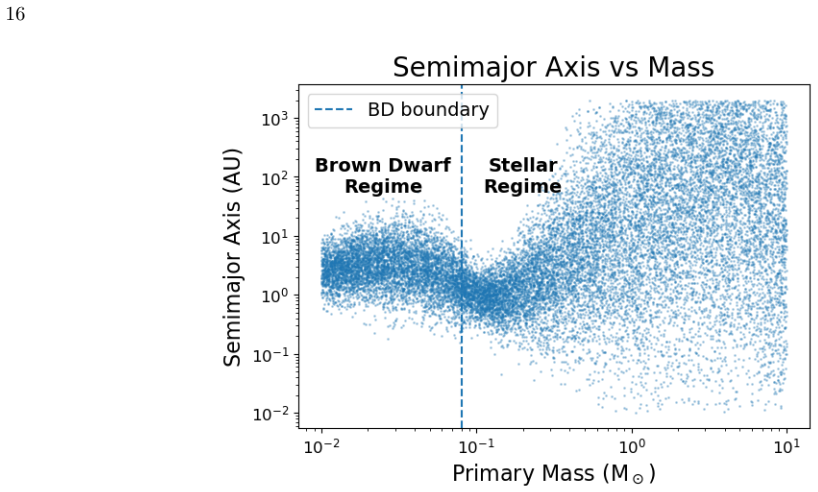
Mean separation ~2–8 AU; σ_log a ~0.2–0.5
- Gaussian Process kernel hyperparameters (ℓ, ν) =
Selected by grid search on model-grid data; exact values not reported
- Interpolation weighting functions (BTSettl/Meisner merge; semimajor axis merge) =
Linear ramp 1000–1200 K for atmospheres; smooth weighting in log M for orbits
assumptions (4)
- domain assumption Brown dwarf mass loss is negligible, so initial mass equals present-day mass.
- domain assumption ATMO/Phillips and Meisner models are valid for solar metallicity brown dwarfs.
- ad hoc to paper Interpolated evolutionary tracks in the 0.075–0.2 M☉ gap are physically plausible.
- domain assumption No brown dwarfs are generated at non-solar metallicities.
Cite this review
Pith. "Pith review of Expanding the SPISEA Stellar Population Synthesis Software to the Substellar Regime." pith.science (2026). https://pith.science/paper/IZPQVBDR
@misc{pith2026260714292,
  author       = {Pith},
  title        = {Pith review of: Expanding the SPISEA Stellar Population Synthesis Software to the Substellar Regime},
  year         = {2026},
  howpublished = {\url{https://pith.science/paper/IZPQVBDR}},
  note         = {Machine review of arXiv:2607.14292}
}
read the original abstract
We present an extension of the SPISEA stellar population synthesis framework that adds brown dwarfs to the existing range of stellar mass objects, enabling physically consistent modeling of brown dwarfs within synthetic star clusters. Previous versions of SPISEA included limited substellar support, relying on outdated initial mass functions and incomplete atmospheric and evolutionary coverage below the hydrogen-burning limit. This was addressed through the implementation of a modern substellar initial mass function based on robust observational constraints, the introduction of merged atmospheric grids that smoothly transition between stellar and brown dwarf regimes, and the construction of unified evolutionary tracks spanning the lowest-mass brown dwarf objects through massive stars at solar metallicity. The updated framework was validated by comparing simulated color-magnitude diagrams to observational data from the Pleiades, Upper Scorpius, and M44 clusters using Gaia, UKIDSS, and 2MASS photometry. The new models allow for generation of user-specified isochrones and clusters that reproduce observed stellar behaviors while enabling realistic population synthesis in the brown dwarf regime. This work extends SPISEA's applicability to substellar science cases, including young cluster studies and microlensing simulations, and provides a foundation for future incorporation of planetary-mass objects and non-solar metallicities.
Figures


Figures from the paper (9 more)


Reference graph
Works this paper leans on
-
[1]
2014, The Astronomical Journal, 148, 129
Aberasturi, M., Burgasser, A., Mora, A., et al. 2014, The Astronomical Journal, 148, 129
2014
-
[2]
S., Lu, J
Abrams, N. S., Lu, J. R., Lam, C. Y., et al. 2025, The Astrophysical Journal, 980, 103
2025
-
[3]
Aguirre, V. S. 2017, in Asteroseismology and Exoplanets: Listening to the Stars and Searching for New Worlds: IVth Azores International Advanced School in Space Sciences (Springer), 3–25 16 Figure 12.Extended Semimajor Axis vs. Mass distribution extending into the brown dwarf mass range, with a weighted interpolation between the substellar and stellar reg...
2017
-
[4]
2013, Proceedings of the International Astronomical Union, 8, 271
Allard, F. 2013, Proceedings of the International Astronomical Union, 8, 271
2013
-
[5]
H., Alexander, D
Allard, F., Hauschildt, P. H., Alexander, D. R., Tamanai, A., & Schweitzer, A. 2001, The Astrophysical Journal, 556, 357
2001
-
[6]
H., & Schwenke, D
Allard, F., Hauschildt, P. H., & Schwenke, D. 2000, The Astrophysical Journal, 540, 1005
2000
-
[7]
Allard, F., Homeier, D., & Freytag, B. 2012, Philosophical Transactions of the Royal Society A: Mathematical, Physical and Engineering Sciences, 370, 2765 Astropy Collaboration, Robitaille, T. P., Tollerud, E. J., et al. 2013, A&A, 558, A33, doi: 10.1051/0004-6361/201322068 Astropy Collaboration, Price-Whelan, A. M., Sip˝ ocz, B. M., et al. 2018, AJ, 156,...
-
[8]
2002, Astronomy & Astrophysics, 382, 563
Baraffe, I., Chabrier, G., Allard, F., & Hauschildt, P. 2002, Astronomy & Astrophysics, 382, 563
2002
Show all 70 references
-
[9]
2003, Astronomy & Astrophysics, 402, 701
Hauschildt, P. 2003, Astronomy & Astrophysics, 402, 701
2003
-
[10]
2015, Astronomy & Astrophysics, 577, A42 B´ ejar, V., & Mart ´ ın, E
Baraffe, I., Homeier, D., Allard, F., & Chabrier, G. 2015, Astronomy & Astrophysics, 577, A42 B´ ejar, V., & Mart ´ ın, E. L. 2018, Handbook of Exoplanets, 92
2015
-
[11]
Dupuy, T. J. 2024, The Astrophysical Journal, 967, 115
2024
-
[12]
2012, Monthly Notices of the Royal Astronomical Society, 427, 127
Bressan, A., Marigo, P., Girardi, L., et al. 2012, Monthly Notices of the Royal Astronomical Society, 427, 127
2012
-
[13]
1993, Reviews of Modern Physics, 65, 301
Burrows, A., & Liebert, J. 1993, Reviews of Modern Physics, 65, 301
1993
-
[14]
Castelli, F., & Kurucz, R. L. 2004, arXiv preprint astro-ph/0405087
2004 arXiv
-
[15]
C., Magnier, E., Metcalfe, N., et al
Chambers, K. C., Magnier, E., Metcalfe, N., et al. 2016, arXiv preprint arXiv:1612.05560
2016 arXiv
-
[16]
Y., Goto, T., Wu, C
Chen, A. Y., Goto, T., Wu, C. K.-W., et al. 2025, Publications of the Astronomical Society of Australia, 42, e042
2025
-
[17]
2016, The Astrophysical Journal, 823, 102
Choi, J., Dotter, A., Conroy, C., et al. 2016, The Astrophysical Journal, 823, 102
2016
-
[18]
2005, Serbian Astronomical Journal, Vol
Cirkovic, M. 2005, Serbian Astronomical Journal, Vol. 171, p. 11-17., 171, 11
2005
-
[19]
Conroy, C., & Gunn, J. E. 2010, The Astrophysical Journal, 712, 833
2010
-
[20]
E., & White, M
Conroy, C., Gunn, J. E., & White, M. 2009, The Astrophysical Journal, 699, 486
2009
-
[21]
A., Schnurr, O., Hirschi, R., et al
Crowther, P. A., Schnurr, O., Hirschi, R., et al. 2010, Monthly Notices of the Royal Astronomical Society, 408, 731 Da Silva, R. L., Fumagalli, M., & Krumholz, M. 2012, The Astrophysical Journal, 745, 145 Duchˆ ene, G., & Kraus, A. 2013, Annual Review of Astronomy and Astrophy...
2010
-
[22]
C., & Delgado, R
Fernandes, R. C., & Delgado, R. M. G. 2010, Monthly Notices of the Royal Astronomical Society, 403, 780
2010
-
[23]
Figer, D. F. 2005, Nature, 434, 192 17
2005
-
[24]
2018, Monthly Notices of the Royal Astronomical Society, 479, 2702
Fontanive, C., Biller, B., Bonavita, M., & Allers, K. 2018, Monthly Notices of the Royal Astronomical Society, 479, 2702
2018
-
[25]
2023, Astronomy & Astrophysics, 669, A84
Zwintz, K. 2023, Astronomy & Astrophysics, 669, A84
2023
-
[26]
R., Millman, K
Harris, C. R., Millman, K. J., van der Walt, S. J., et al. 2020, Nature, 585, 357, doi: 10.1038/s41586-020-2649-2 Hosek Jr, M. W., Lu, J. R., Lam, C. Y., et al. 2020, The Astronomical Journal, 160, 143
2020 doi
-
[27]
Hunter, J. D. 2007, Computing in Science & Engineering, 9, 90, doi: 10.1109/MCSE.2007.55
2007 doi
-
[28]
2013, Astronomy & Astrophysics, 553, A6
Husser, T.-O., Wende-von Berg, S., Dreizler, S., et al. 2013, Astronomy & Astrophysics, 553, A6
2013
-
[29]
2012, European Astronomical Society Publications Series, 57, 45
Jeffries, R. 2012, European Astronomical Society Publications Series, 57, 45
2012
-
[30]
J., et al
Karalidi, T., Marley, M., Fortney, J. J., et al. 2021, The Astrophysical Journal, 923, 269 Kennicutt Jr, R. C. 1983, Astrophysical Journal, Part 1 (ISSN 0004-637X), vol. 272, Sept. 1, 1983, p. 54-67., 272, 54
2021
-
[31]
D., Reid, I
Kirkpatrick, J. D., Reid, I. N., Liebert, J., et al. 1999, The Astrophysical Journal, 519, 802
1999
-
[32]
D., Gelino, C
Kirkpatrick, J. D., Gelino, C. R., Faherty, J. K., et al. 2021, The Astrophysical Journal Supplement Series, 253, 7
2021
-
[33]
D., Marocco, F., Gelino, C
Kirkpatrick, J. D., Marocco, F., Gelino, C. R., et al. 2024, The Astrophysical Journal Supplement Series, 271, 55
2024
-
[34]
2001, Monthly Notices of the Royal Astronomical Society, 322, 231
Kroupa, P. 2001, Monthly Notices of the Royal Astronomical Society, 322, 231
2001
-
[35]
R., Fumagalli, M., da Silva, R
Krumholz, M. R., Fumagalli, M., da Silva, R. L., Rendahl, T., & Parra, J. 2015, Monthly Notices of the Royal Astronomical Society, 452, 1447
2015
-
[36]
2007, Monthly Notices of the Royal Astronomical Society, 379, 1599
Lawrence, A., Warren, S., Almaini, O., et al. 2007, Monthly Notices of the Royal Astronomical Society, 379, 1599
2007
-
[37]
D., et al
Leitherer, C., Schaerer, D., Goldader, J. D., et al. 1999, The Astrophysical Journal Supplement Series, 123, 3
1999
-
[38]
2015, Astrophysics Source Code Library, ascl, 1303
Lim, P., Diaz, R., & Laidler, V. 2015, Astrophysics Source Code Library, ascl, 1303
2015
-
[39]
2012, Monthly Notices of the Royal Astronomical Society, 422, 1495
Lodieu, N., Deacon, N., & Hambly, N. 2012, Monthly Notices of the Royal Astronomical Society, 422, 1495
2012
-
[40]
2007, Monthly Notices of the Royal Astronomical Society, 374, 372
Lodieu, N., Hambly, N., Jameson, R., et al. 2007, Monthly Notices of the Royal Astronomical Society, 374, 372
2007
-
[41]
R., Do, T., Ghez, A
Lu, J. R., Do, T., Ghez, A. M., et al. 2013, The Astrophysical Journal, 764, 155
2013
-
[42]
2018, The Astronomical Journal, 156, 76
Pecaut, M. 2018, The Astronomical Journal, 156, 76
2018
-
[43]
2014, ARA&A, 52, 415, doi: 10.1146/annurev-astro-081811-125615
Madau, P., & Dickinson, M. 2014, ARA&A, 52, 415, doi: 10.1146/annurev-astro-081811-125615
2014 doi
-
[44]
2003, in Extragalactic Globular Cluster Systems: Proceedings of the ESO Workshop Held in
Maraston, C. 2003, in Extragalactic Globular Cluster Systems: Proceedings of the ESO Workshop Held in
2003
-
[45]
Garching, Germany, 27-30 August 2002, Springer, 237–248
2002
-
[46]
2013, in IAU Symposium, Vol
Maraston, C. 2013, in IAU Symposium, Vol. 295, The Intriguing Life of Massive Galaxies, ed. D. Thomas, A. Pasquali, & I. Ferreras, 272–281, doi: 10.1017/S174392131300505X
2013 doi
-
[47]
S., Saumon, D., Visscher, C., et al
Marley, M. S., Saumon, D., Visscher, C., et al. 2021, The Astrophysical Journal, 920, 85
2021
-
[48]
M., Leggett, S
Meisner, A. M., Leggett, S. K., Logsdon, S. E., et al. 2023, The Astronomical Journal, 166, 57
2023
-
[49]
E., & Scalo, J
Miller, G. E., & Scalo, J. M. 1979, and JM Scalo. Astrophysical Journal Supplement Series, vol. 41, Nov. 1979, p. 513-547., 41, 513
1979
-
[50]
R., & Cuillandre, J.-C
Moraux, E., Bouvier, J., Stauffer, J. R., & Cuillandre, J.-C. 2003, Astronomy & Astrophysics, 400, 891 Muˇ zi´ c, K., Scholz, A., Ram ´ ırez, K. P., et al. 2019, The Astrophysical Journal, 881, 79
2003
-
[51]
D., Nagayama, T., et al
Nagashima, C., Dobbie, P. D., Nagayama, T., et al. 2003, Monthly Notices of the Royal Astronomical Society, 343, 1263 OpenAI. 2026, https://chatgpt.com
2003
-
[52]
2011, Journal of Machine Learning Research, 12, 2825
Pedregosa, F., Varoquaux, G., Gramfort, A., et al. 2011, Journal of Machine Learning Research, 12, 2825
2011
-
[53]
2020, Astronomy & Astrophysics, 633, A124
Petrus, S., Bonnefoy, M., Chauvin, G., et al. 2020, Astronomy & Astrophysics, 633, A124
2020
-
[54]
W., Tremblin, P., Baraffe, I., et al
Phillips, M. W., Tremblin, P., Baraffe, I., et al. 2020, Astronomy & Astrophysics, 637, A38
2020
-
[55]
J., Dobbie, P., Jameson, R
Pinfield, D. J., Dobbie, P., Jameson, R. F., et al. 2003, Monthly Notices of the Royal Astronomical Society, 342, 1241
2003
-
[56]
G., et al
Prusti, T., De Bruijne, J., Brown, A. G., et al. 2016, Astronomy & astrophysics, 595, A1
2016
-
[57]
Z., & Mart ´ ın, E
Rebolo, R., Osorio, M. Z., & Mart ´ ın, E. 1995, Nature, 377, 129
1995
-
[58]
1993, Astronomy and Astrophysics (ISSN 0004-6361), vol
Reipurth, B., & Zinnecker, H. 1993, Astronomy and Astrophysics (ISSN 0004-6361), vol. 278, no. 1, p. 81-108, 278, 81 Ryan Jr, R., Thorman, P., Aganze, C., et al. 2022, The Astrophysical Journal, 932, 96
1993
-
[59]
Salpeter, E. E. 1955, Astrophysical Journal, vol. 121, p. 161, 121, 161
1955
-
[60]
2012, Science, 337, 444
Sana, H., De Mink, S., de Koter, A., et al. 2012, Science, 337, 444
2012
-
[61]
2012, Astronomy & Astrophysics, 541, A163
Scholz, R.-D., Bihain, G., Schnurr, O., & Storm, J. 2012, Astronomy & Astrophysics, 541, A163
2012
-
[62]
F., Cutri, R., Stiening, R., et al
Skrutskie, M. F., Cutri, R., Stiening, R., et al. 2006, The Astronomical Journal, 131, 1163 18
2006
-
[63]
P., & Degl’Innocenti, S
Tognelli, E., Moroni, P. P., & Degl’Innocenti, S. 2011, Astronomy & Astrophysics, 533, A109
2011
-
[64]
E., et al
Virtanen, P., Gommers, R., Oliphant, T. E., et al. 2020, Nature Methods, 17, 261, doi: 10.1038/s41592-019-0686-2
2020 doi
-
[65]
2014, The Astrophysical Journal, 784, 57
Wang, P., Chen, W., Lin, C., et al. 2014, The Astrophysical Journal, 784, 57
2014
-
[66]
2022, The Astrophysical Journal, 928, 1
Wang, Y., Zhai, Z., Alavi, A., et al. 2022, The Astrophysical Journal, 928, 1
2022
-
[67]
2004, Monthly Notices of the Royal Astronomical Society, 348, 187
Weidner, C., & Kroupa, P. 2004, Monthly Notices of the Royal Astronomical Society, 348, 187
2004
-
[68]
L., Eisenhardt, P
Wright, E. L., Eisenhardt, P. R., Mainzer, A. K., et al. 2010, The Astronomical Journal, 140, 1868
2010
-
[69]
C., Best, W
Zhang, Z., Liu, M. C., Best, W. M., et al. 2018, The Astrophysical Journal, 858, 41
2018
-
[70]
2000, Proceedings of the National Academy of Sciences, 97, 963
Zuckerman, B. 2000, Proceedings of the National Academy of Sciences, 97, 963
2000
Reviewed August 2, 2026 · model on record in the stance chip above.
Discussion (0). Continue with ORCID to comment.