REVIEW 4 major objections 5 minor 25 references
Mean-variance hedging of unit linked life insurance contracts in a jump-diffusion model
T0 review · 4 major / 5 minor · reviewed 2026-08-14 · deepseek-v4-flash
Pith's one-line read The paper characterizes time-consistent mean-variance hedging in a jump-diffusion insurance market: regular equilibria solve an extended HJB system, and explicit optimal strategies exist when no terminal liability is hedged.
desk verdict The necessity result is a genuine step beyond Lindensjö, but the paper leaves its sufficiency theorem unproved and never checks the regularity its explicit solution needs; the closed-form equilibrium is a candidate, not a certified theorem. read the letter →
The pith
A machine-rendered reading of the paper's core claim, the machinery that carries it, and where it could break.
The reading
What carries the argument
The load-bearing object is the extended HJB system, a coupled system of partial integro-differential equations whose unknowns are the value function $V$, the expected terminal wealth under the equilibrium $g^{u^\star}$, and an auxiliary function $F^{u^\star}$; the first equation combines the generator applied to $V$ with a correction term in $g^{u^\star}$, and the remaining equations fix $F$ and $g$ through their infinitesimal generators. The proof of necessity uses stopping-time perturbations of the equilibrium strategy together with Dynkin's formula, the Borel-Cantelli lemma, and dominated convergence to show that the equilibrium satisfies each row of the system. For the closed-form part, the paper makes the linear-in-wealth Ansatz $V(t,p,z)=A(t)p+B(t,z)$ and $g(t,p,z)=a(t)p+b(t,z)$, reduces the first-order conditions to static optimizations in the portfolio weights, and represents the remaining function $b$ through a Feynman-Kac expectation under a changed measure, with the JCIR model for mortality supplying affine bond prices.
What would settle it
Simulate the terminal payoff under the closed-form strategies (5.12)-(5.13) in the JCIR setting and test a small deviation of the stock or longevity position over a short interval, computing whether the limit in inequality (3.3) is nonnegative; any deviation that strictly improves the mean-variance objective would disprove the equilibrium claim. Alternatively, check computationally whether $A(t)$, $a(t)$, $B(t,z)$, and $b(t,z)$ satisfy the required $C^{1,2,2,2}$ regularity and integrability conditions under the stated parameters.
Extended reading notes
Core claim
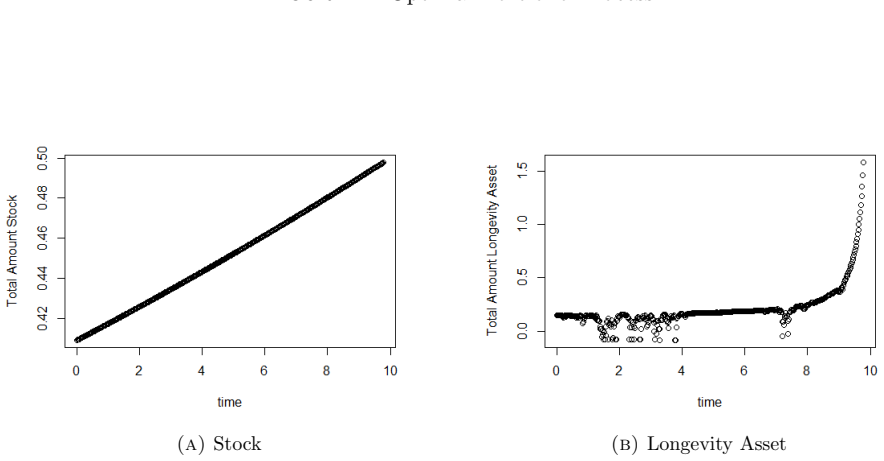
The paper claims that, in a jump-diffusion financial and mortality market, time-consistent mean-variance hedging can be fully characterized by the extended HJB system (3.5): any regular equilibrium quadruple $(u^\star, V, F^{u^\star}, g^{u^\star})$ satisfies the system and $u^\star$ is the maximizing control in its first row. This extends a known necessity result from pure-diffusion markets to markets with jumps and to the presence of a terminal liability hedge. When the liability hedge is dropped ($D\equiv 0$), the paper obtains explicit closed-form optimal strategies: the stock allocation is $u_S^\star(t) = \tilde\mu(\tilde\sigma_S+\tilde\rho_S\xi)^{-1} / (\gamma e^{r(T-t)})$, the longevity-bond allocation is given by a formula involving the gradient of an auxiliary function $b$, and the equilibrium value function and expected terminal wealth split as $V(t,p,z)=A(t)p+B(t,z)$ and $g(t,p,z)=a(t)p+b(t,z)$ with $A(t)=a(t)=e^{r(T-t)}$.
Load-bearing premise
The argument relies on the previously established verification theorem being applicable to the explicit solution: the paper does not prove that the closed-form functions are smooth and integrable enough, so unless those regularity conditions are checked the formulas are candidates rather than proven equilibria.
Editorial extensions
If this is right
- If the necessity theorem is correct, any regular time-consistent mean-variance equilibrium in a jump-diffusion market can be found by solving the extended HJB system; no other equilibrium candidates exist.
- The explicit formulas give an insurer a directly implementable hedging strategy in closed form, with the stock position depending on the risk premium, a covariance matrix corrected for jump covariation, risk aversion, and time to maturity.
- The numerical results imply that, at least in this model, an insurer who ignores jumps or misattributes them to diffusion only sacrifices little in expected terminal wealth and variance.
- The maturity-mismatch result implies that using a longevity bond with time to maturity longer than the insurance horizon does not materially increase terminal-wealth variance, easing the practical illiquidity constraint.
- Because the solution is a Nash subgame perfect equilibrium, the derived strategy is one the insurer will not want to abandon later, resolving the precommitment problem of classical mean-variance optimization.
Reading between the lines
- Because the necessity proof is built on general infinitesimal generators and stopping-time arguments rather than on the specific mean-variance form, the same equivalence between regular equilibria and the extended HJB system is likely to hold for other time-inconsistent Markovian objectives in jump-diffusion settings.
- The closed-form solution's dependence on jump distributions only through the covariation matrix $\xi$ suggests a testable moment-dependence: strategies may be unchanged for any jump-size law with the same second moments, which could be checked by Monte Carlo with heavier-tailed jump distributions.
- The longevity-bond formula shows the optimal hedge is driven by the market price of longevity risk relative to total quadratic variation; a natural extension is to incorporate a terminal liability tied to the insurer's own mortality pool, where the paper's own numerics suggest the effects could be larger.
Signed reviews
Editorial analysis
A structured set of objections, weighed in public.
Referee Report
Summary. The paper considers a time-consistent mean-variance hedging problem of an insurer in a market with stocks, a zero-coupon longevity bond, and a bank account, where asset prices and the mortality force follow jump-diffusions. The authors adopt the Nash subgame-perfect equilibrium concept of Björk and Murgoci (2010), define an extended HJB system, and prove (Theorem 4.4) that a regular equilibrium necessarily solves this system, extending Lindensjö (2016) from a pure-diffusion setting to a jump-diffusion setting including a terminal hedge. For the special case D≡0, they present closed-form expressions for the equilibrium strategies, the value function, and the expected terminal wealth (Theorem 5.1). The final section contains numerical experiments indicating robustness of the expected terminal payoff and its variance with respect to jump-size distributions and to a mis-specification of jump versus diffusion risk, as well as to a maturity mismatch of the longevity asset.
Significance. If the main theorems are correct, the paper provides a useful extension of the equilibrium HJB characterization to jump-diffusion markets and offers a tractable closed-form solution in an insurance setting with basis risk. The numerical findings, if reproducible, are practically relevant. The paper is generally well motivated and the algebraic derivations in Section 5 are careful. However, the sufficiency theorem (Theorem 4.3) is imported without proof, and the regularity and integrability hypotheses needed to apply it to the explicit solution are not verified; the necessity proof also relies on generator applications whose smoothness assumptions are not stated. These gaps affect the main claims as written, but they are potentially fixable within the manuscript's scope.
major comments (4)
- [Section 4, proof of Theorem 4.4 (Lemmas 4.7–4.10, Step 3)] The necessity theorem is proved without explicit regularity assumptions on V, F^{u*}, and g^{u*}. The proof applies Dynkin's formula and the generator A^{u*} to these functions, but Definition 4.2 only assumes u* is an equilibrium control, and Assumption 4.1 only postulates existence of A^{u*}V. In particular, Lemma 4.7 concludes A^{u*}g^{u*}=0 using Dynkin and dominated convergence, yet no C^{1,2,2,2} or boundedness condition is imposed on g^{u*}; Lemma 4.8 similarly requires A^{u*}F^{u*}. The limit interchanges in Step 4 also need a careful justification, as the liminf over c is replaced by a subsequence limit without stating why the two are equal. As written, the proof of the central necessity result is incomplete.
- [Section 5, after Eq. (5.1); Eqs. (5.9), (5.11); Section 6, JCIR model] The closed-form result Theorem 5.1 rests on the sufficiency theorem 4.3, whose hypotheses require F^{u*},g^{u*}∈C^{1,2,2,2} and a strong solution of the extended HJB system. The text only says these functions 'are assumed to satisfy the necessary regularity conditions' without verification. For the numerical model, σ_λ(t,λ)=σ_λ√λ is not globally Lipschitz on R_+, violating Assumption 2.2(ii) at λ=0, so the Feynman-Kac representations (5.9) and (5.11) cannot be taken to yield C^{1,2,2,2} solutions without additional argument. This is load-bearing: without a verification, the formulas in (5.12)–(5.13) are candidate equilibria, not proven ones.
- [Section 6, Table 4 (Panels E and F)] The experiment with T_L=15 and T_L=25 does not match the model setup: Section 2 assumes the insurance horizon and the time to maturity of the longevity bond coincide, and the dynamics of Y in (6.5), the pricing formula (6.4), and the strategy (6.10) are derived for a bond maturing at T. The paper does not specify how the model is modified when T_L≠T, so the claim that maturity differences 'do not add to the variance of the terminal wealth' is not reproducible from the given formulas.
- [Section 5, Eqs. (5.5)–(5.13); Section 6, Eq. (6.10)] Admissibility of the closed-form strategies is not established. In the JCIR example, B_λ(t,T)→0 as t→T, so the coefficients in (6.5) imply σ_L^2+η~_L ≈ O(B_λ^2) while ν_L ≈ O(B_λ); the candidate u_Y in (6.10) then grows like 1/B_λ(t,T) near maturity. The resulting wealth process may fail the condition E[|P_t|^2]<∞ in Definition 2.5. In addition, the Girsanov density Φ in (5.10)/(6.7) is only assumed to be a positive martingale, and the condition C(t,λ,Y,x,x̄)<1 is stated but never verified; without these checks the measure change used for b in (5.9) lacks justification.
minor comments (5)
- [Section 6, title] The heading 'Numercal results' contains a typo and should read 'Numerical results'.
- [Theorem 4.4] The phrase 'Definiton 4.2' should be corrected to 'Definition 4.2'.
- [Section 2, after Eq. (2.3)] The statement 'We take λ_t>0 for all t' appears to conflict with Assumption 2.2, which is formulated on R_+; the CIR volatility σ_λ√λ is not Lipschitz on R_+, so a modified assumption or a localization argument is needed.
- [Section 5, Eq. (5.2)] The Itô expansion leading to Ξ would be easier to follow if the domain of B and b and the integrability conditions on the jump integrals were stated explicitly instead of being left to the reader.
- [Section 6, Table 1] The parameter values are described as 'typical in the literature' without a specific source; a brief calibration reference or a sensitivity discussion would improve reproducibility.
Circularity Check
No circularity: the derivation chain is not self-referential; unverified hypotheses and omitted regularity checks are correctness concerns, not circularity.
full rationale
No circular step could be exhibited. The necessity theorem (Theorem 4.4) is proved from the formal definition of a regular equilibrium using stopping times, Dynkin's formula, and the tower property; it does not assume the extended HJB system as an input. The sufficiency theorem (Theorem 4.3) is delegated to Björk and Murgoci (2010), an external verification result, not a self-citation, and its omission does not make the claimed derivation equivalent to its inputs. The closed-form solution in Section 5 is obtained from an explicitly declared affine Ansatz, followed by first-order conditions and separation of variables; the resulting formulas are solved from the HJB system rather than fitted to the target moments or variances. The numerical robustness analysis is a set of scenario comparisons in which jump parameters are changed while externally specified mean and variance moments are held fixed; these are not calibrated outputs presented as predictions. The skeptical concerns about C^{1,2,2,2} regularity, integrability of b, and the applicability of Feynman-Kac and Dynkin arguments are legitimate gaps in verification, but they concern whether the theorems are fully proved, not whether the argument is circular. No load-bearing self-citation chain, no uniqueness theorem imported from the authors' prior work, and no renaming of a known result was found. The appropriate finding is therefore no significant circularity, score 0.
Assumptions & free parameters
free parameters (1)
- Numerical scenario parameters (Table 1) =
p0=1; T=10; r=0.02; gamma=2; S0=1; mu=0.06; sigma=0.1; rho=0.1; varrho_S=3; beta=0.4; sigma_lambda=0.3; theta=0.1…
assumptions (6)
- domain assumption Assumption 2.1: the Levy measure has finite second moment
- domain assumption Assumptions 2.2 and 2.4: mortality and longevity-asset coefficients satisfy growth and Lipschitz conditions
- domain assumption Assumption 2.3: the dollar value process Y of a longevity bond is a Markovian Ito jump-diffusion with deterministic coefficient functions
- ad hoc to paper Theorem 4.3, sufficiency of the extended HJB system, is taken from Bjork and Murgoci (2010) without proof
- ad hoc to paper Separability Ansatz V(t,p,z)=A(t)p+B(t,z) and g(t,p,z)=a(t)p+b(t,z)
- ad hoc to paper The Girsanov density Phi in (5.10) is a positive martingale and C(t,lambda,Y,x,xbar) is less than 1
Cite this review
Pith. "Pith review of Mean-variance hedging of unit linked life insurance contracts in a jump-diffusion model." pith.science (2026). https://pith.science/paper/IZPRLZDG
@misc{pith2026190805534,
  author       = {Pith},
  title        = {Pith review of: Mean-variance hedging of unit linked life insurance contracts in a jump-diffusion model},
  year         = {2026},
  howpublished = {\url{https://pith.science/paper/IZPRLZDG}},
  note         = {Machine review of arXiv:1908.05534}
}
read the original abstract
We consider a time-consistent mean-variance portfolio selection problem of an insurer and allow for the incorporation of basis (mortality) risk. The optimal solution is identified with a Nash subgame perfect equilibrium. We characterize an optimal strategy as solution of a system of partial integro-differential equations (PIDEs), a so called extended Hamilton-Jacobi-Bellman (HJB) system. We prove that the equilibrium is necessarily a solution of the extended HJB system. Under certain conditions we obtain an explicit solution to the extended HJB system and provide the optimal trading strategies in closed-form. A simulation shows that the previously found strategies yield payoffs whose expectations and variances are robust regarding the distribution of jump sizes of the stock. The same phenomenon is observed when the variance is correctly estimated, but erroneously ascribed to the diffusion components solely. Further, we show that differences in the insurance horizon and the time to maturity of a longevity asset do not add to the variance of the terminal wealth.
Figures

Reference graph
Works this paper leans on
-
[1]
Applebaum, D. (2009). L\'evy processes and stochastic calculus . Cambridge University Press, Cambridge
work page 2009
-
[2]
Basak, S. and Chabakauri, G. (2010). Dynamic mean-variance asset allocation. The Review of Financial Studies , 23(8):2970--3016
work page 2010
-
[3]
Bensoussan, A., Wong, K., Yam, S. C. P., and Yung, S.-P. (2014). Time-consistent portfolio selection under short-selling prohibition: From discrete to continuous setting. SIAM Journal on Financial Mathematics , 5(1):153--190
work page 2014
-
[4]
Bj\"ork, T. and Murgoci, A. (2010). A general theory of Markovian time inconsistent stochastic control problems . Available at SSRN 1694759
work page 2010
-
[5]
Brigo, D. and Mercurio, F. (2006). Interest rate models - theory and practice . Springer finance. Springer, Berlin ; Heidelberg [u.a.], 2. ed. edition
work page 2006
-
[6]
Cairns, A. J., Blake, D., and Dowd, K. (2008). Modelling and management of mortality risk: a review. Scandinavian Actuarial Journal , 2008(2-3):79--113
work page 2008
-
[7]
Cont, R. and Tankov, P. (2012). Financial modelling with jump processes . Chapman 38; Hall/CRC, Boca Raton, Fla. [u.a.], 2. rev. ed. edition
work page 2012
-
[8]
D., Khalaf-Allah, M., Ye, Y., Kumar, S., Cairns, A
Coughlan, G. D., Khalaf-Allah, M., Ye, Y., Kumar, S., Cairns, A. J., Blake, D., and Dowd, K. (2011). Longevity hedging 101: A framework for longevity basis risk analysis and hedge effectiveness. North American Actuarial Journal , 15(2):150--176
work page 2011
Show all 25 references
-
[9]
Czichowsky, C. (2013). Time-consistent mean-variance portfolio selection in discrete and continuous time. Finance and Stochastics , 17(2):227--271
2013
-
[10]
and Pirvu, T
Ekeland, I. and Pirvu, T. A. (2008). Investment and consumption without commitment. Mathematics and Financial Economics , 2(1):57--86
2008
-
[11]
Jin, P., R \"u diger, B., and Trabelsi, C. (2016). Exponential ergodicity of the jump-diffusion CIR process . In Stochastics of Environmental and Financial Economics , pages 285--300. Springer, Cham
2016
-
[12]
Kazamaki, N. (1979). Transformation of H^ p -martingales by a change of law . Probability Theory and Related Fields , 46(3):343--349
1979
-
[13]
Kromer, E., Overbeck, L., and R \"o der, J. (2015). Feynman--Kac for functional jump diffusions with an application to Credit Value Adjustment . Statistics & Probability Letters , 105:120--129
2015
-
[14]
Li, J. S.-H. and Hardy, M. R. (2011). Measuring basis risk in longevity hedges. North American Actuarial Journal , 15(2):177--200
2011
-
[15]
Lim, A. E. and Zhou, X. Y. (2002). Mean-variance portfolio selection with random parameters in a complete market. Mathematics of Operations Research , 27(1):101--120
2002
-
[16]
Lindensj \"o , K. (2016). Time-inconsistent stochastic control: solving the extended HJB system is a necessary condition for regular equilibria . arXiv preprint arXiv:1611.02902
2016 arXiv
-
[17]
and Vigna, E
Luciano, E. and Vigna, E. (2008). Mortality risk via affine stochastic intensities: calibration and empirical relevance. Belgian Actuarial Bulletin , 8:5--16
2008
-
[18]
Markowitz, H. (1952). Portfolio selection. The Journal of Finance , 7(1):77--91
1952
-
[19]
ksendal, B. K. and Sulem, A. (2005). Applied stochastic control of jump diffusions . Springer, Berlin; Heidelberg [u.a.]
2005
-
[20]
Peters, H. (2015). Game theory: A Multi-leveled approach . Springer
2015
-
[21]
Rudin, W. (1987). Real and complex analysis . McGraw-Hill series in higher mathematics. McGraw-Hill, New York, NY [u.a.], 3. ed. edition
1987
-
[22]
Schoutens, W. (2003). L\'evy processes in finance: pricing financial derivatives . Wiley series in probability and statistics. Wiley, Chichester [u.a.]
2003
-
[23]
Strotz, R. H. (1955). Myopia and inconsistency in dynamic utility maximization. The Review of Economic Studies , 23(3):165--180
1955
-
[24]
and Forsyth, P
Wang, J. and Forsyth, P. A. (2011). Continuous time mean variance asset allocation: A time-consistent strategy. European Journal of Operational Research , 209(2):184--201
2011
-
[25]
Zhou, X. Y. and Li, D. (2000). Continuous-time mean-variance portfolio selection: A stochastic LQ framework . Applied Mathematics and Optimization , 42(1):19--33
2000
Reviewed August 14, 2026 · model on record in the stance chip above.
Discussion (0). Continue with ORCID to comment.