Active learning of collinear magnetic Moment Tensor Potentials using the spin-MLIP package from soft-constrained spin-polarized DFT calculations: a case study of Fe-Pd
Pith reviewed 2026-06-29 16:57 UTC · model grok-4.3
The pith
A workflow trains magnetic Moment Tensor Potentials from soft-constrained DFT data and reproduces magnetization and density of states versus volume in Fe-Pd.
A machine-rendered reading of the paper's core claim, the machinery that carries it, and where it could break.
Core claim
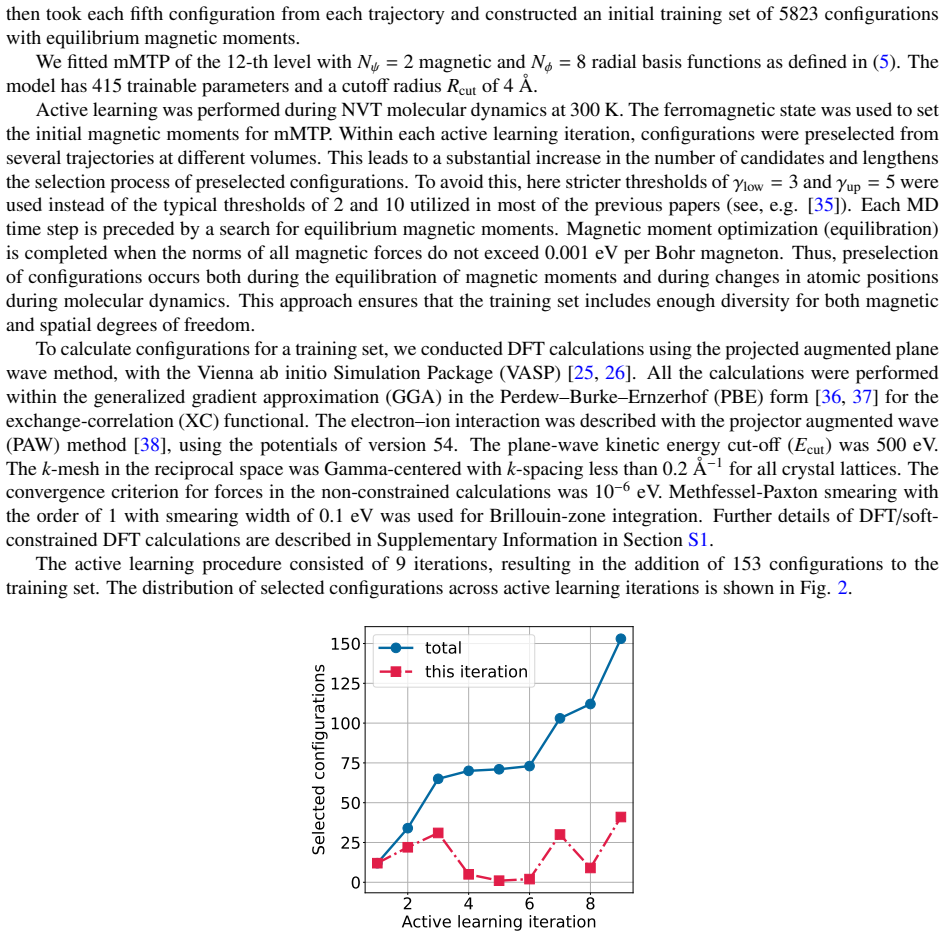
An active-learning procedure implemented in the spin-MLIP package, driven by soft-constrained spin-polarized DFT calculations performed in VASP and MD trajectories run in LAMMPS, produces magnetic Moment Tensor Potentials whose predicted magnetization and density of states versus volume in Fe-Pd agree with direct DFT calculations and with experimental density of states.
What carries the argument
The magnetic Moment Tensor Potential (mMTP), an extension of the standard Moment Tensor Potential that incorporates collinear magnetic moments as additional degrees of freedom and is fitted on-the-fly from non-equilibrium magnetic-moment data.
If this is right
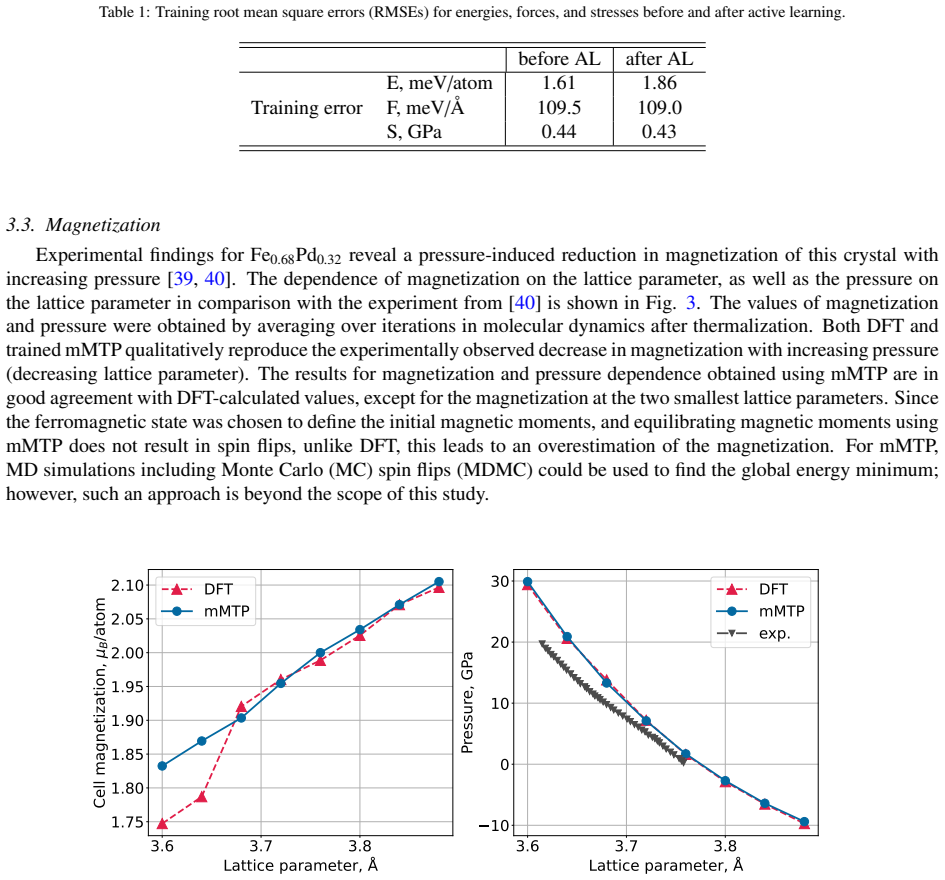
- Magnetization in Fe-Pd varies with supercell volume in the same way under the mMTP as under direct DFT.
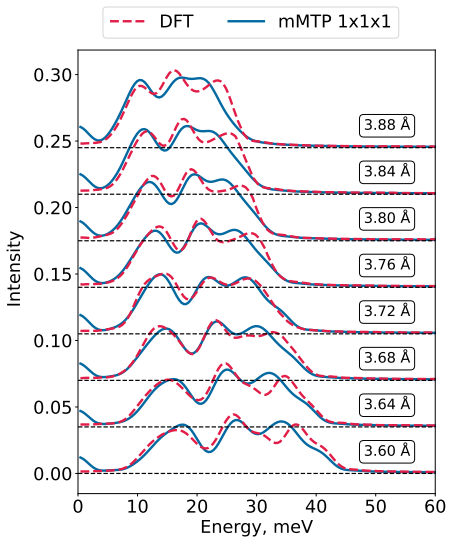
- Density of states computed from the mMTP at different volumes matches both DFT and experimental curves.
- The active-learning loop runs entirely within the spin-MLIP, VASP, and LAMMPS codes without manual intervention.
- The fitted mMTP remains stable during the molecular-dynamics trajectories used for further data acquisition.
Where Pith is reading between the lines
- The same workflow could be applied to other magnetic alloys provided suitable soft-constrained DFT data can be generated.
- Once trained, the mMTP could enable longer or larger simulations than direct DFT while retaining magnetic degrees of freedom.
Load-bearing premise
Soft-constrained spin-polarized DFT calculations supply accurate and diverse non-equilibrium magnetic moment data that suffice to train an mMTP transferable enough to stay reliable throughout active-learning MD trajectories.
What would settle it
An MD trajectory in which the mMTP magnetization or density of states at a volume outside the training set deviates measurably from fresh DFT calculations performed at the same volume.
Figures
read the original abstract
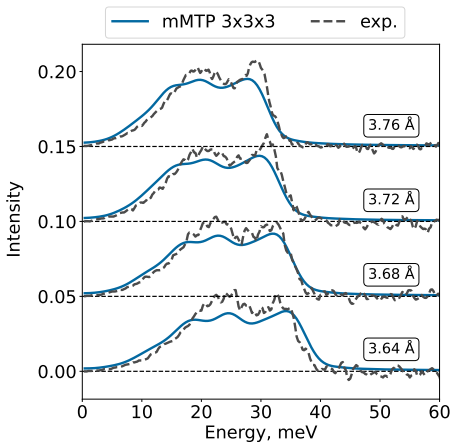
Explicit incorporation of magnetic degrees of freedom in machine-learning interatomic potentials (magnetic MLIPs) plays a crucial role in the correct description of magnetic materials and their properties. An important ingredient for fitting of magnetic MLIPs is spin-polarized density functional theory (DFT) calculations with non-equilibrium magnetic moments, i.e. DFT calculations with constraints on magnetic moments. In this study, we present a workflow for active learning of magnetic Moment Tensor Potential (mMTP) during molecular dynamics (MD) simulations. Magnetic MTP and its active learning algorithm were implemented in the open-source spin-MLIP code, DFT soft-constrained spin-polarized calculations were performed with the VASP code, and MD simulations were conducted in the open-source LAMMPS code. We test our workflow on the Fe-Pd crystal. The dependencies of magnetization and density of states (DOSs) on the volume of a supercell (or, pressure) are in good agreement with those calculated with DFT. Furthermore, the calculated DOSs correspond to the experimental ones.
Editorial analysis
A structured set of objections, weighed in public.
Referee Report
Summary. The manuscript presents a workflow for active learning of collinear magnetic Moment Tensor Potentials (mMTPs) implemented in the open-source spin-MLIP package. Training data are generated from soft-constrained spin-polarized DFT calculations in VASP; MD simulations are performed in LAMMPS. The workflow is tested on Fe-Pd, with the claim that magnetization and DOS versus supercell volume (pressure) from mMTP agree with independent DFT results and that the computed DOS matches experimental data.
Significance. An open-source active-learning implementation for magnetic MLIPs addresses a practical need in modeling magnetic materials. If the quantitative validation holds, the integration of soft-constrained DFT labels with mMTP active learning could enable more reliable simulations of pressure-dependent magnetic properties. The reproducibility afforded by the released spin-MLIP code is a clear strength.
major comments (2)
- [Abstract] Abstract: the central claim that 'the dependencies of magnetization and density of states (DOSs) on the volume of a supercell (or, pressure) are in good agreement with those calculated with DFT' supplies no quantitative error metrics (MAE, RMSE, R²), training-set sizes, or active-learning uncertainty quantification, rendering the agreement impossible to evaluate.
- [Abstract] Abstract / workflow description: no per-configuration deviations from target moments are reported for the soft-constrained VASP calculations, nor is any comparison given to hard-constrained reference data; without this, it is unclear whether the training labels are sufficiently accurate and unbiased for a transferable mMTP whose predictions remain reliable throughout the active-learning MD loop.
minor comments (1)
- [Abstract] The abstract states that 'the calculated DOSs correspond to the experimental ones' without specifying which experimental dataset or energy range is used for the comparison.
Simulated Author's Rebuttal
We thank the referee for their constructive comments. We address each major comment below and indicate the corresponding revisions.
read point-by-point responses
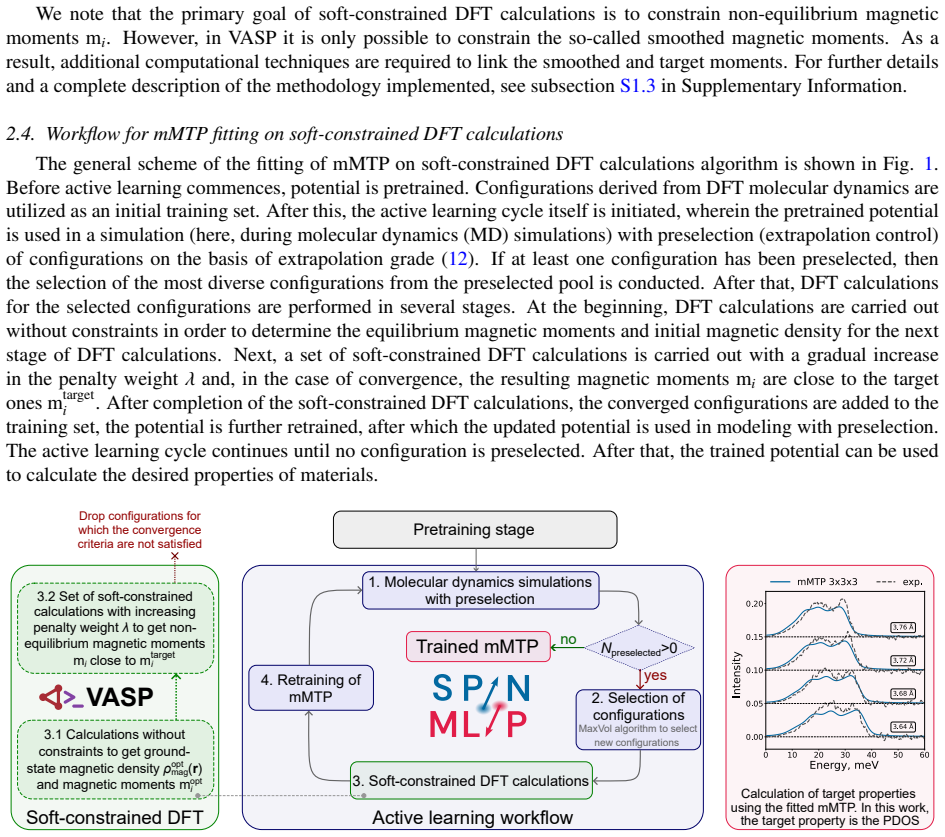
-
Referee: [Abstract] Abstract: the central claim that 'the dependencies of magnetization and density of states (DOSs) on the volume of a supercell (or, pressure) are in good agreement with those calculated with DFT' supplies no quantitative error metrics (MAE, RMSE, R²), training-set sizes, or active-learning uncertainty quantification, rendering the agreement impossible to evaluate.
Authors: We agree that quantitative metrics strengthen the claim. In the revised manuscript we have updated the abstract and results section to report MAE, RMSE and R² for magnetization and DOS versus volume, together with the final training-set size and active-learning uncertainty estimates obtained from the mMTP committee. revision: yes
-
Referee: [Abstract] Abstract / workflow description: no per-configuration deviations from target moments are reported for the soft-constrained VASP calculations, nor is any comparison given to hard-constrained reference data; without this, it is unclear whether the training labels are sufficiently accurate and unbiased for a transferable mMTP whose predictions remain reliable throughout the active-learning MD loop.
Authors: We have added a new paragraph in the Methods section that tabulates the mean and maximum absolute deviations from the target moments for every soft-constrained configuration used in training. A limited comparison against hard-constrained calculations on a representative subset of structures has also been performed and is now reported in the supplementary information; the deviations remain small enough that the soft-constrained labels support reliable mMTP transferability within the explored volume range. revision: yes
Circularity Check
No significant circularity; validation is external to the fitted model
full rationale
The paper describes an active-learning workflow that trains an mMTP on soft-constrained DFT data for Fe-Pd and reports agreement of magnetization and DOS versus volume with independent DFT runs plus experimental DOS. No equations, procedures, or self-citations are shown that reduce any reported prediction or agreement to a quantity fitted inside the same model by construction. The central claim rests on external benchmarks rather than internal re-derivation, satisfying the default expectation of a non-circular derivation chain.
Axiom & Free-Parameter Ledger
axioms (1)
- domain assumption Soft-constrained spin-polarized DFT calculations produce reliable non-equilibrium magnetic moment configurations suitable for training magnetic MLIPs
Reference graph
Works this paper leans on
-
[1]
Effects of magnetic excitations and transitions on vacancy formation: cases of fcc fe and ni compared to bcc fe
Kangming Li, Chu-Chun Fu, and Anton Schneider. Effects of magnetic excitations and transitions on vacancy formation: cases of fcc fe and ni compared to bcc fe. Physical Review B, 104(10):104406, 2021
2021
-
[2]
High-dimensional neural network potentials for magnetic systems using spin- dependent atom-centered symmetry functions
Marco Eckhoffand Jörg Behler. High-dimensional neural network potentials for magnetic systems using spin- dependent atom-centered symmetry functions. npj Computational Materials, 7(1):170, 2021
2021
-
[3]
A machine-learned spin-lattice potential for dynamic simulations of defec- tive magnetic iron
Jacob BJ Chapman and Pui-Wai Ma. A machine-learned spin-lattice potential for dynamic simulations of defec- tive magnetic iron. Scientific Reports, 12(1):22451, 2022
2022
-
[4]
Data-driven magneto-elastic predictions with scalable classical spin-lattice dynamics
Svetoslav Nikolov, Mitchell A Wood, Attila Cangi, Jean-Bernard Maillet, Mihai-Cosmin Marinica, Aidan P Thompson, Michael P Desjarlais, and Julien Tranchida. Data-driven magneto-elastic predictions with scalable classical spin-lattice dynamics. npj Computational Materials, 7(1):153, 2021
2021
-
[5]
Spectral neighbor representation for vector fields: Machine learning potentials including spin
Michelangelo Domina, Matteo Cobelli, and Stefano Sanvito. Spectral neighbor representation for vector fields: Machine learning potentials including spin. Physical Review B, 105(21):214439, 2022
2022
-
[6]
Spin- dependent graph neural network potential for magnetic materials
Hongyu Yu, Yang Zhong, Liangliang Hong, Changsong Xu, Wei Ren, Xingao Gong, and Hongjun Xiang. Spin- dependent graph neural network potential for magnetic materials. Physical Review B, 109(14):144426, 2024
2024
-
[7]
Magnetic moment tensor potentials for collinear spin-polarized materials reproduce different magnetic states of bcc fe.npj Computational Materials, 8(1):13, 2022
Ivan Novikov, Blazej Grabowski, Fritz Körmann, and Alexander Shapeev. Magnetic moment tensor potentials for collinear spin-polarized materials reproduce different magnetic states of bcc fe.npj Computational Materials, 8(1):13, 2022
2022
-
[8]
Physics-informed time-reversal equivariant neural network potential for magnetic materials
Hongyu Yu, Boyu Liu, Yang Zhong, Liangliang Hong, Junyi Ji, Changsong Xu, Xingao Gong, and Hongjun Xiang. Physics-informed time-reversal equivariant neural network potential for magnetic materials. Physical Review B, 110(10):104427, 2024
2024
-
[10]
Equivariant neural network force fields for magnetic materials
Zilong Yuan, Zhiming Xu, He Li, Xinle Cheng, Honggeng Tao, Zechen Tang, Zhiyuan Zhou, Wenhui Duan, and Yong Xu. Equivariant neural network force fields for magnetic materials. Quantum Frontiers, 3(1):8, 2024
2024
-
[11]
Deep learning illuminates spin and lattice interaction in magnetic materials
Teng Yang, Zefeng Cai, Zhengtao Huang, Wenlong Tang, Ruosong Shi, Andy Godfrey, Hanxing Liu, Yuanhua Lin, Ce-Wen Nan, Meng Ye, et al. Deep learning illuminates spin and lattice interaction in magnetic materials. Physical Review B, 110(6):064427, 2024
2024
-
[12]
Coarsening of chiral domains in itinerant electron magnets: A machine learning force-field approach
Yunhao Fan, Sheng Zhang, and Gia-Wei Chern. Coarsening of chiral domains in itinerant electron magnets: A machine learning force-field approach. Physical Review B, 110(24):245105, 2024
2024
-
[13]
Non-collinear magnetic atomic cluster expansion for iron
Matteo Rinaldi, Matous Mrovec, Anton Bochkarev, Yury Lysogorskiy, and Ralf Drautz. Non-collinear magnetic atomic cluster expansion for iron. npj Computational Materials, 10(1):12, 2024
2024
-
[14]
Smooth Overlap of Spin Orientations: Machine Learning Exchange Fields for Ab-initio Spin Dynamics
Yuqiang Gao, Menno Bokdam, and Paul J Kelly. Machine learning exchange fields for ab-initio spin dynamics. arXiv preprint arXiv:2403.10769, 2024. [15]https://github.com/yangtengleo/DeepSPIN/. [16]https://github.com/mttrin93/mag-ace/
work page internal anchor Pith review Pith/arXiv arXiv 2024
-
[15]
Constrained dft-based magnetic machine-learning potentials for magnetic alloys: a case study of fe–al
Alexey S Kotykhov, Konstantin Gubaev, Max Hodapp, Christian Tantardini, Alexander V Shapeev, and Ivan S Novikov. Constrained dft-based magnetic machine-learning potentials for magnetic alloys: a case study of fe–al. Scientific Reports, 13(1):19728, 2023
2023
-
[16]
Actively trained magnetic moment tensor potentials for mechanical, dynami- cal, and thermal properties of paramagnetic crn
Alexey S Kotykhov, Max Hodapp, Christian Tantardini, Konstantin Kravtsov, Ivan Kruglov, Alexander V Shapeev, and Ivan S Novikov. Actively trained magnetic moment tensor potentials for mechanical, dynami- cal, and thermal properties of paramagnetic crn. Physical Review B, 111(9):094438, 2025. 11
2025
-
[17]
How to find a good submatrix
Sergei A Goreinov, Ivan V Oseledets, Dimitry V Savostyanov, Eugene E Tyrtyshnikov, and Nikolay L Zama- rashkin. How to find a good submatrix. In Matrix Methods: Theory, Algorithms And Applications: Dedicated to the Memory of Gene Golub, pages 247–256. World Scientific, 2010. [20]https://gitlab.com/ivannovikov/spin-mlip/. [21]https://gitlab.com/ivannovikov...
2010
-
[18]
Fast parallel algorithms for short-range molecular dynamics
Steve Plimpton. Fast parallel algorithms for short-range molecular dynamics. Journal of computational physics, 117(1):1–19, 1995
1995
-
[19]
Lammps-a flexible simula- tion tool for particle-based materials modeling at the atomic, meso, and continuum scales
Aidan P Thompson, H Metin Aktulga, Richard Berger, Dan S Bolintineanu, W Michael Brown, Paul S Crozier, Pieter J In’t Veld, Axel Kohlmeyer, Stan G Moore, Trung Dac Nguyen, et al. Lammps-a flexible simula- tion tool for particle-based materials modeling at the atomic, meso, and continuum scales. Computer Physics Communications, 271:108171, 2022. [24]https:...
2022
-
[20]
Kresse and J
G. Kresse and J. Furthmüller. Efficient iterative schemes for ab initio total-energy calculations using a plane- wave basis set. Phys. Rev. B, 54:11169–11186, 1996
1996
-
[21]
Kresse and D
G. Kresse and D. Joubert. From ultrasoft pseudopotentials to the projector augmented-wave method. Phys. Rev. B, 59:1758–1775, 1999
1999
-
[22]
Moment tensor potentials: A class of systematically improvable interatomic potentials
Alexander V Shapeev. Moment tensor potentials: A class of systematically improvable interatomic potentials. Multiscale Modeling & Simulation, 14(3):1153–1173, 2016
2016
-
[23]
Accelerating high- throughput searches for new alloys with active learning of interatomic potentials
Konstantin Gubaev, Evgeny V Podryabinkin, Gus LW Hart, and Alexander V Shapeev. Accelerating high- throughput searches for new alloys with active learning of interatomic potentials. Computational Materials Science, 156:148–156, 2019
2019
-
[24]
The convergence of a class of double-rank minimization algorithms 1
Charles George Broyden. The convergence of a class of double-rank minimization algorithms 1. general consid- erations. IMA Journal of Applied Mathematics, 6(1):76–90, 1970
1970
-
[25]
A new approach to variable metric algorithms
Roger Fletcher. A new approach to variable metric algorithms. The computer journal, 13(3):317–322, 1970
1970
-
[26]
A family of variable-metric methods derived by variational means
Donald Goldfarb. A family of variable-metric methods derived by variational means. Mathematics of computation, 24(109):23–26, 1970
1970
-
[27]
Conditioning of quasi-newton methods for function minimization
David F Shanno. Conditioning of quasi-newton methods for function minimization. Mathematics of computation, 24(111):647–656, 1970
1970
-
[28]
Active learning of linearly parametrized interatomic poten- tials
Evgeny V Podryabinkin and Alexander V Shapeev. Active learning of linearly parametrized interatomic poten- tials. Computational Materials Science, 140:171–180, 2017
2017
-
[29]
Machine learning of molecular proper- ties: Locality and active learning
Konstantin Gubaev, Evgeny V Podryabinkin, and Alexander V Shapeev. Machine learning of molecular proper- ties: Locality and active learning. The Journal of chemical physics, 148(24):241727, 2018
2018
-
[30]
Automated calculation of thermal rate coeffi- cients using ring polymer molecular dynamics and machine-learning interatomic potentials with active learning
Ivan S Novikov, Yury V Suleimanov, and Alexander V Shapeev. Automated calculation of thermal rate coeffi- cients using ring polymer molecular dynamics and machine-learning interatomic potentials with active learning. Physical Chemistry Chemical Physics, 20(46):29503–29512, 2018
2018
-
[31]
Perdew, Kieron Burke, and Matthias Ernzerhof
John P. Perdew, Kieron Burke, and Matthias Ernzerhof. Generalized gradient approximation made simple.Phys. Rev. Lett., 77:3865–3868, 1996
1996
-
[32]
Perdew, Kieron Burke, and Matthias Ernzerhof
John P. Perdew, Kieron Burke, and Matthias Ernzerhof. Generalized gradient approximation made simple.Phys. Rev. Lett., 78:1396–1396, 1997. 12
1997
-
[33]
P. E. Blöchl. Projector augmented-wave method. Phys. Rev. B, 50:17953–17979, 1994
1994
-
[34]
Anomalous magnetic moments in fe–pt and fe–pd invar alloys under highpressure
M Matsushita, T Nishimura, S Endo, M Ishizuka, Koichi Kindo, and F Ono. Anomalous magnetic moments in fe–pt and fe–pd invar alloys under highpressure. Journal of Physics: Condensed Matter, 14(44):10753, 2002
2002
-
[35]
Thermodynamic origin of the pressure-induced invar effect: General criterion and experimental study of fe 68 pd 32
ER Priesen Reis, P Guzman, SH Lohaus, A Lin, CM Bernal-Choban, B Fultz, JY Zhao, G Shen, MY Hu, EE Alp, et al. Thermodynamic origin of the pressure-induced invar effect: General criterion and experimental study of fe 68 pd 32. Physical Review B, 112(14):144416, 2025
2025
-
[36]
HPC resources of the higher school of economics
PS Kostenetskiy, RA Chulkevich, and VI Kozyrev. HPC resources of the higher school of economics. InJournal of Physics: Conference Series, volume 1740, page 012050. IOP Publishing, 2021. 13 Supplementary Information: Active learning of collinear magnetic Moment Tensor Potentials using the spin- MLIP package from soft-constrained spin-polarized DFT calculat...
2021
-
[37]
At the beginning, equilibrium self-consistent field calculations (collinear, without constraints on magnetic mo- ments) are performed to obtain an initial approximation of the wave function and ground-state charge density ρmag opt (r), thereby accelerating the subsequent non-collinear calculations
-
[38]
This step is added because the moments msWS i and mWS i reported in the OSZICAR files are obtained by integrating over atom-centered spheres with Wigner-Seitz radii (the RWIGS tag)
After this, non-collinear soft-constrained self-consistent field calculations are performed to rescale the Wigner- Seitz radii. This step is added because the moments msWS i and mWS i reported in the OSZICAR files are obtained by integrating over atom-centered spheres with Wigner-Seitz radii (the RWIGS tag). The differences in the integration schemes betw...
-
[39]
Due to the smooth- ing functionF i(|r|), the constrained magnetic moments m sWS i always differ from mtarget i , which are required to retrain mMTP
The next step is a linear fit between the unsmoothed magnetic moments m WS i and the smoothed magnetic mo- ments msWS i , the result of which is used to adapt the initial target magnetic moments mtarget i . Due to the smooth- ing functionF i(|r|), the constrained magnetic moments m sWS i always differ from mtarget i , which are required to retrain mMTP. T...
-
[40]
Once we found m constr i , non-collinear soft-constrained calculations are performed during which the functional is minimized: EDFT =min ρ E[ρ;R,Z,L]+λ NatomsX i=1 msWS i −m constr i 2 .(S4) After minimization, the convergence criteria for magnetic moments are checked (see subsection S1.6). If at least one of the criteria is violated, the...
-
[41]
After the soft-constrained calculations, we obtain msWS i ≃m constr i
Finally, magnetic moments are refined. After the soft-constrained calculations, we obtain msWS i ≃m constr i . How- ever, the magnetic moments mi reported in the OUTCAR file slightly differ from the integrated magnetic mo- ment mWS i in the OSZICAR file due to different integration schemes. The values mi are obtained by integration over PAW regions, while...
-
[42]
Soft-constrained SCF to rescale Wigner-Seitz radii
-
[43]
Linear fit between unsmoothed and smoothed magnetic moments (using OSZICAR)M_int and MW_int moments (old) (new) Add M_CONSTR and iteratevily increase λi
-
[44]
Refinement of magnetic moments
-
[45]
Check convergence criteria between calculated (from OUTCAR) and target (needed for MTP retraining) magnetic moments
-
[46]
(1) Equilibrium self-consistent field (SCF) calculation
Add configuration to the training set (adjust constrained moments using difference between calculated and target moments) δ δ λi > λmax Magnetic moments and λi from the stage with fulfilled convergence criteria Magnetic moments and λi from the stage with minimal MAE no yes Select calculated configurations with magnetic moments close to the target magnetic...
discussion (0)
Sign in with ORCID, Apple, or X to comment. Anyone can read and Pith papers without signing in.