Experimental test of symmetron-field based dark energy model using neutron interferometry
Pith reviewed 2026-06-28 09:39 UTC · model grok-4.3
The pith
Neutron interferometry finds no phase shift from symmetron fields, constraining dark energy models
A machine-rendered reading of the paper's core claim, the machinery that carries it, and where it could break.
Core claim
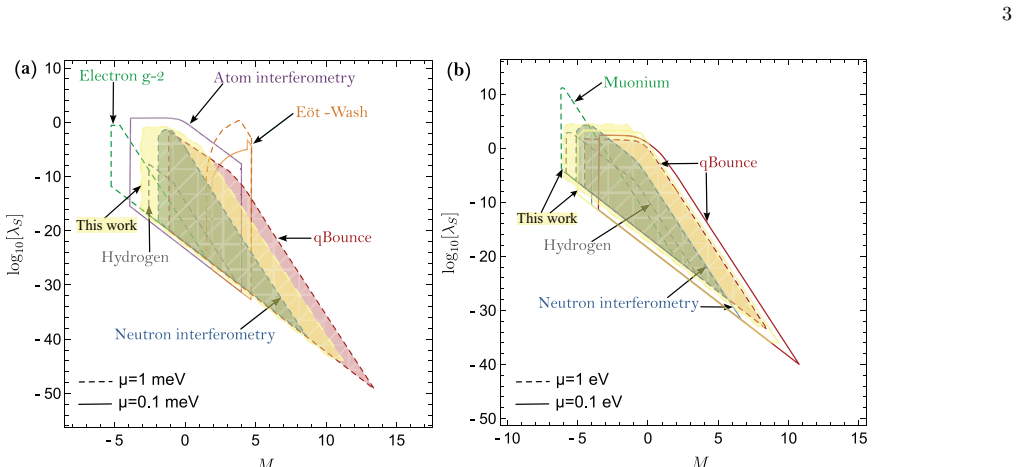
Phase shift measurements of neutron matter waves in vacuum and low-pressure Argon gas show no additional shifts induced by couplings to scalar fields. From this null result, stringent constraints are set on a scalar symmetron-field as a candidate for quintessence dark energy.
What carries the argument
Neutron interferometric measurements of phase shifts to probe couplings to scalar fields
Load-bearing premise
The symmetron field with parameters in the tested range would produce a phase shift large enough to be detected by the neutron interferometer
What would settle it
Detection of a phase shift in the neutron waves that matches the magnitude and dependence predicted by the symmetron model for the tested parameters
Figures
read the original abstract
We report phase shift measurements of neutron matter waves propagating in vacuum and low-pressure Argon gas, using a technique developed for neutron interferometric scattering length measurements. The experiment probes additional phase shifts induced by couplings to scalar fields. From the absence of such effects, we set stringent constraints on a scalar symmetron-field, a leading candidate for quintessence dark energy.
Editorial analysis
A structured set of objections, weighed in public.
Referee Report
Summary. The paper reports phase shift measurements using neutron interferometry in vacuum and low-pressure Argon gas. It claims that the absence of additional phase shifts beyond those expected from standard interactions allows stringent constraints to be placed on the parameters of a symmetron scalar field model for quintessence dark energy.
Significance. If the central assumption that the symmetron field remains unscreened along the neutron paths holds, the work introduces a novel laboratory probe of scalar dark energy candidates via precision matter-wave interferometry. This could complement existing bounds from astrophysics and other experiments, provided the mapping from null result to parameter space is robust and the experimental sensitivity is quantified.
major comments (2)
- [Experimental setup and model section] The experimental setup relies on silicon crystal blades (density ~2.3 g/cm³) to split and recombine the neutron beams. The manuscript does not analyze whether the symmetron effective potential leads to screening inside these dense crystals, which would suppress the field amplitude and produce a null phase shift for any parameter values in the tested range regardless of the model. This assumption is load-bearing for the claim that the null result constrains the symmetron parameters (see abstract and experimental description).
- [Results and constraints] The abstract states that constraints are set from the absence of effects, but the text provides no tabulated phase shift data, error bars, statistical significance of the null result, or explicit mapping from measured phase to excluded symmetron coupling and mass ranges. Without these, the stringency of the bounds cannot be evaluated (abstract and results section).
minor comments (1)
- [Theory section] Notation for the symmetron potential and coupling parameters should be defined consistently with standard literature references to allow direct comparison of bounds.
Simulated Author's Rebuttal
We thank the referee for the careful reading of our manuscript and the constructive comments. We address each major point below and will revise the manuscript accordingly to strengthen the presentation and analysis.
read point-by-point responses
-
Referee: [Experimental setup and model section] The experimental setup relies on silicon crystal blades (density ~2.3 g/cm³) to split and recombine the neutron beams. The manuscript does not analyze whether the symmetron effective potential leads to screening inside these dense crystals, which would suppress the field amplitude and produce a null phase shift for any parameter values in the tested range regardless of the model. This assumption is load-bearing for the claim that the null result constrains the symmetron parameters (see abstract and experimental description).
Authors: We agree that screening of the symmetron field inside the silicon blades represents a critical assumption that requires explicit analysis. In the revised version we will add a dedicated paragraph in the experimental setup section that computes the local density threshold for screening and evaluates the field amplitude inside the blades for the parameter ranges probed by the experiment. This calculation will show that the thin geometry of the blades and the low-density neutron paths limit any suppression effect, thereby preserving the mapping from the null result to the reported constraints. revision: yes
-
Referee: [Results and constraints] The abstract states that constraints are set from the absence of effects, but the text provides no tabulated phase shift data, error bars, statistical significance of the null result, or explicit mapping from measured phase to excluded symmetron coupling and mass ranges. Without these, the stringency of the bounds cannot be evaluated (abstract and results section).
Authors: The phase-shift measurements and their uncertainties are discussed in the results section, but we acknowledge that a clearer tabular presentation and explicit mapping would improve evaluability. We will add a table listing the measured phase shifts (vacuum and argon), associated statistical and systematic errors, and the significance of the null result. We will also include a short appendix that derives the excluded region in the symmetron (mass, coupling) plane from the measured phase upper limit, quoting the relevant formulas and the assumed neutron coherence length. revision: yes
Circularity Check
Experimental null result with no derivation reducing to inputs by construction
full rationale
The paper reports neutron interferometry phase-shift measurements in vacuum and low-pressure argon, then places upper limits on symmetron parameters from the null result. No equations derive a 'prediction' that is fitted from the same data, no self-citation supplies a uniqueness theorem, and no ansatz is smuggled via prior work. The central output is an experimental constraint whose validity rests on the measured phase difference and the stated theoretical phase-shift formula, both independent of the fitted parameters being bounded.
Axiom & Free-Parameter Ledger
invented entities (1)
-
symmetron scalar field
no independent evidence
Forward citations
Cited by 1 Pith paper
-
Quantum corrections to symmetron fifth forces for planar sources
Quantum corrections suppress the symmetron fifth force by order 10% within a Compton wavelength of a thick planar source and enhance it at larger distances.
Reference graph
Works this paper leans on
-
[1]
for a living review). These models predict a quantum-mechanical phase shift for neutrons traversing a vacuum region in which the corresponding scalar field develops in the absence of matter [25–27]. The effective potentials are given by Veff (φ, ρ ) = V (φ) +ρ A(φ), where V (φ) describes the self- interactions of the field and A(φ) the coupling to the ∗ andre...
Pith/arXiv arXiv 2026
-
[2]
This approx- imation, referred to as Fermi screening, enables an effec- tive treatment of neutron screening effects
5 fm, consistent with QCD expectations. This approx- imation, referred to as Fermi screening, enables an effec- tive treatment of neutron screening effects. Within this framework, the scalar potential is rescaled by a screening charge Q, which ranges from 0 for a fully screened sphere to 1 for an unscreened sphere. The analytical expressions employed for th...
-
[3]
The purpose of the Argon chambers is to ensure a defined gas composition and to have the same type of cell windows in both beam paths
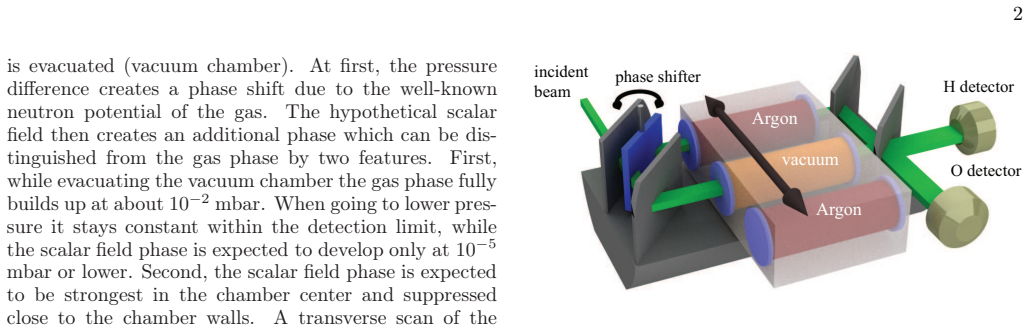
A gas handling system sets a constant pressure of 1050 mbar of a pure Argon gas in the two outer chambers. The purpose of the Argon chambers is to ensure a defined gas composition and to have the same type of cell windows in both beam paths. The mid- dle chamber is connected to a vacuum control system consisting of a pressure gauge, a motorized leak valve ...
-
[4]
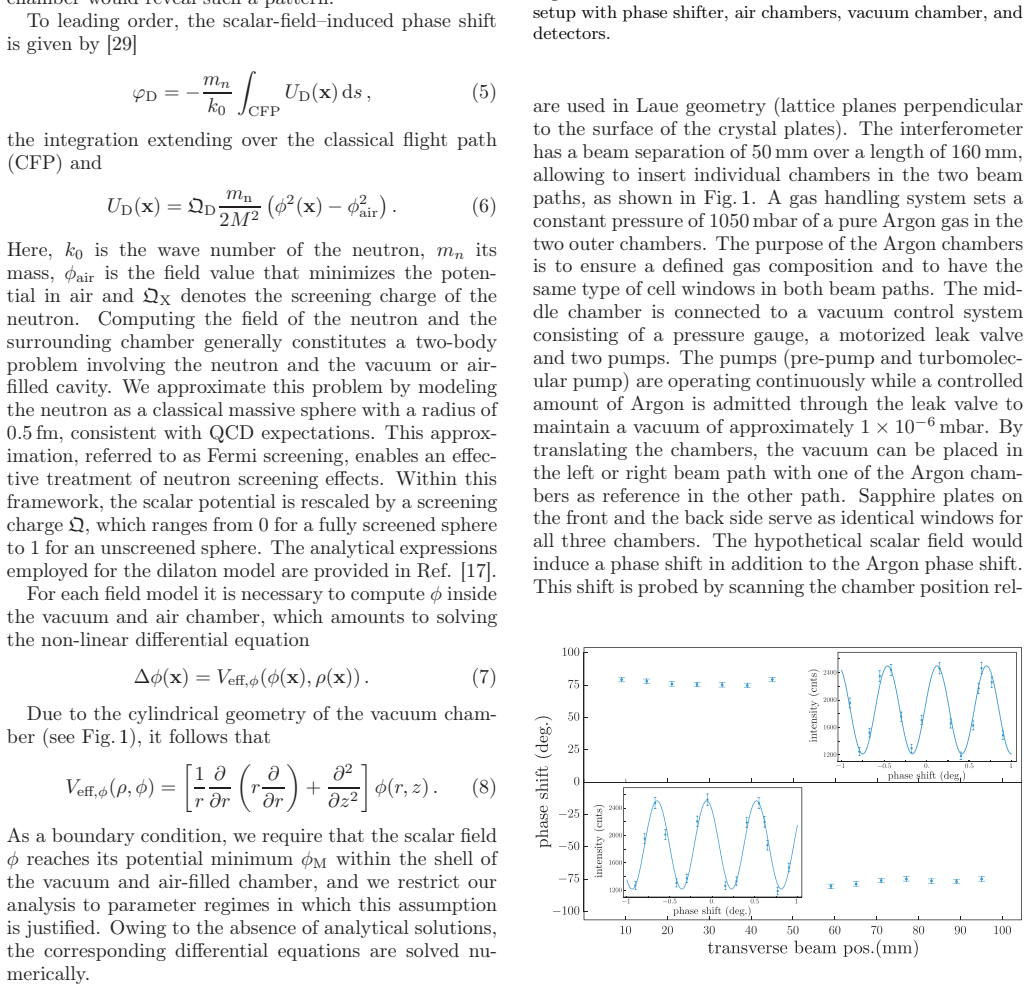
with a loop size of 50 mm × 160 mm in order to max- imize the size of the chambers. Such large single crystal interferometers are extremely sensitive to temperature 4 gradients, air flow, vibrations, bending, and other pertur- bations. Consequently, the interference contrast (fringe visibility) is limited to approximately 27 % to 45 %. The interferograms a...
-
[5]
A. G. Riess et al. (Supernova Search Team), Ob- servational evidence from supernovae for an ac- celerating universe and a cosmological constant, Astron. J. 116, 1009 (1998) , arXiv:astro-ph/9805201
Pith/arXiv arXiv 1998
-
[6]
S. Perlmutter et al. (Supernova Cosmology Project), Measurements of ω and λ from 42 high red- shift supernovae, Astrophys. J. 517, 565 (1999) , arXiv:astro-ph/9812133
Pith/arXiv arXiv 1999
-
[7]
A. Joyce, B. Jain, J. Khoury, and M. Trodden, Beyond the cosmological stan- dard model, Phys. Rept. 568, 1 (2015) , arXiv:1407.0059 [astro-ph.CO]
Pith/arXiv arXiv 2015
-
[8]
P. Brax, C. van de Bruck, A.-C. Davis, and D. Shaw, The dilaton and modi- fied gravity, Phys. Rev. D 82, 063519 (2010) , arXiv:1005.3735 [astro-ph.CO]
Pith/arXiv arXiv 2010
-
[9]
G. Cronenberg, P. Brax, H. Filter, P. Geltenbort, T. Jenke, G. Pignol, M. Pitschmann, M. Thalham- mer, and H. Abele, Acoustic rabi oscillations be- tween gravitational quantum states and impact on symmetron dark energy, Nature Phys. 14, 1022 (2018) , arXiv:1902.08775 [hep-ph]
Pith/arXiv arXiv 2018
-
[10]
P. Brax and M. Pitschmann, Exact solutions to nonlinear symmetron theory: One- and two- mirror systems, Phys. Rev. D 97, 064015 (2018) , arXiv:1712.09852 [gr-qc]
Pith/arXiv arXiv 2018
-
[11]
Pitschmann, Exact solutions to nonlin- ear symmetron theory: One- and two-mirror systems
M. Pitschmann, Exact solutions to nonlin- ear symmetron theory: One- and two-mirror systems. ii., Phys. Rev. D 103, 084013 (2021) , [Erratum: Phys.Rev.D 106, 109902 (2022)], arXiv:2012.12752 [gr-qc]
arXiv 2021
-
[12]
Brax and S
P. Brax and S. Fichet, Quantum chameleons, Phys. Rev. D 99, 104049 (2019)
2019
-
[13]
C. Burrage and J. Sakstein, Tests of chameleon gravity, Living Reviews in Relativity 21, 10.1007/s41114-018-0011-x (2018)
-
[14]
M. Gasperini, F. Piazza, and G. Veneziano, Quintessence as a runaway dilaton, Phys. Rev. D 65, 023508 (2002) , arXiv:gr-qc/0108016
Pith/arXiv arXiv 2002
-
[15]
T. Damour, F. Piazza, and G. Veneziano, Violations of 5 the equivalence principle in a dilaton-runaway scenario, Physical Review D 66, 10.1103/physrevd.66.046007 (2002)
-
[16]
T. Damour, F. Piazza, and G. Veneziano, Runaway dila- ton and equivalence principle violations, Physical Review Letters 89, 10.1103/physrevlett.89.081601 (2002)
-
[17]
Müller, T
J. Müller, T. W. Murphy, U. Schreiber, P. J. Shelus, J.- M. Torre, J. G. Williams, D. H. Boggs, S. Bouquillon, A. Bourgoin, and F. Hofmann, Lunar laser ranging: a tool for general relativity, lunar geophysics and earth sci - ence, Journal of Geodesy 93, 2195 (2019)
2019
-
[18]
Abele, T
H. Abele, T. Jenke, H. Leeb, and J. Schmiedmayer, Ram- sey’s method of separated oscillating fields and its appli- cation to gravitationally induced quantum phase shifts, Phys. Rev. D 81, 065019 (2010)
2010
-
[19]
Jenke, P
T. Jenke, P. Geltenbort, H. Lemmel, and H. Abele, Re- alization of a gravity-resonance-spectroscopy technique , Nature Phys. 7, 468 (2011)
2011
-
[20]
R. I. P. Sedmik and M. Pitschmann, Next generation design and prospects for cannex, Universe 7, 234 (2021) , arXiv:2107.07645 [physics.ins-det]
arXiv 2021
-
[21]
P. Brax, H. Fischer, C. Käding, and M. Pitschmann, The environment dependent dilaton in the laboratory and the solar system, Eur. Phys. J. C 82, 934 (2022) , arXiv:2203.12512 [gr-qc]
arXiv 2022
-
[22]
Fischer, C
H. Fischer, C. Käding, R. I. Sedmik, H. Abele, P. Brax, and M. Pitschmann, Search for environment-dependent dilatons, Physics of the Dark Universe 43, 101419 (2024)
2024
- [23]
-
[24]
Burrage, C
C. Burrage, C. Käding, P. Millington, and J. Minář, Open quantum dynamics induced by light scalar fields, Phys. Rev. D 100, 076003 (2019)
2019
-
[25]
Burrage, C
C. Burrage, C. Käding, P. Millington, and J. Minář, Influence functionals, deco- herence and conformally coupled scalars, Journal of Physics: Conference Series 1275, 012041 (2019)
2019
-
[26]
Käding and M
C. Käding and M. Pitschmann, New method for directly computing reduced density matrices, Phys. Rev. D 107, 016005 (2023)
2023
-
[27]
Hinterbichler and J
K. Hinterbichler and J. Khoury, Symmetron fields: Screening long-range forces through local symmetry restoration, Phys. Rev. Lett. 104, 231301 (2010)
2010
-
[28]
Hinterbichler, J
K. Hinterbichler, J. Khoury, A. Levy, and A. Matas, Sym- metron cosmology, Phys. Rev. D 84, 103521 (2011)
2011
-
[29]
Lemmel, P
H. Lemmel, P. Brax, A. Ivanov, T. Jenke, G. Pig- nol, M. Pitschmann, T. Potocar, M. Wellenzohn, M. Zawisky, and H. Abele, Neutron interfer- ometry constrains dark energy chameleon fields, Physics Letters B 743, 310 (2015)
2015
-
[30]
K. Li, M. Arif, D. G. Cory, R. Haun, B. Heacock, M. G. Huber, J. Nsofini, D. A. Pushin, P. Saggu, D. Sarenac, C. B. Shahi, V. Skavysh, W. M. Snow, and A. R. Young (The INDEX Collaboration), Neu- tron limit on the strongly-coupled chameleon field, Phys. Rev. D 93, 062001 (2016)
2016
-
[31]
Lemmel, M
H. Lemmel, M. Jentschel, H. Abele, F. Lafont, B. Guer- ard, C. P. Sasso, G. Mana, and E. Massa, Neu- tron interference from a split-crystal interferometer, Journal of Applied Crystallography 55, 870 (2022)
2022
-
[32]
P. Brax, C. Burrage, and A.-C. Davis, Laboratory con- straints, Int. J. Mod. Phys. D 27, 1848009 (2018)
2018
-
[33]
D. M. Greenberger and A. W. Overhauser, Coherence effects in neutron diffraction and gravity experiments, Rev. Mod. Phys. 51, 43 (1979)
1979
-
[34]
Upadhye, Symmetron dark energy in laboratory ex- periments, Phys
A. Upadhye, Symmetron dark energy in laboratory ex- periments, Phys. Rev. Lett. 110, 031301 (2013)
2013
-
[35]
C. D. Panda, M. J. Tao, M. Ceja, J. Khoury, G. M. Tino, and H. Müller, Measuring gravitational attraction with a lattice atom interferometer, Nature 631, 515 (2024)
2024
-
[36]
Brax, A.-C
P. Brax, A.-C. Davis, and B. Elder, Screened scalar fields in hydrogen and muonium, Phys. Rev. D 107, 044008 (2023)
2023
-
[37]
Fischer, C
H. Fischer, C. Käding, H. Lemmel, S. Sponar, and M. Pitschmann, Search for dark energy with neutron interferometry, Progress of Theoretical and Experimental Physics 2024, 023E02
2024
-
[38]
H. Fischer, C. Käding, and M. Pitschmann, Screened scalar fields in the laboratory and the solar system, Uni- verse 10, 10.3390/universe10070297 (2024)
-
[39]
Zawinsky, M
M. Zawinsky, M. Baron, L. R., and H. Rauch, Testing the world’s largest mono- lithic perfect crystal neutron interferometer, Nuclear Instruments and Methods in Physics Research Sectio n A:
-
[40]
Dvorak, T
A. Dvorak, T. Jenke, H. Lemmel, K. Obigane, and S. Sponar, Scalar field based dark energy models (2025)
2025
discussion (0)
Sign in with ORCID, Apple, or X to comment. Anyone can read and Pith papers without signing in.