REVIEW 3 major objections 4 minor 13 references
Oilbird: Training-Free Speculative Decoding with Keys the Verifier Already Computes
T0 review · 3 major / 4 minor · reviewed 2026-08-05 · deepseek-v4-flash
Pith's one-line read Training-free speculative decoding fails on tool-calling traffic because its exact-match key cannot address continuations already in its own store; Oilbird re-keys the same store by hidden states the verifier already computes and recovers m
desk verdict A well-measured, genuinely novel fix for a specific failure of training-free speculative decoding on tool-calling traffic; the central claim holds in scope, but the missing artifacts and unvalidated hyperparameters make it a conditional accept. read the letter →
The pith
A machine-rendered reading of the paper's core claim, the machinery that carries it, and where it could break.
The reading
What carries the argument
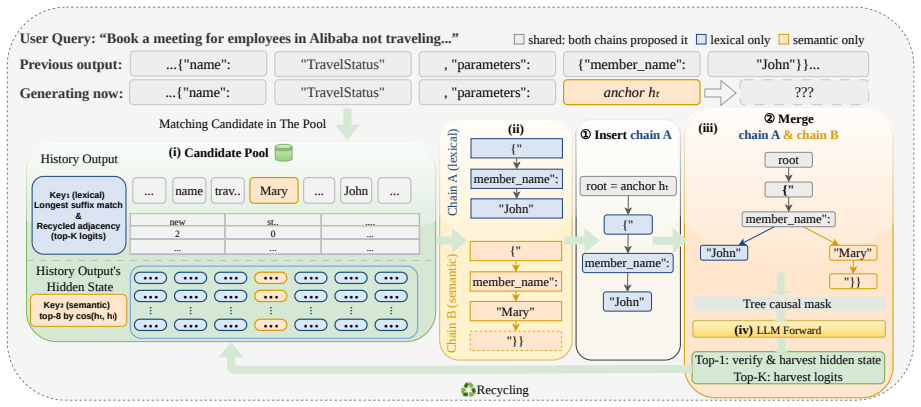
One store, two keys: over a pool of previously generated tokens the system keeps a longest-suffix index and a cosine index over hidden states read at layer round(0.85L). The semantic key's query is the hidden state h_t left by the last verifying forward; it retrieves the top-8 pool positions by cosine similarity above a firing floor θ=0.8 and copies a chain γ_i = x_{i+2:i+1+D(s_i)} from two positions past each neighbor, where depth D(s) is 48, 8, or 0 tokens according to similarity. The merge re-walks the draft tree from the root, costing |γ|−π(γ,T) nodes where π is the longest prefix already present, so semantic chains ride inside the lexical tree at a fixed 16-node reservation of the 60-no
What would settle it
On a fresh tool-calling benchmark with high lexical availability, run the paper's exact-match oracle and then the semantic key at the same eight-candidate budget: if recall at gap positions does not clearly beat the static token-embedding baseline (~23%) and approach ~81%, the addressing diagnosis fails. On API-Bank itself, zeroing the semantic entry budget should cost about +6.2% of accepted length; a null result there would falsify the practical claim.
Extended reading notes
Core claim
The paper's central claim is that the bottleneck in training-free speculative decoding on repetitive tool-calling traffic is addressing, not coverage. A position-by-position census over ten benchmarks shows that on API-Bank about half of what the strongest exact-match drafter misses is text already verbatim in the pool yet unreachable by suffix matching: the failure is a cliff, not a slope, with median matched suffix length dropping from sixteen tokens at successful positions to one at gap positions. The proposed fix, Oilbird, stores one hidden vector per generated token—captured for free from the verifying forward—and queries it per position by cosine similarity. That key finds the true nex
Load-bearing premise
The claim rests on cosine similarity between hidden states taken at layer round(0.85L) of the target model identifying past positions whose next token is the correct continuation of the current context; if that similarity stops tracking correct continuations on other traffic, the recovered gap and the 24–29% gains disappear.
Editorial extensions
If this is right
- A larger store is not the remedy the numbers point to: on API-Bank, about half of the strongest exact-match drafter's misses are already in the pool, so re-keying that pool can buy more than growing it.
- The semantic source is portable: three published training-free drafters, each already holding the same pool under its own exact-match key, gain 23.6–29.4% accepted length when the semantic key is merged in at an unchanged node budget.
- Oilbird is lossless and training-free, and on API-Bank with Llama-3.1-8B it beats the trained EAGLE-3 in wall-clock speedup (4.39x vs 2.03x) while producing identical greedy output.
- The gain is regime-specific: at batch sizes 8–32 speculation's edge over autoregressive decoding shrinks and the semantic key's per-position retrieval is neutral or negative, so the result is a batch-1 serving speedup.
- On non-repetitive workloads the semantic source is neutral rather than costly, and a trained drafter remains the better choice there; the method's value concentrates on repetitive structured traffic.
Reading between the lines
- The identifiability gap should generalize to any traffic where a few minted values sit inside repeated structured frames—agent logs, SQL, configs, JSON envelopes—so the same re-keying diagnosis may transfer to other cache-based reuse systems, though the paper only measures language decoding.
- Because the key matches hidden states rather than strings, it may also reach positions where the text differs but the situation is semantically aligned; the per-position similarity-scaled depth hints at this, but the paper does not test paraphrase-level reuse separately.
- The measured near-independence of the semantic key and the lexical keys (lift 1.013 and 1.009) suggests adding a third orthogonal addressing key could keep buying accepted length until the uniquely-addressable positions are saturated; that saturation point is not identified.
- Layer choice is an assumption with an easy check: the 0.85L layer works for the two 8B families measured, and recall at gap positions on a new family or scale should be probed before trusting the 81% figure.
Signed reviews
Editorial analysis
A structured set of objections, weighed in public.
Referee Report
Summary. The paper proposes Oilbird, a training-free speculative decoding extension that augments an exact-suffix lexical drafter with a second, per-position semantic key over hidden states the verifier already computes. It first presents a method-independent diagnosis on ten benchmarks, separating coverage failures (continuation absent from the pool) from addressability failures (present but unreachable by exact matching). On API-Bank the paper measures a 6.8% identifiability gap and reports that a cosine key over layer round(0.85L) hidden states recovers about 81% of those gap positions at the same candidate budget. The deployed system merges the semantic source into a multi-source tree within a fixed node budget, reports +6.2% accepted length over its lexical-only host on API-Bank, +24–29% accepted length when transplanted into three published drafters, and 4.39x autoregressive speedup on API-Bank with Llama-3.1-8B, ahead of the training-free baselines and EAGLE-3 in the same harness. The paper includes ablations, batch-size probes, memory/retrieval-cost accounting, and an ethics statement.
Significance. The central contribution is an empirical diagnosis that is falsifiable and largely method-independent: the no-drafter census, the exact-match oracle, bootstrap intervals, and token-for-token audited greedy verification are credible controls. If the results hold, they reframe training-free speculative decoding on repetitive serving traffic from a coverage problem to an addressing problem, and show that a cheap side channel already computed by the verifier can close a substantial part of that gap. The transplant study into three drafters the authors did not write is a strong control, and the ablations consistently show that no source is free to remove. The paper is also appropriately careful about scope: it states where the semantic source is neutral or negative, discloses memory and retrieval costs, and reports batch-size sensitivity. The main weaknesses are evidential rather than technical: key hyperparameters are fixed without a validation split, and no artifacts are released. I agree with the stress-test note that no load-bearing flaw in the central derivation or measurement was identified; the off-by-one in Eq. (3) is plausibly explained by the bonus-token lag, and the semantic
major comments (3)
- [Algorithm 1, Eq. (3), §5] Several load-bearing parameters are fixed without a validation split: theta = 0.8, layer round(0.85L), k = 8, Bret = 16/60, and the depth schedule D(s) in Eq. (3). The central quantitative claims (81% gap recall, +6.2% over the lexical-only host, +24-29% transplant gains, and the Table 1 speedups) are measured on the same benchmarks used to motivate these settings. This leaves open the possibility that part of the reported gain is a selection artifact. I request either a held-out validation split or a sensitivity sweep over theta, layer, k, and Bret showing the results are stable within a reasonable operating range.
- [§3 vs. §4] The diagnosis in §3 is defined over 'everything the requests before it contain' and Table 7 says 'verbatim in an earlier trace,' while §4 states that the deployed store records only generated tokens and that prompts are never stored. If the census predicate includes prompt and tool-observation text that the deployed pool excludes, then the 6.8% identifiability gap and the 81% semantic recall would overestimate what Oilbird can recover. Please state unambiguously whether the census store is identical to the deployed store, and if it is not, recompute the gap and recall under the deployed store definition. This is load-bearing for the addressing-vs-coverage claim.
- [§5, Table 2, audit statement] The paper states that an audit script recomputes 765 numbers from raw data, but no code, data, or raw logs are released. For an empirical systems paper whose central claims are measured numbers (4.39x, +24-29%, 6.8% gap), this blocks independent verification of the very results on which the contribution rests. Please release the implementation, the exact-match oracle, the audit script, and per-benchmark logs, or provide a detailed reproducibility appendix with the same information.
minor comments (4)
- [Algorithm 1, line for SELFCAL] SELFCAL is referenced in Algorithm 1 and in the component ablation, but its muting criterion is never defined. Please specify the mechanism or, if it is a minor safeguard, state that it is disabled in the reported configuration.
- [§6.1 vs. Table 5(a)] The sentence 'With both lexical sources removed it stops drafting altogether, committing exactly one token per verification pass' appears inconsistent with Table 5(a), which reports tau = 3.75 for the 'semantic only' row. Please clarify the configuration being described in the text.
- [Figure 3] The ablation bars in Figure 3 are reported without repeat variance. Since Table 2 mentions two repeats and the authors already use bootstrap intervals elsewhere, adding error bars or per-replicate values would strengthen the claim that the semantic key's loss is 'never zero and never favorable.'
- [Table 8] Wilson intervals are only given for the Llama API-Bank row, and the authors note that request-level resampling widens them. Reporting request-resampled intervals for the other high-gap rows (e.g., tau-bench retail, ToolAlpaca) would help readers gauge how robust the cross-benchmark recall numbers are.
Circularity Check
No significant circularity: the diagnosis and gains are empirical measurements with independent transplant controls; the only self-citation (GOOSE) is a baseline, not load-bearing.
full rationale
The paper's central claims are empirical rather than derivational. The identifiability gap in Section 3 is defined independently of the semantic key: a position is 'available' if its two-token future occurs verbatim in an earlier trace, and 'not producible' if the exact-match oracle fails; the semantic key's recall is then measured against that fixed universe. No equation reduces the method to its inputs: Eq. (3) copies from x_{i+2} to account for the bonus-token lag, and the merge cost in Eq. (4) is an algorithmic budget rule, not a hidden reuse of the target quantity. The 24-29% accepted-length lifts are controlled comparisons against each host drafter's own exact-match key (Figure 4), and the ablations in Figure 3 show no source is free to remove, with the semantic key's contribution being the smallest, as the gap diagnosis predicts. The only self-citation is GOOSE (Jin et al., 2026), used as a baseline and as the incumbent tree for the main speedup measurement; however, the semantic-key contribution is independently demonstrated on PLD, Token Recycling, and ToolSpec, so the self-citation is not load-bearing. Hyperparameters such as theta=0.8 and the depth schedule are hand-set and no validation split is disclosed, which is an evidential/reproducibility caveat, not circularity. No specific circular step can be exhibited; the low score reflects the minor non-load-bearing self-citation only.
Assumptions & free parameters
free parameters (5)
- theta (semantic key firing threshold) =
0.8
- layer l = round(0.85L) =
0.85*L (e.g., about 27 for a 32-layer model)
- k (neighbors retrieved) =
8
- Bret (node reservation for semantic chains) =
16 of 60 nodes
- D(s) depth schedule =
48 tokens if s>=0.90; 8 if >=0.82; 0 otherwise
assumptions (3)
- domain assumption Hidden states at layer round(0.85L) are semantically similar for positions that should share continuations
- domain assumption The online pool accumulated from past requests is representative and sufficiently large for neighbor retrieval
- standard math Greedy verification is lossless, so accepted tokens match the target's greedy output
Cite this review
Pith. "Pith review of Oilbird: Training-Free Speculative Decoding with Keys the Verifier Already Computes." pith.science (2026). https://pith.science/paper/J2HBNGPM
@misc{pith2026260803839,
  author       = {Pith},
  title        = {Pith review of: Oilbird: Training-Free Speculative Decoding with Keys the Verifier Already Computes},
  year         = {2026},
  howpublished = {\url{https://pith.science/paper/J2HBNGPM}},
  note         = {Machine review of arXiv:2608.03839}
}
read the original abstract
Training-free speculative decoding drafts by matching an exact suffix of the context against a pool of earlier context. That lookup misses correct drafts already in the pool, most visibly on tool-calling traffic, where a request repeats almost everything but the few values minted for it, and where one rejected token discards the correct continuation behind it. We diagnose the failure position by position across ten benchmarks and find it to be a problem of addressing rather than of coverage: on our densest tool-calling benchmark, about half of what the strongest exact-match drafter misses is present in the pool yet unreachable by exact matching. We therefore propose a second, semantic draft source: the same pool, re-keyed by the hidden state the verifier has already computed at each committed token, together with a merge that lets it ride inside an existing lexical drafter's tree. In three published drafters, at matched pool and budget, it lifts accepted length by 24-29%. Oilbird reaches 4.4x autoregressive decoding speed on API-Bank, against 3.9x for the strongest training-free baseline in our harness and 2.0x for EAGLE-3.
Figures


Figures from the paper (4 more)


Reference graph
Works this paper leans on
-
[1]
Provide at least one of ‘<tool_call>‘
-
[2]
You can invoke multiple tool calls simultaneously in the ‘<tool_call>‘ fields. Each tool call should be a JSON object with a "name" field and an "parameters" field containing a dictionary of parame [< 84 more characters on this line>]
-
[3]
Training verifiers to solve math word prob- lems.Preprint, arXiv:2110.14168. Maxim Divilkovskiy, Vitaly Malygin, Sergey Zlobin, Stanislav Ilyushin, Sultan Isali, Vasily Kalugin, Nur- iza Aitassova, Fei Yi, and Weidi Zeng. 2025. Reader: Retrieval-assisted drafter for efficient llm inference. Preprint, arXiv:2508.09072. Ximing Dong, Shaowei Wang, Dayi Lin, ...
arXiv 2025
-
[8]
A Practical Investigation of Training-free Relaxed Speculative Decoding
Planbench: An extensible benchmark for eval- uating large language models on planning and reason- ing about change. InAdvances in Neural Information Processing Systems, volume 36, pages 38975–38987. Curran Associates, Inc. Shufan Wang, Yixiao Song, Andrew Drozdov, Aparna Garimella, Varun Manjunatha, and Mohit Iyyer. 2023. $k$NN-LM does not improve open-en...
work page Pith review arXiv 2023
-
[9]
Wenting Zhao, Xiang Ren, Jack Hessel, Claire Cardie, Yejin Choi, and Yuntian Deng
RACER: Retrieval-augmented contextual rapid speculative decoding. Wenting Zhao, Xiang Ren, Jack Hessel, Claire Cardie, Yejin Choi, and Yuntian Deng. 2024. Wildchat: 1m chatGPT interaction logs in the wild. InThe Twelfth International Conference on Learning Representa- tions. Lianmin Zheng, Wei-Lin Chiang, Ying Sheng, Siyuan Zhuang, Zhanghao Wu, Yonghao Zh...
work page 2024
-
[12]
Refer to the previous dialogue records in the history, including the user’s queries, previous ‘<tool_ call>‘, ‘<response>‘, and any tool feedback noted as ‘<obs>‘ (if exists). USER TURN / CONVERSATION SO FAR **Dialogue Records History ** <user>Book a meeting for me, including all employees in the Alibaba who are not traveling. Today is 2023 .6.8, the meet...
work page 2023
-
[13]
Truncated at this trace’s 200-token cap
Vertical bars mark span boundaries and arenotin the model’s output; lines over 104 characters are wrapped by us. Truncated at this trace’s 200-token cap. 17 Llama Qwen3 The diagnosis: three questions per position, % Available (verbatim in an earlier trace) 91.5 91.5 Lexically producible (oracle) 86.8 86.0 Available yet not producible (the gap) 6.81 7.52 W...
-
[2021]
Shaowen Chen, Zhicheng Liao, and Hongwei Wang
Evaluating large language models trained on code.Preprint, arXiv:2107.03374. Shaowen Chen, Zhicheng Liao, and Hongwei Wang
Show all 13 references
-
[2022]
InFindings of the Association for Computational Linguistics: EMNLP 2022, pages 2997–3007, Abu Dhabi, United Arab Emirates
You can’t pick your neighbors, or can you? when and how to rely on retrieval in the kNN-LM. InFindings of the Association for Computational Linguistics: EMNLP 2022, pages 2997–3007, Abu Dhabi, United Arab Emirates. Association for Com- putational Linguistics. 9 Xueying Du, Min...
2022 arXiv
-
[2023]
InProceedings of the 40th Inter- national Conference on Machine Learning, volume 202 ofProceedings of Machine Learning Research, pages 19274–19286
Fast inference from transformers via spec- ulative decoding. InProceedings of the 40th Inter- national Conference on Machine Learning, volume 202 ofProceedings of Machine Learning Research, pages 19274–19286. PMLR. Haoran Li, Abhinav Arora, Shuohui Chen, Anchit Gupta, Sonal Gu...
2021
-
[2024]
InProceedings of the 41st International Conference on Machine Learn- ing, volume 235 ofProceedings of Machine Learning Research, pages 14060–14079
Break the sequential dependency of LLM in- ference using lookahead decoding. InProceedings of the 41st International Conference on Machine Learn- ing, volume 235 ofProceedings of Machine Learning Research, pages 14060–14079. PMLR. Milan Gritta, Huiyin Xue, and Gerasimos Lampouras
-
[2025]
InFindings of the Association for Computa- tional Linguistics: ACL 2025, pages 19822–19832, Vienna, Austria
DReSD: Dense retrieval for speculative de- coding. InFindings of the Association for Computa- tional Linguistics: ACL 2025, pages 19822–19832, Vienna, Austria. Association for Computational Lin- guistics. Junxian He, Graham Neubig, and Taylor Berg- Kirkpatrick. 2021. Efficient...
2025 arXiv
-
[2026]
Zhuoming Chen, Avner May, Ruslan Svirschevski, Yuh- sun Huang, Max Ryabinin, Zhihao Jia, and Beidi Chen
Sense: Semantic embedding navigation with soft-gated evaluation for retrieval-based speculative decoding.Preprint, arXiv:2606.00021. Zhuoming Chen, Avner May, Ruslan Svirschevski, Yuh- sun Huang, Max Ryabinin, Zhihao Jia, and Beidi Chen. 2024. Sequoia: Scalable and robust spec...
2024 arXiv
Reviewed August 5, 2026 · model on record in the stance chip above.
Discussion (0). Continue with ORCID to comment.