Spherical Collapse and Halo Formation in a Cosmology with Decaying Dark Matter and a Semi-Cosmographic Dark Energy
Pith reviewed 2026-06-26 04:04 UTC · model grok-4.3
The pith
Decaying dark matter and reconstructed dark energy keep the spherical collapse threshold close to standard while altering massive halo abundances.
A machine-rendered reading of the paper's core claim, the machinery that carries it, and where it could break.
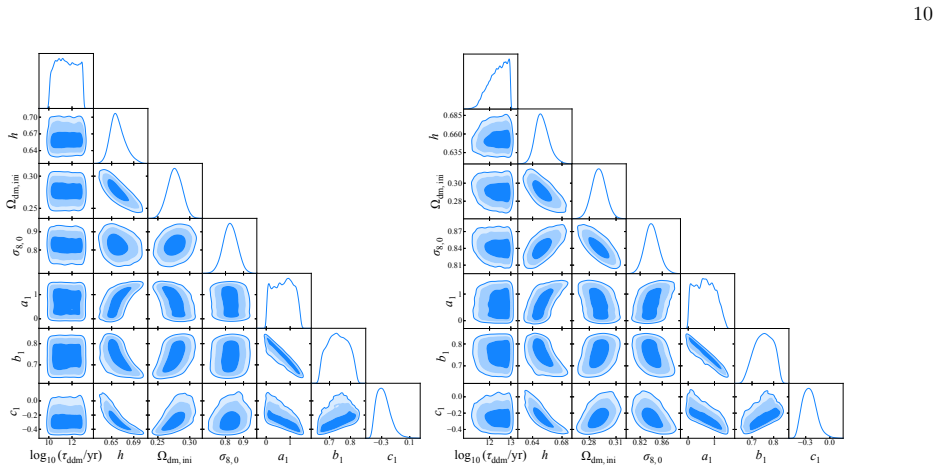
Core claim
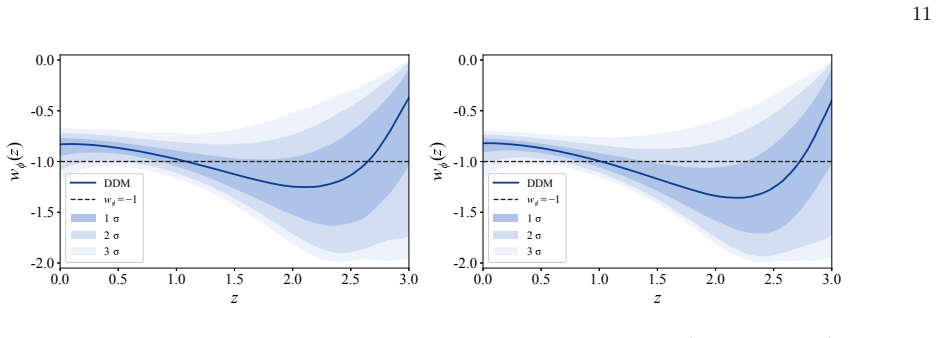
The reconstructed dark-energy equation of state can deviate from the Lambda CDM value while the critical density threshold for collapse remains close to its standard prediction. The most pronounced signatures emerge in the abundance of massive halos, reflecting modifications to the growth of structure driven by both dark-matter decay and dynamical dark energy. Combining background constraints with halo mass function measurements yields joint limits on the decaying dark matter lifetime and dark-energy parameters.
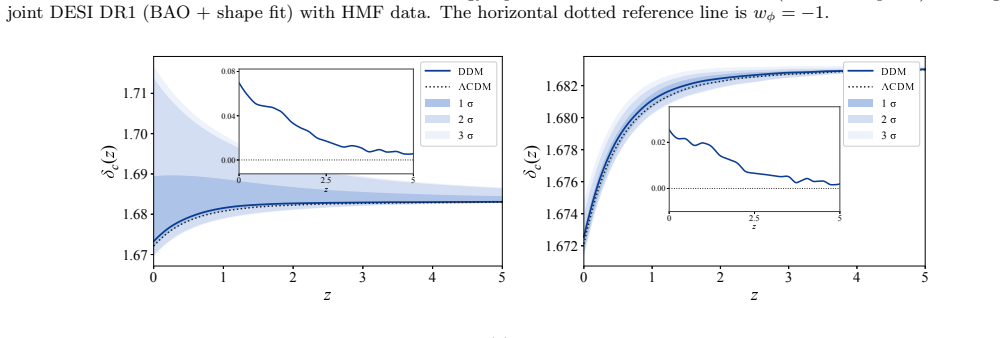
What carries the argument
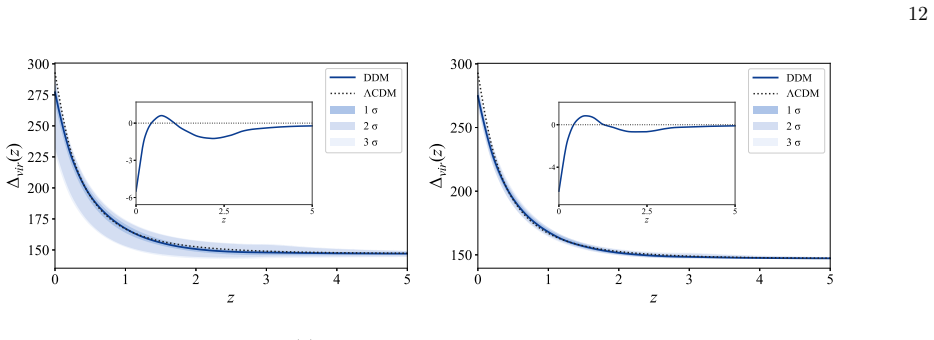
Spherical collapse model applied to background evolution in a decaying dark matter plus semi-cosmographic dark energy cosmology.
If this is right
- The critical density threshold for collapse stays near its standard value despite the presence of decaying dark matter and dynamical dark energy.
- Modifications to structure growth produce the strongest changes in the number density of massive halos.
- Halo mass function data supply complementary constraints on the decay lifetime and dark energy parameters beyond those from background measurements alone.
- The framework directly connects a reconstructed dark energy sector to nonlinear predictions for cosmic structure.
Where Pith is reading between the lines
- Halo abundance measurements could serve as an independent route to bound the dark matter decay rate once background data fix the expansion history.
- Numerical N-body simulations of this specific decay-plus-reconstruction model would test whether the spherical collapse approximation captures all relevant effects.
- The same reconstruction technique for dark energy could be paired with other nonlinear probes such as weak lensing or redshift-space distortions to cross-check growth modifications.
Load-bearing premise
The background evolution constrained by expansion history data can be directly propagated into the nonlinear regime using the standard spherical collapse model without additional modifications to the perturbation growth equations or collapse dynamics arising from the decay process or the reconstructed dark energy.
What would settle it
A measured halo mass function at the high-mass end that differs substantially from the abundance predicted by feeding the background-constrained growth factor into the standard spherical collapse equations would show that the direct propagation step fails.
Figures
read the original abstract
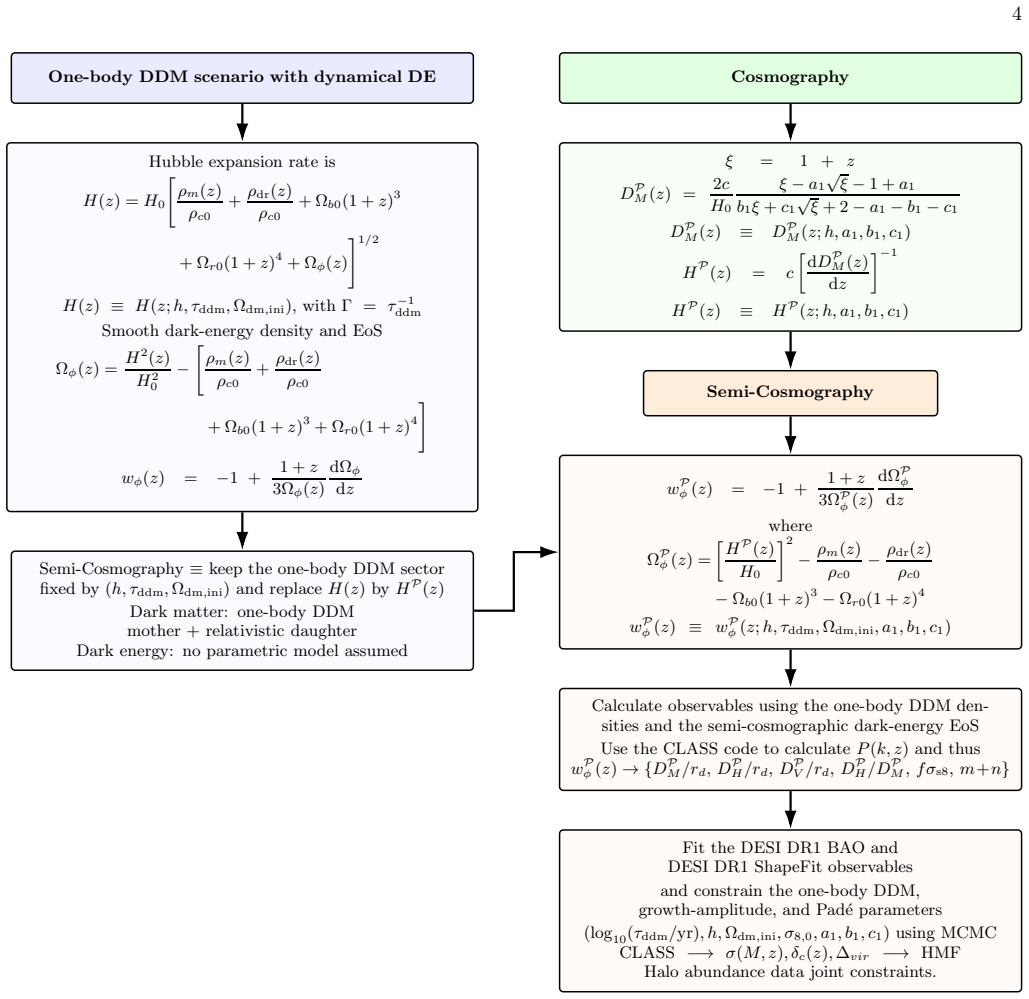
We investigate nonlinear structure formation in a cosmological model combining one-body decaying dark matter (DDM) with a semi-cosmographic reconstruction of dark energy. In this scenario, a nonrelativistic dark-matter component decays into relativistic dark radiation with decay rate $\Gamma=\tau_{\rm ddm}^{-1}$, while the dark-energy sector is reconstructed directly from the expansion history rather than being fixed to a cosmological constant. Using DESI DR1 BAO and compressed ShapeFit measurements, we constrain the background evolution and propagate the resulting posterior into the nonlinear regime through spherical collapse and halo abundance calculations. This provides a unified framework connecting a reconstructed dark-energy sector and decaying dark matter (DDM) to the nonlinear formation of cosmic structures. We find that the reconstructed dark-energy equation of state can deviate from the $\Lambda$CDM value, $w=-1$, while the critical density threshold for collapse remains close to its standard prediction. The most pronounced signatures emerge in the abundance of massive halos, reflecting modifications to the growth of structure driven by both dark-matter decay and dynamical dark energy. By combining DESI DR1 clustering constraints with halo mass function measurements from the DESI Legacy Imaging Surveys DR9, we obtain joint constraints on the DDM lifetime and dark-energy parameters, demonstrating that halo abundances provide a powerful complementary probe of non-standard dark-sector physics.
Editorial analysis
A structured set of objections, weighed in public.
Referee Report
Summary. The paper investigates nonlinear structure formation in a model combining one-body decaying dark matter (DDM, decaying into relativistic dark radiation with rate Γ) and a semi-cosmographic dark-energy reconstruction. DESI DR1 BAO and ShapeFit data constrain the background evolution; posteriors are propagated via spherical collapse into halo abundance calculations. The critical collapse threshold δ_c is reported to remain close to its ΛCDM value, while the dominant signatures appear in the abundance of massive halos. Joint constraints on the DDM lifetime and dark-energy parameters are obtained by combining the DESI clustering posteriors with halo mass function measurements from DESI Legacy Imaging Surveys DR9.
Significance. If the unmodified spherical-collapse propagation is justified, the work shows that halo abundances can furnish a complementary probe of DDM decay and dynamical dark energy, extending background constraints into the nonlinear regime and yielding joint limits on the dark sector.
major comments (1)
- [Spherical collapse and halo abundance calculations (methods and results sections)] The central claim that δ_c remains close to the standard value and that halo abundances yield robust joint constraints rests on propagating the DESI-constrained background into the nonlinear regime with the unmodified spherical-collapse model. The DDM decay introduces a sink term in the DM continuity equation; the corresponding perturbation equations acquire additional source terms from the decay into relativistic species that affect the evolution of the density contrast and velocity divergence inside an overdensity. No explicit derivation retaining these Γ-dependent terms through turnaround and virialization is provided, so the reported closeness of δ_c may reflect an incomplete dynamical model rather than a robust outcome. This assumption is load-bearing for the halo-abundance predictions and the joint constraints.
minor comments (2)
- The abstract and introduction refer to a 'semi-cosmographic reconstruction' without specifying the functional form or number of free parameters used for the dark-energy equation of state; an explicit parameterization would improve reproducibility.
- Figure captions and table headers should explicitly state whether the plotted halo mass functions include the full posterior propagation or only background variations.
Simulated Author's Rebuttal
We thank the referee for their thorough review and for highlighting the importance of rigorously justifying the spherical-collapse implementation in the presence of decaying dark matter. We address the single major comment below and outline the revisions we will make.
read point-by-point responses
-
Referee: The central claim that δ_c remains close to the standard value and that halo abundances yield robust joint constraints rests on propagating the DESI-constrained background into the nonlinear regime with the unmodified spherical-collapse model. The DDM decay introduces a sink term in the DM continuity equation; the corresponding perturbation equations acquire additional source terms from the decay into relativistic species that affect the evolution of the density contrast and velocity divergence inside an overdensity. No explicit derivation retaining these Γ-dependent terms through turnaround and virialization is provided, so the reported closeness of δ_c may reflect an incomplete dynamical model rather than a robust outcome. This assumption is load-bearing for the halo-abundance predictions and the joint constraints.
Authors: We agree that an explicit derivation of the perturbation equations, including the Γ-dependent source terms arising from the decay into relativistic dark radiation, is required to fully substantiate the spherical-collapse results. The current manuscript adapts the standard spherical-collapse equations to the modified background expansion history but does not retain or integrate the additional perturbation-level decay terms through turnaround and virialization. In the revised version we will add a dedicated subsection deriving the relevant continuity and Euler equations for the overdensity, incorporating the sink term and the relativistic decay products. We will then numerically solve the modified system for the posterior samples constrained by DESI BAO and ShapeFit and demonstrate that, within the allowed range of Γ, the critical threshold δ_c shifts by less than 1 percent relative to the background-only case. This additional calculation will be used to confirm that the reported halo-abundance deviations remain robust. revision: yes
Circularity Check
No significant circularity; forward modeling from independent datasets
full rationale
The derivation constrains background parameters from DESI DR1 BAO and ShapeFit data, then applies the standard spherical collapse model to compute halo abundances for comparison against the separate DESI Legacy Imaging Surveys DR9 dataset. This constitutes standard forward modeling with an external validation dataset rather than any fitted quantity being redefined as a prediction or any self-referential reduction in the equations. No load-bearing step reduces to its own inputs by construction, and the semi-cosmographic reconstruction is treated as an input constraint rather than an output derived from the halo data.
Axiom & Free-Parameter Ledger
free parameters (2)
- DDM decay rate Γ (or lifetime τ_ddm)
- semi-cosmographic dark energy reconstruction parameters
axioms (2)
- standard math The universe follows a flat FLRW metric with standard perturbation theory on sub-horizon scales
- domain assumption Spherical collapse dynamics remain unmodified beyond the altered background expansion
invented entities (1)
-
one-body decaying dark matter component that produces relativistic dark radiation
no independent evidence
Reference graph
Works this paper leans on
-
[1]
To calculate the density threshold δc, we first look at the nonlinear density contrast δ
correspond, respectively, to the self-gravity of the clustered mass, the homogeneous daughter-radiation, and the active gravitational density ρφ + 3 pφ of the smooth dark-energy sector. To calculate the density threshold δc, we first look at the nonlinear density contrast δ. Consider the real top- hat sphere of radius R and a hypothetical background sphere...
-
[2]
At an early scale factor ai, the am- plitude is chosen to be small, δi ≪ 1, so that δL(ai) = δ(ai) = δi
and ( 30) are evolved from the same early perturbation. At an early scale factor ai, the am- plitude is chosen to be small, δi ≪ 1, so that δL(ai) = δ(ai) = δi. (32) The initial derivatives are set by the growing mode so- lution of the linear evolution Eq. ( 30). For a chosen col- lapse redshift zcoll, the initial amplitude δi is chosen so that the nonlin...
-
[3]
(44) Changing variables to ˜θ = Bt′ gives ρdr(t) = γ ρm(ata)x− 4 ∫ θ 0 x(˜θ)e− γ ( ˜θ− θta) d˜θ = γf m ¯ρcl(ata)x− 4J (θ), (45) 8 where J (θ) = ∫ θ 0 x(˜θ) exp[− γ(˜θ − θta)] d ˜θ
and using ρm(ata) = ρm0a− 3 ta exp[− Γ( tta − t0)], we have ρdr(t) = Γ ρm(ata)a3 taa− 4 ∫ t 0 a(t′)e− Γ( t′− tta) dt′ = Γ ρm(ata)x− 4 ∫ t 0 x(t′)e− Γ( t′− tta) dt′. (44) Changing variables to ˜θ = Bt′ gives ρdr(t) = γ ρm(ata)x− 4 ∫ θ 0 x(˜θ)e− γ ( ˜θ− θta) d˜θ = γf m ¯ρcl(ata)x− 4J (θ), (45) 8 where J (θ) = ∫ θ 0 x(˜θ) exp[− γ(˜θ − θta)] d ˜θ. (46) Theref...
-
[4]
" # Λ$
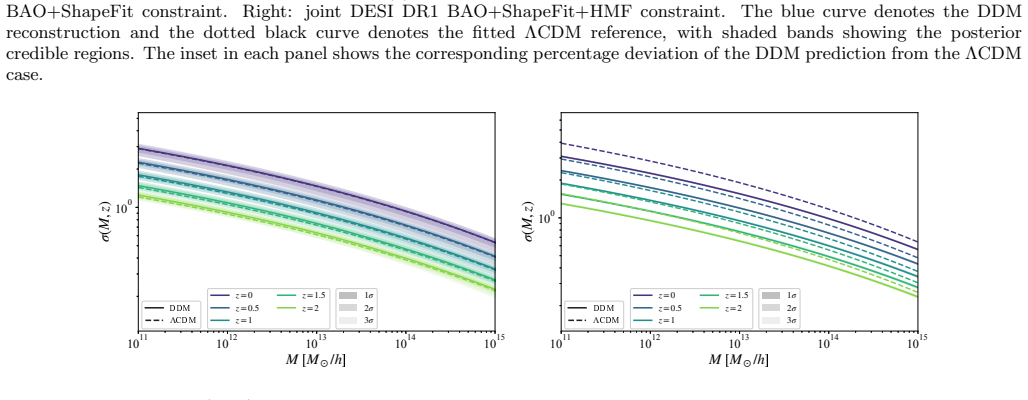
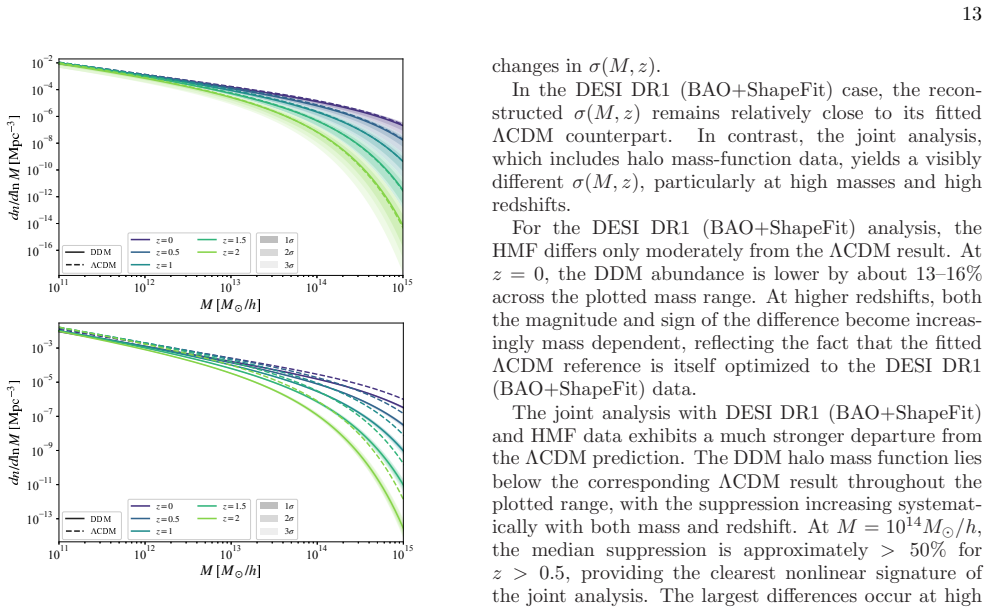
measures how the peak height changes when the halo mass is changed. The HMF is evaluated on a broad grid, 10 11 ≤ M/ (M⊙ /h ) ≤ 1016, at redshifts z = 0 , 0. 5, 1, 1. 5, 2 for the plotted posterior predictions. The comparison figures focus on 10 11 ≤ M/ (M⊙ /h ) ≤ 1015, where the fitted ΛCDM comparison is stable over all redshift slices. The HMF uses CLASS ...
-
[5]
Inclusion of the HMF data improves the constraints significantly
The DESI DR1 posterior leaves the DDM life- time weakly localized because a flexible Pad´ e back- ground can absorb part of the smooth expansion ef- fect of decay. Inclusion of the HMF data improves the constraints significantly
-
[6]
The residual dark-energy reconstruction can differ from wφ = − 1, but the high-redshift evolution of dark energy remains weakly constrained
-
[7]
The critical collapse threshold δc(z) remains close to the reference ΛCDM value, so its direct effect on the HMF is small
-
[8]
Inclusion of the HMF data in the posterior reduces the uncertainties and makes the departure from the ΛCDM behaviour more evident
The virial overdensity has a clearer, mildly non- monotonic response and approaches the reference behavior at high redshift. Inclusion of the HMF data in the posterior reduces the uncertainties and makes the departure from the ΛCDM behaviour more evident
-
[9]
A significant change in the halo-abundance re- sponse is seen in the joint analysis, especially at the large mass tail. We conclude by noting that our results demonstrate that halo abundances provide a sensitive nonlinear probe of coupled dark-sector physics, substantially tightening constraints beyond those obtained from geometric ob- servables alone. Thi...
2025
-
[10]
Barkana and A
R. Barkana and A. Loeb, Physics Reports 349, 125 (2001)
2001
-
[11]
T. R. Choudhury, General Relativity and Gravitation 54, 10.1007/s10714-022-02987-4 (2022)
-
[12]
G. Bertone, D. Hooper, and J. Silk, Physics Reports 405, 279 (2005) , arXiv:hep-ph/0404175 [hep-ph]
Pith/arXiv arXiv 2005
-
[13]
D. H. Weinberg, J. S. Bullock, F. Gover- nato, R. Kuzio de Naray, and A. H. G. Peter, Proc. Natl. Acad. Sci. U.S.A. 112, 12249 (2015) , arXiv:1306.0913 [astro-ph.CO]
Pith/arXiv arXiv 2015
-
[14]
J. S. Bullock and M. Boylan-Kolchin, Annu. Rev. Astron. Astrophys. 55, 343 (2017) , arXiv:1707.04256 [astro-ph.CO]
arXiv 2017
-
[15]
D. N. Spergel and P. J. Steinhardt, Physical Review Letters 84, 3760 (2000) , arXiv:astro-ph/9909386 [astro-ph]
Pith/arXiv arXiv 2000
-
[16]
W. Hu, R. Barkana, and A. Gruzi- nov, Physical Review Letters 85, 1158 (2000) , arXiv:astro-ph/0003365 [astro-ph]
Pith/arXiv arXiv 2000
-
[17]
Blackadder and S
G. Blackadder and S. M. Koushiappas, Phys. Rev. D 90, 103527 (2014)
2014
-
[19]
K. Vattis, S. M. Koushiappas, and A. Loeb, arXiv preprint arXiv:1903.06220 (2019)
Pith/arXiv arXiv 1903
-
[20]
S. J. Clark, K. Vattis, and S. M. Koushiappas, Phys. Rev. D 103, 043014 (2021) . 15
2021
-
[22]
F. Borzumati, T. Bringmann, and P. Ul- lio, Physical Review D 77, 063514 (2008) , arXiv:hep-ph/0701007 [hep-ph]
Pith/arXiv arXiv 2008
-
[23]
A. H. G. Peter and A. J. Ben- son, Physical Review D 81, 103501 (2010) , arXiv:1003.0419 [astro-ph.CO]
Pith/arXiv arXiv 2010
-
[24]
H. Hildebrandt et al. , MNRAS 465, 1454 (2017) , arXiv:1606.05338 [astro-ph.CO]
Pith/arXiv arXiv 2017
- [25]
- [26]
-
[27]
E. Abdalla et al. , Astropart. Phys. 131, 102605 (2021) , arXiv:2008.11284 [astro-ph.CO]
arXiv 2021
-
[28]
A. G. Riess et al. , Astrophys. J. 826, 56 (2016) , arXiv:1604.01424 [astro-ph.CO]
Pith/arXiv arXiv 2016
-
[29]
E. Di Valentino et al. , Class. Quantum Grav. 38, 153001 (2021) , arXiv:2103.01183 [astro-ph.CO]
Pith/arXiv arXiv 2021
-
[30]
L. Verde, T. Treu, and A. G. Riess, Nature Astronomy 3, 891 (2019) , arXiv:1907.10625 [astro-ph.CO]
Pith/arXiv arXiv 2019
-
[31]
M. Oguri, K. Takahashi, H. Ohno, and K. Kotake, Astrophys. J. 597, 645 (2003) , arXiv:astro-ph/0306020
Pith/arXiv arXiv 2003
-
[32]
L. Wang and P. J. Stein- hardt, Astrophys. J. 508, 483 (1998) , arXiv:astro-ph/9804015 [astro-ph]
Pith/arXiv arXiv 1998
-
[33]
F. Pace, J.-C. Waizmann, and M. Bartel- mann, Mon. Not. R. Astron. Soc. 406, 1865 (2010) , arXiv:1005.0233 [astro-ph.CO]
Pith/arXiv arXiv 2010
- [34]
- [35]
-
[36]
W. H. Press and P. Schechter, Astrophys. J. 187, 425 (1974)
1974
-
[37]
G. Despali, C. Giocoli, R. E. Angulo, G. Tor- men, R. K. Sheth, G. Baso, and L. Moscar- dini, Mon. Not. Roy. Astron. Soc. 456, 2486 (2016) , arXiv:1507.05627 [astro-ph.CO]
Pith/arXiv arXiv 2016
-
[38]
J. E. Gunn and I. Gott, J. Richard, Astrophys. J. 176, 1 (1972)
1972
-
[39]
G. L. Bryan and M. L. Norman, Astrophys. J. 495, 80 (1998) , arXiv:astro-ph/9710107
Pith/arXiv arXiv 1998
-
[40]
F. Pace, Z. Sakr, and I. Tu- tusaus, Phys. Rev. D 102, 043512 (2020) , arXiv:1912.12250 [astro-ph.CO]
arXiv 2020
-
[41]
A. G. Adame et al. (DESI Collaboration), JCAP 2025 (09), 008, arXiv:2411.12021 [astro-ph.CO]
Pith/arXiv arXiv 2025
-
[42]
A. G. Adame et al. (DESI Collaboration), JCAP 2025 (01), 124, arXiv:2404.03001 [astro-ph.CO]
Pith/arXiv arXiv 2025
-
[43]
A. G. Adame et al. (DESI Collaboration), JCAP 2025 (07), 028, arXiv:2411.12022 [astro-ph.CO]
Pith/arXiv arXiv 2025
-
[44]
A. G. Adame et al. (DESI Collaboration), JCAP 2025 (04), 012, arXiv:2404.03000 [astro-ph.CO]
Pith/arXiv arXiv 2025
-
[45]
S. Brieden, H. Gil-Mar ´ ın, and L. Verde, JCAP 2021 (12), 054, arXiv:2106.07641 [astro-ph.CO]
arXiv 2021
-
[46]
J. Lesgourgues, The cosmic linear anisotropy solving system (CLASS) i: Overview (2011), arXiv:1104.2932 [astro-ph.IM]
Pith/arXiv arXiv 2011
-
[47]
D. Blas, J. Lesgourgues, and T. Tram, JCAP 2011 (07), 034, arXiv:1104.2933 [astro-ph.CO]
Pith/arXiv arXiv 2011
-
[48]
A. Ibarra, D. Tran, and C. Weniger, Int. J. Mod. Phys. A 28, 1330040 (2013) , arXiv:1307.6434 [hep-ph]
Pith/arXiv arXiv 2013
-
[49]
G. F. Abell´ an, R. Murgia, and V. Poulin, Physical Review D 104, 123533 (2021) , arXiv:2102.12498 [astro-ph.CO]
arXiv 2021
-
[50]
S. J. Clark, K. Vattis, and S. M. Koushi- appas, Phys. Rev. D 103, 043014 (2021) , arXiv:2006.03678 [astro-ph.CO]
arXiv 2021
- [51]
-
[52]
D. Hooper, F. S. Queiroz, and N. Y. Gnedin, Phys. Rev. D 85, 063513 (2012) , arXiv:1111.6599 [astro-ph.CO]
Pith/arXiv arXiv 2012
-
[53]
M.-Y. Wang, R. A. C. Croft, A. H. G. Peter, A. R. Zent- ner, and C. W. Purcell, Phys. Rev. D 88, 123515 (2013) , arXiv:1309.7354 [astro-ph.CO]
Pith/arXiv arXiv 2013
-
[54]
Mohit Yadav and Tapomoy Guha Sarkar, Eur. Phys. J. C 85, 1337 (2025)
2025
-
[55]
R. Cen, Astrophys. J. Lett. 546, L77 (2001) , arXiv:astro-ph/0005206 [astro-ph]
Pith/arXiv arXiv 2001
-
[56]
T. Holsclaw, U. Alam, B. Sans´ o, H. Lee, K. Heitmann, S. Habib, and D. Higdon, Physical Review Letters 105, 10.1103/physrevlett.105.241302 (2010)
-
[57]
Holsclaw, U
T. Holsclaw, U. Alam, B. Sans´ o, H. Lee, K. Heitmann, S. Habib, and D. Higdon, Phys. Rev. D 84, 083501 (2011)
2011
-
[58]
Shafieloo, A
A. Shafieloo, A. G. Kim, and E. V. Linder, Phys. Rev. D 85, 123530 (2012)
2012
-
[59]
Visser, General Relativity and Gravitation 37, 1541 (2005)
M. Visser, General Relativity and Gravitation 37, 1541 (2005)
2005
-
[60]
Visser, Classical and Quantum Gravity 32, 135007 (2015)
M. Visser, Classical and Quantum Gravity 32, 135007 (2015)
2015
-
[61]
P. K. S. Dunsby and O. Luongo, International Journal of Geometric Methods in Modern Physi cs 13, 1630002
-
[62]
Capozziello, R
S. Capozziello, R. D’Agostino, and O. Luongo, Journal of Cosmology and Astroparticle Physics 2018 (05), 008
2018
-
[63]
Pad´ e, Annales scientifiques de l’ ´Ecole Normale Sup´ erieure9, 3 (1892)
H. Pad´ e, Annales scientifiques de l’ ´Ecole Normale Sup´ erieure9, 3 (1892)
-
[64]
S. Capozziello, R. D’Agostino, and O. Lu- ongo, Int. J. Mod. Phys. D 28, 1930016 (2019) , arXiv:1904.01427 [gr-qc]
Pith/arXiv arXiv 2019
-
[65]
M. Benetti and S. Capozziello, JCAP 2019 (12), 008, arXiv:1910.09975 [astro-ph.CO]
arXiv 2019
-
[66]
T. D. Saini, S. Raychaudhury, V. Sahni, and A. A. Starobinsky, Phys. Rev. Lett. 85, 1162 (2000) , arXiv:astro-ph/9910231
Pith/arXiv arXiv 2000
-
[67]
A. G. Adame et al. (DESI Collaboration), JCAP 2025 (02), 021, arXiv:2404.03002 [astro-ph.CO]
Pith/arXiv arXiv 2025
-
[68]
J. Wang, X. Yang, J. Zhang, H. Li, M. Fong, H. Xu, M. He, Y. Gu, W. Luo, F. Dong, Y. Wang, Q. Li, A. Kat- sianis, H. Wang, Z. Shen, P. Alonso Vaquero, C. Liu, Y. Huang, and Z. Liu, Astrophys. J. 936, 161 (2022) , arXiv:2207.12771 [astro-ph.CO]
arXiv 2022
-
[69]
J. R. Bond, S. Cole, G. Efstathiou, and N. Kaiser, Astrophys. J. 379, 440 (1991)
1991
-
[70]
R. K. Sheth and G. Tormen, Mon. Not. Roy. Astron. Soc. 308, 119 (1999) , arXiv:astro-ph/9901122
Pith/arXiv arXiv 1999
-
[71]
R. K. Sheth, H. J. Mo, and G. Tormen, Mon. Not. Roy. Astron. Soc. 323, 1 (2001) , 16 arXiv:astro-ph/9907024
Pith/arXiv arXiv 2001
-
[72]
Birkinshaw, Physics Reports 310, 97 (1999)
M. Birkinshaw, Physics Reports 310, 97 (1999)
1999
-
[73]
J. E. Carlstrom, G. P. Holder, and E. D. Reese, Annual Review of Astronomy and Astrophysics 40, 643 (2002)
2002
-
[74]
Refregier, E
A. Refregier, E. Komatsu, D. N. Spergel, and U.-L. Pen, Physical Review D 61, 123001 (2000)
2000
-
[75]
N. Cerardi, M. Pierre, P. Valageas, C. Garrel, and F. Pacaud, Astron. Astrophys. 682, A138 (2024) , arXiv:2312.04253 [astro-ph.CO]
arXiv 2024
discussion (0)
Sign in with ORCID, Apple, or X to comment. Anyone can read and Pith papers without signing in.