REVIEW 3 major objections 5 minor 54 references
Topology of Shape and Data in Material Microstructures
T0 review · 3 major / 5 minor · reviewed 2026-08-01 · deepseek-v4-flash
Pith's one-line read A scalar bipersistence summary I, integrating Betti-1 counts over a shape-distance and spatial-scale filtration, sharply distinguishes low- from high-strain ice microstructures and detects onset of dynamic recrystallization.
desk verdict Promising TDA+SST framework, but the headline scalar summary is likely confounded by grain density; needs null models and normalization before the claims hold. read the letter →
The pith
A machine-rendered reading of the paper's core claim, the machinery that carries it, and where it could break.
The reading
What carries the argument
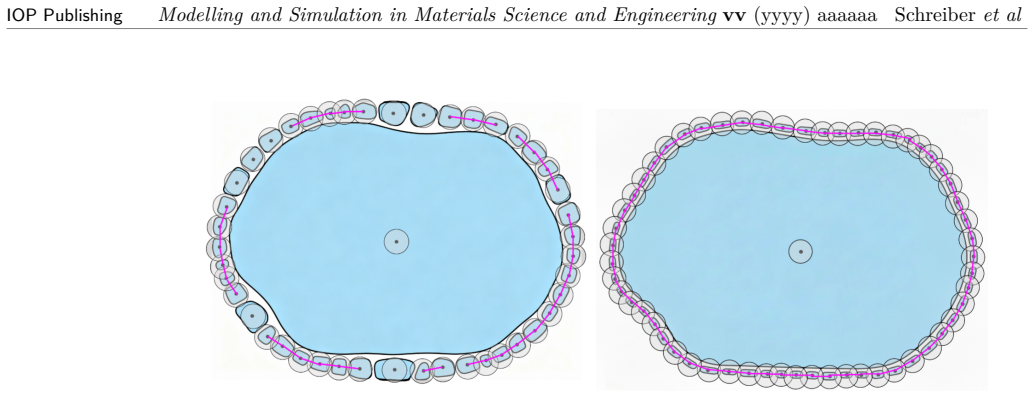
The central object is the sublevel Rips bifiltration S↑_{ε,ℓ} = φ^{-1}((-∞,ℓ]) ∩ Rips(ε), built on grain centroids, where φ is the distance of each grain's separable shape tensor from the intrinsic mean on the product manifold Gr(d,q) × S^d_{++}. The first parameter ε is the Rips radius controlling spatial connectivity; the second ℓ is a shape-distance threshold selecting grains similar to the mean. Tracking Betti-1 counts β1(ε,ℓ) across the two-parameter grid, and integrating them to define I = ∫∫ β1 dε dℓ, converts the spatial pattern of similar-shaped grains into a single number. The key mechanism is that a ring of fine grains surrounding a coarse grain completes a 1-cycle at relatively s
What would settle it
Take each ice-sample scan, keep the same number of grain centroids and the same image domain, but place the centroids uniformly at random (or as a Poisson process) with the observed shape-distance values assigned to them; compute the same bifiltration and I. If the sharp jump in I between 8% and 12% strain largely persists under random placement, the measure is tracking density or domain effects rather than ring topology; if the jump disappears, the necklace interpretation is supported.
Extended reading notes
Core claim
The central claim is that a bifiltration combining spatial Rips complexes with shape-distance sublevel sets — using the separable shape-tensor distance from the intrinsic mean as the second parameter — turns the heuristic notion of necklacing into a measurable topological signature: a plateau of elevated Betti-1 counts over a range of spatial scales, visible as an island in the (ε, ℓ) contour map. The scalar I = ∫∫ β1(ε,ℓ) dε dℓ accumulates this persistence and increases monotonically with strain, with a sharp transition between 8% and 12% strain that the authors identify with the onset of dynamic recrystallization as the dominant grain-refinement mechanism. The authors further argue that th
Load-bearing premise
The key load-bearing premise is that the scalar I captures necklace topology rather than merely reflecting the number of grain centroids: the grain count roughly doubles over the same 8%–12% strain range where I jumps, and the paper does not control for point density in its summary.
Editorial extensions
If this is right
- Necklacing and other duplex grain arrangements can be assigned a quantitative scalar I, or region-specific integrals, providing a basis for ordering or clustering microstructure samples without manual grading.
- Because the construction uses only grain centroids and shape distances, it can be applied to metals, ceramics, and composites imaged by EBSD or optical microscopy, where standard test methods currently rely on qualitative pattern descriptions.
- The sharp rise in I between 8% and 12% strain localizes the strain range in which dynamic recrystallization becomes the dominant grain-refinement mechanism, offering a quantitative fingerprint of processing history.
- Region-restricted integrals of β1 can be tuned to isolate specific topological patterns — necklacing, banding, duplex distributions — allowing standards to be extended with quantitative pattern-specific measures.
- The scalar I and bifiltration surfaces can serve as reduced-order inputs or calibration targets for phase-field and cellular automata simulations of grain growth and recrystallization.
Reading between the lines
- The paper does not normalize β1 or I by the number of grain centroids; since Rips Betti numbers grow with point count, a comparison against random point configurations matched for count and domain would clarify whether I measures ring topology or simply grain density. (Editorial extension.)
- If the necklace plateau is the mechanistic signature, the same bifiltration could be used to detect percolation-like transitions in other spatial networks where a second attribute (shape, intensity, orientation) conditions connectivity.
- The shape-distance axis could be replaced by other grain attributes — orientation, phase, or local misorientation — yielding bifiltrations tuned to different microstructural patterns, such as banding or clustering by crystallographic orientation.
- A natural testable extension is to normalize I by the integral over a null ensemble of Poisson-distributed centroids; the strain transition's persistence under this normalization would separate topology from density effects.
Editorial analysis
A structured set of objections, weighed in public.
Referee Report
Summary. The paper proposes a dual-parameter topological summary for microstructure images: a Rips bifiltration on grain centroids with a second axis given by sublevel sets of a Separable Shape Tensor (SST) shape distance from an intrinsic mean. It defines a scalar I as the double integral of the Betti-1 count over the two-parameter domain (Eq. 3). The method is demonstrated on four EBSD ice samples strained from 0.03 to 0.20. The central claim (Sections 1.2, 4.1, Fig. 12) is that I reveals a sharp transition in topological texture between 8% and 12% strain, coinciding with the onset of dynamic recrystallization and necklacing as described in ASTM E1181.
Significance. If the empirical claim were established, the framework would be a meaningful contribution: it combines shape and spatial arrangement in one interpretable summary, with no labels or threshold choices. The construction of the two-parameter filtration from SST distances is original and clearly explained, and the paper is generally readable. However, the demonstration is too weak to support the headline result: only four strain levels with one image each are used, no uncertainty quantification is provided, and the key scalar is not separated from a known confound with grain centroid density. As it stands, I is not a validated measure of necklacing topology.
major comments (3)
- [Section 4.1, Fig. 12, Eq. (3)] The central claim that I measures topological texture is confounded by grain count. I is a double integral of β1 over a Rips filtration on grain centroids. For any stationary point process, expected β1 is proportional to intensity; doubling the number of centroids roughly doubles I even if the spatial pattern is unchanged. The paper itself cites Fan et al. [42] reporting that grain number density more than doubles between 8% and 12% strain, exactly where I jumps. No normalization by grain count, no comparison with randomized configurations of the same N, and no spatial thinning are provided. The observed rise in I is therefore equally consistent with a density effect, and the claim of a topological transition is unsupported.
- [Section 4.1, Fig. 12] The statistical evidence is very limited. Only one EBSD scan is used per strain level, so Figure 12 has four points and no error bars. The 'sharp transition' rests on a comparison of one image at 8% and one at 12%. The 'plateau' between 12% and 20% also rests on two points. To support the monotonic trend and the location of a transition, the authors need replicated scans, bootstrap over subregions, or at least a statement of measurement uncertainty; otherwise the scalar I cannot be distinguished from sample-to-sample variation.
- [Section 2.1, Fig. 5; Section 4.1] The identification of β1 cycles with necklacing is not validated. The idealized Figure 5 shows one mechanism by which rings of fine grains create persistent holes, but Rips complexes on random point clouds also produce β1, especially as density increases. The paper provides no synthetic experiments with known necklace versus random arrangements at matched density. Consequently, the mechanistic interpretation in Section 4.1 (core-and-mantle structure, saturation of necklace topology) and the stronger claim in Section 5 that I is a 'direct, quantitative proxy' for creep and ductility are not supported by the evidence presented.
minor comments (5)
- [General/typos] Typos: 'difficult' (Section 1), 'recrystalization' and 'bewteen' (Section 4.1). Please proofread.
- [Eq. (1), Section 2.2] The dimensions in the product manifold Gr(d,q) × S^d_++ and the role of the low-dimensional submanifold principal directions are not fully defined. Since a,b,d and the number of principal directions are user choices, a sensitivity study or explicit default values are needed for reproducibility.
- [Section 5] The authors note that the construction 'may not necessarily reflect standard two-parameter TDA.' This caveat is important and should be moved earlier (e.g., Section 3.1) so that readers do not mistake the scalar I for a multiparameter persistence invariant such as a rank invariant.
- [Figure 7] The histograms are not clearly captioned; it is difficult to read which distance is plotted in each panel. Please label directly.
- [Reproducibility] Javaplex and public data are cited, but the grid resolution used for the bifiltration, the weights a,b in Eq. (1), and the SST rank d are not reported. For a methods paper, this information should be given so the scalar I can be reproduced.
Circularity Check
No significant circularity: I is a defined summary statistic, not a fitted prediction, and the SST self-citations are not load-bearing.
full rationale
The derivation chain is explicit: SST shape distance (Eq. 1) feeds a sublevel Rips bifiltration (Eq. 2), whose Betti-1 counts are integrated to form I (Eq. 3). I is therefore a direct integral of computed β1 values, not a parameter fitted to the strain trend. The only empirically chosen parameters are the weights a and b in Eq. (1), which the paper states are 'selected empirically to normalize distances for the purposes of combining their distinct value ranges'; they are not tuned to reproduce the strain response or Fan et al.'s observations. The reported monotone increase and sharp rise in I (Fig. 12) is an observed output, not a fitted input renamed as a prediction. The SST machinery is taken from the authors' prior work ([33], [34]), but the paper does not invoke a self-cited uniqueness theorem, and it explicitly says in Section 5 that 'Alternate shape distances, such as those induced by elastic, information-geometric, or kernel-based metrics, may be substituted when required by the application.' Thus the self-citations are not load-bearing. The identification of necklacing with elevated β1 is an externally grounded modeling assumption tied to ASTM E1181's qualitative 'rings of significantly finer grains' definition, not a conclusion defined into existence. The most substantive criticism—that β1 in a Rips complex grows with point count and that Fan et al. report grain number density more than doubling in the 8–12% strain window—is a real statistical confound for the empirical claim, but it is not circularity under the stated definitions: I is not constructed from, or fitted to, Fan et al.'s density values, and no equation makes the claimed transition equal to an input. That concern belongs in a correctness/statistical-validity review, not in the circularity score.
Assumptions & free parameters
free parameters (4)
- a,b (SST product metric weights) =
not stated
- SST rank d =
not stated
- Submanifold principal-direction count =
not stated
- Bifiltration grid resolution =
not stated
assumptions (4)
- standard math Rips–Vietoris filtration on Euclidean point clouds gives valid persistence intervals
- domain assumption SST product manifold Gr(d,q) × S^d_{++} with Fréchet mean and log-map distances is a faithful shape representation
- domain assumption Grain centroids and Euclidean distance adequately represent spatial arrangement for detecting necklace loops
- standard math The sublevel Rips bifiltration S↑(f) is computable and its Betti counts can be summed over the grid
Cite this review
Pith. "Pith review of Topology of Shape and Data in Material Microstructures." pith.science (2026). https://pith.science/paper/J2NRR6D6
@misc{pith2026260727493,
  author       = {Pith},
  title        = {Pith review of: Topology of Shape and Data in Material Microstructures},
  year         = {2026},
  howpublished = {\url{https://pith.science/paper/J2NRR6D6}},
  note         = {Machine review of arXiv:2607.27493}
}
read the original abstract
One of the challenges in microstructure analysis is the rigorous quantification of the shape, size, and spatial arrangement of the microstructure beyond comparison of average values. We expound on formal principles combining Topological Data Analysis (TDA) and non-Euclidean distances between curves to motivate novel perspectives on the form and nature of pattern and shape in images. Specifically, TDA descriptors extracting persistent topological structures are combined with product submanifold learning of separable shape tensors (SST) to offer unique insights about electron backscatter diffraction (EBSD) images of material microstructures through the lens of a dual-parameter filtration. Beyond standard approaches, our methodology highlights how different choices or permutations of shape distances can lead to distinct notions of topological persistence, thereby broadening the interpretive scope of TDA. The resulting visualizations of feature extraction are designed to be both principled and explanatory, offering novel tools for modern imaging science with applications to material metrology. More broadly, this framework has strong potential to impact domains where precise quantification of topology and shape is critical for uncovering fundamental image patterns and features, and enables additional data-driven tools for microstructure analysis.
Figures


Figures from the paper (9 more)



Reference graph
Works this paper leans on
-
[42]
Temperature and strain controls on ice deformation mechanisms: insights from the microstructures of samples deformed to progressively higher strains at- 10,- 20 and- 30° c
Sheng Fan, Travis F Hager, David J Prior, Andrew J Cross, David L Goldsby, Chao Qi, Marianne Negrini, and John Wheeler. Temperature and strain controls on ice deformation mechanisms: insights from the microstructures of samples deformed to progressively higher strains at- 10,- 20 and- 30° c. The Cryosphere , 14(11):3875–3905, 2020
2020
-
[1]
Grey and Paul G
Zachary J. Grey and Paul G. Constantine. Active subspaces of airfoil shape parameterizations. AIAA Journal , 56(5):2003–2017, 2018
2003
-
[2]
Doronina, Zachary J
Olga A. Doronina, Zachary J. Grey, and Andrew Glaws. G2aero: A python package for separable shape tensors. Journal of Open Source Software , 8(89):5408, 2023
2023
-
[3]
Restoration of noisy orientation maps from electron backscatter diffraction imaging
Emmanuel Atindama, Peter Lef, Günay Doğan, and Prashant Athavale. Restoration of noisy orientation maps from electron backscatter diffraction imaging. Integrating Materials and Manufacturing Innovation , 12(3):251–266, 2023
2023
-
[4]
Inferential statistics of electron backscatter diffraction data from within individual crystalline grains
Florian Bachmann, Ralf Hielscher, Peter E Jupp, Wolfgang Pantleon, Helmut Schaeben, and Elias Wegert. Inferential statistics of electron backscatter diffraction data from within individual crystalline grains. Journal of Applied Crystallography , 43(6):1338–1355, 2010. 16 IOP Publishing Modelling and Simulation in Materials Science and Engineering vv (yyyy...
2010
-
[5]
Claire: A distributed-memory solver for constrained large deformation diffeomorphic image registration
Andreas Mang, Amir Gholami, Christos Davatzikos, and George Biros. Claire: A distributed-memory solver for constrained large deformation diffeomorphic image registration. SIAM Journal on Scientific Computing , 41(5):C548–C584, 2019
2019
-
[6]
Morphometry of anatomical shape complexes with dense deformations and sparse parameters
Stanley Durrleman, Marcel Prastawa, Nicolas Charon, Julie R Korenberg, Sarang Joshi, Guido Gerig, and Alain Trouvé. Morphometry of anatomical shape complexes with dense deformations and sparse parameters. NeuroImage, 101:35–49, 2014
2014
-
[7]
Generative models for functional data using phase and amplitude separation
J Derek Tucker, Wei Wu, and Anuj Srivastava. Generative models for functional data using phase and amplitude separation. Computational Statistics & Data Analysis , 61:50–66, 2013
2013
Show all 54 references
-
[8]
Coherence-based underwater target detection from multiple disparate sonar platforms
J Derek Tucker and Mahmood R Azimi-Sadjadi. Coherence-based underwater target detection from multiple disparate sonar platforms. IEEE Journal of Oceanic Engineering , 36(1):37–51, 2011
2011
-
[9]
Elastic shape analysis of surfaces with second-order sobolev metrics: a comprehensive numerical framework
Emmanuel Hartman, Yashil Sukurdeep, Eric Klassen, Nicolas Charon, and Martin Bauer. Elastic shape analysis of surfaces with second-order sobolev metrics: a comprehensive numerical framework. International Journal of Computer Vision , 131(5):1183–1209, 2023
2023
-
[10]
Shape analysis of elastic curves in euclidean spaces
Anuj Srivastava, Eric Klassen, Shantanu H Joshi, and Ian H Jermyn. Shape analysis of elastic curves in euclidean spaces. IEEE transactions on pattern analysis and machine intelligence , 33(7):1415–1428, 2010
2010
-
[11]
Testing equality of cell populations based on shape and geodesic distance
Charles Hagwood, Javier Bernal, Michael Halter, John Elliott, and Tegan Brennan. Testing equality of cell populations based on shape and geodesic distance. IEEE Transactions on Medical Imaging, 32(12):2230–2237, 2013
2013
-
[12]
Phg-net: Persistent homology guided medical image classification
Yaopeng Peng, Hongxiao Wang, Milan Sonka, and Danny Z Chen. Phg-net: Persistent homology guided medical image classification. In Proceedings of the IEEE/CVF Winter Conference on Applications of Computer Vision , pages 7583–7592, 2024
2024
-
[13]
Train-free segmentation in mri with cubical persistent homology
Anton François and Raphaël Tinarrage. Train-free segmentation in mri with cubical persistent homology. arXiv preprint arXiv:2401.01160 , 2024
2024 arXiv
-
[14]
The persistent homology mathematical framework provides enhanced genotype-to-phenotype associations for plant morphology
Mao Li, Margaret H Frank, Viktoriya Coneva, Washington Mio, Daniel H Chitwood, and Christopher N Topp. The persistent homology mathematical framework provides enhanced genotype-to-phenotype associations for plant morphology. Plant physiology , 177(4):1382–1395, 2018
2018
-
[15]
Fast and accurate tumor segmentation of histology images using persistent homology and deep convolutional features
Talha Qaiser, Yee-Wah Tsang, Daiki Taniyama, Naoya Sakamoto, Kazuaki Nakane, David Epstein, and Nasir Rajpoot. Fast and accurate tumor segmentation of histology images using persistent homology and deep convolutional features. Medical image analysis , 55:1–14, 2019
2019
-
[16]
Persistent-homology-based machine learning and its applications–a survey
Chi Seng Pun, Kelin Xia, and Si Xian Lee. Persistent-homology-based machine learning and its applications–a survey. arXiv preprint arXiv:1811.00252 , 2018
2018 arXiv
-
[17]
A topological” reading” lesson: Classification of mnist using tda
Adélie Garin and Guillaume Tauzin. A topological” reading” lesson: Classification of mnist using tda. In 2019 18th IEEE International Conference On Machine Learning And Applications (ICMLA), pages 1551–1556. IEEE, 2019
2019
-
[18]
Noise robustness of persistent homology on greyscale images, across filtrations and signatures
Renata Turkeš, Jannes Nys, Tim Verdonck, and Steven Latré. Noise robustness of persistent homology on greyscale images, across filtrations and signatures. Plos one , 16(9):e0257215, 2021
2021
-
[19]
Electron backscatter diffraction in materials science , volume 2
Adam J Schwartz, Mukul Kumar, Brent L Adams, and David P Field. Electron backscatter diffraction in materials science , volume 2. Springer, 2009
2009
-
[20]
Saville, Sven C
Alec I. Saville, Sven C. Vogel, Adam Creuziger, Jake T. Benzing, Adam L. Pilchak, Peeyush Nandwana, Jonah Klemm-Toole, Kester D. Clarke, S. Lee Semiatin, and Amy J. Clarke. Texture evolution as a function of scan strategy and build height in electron beam melted ti-6al-4v. Add...
2021
-
[21]
Location-specific microstructure characterization within in625 additive manufacturing benchmark test artifacts
Mark R Stoudt, Maureen E Williams, Lyle E Levine, Adam Creuziger, Sandra A Young, Jarred C Heigel, Brandon M Lane, and Thien Q Phan. Location-specific microstructure characterization within in625 additive manufacturing benchmark test artifacts. Integrating Materials and Manufa...
2020
-
[22]
Texture analysis with MTEX–free and open source software toolbox
F Bachmann, Ralf Hielscher, and Helmut Schaeben. Texture analysis with MTEX–free and open source software toolbox. Solid state phenomena , 160:63–68, 2010
2010
-
[23]
Prior, Andrew J
Sheng Fan, David J. Prior, Andrew J. Cross, David L. Goldsby, Travis Hager, Marianne Negrini, and Chao Qi. EBSD data for synthetic polycrystalline pure water ice samples deformed at high homologous temperatures. FigShare, 12 2020
2020
-
[24]
Using grain boundary irregularity to quantify dynamic recrystallization in ice
Sheng Fan, David J Prior, Andrew J Cross, David L Goldsby, Travis F Hager, Marianne Negrini, and Chao Qi. Using grain boundary irregularity to quantify dynamic recrystallization in ice. Acta Materialia , 209:116810, 2021
2021
-
[25]
Hielscher and H
R. Hielscher and H. Schaeben. A novel pole figure inversion method: specification of the MTEX algorithm. Journal of Applied Crystallography , 41(6):1024–1037, Dec 2008
2008
-
[26]
ASTM E1181-02R23: Test Methods for Characterizing Duplex Grain Sizes, 2023
ASTM International. ASTM E1181-02R23: Test Methods for Characterizing Duplex Grain Sizes, 2023
2023
-
[27]
ASTM E112-24: Test Methods for Determining A verage Grain Size, 2024
ASTM International. ASTM E112-24: Test Methods for Determining A verage Grain Size, 2024
2024
-
[28]
ASTM E1382-97R23: Test Methods for Determining A verage Grain Size Using Semiautomatic and Automatic Image Analysis, 2023
ASTM International. ASTM E1382-97R23: Test Methods for Determining A verage Grain Size Using Semiautomatic and Automatic Image Analysis, 2023
2023
-
[29]
ASTM E45-18a:Test Methods for Determining the Inclusion Content of Steel, 2023
ASTM International. ASTM E45-18a:Test Methods for Determining the Inclusion Content of Steel, 2023
2023
-
[30]
ASTM E562-19: Test Method for Determining Volume Fraction by Systematic Manual Point Count, 2019
ASTM International. ASTM E562-19: Test Method for Determining Volume Fraction by Systematic Manual Point Count, 2019
2019
-
[31]
ASTM E1245-03R23: Practice for Determining the Inclusion or Second-Phase Constituent Content of Metals by Automatic Image Analysis, 2023
ASTM International. ASTM E1245-03R23: Practice for Determining the Inclusion or Second-Phase Constituent Content of Metals by Automatic Image Analysis, 2023
2023
-
[32]
Graphs in statistical analysis
Francis J Anscombe. Graphs in statistical analysis. The american statistician , 27(1):17–21, 1973
1973
-
[33]
Separable shape tensors for aerodynamic design
Zachary J Grey, Olga A Doronina, and Andrew Glaws. Separable shape tensors for aerodynamic design. Journal of Computational Design and Engineering , 10(1):468–487, 01 2023
2023
-
[34]
Explainable binary classification of separable shape ensembles
Zachary Grey, Nicholas Fisher, Andrew Glaws, and Gunay Dogan. Explainable binary classification of separable shape ensembles. arXiv preprint arXiv:2410.12994 , 2024
2024
-
[35]
ASTM E930-18: Test Methods for Estimating the Largest Grain Observed in a Metallographic Section (ALA Grain Size), 2018
ASTM International. ASTM E930-18: Test Methods for Estimating the Largest Grain Observed in a Metallographic Section (ALA Grain Size), 2018
2018
-
[36]
Topological data analysis in medical imaging: current state of the art
Yashbir Singh, Colleen M Farrelly, Quincy A Hathaway, Tim Leiner, Jaidip Jagtap, Gunnar E Carlsson, and Bradley J Erickson. Topological data analysis in medical imaging: current state of the art. Insights into Imaging , 14(1):58, 2023
2023
-
[37]
An introduction to multiparameter persistence
Magnus Bakke Botnan and Michael Lesnick. An introduction to multiparameter persistence. arXiv preprint arXiv:2203.14289 , 2022
2022 arXiv
-
[38]
The theory of multidimensional persistence
Gunnar Carlsson and Afra Zomorodian. The theory of multidimensional persistence. In Proceedings of the twenty-third annual symposium on Computational geometry , pages 184–193, 2007
2007
-
[39]
Multiparameter persistent homology landscapes identify immune cell spatial patterns in tumors
Oliver Vipond, Joshua A Bull, Philip S Macklin, Ulrike Tillmann, Christopher W Pugh, Helen M Byrne, and Heather A Harrington. Multiparameter persistent homology landscapes identify immune cell spatial patterns in tumors. Proceedings of the National Academy of Sciences, 118(41)...
2021
-
[40]
A multi-parameter persistence framework for mathematical morphology
Yu-Min Chung, Sarah Day, and Chuan-Shen Hu. A multi-parameter persistence framework for mathematical morphology. Scientific reports, 12(1):6427, 2022
2022
-
[41]
Mix-geneo: A flexible filtration for multiparameter persistent homology detects digital images
Jiaxing He, Bingzhe Hou, Tieru Wu, and Yue Xin. Mix-geneo: A flexible filtration for multiparameter persistent homology detects digital images. arXiv e-prints , pages arXiv–2401, 2024. 18 IOP Publishing Modelling and Simulation in Materials Science and Engineering vv (yyyy) aa...
2024
-
[43]
Computational topology: an introduction
Herbert Edelsbrunner and John L Harer. Computational topology: an introduction . American Mathematical Society, 2022
2022
-
[44]
Topology and data
Gunnar Carlsson. Topology and data. Bulletin of the American Mathematical Society , 46(2):255–308, 2009
2009
-
[45]
Computing persistent homology
Afra Zomorodian and Gunnar Carlsson. Computing persistent homology. In Proceedings of the twentieth annual symposium on Computational geometry , pages 347–356, 2004
2004
-
[46]
Algebraic topology
Allen Hatcher. Algebraic topology. Cambridge Univeristy Press, 2002
2002
-
[47]
Randomness of shapes and statistical inference on shapes via the smooth euler characteristic transform
Kun Meng, Jinyu Wang, Lorin Crawford, and Ani Eloyan. Randomness of shapes and statistical inference on shapes via the smooth euler characteristic transform. Journal of the American Statistical Association, (just-accepted):1–25, 2024
2024
-
[48]
Barcodes: the persistent topology of data
Robert Ghrist. Barcodes: the persistent topology of data. Bulletin of the American Mathematical Society, 45(1):61–75, 2008
2008
-
[49]
Fast construction of the vietoris-rips complex
Afra Zomorodian. Fast construction of the vietoris-rips complex. Computers & Graphics , 34(3):263–271, 2010
2010
-
[50]
Absil, R
P.-A. Absil, R. Mahony, and R. Sepulchre. Optimization Algorithms on Matrix Manifolds . Princeton University Press, 6 2008
2008
-
[51]
Statistics of shape via principal geodesic analysis on Lie groups
P Thomas Fletcher, Conglin Lu, and Sarang Joshi. Statistics of shape via principal geodesic analysis on Lie groups. In 2003 IEEE Computer Society Conference on Computer Vision and Pattern Recognition, 2003. Proceedings., volume 1, pages I–I. IEEE, 2003
2003
-
[52]
Javaplex: A research software package for persistent (co) homology
Henry Adams, Andrew Tausz, and Mikael Vejdemo-Johansson. Javaplex: A research software package for persistent (co) homology. In Mathematical Software–ICMS 2014: 4th International Congress, Seoul, South Korea, August 5-9, 2014. Proceedings 4 , pages 129–136. Springer, 2014
2014
-
[53]
Black, J.C
Malo Jullien, R.L. Black, J.C. Stinville, Marc Legros, and Damien Texier. Grain size effect on strain localization, slip-grain boundary interaction and damage in the alloy 718 ni-based superalloy at 650 °c. Materials Science and Engineering: A , 912:146927, 2024
2024
-
[54]
Mikhaylovskaya, O.A
A.V. Mikhaylovskaya, O.A. Yakovtseva, and A.V. Irzhak. The role of grain boundary sliding and intragranular deformation mechanisms for a steady stage of superplastic flow for al–mg-based alloys. Materials Science and Engineering: A , 833:142524, 2022. A TDA F ormalism A.1 Homo...
2022
Reviewed August 1, 2026 · model on record in the stance chip above.
Discussion (0). Continue with ORCID to comment.