REVIEW 5 major objections 5 minor 55 references
Bringing Schrodinger's Cat to Life with Non-Equilibrium Respiration
T0 review · 5 major / 5 minor · reviewed 2026-08-14 · deepseek-v4-flash
Pith's one-line read Placing a Schrödinger-cat generator between two heat baths at different temperatures preserves its quantum coherence, the paper argues, even at high temperature and long times.
desk verdict The two-bath non-equilibrium idea is genuinely new, but Eq. (8) traces over the output photon ports instead of conditioning on a detector click, so the central Wigner-function results may be for a mixture rather than a cat state. read the letter →
The pith
A machine-rendered reading of the paper's core claim, the machinery that carries it, and where it could break.
The reading
What carries the argument
The load-bearing object is the second-order Born-type expansion of the interaction-picture time-evolution operator, Eq. (5), truncated at the double integral over Ĥint(t1) ⊗ Ĥint(t2). This expansion converts the bath influence into environment-induced operator terms F̂i(2) and F̂i′(2) that enter the Weyl function of the cat state, with the thermal properties of the two baths carried by the correlation functions χTC and χTH of Eq. (11). The general spectral density of Eq. (6) classifies the environments as Ohmic (s = 1), sub-Ohmic (0 < s < 1), or super-Ohmic (s > 1), and the dimensionless parameters ε = λH t, δ = ωK/λH, and κ = ℏλH/(2kBT) organize the two frequency regimes (ωK ≈ ωe and ωK ≪ ωe) in which the correlation functions are evaluated analytically. The Wigner function's negativity — computed from the Weyl function — is the witness that the alive-dead superposition has survived.
What would settle it
Run the same two-bath model (J0 = 0.1, TH = 300 K, TC = 100 K, Ohmic spectral density, ωK ≈ ωe) through a numerically exact, non-perturbative open-system simulation that does not truncate the bath correlations, and evaluate the Wigner function at λH t = 1000. If the negative region has vanished, the paper's central claim is an artifact of the second-order truncation. The corresponding experiment is a microwave-band Mach–Zehnder interferometer with two thermal baths at 300 K and 100 K, measuring Wigner-function negativity via homodyne tomography at times corresponding to λH t ≈ 1000.
Extended reading notes
Core claim
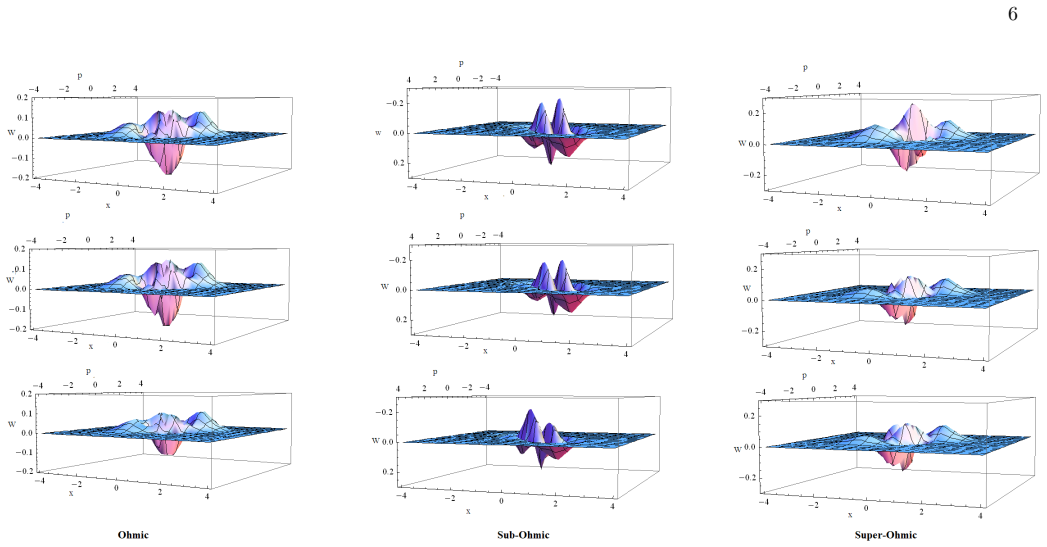
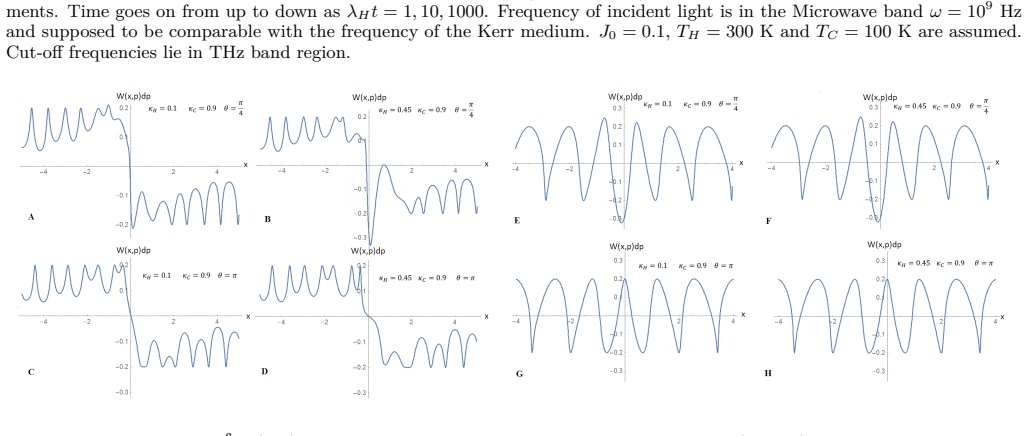
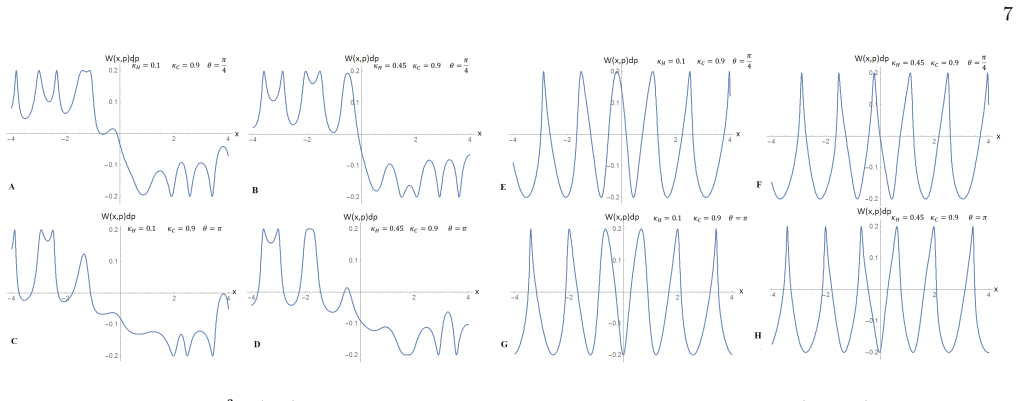
The paper claims that non-equilibrium conditions can protect macroscopic quantum coherence that would be destroyed by a single thermal bath. Starting from a single-photon input and a coherent-state Kerr medium with Kτ = π, the setup prepares the usual Yurke–Stoler superposition; the new step is coupling the two interferometer arms to two bosonic baths at temperatures TH > TC, with cut-off frequencies λC > λH. Using a second-order Born-type expansion of the interaction-picture evolution, the authors derive the Weyl function of the detected cat state, express it as a sum of four unitary terms plus environment-induced correction terms built from the bath correlation functions, and obtain the Wigner function analytically in two frequency regimes. Their central result is that the Wigner function keeps a negative region, and the integrated momentum distributions keep oscillating, out to dimensionless times λH t = 1000 for Ohmic, super-Ohmic, and sub-Ohmic spectral densities — even though the baths sit at 300 K and 100 K. They also find that the two classical peaks decay asymmetrically, which they attribute to the mutual influence of the two baths allowing populations and coherences to reinforce each other.
Load-bearing premise
The entire calculation assumes that the second-order Born-type expansion of the interaction-picture evolution (Eq. 5) remains accurate out to λH t = 1000 with coupling strength J0 ≈ 0.1; if higher-order bath correlations become significant at those long times, the revived quantum beats and Wigner negativity would be artifacts of the truncation rather than genuine non-equilibrium protection.
Editorial extensions
If this is right
- Cat states prepared in this way would retain measurable Wigner negativity at room temperature, which is exactly the regime where ordinary decoherence arguments predict rapid destruction of the superposition.
- The protocol turns the environment from an adversary into a resource: by choosing the temperature difference and cut-off frequencies, one can tune the beat pattern of the alive-dead oscillation.
- Because the superposition is selected by triggering detectors D1 or D2, the method avoids conditional-state generation and the associated probabilistic overhead of post-selection.
- The effect appears for Ohmic, super-Ohmic, and sub-Ohmic environments, so the protection is not tied to a finely tuned spectral shape — only to the non-equilibrium condition TH ≠ TC.
Reading between the lines
- One could sharpen the claim by asking whether the protection is a resonance effect: the paper's two regimes are ωK ≈ ωe and ωK ≪ ωe, and an exact calculation of the revival time as a function of the temperature ratio TH/TC would reveal whether the effect optimizes at a finite bias, as one would expect if the baths act like a small quantum engine.
- The same two-bath geometry could be tested for other fragile resources, such as squeezing, entanglement between the two output modes, or photon-number superpositions, since the mechanism (population-coherence synergy mediated by bath correlation functions) is not specific to coherent-state superpositions.
- A concrete experimental extension: sweep TC from 300 K down to 10 K while holding TH fixed, and map the Wigner-negativity lifetime; the paper's plots suggest the revival persists across this range, which a single room-temperature run could verify directly.
- If the second-order truncation is the only thing keeping the cat alive, then the paper's conclusion flips from 'non-equilibrium protects coherence' to 'the approximation does,' which is why a non-perturbative check should accompany any experimental proposal.
Signed reviews
Editorial analysis
A structured set of objections, weighed in public.
Referee Report
Summary. The paper proposes an open-quantum-optics scheme for generating and preserving optical Schrödinger-cat states. A single photon passes through a Mach-Zehnder interferometer containing a Kerr medium and then interacts with two bosonic heat baths at different temperatures. Using a second-order interaction-picture expansion and Ohmic, sub-Ohmic, and super-Ohmic spectral densities, the authors derive a Wigner function for the cat state and report Wigner negativity and quantum-beat revivals up to dimensionless times λH t = 1000, interpreting these as non-equilibrium protection of macroscopic superpositions at high temperature. The central derivation relies on formulas placed in a supplementary information file, and the main text contains the parameter regimes and figures.
Significance. If the claims were fully justified, the paper would offer a concrete and experimentally motivated route to extending the lifetime of macroscopic superpositions by engineering two non-equilibrium baths, with falsifiable predictions in the form of Wigner negativity and beat oscillations. The closed-system stage (Kerr-interaction cat generation) is standard, and the explicit spectral-density modeling is a strength. However, the main result is currently not established: the state in Eq. (8) is not the conditional D1 state, the perturbative truncation is uncontrolled at the times shown, most of the calculational content is in a missing supplement, and the plotted 'imaginary part' of a real Wigner function is unexplained. These issues bear directly on the central claim.
major comments (5)
- [Sec. II, Eq. (8)] Equation (8) defines the final state by tracing over the output photon modes b and c without any projector, yet the text and Eq. (9) identify this state with the cat state obtained 'after triggering of D1'. After BS2 the two cat components are correlated with the two output ports, so the unconditional trace is an incoherent mixture of the detector-conditioned states; for a macroscopically separated cat the mixture can have essentially no Wigner negativity even when each conditional state does. The conditional state should be written with a postselection projector, e.g. P_D1 = |10><10|_{bc}, and every figure (Figs. 2-6) should be re-derived from that state. This issue is prior to the validity of the perturbative expansion.
- [Sec. II, Eq. (5)] The reduced dynamics is computed from a second-order Dyson expansion (Eq. (5)) with no Markov assumption, and results are shown at dimensionless times lambda_H t = 1000 with J0 approximately 0.1. No estimate of the third-order terms or a dimensionless small parameter is provided; at these long times secular terms can make the second-order result unreliable, so the reported revivals and Wigner negativities could be truncation artifacts. The authors should either bound the omitted terms, resum the series, or benchmark against a non-perturbative method.
- [Sec. II after Eq. (9) and Eq. (12)] The central bath-induced quantities—the operators f_i^(2), the coefficients Theta_i(t), and the analytical correlation-function integrals used in Eqs. (9)-(12)—are relegated to a 'Supplementary Information' that is not included with this submission. Since these objects drive the Wigner-function result that is the paper's main claim, the derivation is not reproducible as submitted. The supplement must be provided and the key expressions should at least be summarized in the main text.
- [Sec. III, Figs. 3-6] Figs. 3-6 plot the 'Imaginary part of ∫ W(x,p) dp'. For a physical density matrix the Wigner function is real-valued, so the imaginary part of its momentum integral is identically zero; if W in Eq. (12) is not the standard Wigner function, the plotted quantity must be defined explicitly. The quantum beats are read off this quantity, so the paper must clarify which observable is actually computed and why it is nonzero.
- [Sec. II, Eqs. (2), (8) and formalism] The initial state is inconsistent: Eq. (2) defines |psi_0> as the state before BS2 and the text defines |psi±0> after BS2 and detection, but later rho_0 is set to |psi+0><psi+0| ⊗ rho_TH ⊗ rho_TC, while Eq. (8) evolves rho(0) through U_BS1, U_theta, U_Kerr, U(t), and finally U_BS2. The paper should state unambiguously whether the open-system evolution starts from the input state before the interferometer or from the already-prepared postselected cat state, and adjust Eq. (8) accordingly.
minor comments (5)
- [Eq. (12)] The dummy variable in the Wigner integral is written as lambda after an integral over d^2 gamma; the argument should match the integration variable, and the convention for the Fourier factor should be stated explicitly.
- [Throughout] There are numerous typographical errors ('suffeirng', 'resluts', 'strighforward', 'Trnasforming', 'surronding', 'bizzardness', 'intercat') that should be corrected in a revision.
- [Sec. III] The text sets lambda_C = 2 lambda_H and T_H > T_C while later using parameter pairs kappa_C = kappa_H and kappa_C = 2 kappa_H; the relationship between these choices and the stated condition kappa_C > kappa_H should be clarified.
- [Introduction and Sec. II] The Introduction says the Kerr-MZ approach is independent of conditional measurements, but Sec. II obtains the cat state 'after triggering of D1' and Eq. (8) is called the state after detection; these statements should be reconciled.
- [Sec. II, Eq. (5)] The claim 'without imposing Markov assumption' should be qualified, because the second-order Born-type truncation in Eq. (5) is itself a weak-coupling approximation.
Circularity Check
No circularity: the paper's predictions are forward outputs of a stated perturbative model, not re-statements of its inputs.
full rationale
The derivation chain is a forward calculation: the authors specify a total Hamiltonian (Eqs. 3-4), expand the interaction-picture evolution operator to second order (Eq. 5), trace out the environmental and output-photon degrees of freedom (Eq. 8), and compute the Wigner function (Eq. 12) from the resulting reduced state. The claimed revivals of Wigner negativity and quantum beats are outputs of this calculation, not quantities inserted as inputs. The parameters (J0 ≈ 0.1, TH = 300 K, TC = 100 K, cut-off frequencies, spectral-density exponents s = 1, -0.5, 2) are physical scenario choices, not fit parameters tuned to reproduce a target curve; no subset of the reported data is used to predict another subset. There are no load-bearing self-citations: the cited works are external standard references, and the 'after triggering of D1' claim is not justified by a circular uniqueness theorem. The skeptic's concern that Eq. (8) traces over the output photon ports instead of applying a detector projector is a potential mismatch between the stated object and the actual computed state — a correctness risk, not a circularity, because it does not make the conclusion equivalent to an assumption by construction. Likewise, the second-order Born truncation is an approximation validity concern, not circularity. The paper's central claim therefore has independent content from its inputs, and the honest finding is no significant circularity.
Assumptions & free parameters
free parameters (8)
- J0 =
0.1
- TH =
300 K
- TC =
100 K
- λH, λC =
THz band, λC = 2λH
- s =
1 (Ohmic), 0.5 (sub-Ohmic), 2 (super-Ohmic)
- θ =
π or π/4
- δ =
0.01
- ω =
10^9 Hz
assumptions (5)
- domain assumption The environment consists of two independent bosonic baths at different temperatures.
- domain assumption The second-order Born-type expansion (Eq. 5) is sufficient to describe the reduced dynamics at the time scales considered.
- domain assumption The spectral density has the generalized Ohmic form with the cutoff structure of Eq. (6).
- domain assumption The initial bath states are thermal and uncorrelated with the system.
- standard math Negativity of the Wigner function is a faithful witness of the presence of the macroscopic superposition.
Cite this review
Pith. "Pith review of Bringing Schrodinger's Cat to Life with Non-Equilibrium Respiration." pith.science (2026). https://pith.science/paper/J2PGDMM7
@misc{pith2026190802509,
  author       = {Pith},
  title        = {Pith review of: Bringing Schrodinger's Cat to Life with Non-Equilibrium Respiration},
  year         = {2026},
  howpublished = {\url{https://pith.science/paper/J2PGDMM7}},
  note         = {Machine review of arXiv:1908.02509}
}
read the original abstract
In this study, we have proposed a method based on non-equilibrium effects to generate the superposition of macroscopically distinguishable quantum states, known as Schrodinger cat states, by using a Mach-Zehnder interferometry type experiment. Interaction of the input number state with a Kerr medium in the presence of a couple of heat baths in different temperatures in interaction picture and without imposing Markov assumption is considered. We have shown that the study of dynamics of the cat states under non-equilibrium condition open a way for the robustness of quantum features against the destructive role of the environment even at high temperature limit. It is verified that mutual influence of the environments, far from equilibrium, on the open system, makes it possible to revive quantum beats for longer time intervals. Moreover, we have probed how the traits of the environment, like its temperature and the Ohmic, super-Ohmic or sub-Ohmic functionality of the spectral density, may affect the pattern of the oscillation between alive or dead states of the cat.
Figures

Figures from the paper (3 more)


Reference graph
Works this paper leans on
-
[1]
K .G. Johnson, J. D. Wong-Campos, B. Neyenhuis, J. Mizrahi and C. Monroe, Nat. Commun. 697, 1 (2017)
work page 2017
- [2]
- [3]
-
[4]
A. J. Leggett, J. Phys.: Condens. Matter 14, R415 (2002)
2002
-
[5]
W. H. Zurek, Phys. Today 44(10), 36 (1991)
work page 1991
-
[6]
T. C. Ralph, Phys. Rev. A 65(10), 042313 (2002)
work page 2002
-
[7]
W. J. Munro, K. Nemoto, G. J. Milburn, and S. L. Braunstein, Phys. Rev. A 66(10), 023819 (2002)
work page 2002
-
[8]
A. Gilchrist, K. Nemeto, W. J. Munro, T. C. Ralph, S. Glancy, S. L. Braunstein and G. J. Milburn J. Opt. B 6(10), S828 (2004)
work page 2004
Show all 55 references
-
[9]
S. J. van Enk and O. Hirota, Phys. Rev. A 64, 022313 (2001)
2001
-
[10]
Jeong, M
H. Jeong, M. S. Kim, T. C. Ralph and B. S. Ham, Phys. Rev. A 70, 06180 (2004)
2004
-
[11]
Wang, Phys
X. Wang, Phys. Rev. A 64, 022302 (2001)
2001
-
[13]
T. C. Ralph, A. Gilchrist, G. J. Milburn, W. J. Munro and S. Glancy, Phys. Rev. A 68, 042319 (2003)
2003
-
[14]
Brune, S
M. Brune, S. Haroche, J. M. Raimond, L. Davidovich, and N. Zagury, Phys. Rev. A 45, 5193 (1992)
1992
-
[15]
Brune, E
M. Brune, E. Hagley, J. Dreyel, X. Matitre, A. Maali, C. Wunderlich, J. M. Raimond, and S. Haroche, Phys. Rev. Lett. 77, 4887 (1996)
1996
-
[16]
Davidovich, M
L. Davidovich, M. Brune, J. M. Raimond and S. Haroche, Phys. Rev. A 53, 1295 (1996)
1996
-
[17]
J. Liao, J. Huang and L. Tian, Phys. Rev. A 93, 033853 (2016)
2016
-
[18]
Asavanant, K
W. Asavanant, K. Nakashima, Y. Shiozawa, J. Yoshikama and A. Furusawa, Opt. Express 25, 32227 (2017)
2017
-
[19]
Yurke and D
B. Yurke and D. Stoler, Phys. Rev. Lett. 57, 13 (1986)
1986
-
[20]
C. C. Gerry, Opt. Commun. 91, 247 (1992)
1992
-
[21]
C. C. Gerry, Phys. Rev. A 59, 4095(1999)
1999
-
[22]
M. G. A. Paris, J. Opt. B 1, 662 (1999)
1999
-
[23]
Leibfried and et al
D. Leibfried and et al. Nature 438, 639 (2005)
2005
-
[24]
Ourjoumtsev, H
A. Ourjoumtsev, H. Jeong, R. Tualle-Brouri and P. Grangier, Nature 448, 784 (2007)
2007
-
[25]
S. Bose, K. Jacobs, and P. L. Knight, Phys. Rev. A 56, 4175 (1997)
1997
-
[26]
Braun, P
D. Braun, P. A. Braun and F. Haake, Opt. Commun. 179, 411 (2000)
2000
-
[27]
Jeong, Phys
H. Jeong, Phys. Rev. A 72, 034305 (2005)
2005
-
[28]
D. Yang, J. Kim, M. Lee, Y. Chough and K. An, Phys. Rev. A 94, 023826 (2016)
2016
-
[29]
V.V Dodonov, J. Opt. B 4, R1 (2002)
2002
-
[30]
Kenfack and K
A. Kenfack and K. Zyczkowski, J. Opt. B 6, 396 (2004)
2004
-
[31]
Banaszek, C
K. Banaszek, C. Radzewicz and K. WÂťodkiewicz, Phys. Rev. A 60, 674 (1999)
1999
-
[32]
Breitenbach, S
G. Breitenbach, S. Schiller and J. Mlynek, Nature 387, 471 (1997)
1997
-
[33]
Kurtsiefer, T
C. Kurtsiefer, T. Pfau and J. Mlynek, Nature 386, 150 (1997)
1997
-
[34]
A. I. Lvovsky, H. Hansen, T. Aichele, O. Benson, J. Mlynek and S. Schiller, Phys. Rev. Lett. 87,0504021 (2001)
2001
-
[35]
Imoto, H
N. Imoto, H. A. Haus and Y. Yamamoto, Phys. Rev. A 32, 2287 (1985)
1985
-
[36]
Gerry and P
C. Gerry and P. Knight, Introductory Quantum Optics , Cambridge University Press, (2005)
2005
-
[37]
Takagi, Macroscopic Quantum Tunneling , Cambridge University Press, New York (2005)
S. Takagi, Macroscopic Quantum Tunneling , Cambridge University Press, New York (2005)
2005
-
[38]
H. A. Bachor, T. C. Ralph, A guide to Experiments in Quantum Optics , Third Edition, Wiley-VCH, (2019)
2019
-
[39]
Z. H. Peng, S. E. de Graaf, J. S. Tsai, O. V. Astafiev, Tuneable on-demand single-photon source in the microwave range, Nat. Commun., 7, 12588, (2016)
2016
-
[40]
A. A. Houck and et al, Generating single microwave photons in a circuit, Nature, 449, 328âĂŞ331, (2006)
2006
-
[41]
Hofheinz and et al, Generation of fock states in a superconducting quantum circuit, Nature, 454, 310âĂŞ314, (2008)
M. Hofheinz and et al, Generation of fock states in a superconducting quantum circuit, Nature, 454, 310âĂŞ314, (2008)
2008
-
[42]
Bozyigit and et al, Antibunching of microwave-frequency photons observed in correlation measurements using linear detectors, Nat
D. Bozyigit and et al, Antibunching of microwave-frequency photons observed in correlation measurements using linear detectors, Nat. Phys., 7, 154âĂŞ158, (2011)
2011
-
[43]
Lang and et al., Observation of resonant photon blockade at microwave frequencies using correlation function measure- ments, Phys
C. Lang and et al., Observation of resonant photon blockade at microwave frequencies using correlation function measure- ments, Phys. Rev. Lett., 106, 243601, (2011)
2011
-
[44]
Lang and et al., Correlations, indistinguishability and entanglement in Hong-Ou-Mandel experiments at microwave frequencies, Nat
C. Lang and et al., Correlations, indistinguishability and entanglement in Hong-Ou-Mandel experiments at microwave frequencies, Nat. Phys., 9, 345âĂŞ348, (2013)
2013
-
[45]
C. K. Hong, Experimental realization of a localized one-photon state, Phys. Rev. Lett, 56, 58, (1986)
1986
-
[46]
B. C. Sanders and G. J. Milburn, Quantum limits to all-optical phase shifts in a Kerr nonlinear medium, Phys. Rev. A, 45, 1919, (1992)
1992
-
[47]
Jeong, Using weak non-linearity under decoherence for macroscopic entanglement generation, Phys
H. Jeong, Using weak non-linearity under decoherence for macroscopic entanglement generation, Phys. Rev. A, 72, 034305, (2005)
2005
-
[48]
Sizmann, and G
A. Sizmann, and G. Leuchs, The optical Kerr effect and quantum optics in fibers, Prog. Optics, 39, 373, (1999). 10
1999
-
[49]
G. J. Milburn and et al, Optical-fiber media for squeezed-state generation, J. Opt. Soc. Am. B, 4,1476, (1987)
1987
-
[50]
J. Ries, B. Brezger and A. I. Lvovsky, Experimental vacuum squeezing in Rubidium vapor via self-rotation, Phys. Rev. A, 68, 025801, (2003)
2003
-
[51]
Z-Y Jeff Ou, Quantum Optics for Experimentalists , World Scientific Press, (2017)
2017
-
[52]
Rousseau, Statistical properties of optical fields scattered by random media: Application to rotating ground glass, J
M. Rousseau, Statistical properties of optical fields scattered by random media: Application to rotating ground glass, J. Opt. Soc. Am., 61, 1307âĂŞ1316, (1971)
1971
-
[53]
L. E. Estes L E, L. M. Narducci, R. A. Tuft, Scattering of light from a rotating ground glass, J. Opt. Soc. Am., 61, 1301âĂŞ1306, (1971)
1971
-
[54]
Mika and et al, Generation of ideal thermal light in warm atomic vapor, New J
J. Mika and et al, Generation of ideal thermal light in warm atomic vapor, New J. Phys, 20, 093002, (2018)
2018
-
[55]
Dechant, N
A. Dechant, N. Kiesel and E. Lutz, All-optical nanomechanical heat engine, Phys. Rev. Lett., 114, 183602, (2015)
2015
-
[56]
Blickle and C
V. Blickle and C. Bechinger, Realization of a micrometre-sized stochastic heat engine, Nat. Phys., 8, 143, (2011)
2011
Reviewed August 14, 2026 · model on record in the stance chip above.
Discussion (0). Continue with ORCID to comment.