REVIEW 3 major objections 4 minor 1 cited by
Gravitational Wave Signatures Induced by Dark Fluid Accretion in Binary Systems
T0 review · 3 major / 4 minor · reviewed 2026-08-08 · deepseek-v4-flash
Pith's one-line read An accreting dark fluid around a supermassive black hole imprints its equation of state on the gravitational-wave phase of an inspiraling stellar-mass companion.
desk verdict A coherent framework for accreting-fluid effects on EMRI dephasing, honestly labeled preliminary, but the detectability claim rests on systematics control the paper does not provide. read the letter →
The pith
A machine-rendered reading of the paper's core claim, the machinery that carries it, and where it could break.
The reading
What carries the argument
The machinery is a post-Newtonian Lagrangian two-body model in which the 1PN and 2.5PN corrections are inserted as generalized forces (Eqs. (13)-(14)), supplemented by two fluid effects. The accretion profile comes from the steady-state, spherically symmetric Michel solution for a perfect fluid with linear equation of state $p=\alpha(\rho-\rho_0)c^2$, giving radial velocity and density profiles $u^r(r)$ and $\rho(r)$ from Eqs. (55)-(56). The load-bearing object is the global radial force $f_r^{\rm fluid}=-4\pi G r^{-2}\int_{r_S}^{r}\left(\rho(r')+3p(r')/c^2\right) r'^2\,dr'$ (Eq. (60)), the spherical-shell gravitational pull of the fluid on the perturber, which dominates over dynamical friction at large separations and whose zero controls the sign flip of the de-phasing. Waveforms are then computed from the quadrupole formula using the fluid-corrected trajectories, and phase shifts are read off as $\Delta\phi=\phi_{\rm fluid}-\phi$.
What would settle it
Run a fully relativistic hydrodynamical simulation of a test fluid accreting onto a Schwarzschild black hole with a companion moving through it, including the fluid's self-gravity, and compare the resulting radial force on the companion with Eq. (60) at radii of $10$-$250\,r_{\rm ISCO}$; if the sign or magnitude of the force changes, the claimed $w$-dependence of the de-phasing would not survive.
Extended reading notes
Core claim
The paper claims that for an extreme-mass-ratio inspiral composed of a $10^6\,M_\odot$ Schwarzschild black hole and a $10\,M_\odot$ perturber, the dominant environmental effect of a spherically accreting dark fluid is not the local dynamical friction but the global gravitational pull of the fluid shell between the horizon and the perturber. The de-phasing $\Delta\phi\equiv\phi_{\rm fluid}-\phi$ at ten years is negative for $w\lesssim 0$ and positive for $w\gtrsim 0$ at $r_{\rm init}=70\,r_{\rm ISCO}$ when $\rho_\infty=\rho_{\rm crit}$, passing through zero where the integrated force in Eq. (60) vanishes, and the precise crossing value shifts with distance. Quantitatively, for $\rho_\infty=\rho_{\rm crit}$ the ten-year shift is of order $10^{-6}$ rad, while at $\rho_\infty=10^6\rho_{\rm crit}$ and $r_{\rm init}=10\,r_{\rm ISCO}$ the four-year de-phasing is $\sim -0.01$ rad for $w\simeq -1$. The paper further claims that sudden cosmological singularities produce only a negligible waveform de-phasing at cosmologically relevant densities, although they kick the perturber's radial velocity by an amount that grows with distance.
Load-bearing premise
The calculation assumes that the fluid's own gravity is too weak to affect its own density profile, yet the fluid's gravity is strong enough to pull the orbiting black hole; if that combination is internally inconsistent, the predicted phase shifts would change.
Editorial extensions
If this is right
- At large separations of tens to hundreds of $r_{\rm ISCO}$, de-phasing from spherical accretion is dominated by the fluid's global gravity rather than dynamical friction, so measurements of phase can constrain the enclosed fluid mass instead of only local dissipation.
- The sign of $\Delta\phi$ at a given distance is a function of $w$: stiff fluids with $w\gtrsim 0$ produce a positive shift while dark-energy-like fluids with $w\lesssim 0$ produce a negative shift, with the transition point depending on orbital radius.
- For cosmologically relevant densities the predicted shift is too small to observe, but for densities of $10^6\rho_{\rm crit}$ the four-year shift reaches $\sim -0.01$ rad at $r_{\rm init}=10\,r_{\rm ISCO}$, potentially within reach of next-generation space-based gravitational-wave detectors.
- Sudden cosmological singularities can deform an initially circular orbit into a mildly eccentric one through a velocity kick that grows with distance, but the resulting gravitational-wave de-phasing is negligible at $\rho_\infty=\rho_{\rm crit}$.
- The Lagrangian generalized-force framework applies to any dissipative or conservative environmental effect expressible as a force, so the same method can be reused for other dark-fluid equations of state and for more general fluid geometries.
Reading between the lines
- The paper leaves implicit that the sign flip near $w\simeq 0$ could serve as a model-independent diagnostic: if an observed EMRI de-phasing tracks the enclosed-mass integral rather than the local density, that favors a pressure-supporting dark fluid over a collisionless spike, whose global and local effects scale differently.
- At densities far above $\rho_{\rm crit}$, non-spherically symmetric accretion may make dynamical friction dominate again, as the paper itself notes, so the sign-flip diagnostic would need calibration on inflow geometry before being used as a precise equation-of-state probe.
- A natural test of the framework would be a fully relativistic hydrodynamical simulation of Bondi-Michel accretion onto a Schwarzschild black hole with a perturbing companion, checking whether the integrated shell force matches Eq. (60) to the claimed precision at radii of $10$-$250\,r_{\rm ISCO}$.
- The sudden-singularity velocity kick in Eq. (76) could be confronted with cosmological simulations of type-II singularities; if future observations ever tie an EMRI eccentricity to a singularity time, that would give an independent constraint on the jump parameter $\eta$ and the background equation-of-state parameter $w_\infty$.
Signed reviews
Editorial analysis
A structured set of objections, weighed in public.
Referee Report
Summary. The paper studies an extreme-mass-ratio inspiral (a 10^6 M_sun Schwarzschild black hole with a 10 M_sun companion) embedded in a spherically symmetric, steadily accreting dark fluid with a linear equation of state p = alpha (rho - rho0) c^2. The authors combine 1PN and 2.5PN equations of motion with local dynamical friction from the fluid and a global gravitational force from the fluid enclosed inside the perturber's orbit. They compute gravitational-wave dephasing relative to a no-fluid binary, report a dependence of the dephasing on the equation-of-state parameter w (of order 10^-6 rad over 10 years at rho_inf = rho_crit and r_init = 70 r_ISCO), and extend the formalism to sudden cosmological singularities, finding those give negligible dephasing at cosmological densities. The paper validates its numerical setup against the dark-matter-spike results of Montalvo et al. (2024).
Significance. If the reported dephasing numbers were correct, the paper would provide a useful framework for studying environmental effects on EMRI waveforms and a concrete, falsifiable prediction connecting a dark fluid's equation of state to gravitational-wave phase evolution. The manuscript has clear strengths: the equations of motion are explicit, the accretion profiles are derived from the standard Babichev et al. formalism, and the validation against an earlier dark-matter-spike calculation is a good check of the numerical pipeline. However, the central quantitative claim at cosmologically relevant densities is called into question by a simple order-of-magnitude estimate given in the major comments below, and the paper does not provide the systematic-error analysis needed to support the inference statement in Section 5.1.
major comments (3)
- [5.1, Eq. (60), Fig. 5 upper panel] The magnitude of the reported dephasing is inconsistent with the input physics by many orders of magnitude. For rho_inf = rho_crit, m1 = 10^6 M_sun, and r = 70 r_ISCO = 6.2e11 m, the enclosed active mass is |M_enc| ~ (4 pi / 3) |rho + 3p/c^2| r^3 ~ 1.7e10 kg (for w = -1), so the fluid acceleration on the perturber is G |M_enc| / r^2 ~ 3e-24 m/s^2 and the fractional change of the central acceleration is |M_enc|/m1 ~ 8e-27. With about 1.2e3 orbits in 10 years, the accumulated dephasing is Delta-phi ~ pi N |M_enc|/m1 ~ 1e-23 rad, not the plotted 10^-6 rad. This 17-order-of-magnitude discrepancy suggests a unit conversion or rescaling error in the numerical implementation of Eq. (60) (for example, using the SI density without the G/c^2 conversion to active gravitational mass). The authors should verify their code against the enclosed-mass benchmark and report the physical acceleration and dephasing for a test case.
- [2, 5.1, and Conclusions] The inference claim in Section 5.1 ('the equation of state of the accreting energy density can be inferred from its impact on the binary system's dynamics') is not supported by a systematic-error budget. The model omits 2PN and all spin-orbit and spin-spin terms; at r_init = 70 r_ISCO, (v/c)^2 ~ 2.4e-3, so the omitted 2PN phase over 10 years is of order (v/c)^4 * 2 pi N ~ 0.08 rad, roughly five orders of magnitude above the claimed fluid dephasing. Computing Delta-phi as a fluid-minus-no-fluid difference cancels the leading omitted PN terms in that idealized comparison, but a real measurement requires a vacuum waveform model accurate below the fluid signal, and the paper provides no Fisher-matrix, mismatch, or systematic-error estimate. The Conclusions acknowledge that such effects may be overshadowed, but the stronger statement in Section 5.1 should either be removed or backed by a concrete template-accuracy calculation.
- [4 and 5, Eq. (60)] The treatment of the fluid's self-gravity is asymmetric and its domain of validity is not quantified. The accretion profiles are derived under the explicit assumption that 'the fluid's energy density is sufficiently low, such that its self-gravity can be neglected' (Section 4), yet the same fluid is used to produce a global gravitational force on the perturber of the form G M_enc(r)/r^2 in Eq. (60). This is consistent only to leading order in M_enc(r)/m1, and the manuscript does not state this small parameter or give its value for the plotted examples. The extrapolation to 'higher energy densities' where the effect becomes significant is precisely the regime where M_enc(r)/m1 may no longer be small (for example, at 10^25 rho_crit and 70 r_ISCO, M_enc/m1 ~ 4e-2). The paper should specify the validity condition and report M_enc/m1 for the cases shown.
minor comments (4)
- [5] The sentence 'As long as m1 << m2, such that the center of mass nearly coincides with the center of the supermassive black hole' has the mass ratio reversed; it should read m2 << m1.
- [5, Eq. (62)] The quadrupole moment in Eq. (62) includes the static, spherically symmetric T00_fluid term. Such a term contributes a constant to Mij and therefore has zero second time derivative, so it does not affect the waveform polarizations in Eqs. (18)-(19); the text should clarify why it is included or remove it.
- [2, Eq. (11)] The notation in Eq. (11) appears garbled ('tyre', 'ctyre2'); the definitions of ar r and ar t should be typeset as ar r = r/(c t_yr e) and ar t = t/t_yr, or similar, and the text should define all symbols.
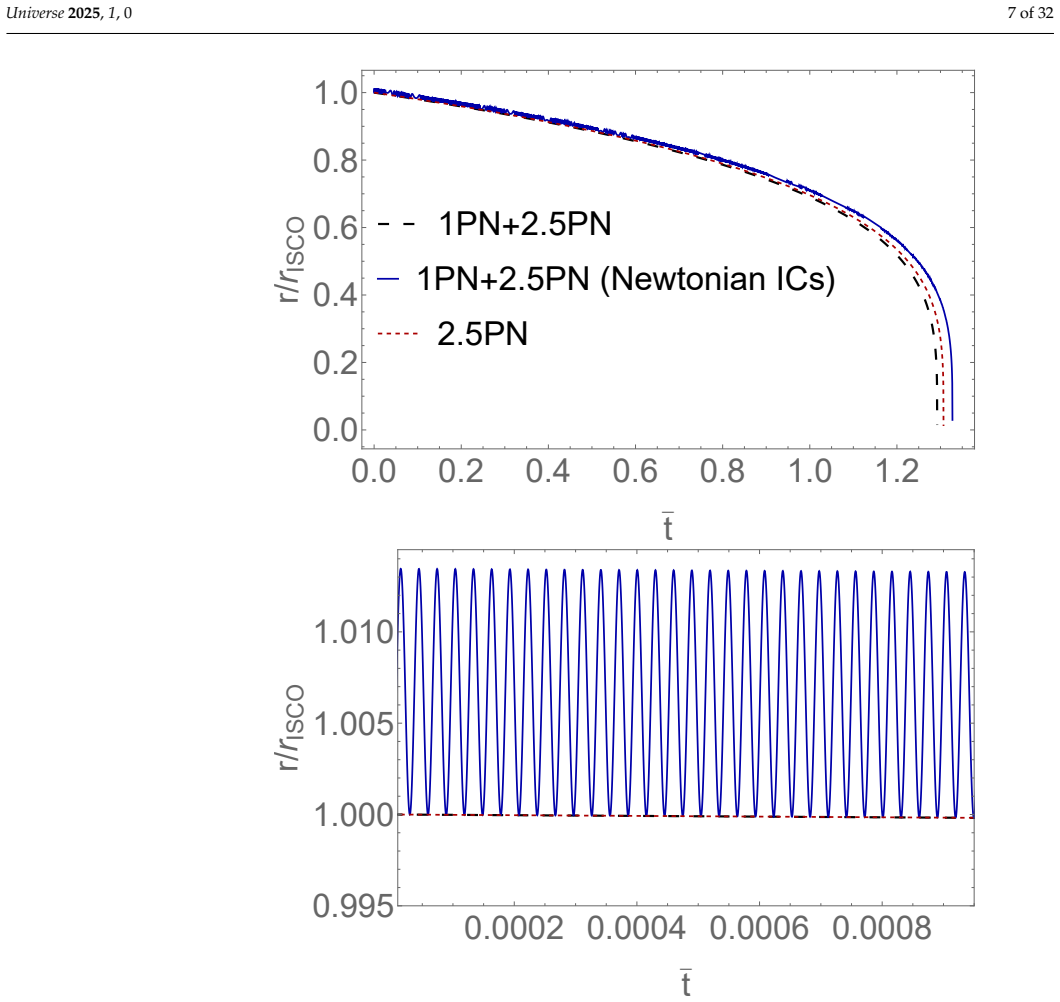
- [Figure 7 caption] The caption refers to 'Left Panel' and 'Right Panel', while the text refers to 'upper panel' and 'lower panel'; the panel labeling should be made consistent.
Circularity Check
No significant circularity in the central fluid-EoS dephasing derivation; only a minor non-load-bearing self-citation in the sudden-singularity section.
-
other
[Section 5.3, Equation (67)]
"The scale factor of a past sudden singularity event, ensuring that a(τ0)=1, is parametrized as follows [93]:"
Equation (67) is attributed to reference [93], which is the authors' own prior paper. The parametrization is not derived in the present work, and the cited prior paper introduced it as a model ansatz rather than as an externally established theorem. This is a self-citation for an adopted functional form. It is not load-bearing for the central claim: the sudden-singularity section is an extension, and its conclusion (negligible dephasing for cosmological densities) is computed from the displayed formula rather than assumed from the citation.
full rationale
The central dephasing result is not circular. The fluid density and velocity profiles are obtained from the steady-state accretion equations of Babichev et al. [49,53], which are external references, not fitted to the GW phase. The dephasing Δφ = φ_fluid − φ is computed by numerically integrating the 1PN+2.5PN equations of motion with and without the fluid force (Eqs. 58-60) and comparing the resulting orbital phases. No parameter of the fluid model is adjusted to reproduce Δφ, and the comparison with Montalvo et al. [43] is an external validation. The only self-citation that enters is the sudden-singularity scale-factor parametrization of Eq. (67), taken from the authors' own prior paper [93]; it is an explicit ansatz for a secondary analysis and does not support the main fluid-EoS dephasing claim. The skeptic's concern about omitted 2PN and spin contributions is a validity/robustness issue, not circularity, since both the fluid and no-fluid trajectories omit the same terms and the claim about w-dependence is not obtained by fitting those omitted terms. Overall, the paper's derivation chain is self-contained for its main claim.
Assumptions & free parameters
free parameters (8)
- alpha (equation-of-state slope) =
0.24, 0.9, 1
- rho_0 / rho_infty (equation-of-state offset) =
0, 0.5, 2, 7/3
- eta (sudden-singularity jump parameter) =
-10, -1, 1, 5, 10, 100
- beta or w_infty for the singularity =
beta = 666.667, w_infty = -0.999
- tau_s (singularity occurrence time) =
13.7 Gyr + 5 yr
- initial separation r_init =
70 r_ISCO, with additional examples at 10 and 250 r_ISCO
- Coulomb logarithm ln Lambda =
3
- Dark-matter spike fit parameters A, w, q =
A = 6.42e-43 x 1477.063 x 1.989e30 kg/m^3, w = 1.82, q = 1.91
assumptions (8)
- domain assumption The binary equations of motion are obtained by adding 1PN and 2.5PN generalized forces to the Newtonian Lagrangian, following Montalvo et al.
- domain assumption The accreting fluid is a perfect, non-self-gravitating test fluid in steady-state spherical flow on a Schwarzschild background.
- domain assumption The linear equation of state p = alpha (rho - rho_0) c^2 approximates the dark fluid, with 0 < alpha <= 1 for stability.
- ad hoc to paper The fluid's own gravity can be neglected in the accretion solution but included as a Newtonian spherical-shell force on the perturber.
- ad hoc to paper At distances of tens to hundreds of r_ISCO, omission of 2PN, spin-orbit and spin-spin terms does not affect the small fluid-induced dephasing.
- domain assumption The sudden singularity is described by the parametrized scale factor Eq. (67) with a Heaviside jump, taken from the authors' earlier work.
- domain assumption Gravitational waveforms are computed with the quadrupole formula using the retarded time, with the observer placed at 1 Mpc.
- domain assumption The orbit remains quasi-circular throughout the inspiral until the plunge.
Cite this review
Pith. "Pith review of Gravitational Wave Signatures Induced by Dark Fluid Accretion in Binary Systems." pith.science (2026). https://pith.science/paper/J2PU4HFQ
@misc{pith2026250207929,
  author       = {Pith},
  title        = {Pith review of: Gravitational Wave Signatures Induced by Dark Fluid Accretion in Binary Systems},
  year         = {2026},
  howpublished = {\url{https://pith.science/paper/J2PU4HFQ}},
  note         = {Machine review of arXiv:2502.07929}
}
read the original abstract
We investigate the impact of dark fluid accretion on gravitational waveforms emitted by a compact binary system consisting of a supermassive black hole and a stellar-mass black hole. Using a Lagrangian framework with 1~PN and 2.5~PN corrections, we analyze the effects of the spherically symmetric accretion of a fluid with steady-state flow, including those characterized by an equation of state parameter resembling dark energy, on the binary's dynamics. We validate our approach by comparing it with previous studies in the common region of validity and extend the analysis to include both local effects, such as dynamical friction, and global gravitational interactions with the stellar-mass black hole, focusing on their dependence on the fluid's properties. Our analysis reveals that these interactions induce de-phasing in gravitational waveforms, with the phase shift influenced by the fluid's equation of state and energy density. We also extend the study to sudden cosmological singularities, finding that, although they can deform the binary's orbit from initially circular to elliptical, their effect on de-phasing is negligible for cosmologically relevant energy densities. By incorporating both the local and global gravitational interactions of a fluid on a two-body system into the equations of motion, this preliminary study provides a framework for understanding the interplay between fluid dynamics and gravitational wave emissions in astrophysical systems. It further reinforces the potential for probing the properties of astrophysically relevant fluids through gravitational wave observations.
Figures


Figures from the paper (4 more)


Forward citations
Cited by 1 Pith paper
-
Static Dark Fluid Thin Shells in Schwarzschild-de Sitter Spacetimes: Stability and Black Hole Shadows
Stable static dark-fluid shells separating two Schwarzschild–de Sitter spacetimes exist only for m_+/m_->1 and arise at three scales, imprinting observable black-hole shadow deviations.
Reference graph
Works this paper leans on
-
[1]
Abbott, B.P .; Abbott, R.; Abbott, T.; Abraham, S.; Acernese, F.; Ackley, K.; Adams, C.; Adhikari, R.X.; Adya, V .B.; Affeldt, C.; et al. GWTC-1: A Gravitational-Wave Transient Catalog of Compact Binary Mergers Observed by LIGO and Virgo during the First and Second Observing Runs. Phys. Rev. X 2019, 9, 031040. https://doi.org/10.1103/PhysRevX.9.031040
-
[2]
Abbott, R.; Abbott, T.D.; Abraham, S.; Acernese, F.; Ackley, K.; Adams, A.; Adams, C.; Adhikari, R.X.; Adya, V .B.; Affeldt, C.; et al. GWTC-2: Compact Binary Coalescences Observed by LIGO and Virgo During the First Half of the Third Observing Run. Phys. Rev. X 2021, 11, 021053. https://doi.org/10.1103/PhysRevX.11.021053
-
[3]
Abbott, R.; Abbott, T.D.; Acernese, F.; Ackley, K.; Adams, C.; Adhikari, N.; Adhikari, R.X.; Adya, V .B.; Affeldt, C.; Agarwal, D.; et al. GWTC-3: Compact Binary Coalescences Observed by LIGO and Virgo during the Second Part of the Third Observing Run. Phys. Rev. X 2023, 13, 041039. https://doi.org/10.1103/PhysRevX.13.041039
-
[4]
Abbott, R.; Abbott, T.D.; Acernese, F.; Ackley, K.; Adams, C.; Adhikari, N.; Adhikari, R.X.; Adya, V .B.; Affeldt, C.; Agarwal, D.; et al. GWTC-2.1: Deep extended catalog of compact binary coalescences observed by LIGO and Virgo during the first half of the third observing run. Phys. Rev. D 2024, 109, 022001. https://doi.org/10.1103/PhysRevD.109.022001
-
[5]
Laser Interferometer Space Antenna
Amaro-Seoane, P .; Audley, H.; Babak, S.; Baker, J.; Barausse, E.; Bender, P .; Berti, E.; Binetruy, P .; Born, M.; Bortoluzzi, D.; et al. Laser Interferometer Space Antenna. arXiv 2017, arXiv:1702.00786
arXiv 2017
-
[6]
The Taiji Program in Space for gravitational wave physics and the nature of gravity
Hu, W.R.; Wu, Y.L. The Taiji Program in Space for gravitational wave physics and the nature of gravity. Natl. Sci. Rev. 2017, 4, 685–686. https://doi.org/10.1093/nsr/nwx116
-
[7]
TianQin: A space-borne gravitational wave detector
Luo, J.; Chen, L.S.; Duan, H.Z.; Gong, Y.G.; Hu, S.; Ji, J.; Liu, Q.; Mei, J.; Milyukov, V .; Sazhin, M.; et al. TianQin: A space-borne gravitational wave detector. Class. Quantum Gravity 2016, 33, 035010. https://doi.org/10.1088/0264-9381/33/3/035010. Universe 2025, 1, 0 29 of 32
-
[8]
The Einstein Telescope: A third-generation gravitational wave observatory
Punturo, M.; Abernathy, M.; Acernese, F.; Allen, B.; Andersson, N.; Arun, K.; Barone, F.; Barr, B.; Barsuglia, M.; Beker, M.; et al. The Einstein Telescope: A third-generation gravitational wave observatory. Class. Quantum Gravity 2010, 27, 194002. https://doi.org/10.1088/0264-9381/27/19/194002
Show all 95 references
-
[9]
Possibility of direct measurement of the acceleration of the universe using 0.1-Hz band laser interferometer gravitational wave antenna in space
Seto, N.; Kawamura, S.; Nakamura, T. Possibility of direct measurement of the acceleration of the universe using 0.1-Hz band laser interferometer gravitational wave antenna in space. Phys. Rev. Lett. 2001, 87, 221103. https://doi.org/10.1103/PhysRevLett. 87.221103
2001 doi
-
[10]
Gravitational radiation from binary systems in massive graviton theories
Poddar, T.K.; Mohanty, S.; Jana, S. Gravitational radiation from binary systems in massive graviton theories. JCAP 2022, 3, 019. https://doi.org/10.1088/1475-7516/2022/03/019
2022 doi
-
[11]
Probing modified gravitational wave propagation with strongly lensed coalescing binaries
Finke, A.; Foffa, S.; Iacovelli, F.; Maggiore, M.; Mancarella, M. Probing modified gravitational wave propagation with strongly lensed coalescing binaries. Phys. Rev. D 2021, 104, 084057. https://doi.org/10.1103/PhysRevD.104.084057
2021 doi
-
[12]
Measuring the propagation speed of gravitational waves with LISA
Baker, T.; Calcagni, G.; Chen, A.; Fasiello, M.; Lombriser, L.; Martinovic, K.; Pieroni, M.; Sakellariadou, M.; Tasinato, G.; Bertacca, D.; et al. Measuring the propagation speed of gravitational waves with LISA. JCAP 2022, 8, 031. https://doi.org/10.1088/1475-7 516/2022/08/031
2022 doi
-
[13]
Black-hole ringdown as a probe of higher-curvature gravity theories
Silva, H.O.; Ghosh, A.; Buonanno, A. Black-hole ringdown as a probe of higher-curvature gravity theories. Phys. Rev. D 2023, 107, 044030. https://doi.org/10.1103/PhysRevD.107.044030
2023 doi
-
[14]
Strong constraints on the gravitational law from Gaia DR3 wide binaries
Banik, I.; Pittordis, C.; Sutherland, W.; Famaey, B.; Ibata, R.; Mieske, S.; Zhao, H. Strong constraints on the gravitational law from Gaia DR3 wide binaries. Mon. Not. R. Astron. Soc. 2024, 527, 4573–4615. https://doi.org/10.1093/mnras/stad3393
2024 doi
-
[15]
Parametrized post-Einsteinian framework for precessing binaries.Phys
Loutrel, N.; Pani, P .; Yunes, N. Parametrized post-Einsteinian framework for precessing binaries.Phys. Rev. D 2023, 107, 044046. https://doi.org/10.1103/PhysRevD.107.044046
2023 doi
-
[16]
Parameter estimation of eccentric gravitational waves with a decihertz observatory and its cosmological implications
Yang, T.; Cai, R.G.; Cao, Z.; Lee, H.M. Parameter estimation of eccentric gravitational waves with a decihertz observatory and its cosmological implications. Phys. Rev. D 2023, 107, 043539. https://doi.org/10.1103/PhysRevD.107.043539
2023 doi
-
[17]
Constraining Horndeski theory with gravitational waves from coalescing binaries
Quartin, M.; Tsujikawa, S.; Amendola, L.; Sturani, R. Constraining Horndeski theory with gravitational waves from coalescing binaries. JCAP 2023, 8, 049. https://doi.org/10.1088/1475-7516/2023/08/049
2023 doi
-
[18]
Prospects of constraining f(T) gravity with the third-generation gravitational-wave detectors
Chen, R.; Wang, Y.Y.; Zu, L.; Fan, Y.Z. Prospects of constraining f(T) gravity with the third-generation gravitational-wave detectors. Phys. Rev. D 2024, 109, 024041. https://doi.org/10.1103/PhysRevD.109.024041
2024 doi
-
[19]
GW170817: Measurements of neutron star radii and equation of state
Abbott, B.P .; Abbott, R.; Abbott, T.D.; Acernese, F.; Ackley, K.; Adams, C.; Adams, T.; Addesso, P .; Adhikari, R.X.; Adya, V .B.; et al. GW170817: Measurements of neutron star radii and equation of state. Phys. Rev. Lett. 2018, 121, 161101. https://doi.org/10.1103/PhysRevLet...
2018 doi
-
[20]
Properties of the binary neutron star merger GW170817
Abbott, B.P .; Abbott, R.; Abbott, T.D.; Acernese, F.; Ackley, K.; Adams, C.; Adams, T.; Addesso, P .; Adhikari, R.X.; Adya, V .B.; et al. Properties of the binary neutron star merger GW170817. Phys. Rev. X 2019, 9, 011001. https://doi.org/10.1103/PhysRevX.9.0110 01
2019 doi
-
[21]
Observation of Gravitational Waves from Two Neutron Star–Black Hole Coalescences
Abbott, R.; Abbott, T.D.; Abraham, S.; Acernese, F.; Ackley, K.; Adams, A.; Adams, C.; Adhikari, R.X.; Adya, V .B.; Affeldt, C.; et al. Observation of Gravitational Waves from Two Neutron Star–Black Hole Coalescences. Astrophys. J. Lett. 2021, 915, L5. https://doi.org/10.3847/...
2021 doi
-
[22]
Multimessenger constraints on the neutron-star equation of state and the Hubble constant
Dietrich, T.; Coughlin, M.W.; Pang, P .T.H.; Bulla, M.; Heinzel, J.; Issa, L.; Tews, I.; Antier, S. Multimessenger constraints on the neutron-star equation of state and the Hubble constant. Science 2020, 370, 1450–1453. https://doi.org/10.1126/science.abb4317
2020 doi
-
[23]
Quarkyonic Matter and Neutron Stars
McLerran, L.; Reddy, S. Quarkyonic Matter and Neutron Stars. Phys. Rev. Lett. 2019, 122, 122701. https://doi.org/10.1103/ PhysRevLett.122.122701
2019
-
[24]
New Probe of Dark-Matter Properties: Gravitational Waves from an Intermediate-Mass Black Hole Embedded in a Dark-Matter Minispike
Eda, K.; Itoh, Y.; Kuroyanagi, S.; Silk, J. New Probe of Dark-Matter Properties: Gravitational Waves from an Intermediate-Mass Black Hole Embedded in a Dark-Matter Minispike. Phys. Rev. Lett. 2013, 110, 221101. https://doi.org/10.1103/PhysRevLett.110. 221101
2013 doi
-
[25]
Gravitational waves as a probe of dark matter minispikes
Eda, K.; Itoh, Y.; Kuroyanagi, S.; Silk, J. Gravitational waves as a probe of dark matter minispikes. Phys. Rev. D 2015, 91, 044045. https://doi.org/10.1103/PhysRevD.91.044045
2015 doi
-
[26]
Black holes surrounded by generic matter distributions: Polar perturbations and energy flux
Speeney, N.; Berti, E.; Cardoso, V .; Maselli, A. Black holes surrounded by generic matter distributions: Polar perturbations and energy flux. Phys. Rev. D 2024, 109, 084068. https://doi.org/10.1103/PhysRevD.109.084068
2024 doi
-
[27]
Dynamical Friction
Chandrasekhar, S. Dynamical Friction. I. General Considerations: The Coefficient of Dynamical Friction. Astrophys. J. 1943, 97, 255. https://doi.org/10.1086/144517
1943 doi
-
[28]
Probing dark matter spikes via gravitational waves of extreme-mass-ratio inspirals
Li, G.L.; Tang, Y.; Wu, Y.L. Probing dark matter spikes via gravitational waves of extreme-mass-ratio inspirals. Sci. China Phys. Mech. Astron. 2022, 65, 100412. https://doi.org/10.1007/s11433-022-1930-9
2022 doi
-
[29]
Measuring dark matter spikes around primordial black holes with Einstein Telescope and Cosmic Explorer
Cole, P .S.; Coogan, A.; Kavanagh, B.J.; Bertone, G. Measuring dark matter spikes around primordial black holes with Einstein Telescope and Cosmic Explorer. Phys. Rev. D 2023, 107, 083006. https://doi.org/10.1103/PhysRevD.107.083006
2023 doi
-
[30]
The effect of mission duration on LISA science objectives
Amaro, Seoane, P .; Arca, Sedda, M.; Babak, S.; Berry, C.P .; Berti, E.; Bertone, G.; Blas, D.; Bogdanovi´ c, T.; Bonetti, M.; Breivik, K.; et al. The effect of mission duration on LISA science objectives. Gen. Relativ. Gravit. 2022, 54, 3. https://doi.org/10.1007/s10714 -021-...
2022 doi
-
[31]
Star distribution around a massive black hole in a globular cluster
Bahcall, J.N.; Wolf, R.A. Star distribution around a massive black hole in a globular cluster. Astrophys. J. 1976, 209, 214–232. https://doi.org/10.1086/154711
1976 doi
-
[32]
Gravitational collapse and related phenomena from an empirical point of view, or, black holes are where you find them
Peebles, P .J.E. Gravitational collapse and related phenomena from an empirical point of view, or, black holes are where you find them. Gen. Relativ. Gravit. 1972, 3, 63–82. https://doi.org/10.1007/BF00755923
1972 doi
-
[33]
Models of Galaxies with Central Black Holes: Adiabatic Growth in Spherical Galaxies
Quinlan, G.D.; Hernquist, L.; Sigurdsson, S. Models of Galaxies with Central Black Holes: Adiabatic Growth in Spherical Galaxies. Astrophys. J. 1995, 440, 554–564
1995
-
[34]
Dark matter distributions around massive black holes: A general relativistic analysis
Sadeghian, L.; Ferrer, F.; Will, C.M. Dark matter distributions around massive black holes: A general relativistic analysis. Phys. Rev. D 2013, 88, 063522. https://doi.org/10.1103/PhysRevD.88.063522
2013 doi
-
[35]
Dark matter spikes in the vicinity of Kerr black holes
Ferrer, F.; da Rosa, A.M.; Will, C.M. Dark matter spikes in the vicinity of Kerr black holes. Phys. Rev. D 2017, 96, 083014. https://doi.org/10.1103/PhysRevD.96.083014
2017 doi
-
[36]
A Dark matter spike at the galactic center? Phys
Ullio, P .; Zhao, H.; Kamionkowski, M. A Dark matter spike at the galactic center? Phys. Rev. D 2001, 64, 043504. https: //doi.org/10.1103/PhysRevD.64.043504
2001 doi
-
[37]
Dark matter spikes and annihilation radiation from the galactic center
Merritt, D.; Milosavljevic, M.; Verde, L.; Jimenez, R. Dark matter spikes and annihilation radiation from the galactic center. Phys. Rev. Lett. 2002, 88, 191301. https://doi.org/10.1103/PhysRevLett.88.191301
2002 doi
-
[38]
A new signature of dark matter annihilations: Gamma-rays from intermediate-mass black holes
Bertone, G.; Zentner, A.R.; Silk, J. A new signature of dark matter annihilations: Gamma-rays from intermediate-mass black holes. Phys. Rev. D 2005, 72, 103517. https://doi.org/10.1103/PhysRevD.72.103517
2005 doi
-
[39]
Mini-dark halos with intermediate mass black holes
Zhao, H.S.; Silk, J. Mini-dark halos with intermediate mass black holes. Phys. Rev. Lett. 2005, 95, 011301. https://doi.org/10.110 3/PhysRevLett.95.011301
2005
-
[40]
Detecting dark matter around black holes with gravitational waves: Effects of dark-matter dynamics on the gravitational waveform
Kavanagh, B.J.; Nichols, D.A.; Bertone, G.; Gaggero, D. Detecting dark matter around black holes with gravitational waves: Effects of dark-matter dynamics on the gravitational waveform. Phys. Rev. D 2020, 102, 083006. https://doi.org/10.1103/ PhysRevD.102.083006
2020
-
[41]
Measuring the dark matter environments of black hole binaries with gravitational waves
Coogan, A.; Bertone, G.; Gaggero, D.; Kavanagh, B.J.; Nichols, D.A. Measuring the dark matter environments of black hole binaries with gravitational waves. Phys. Rev. D 2022, 105, 043009. https://doi.org/10.1103/PhysRevD.105.043009
2022 doi
-
[42]
Black holes surrounded by generic dark matter profiles: Appearance and gravitational- wave emission
Figueiredo, E.; Maselli, A.; Cardoso, V . Black holes surrounded by generic dark matter profiles: Appearance and gravitational- wave emission. Phys. Rev. D 2023, 107, 104033. https://doi.org/10.1103/PhysRevD.107.104033
2023 doi
-
[43]
Post-Newtonian Effects in Compact Binaries with a Dark Matter Spike: A Lagrangian Approach
Montalvo, D.; Smith-Orlik, A.; Rastgoo, S.; Sagunski, L.; Becker, N.; Khan, H. Post-Newtonian Effects in Compact Binaries with a Dark Matter Spike: A Lagrangian Approach. Universe 2024, 10, 427. https://doi.org/10.3390/universe10110427
2024 doi
-
[44]
Dark matter, black holes, and gravitational waves
Bertone, G. Dark matter, black holes, and gravitational waves. Nucl. Phys. B 2024, 1003, 116487. https://doi.org/10.1016/j. nuclphysb.2024.116487
2024
-
[45]
Gravitational Waves
Maggiore, M. Gravitational Waves. Vol. 2: Astrophysics and Cosmology ; Oxford University Press: Oxford, UK, 2018
2018
-
[46]
Impact of relativistic corrections on the detectability of dark-matter spikes with gravitational waves
Speeney, N.; Antonelli, A.; Baibhav, V .; Berti, E. Impact of relativistic corrections on the detectability of dark-matter spikes with gravitational waves. Phys. Rev. D 2022, 106, 044027. https://doi.org/10.1103/PhysRevD.106.044027
2022 doi
-
[47]
A Universal density profile from hierarchical clustering
Navarro, J.F.; Frenk, C.S.; White, S.D.M. A Universal density profile from hierarchical clustering. Astrophys. J. 1997, 490, 493–508. https://doi.org/10.1086/304888
1997 doi
-
[48]
Accretion onto a moving black hole: An exact solution
Petrich, L.I.; Shapiro, S.L.; Teukolsky, S.A. Accretion onto a moving black hole: An exact solution. Phys. Rev. Lett. 1988, 60, 1781–1784. https://doi.org/10.1103/PhysRevLett.60.1781
1988 doi
-
[49]
Black hole mass decreasing due to phantom energy accretion.Phys
Babichev, E.; Dokuchaev, V .; Eroshenko, Y. Black hole mass decreasing due to phantom energy accretion.Phys. Rev. Lett. 2004, 93, 021102. https://doi.org/10.1103/PhysRevLett.93.021102
2004 doi
-
[50]
On spherically symmetrical accretion
Bondi, H. On spherically symmetrical accretion. Mon. Not. R. Astron. Soc. 1952, 112, 195. https://doi.org/10.1093/mnras/112.2. 195
1952 doi
-
[51]
Accretion of matter by condensed objects
Michel, F.C. Accretion of matter by condensed objects. Astrophys. Space Sci. 1972, 15, 153–160. https://doi.org/10.1007/BF00649 949
1972 doi
-
[52]
Stability of stationary, spherical accretion onto a Schwarzschild black hole
Moncrief, V . Stability of stationary, spherical accretion onto a Schwarzschild black hole. Astroph. J. 1980, 235, 1038–1046. https://doi.org/10.1086/157707
1980 doi
-
[53]
Black holes in the presence of dark energy.Phys
Babichev, E.O.; Dokuchaev, V .I.; Eroshenko, Y.N. Black holes in the presence of dark energy.Phys. Uspekhi 2013, 56, 1155–1175. https://doi.org/10.3367/UFNe.0183.201312a.1257
2013
-
[54]
Accretion Processes for General Spherically Symmetric Compact Objects
Bahamonde, S.; Jamil, M. Accretion Processes for General Spherically Symmetric Compact Objects. Eur. Phys. J. C 2015, 75, 508. https://doi.org/10.1140/epjc/s10052-015-3734-9
2015 doi
-
[55]
Radial accretion flows on static spherically symmetric black holes
Chaverra, E.; Sarbach, O. Radial accretion flows on static spherically symmetric black holes. Class. Quantum Gravity 2015, 32, 155006. https://doi.org/10.1088/0264-9381/32/15/155006
2015 doi
-
[56]
Michel accretion of a polytropic fluid with adiabatic index γ > 5/3: Global flows versus homoclinic orbits
Chaverra, E.; Mach, P .; Sarbach, O. Michel accretion of a polytropic fluid with adiabatic index γ > 5/3: Global flows versus homoclinic orbits. Class. Quantum Gravity 2016, 33, 105016. https://doi.org/10.1088/0264-9381/33/10/105016
2016 doi
-
[57]
Accretion onto Some Well-Known Regular Black Holes
Jawad, A.; Shahzad, M.U. Accretion onto Some Well-Known Regular Black Holes. Eur. Phys. J. C 2016, 76, 123. https: //doi.org/10.1140/epjc/s10052-016-3967-2. Universe 2025, 1, 0 31 of 32
2016 doi
-
[58]
Spherical Accretion Flow onto General Parameterized Spherically Symmetric Black Hole Spacetimes
Yang, S.; Liu, C.; Zhu, T.; Zhao, L.; Wu, Q.; Yang, K.; Jamil, M. Spherical Accretion Flow onto General Parameterized Spherically Symmetric Black Hole Spacetimes. Chin. Phys. C 2021, 45, 015102. https://doi.org/10.1088/1674-1137/abc066
2021 doi
-
[59]
Spherical accretion: Bondi, Michel, and rotating black holes
Aguayo-Ortiz, A.; Tejeda, E.; Sarbach, O.; López-Cámara, D. Spherical accretion: Bondi, Michel, and rotating black holes. Mon. Not. R. Astron. Soc. 2021, 504, 5039–5053. https://doi.org/10.1093/mnras/stab1127
2021 doi
-
[60]
Possible Causes of False General Relativity Violations in Gravitational Wave Observations
Gupta, A.; Arun, K.G.; Barausse, E.; Bernard, L.; Berti, E.; Bhat, S.A.; Buonanno, A.; Cardoso, V .; Cheung, S.Y.; Clarke, T.A.; et al. Possible Causes of False General Relativity Violations in Gravitational Wave Observations. arXiv 2024, arXiv:2405.02197
2024 arXiv
-
[61]
Fluid accretion onto a spherical black hole: Relativistic description versus Bondi model
Malec, E. Fluid accretion onto a spherical black hole: Relativistic description versus Bondi model. Phys. Rev. D 1999, 60, 104043. https://doi.org/10.1103/PhysRevD.60.104043
1999 doi
-
[62]
Dark energy cosmology with generalized linear equation of state.Class
Babichev, E.; Dokuchaev, V .; Eroshenko, Y. Dark energy cosmology with generalized linear equation of state.Class. Quantum Gravity 2005, 22, 143–154. https://doi.org/10.1088/0264-9381/22/1/010
2005 doi
-
[63]
Planck 2018 results
Aghanim, N.; Akrami, Y.; Ashdown, M.; Aumont, J.; Baccigalupi, C.; Ballardini, M.; B.; ay, A.J.; Barreiro, R.B.; Bartolo, N.; Basak, S.; et al. Planck 2018 results. VI. Cosmological parameters. Astron. Astrophys. 2020, 641, A6. Erratum in Astron. Astrophys. 2021, 652, C4. http...
2018 doi
-
[64]
The Dynamics of precessing binary black holes using the post-Newtonian approximation
Hartl, M.D.; Buonanno, A. The Dynamics of precessing binary black holes using the post-Newtonian approximation. Phys. Rev. D 2005, 71, 024027. https://doi.org/10.1103/PhysRevD.71.024027
2005 doi
-
[65]
An Improved effective-one-body Hamiltonian for spinning black-hole binaries
Barausse, E.; Buonanno, A. An Improved effective-one-body Hamiltonian for spinning black-hole binaries. Phys. Rev. D 2010, 81, 084024. https://doi.org/10.1103/PhysRevD.81.084024
2010 doi
-
[66]
Sudden future singularities
Barrow, J.D. Sudden future singularities. Class. Quantum Gravity 2004, 21, L79–L82. https://doi.org/10.1088/0264-9381/21/11/ L03
2004 doi
-
[67]
PostNewtonian gravitational radiation and equations of motion via direct integration of the relaxed Einstein equations
Pati, M.E.; Will, C.M. PostNewtonian gravitational radiation and equations of motion via direct integration of the relaxed Einstein equations. 1. Foundations. Phys. Rev. D 2000, 62, 124015. https://doi.org/10.1103/PhysRevD.62.124015
-
[68]
Gravitational Waves
Maggiore, M. Gravitational Waves. Vol. 1: Theory and Experiments ; Oxford University Press: Oxford, UK, 2007. https://doi.org/10 .1093/acprof:oso/9780198570745.001.0001
2007
-
[69]
On the unreasonable effectiveness of the post-Newtonian approximation in gravitational physics
Will, C.M. On the unreasonable effectiveness of the post-Newtonian approximation in gravitational physics. Proc. Nat. Acad. Sci. USA 2011, 108, 5938. https://doi.org/10.1073/pnas.1103127108
2011 doi
-
[70]
General Relativity; Graduate Texts in Physics; Springer: Dordrecht, The Netherlands, 2013
Straumann, N. General Relativity; Graduate Texts in Physics; Springer: Dordrecht, The Netherlands, 2013. https://doi.org/10.100 7/978-94-007-5410-2
2013
-
[71]
Gravitational Radiation from Post-Newtonian Sources and Inspiralling Compact Binaries
Blanchet, L. Gravitational Radiation from Post-Newtonian Sources and Inspiralling Compact Binaries. Living Rev. Relativ. 2014, 17, 2. https://doi.org/10.12942/lrr-2014-2
2014 doi
-
[72]
PostNewtonian gravitational radiation and equations of motion via direct integration of the relaxed Einstein equations
Pati, M.E.; Will, C.M. PostNewtonian gravitational radiation and equations of motion via direct integration of the relaxed Einstein equations. 2. Two-body equations of motion to second postNewtonian order, and radiation reaction to 3.5 postNewtonia order. Phys. Rev. D 2002, 65...
2002 doi
-
[73]
Transition from inspiral to plunge in binary black hole coalescences
Buonanno, A.; Damour, T. Transition from inspiral to plunge in binary black hole coalescences. Phys. Rev. D 2000, 62, 064015. https://doi.org/10.1103/PhysRevD.62.064015
2000 doi
-
[74]
Improved gravitational radiation time-scales: Significance for LISA and LIGO-Virgo sources
Zwick, L.; Capelo, P .R.; Bortolas, E.; Mayer, L.; Amaro-Seoane, P . Improved gravitational radiation time-scales: Significance for LISA and LIGO-Virgo sources. Mon. Not. R. Astron. Soc. 2020, 495, 2321–2331. https://doi.org/10.1093/mnras/staa1314
2020 doi
-
[75]
Astrophysics with the Laser Interferometer Space Antenna
Amaro-Seoane, P .; Andrews, J.; Arca, Sedda, M.; Askar, A.; Baghi, Q.; Balasov, R.; Bartos, I.; Bavera, S.S.; Bellovary, J.; Berry, C.P .; et al. Astrophysics with the Laser Interferometer Space Antenna. Living Rev. Relativ. 2023, 26, 2. https://doi.org/10.1007/s41114 -022-00041-y
2023 doi
-
[76]
The Approximation of radiative effects in relativistic gravity - Gravitational radiation reaction and energy loss in nearly Newtonian systems
Walker, M.; Will, C.M. The Approximation of radiative effects in relativistic gravity - Gravitational radiation reaction and energy loss in nearly Newtonian systems. Astrophys. J. Lett. 1980, 242, L129–L133. https://doi.org/10.1086/183417
1980 doi
-
[77]
Relativistic dynamical friction in a collisional fluid
Barausse, E. Relativistic dynamical friction in a collisional fluid. Mon. Not. R. Astron. Soc. 2007, 382, 826–834. https: //doi.org/10.1111/j.1365-2966.2007.12408.x
2007
-
[78]
Dynamical friction from scalar dark matter in the relativistic regime
Traykova, D.; Clough, K.; Helfer, T.; Berti, E.; Ferreira, P .G.; Hui, L. Dynamical friction from scalar dark matter in the relativistic regime. Phys. Rev. D 2021, 104, 103014. https://doi.org/10.1103/PhysRevD.104.103014
2021 doi
-
[79]
Primordial black holes captured by neutron stars: Relativistic point-mass treatment
Baumgarte, T.W.; Shapiro, S.L. Primordial black holes captured by neutron stars: Relativistic point-mass treatment. Phys. Rev. D 2024, 109, 123012. https://doi.org/10.1103/PhysRevD.109.123012
2024 doi
-
[80]
To circularize or not to circularize? Orbital evolution of satellite galaxies
Hashimoto, Y.; Funato, Y.; Makino, J. To circularize or not to circularize? Orbital evolution of satellite galaxies. Astrophys. J. 2003, 582, 196–201. https://doi.org/10.1086/344260
2003 doi
-
[81]
Dynamical friction on satellite galaxies
Fujii, M.; Funato, Y.; Makino, J. Dynamical friction on satellite galaxies. Publ. Astron. Soc. Jpn. 2006, 58, 743. https: //doi.org/10.1093/pasj/58.4.743
2006 doi
-
[82]
Dynamical Friction of a Circular-Orbit Perturber in a Gaseous Medium
Kim, H.; Kim, W.T. Dynamical Friction of a Circular-Orbit Perturber in a Gaseous Medium. Astrophys. J. 2007, 665, 432. https://doi.org/10.1086/519302
2007 doi
-
[83]
Dynamical friction of black holes in ultralight dark matter
Vicente, R.; Cardoso, V . Dynamical friction of black holes in ultralight dark matter. Phys. Rev. D 2022, 105, 083008. https: //doi.org/10.1103/PhysRevD.105.083008. Universe 2025, 1, 0 32 of 32
2022 doi
-
[84]
Extreme dark matter tests with extreme mass ratio inspirals
Hannuksela, O.A.; Ng, K.C.Y.; Li, T.G.F. Extreme dark matter tests with extreme mass ratio inspirals. Phys. Rev. D 2020, 102, 103022. https://doi.org/10.1103/PhysRevD.102.103022
2020 doi
-
[85]
General Relativity: An Introduction for Physicists ; Cambridge University Press: Cambridge, UK, 2006
Hobson, M.P .; Efstathiou, G.P .; Lasenby, A.N. General Relativity: An Introduction for Physicists ; Cambridge University Press: Cambridge, UK, 2006
2006
-
[86]
The Accretion of dark energy onto a black hole.J
Babichev, E.; Dokuchaev, V .; Eroshenko, Y. The Accretion of dark energy onto a black hole.J. Exp. Theor. Phys. 2005, 100, 528–538. https://doi.org/10.1134/1.1901765
2005 doi
-
[87]
Accretion and Evaporation of Modified Hayward Black Hole
Debnath, U. Accretion and Evaporation of Modified Hayward Black Hole. Eur. Phys. J. C 2015, 75, 129. https://doi.org/10.1140/ epjc/s10052-015-3349-1
2015
-
[88]
Does the mass of a black hole decrease due to the accretion of phantom energy.Phys
Gao, C.; Chen, X.; Faraoni, V .; Shen, Y.G. Does the mass of a black hole decrease due to the accretion of phantom energy.Phys. Rev. D 2008, 78, 024008. https://doi.org/10.1103/PhysRevD.78.024008
2008 doi
-
[89]
Dark Energy Accretion onto black holes in a cosmic scenario
Martin-Moruno, P .; Marrakchi, A.E.L.; Robles-Perez, S.; Gonzalez-Diaz, P .F. Dark Energy Accretion onto black holes in a cosmic scenario. Gen. Relativ. Gravit. 2009, 41, 2797–2811. https://doi.org/10.1007/s10714-009-0808-8
2009 doi
-
[90]
Bondi accretion onto cosmological black holes
Karkowski, J.; Malec, E. Bondi accretion onto cosmological black holes. Phys. Rev. D 2013, 87, 044007. https://doi.org/10.1103/ PhysRevD.87.044007
2013
-
[91]
Can environmental effects spoil precision gravitational-wave astrophysics?Phys
Barausse, E.; Cardoso, V .; Pani, P . Can environmental effects spoil precision gravitational-wave astrophysics?Phys. Rev. D 2014, 89, 104059. https://doi.org/10.1103/PhysRevD.89.104059
2014 doi
-
[92]
Finite-time cosmological singularities and the possible fate of the Universe
de Haro, J.; Nojiri, S.; Odintsov, S.D.; Oikonomou, V .K.; Pan, S. Finite-time cosmological singularities and the possible fate of the Universe. Phys. Rep. 2023, 1034, 1–114. https://doi.org/10.1016/j.physrep.2023.09.003
2023 doi
-
[93]
Effects of a Late Gravitational Transition on Gravitational Waves and Anticipated Constraints
Paraskevas, E.A.; Perivolaropoulos, L. Effects of a Late Gravitational Transition on Gravitational Waves and Anticipated Constraints. Universe 2023, 9, 317. https://doi.org/10.3390/universe9070317
2023 doi
-
[94]
Chapter 1—Mathematical Preliminaries
Arfken, G.B.; Weber, H.J.; Harris, F.E. Chapter 1—Mathematical Preliminaries. In Mathematical Methods for Physicists , 7th ed.; Arfken, G.B., Weber, H.J., Harris, F.E., Eds.; Academic Press: Boston, MA, USA, 2013; pp. 1–82. https://doi.org/10.1016/B978-0 -12-384654-9.00001-3
2013 doi
-
[95]
Classical Electrodynamics; Wiley: Hoboken, NJ, USA, 1998
Jackson, J.D. Classical Electrodynamics; Wiley: Hoboken, NJ, USA, 1998. Disclaimer/Publisher’s Note: The statements, opinions and data contained in all publications are solely those of the individual author(s) and contributor(s) and not of MDPI and/or the editor(s). MDPI and/o...
1998
Reviewed August 8, 2026 · model on record in the stance chip above.
Discussion (0). Continue with ORCID to comment.