REVIEW 4 major objections 5 minor 31 references
The interaction of inner and outer surface corners during spontaneous wetting
T0 review · 4 major / 5 minor · reviewed 2026-08-14 · deepseek-v4-flash
Pith's one-line read The paper proposes a unified differential equation for the static rivulet shape at a 270° inner corner, the first to reproduce the Concus-Finn criterion, and supports it with measurements showing the rivulet profile is independent of step…
desk verdict Solid experimental study of corner-wetting interaction, but the central 'unified' rivulet equation fails its stated α=90° limit by a factor of two, so the claimed unification is not yet established. read the letter →
The pith
A machine-rendered reading of the paper's core claim, the machinery that carries it, and where it could break.
The reading
What carries the argument
The central object is Eq. (8), a first-order nonlinear ordinary differential equation for the rivulet height $h(x)$ in terms of the distance $x$ from the corner. Its working parts are: the identification of the local slope angle $\alpha$ as the effective opening angle between the walls seen by an inclined liquid slice; the geometric fact that the distance from a wall point to the 45° bisector equals the wall position $x$; the blend of parallel-wall capillary rise (vertical curvature) with horizontal-arc capillary rise (horizontal curvature); and an empirical correction for the difference between average meniscus height and deepest meniscus point. The equation's defining property is its limiting behavior: it becomes the parallel-wall law for $\alpha=0$, the horizontal-arc law for $\alpha=90^\circ$, and it is the first such description that respects the Concus-Finn criterion over the full 0° to 90° contact-angle range.
What would settle it
Take the same step geometry with a liquid having a stable contact angle above 45°, which the authors could not obtain reproducibly, and compare the measured equilibrium rivulet profile to Eq. (8). A systematic departure in height or width, or a full numerical solution of the Young-Laplace surface that does not match the slice prediction, would show the slice decomposition fails for high contact angles.
Extended reading notes
Core claim
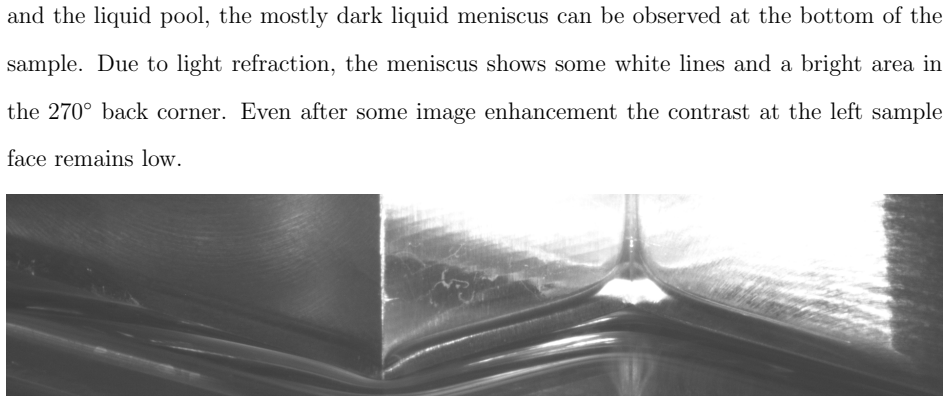
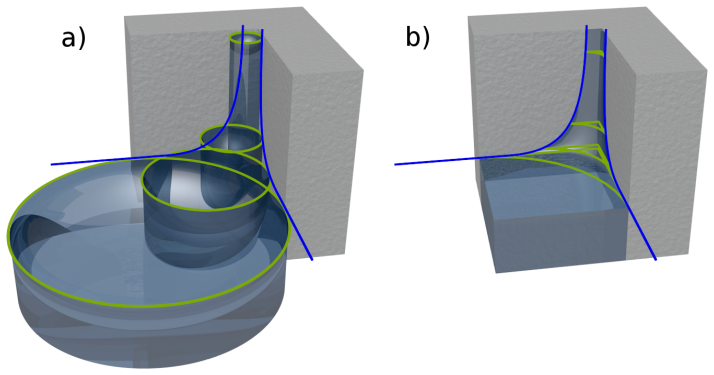
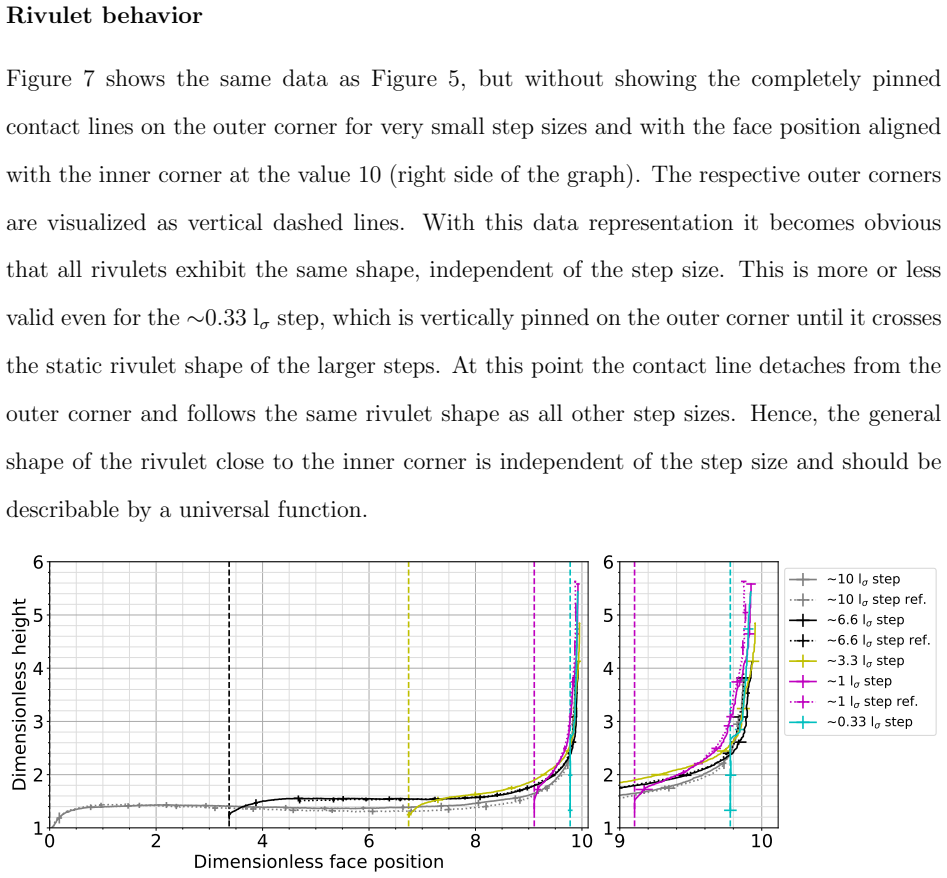
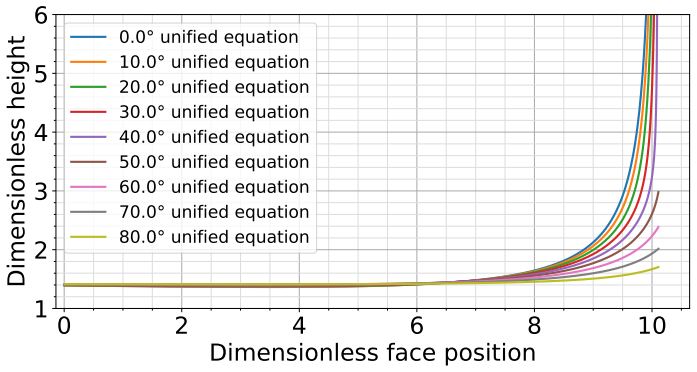
The central discovery is that the entire static contact line contour between a 90° outer corner and a 270° inner corner can be described by treating the rivulet as a stack of liquid slices normal to the main curvature. Each slice sits between two walls whose effective opening angle equals the local slope angle $\alpha=\arctan(-\partial h/\partial x)$. Combining the vertical-curvature rise of parallel-wall theory with the horizontal-curvature rise of arc theory gives a unified differential equation, and adding an empirical meniscus-height correction yields Eq. (8): $$h = \frac{\$\sigma$ \sin\left(\frac{\pi}{2}-\$\theta$-\frac{\$\alpha$}{2}\right)}{\cos\left(\frac{\$\alpha$}{2}\right)\rho g x} - 2x \left(f(\$\theta$)g(\sigma_B)$e^{{-4.48\sigma_B^{1/8}}$}\right).$$ This equation reduces to the parallel-wall law far from the corner ($\alpha=0$) and to the horizontal-arc law at the corner ($\alpha=90^\circ$). Unlike either parent model, it satisfies the Concus-Finn criterion: it gives an infinite rivulet for $\theta<45^\circ$, finite heights for $\theta>45^\circ$, and a flat surface at $\theta=90^\circ$. Measurements with silicone oil show that the rivulet shape near the inner corner is independent of step size and matches this unified equation for the largest step at low contact angle.
Load-bearing premise
The prediction hangs on treating the rivulet as independent slices normal to the main curvature, with each slice seeing an opening angle equal to the local slope and with the second curvature along the contact line neglected; this geometric equivalence is asserted rather than derived from the full three-dimensional capillary equation.
Editorial extensions
If this is right
- For contact angles below 45°, the inner-corner rivulet rises without bound; above 45° it reaches a finite equilibrium height that shrinks to a flat surface as the contact angle approaches 90°.
- Near the inner corner, the rivulet shape is universal: it stays the same for step sizes from about one capillary length up to at least ten capillary lengths.
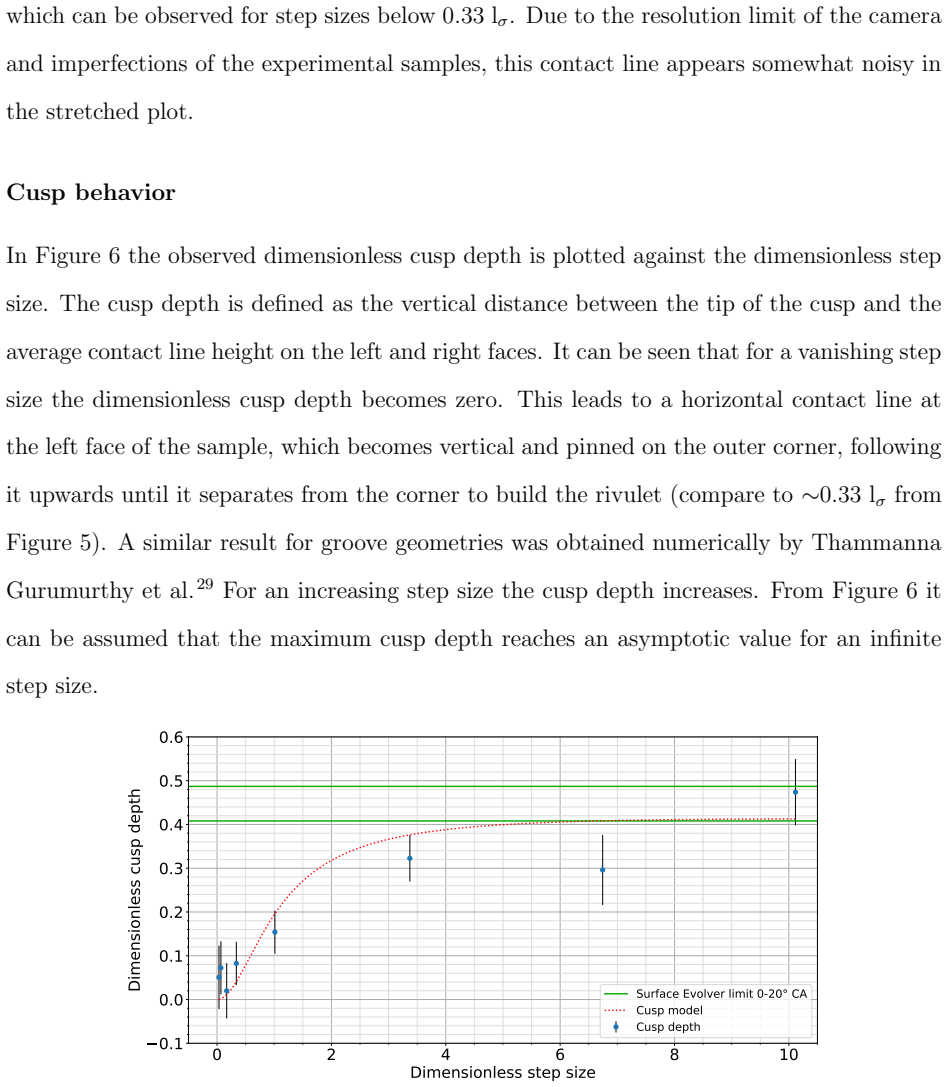
- The outer corner's cusp becomes shallower as the two corners move closer; when the step is smaller than the capillary length, the contact line pins at the outer corner and follows the vertical edge.
- The contact line contour on the face between the two corners can be computed from the unified equation together with the cusp-depth relation, giving a quantitative model of the whole contour rather than a pointwise rise height.
- The rivulet tip rise speed is independent of step size except for very small steps, and a model comparing the curvature of a pinned slice with an unhindered slice accounts for the slowdown at small steps.
Reading between the lines
- Editorial extension: the same slice construction could be applied to inner corners with opening angles different from 90°, where the bisector-distance identity would take a different form; the predicted threshold would then follow the general Concus-Finn angle rather than 45°.
- Editorial extension: Eq. (8) adds the empirical correction without blending near the corner, so a high-contact-angle experiment would reveal whether the correction is hiding a real geometric effect outside the parallel-wall regime where it was originally derived.
- Editorial extension: the tip-only dynamics suggested by the velocity data could be tested by tracking a rivulet tip on a sample with a sudden step-width change; the curvature-ratio model predicts an immediate speed change tied to the local geometry rather than to the overall step size.
Signed reviews
Editorial analysis
A structured set of objections, weighed in public.
Referee Report
Summary. The manuscript reports an experimental and theoretical study of spontaneous wetting on a flat vertical step bounded by a 90° outer corner and a 270° inner corner. For step sizes ranging from about 0.03 to 10 capillary lengths, the authors measure the full three-dimensional contact line contour, quantify the cusp at the outer corner and the rivulet at the inner corner, and track the early-time rivulet rise. The main theoretical contribution is a unified rivulet equation (Eq. 8) that is intended to combine a vertical-curvature model (Eqs. 2–4) with a horizontal-curvature model (Eq. 5), to reduce to each in the appropriate limits, and to be the first rivulet shape description that obeys the Concus–Finn criterion: infinite rise for contact angles below 45° and finite rise for angles above 45°. The paper also proposes an empirical cusp-depth relation and a simple model for the effect of small step size on rivulet rise speed.
Significance. If the unified equation were correctly derived and validated, the paper would provide a useful quantitative framework for wetting on surfaces containing interacting sharp corners, a setting relevant to coating, printing, and textured-surface wetting. The experimental work is careful: contact lines were measured manually with repeated averaging, error bars are shown, and step-size independence of the inner-corner rivulet shape is a clean and well-supported observation. The use of independent Surface Evolver calculations to bound the asymptotic cusp depth is a methodological strength. The claim about the Concus–Finn behavior is attractive but, as detailed below, is not currently supported because the central equation fails its own stated limit by a factor of two. The paper is therefore a promising experimental study whose main theoretical claim needs substantial repair.
major comments (4)
- [Rivulet behavior, Eq. (7)] The paper states that for α = 90°, Eq. (7) 'becomes equal to Eq. (5)'. Direct substitution gives h = σ sin(π/2 − θ − π/4) cos(π/4)/(ρg x) = σ(cos θ − sin θ)/(2ρg x), whereas Eq. (5) gives h = √2 σ sin(π/4 − θ)/(ρg x) = σ(cos θ − sin θ)/(ρg x). Thus Eq. (7) is exactly half of Eq. (5) at the stated limit. At θ = 0 both constituent models reduce to σ/(ρg x), but Eq. (7) gives σ/(2ρg x). Since Eq. (8) inherits this factor, the quantitative rivulet profile near the corner and the high-contact-angle curves in Fig. 10 rest on an internally inconsistent equation. The low-contact-angle agreement with the measured rivulet in Fig. 8 cannot validate the claimed unification until this limit is repaired.
- [Rivulet behavior, Figure 9 and derivation of Eq. (7)] The slice model behind Eq. (7) is an ansatz rather than a derivation from the three-dimensional Young–Laplace equation. The manuscript asserts that each slice normal to the main curvature sees two walls whose opening angle is equal to the local slope α and that the second curvature along the contact line is negligible ('tests... showed that its effect is negligible'), but no quantitative support or error estimate is given. Because the α = 90° limit fails by a factor of two, the geometrical equivalence is not merely unproven; the interpolation does not correctly reproduce either limiting model, so the physical grounding of Eq. (7) is currently missing.
- [Rivulet behavior, Eq. (8)] The Bullard correction term from Eq. (4) is applied in Eq. (8) to an inclined, nonparallel-wall slice geometry, although Eq. (4) was fitted to numerical simulations of menisci between parallel planar walls. The manuscript gives no justification for transferring this empirical correction to slices with opening angle α. The correction is not negligible at the intermediate distances where the model is compared with the measured rivulet in Fig. 8, so the apparent agreement shown there does not by itself validate Eq. (8).
- [Conclusions, high-contact-angle predictions] The conclusion that Eq. (8) is the first model able to 'quantitatively predict rivulet shapes for all contact angles between 0° and 90°' is overstated. The manuscript states that reproducible contact angles above 45° could not be achieved and that the high-angle comparison is only qualitative. Given the factor-of-two error in Eq. (7), the θ > 45° curves in Fig. 10 are unverified predictions rather than validated results, and the claim should be softened or supported by additional evidence.
minor comments (5)
- [Abstract] The abstract contains a typo: 'in uenced' should read 'influenced'.
- [Results and Discussion, General phenomena] In the text near Fig. 2 the phrase 'the contact line deviatesis no longer straight' appears corrupted; it should likely read 'the contact line deviates, i.e., it is no longer straight' or similar.
- [Figure 9 caption] The caption of Fig. 9 uses 'slides' where 'slices' is meant; this should be corrected.
- [Figures 5 and 7] The legend entries labeled 'ref.' are not defined in the captions; the definition given in the accompanying text should also appear in the figure captions for clarity.
- [Cusp behavior, Eq. (1)] Eq. (1) should be described more carefully as an empirical model with c_max as an input parameter taken from the Surface Evolver calculation, rather than as a prediction; the two outlier data points are attributed to calibration inaccuracies without supporting evidence, and this should be flagged as a limitation.
Circularity Check
Static rivulet model is self-contained; only minor fitted d appears in the secondary rivulet-speed model.
-
fitted input called prediction
[Rivulet dynamics section, after Eq. 10 and Figure 12 caption]
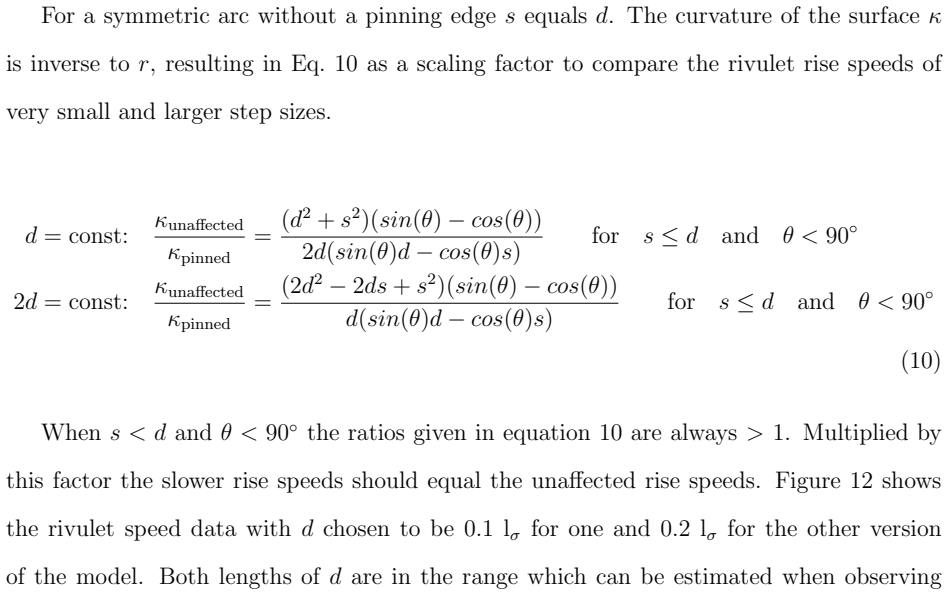
"Figure 12 shows the rivulet speed data with d chosen to be 0.1 lσ for one and 0.2 lσ for the other version of the model. Both lengths of d are in the range which can be estimated when observing Figure 7. ... it is capable of correcting the rivulet rise speeds in both versions using realistic values for d."
The scaling factor in Eq. 10 contains d, the rivulet tip width, and d is not measured or predicted independently: it is chosen from Figure 7 specifically to make the slower small-step speeds collapse onto the unaffected speeds in Figure 12. Thus the demonstrated agreement is partly produced by the fitted parameter rather than being an independent prediction. The authors explicitly call the model very simple and of empirical nature, and this step does not affect the static rivulet shape (Eqs. 7-8) or the cusp model, so the circularity is minor and secondary.
full rationale
The central static-rivulet derivation is self-contained rather than circular. Equation 7 is not fitted to the measured rivulet profiles; its two anchors are the parallel-wall rise expression (Eq. 3) at alpha = 0 and the horizontal-curvature expression (Eq. 5) at the steep limit, and its parameters are geometric (x, alpha, theta, rho, g, sigma). Equation 8 appends the independent numerical correction of Bullard et al. (Eq. 4) to the same equation, and Figure 8 is an external comparison against a measured ~10 l_sigma rivulet, not a fit. The cusp depth model (Eq. 1) uses c_max from an independent Surface Evolver calculation, so its agreement is not constructed from the cusp measurements. The Concus-Finn behavior claimed for Eq. 8 is inherited from the known horizontal-curvature branch (Eq. 5) and from the externally cited Concus-Finn condition, not from a fitted parameter. The only step that reduces to its own input is the rivulet-speed scaling: d in Eq. 10 is chosen from Figure 7 to make Figure 12 collapse, so the correction is partly a fitted curve collapse rather than an independent prediction; the authors themselves label this model empirical and very simple. This is secondary. I also note, as a correctness issue rather than circularity, that Eq. 7 at alpha = 90 degrees is actually half of Eq. 5, so the text's claim that it 'becomes equal to Eq. 5' is internally inconsistent; that is a modeling defect, not a circularity. No load-bearing self-citation chain was found: the overlapping-author citations (Refs. 28 and 29) are numerical confirmations of externally established criteria, and the central equations do not rely on those citations for their derivation.
Assumptions & free parameters
free parameters (2)
- c_max in cusp depth model (Eq. 1) =
0.408 l_sigma (Surface Evolver, 20-degree contact angle; 0.487 l_sigma for 0 degrees)
- d (rivulet tip width) =
0.1 l_sigma or 0.2 l_sigma
assumptions (5)
- domain assumption The liquid surface in the rivulet is decomposed into independent slices normal to the main curvature; the second curvature along the contact line is negligible.
- domain assumption An inclined slice sees two walls with an opening angle equal to the local slope angle alpha.
- domain assumption The Bullard empirical correction (Eq. 4), fitted for menisci between parallel walls, can be added to the wedge solution in Eq. 8 without modification.
- domain assumption The quasi-static contact line at dipping speed 0.01 mm/s reproduces the equilibrium meniscus.
- domain assumption The silicone oil contact angle is below 20 degrees and pinning is negligible.
Cite this review
Pith. "Pith review of The interaction of inner and outer surface corners during spontaneous wetting." pith.science (2026). https://pith.science/paper/J37JBNTQ
@misc{pith2026190801221,
  author       = {Pith},
  title        = {Pith review of: The interaction of inner and outer surface corners during spontaneous wetting},
  year         = {2026},
  howpublished = {\url{https://pith.science/paper/J37JBNTQ}},
  note         = {Machine review of arXiv:1908.01221}
}
read the original abstract
Real world surfaces can often be modeled as a collection of edges, corners, dents or spikes of varying roundness. These features exhibit individual spontaneous wetting behaviors comprising pinned contact lines, rivulets or cusps. If occurring in proximity to one another, as is often the case in applications, these wetting properties interact, resulting in an overall changed wetting pattern on the surface. Hence, there is considerable interest in understanding when, and to what extent, interactions occur, and how wetting then deviates from the wetting of isolated surface features. The present study addresses these questions by experimentally and theoretically studying the capillary interaction of sharp-edged 90{\deg} (outer) and 270{\deg} (inner) corners in proximity to one another. It is shown that the spontaneous wetting at the convex outer corner is in uenced by the concave inner corner even when they are separated by a distance of several times the capillary length, while the wetting of the inner corner takes place unaffected by the outer corner, except when the separating distance is much smaller than the capillary length. The final contact line shape at the inner corner is measured and theoretically modelled for contact angles up to 90{\deg}.
Figures

Figures from the paper (10 more)






Reference graph
Works this paper leans on
-
[1]
A two-scale model for discrete cell gravure roll caoting
Hewson, R.; Kapur, N.; Gaskell, P. A two-scale model for discrete cell gravure roll caoting. Chemical Engineering Science 2011, 66, 3666--3674
work page 2011
-
[2]
Schneider, R.; Losio, P. A.; Nüesch, F. A.; Heier, J. Gravure printed Ag/conductive polymer electrodes and simulation of their electrical properties. The International Journal of Advanced Manufacturing Technology 2019,
work page 2019
-
[3]
Advances in Modelling A-Pillar Water Overflow
Jilesen, J.; Gaylard, A.; Spruss, I.; Kuthada, T.; Wiedemann, J. Advances in Modelling A-Pillar Water Overflow. SAE Technical Paper Series 2015, 1
work page 2015
-
[4]
A Coupled Level Set and Volume of Fluid method for automotive exterior water management applications
Dianat, M.; Skarysz, M.; Garmory, A. A Coupled Level Set and Volume of Fluid method for automotive exterior water management applications. International Journal of Multiphase Flow 2017, 91, 19--38
work page 2017
-
[5]
Capillary Phenomena in Assemblies of Parallel Cylinders
Princen, H. Capillary Phenomena in Assemblies of Parallel Cylinders. Journal of Colloid and Interface Science 1969, 30, 69--75
work page 1969
-
[6]
Clanet, C.; Qu\'er\'e, D. Onset of menisci. Journal of Fluid Mechanics 2002, 460
work page 2002
-
[7]
A universal law for capillary rise in corners
Ponomarenko, A.; Qu\'er\'e, D.; Clanet, C. A universal law for capillary rise in corners. Journal of Fluid Mechanics 2011, 666, 146--154
work page 2011
-
[8]
Liquid Wetting, Transport, and Retention Properties of Fibrous Assemblies
Hsieh, Y.-L.; Yu, B. Liquid Wetting, Transport, and Retention Properties of Fibrous Assemblies. Textile Research Journal 1992, 62, 677--685
work page 1992
Show all 31 references
-
[9]
Wetting of fibers : theory and experiments
Qu\'er\'e, D.; Di Meglio, J.-M.; Brochard-Wyart, F. Wetting of fibers : theory and experiments. Revue de Physique Appliquée 1988, 23, 1023--1030
1988
-
[10]
Wetting behaviour and surface properties of technical bamboo fibres
Fuentes, C.; Tran, L.; Dupont-Gillain, C.; Vanderlinden, W.; De Feyter, S.; Van Vuure, A.; Verpoest, I. Wetting behaviour and surface properties of technical bamboo fibres. Colloids and Surfaces A 2011, 380, 89--99
2011
-
[11]
Wetting behavior of flax fibers as reinforcement for polypropylene
Aranberri-Askargorta, I.; Lampke, T.; Bismarck, A. Wetting behavior of flax fibers as reinforcement for polypropylene. Journal of Colloid and Interface Science 2003, 263, 580--589
2003
-
[12]
Wetting, Pore Structure, and Liquid Retention of Hydrolyzed Polyester Fabrics
Hsieh, Y.-L.; Miller, A.; Thompson, J. Wetting, Pore Structure, and Liquid Retention of Hydrolyzed Polyester Fabrics. Textile Research Journal 1996, 66, 1--10
1996
-
[13]
Wetting and absorbency of nonionic surfactant solutions on cotton fabrics
Kim, C.; Hsieh, Y.-L. Wetting and absorbency of nonionic surfactant solutions on cotton fabrics. Colloids and Surfaces A 2001, 187-188, 385--397
2001
-
[14]
Investigation of wicking, wetting and drying properties of acrylic knitted fabrics
Yanılmaz, M.; Kalaoğlu, F. Investigation of wicking, wetting and drying properties of acrylic knitted fabrics. Textile Research Journal 2012, 82, 820--831
2012
-
[15]
Rough wetting
Bico, J.; Tordeux, C.; Quéré, D. Rough wetting. Europhysics Letters 2001, 55, 214--220
2001
-
[16]
Palasantzas, G.; De Hosson, J. T. M. Wetting on rough surfaces. Acta Materialia 2001, 49, 3533--3538
2001
-
[17]
B.; Baker, C
Boreyko, J. B.; Baker, C. H.; Poley, C. R.; Chen, C.-H. Wetting and dewetting transitions on hierarchical superhydrophobic surfaces. Langmuir 2011, 27, 7502--7509
2011
-
[18]
Wetting on the microscale: shape of a liquid drop on a microstructured surface at different length scales
Papadopoulos, P.; Deng, X.; Mammen, L.; Drotlef, D.-M.; Battagliarin, G.; Li, C.; Müllen, K.; Landfester, K.; del Campo, A.; Butt, H.-J.; Vollmer, D. Wetting on the microscale: shape of a liquid drop on a microstructured surface at different length scales. Langmuir 2012, 28, 8...
2012
-
[19]
Wetting hysteresis induced by nanodefects
Giacomello, A.; Schimmele, L.; Dietrich, S. Wetting hysteresis induced by nanodefects. Proceedings of the National Academy of Sciences of the United States of America 2016, 113, E262--71
2016
-
[20]
R.; Yost, F
Rye, R. R.; Yost, F. G.; Mann, J. A. J. Wetting Kinetics in Surface Capillary Grooves. Langmuir 1996, 12, 4625--4627
1996
-
[21]
G.; Rye, R
Yost, F. G.; Rye, R. R.; Mann, J. A. J. Solder wetting kinetics in narrow V-grooves. Acta Materialia 1997, 45, 5337--5345
1997
-
[22]
J.; Lange, F
Seemann, R.; Brinkmann, M.; Kramer, E. J.; Lange, F. F.; Lipowsky, R. Wetting morphologies at microstructured surfaces. Proceedings of the National Academy of Sciences of the United States of America 2005, 102, 1848--1852
2005
-
[23]
Wetting and Dewetting of Complex Surface Geometries
Herminghaus, S.; Brinkmann, M.; Seemann, R. Wetting and Dewetting of Complex Surface Geometries. Annual Review of Materials Research 2008, 38, 101--121
2008
-
[24]
Characterization of capillary rise dynamics in parallel micro V-grooves
Deng, D.; Tang, Y.; Zeng, J.; Yang, S.; Shao, H. Characterization of capillary rise dynamics in parallel micro V-grooves. International Journal of Heat and Mass Transfer 2014, 77, 311--320
2014
-
[25]
J.; Craig, R
O'Brien, W. J.; Craig, R. G.; Peyton, F. A. Capillary Penetration between Dissimilar Solids. Journal of Colloid and Interface Science 1968, 26, 500--508
1968
-
[26]
Capillary Rise in Tubes with Sharp Grooves
Tang, L.-H.; Tang, Y. Capillary Rise in Tubes with Sharp Grooves. Journal de Physique II 1994,
1994
-
[27]
On the behavior of a capillary surface in a wedge
Concus, P.; Finn, R. On the behavior of a capillary surface in a wedge. Proceedings of the National Academy of Sciences of the United States of America 1969, 63, 292--299
1969
-
[28]
V.; Tropea, C.; Garoff, S
Thammanna Gurumurthy, V.; Rettenmaier, D.; Roisman, I. V.; Tropea, C.; Garoff, S. Computations of spontaneous rise of a rivulet in a corner of a vertical square capillary. Colloids and Surfaces A: Physicochemical and Engineering Aspects 2018, 544, 118--126
2018
-
[29]
V.; Tropea, C.; Garoff, S
Thammanna Gurumurthy, V.; Roisman, I. V.; Tropea, C.; Garoff, S. Spontaneous rise in open rectangular channels under gravity. Journal of Colloid and Interface Science 2018, 527, 151--158
2018
-
[30]
Brakke, K. A. The Surface Evolver. Experimental Mathematics 1992, 1, 141--165
1992
-
[31]
at Darmstadt, Darmstadt, Germany Maximilian Hartmann [NMF] Institute for Nano- and Microfluidics, Technische Universit\
Bullard, J. W.; Garboczi, E. J. Capillary rise between planar surfaces. Physical Review: E 2009, 79, 011604 mcitethebibliography article_langmuir_19.tex0000664000000000000000000013672613521356516014160 0ustar rootroot [journal=langd5,manuscript=article] achemso [version=3] mhc...
2009
Reviewed August 14, 2026 · model on record in the stance chip above.
Discussion (0). Continue with ORCID to comment.