Multilevel Stochastic Plug-and-Play for Sparse-View CT Reconstruction
Pith reviewed 2026-06-26 00:31 UTC · model grok-4.3
The pith
Multilevel stochastic Plug-and-Play reconstructs sparse-view CT images at speeds comparable to state-of-the-art while matching their quality.
A machine-rendered reading of the paper's core claim, the machinery that carries it, and where it could break.
Core claim
In the stochastic Plug-and-Play setting, enforcing prior coherence across resolution levels normally demands multiple fine-scale denoiser calls to estimate the required gradient corrections. When the multilevel steps are executed inside the approximation spaces of a multiresolution analysis, the structure of the wavelet decomposition makes the prior-coherence correction vanish in expectation. This property removes the need to compute those expensive fine-level stochastic prior gradients for the coarse-level updates, yielding an accelerated reconstruction algorithm whose output quality remains comparable to single-level stochastic PnP on sparse-view CT data.
What carries the argument
Multilevel stochastic Plug-and-Play (ML-SPnP) executed in multiresolution analysis approximation spaces, where the wavelet decomposition structure makes the prior-coherence correction vanish in expectation.
If this is right
- ML-SPnP produces SVCT reconstructions of quality comparable to state-of-the-art single-level stochastic PnP.
- Runtime is substantially lower because fine-level stochastic prior gradients need not be estimated for coarse corrections.
- The acceleration is obtained by restricting multilevel steps to MRA approximation spaces.
- The method inherits the robustness properties of stochastic PnP while inheriting the speed of multilevel schemes.
Where Pith is reading between the lines
- The same vanishing-expectation property could be tested in other inverse problems that already use stochastic PnP, such as limited-angle tomography or MRI.
- If the result holds for additional wavelet families, deeper multilevel hierarchies become feasible without linear cost growth.
- Faster per-iteration times might allow the method to be embedded inside real-time or adaptive acquisition protocols for low-dose CT.
- The approach leaves open whether similar expectation cancellations exist for non-wavelet multiresolution bases.
Load-bearing premise
The structure of the wavelet decomposition causes the prior-coherence correction to vanish in expectation.
What would settle it
Measure the expected value of the prior-coherence correction term on SVCT data using the chosen wavelet family; if the expectation is not statistically indistinguishable from zero, the runtime saving disappears.
Figures
read the original abstract
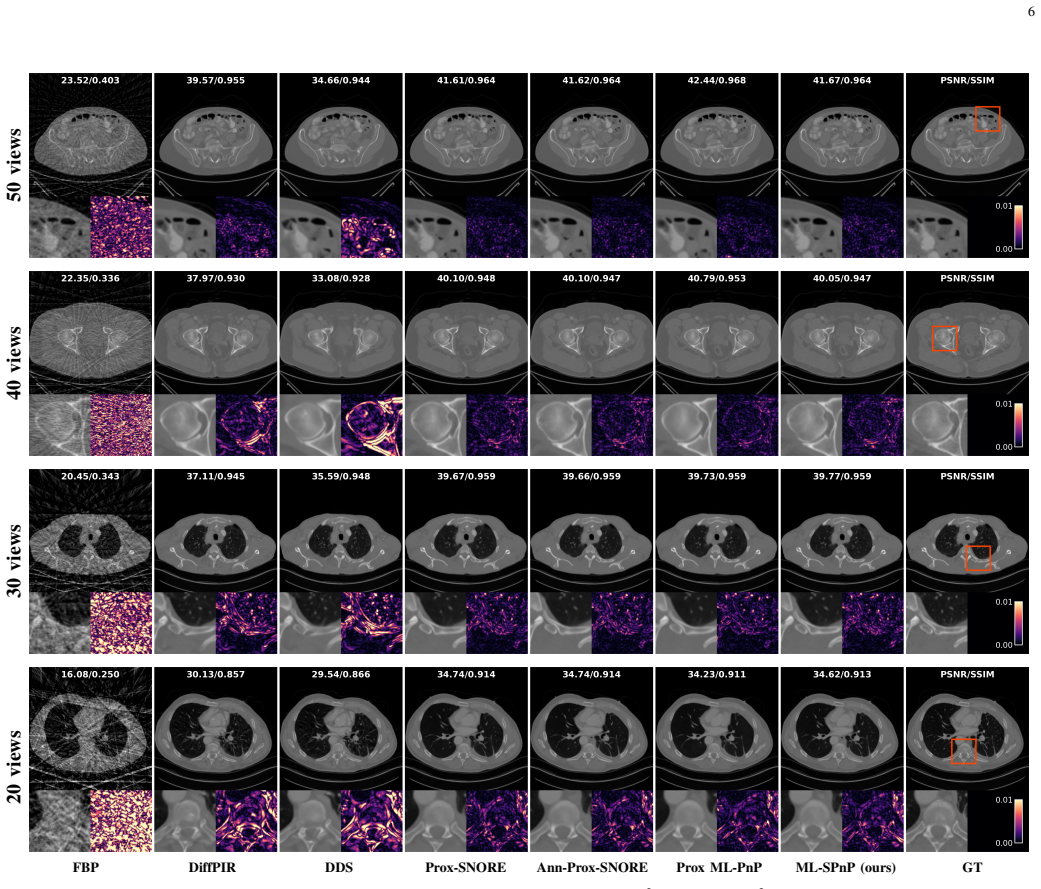
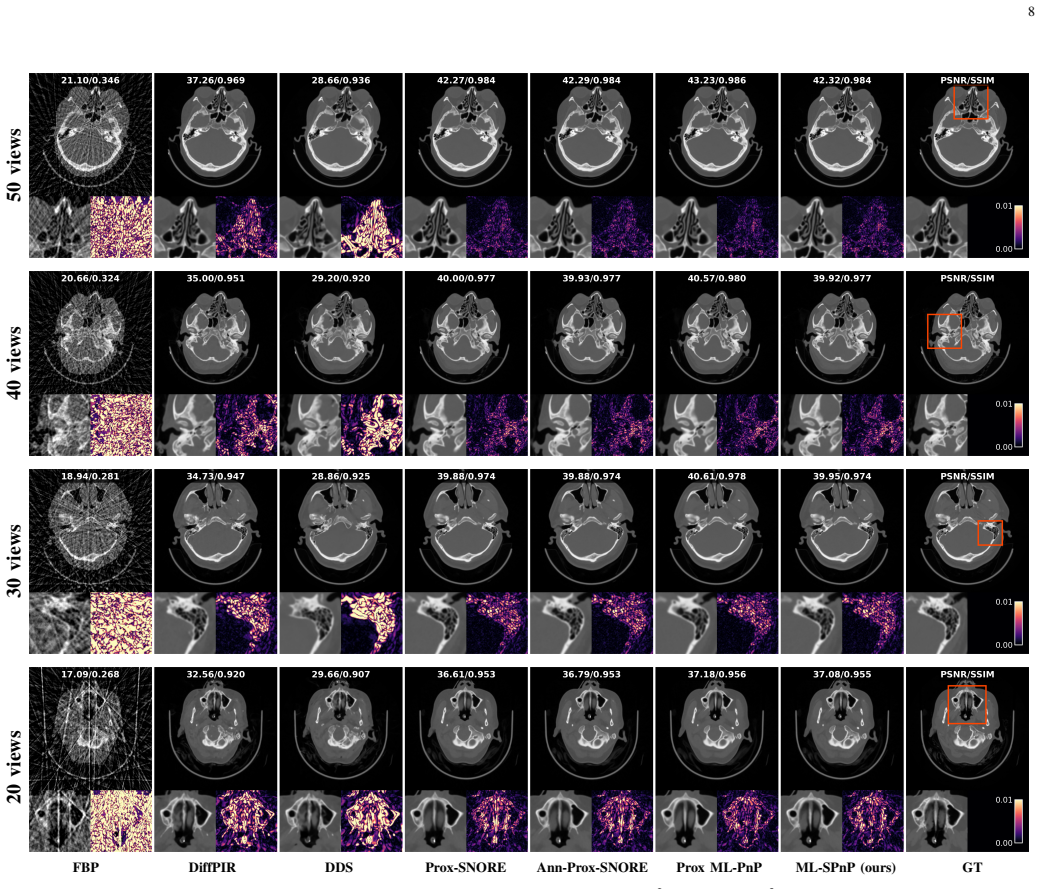
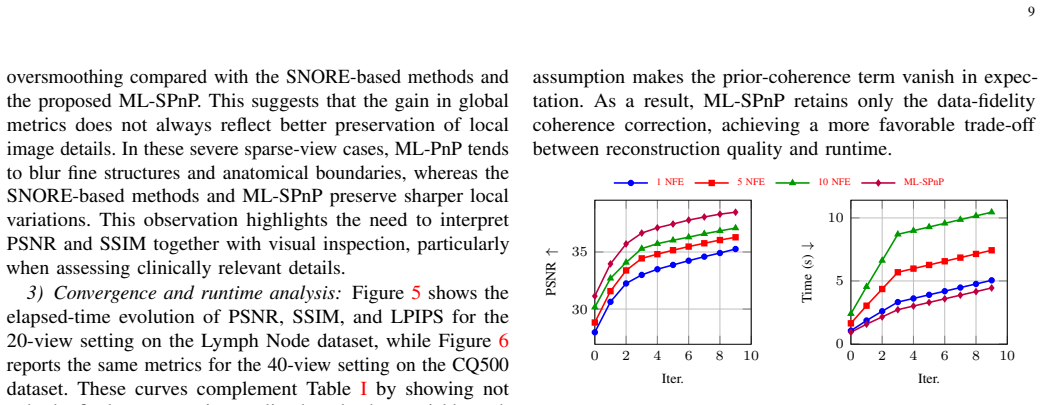
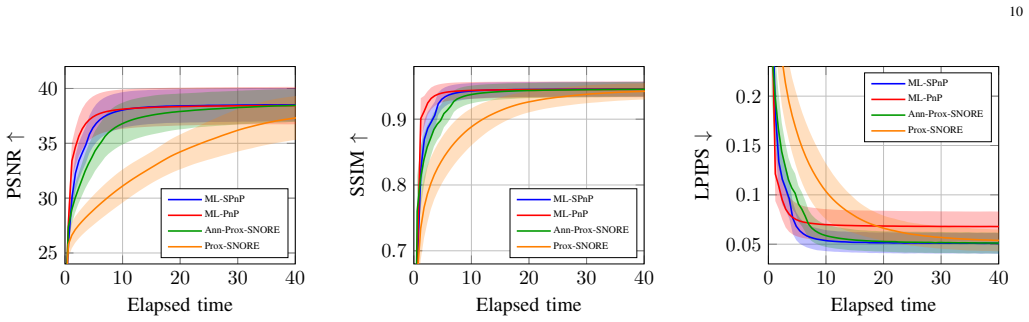
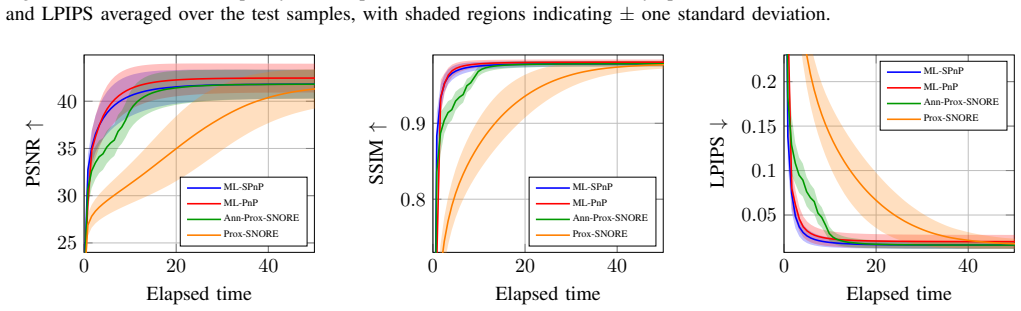
Sparse-view computed tomography (SVCT) reduces radiation exposure and acquisition time, but the limited number of projection views makes the reconstruction problem severely ill-posed and leads to streak artifacts when analytical methods are used. Plug-and-Play (PnP) methods provide an effective way to combine data fidelity with learned image priors, while stochastic PnP methods further improve robustness by matching the denoiser input distribution through re-noising. However, these methods often require many iterations to converge, which limits their practical efficiency. In this work, we propose a multilevel (ML) stochastic PnP method for SVCT that accelerates stochastic PnP reconstruction. We highlight that, in the stochastic setting, directly enforcing prior coherence across levels would require accurately estimating fine-level prior gradients through multiple denoiser function evaluations, which substantially increases the computational cost. Motivated by this observation, we perform the multilevel steps in multiresolution analysis (MRA) approximation spaces. This choice is supported by the structure of the wavelet decomposition, which causes the prior-coherence correction to vanish in expectation, thereby avoiding costly estimation of fine-level stochastic prior gradients for the coarse-level corrections. Experiments on SVCT reconstruction show that our method, called Multilevel Stochastic Plug-and-Play (ML-SPnP), achieves reconstruction quality comparable to state-of-the-art methods while substantially reducing runtime.
Editorial analysis
A structured set of objections, weighed in public.
Referee Report
Summary. The paper proposes Multilevel Stochastic Plug-and-Play (ML-SPnP) for sparse-view CT (SVCT) reconstruction. It performs multilevel corrections within multiresolution analysis (MRA) approximation spaces, asserting that the structure of the wavelet decomposition causes the prior-coherence correction term to vanish in expectation. This is claimed to avoid repeated fine-level stochastic denoiser evaluations required for prior-coherence enforcement. Experiments are said to show reconstruction quality comparable to state-of-the-art methods with substantially reduced runtime.
Significance. If the vanishing-in-expectation property holds for the chosen stochastic PnP noise model, denoiser, and wavelet family, and if the runtime/quality claims are substantiated with quantitative evidence, the approach would offer a structurally motivated way to accelerate stochastic PnP iterations for ill-posed inverse problems without additional per-iteration cost. This could be relevant for practical deployment of learned-prior methods in CT.
major comments (1)
- [Abstract] Abstract: The runtime-reduction claim rests on the assertion that 'the structure of the wavelet decomposition... causes the prior-coherence correction to vanish in expectation.' No derivation, explicit expectation calculation, or numerical verification is referenced for the specific stochastic PnP noise model and wavelet family. If this expectation is not exactly zero, the claimed computational saving does not materialize and the method reverts to the cost it seeks to avoid.
minor comments (1)
- [Abstract] Abstract: Experimental claims are stated without any quantitative metrics (e.g., PSNR/SSIM), dataset descriptions, baseline methods, or runtime numbers, making the 'comparable quality... substantially reducing runtime' statement impossible to assess from the given text.
Simulated Author's Rebuttal
We thank the referee for their detailed review and constructive feedback on our manuscript. We address the major comment point-by-point below.
read point-by-point responses
-
Referee: [Abstract] Abstract: The runtime-reduction claim rests on the assertion that 'the structure of the wavelet decomposition... causes the prior-coherence correction to vanish in expectation.' No derivation, explicit expectation calculation, or numerical verification is referenced for the specific stochastic PnP noise model and wavelet family. If this expectation is not exactly zero, the claimed computational saving does not materialize and the method reverts to the cost it seeks to avoid.
Authors: We agree that the abstract would benefit from an explicit pointer to the supporting analysis. In the revised version we will expand the relevant paragraph in Section 3 to include the full expectation calculation: under the orthogonal wavelet decomposition and the zero-mean stochastic noise model used in the PnP iteration, the cross-term between the prior-coherence correction and the detail coefficients integrates to zero by construction of the MRA approximation spaces. We will also add a short numerical check (Monte-Carlo estimate of the expectation on a held-out phantom) in the supplementary material to confirm the property holds for the specific denoiser and wavelet family employed. revision: yes
Circularity Check
No circularity: efficiency claim rests on asserted wavelet property, not self-referential reduction
full rationale
The abstract presents the runtime reduction as following from the wavelet decomposition structure causing prior-coherence correction to vanish in expectation. This is framed as a direct consequence of MRA properties rather than a fitted parameter, self-citation chain, or definition that loops back to the method's own outputs. No equations, derivations, or self-citations are exhibited that would make any prediction equivalent to its inputs by construction. The derivation chain is therefore self-contained against external benchmarks.
Axiom & Free-Parameter Ledger
axioms (1)
- domain assumption Wavelet decomposition structure causes the prior-coherence correction to vanish in expectation
Reference graph
Works this paper leans on
-
[1]
Computed tomography—an increasing source of radiation exposure,
D. J. Brenner and E. J. Hall, “Computed tomography—an increasing source of radiation exposure,” New England Journal of Medicine , vol. 357, no. 22, pp. 2277–2284, 2007. DOI: 10.1056/NEJMra072149
-
[2]
Strategies for reducing radiation dose in CT,
C. H. McCollough, A. N. Primak, N. Braun, J. Kofler, L. Yu, and J. Christner, “Strategies for reducing radiation dose in CT,” Radiologic Clinics of North America, vol. 47, no. 1, p. 27, 2009. DOI: 10.1016/j.rcl.2008.10.006
-
[3]
Natterer, The mathematics of computerized tomography
F. Natterer, The mathematics of computerized tomography . SIAM, 2001, ISBN : 0898714931
2001
-
[4]
Monotonic algorithms for transmission tomogra- phy,
H. Erdogan and J. A. Fessler, “Monotonic algorithms for transmission tomogra- phy,” in 5th IEEE EMBS International Summer School on Biomedical Imaging, 2002., IEEE, 2002, 14–pp. DOI: 10.1109/SSBI.2002.1233986. 11
-
[5]
E. Y . Sidky and X. Pan, “Image reconstruction in circular cone-beam computed tomography by constrained, total-variation minimization,” Physics in Medicine & Biology, vol. 53, no. 17, pp. 4777–4807, 2008. DOI: 10.1088/0031-9155/53/ 17/021
-
[6]
A First–Order Primal–Dual Algo- rithm for Convex Problems with Applications to Imaging
A. Chambolle and T. Pock, “A first-order primal-dual algorithm for convex problems with applications to imaging,” Journal of Mathematical Imaging and Vision, vol. 40, no. 1, pp. 120–145, 2011. DOI: 10.1007/s10851-010-0251-1
-
[7]
Sparse- view x-ray CT reconstruction via total generalized variation regularization,
S. Niu, Y . Gao, Z. Bian, J. Huang, W. Chen, G. Yu, Z. Liang, and J. Ma, “Sparse- view x-ray CT reconstruction via total generalized variation regularization,” Physics in Medicine & Biology , vol. 59, no. 12, pp. 2997–3017, 2014. DOI: 10.1088/0031-9155/59/12/2997
-
[8]
Low-dose CT with a residual encoder-decoder convolutional neural network,
H. Chen, Y . Zhang, M. K. Kalra, F. Lin, Y . Chen, P. Liao, J. Zhou, and G. Wang, “Low-dose CT with a residual encoder-decoder convolutional neural network,” IEEE Transactions on Medical Imaging , vol. 36, no. 12, pp. 2524–2535, 2017. DOI: 10.1109/TMI.2017.2715284
-
[9]
Deep convolutional neural network for inverse problems in imaging,
K. H. Jin, M. T. McCann, E. Froustey, and M. Unser, “Deep convolutional neural network for inverse problems in imaging,” IEEE Transactions on Image Processing, vol. 26, no. 9, pp. 4509–4522, 2017. DOI: 10.1109/TIP.2017.2713099
-
[10]
J. Adler and O. ¨Oktem, “Learned primal-dual reconstruction,” IEEE Transactions on Medical Imaging , vol. 37, no. 6, pp. 1322–1332, 2018. DOI: 10.1109/TMI. 2018.2799231
work page doi:10.1109/tmi 2018
-
[11]
3D helical CT reconstruction with a memory efficient learned primal-dual architecture,
J. Rudzusika, B. Baji ´c, T. Koehler, and O. ¨Oktem, “3D helical CT reconstruction with a memory efficient learned primal-dual architecture,” IEEE Transactions on Computational Imaging , vol. 10, pp. 1414–1424, 2024. DOI: 10.1109/TCI. 2024.3463485
work page doi:10.1109/tci 2024
-
[12]
arXiv preprint arXiv:2601.22259 (2026).https://doi.org/10.48550/arXiv.2601
R. V o and J. Tachella, “Efficient unrolled networks for large-scale 3D inverse problems,” arXiv preprint arXiv:2601.02141 , 2026. DOI: 10.48550/arXiv.2601. 02141
-
[13]
Denoising diffusion probabilistic models,
J. Ho, A. Jain, and P. Abbeel, “Denoising diffusion probabilistic models,” Advances in neural information processing systems , vol. 33, pp. 6840–6851,
-
[14]
DOI: 10.48550/arXiv.2006.11239
work page internal anchor Pith review Pith/arXiv arXiv doi:10.48550/arxiv.2006.11239 2006
-
[15]
Diffusion posterior sampling for general noisy inverse problems,
H. Chung, J. Kim, M. T. Mccann, M. L. Klasky, and J. C. Ye, “Diffusion posterior sampling for general noisy inverse problems,” arXiv preprint arXiv:2209.14687 ,
-
[16]
DOI: 10.48550/arXiv.2209.14687
work page internal anchor Pith review Pith/arXiv arXiv doi:10.48550/arxiv.2209.14687
-
[17]
Uncrtaints: Uncertainty quantification for cloud removal in optical satellite time series,
Y . Zhu, K. Zhang, J. Liang, J. Cao, B. Wen, R. Timofte, and L. Van Gool, “Denoising diffusion models for plug-and-play image restoration,” in Proceedings of the IEEE/CVF conference on computer vision and pattern recognition , 2023, pp. 1219–1229. DOI: 10.1109/CVPRW59228.2023.00129
-
[18]
DOLCE: A model-based probabilistic diffusion framework for limited-angle CT reconstruction,
J. Liu, R. Anirudh, J. J. Thiagarajan, S. He, K. A. Mohan, U. S. Kamilov, and H. Kim, “DOLCE: A model-based probabilistic diffusion framework for limited-angle CT reconstruction,” in Proceedings of the IEEE/CVF international conference on computer vision , 2023, pp. 10 498–10 508. DOI: 10 . 1109 / ICCV51070.2023.00963
arXiv 2023
-
[19]
H. Chung, D. Ryu, M. T. McCann, M. L. Klasky, and J. C. Ye, “Solving 3D inverse problems using pre-trained 2D diffusion models,” in Proceedings of the IEEE/CVF conference on computer vision and pattern recognition , 2023, pp. 22 542–22 551. DOI: 10.1109/CVPR52729.2023.02159
-
[20]
Decomposed diffusion sampler for accelerating large-scale inverse problems,
H. Chung, S. Lee, and J. C. Ye, “Decomposed diffusion sampler for accelerating large-scale inverse problems,” in International conference on learning represen- tations, vol. 2024, 2024, pp. 38 922–38 949. DOI: 10.48550/arXiv.2303.05754
-
[21]
CT reconstruction using diffusion posterior sampling conditioned on a nonlinear measurement model,
S. Li, X. Jiang, M. Tivnan, G. J. Gang, Y . Shen, and J. W. Stayman, “CT reconstruction using diffusion posterior sampling conditioned on a nonlinear measurement model,” Journal of Medical Imaging , vol. 11, no. 4, pp. 043 504– 043 504, 2024. DOI: 10.1117/1.JMI.11.4.043504
-
[22]
Hallucination index: An image quality metric for generative reconstruction models,
M. Tivnan, S. Yoon, Z. Chen, X. Li, D. Wu, and Q. Li, “Hallucination index: An image quality metric for generative reconstruction models,” in International Conference on Medical Image Computing and Computer-Assisted Intervention , Springer, 2024, pp. 449–458. DOI: 10.1007/978-3-031-72117-5 42
-
[23]
A Stability Benchmark of Generative Regularizers for Inverse Problems
A. Denker, J. Hertrich, and S. Neumayer, “A stability benchmark of generative regularizers for inverse problems,” arXiv preprint arXiv:2605.10076 , 2026. DOI: 10.48550/arXiv.2605.10076
work page internal anchor Pith review Pith/arXiv arXiv doi:10.48550/arxiv.2605.10076 2026
-
[24]
Plug-and-play priors for model based reconstruction,
S. V . Venkatakrishnan, C. A. Bouman, and B. Wohlberg, “Plug-and-play priors for model based reconstruction,” in 2013 IEEE global conference on signal and information processing, IEEE, 2013, pp. 945–948. DOI: 10.1109/GlobalSIP. 2013.6737048
-
[25]
Plug-and-play ADMM for image restoration: Fixed-point convergence and applications,
S. H. Chan, X. Wang, and O. A. Elgendy, “Plug-and-play ADMM for image restoration: Fixed-point convergence and applications,” IEEE Transactions on Computational Imaging, vol. 3, no. 1, pp. 84–98, 2016. DOI: 10.1109/TCI.2016. 2629286
-
[26]
Y . Romano, M. Elad, and P. Milanfar, “The little engine that could: Regularization by denoising (RED),”SIAM journal on imaging sciences, vol. 10, no. 4, pp. 1804– 1844, 2017. DOI: 10.1137/16M1102884
-
[27]
Plug-and- play image restoration with deep denoiser prior,
K. Zhang, Y . Li, W. Zuo, L. Zhang, L. Van Gool, and R. Timofte, “Plug-and- play image restoration with deep denoiser prior,” IEEE Transactions on Pattern Analysis and Machine Intelligence , vol. 44, no. 10, pp. 6360–6376, 2021. DOI: 10.1109/TPAMI.2021.3088914
-
[28]
URL https://doi.org/10.48550/arXiv.2501
S. Hurault, A. Leclaire, and N. Papadakis, “Gradient step denoiser for convergent plug-and-play,” arXiv preprint arXiv:2110.03220 , 2021. DOI: 10.48550/arXiv. 2110.03220
work page internal anchor Pith review doi:10.48550/arxiv 2021
-
[29]
Proximal denoiser for convergent plug-and-play optimization with nonconvex regularization,
S. Hurault, A. Leclaire, and N. Papadakis, “Proximal denoiser for convergent plug-and-play optimization with nonconvex regularization,” in International Conference on Machine Learning , PMLR, 2022, pp. 9483–9505. DOI: 10.48550/ arXiv.2201.13256
arXiv 2022
-
[30]
Plug-and-Play image restoration with Stochastic deNOising REgularization
M. Renaud, J. Prost, A. Leclaire, and N. Papadakis, “Plug-and-play image restoration with stochastic denoising regularization,” in Forty-first International Conference on Machine Learning , 2024. DOI: 10.48550/arXiv.2402.01779
work page internal anchor Pith review Pith/arXiv arXiv doi:10.48550/arxiv.2402.01779 2024
-
[31]
Stochastic Generative Plug-and-Play Priors
C. Y . Park, E. P. Chandler, Y . Hu, M. T. McCann, C. Garcia-Cardona, B. Wohlberg, and U. S. Kamilov, “Stochastic generative plug-and-play priors,” arXiv preprint arXiv:2604.03603 , 2026. DOI: 10.48550/arXiv.2604.03603
work page internal anchor Pith review Pith/arXiv arXiv doi:10.48550/arxiv.2604.03603 2026
-
[32]
Rethinking VLMs and LLMs for Image Classification.arXiv e-prints, art
S. Martin, A. Gagneux, P. Hagemann, and G. Steidl, “PnP-flow: Plug-and-play image restoration with flow matching,” in International Conference on Learning Representations, vol. 2025, 2025, pp. 45 466–45 492. DOI: 10.48550/arXiv.2410. 02423
-
[33]
Gradient Step Plug-and-Play Model for Dental Cone-Beam CT Reconstruction
I. Tatachak, L. Kabongo, N. Papadakis, X. Ripoche, and S. Rit, “Gradient step plug-and-play model for dental cone-beam CT reconstruction,” arXiv preprint arXiv:2605.28124, 2026. DOI: 10.48550/arXiv.2605.28124
work page internal anchor Pith review Pith/arXiv arXiv doi:10.48550/arxiv.2605.28124 2026
-
[34]
A multigrid approach to discretized optimization problems,
S. G. Nash, “A multigrid approach to discretized optimization problems,” Optimization Methods and Software , vol. 14, no. 1-2, pp. 99–116, 2000. DOI: 10.1080/10556780008805795
-
[35]
Multilevel FISTA for image restoration,
G. Lauga, E. Riccietti, N. Pustelnik, and P. Gon c ¸alves, “Multilevel FISTA for image restoration,” in ICASSP 2023-2023 IEEE International Conference on Acoustics, Speech and Signal Processing (ICASSP) , IEEE, 2023, pp. 1–5. DOI: 10.48550/arXiv.2210.15940
-
[36]
IML FISTA: A multilevel framework for inexact and inertial forward-backward. application to image restoration,
G. Lauga, E. Riccietti, N. Pustelnik, and P. Gonc ¸alves, “IML FISTA: A multilevel framework for inexact and inertial forward-backward. application to image restoration,” SIAM Journal on Imaging Sciences , vol. 17, no. 3, pp. 1347–1376,
-
[37]
DOI: 10.1137/23M1582345
-
[38]
Multilevel plug-and-play image restoration,
N. Laurent, J. Tachella, E. Riccietti, and N. Pustelnik, “Multilevel plug-and-play image restoration,” IEEE Transactions on Computational Imaging , 2025. DOI: 10.1109/TCI.2025.3640427
-
[39]
Convergence analysis of a proximal stochastic denoising regularization algorithm,
M. Renaud, J. Hermant, and N. Papadakis, “Convergence analysis of a proximal stochastic denoising regularization algorithm,” in International Conference on Scale Space and Variational Methods in Computer Vision , Springer, 2025, pp. 17–29. DOI: 10.1007/978-3-031-92369-2 2
-
[40]
C. Phung-Ngoc, A. Bousse, A. De Paepe, H. -P. Dang, O. Saut, and D. Visvikis, “Joint reconstruction of activity and attenuation in PET by diffusion posterior sampling in wavelet coefficient space,” arXiv preprint arXiv:2505.18782 , 2025. DOI: 10.48550/arXiv.2505.18782
work page internal anchor Pith review Pith/arXiv arXiv doi:10.48550/arxiv.2505.18782 2025
-
[41]
Adaptive diffusion models for sparse-view motion-corrected head cone-beam CT,
A. De Paepe, A. Bousse, C. Phung-Ngoc, Y . Mellak, and D. Visvikis, “Adaptive diffusion models for sparse-view motion-corrected head cone-beam CT,” IEEE Transactions on Radiation and Plasma Medical Sciences , vol. 10, no. 5, pp. 662– 672, 2026. DOI: 10.1109/TRPMS.2025.3637124
-
[42]
N. Parikh and S. Boyd, “Proximal algorithms,” Foundations and Trends in optimization, vol. 1, no. 3, pp. 127–239, 2014. DOI: 10.1561/2400000003
-
[43]
Hackbusch, Multi-grid methods and applications
W. Hackbusch, Multi-grid methods and applications . Springer Science & Business Media, 2013. DOI: 10.1137/1.9781611971057.appb
-
[44]
A multilevel proximal gradient algorithm for a class of composite optimization problems,
P. Parpas, “A multilevel proximal gradient algorithm for a class of composite optimization problems,” SIAM Journal on Scientific Computing , vol. 39, no. 5, S681–S701, 2017. DOI: 10.1137/16M1082299
-
[45]
On solving the densest k-subgraph problem on large graphs,
C. P. Ho, M. Ko ˇcvara, and P. Parpas, “Newton-type multilevel optimization method,” Optimization Methods and Software , vol. 37, no. 1, pp. 45–78, 2022. DOI: 10.1080/10556788.2019.1700256
-
[46]
A line search multigrid method for large-scale nonlinear optimization,
Z. Wen and D. Goldfarb, “A line search multigrid method for large-scale nonlinear optimization,” SIAM Journal on Optimization, vol. 20, no. 3, pp. 1478– 1503, 2010. DOI: 10.1137/08071524X
-
[47]
W. L. Briggs, V . E. Henson, and S. F. McCormick, A multigrid tutorial . SIAM, 2000, ISBN : 9780898714623
2000
-
[48]
Nonlinear multigrid methods of optimization in bayesian tomographic image reconstruction,
C. A. Bouman and K. D. Sauer, “Nonlinear multigrid methods of optimization in bayesian tomographic image reconstruction,” in Neural and Stochastic Methods in Image and Signal Processing , SPIE, vol. 1766, 1992, pp. 296–306. DOI: 10.1117/12.130838
-
[49]
First-order geometric multilevel optimization for discrete tomography,
J. Plier, F. Savarino, M. Ko ˇcvara, and S. Petra, “First-order geometric multilevel optimization for discrete tomography,” in International Conference on Scale Space and Variational Methods in Computer Vision, Springer, 2021, pp. 191–203. DOI: 10.1007/978-3-030-75549-2 16
-
[50]
Multilevel bregman proximal gradient descent,
Y . Elshiaty and S. Petra, “Multilevel bregman proximal gradient descent,” SIAM Journal on Imaging Sciences , vol. 19, no. 2, pp. 913–942, 2026. DOI: 10.1137/ 25M1775725
2026
-
[51]
Mallat, A wavelet tour of signal processing
S. Mallat, A wavelet tour of signal processing . Elsevier, 1999. DOI: 10.1016/ B978-0-12-374370-1.X0001-8
1999
-
[52]
A flexible block-coordinate forward-backward algorithm for non-smooth and non- convex optimization,
L. Brice ˜no-Arias, P. Gonc ¸alves, G. Lauga, N. Pustelnik, and E. Riccietti, “A flexible block-coordinate forward-backward algorithm for non-smooth and non- convex optimization,” arXiv preprint arXiv:2510.26477 , 2025. DOI: 10.48550/ arXiv.2510.26477
arXiv 2025
-
[53]
A new 2.5D representation for lymph node detection using random sets of deep convolutional neural network observations,
H. R. Roth, L. Lu, A. Seff, K. M. Cherry, J. Hoffman, S. Wang, J. Liu, E. Turkbey, and R. M. Summers, “A new 2.5D representation for lymph node detection using random sets of deep convolutional neural network observations,” in International conference on medical image computing and computer-assisted intervention, Springer, 2014, pp. 520–527. DOI: 0.1007/9...
2014
-
[54]
Deep learning algorithms for detection of critical findings in head CT scans: A retrospective study,
S. Chilamkurthy, R. Ghosh, S. Tanamala, M. Biviji, N. G. Campeau, V . K. Venugopal, V . Mahajan, P. Rao, and P. Warier, “Deep learning algorithms for detection of critical findings in head CT scans: A retrospective study,” The Lancet, vol. 392, no. 10162, pp. 2388–2396, 2018. DOI: 10 . 1016 / S0140 - 6736(18)31645-3
2018
-
[55]
X. Jiang, G. J. Gang, and J. W. Stayman, “CTorch: PyTorch-compatible GPU- accelerated auto-differentiable projector toolbox for computed tomography,” arXiv preprint arXiv:2503.16741 , 2025. DOI: 10.48550/arXiv.2503.16741
-
[56]
Statistical image reconstruction for polyenergetic x-ray computed tomography,
I. A. Elbakri and J. A. Fessler, “Statistical image reconstruction for polyenergetic x-ray computed tomography,” IEEE Transactions on Medical Imaging , vol. 21, no. 2, pp. 89–99, 2002. DOI: 10.1109/42.993128
-
[57]
Deepinverse: A python package for solving imaging inverse problems with deep learning,
J. Tachella, M. Terris, et al. , “Deepinverse: A python package for solving imaging inverse problems with deep learning,” Journal of Open Source Software, 12 vol. 10, no. 115, p. 8923, 2025. DOI: 10.21105/joss.08923. [Online]. Available: https://doi.org/10.21105/joss.08923
-
[58]
Equivariant plug-and- play image reconstruction,
M. Terris, T. Moreau, N. Pustelnik, and J. Tachella, “Equivariant plug-and- play image reconstruction,” in Proceedings of the IEEE/CVF conference on computer vision and pattern recognition , 2024, pp. 25 255–25 264. DOI: 10. 1109/CVPR52733.2024.02386
arXiv 2024
-
[59]
The Unreasonable Effectiveness of Deep Features as a Perceptual Metric
R. Zhang, P. Isola, A. A. Efros, E. Shechtman, and O. Wang, “The unreasonable effectiveness of deep features as a perceptual metric,” in Proceedings of the IEEE conference on computer vision and pattern recognition , 2018, pp. 586–595. DOI: 10.48550/arXiv.1801.03924
work page internal anchor Pith review Pith/arXiv arXiv doi:10.48550/arxiv.1801.03924 2018
discussion (0)
Sign in with ORCID, Apple, or X to comment. Anyone can read and Pith papers without signing in.