REVIEW 3 major objections 4 minor 58 references
Trotterization, Operator Scrambling, and Entanglement
T0 review · 3 major / 4 minor · reviewed 2026-08-06 · deepseek-v4-flash
Pith's one-line read Trotter error is bounded by quantum scrambling
desk verdict The scrambling-based observable Trotter bound is a real, useful result; the long-time double-Frobenius entanglement speedup claim outruns what the proof and numerics actually support. read the letter →
The pith
A machine-rendered reading of the paper's core claim, the machinery that carries it, and where it could break.
The reading
What carries the argument
The load-bearing objects are the multiplicative error operator $M$, defined by $U_p = U_0(I+M)$, and the scrambling quantity $C_k = \langle\psi_k|\,[O(k\delta t), M]^{\dagger}[O(k\delta t), M]\,|\psi_k\rangle$ that appears in Theorem II.1. The short-time bound follows from expanding $\epsilon_O^2$ and using Cauchy–Schwarz so that all terms collect into the squared commutator. For the entanglement version, the paper uses the decomposition of an operator into local terms and the identity $\|A|\chi\rangle\|^2 \leq \|A\|_F^2 + \Delta_A(|\chi\rangle)$, where $\Delta_A$ measures how far the reduced states of $|\chi\rangle$ depart from maximally mixed on the supports of pairs of local terms of $A$; when entanglement entropy is near maximal, $\Delta_A \approx 0$. The vector-norm form splits the error into products like $\|O|\psi(\delta t)\rangle\|\,\|M|\psi_{O(\delta t)}\rangle\|$, which is what lets the final state control the $O$-dependent factors.
What would settle it
Simulate a 1D spin chain with a product initial state whose final state is near-maximally entangled but whose intermediate states stay almost product, and check whether the empirical long-time observable error exceeds $2r\|O\|_F\|M\|_F\,\delta t^{p+1}$. If it does, the final-state-dominated Frobenius bound fails; if it stays below, the bound holds in exactly the regime where intermediate entanglement is absent.
Extended reading notes
Core claim
For a pure state $|\psi\rangle$, the one-step observable Trotter error satisfies $\epsilon_O^2 \leq \langle\psi|\,[O(\delta t), M]^{\dagger}[O(\delta t), M]\,|\psi\rangle$, where $U_p = U_0(I+M)$ defines the multiplicative error operator $M$ and $O(\delta t)$ is the Heisenberg-evolved observable. Since the right-hand side is exactly the operator scrambling of $O(\delta t)$ against $M$, the simulation error is literally bounded by how much the observable has scrambled with the error of the product formula. Summing segments gives Theorem II.1, in which the long-time error is bounded by accumulated scrambling terms. When the states entering the bound have near-maximal entanglement on the supports of the local terms of $O$ and $M$, the entropy corrections $\Delta_A$ vanish and the bound becomes $\epsilon_O \lesssim 2\|O\|_F\|M\|_F\,\delta t^{p+1}$; here the normalized Frobenius norms replace spectral norms, which the paper calls a parallel quadratic speedup in both the observable and the error operator. The paper also proves that the long-time error's dependence on the observable is largely fixed by the final state, so a sufficiently entangled final state can deliver the Frobenius-norm advantage even if intermediate states are barely entangled.
Load-bearing premise
The Frobenius-norm speedup assumes that all states appearing in the bound, notably the early-time states $|\psi_k\rangle$ in the long-time sum, have near-maximal entanglement on the supports of every relevant pair of local terms of $O$ and $M$, so that every entropy correction $\Delta_A$ vanishes; the numerics confirm this condition only partially for the early-time $M$-dependent terms.
Editorial extensions
If this is right
- For any fixed initial state the scrambling bound is strictly tighter than the Lieb-Robinson/spectral-norm bound, and errors coming from outside the evolved light cone of $O(\delta t)$ drop out automatically.
- In the high-entanglement regime the one-step error scales as $2\|O\|_F\|M\|_F\,\delta t^{p+1}$, improving over spectral-norm scalings; since $\|M\|_F$ is typically $\sqrt{N}$ smaller than $\|M\|$, this cuts the required Trotter steps roughly in half.
- The long-time bound's $O$-dependent terms are controlled by the final state, so a simulation can enjoy the entanglement speedup even if the intermediate states are nearly product states.
- Operator-induced entanglement provides an error-suppression channel in low-entanglement regimes such as many-body localized dynamics.
- The analysis applies beyond Trotterization to any approximate circuit with a multiplicative error operator, bounding observable error by accumulated scrambling in imperfect unitary circuits.
Reading between the lines
- A practical diagnostic suggested by the bound: measure the scrambling expectation value $\langle[O(\delta t), M]^{\dagger}[O(\delta t), M]\rangle$ on the actual simulation state to certify the per-step error without computing worst-case norms.
- Because the $O$-dependent factors are fixed by the final state, one could in principle choose the product-formula order or step size adaptively based on the estimated final-state entanglement, rather than on intermediate entanglement.
- The same commutator bound transfers to coherent noise in analog simulators: any perturbation that can be written as a multiplicative error $M$ will have observable error bounded by scrambling against $M$, which may inform error mitigation.
- A quantitative test of the paper's picture would be to compare the scrambling bound with empirical errors for random local Hamiltonians of increasing size; the bound should stay tight in low-entanglement regimes and loosen as entanglement grows.
Editorial analysis
A structured set of objections, weighed in public.
Referee Report
Summary. This manuscript establishes a connection between observable Trotter error and operator scrambling. For a pure state, the one-step error is bounded by the norm of the commutator of the Heisenberg-evolved observable with the multiplicative error operator (Eq. 4); the bound is accumulated over r Trotter steps in Theorem II.1. The authors then derive entanglement-based bounds (Theorems III.1 and III.2) intended to show that sufficient entanglement yields error scaling with normalized Frobenius norms of both the observable and the error operator, and they argue that operator-induced entanglement can suppress errors even when state entanglement is low. The proofs are largely deferred to Appendices C through E, with numerical experiments on a mixed-field Ising chain.
Significance. If fully established, the scrambling-based bound would be a useful state-dependent improvement over worst-case Lieb-Robinson-style bounds, and the average-case 1-design result and the concrete PF1/PF2 error expressions are valuable technical contributions. The numerical Trotter-step comparison in Fig. 5 supports the practical relevance of the scrambling bound. However, the entanglement-based long-time Frobenius speedup is not established by the theorems as stated, and the short-time sufficient condition is not directly tested by the shown numerics. The claim about operator-induced entanglement is plausible but only weakly supported. The paper's central sound contribution is the scrambling bound; the entanglement narrative needs substantial revision before the advertised conclusions can be accepted.
major comments (3)
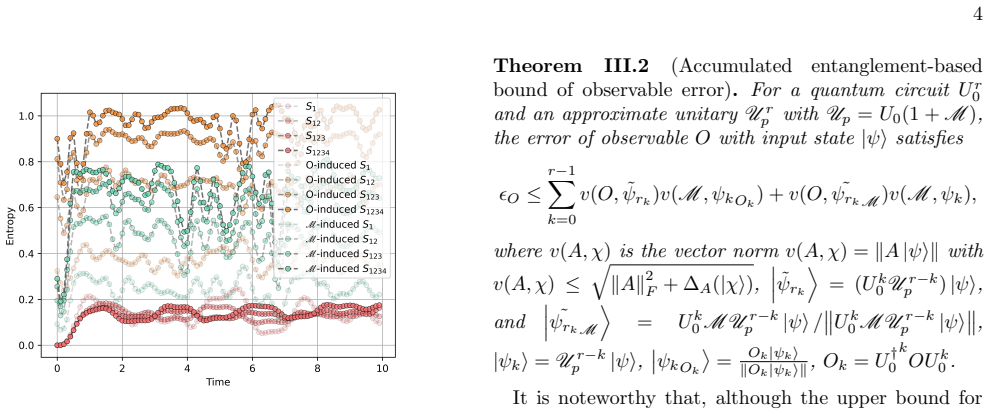
- [Theorem III.2 / Observation 1] The long-time entanglement bound does not deliver the advertised two-sided normalized-Frobenius speedup. In Theorem D.2 (Eq. D16), each segment contains factors sqrt(||M||_F^2 + Delta_M(|psi_k>)) and sqrt(||M||_F^2 + Delta_M(|psi_k^{O_k}>)) multiplying the O-vector factors. Observation 1 and Fig. 4(a) only justify the O-vector factors; Fig. 4(b) explicitly shows that ||M_k|psi_k>||/||M|| departs from ||M||_F/||M|| as k approaches r-1, and the text concedes that the vector norm of the error operator M itself varies throughout the evolution like [26]. Therefore Theorem III.2 cannot be used to conclude epsilon_O approximately 2||O||_F||M||_F delta t^{p+1} over long times; the M-dependent terms require state-dependent conditions for every segment that are neither proved nor satisfied in the supplied numerics. The theorem and the abstract should be revised to state exactly which factors are bounded by Frobenius norms.
- [Eq. (10) and Section IV] The short-time Frobenius statement Eq. (10) requires all four Delta terms in Theorem III.1 to be approximately zero, including Delta_M(|psi>) for the input state. The numerical runs in Section IV initialize in |0>^N or |01>^{N/2}, a product state, so Delta_M(|psi>) is not small at the beginning of a segment; the agreement in Figs. 2-3 is with the scrambling bound of Eq. (4), not with the entanglement-based sufficient condition. The paper should either test Eq. (10) on states whose relevant reduced states are near maximally mixed, or present the computed Delta terms, and it should not present these figures as direct evidence for the Frobenius speedup.
- [Section III and Appendix F2] The claim that operator-induced entanglement suppresses errors in low-entanglement regimes is not established by the supplied evidence. Fig. 1 shows that |psi_M> and |psi_O> can have larger entanglement entropy than the low-entropy state |psi(t)>, and Fig. 8 shows lower errors for certain 2-local observables than for Pauli observables, but these comparisons do not isolate induced entanglement from differences in commutator magnitudes or operator locality. A controlled test varying the spectral decomposition of O or M while holding [O(delta t), M] fixed, or a quantitative evaluation of the Delta terms in Theorem III.1, is needed before the abstract's claim can be supported.
minor comments (4)
- [Throughout] There are several notation and typographical errors that should be corrected: Eq. (3) uses 'donated' instead of 'denoted'; the Appendix heading reads 'T rotterization'; Lemma VII.2 is labelled as 'first-order product formula U1' although it treats the second-order formula; the Fig. 2 caption uses hz while the model in Eq. (F1) has no hz; and the main text and Fig. 2 caption disagree on whether the initial state is |0>^N or |01>^{N/2}.
- [Theorem III.1 statement] In the statement of Theorem III.1, 'Up = e^{-iH delta t} (I + M t^{p+1} + O(delta t^{p+2}))' should read 'M delta t^{p+1}', not 'M t^{p+1}', to be consistent with the rest of the manuscript.
- [Observation 1] The threshold condition in Observation 1, namely S(rho_{i,i'}) >= supp(O_i^dagger O_i') - O(||O||_F^4 / (sum_i ||O||_i)), is not meaningful as written because the right-hand side mixes an integer support size with a big-O remainder; the intended Pinsker-type condition needs to be stated with explicit constants and dimensions.
- [Lemma C.2] In Lemma C.2, the notation '||[OU0 , M ||_F' is missing a closing bracket and should be '||[OU0, M]||_F', matching the definition of the normalized Frobenius norm used elsewhere in the paper.
Circularity Check
No load-bearing circularity: Eq. (4) is a genuine non-tautological bound and the entanglement lemma is proven in the appendix rather than merely imported by self-citation.
full rationale
The scrambling-based bound in Eq. (4) is not circular. The quantity C(t) is defined independently in Section II as C(t)=<[O(t),V]^dag[O(t),V]>, and the theorem applies this existing definition with V=M. The inequality eps_O^2 <= <psi|[O(dt),M]^dag[O(dt),M]|psi> is obtained from Cauchy-Schwarz and the unitary-commutation algebra of the multiplicative error; it is not an identity of definitions because the left side is the absolute expectation of the difference operator and the right side is the squared vector norm of a commutator, which can be strictly larger. The entanglement-based bounds in Theorems III.1 and III.2 do rely on Lemma D.3/D.4, which is cited from Ref. [26] by the same author group, but the lemma is stated and fully proven in Appendix D with assumptions that do not include the Trotter-error result being derived. The citation is therefore independent support and not load-bearing. The long-time two-sided Frobenius-norm speedup is advertised only conditionally: it would require v(M,|psi_k>) ~ ||M||_F for every segment, and the paper's own Fig. 4(b) shows this condition fails for early-time states close to the product state. This is a rigor or overclaim issue about the scope of the proven statement, not a circularity, because the theorem as stated is a valid upper bound in terms of the actual vector norms. The numerical experiments compare directly computed bounds to empirical errors without fitting parameters, so there is no fitted-input-called-prediction pattern. No self-definitional, uniqueness-importation, or renaming step was found. Score 0.
Assumptions & free parameters
assumptions (4)
- standard math The Trotter circuit U_p is exactly unitary, so I+M is unitary and M satisfies M+M†+MM† = M+M†+M†M = 0.
- domain assumption The multiplicative error M(δt) decomposes as Σ_j M_j δt^{p+1} + M_Re with M_Re = O(α_{p+2} δt^{p+2}), following Theorems 3, 5 and 6 of Ref [20].
- domain assumption Lemma D.4, the entanglement-based bound on ∥A|ψ⟩∥² in terms of the normalized Frobenius norm and entanglement entropy, from Ref [26] is valid as stated.
- domain assumption Input states and evolved states are pure throughout; mixed-state generalizations are not treated.
Cite this review
Pith. "Pith review of Trotterization, Operator Scrambling, and Entanglement." pith.science (2026). https://pith.science/paper/J4L4QYKR
@misc{pith2026250623345,
  author       = {Pith},
  title        = {Pith review of: Trotterization, Operator Scrambling, and Entanglement},
  year         = {2026},
  howpublished = {\url{https://pith.science/paper/J4L4QYKR}},
  note         = {Machine review of arXiv:2506.23345}
}
read the original abstract
Operator scrambling, which governs the spread of quantum information in many-body systems, is a central concept in both condensed matter and high-energy physics. Accurately capturing the emergent properties of these systems remains a formidable challenge for classical computation, while quantum simulators have emerged as a powerful tool to address this complexity. In this work, we reveal a fundamental connection between operator scrambling and the reliability of quantum simulations. We show that the Trotter error in simulating operator dynamics is bounded by the degree of operator scrambling, providing the most refined analysis of Trotter errors in operator dynamics so far. Furthermore, we investigate the entanglement properties of the evolved states, revealing that sufficient entanglement can lead to error scaling governed by the normalized Frobenius norms of both the observables of interest and the error operator, thereby enhancing simulation robustness and efficiency compared to previous works. We also show that even in regimes where the system's entanglement remains low, operator-induced entanglement can still emerge and suppress simulation errors. Our results unveil a comprehensive relationship between Trotterization, operator scrambling, and entanglement, offering new perspectives for optimizing quantum simulations.
Figures


Figures from the paper (7 more)


Reference graph
Works this paper leans on
- [23]
-
[26]
Q. Zhao, Y. Zhou, and A. M. Childs, Entanglement ac- celerates quantum simulation (2024), arXiv:2406.02379 [quant-ph]
work page Pith review arXiv 2024
-
[1]
S. H. Shenker and D. Stanford, Journal of High Energy Physics 2014, 10.1007/jhep03(2014)067 (2014)
- [2]
-
[3]
Hayden and J
P. Hayden and J. Preskill, Journal of high energy physics 2007, 120 (2007)
2007
-
[4]
J. Maldacena, S. H. Shenker, and D. Stanford, Journal of High Energy Physics 2016, 1 (2016)
work page 2016
- [5]
-
[6]
Srednicki, Phys
M. Srednicki, Phys. Rev. E 50, 888 (1994)
1994
Show all 58 references
-
[8]
Hosur, X.-L
P. Hosur, X.-L. Qi, D. A. Roberts, and B. Yoshida, Jour- nal of High Energy Physics 2016, 1 (2016)
2016
-
[9]
D. A. Roberts and B. Yoshida, Journal of High Energy Physics 2017, 1 (2017)
2017
-
[10]
Swingle, Nature Physics 14, 988 (2018)
B. Swingle, Nature Physics 14, 988 (2018)
2018
-
[11]
Mezei and D
M. Mezei and D. Stanford, Journal of High Energy Physics 2017, 1 (2017)
2017
-
[12]
Couch, S
J. Couch, S. Eccles, P. Nguyen, B. Swingle, and S. Xu, Physical Review B 102, 045114 (2020)
2020
-
[13]
Liu and S
H. Liu and S. J. Suh, Physical review letters 112, 011601 (2014)
2014
-
[14]
M. C. Ba˜ nuls, J. I. Cirac, and M. B. Hastings, Physical review letters 106, 050405 (2011)
2011
-
[15]
R. P. Feynman, in Feynman and computation(cRc Press,
-
[16]
Lloyd, Science 273, 1073 (1996)
S. Lloyd, Science 273, 1073 (1996)
1996
-
[17]
Suzuki, Journal of mathematical physics 32, 400 (1991)
M. Suzuki, Journal of mathematical physics 32, 400 (1991)
1991
-
[18]
A. M. Childs, D. Maslov, Y. Nam, N. J. Ross, and Y. Su, Proceedings of the National Academy of Sciences 115, 9456 (2018)
2018
-
[19]
A. M. Childs and Y. Su, Physical review letters 123, 050503 (2019)
2019
-
[20]
A. M. Childs, Y. Su, M. C. Tran, N. Wiebe, and S. Zhu, Phys. Rev. X 11, 011020 (2021)
2021
-
[21]
G. H. Low and I. L. Chuang, Quantum 3, 163 (2019)
2019
-
[22]
M. Heyl, P. Hauke, and P. Zoller, Science advances 5, eaau8342 (2019)
2019
-
[24]
W. Yu, J. Xu, and Q. Zhao, Observable-driven speed-ups in quantum simulations (2024), arXiv:2407.14497 [quant- ph]. 9
2024 arXiv
-
[25]
Q. Zhao, Y. Zhou, A. F. Shaw, T. Li, and A. M. Childs, Physical Review Letters 129, 270502 (2022)
2022
-
[27]
Nozaki, T
M. Nozaki, T. Numasawa, and T. Takayanagi, Physi- cal Review Letters 112, 10.1103/physrevlett.112.111602 (2014)
2014 doi
-
[30]
Trivedi, A
R. Trivedi, A. F. Rubio, and J. I. Cirac, Quantum ad- vantage and stability to errors in analogue quantum sim- ulators (2023), arXiv:2212.04924 [quant-ph]
2023 arXiv
-
[31]
Huang, R
H.-Y. Huang, R. Kueng, and J. Preskill, Nature Physics 16, 1050–1057 (2020)
2020
-
[32]
K. A. Landsman, C. Figgatt, T. Schuster, N. M. Linke, B. Yoshida, N. Y. Yao, and C. Monroe, Nature 567, 61 (2019)
2019
-
[33]
See supplementary materials
-
[34]
M. C. Tran, C.-F. Chen, A. Ehrenberg, A. Y. Guo, A. Deshpande, Y. Hong, Z.-X. Gong, A. V. Gorshkov, and A. Lucas, Physical Review X 10, 031009 (2020)
2020
-
[35]
Eisert, M
J. Eisert, M. Cramer, and M. B. Plenio, Reviews of mod- ern physics 82, 277 (2010)
2010
-
[36]
Bianchi, L
E. Bianchi, L. Hackl, M. Kieburg, M. Rigol, and L. Vid- mar, PRX Quantum 3, 030201 (2022)
2022
-
[37]
Nandkishore and D
R. Nandkishore and D. A. Huse, Annu. Rev. Condens. Matter Phys. 6, 15 (2015)
2015
-
[38]
D. A. Abanin, E. Altman, I. Bloch, and M. Serbyn, Rev. Mod. Phys. 91, 021001 (2019)
2019
-
[39]
Bravyi, Physical Review A 76, 10.1103/phys- reva.76.052319 (2007)
S. Bravyi, Physical Review A 76, 10.1103/phys- reva.76.052319 (2007)
2007 doi
-
[40]
(Anthony) Chen, A
C.-F. (Anthony) Chen, A. Lucas, and C. Yin, Reports on Progress in Physics 86, 116001 (2023)
2023
-
[41]
Buluta and F
I. Buluta and F. Nori, Science 326, 108 (2009)
2009
-
[42]
I. M. Georgescu, S. Ashhab, and F. Nori, Reviews of Modern Physics 86, 153 (2014)
2014
-
[43]
Y. Cai, Y. Tong, and J. Preskill, in 19th Conference on the Theory of Quantum Computation, Communication and Cryptography (TQC 2024) , Leibniz International Proceedings in Informatics (LIPIcs), Vol. 310, edited by F. Magniez and A. B. Grilo (Schloss Dagstuhl – Leibniz- Zentrum...
2024
-
[44]
Kashyap, G
V. Kashyap, G. Styliaris, S. Mouradian, J. I. Cirac, and R. Trivedi, Phys. Rev. X 15, 021017 (2025)
2025
-
[45]
H. Zhao, M. Bukov, M. Heyl, and R. Moessner, Phys. Rev. Lett. 133, 010603 (2024)
2024
-
[46]
F. L. Buessen, D. Segal, and I. Khait, Phys. Rev. Res. 5, L022003 (2023)
2023
-
[47]
T. Feng, J. Xu, W. Yu, Z. Ye, P. Yao, and Q. Zhao, Dis- tributed quantum simulation (2024), arXiv:2411.02881 [quant-ph]
2024 arXiv
-
[48]
R. A. Low, Pseudo-randomness and learning in quantum computation (2010), arXiv:1006.5227 [quant-ph]
2010 arXiv
-
[49]
A. W. Harrow, The church of the symmetric subspace (2013), arXiv:1308.6595 [quant-ph]. 10 SUPPLEMENT AR Y MA TERIALS CONTENTS Supplementary Materials Contents . . . . . . . . . . . . . . . . . . . . . . . . 10 A Brief introduction of Trotterization . . . . . . . . . . . . . . ...
2013 arXiv
-
[50]
Suppose U0 is the ideal unitary, and U is the approximate unitary
Operator scrambling-based bound of observable error for general quantum circuits Here we consider the algorithm or coherence error of the quantum circuit, i.e., Trotter error. Suppose U0 is the ideal unitary, and U is the approximate unitary. For a given initial state |ψ⟩ and ...
-
[51]
Operator scrambling-based bound of observable error for a single segment In this section, we primarily focus on short-time evolution e−iHδt and establish a connection between the Trotter error in a single segment and operator scrambling. Considering the target quantum evolutio...
-
[52]
This is the p-th product formula for quantum simulation
Operator scrambling-based bound of observable error for long-time evolution We are interested in the ideal unitary of U r 0 and the approximate unitary of U r p . This is the p-th product formula for quantum simulation. Since |⟨ψ|B |ψ⟩| ≤ p ⟨ψ|B†B |ψ⟩, we have ϵO = ⟨ψ|U † 0 r ...
-
[53]
In this subsection, we analyze the average performance of observable error for input states chosen randomly from a given ensemble
Observable error of scrambling based bound with random inputs Our previous analysis of the scrambling-based bound focused on a fixed input state. In this subsection, we analyze the average performance of observable error for input states chosen randomly from a given ensemble. ...
-
[54]
However, in many practical scenarios, this upper bound becomes infeasible to compute for large system sizes
V ector norm-based bound of observable error The operator scrambling bound suggests ϵO ≤ p ⟨ψ| [O′, M ]†[O′, M ] |ψ⟩ where O′ = U † 0 OU0. However, in many practical scenarios, this upper bound becomes infeasible to compute for large system sizes. To efficiently estimate the e...
-
[55]
Here we introduce the following Lemma, presented in [26]
Entanglement-based bound of observable error Here we would like to investigate how the information scrambling of observable O and M , i.e, operator growth, can influence the observable error. Here we introduce the following Lemma, presented in [26]. Lemma D.3. (Distance-based ...
-
[56]
(Operator scrambling-based bound for PF1) For a two-term Hamiltonian H = A + B, consider the first-order product formula U1(δt) = e−iAδte−iBδt with initial state |ψ⟩
Concrete upper bound for PF1 Lemma E.1. (Operator scrambling-based bound for PF1) For a two-term Hamiltonian H = A + B, consider the first-order product formula U1(δt) = e−iAδte−iBδt with initial state |ψ⟩. Let M = − 1 2 [A, B] = P j Mj. Then the trotter error for the observab...
-
[57]
(Operator scrambling-based bound for PF2) For a two-term Hamiltonian H = A + B, consider the first- order product formula U1(δt) = e−iAδte−iBδt with initial state |ψ⟩
Concrete upper bound for PF2 Lemma E.2. (Operator scrambling-based bound for PF2) For a two-term Hamiltonian H = A + B, consider the first- order product formula U1(δt) = e−iAδte−iBδt with initial state |ψ⟩. Let M = 1 12 [−iB, [−iB, −iA]] + 1 24 [iA, [iA, iB]] =P j Mj. Then th...
-
[58]
2 in the main part but with some different ob- servables
The one-step T rotter error of various observables Here we show some more numerical results analogous to Figure. 2 in the main part but with some different ob- servables. Fig. 6 shows the error in the expectation value of the results for observable O = P j XjXj+1 ∥ P j XjXj+1∥...
-
[59]
Operator-induced entanglement To show that induced entropy can cause a reduction in Trotter error, we compare the Trotter error and expectation value for the same set of observables as shown in Figure. 8. Figure. 8(a) shows the one-step Trotter error for Pauli operators P1 = X...
-
[60]
In particular, the maximum attainable entanglement entropy during evolution depends critically on the initial energy of the state
Energy and entropy in quantum simulation Here we numerically observe that certain initial states exhibit a saturation of entanglement entropy at values below the theoretical maximum log(dsupp), where dsupp denotes the dimension of the corresponding subsystem. In particular, th...
-
[61]
Here, we can define two qualities to quantify the performance of quantum simulation
Minimal T rotter steps Consider a set of observable of interest{O} = {OJ1 , OJ2 , ..., OJM } and input state |ψ⟩ with Hamiltonian H, our task is to simulate these observables to the evolution e−iHt simultaneously. Here, we can define two qualities to quantify the performance o...
Reviewed August 6, 2026 · model on record in the stance chip above.
Discussion (0). Sign in to comment.