REVIEW 3 major objections 5 minor 95 references
AgriField-40K: Adapting Vision Models to Agriculture With Efficient Continual Pretraining
T0 review · 3 major / 5 minor · reviewed 2026-08-12 · deepseek-v4-flash
Pith's one-line read Adapter-only retraining on field imagery can match full fine-tuning in agricultural vision while updating up to 9x fewer parameters.
desk verdict Useful dataset and disciplined experiments, but the headline result confounds domain adaptation with DINOv3 distillation; the claim needs a control baseline. read the letter →
The pith
A machine-rendered reading of the paper's core claim, the machinery that carries it, and where it could break.
The reading
What carries the argument
The load-bearing components are (1) AgriField-40K, a curated corpus of 39,963 field images from 17 public datasets, resized to 512x512, stripped of labels, and split at the sequence level to avoid near-duplicate frames; (2) parallel AdaptFormer adapters with bottleneck rank 512 inserted into every transformer block of a frozen MAE; and (3) a semantic feature reconstruction loss that predicts, from a masked view, the dense patch embeddings produced by a frozen DINOv3 ViT-L teacher, compared by cosine distance over masked and visible patches. The adapters are the only trainable parameters in continual pretraining and again the only backbone parameters tuned during downstream transfer.
What would settle it
Compute image-level near-duplicate similarity between every AgriField-40K PhenoBench patch and every PhenoBench labelled training and validation image; if a material share of labelled images are near-duplicates of pretraining patches, then retrain AgriMAE on AgriField-40K with PhenoBench excluded and check whether the reported PhenoBench mIoU gain (80.58 vs 79.81) survives. A cleaner test would pretrain on the full corpus minus all PhenoBench patches and compare downstream mIoU against the published number.
Extended reading notes
Core claim
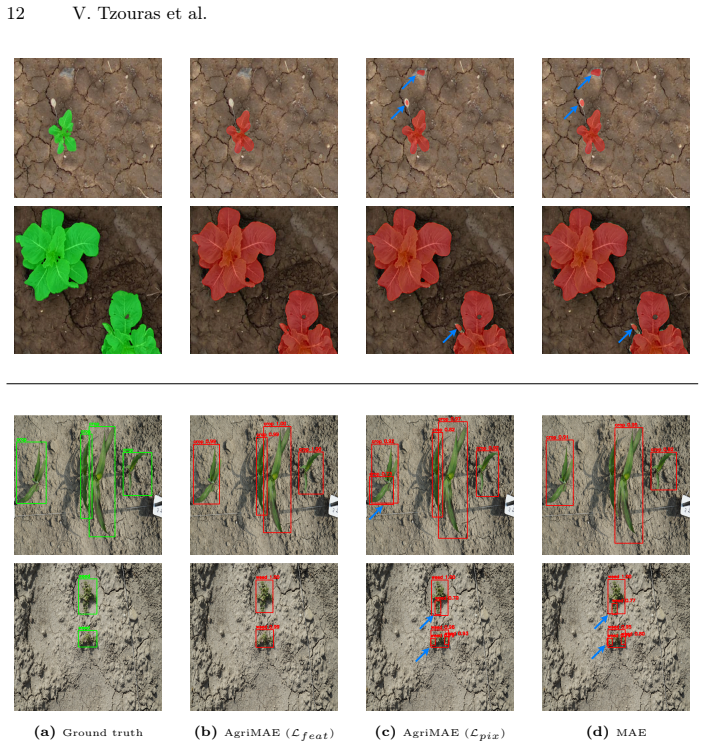
AgriMAE is a parameter-efficient continual pretraining recipe: starting from an ImageNet-pretrained MAE ViT-B, the authors insert AdaptFormer bottleneck adapters in parallel with each frozen transformer MLP and train only those adapters on unlabelled AgriField-40K images. With pixel reconstruction this already improves downstream accuracy; replacing the pixel target with cosine-distance reconstruction of patch-level DINOv3 features, computed over masked and visible patches alike, yields the strongest representations. The resulting models beat full fine-tuning on DeepWeeds classification (94.72 vs 92.23 top-1 accuracy) and CropAndWeed detection (mAP50 66.23 vs 63.25) while updating about 9x and 3.8x fewer trainable parameters, respectively, and nearly match it on PhenoBench segmentation. The paper's central claim is that field-centric unlabelled data plus adapter-only continual pretraining is a practical way to specialize large pretrained vision models to agriculture.
Load-bearing premise
The evaluation assumes that the labelled PhenoBench images used for downstream testing do not overlap with the unlabelled PhenoBench patches used to pretrain AgriMAE; the paper notes that PhenoBench's own documentation does not say how images were partitioned, so this cannot currently be verified.
Editorial extensions
If this is right
- Continual pretraining with adapters on AgriField-40K improves downstream accuracy over the frozen MAE baseline on all four tested datasets.
- AgriMAE with feature reconstruction matches or outperforms full fine-tuning on DeepWeeds and CropAndWeed while updating far fewer parameters.
- Reconstructing DINOv3 features beats pixel reconstruction as a continual-pretraining objective on every downstream task.
- The dataset is released under CC BY-SA 4.0, giving the community a common unlabelled field-imagery corpus for benchmarking.
Reading between the lines
- Beyond the paper's benchmarks, the same adapter-only recipe likely transfers to other dense agricultural tasks, such as plant phenotyping and drone-based field monitoring, without any backbone retraining.
- The feature-reconstruction result suggests the teacher model's quality matters; comparing DINOv3 against smaller or cheaper teachers would separate the effect of semantic targets from the effect of teacher scale.
- Because AgriField-40K discards labels, it could also support contrastive or self-distillation pretraining, which the paper does not test.
- We infer that the parameter savings (up to 9x) could make continual pretraining practical on edge hardware such as farm robots, where storing and updating a full ViT backbone is costly.
Editorial analysis
A structured set of objections, weighed in public.
Referee Report
Summary. The paper introduces AgriField-40K, a curated dataset of roughly 40,000 field-centric agricultural images assembled from 17 public sources, and presents AgriMAE, a parameter-efficient continual pretraining approach that keeps an ImageNet-pretrained MAE backbone frozen and trains only AdaptFormer adapters on the new corpus. Two reconstruction objectives are compared: standard pixel reconstruction (L_pix) and semantic feature reconstruction (L_feat) that regresses dense DINOv3 features. Downstream evaluation covers classification (DeepWeeds), semantic segmentation (PhenoBench, GrowliFlower), and object detection (CropAndWeed), with five-seed means and standard deviations. The results show that adapter-based continual pretraining consistently improves over randomly initialized adapters, and the L_feat variant matches or exceeds full fine-tuning on DeepWeeds and CropAndWeed while updating far fewer parameters.
Significance. If the claims hold, the paper provides two useful assets: a unified, field-centric pretraining corpus for agricultural vision and a reproducible parameter-efficient baseline for continual pretraining. The evaluation is solid in structure: four external downstream tasks, five seeds, standard deviations, and a clear comparison against full fine-tuning. The dataset curation effort is substantial, and the code and dataset release would be a practical community resource. Credit is due for the controlled comparison within the PEFT setting and for explicitly acknowledging the PhenoBench overlap limitation in Section 6. The main weakness is that the headline 'match or outperform full fine-tuning' claim is mostly carried by the L_feat variant, which conflates the effect of the agricultural corpus with the effect of distilling a much stronger DINOv3 teacher; this attribution issue needs to be resolved before the central claim is fully convincing.
major comments (3)
- [Section 4.3, Tables 2-5] The headline claim that AgriMAE 'can match or even outperform full fine-tuning' is primarily carried by the L_feat variant (e.g., DeepWeeds 94.72 vs 92.23; CropAndWeed mAP50 66.23 vs 63.25). In this variant the adapters are trained to regress dense features from a DINOv3 ViT-L/16 model pretrained on LVD-1689M, while the comparison baselines train the same adapter architecture with random initialization or pixel reconstruction. The design therefore varies the reconstruction target and the agricultural corpus simultaneously; the large L_feat gains could in principle be obtained by distilling DINOv3 into the frozen MAE backbone on almost any image corpus, independent of AgriField-40K. The paper needs a control that applies L_feat to a natural-image corpus (or otherwise isolates the effect of the agricultural data) before claiming that the dataset is responsible for the match/outperform result.
- [Section 6, Table 3] The authors acknowledge that PhenoBench does not provide sufficient detail on how images were partitioned across fields, sequences, or campaigns, so near-duplicate overlap between the unlabelled patches used in AgriField-40K and the labelled split used for evaluation cannot be ruled out. Since the reported PhenoBench improvement (80.58 vs 79.81 mIoU) is modest, contamination could materially inflate it. The authors should either remove PhenoBench from the pretraining corpus and re-run the evaluation, or provide an overlap analysis (e.g., nearest-neighbour image similarity) to support the claim of consistent downstream improvement.
- [Section 5.2, Tables 2-5] The paper repeatedly frames the results as showing that AgriMAE 'consistently improves downstream performance' and 'can match or even outperform full fine-tuning.' However, the pixel-reconstruction variant, which isolates the contribution of AgriField-40K, shows only small gains over random adapters (e.g., GrowliFlower 57.22 vs 56.58; CropAndWeed mAP50 60.79 vs 60.03), and these gains are not tested for statistical significance. A paired significance test or confidence intervals across the five seeds would make the 'consistent improvement' claim more rigorous, particularly for the tasks where the margin is smaller than the inter-seed variability.
minor comments (5)
- [Table 1 caption] The abbreviations 'H. Cameras' and 'O. Cameras' are not defined in the caption; please define them in the caption or in the table notes.
- [Section 3] The sentence 'we manually remove, blurry and low-resolution samples' contains a grammatical error; it should read 'we manually remove blurry and low-resolution samples.'
- [Section 5.1] The phrase 'the GrowliFlower L subset' is used without explaining what the 'L' refers to; please clarify.
- [References] References [8] and [9] are identical (Bunyang et al.), and the iNaturalist reference [41] is a bare URL without an access date; both need correction.
- [Section 6] The sentence 'Future work could also study efficient adaption of agriculture-specific foundation models' contains a typo; 'adaption' should be 'adaptation.'
Circularity Check
No material circularity: AgriMAE's downstream numbers come from external benchmarks; the L_feat objective uses an external DINOv3 teacher, and the PhenoBench overlap is a leakage risk, not a circular reduction.
full rationale
AgriMAE's continual pretraining is a standard PEFT pipeline: only adapter parameters ψ (Eq. 1) are optimized on AgriField-40K, using either pixel reconstruction (Eq. 2) or cosine-distance regression to frozen DINOv3 features (Eq. 3). The downstream evaluations are performed on external datasets (DeepWeeds, GrowliFlower, CropAndWeed, and the officially labelled PhenoBench split) with frozen backbones, so the reported accuracies are not inputs to, or algebraic consequences of, the pretraining objective. The L_feat variant does distill an external teacher, but the paper never claims the teacher features themselves are the predicted output; the predictions are task labels, and DINOv3 is a fixed external model pretrained on LVD-1689M, not a parameter fitted to the reported numbers. The pixel-reconstruction variant (L_pix) also improves over the frozen-MAE adapter baseline on every benchmark, giving the agricultural-data contribution independent content. The self-citations (e.g., Refs. [26], [30], [33], [82]) appear only as related-work context or dataset provenance and carry no uniqueness or derivation claim, so they are not load-bearing. The one caveat worth weighing is Section 6's admission that 'PhenoBench does not provide sufficient detail on how images were partitioned across fields, sequences, or campaigns', so near-duplicate overlap between the unlabelled pretraining patches and the labelled evaluation split cannot be ruled out. That is a potential contamination/validity issue for one of four benchmarks, not a circularity by construction.
Assumptions & free parameters
free parameters (3)
- Adapter bottleneck rank r =
512
- Masking ratio delta =
0.75
- Frame sampling interval k per source =
Not specified
assumptions (4)
- domain assumption ImageNet-1K MAE pretraining is a suitable starting point for agricultural field continual pretraining
- domain assumption DINOv3 ViT-L features are a high-quality semantic target for field imagery
- domain assumption After filtering and fixed-interval sampling, the aggregation of 17 sources forms a representative and diverse field-centric corpus
- domain assumption Downstream evaluation splits are independent of the pretraining corpus
Cite this review
Pith. "Pith review of AgriField-40K: Adapting Vision Models to Agriculture With Efficient Continual Pretraining." pith.science (2026). https://pith.science/paper/J4NUWEIH
@misc{pith2026260807984,
  author       = {Pith},
  title        = {Pith review of: AgriField-40K: Adapting Vision Models to Agriculture With Efficient Continual Pretraining},
  year         = {2026},
  howpublished = {\url{https://pith.science/paper/J4NUWEIH}},
  note         = {Machine review of arXiv:2608.07984}
}
abstract
Field-based agricultural computer vision is important for precision agriculture, yet it largely depends on expensive annotations and costly adaptation of large pretrained models. We introduce AgriField-40K, a field-centric dataset curated from 17 public resources and covering diverse crops, weeds, and field conditions. Building on this, we present AgriMAE, a parameter-efficient continual pretraining baseline that adapts a masked autoencoder pretrained on natural images by training only lightweight adapters. We further explore semantic feature reconstruction as an alternative pretraining objective and evaluate transfer across multiple tasks. AgriMAE consistently improves downstream performance and can match or even outperform full fine-tuning while using up to $9\times$ fewer trainable parameters, showing that AgriField-40K is a practical resource for continual pretraining in agricultural vision. Project page: https://dtu-pas.github.io/agrifield40k/
Figures


Figures from the paper (2 more)

Reference graph
Works this paper leans on
-
[1]
CoRR (2021),https://arxiv.org/abs/2109
Ahmadi, A., Halstead, M., McCool, C.: Towards Autonomous Crop-Agnostic Vi- sual Navigation in Arable Fields. CoRR (2021),https://arxiv.org/abs/2109. 11936
2021
-
[2]
Ahmadi, A., Halstead, M., McCool, C.: Virtual Temporal Samples for Recurrent Neural Networks: applied to semantic segmentation in agriculture. CoRR (2021), https://arxiv.org/abs/2106.10118
work page Pith review arXiv 2021
-
[3]
In: Proceedings of the IEEE/CVF conference on computer vision and pattern recognition
Assran, M., Duval, Q., Misra, I., Bojanowski, P., Vincent, P., Rabbat, M., LeCun, Y., Ballas, N.: Self-supervised learning from images with a joint-embedding predic- tive architecture. In: Proceedings of the IEEE/CVF conference on computer vision and pattern recognition. pp. 15619–15629 (2023)
2023
-
[4]
arXiv preprint arXiv:2106.08254 (2021)
Bao, H., Dong, L., Piao, S., Wei, F.: Beit: Bert pre-training of image transformers. arXiv preprint arXiv:2106.08254 (2021)
arXiv 2021
-
[5]
arXiv preprint arXiv:2105.04906 (2021)
Bardes, A., Ponce, J., LeCun, Y.: Vicreg: Variance-invariance-covariance regular- ization for self-supervised learning. arXiv preprint arXiv:2105.04906 (2021)
arXiv 2021
-
[6]
In: 2017 IEEE in- ternational conference on robotics and automation (ICRA)
Bargoti, S., Underwood, J.: Deep fruit detection in orchards. In: 2017 IEEE in- ternational conference on robotics and automation (ICRA). pp. 3626–3633. IEEE (2017) 16 V. Tzouras et al
2017
-
[7]
In: Joint European Conference on Machine Learning and Knowledge Dis- covery in Databases
Bertoglio,R.,Spizzichino,E.,Kalouguine,A.,Vitali,G.,Matteucci,M.:TheACRE Crop-Weed Dataset for Benchmarking Weed Detection Models on Maize and Beans Fields. In: Joint European Conference on Machine Learning and Knowledge Dis- covery in Databases. pp. 312–323. Springer (2023)
2023
-
[9]
Advances in Computational Intelligence3(5), 18 (2023)
Bunyang, S., Thedwichienchai, N., Pintong, K., Lael, N., Kunaborimas, W., Boon- rat, P., Siriborvornratanakul, T.: Self-supervised learning advanced plant disease image classification with SimCLR. Advances in Computational Intelligence3(5), 18 (2023)
2023
Show all 95 references
-
[10]
Springer Nature (2022)
Burger, W., Burge, M.J.: Digital image processing: An algorithmic introduction. Springer Nature (2022)
2022
-
[11]
Computers and electronics in agriculture211, 107993 (2023)
Cao, Y., Chen, L., Yuan, Y., Sun, G.: Cucumber disease recognition with small samples using image-text-label-based multi-modal language model. Computers and electronics in agriculture211, 107993 (2023)
2023
-
[12]
Advances in neural information processing systems33, 9912–9924 (2020)
Caron, M., Misra, I., Mairal, J., Goyal, P., Bojanowski, P., Joulin, A.: Unsupervised learning of visual features by contrasting cluster assignments. Advances in neural information processing systems33, 9912–9924 (2020)
2020
-
[13]
In: Proceedings of the IEEE/CVF international conference on computer vision
Caron, M., Touvron, H., Misra, I., Jégou, H., Mairal, J., Bojanowski, P., Joulin, A.: Emerging properties in self-supervised vision transformers. In: Proceedings of the IEEE/CVF international conference on computer vision. pp. 9650–9660 (2021)
2021
-
[14]
In: Proceedings of the IEEE/CVF International Conference on Computer Vision
Chen, F., Giuffrida, M.V., Tsaftaris, S.A.: Adapting vision foundation models for plant phenotyping. In: Proceedings of the IEEE/CVF International Conference on Computer Vision. pp. 604–613 (2023)
2023
-
[15]
Advances in Neural Information Processing Systems35, 16664–16678 (2022)
Chen, S., Ge, C., Tong, Z., Wang, J., Song, Y., Wang, J., Luo, P.: Adaptformer: Adapting vision transformers for scalable visual recognition. Advances in Neural Information Processing Systems35, 16664–16678 (2022)
2022
-
[16]
In: International conference on machine learning
Chen, T., Kornblith, S., Norouzi, M., Hinton, G.: A simple framework for con- trastive learning of visual representations. In: International conference on machine learning. pp. 1597–1607. PmLR (2020)
2020
-
[17]
Chen,X.,He,K.:Exploringsimplesiameserepresentationlearning.In:Proceedings of the IEEE/CVF conference on computer vision and pattern recognition. pp. 15750–15758 (2021)
2021
-
[18]
Scientific Data (2026)
Chong, Y.L., Krämer, J., Chakhvashvili, E., Marks, E., Esser, F., Dreier, A., Rosu, R.A., Warstat, K., Pude, R., Behnke, S., et al.: The Multi-Sensor and Multi- Temporal Dataset of Multiple Crops for In-Field Phenotyping and Monitoring. Scientific Data (2026)
2026
-
[19]
Coleman, G., Kutugata, M., Walsh, M., Bagavathiannan, M.: Palmer Amaranth Growth Stage – 8 (PAGS8) (2023),https://weed-ai.sydney.edu.au/datasets/ 5c78d067-8750-4803-9cbe-57df8fae55e4
2023
-
[20]
In: Proceedings of the IEEE/CVF Winter Conference on applications of computer vision
Dadashzadeh, A., Duan, S., Whone, A., Mirmehdi, M.: Pecop: Parameter effi- cient continual pretraining for action quality assessment. In: Proceedings of the IEEE/CVF Winter Conference on applications of computer vision. pp. 42–52 (2024)
2024
-
[21]
In: 2009 IEEE conference on computer vision and pattern recognition
Deng, J., Dong, W., Socher, R., Li, L.J., Li, K., Fei-Fei, L.: Imagenet: A large- scale hierarchical image database. In: 2009 IEEE conference on computer vision and pattern recognition. pp. 248–255. Ieee (2009) AgriField-40K: Continual Pretraining for Agriculture 17
2009
-
[22]
In: Proceedings of the 2019 conference of the North American chapter of the association for computational linguistics: human language technologies, volume 1 (long and short papers)
Devlin, J., Chang, M.W., Lee, K., Toutanova, K.: Bert: Pre-training of deep bidi- rectional transformers for language understanding. In: Proceedings of the 2019 conference of the North American chapter of the association for computational linguistics: human language technologi...
2019
-
[23]
arXiv preprint arXiv:2010.11929 (2020)
Dosovitskiy, A., Beyer, L., Kolesnikov, A., Weissenborn, D., Zhai, X., Unterthiner, T., Dehghani, M., Minderer, M., Heigold, G., Gelly, S., et al.: An image is worth 16x16 words: Transformers for image recognition at scale. arXiv preprint arXiv:2010.11929 (2020)
2020 arXiv
-
[24]
org/10.48714/DTU.HPC.0001,https://doi.org/10.48714/DTU.HPC.0001
DTU Computing Center: DTU Computing Center resources (2024).https://doi. org/10.48714/DTU.HPC.0001,https://doi.org/10.48714/DTU.HPC.0001
2024 doi
-
[25]
arXiv preprint arXiv:2509.17816 (2025)
Ebouky, B., Chhatkuli, A., Malossi, C., Studer, C., Assaf, R., Bartezzaghi, A.: Enhancing Semantic Segmentation with Continual Self-Supervised Pre-training. arXiv preprint arXiv:2509.17816 (2025)
2025
-
[26]
Computers and Electronics in Agriculture239, 110900 (2025)
Espejo-Garcia, B., Güldenring, R., Nalpantidis, L., Fountas, S.: Foundation vision models in agriculture: DINOv2, LoRA and knowledge distillation for disease and weed identification. Computers and Electronics in Agriculture239, 110900 (2025)
2025
-
[27]
In: Thirty-fifth Conference on Neu- ral Information Processing Systems Datasets and Benchmarks Track (Round 2) (2021)
Garcin, C., Bonnet, P., Affouard, A., Lombardo, J.C., Chouet, M., Servajean, M., Lorieul, T., Salmon, J., et al.: Pl@ ntNet-300K: a plant image dataset with high label ambiguity and a long-tailed distribution. In: Thirty-fifth Conference on Neu- ral Information Processing Syst...
2021
-
[28]
Geisler, B.: Perrenial Plants Detection (2021),https : / / www . kaggle . com / datasets/benediktgeisler/perrenial-plants-detection
2021
-
[29]
Advances in neural information processing systems33, 21271–21284 (2020)
Grill, J.B., Strub, F., Altché, F., Tallec, C., Richemond, P., Buchatskaya, E., Do- ersch, C., Avila Pires, B., Guo, Z., Gheshlaghi Azar, M., et al.: Bootstrap your own latent-a new approach to self-supervised learning. Advances in neural information processing systems33, 2127...
2020
-
[30]
IEEE Robotics and Automa- tion Letters9(2), 1588–1595 (2023)
Güldenring, R., Andersen, R.E., Nalpantidis, L.: Zoom in on the Plant: Fine- Grained Analysis of Leaf, Stem, and Vein Instances. IEEE Robotics and Automa- tion Letters9(2), 1588–1595 (2023)
2023
-
[31]
In 2021 IEEE
Güldenring, R., Boukas, E., Ravn, O., Nalpantidis, L.: Few-leaf Learning: Weed Segmentation in Grasslands. In 2021 IEEE. In: RSJ International Conference on Intelligent Robots and Systems (IROS). pp. 3248–3254 (2021)
2021
-
[32]
Computers and Electronics in Agriculture191, 106510 (2021)
Güldenring, R., Nalpantidis, L.: Self-supervised contrastive learning on agricultural images. Computers and Electronics in Agriculture191, 106510 (2021)
2021
-
[33]
Journal of Field Robotics40(6), 1639–1656 (2023)
Güldenring, R., Van Evert, F.K., Nalpantidis, L.: RumexWeeds: A grassland dataset for agricultural robotics. Journal of Field Robotics40(6), 1639–1656 (2023)
2023
-
[34]
In: Proceedings of the IEEE/CVF conference on computer vision and pattern recognition
He, K., Chen, X., Xie, S., Li, Y., Dollár, P., Girshick, R.: Masked autoencoders are scalable vision learners. In: Proceedings of the IEEE/CVF conference on computer vision and pattern recognition. pp. 16000–16009 (2022)
2022
-
[35]
In: Proceedings of the IEEE/CVF conference on computer vision and pattern recognition
He, K., Fan, H., Wu, Y., Xie, S., Girshick, R.: Momentum contrast for unsupervised visual representation learning. In: Proceedings of the IEEE/CVF conference on computer vision and pattern recognition. pp. 9729–9738 (2020)
2020
-
[36]
He,K.,Zhang,X.,Ren,S.,Sun,J.:Deepresiduallearningforimagerecognition.In: Proceedings of the IEEE conference on computer vision and pattern recognition. pp. 770–778 (2016)
2016
-
[37]
arXiv preprint arXiv:2208.06049 (2022) 18 V
Hou,Z.,Sun,F.,Chen,Y.K.,Xie,Y.,Kung,S.Y.:Milan:Maskedimagepretraining on language assisted representation. arXiv preprint arXiv:2208.06049 (2022) 18 V. Tzouras et al
2022 arXiv
-
[38]
In: International conference on machine learning
Houlsby, N., Giurgiu, A., Jastrzebski, S., Morrone, B., De Laroussilhe, Q., Ges- mundo, A., Attariyan, M., Gelly, S.: Parameter-efficient transfer learning for NLP. In: International conference on machine learning. pp. 2790–2799. PMLR (2019)
2019
-
[39]
Iclr1(2), 3 (2022)
Hu, E.J., Shen, Y., Wallis, P., Allen-Zhu, Z., Li, Y., Wang, S., Wang, L., Chen, W., et al.: Lora: Low-rank adaptation of large language models. Iclr1(2), 3 (2022)
2022
-
[40]
arXiv preprint arXiv:1511.08060 (2015)
Hughes, D., Salathé, M., et al.: An open access repository of images on plant health to enable the development of mobile disease diagnostics. arXiv preprint arXiv:1511.08060 (2015)
2015 arXiv
-
[41]
iNaturalist: inaturalist.https://www.inaturalist.org(2026)
2026
-
[42]
In: Proceedings of the Computer Vision and Pattern Recognition Confer- ence
Jain, N., Joshi, A., Earles, M.: iNatAg: Multi-Class Classification Models Enabled by a Large-Scale Benchmark Dataset with 4.7 M Images of 2,959 Crop and Weed Species. In: Proceedings of the Computer Vision and Pattern Recognition Confer- ence. pp. 5501–5510 (2025)
2025
-
[43]
In: European conference on computer vision
Jia, M., Tang, L., Chen, B.C., Cardie, C., Belongie, S., Hariharan, B., Lim, S.N.: Visual prompt tuning. In: European conference on computer vision. pp. 709–727. Springer (2022)
2022
-
[44]
Data in brief52, 109935 (2024)
Justina, M.J., Thenmozhi, M.: SorghumWeedDataset_Classification and SorghumWeedDataset_Segmentation datasets for classification, detection, and segmentation in deep learning. Data in brief52, 109935 (2024)
2024
-
[45]
Com- puters and electronics in agriculture147, 70–90 (2018)
Kamilaris, A., Prenafeta-Boldú, F.X.: Deep learning in agriculture: A survey. Com- puters and electronics in agriculture147, 70–90 (2018)
2018
-
[46]
arXiv preprint arXiv:2406.10973 (2024)
Khanna, S., Irgau, M., Lobell, D.B., Ermon, S.: Explora: Parameter-efficient extended pre-training to adapt vision transformers under domain shifts. arXiv preprint arXiv:2406.10973 (2024)
2024
-
[47]
Journal of Field Robotics40(2), 173–192 (2023)
Kierdorf, J., Junker-Frohn, L.V., Delaney, M., Olave, M.D., Burkart, A., Jaenicke, H., Muller, O., Rascher, U., Roscher, R.: GrowliFlower: An image time-series dataset for GROWth analysis of cauLIFLOWER. Journal of Field Robotics40(2), 173–192 (2023)
2023
-
[48]
Sensors23(5), 2713 (2023)
Kitzler,F.,Barta,N.,Neugschwandtner,R.W.,Gronauer,A.,Motsch,V.:WE3DS: An RGB-D image dataset for semantic segmentation in agriculture. Sensors23(5), 2713 (2023)
2023
-
[49]
Data in Brief42, 108035 (2022)
Lac, L., Keresztes, B., Louargant, M., Donias, M., Da Costa, J.P.: An annotated image dataset of vegetable crops at an early stage of growth for proximal sensing applications. Data in Brief42, 108035 (2022)
2022
-
[50]
In: Proceedings of the IEEE conference on computer vision and pattern recognition
Lin, T.Y., Dollár, P., Girshick, R., He, K., Hariharan, B., Belongie, S.: Feature pyramid networks for object detection. In: Proceedings of the IEEE conference on computer vision and pattern recognition. pp. 2117–2125 (2017)
2017
-
[51]
arXiv preprint arXiv:1711.05101 (2017)
Loshchilov, I., Hutter, F.: Decoupled weight decay regularization. arXiv preprint arXiv:1711.05101 (2017)
2017 arXiv
-
[52]
In: Interna- tional Conference on Learning Representations
Lu, H., Huo, Y., Yang, G., Lu, Z., Zhan, W., Tomizuka, M., Ding, M.: Uniadapter: Unified parameter-efficient transfer learning for cross-modal modeling. In: Interna- tional Conference on Learning Representations. vol. 2024, pp. 24577–24596 (2024)
2024
-
[53]
Journal of machine learn- ing research9(Nov), 2579–2605 (2008)
Maaten, L.v.d., Hinton, G.: Visualizing data using t-sne. Journal of machine learn- ing research9(Nov), 2579–2605 (2008)
2008
-
[54]
Scientific Data10(1), 302 (2023)
Madec, S., Irfan, K., Velumani, K., Baret, F., David, E., Daubige, G., Samatan, L.B., Serouart, M., Smith, D., James, C., et al.: VegAnn, Vegetation Annotation of multi-crop RGB images acquired under diverse conditions for segmentation. Scientific Data10(1), 302 (2023)
2023
-
[55]
In: CLEF 2025-Working Notes of the Conference and Labs of the Evaluation Forum
Martellucci, G., Goëau, H., Bonnet, P., Vinatier, F., Joly, A.: Overview of Plant- CLEF 2025: Multi-Species Plant Identification in Vegetation Quadrat Images: AgriField-40K: Continual Pretraining for Agriculture 19 Notebook for the LifeCLEF Lab at CLEF 2025. In: CLEF 2025-Work...
2025
-
[56]
In: Proceedings of the IEEE/CVF International Conference on Computer Vision
Mendieta, M., Han, B., Shi, X., Zhu, Y., Chen, C.: Towards geospatial foundation models via continual pretraining. In: Proceedings of the IEEE/CVF International Conference on Computer Vision. pp. 16806–16816 (2023)
2023
-
[57]
In: 2018 IEEE international conference on robotics and automation (ICRA)
Milioto, A., Lottes, P., Stachniss, C.: Real-time semantic segmentation of crop and weed for precision agriculture robots leveraging background knowledge in CNNs. In: 2018 IEEE international conference on robotics and automation (ICRA). pp. 2229–2235. IEEE (2018)
2018
-
[58]
Frontiers in plant science7, 1419 (2016)
Mohanty, S.P., Hughes, D.P., Salathé, M.: Using deep learning for image-based plant disease detection. Frontiers in plant science7, 1419 (2016)
2016
-
[59]
The Plant Phenome Journal5(1), e20051 (2022)
Nagasubramanian, K., Singh, A., Singh, A., Sarkar, S., Ganapathysubramanian, B.: Plant phenotyping with limited annotation: Doing more with less. The Plant Phenome Journal5(1), e20051 (2022)
2022
-
[60]
In: Proceedings of the Computer Vision and Pattern Recog- nition Conference
Nahian, A., Jaber, M., et al.: Agri-FM+: A Self-Supervised Foundation Model for Agricultural Vision. In: Proceedings of the Computer Vision and Pattern Recog- nition Conference. pp. 5511–5523 (2025)
2025
-
[61]
In: Proceedings of the 31st International Conference on Computational Linguistics
Nawaz, U., Muhammad, A., Gani, H., Naseer, M., Khan, F.S., Khan, S., Anwer, R.: AgriCLIP: Adapting CLIP for agriculture and livestock via domain-specialized cross-model alignment. In: Proceedings of the 31st International Conference on Computational Linguistics. pp. 9630–9639 (2025)
2025
-
[62]
Data in Brief47, 109030 (2023)
Olaniyi, O.M., Salaudeen, M.T., Daniya, E., Abdullahi, I.M., Folorunso, T.A., Bala, J.A., Nuhu, B.K., Adedigba, A.P., Oluwole, B.I., Bankole, A.O., et al.: De- velopment of maize plant dataset for intelligent recognition and weed control. Data in Brief47, 109030 (2023)
2023
-
[63]
Scientific reports9(1), 2058 (2019)
Olsen, A., Konovalov, D.A., Philippa, B., Ridd, P., Wood, J.C., Johns, J., Banks, W., Girgenti, B., Kenny, O., Whinney, J., et al.: Deepweeds: A multiclass weed species image dataset for deep learning. Scientific reports9(1), 2058 (2019)
2019
-
[64]
arXiv preprint arXiv:2304.07193 (2023)
Oquab, M., Darcet, T., Moutakanni, T., Vo, H., Szafraniec, M., Khalidov, V., Fernandez, P., Haziza, D., Massa, F., El-Nouby, A., et al.: Dinov2: Learning robust visual features without supervision. arXiv preprint arXiv:2304.07193 (2023)
2023 arXiv
-
[65]
In: International conference on machine learning
Radford, A., Kim, J.W., Hallacy, C., Ramesh, A., Goh, G., Agarwal, S., Sastry, G., Askell, A., Mishkin, P., Clark, J., et al.: Learning transferable visual models from natural language supervision. In: International conference on machine learning. pp. 8748–8763. PmLR (2021)
2021
-
[66]
Rayner, G.: RadishWheatDataset (2022),https://weed- ai.sydney.edu.au/ datasets/8b8f134f-ede4-4792-b1f7-d38fc05d8127
2022
-
[67]
In: Proceedings of the IEEE/CVF winter conference on applications of computer vision
Reed, C.J., Yue, X., Nrusimha, A., Ebrahimi, S., Vijaykumar, V., Mao, R., Li, B., Zhang, S., Guillory, D., Metzger, S., et al.: Self-supervised pretraining improves self-supervised pretraining. In: Proceedings of the IEEE/CVF winter conference on applications of computer visio...
2022
-
[68]
Advances in neural information processing systems28(2015)
Ren, S., He, K., Girshick, R., Sun, J.: Faster r-cnn: Towards real-time object de- tection with region proposal networks. Advances in neural information processing systems28(2015)
2015
-
[69]
Machine vision and applications27(4), 585–606 (2016) 20 V
Scharr,H.,Minervini,M.,French,A.P.,Klukas,C.,Kramer,D.M.,Liu,X.,Luengo, I., Pape, J.M., Polder, G., Vukadinovic, D., et al.: Leaf segmentation in plant phenotyping: a collation study. Machine vision and applications27(4), 585–606 (2016) 20 V. Tzouras et al
2016
-
[70]
In: Proceedings of the IEEE/CVF Conference on Computer Vision and Pattern Recognition
Scheibenreif, L., Mommert, M., Borth, D.: Parameter efficient self-supervised geospatial domain adaptation. In: Proceedings of the IEEE/CVF Conference on Computer Vision and Pattern Recognition. pp. 27841–27851 (2024)
2024
-
[71]
arXiv preprint arXiv:2505.18930 (2025)
Shen, Y., Ayanlade, T.T., Boddepalli, V.N., Saadati, M., Rairdin, A., Deng, Z.K., Arshad, M.A., Balu, A., Mueller, D., Singh, A.K., et al.: WeedNet: A foundation model-based global-to-local AI approach for real-time weed species identification and classification. arXiv preprin...
2025 arXiv
-
[72]
In: Proceedings of the IEEE/CVF Conference on Computer Vision and Pattern Recognition
Shikhar, S., Sobti, A.: Label-free anomaly detection in aerial agricultural images with masked image modeling. In: Proceedings of the IEEE/CVF Conference on Computer Vision and Pattern Recognition. pp. 5440–5449 (2024)
2024
-
[73]
arXiv preprint arXiv:2508.10104 (2025)
Siméoni, O., Vo, H.V., Seitzer, M., Baldassarre, F., Oquab, M., Jose, C., Khali- dov, V., Szafraniec, M., Yi, S., Ramamonjisoa, M., et al.: Dinov3. arXiv preprint arXiv:2508.10104 (2025)
2025 arXiv
-
[74]
Trends in plant science 23(10), 883–898 (2018)
Singh, A.K., Ganapathysubramanian, B., Sarkar, S., Singh, A.: Deep learning for plant stress phenotyping: trends and future perspectives. Trends in plant science 23(10), 883–898 (2018)
2018
-
[75]
Singh, D., Jain, N., Jain, P., Kayal, P., Kumawat, S., Batra, N.: PlantDoc: A dataset for visual plant disease detection (2020)
2020
-
[76]
In: Proceedings of the IEEE/CVF conference on computer vision and pattern recognition workshops
Skovsen, S., Dyrmann, M., Mortensen, A.K., Laursen, M.S., Gislum, R., Eriksen, J., Farkhani, S., Karstoft, H., Jorgensen, R.N.: The GrassClover image dataset for semantic and hierarchical species understanding in agriculture. In: Proceedings of the IEEE/CVF conference on compu...
2019
-
[77]
arXiv preprint arXiv:2403.15248 (2024)
Sornapudi, S., Singh, R.: Self-supervised backbone framework for diverse agricul- tural vision tasks. arXiv preprint arXiv:2403.15248 (2024)
2024 arXiv
-
[78]
In: Proceedings of the IEEE/CVF Winter Conference on Applications of Computer Vision
Steininger, D., Trondl, A., Croonen, G., Simon, J., Widhalm, V.: The cropandweed dataset: A multi-modal learning approach for efficient crop and weed manipulation. In: Proceedings of the IEEE/CVF Winter Conference on Applications of Computer Vision. pp. 3729–3738 (2023)
2023
-
[79]
Data in brief31, 105833 (2020)
Sudars, K., Jasko, J., Namatevs, I., Ozola, L., Badaukis, N.: Dataset of annotated food crops and weed images for robotic computer vision control. Data in brief31, 105833 (2020)
2020
-
[80]
In: Proceedings of the IEEE international conference on computer vision
Sun,C.,Shrivastava,A.,Singh,S.,Gupta,A.:Revisitingunreasonableeffectiveness of data in deep learning era. In: Proceedings of the IEEE international conference on computer vision. pp. 843–852 (2017)
2017
-
[81]
Information processing in agriculture7(1), 1– 19 (2020)
Tian, H., Wang, T., Liu, Y., Qiao, X., Li, Y.: Computer vision technology in agricultural automation—A review. Information processing in agriculture7(1), 1– 19 (2020)
2020
-
[82]
In: Scandinavian Confer- ence on Image Analysis
Tzouras, V., Nalpantidis, L., Güldenring, R.: From web data to real fields: Low-cost unsupervised domain adaptation for agricultural robots. In: Scandinavian Confer- ence on Image Analysis. pp. 203–216. Springer (2025)
2025
-
[83]
Kaggle Dataset (2020),https://www.kaggle.com/datasets/ ravirajsinh45/crop-and-weed-detection-data-with-bounding-boxes
Utsav, P., Raviraj, P., Rayja, M.: Crop and Weed Detection Data with Bounding Boxes. Kaggle Dataset (2020),https://www.kaggle.com/datasets/ ravirajsinh45/crop-and-weed-detection-data-with-bounding-boxes
2020
-
[84]
In: Proceedings of the IEEE conference on computer vision and pattern recognition
Van Horn, G., Mac Aodha, O., Song, Y., Cui, Y., Sun, C., Shepard, A., Adam, H., Perona, P., Belongie, S.: The inaturalist species classification and detection dataset. In: Proceedings of the IEEE conference on computer vision and pattern recognition. pp. 8769–8778 (2018)
2018
-
[85]
In: 6th International Conference on Optical Character- ization of Materials, OCM
Varga, L.A., Frank, H., Zell, A.: Self-supervised pretraining for hyperspectral clas- sification of fruit ripeness. In: 6th International Conference on Optical Character- ization of Materials, OCM. pp. 97–108 (2023) AgriField-40K: Continual Pretraining for Agriculture 21
2023
-
[86]
Agronomy14(3), 500 (2024)
Wang, Y., Yin, Y., Li, Y., Qu, T., Guo, Z., Peng, M., Jia, S., Wang, Q., Zhang, W., Li, F.: Classification of plant leaf disease recognition based on self-supervised learning. Agronomy14(3), 500 (2024)
2024
-
[87]
In: Chinese Conference on Pattern Recognition and Computer Vision (PRCV)
Wang, Z., Wang, R., Wang, M., Lai, T., Zhang, M.: Self-supervised transformer- based pre-training method with General Plant Infection dataset. In: Chinese Conference on Pattern Recognition and Computer Vision (PRCV). pp. 189–202. Springer (2024)
2024
-
[88]
IEEE transactions on pattern analysis and machine intelligence46(12), 9583–9594 (2024)
Weyler, J., Magistri, F., Marks, E., Chong, Y.L., Sodano, M., Roggiolani, G., Che- brolu, N., Stachniss, C., Behley, J.: Phenobench: A large dataset and benchmarks for semantic image interpretation in the agricultural domain. IEEE transactions on pattern analysis and machine i...
2024
-
[89]
arXiv preprint arXiv:2603.27519 (2026)
Xiang, S., Guo, W., Burridge, J., Liu, S., Lu, H., Fukatsu, T.: SPROUT: A Scalable Diffusion Foundation Model for Agricultural Vision. arXiv preprint arXiv:2603.27519 (2026)
2026 arXiv
-
[90]
In: Proceedings of the European conference on computer vision (ECCV)
Xiao, T., Liu, Y., Zhou, B., Jiang, Y., Sun, J.: Unified perceptual parsing for scene understanding. In: Proceedings of the European conference on computer vision (ECCV). pp. 418–434 (2018)
2018
-
[91]
In: Proceedings of the IEEE/CVF conference on computer vision and pattern recognition
Xie, Z., Zhang, Z., Cao, Y., Lin, Y., Bao, J., Yao, Z., Dai, Q., Hu, H.: Simmim: A simple framework for masked image modeling. In: Proceedings of the IEEE/CVF conference on computer vision and pattern recognition. pp. 9653–9663 (2022)
2022
-
[92]
Plant phenomics (2022)
Xu, R., Li, C.: A review of high-throughput field phenotyping systems: Focusing on ground robots. Plant phenomics (2022)
2022
-
[93]
Sensors23(14), 6298 (2023)
Yordanov, M., d’Andrimont, R., Martinez-Sanchez, L., Lemoine, G., Fasbender, D., Van der Velde, M.: Crop identification using deep learning on LUCAS crop cover photos. Sensors23(14), 6298 (2023)
2023
-
[94]
In: International conference on machine learn- ing
Zbontar, J., Jing, L., Misra, I., LeCun, Y., Deny, S.: Barlow twins: Self-supervised learning via redundancy reduction. In: International conference on machine learn- ing. pp. 12310–12320. PMLR (2021)
2021
-
[95]
Remote Sensing14(6), 1400 (2022)
Zhang, X., Han, L., Sobeih, T., Lappin, L., Lee, M.A., Howard, A., Kisdi, A.: The self-supervised spectral–spatial vision transformer network for accurate prediction of wheat nitrogen status from UAV imagery. Remote Sensing14(6), 1400 (2022)
2022
-
[96]
arXiv preprint arXiv:2111.07832 (2021)
Zhou, J., Wei, C., Wang, H., Shen, W., Xie, C., Yuille, A., Kong, T.: ibot: Image bert pre-training with online tokenizer. arXiv preprint arXiv:2111.07832 (2021)
2021 arXiv
Reviewed August 12, 2026 · model on record in the stance chip above.
Discussion (0). Continue with ORCID to comment.