Physically-Constrained Mamba-SDE for Remaining Useful Life Prediction under Irregular Observations
Pith reviewed 2026-06-28 14:52 UTC · model grok-4.3
The pith
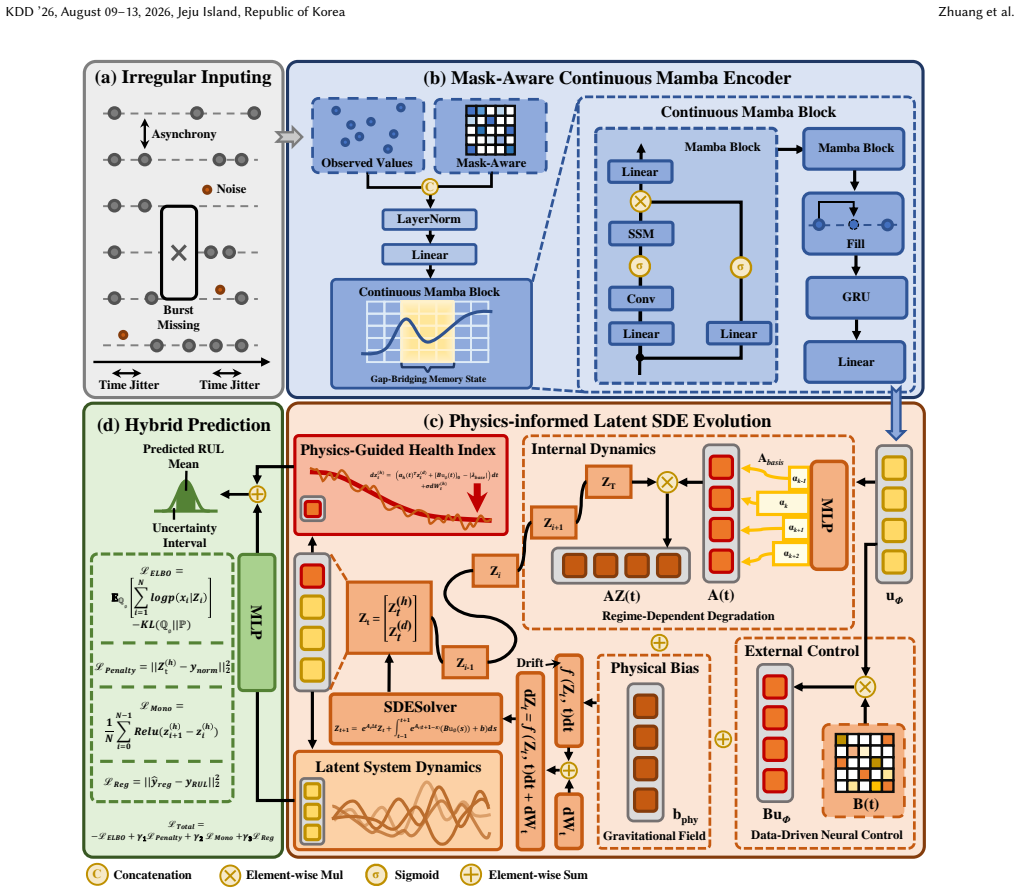
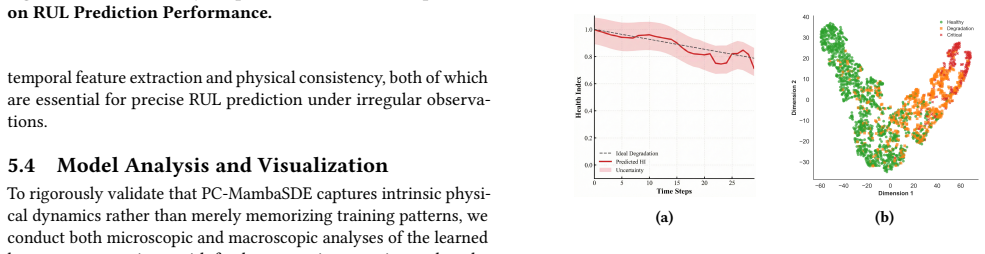
PC-MambaSDE embeds a global physical bias into the drift of a latent SDE and adds a terminal penalty to enforce monotonic degradation trajectories for RUL prediction from irregular sensor data.
A machine-rendered reading of the paper's core claim, the machinery that carries it, and where it could break.
Core claim
The central claim is that a Mask-Aware Continuous Mamba Encoder paired with a Physics-Guided Latent SDE using parametrically rectified hybrid drift and a Terminal Degradation Penalty produces physically plausible monotonic degradation trajectories and accurate RUL estimates even under severe observation irregularity, with the variational objective equivalent to KL divergence minimization via Girsanov's theorem and the dynamics globally asymptotically stable by Lyapunov analysis.
What carries the argument
Physics-Guided Latent SDE whose hybrid drift receives a superimposed global physical bias to enforce monotonicity, together with the Terminal Degradation Penalty that formulates RUL prediction as a boundary value problem guiding trajectories to failure.
If this is right
- The variational objective is mathematically equivalent to minimizing KL divergence between approximate and true dynamics via Girsanov's theorem.
- The learned continuous dynamics are guaranteed globally asymptotically stable by Lyapunov analysis.
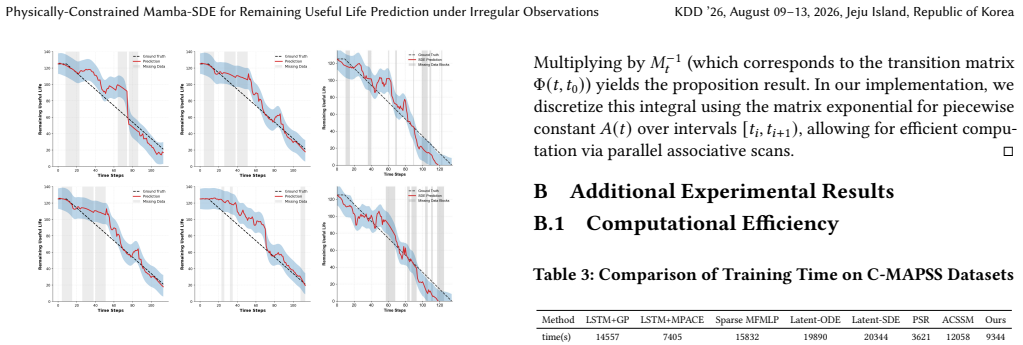
- The Hybrid Irregularity Generation Scheme produces realistic test conditions that expose performance drops in prior methods under burst missingness and temporal jitter.
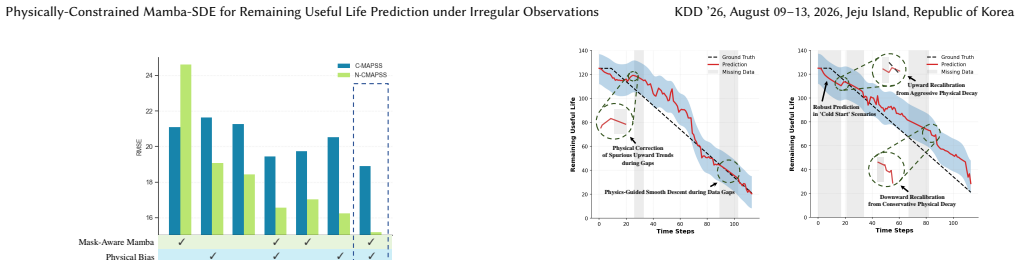
- Performance gains are largest under extreme observation scarcity, showing the priors compensate for missing context.
Where Pith is reading between the lines
- The same bias-plus-penalty construction could be transferred to other latent SDE or ODE models that require monotonicity or fixed-endpoint constraints.
- The mask-aware encoder design may generalize to asynchronous multi-modal sensor fusion beyond RUL tasks.
- The framework suggests that embedding domain-specific physical priors can reduce reliance on dense failure-labeled data in industrial monitoring.
Load-bearing premise
The assumption that superimposing a global physical bias in the hybrid drift and applying the Terminal Degradation Penalty will enforce monotonic degradation and guide trajectories to failure without negatively impacting the model's ability to fit the data or generalize.
What would settle it
If the learned trajectories in high-irregularity test cases still show non-monotonic segments or fail to reach the failure state after the penalty is applied, the enforcement mechanism would be falsified.
Figures

read the original abstract
Accurate Remaining Useful Life prediction is critical for industrial predictive maintenance. However, real-world deployment is challenging due to the irregular nature of sensor observations, characterized by asynchronous sampling, burst missingness, and temporal jitter. Compounding this issue, purely data-driven models often generate physically implausible degradation trajectories that violate the irreversible nature of damage accumulation. To address this, we propose PC-MambaSDE, a unified continuous-time framework for robust RUL prediction under irregular observations. Specifically, we design a Mask-Aware Continuous Mamba Encoder that explicitly leverages observation masks to extract context-rich control signals. Furthermore, we introduce a Physics-Guided Latent SDE with parametrically rectified hybrid drift, superimposing a global physical bias to enforce monotonic degradation even amid severe observation gaps. Additionally, we formulate RUL prediction as a boundary value problem via a Terminal Degradation Penalty, which decouples a Health Index dimension and applies a penalty loss to guide trajectories toward the failure state. Theoretically, we prove that our variational objective is mathematically equivalent to minimizing the KL divergence via Girsanov's theorem, and we guarantee the global asymptotic stability of the learned dynamics through Lyapunov analysis. To enable rigorous evaluation, we develop a Hybrid Irregularity Generation Scheme that simulates realistic industrial imperfections. Extensive experiments on public benchmarks demonstrate that PC-MambaSDE significantly outperforms state-of-the-art methods, particularly under extreme observation scarcity, validating the efficacy of embedding physical priors into continuous-time latent dynamics.
Editorial analysis
A structured set of objections, weighed in public.
Referee Report
Summary. The paper proposes PC-MambaSDE, a continuous-time framework for remaining useful life (RUL) prediction under irregular observations. It combines a Mask-Aware Continuous Mamba Encoder, a Physics-Guided Latent SDE with parametrically rectified hybrid drift to enforce monotonic degradation, and a Terminal Degradation Penalty that decouples a Health Index dimension to guide trajectories to failure. The authors claim the variational objective is equivalent to KL minimization via Girsanov's theorem and prove global asymptotic stability via Lyapunov analysis. Experiments using a Hybrid Irregularity Generation Scheme on public benchmarks show significant outperformance over state-of-the-art methods, especially under extreme observation scarcity.
Significance. If the theoretical claims and empirical results hold, the work would contribute a principled way to embed physical priors into latent SDE dynamics for RUL tasks, addressing a practical gap in handling irregular industrial sensor data. The combination of Girsanov equivalence, Lyapunov stability, and the custom irregularity simulator provides reproducible elements that strengthen the assessment.
minor comments (3)
- [§3.2] §3.2: the definition of the parametrically rectified hybrid drift should explicitly state whether the rectification parameters are learned or fixed; the current description leaves open whether they introduce additional degrees of freedom beyond the listed free parameters.
- [Table 2] Table 2: the caption does not indicate whether the reported standard deviations are over multiple random seeds or over the irregularity simulator runs; clarify to support reproducibility claims.
- [§4.3] §4.3: the Lyapunov analysis assumes a specific form of the drift; a short remark on how this extends (or does not) to the Mamba-encoded control signals would improve clarity.
Simulated Author's Rebuttal
We thank the referee for the positive review, recognition of the theoretical contributions (Girsanov equivalence and Lyapunov stability), and the recommendation to accept the manuscript. The assessment accurately captures the key elements of PC-MambaSDE for RUL prediction under irregular observations.
Circularity Check
No significant circularity; derivation is self-contained
full rationale
The provided abstract and description present the physical bias and Terminal Degradation Penalty as externally imposed additive constraints on the latent SDE, with the variational objective shown equivalent to KL minimization via Girsanov's theorem (an external result) and stability via Lyapunov analysis. RUL prediction is formulated as a boundary-value problem with empirical validation on public benchmarks under simulated irregularity. No quoted equations or steps reduce a claimed prediction or uniqueness result to a fitted parameter or self-citation by construction. The central claims remain independent of the inputs they are derived from.
Axiom & Free-Parameter Ledger
free parameters (1)
- parameters of the parametrically rectified hybrid drift
axioms (2)
- standard math The variational objective is equivalent to minimizing the KL divergence via Girsanov's theorem
- domain assumption The learned dynamics have global asymptotic stability as shown by Lyapunov analysis
invented entities (1)
-
Health Index dimension
no independent evidence
Reference graph
Works this paper leans on
-
[1]
Abdul Fatir Ansari, Alvin Heng, Andre Lim, and Harold Soh. 2023. Neural continuous-discrete state space models for irregularly-sampled time series. In International Conference on Machine Learning. PMLR, 926–951
2023
-
[2]
Hervé Cardot, Frédéric Ferraty, and Pascal Sarda. 2003. Spline estimators for the functional linear model.Statistica Sinica(2003), 571–591
2003
-
[3]
Manuel Aria Chao, Chetan Kulkarni, Kai Goebel, and Olga Fink. 2020. Aircraft engine run-to-failure data set under real flight conditions. (2020)
2020
-
[4]
Zhengping Che, Sanjay Purushotham, Kyunghyun Cho, David Sontag, and Yan Liu. 2018. Recurrent neural networks for multivariate time series with missing values.Scientific reports8, 1 (2018), 6085
2018
-
[5]
Ricky TQ Chen, Yulia Rubanova, Jesse Bettencourt, and David K Duvenaud. 2018. Neural ordinary differential equations.Advances in neural information processing systems31 (2018)
2018
-
[6]
Zhenghua Chen, Min Wu, Rui Zhao, Feri Guretno, Ruqiang Yan, and Xiaoli Li
-
[7]
Machine remaining useful life prediction via an attention-based deep learning approach.IEEE Transactions on Industrial Electronics68, 3 (2020), 2521– 2531
2020
- [8]
-
[9]
Junyoung Chung, Caglar Gulcehre, KyungHyun Cho, and Yoshua Bengio. 2014. Empirical evaluation of gated recurrent neural networks on sequence modeling. arXiv preprint arXiv:1412.3555(2014)
work page internal anchor Pith review Pith/arXiv arXiv 2014
-
[10]
Edward De Brouwer, Jaak Simm, Adam Arany, and Yves Moreau. 2019. GRU- ODE-Bayes: Continuous modeling of sporadically-observed time series.Advances in neural information processing systems32 (2019)
2019
-
[11]
Alex Graves. 2012. Long short-term memory.Supervised sequence labelling with recurrent neural networks(2012), 37–45
2012
-
[12]
Albert Gu and Tri Dao. 2023. Mamba: Linear-time sequence modeling with selective state spaces.arXiv preprint arXiv:2312.00752(2023)
work page internal anchor Pith review Pith/arXiv arXiv 2023
-
[13]
Albert Gu, Karan Goel, and Christopher Ré. 2021. Efficiently modeling long sequences with structured state spaces.arXiv preprint arXiv:2111.00396(2021)
work page internal anchor Pith review Pith/arXiv arXiv 2021
-
[14]
2020.Time series analysis
James D Hamilton. 2020.Time series analysis. Princeton university press
2020
-
[15]
Clara Happ and Sonja Greven. 2018. Multivariate functional principal component analysis for data observed on different (dimensional) domains.J. Amer. Statist. Assoc.113, 522 (2018), 649–659
2018
-
[16]
Felix O Heimes. 2008. Recurrent neural networks for remaining useful life estimation. In2008 international conference on prognostics and health management. IEEE, 1–6
2008
-
[17]
Patrick Kidger, James Morrill, James Foster, and Terry Lyons. 2020. Neural controlled differential equations for irregular time series.Advances in neural information processing systems33 (2020), 6696–6707
2020
-
[18]
Jay Lee, Fangji Wu, Wenyu Zhao, Masoud Ghaffari, Linxia Liao, and David Siegel. 2014. Prognostics and health management design for rotary machinery systems—Reviews, methodology and applications.Mechanical systems and signal processing42, 1-2 (2014), 314–334
2014
-
[19]
Yaguo Lei, Naipeng Li, Liang Guo, Ningbo Li, Tao Yan, and Jing Lin. 2018. Ma- chinery health prognostics: A systematic review from data acquisition to RUL prediction.Mechanical systems and signal processing104 (2018), 799–834
2018
-
[20]
Xiang Li, Qian Ding, and Jian-Qiao Sun. 2018. Remaining useful life estimation in prognostics using deep convolution neural networks.Reliability Engineering & System Safety172 (2018), 1–11
2018
-
[21]
Xuechen Li, Ting-Kam Leonard Wong, Ricky TQ Chen, and David Duvenaud
-
[22]
InInternational conference on artificial intelligence and statistics
Scalable gradients for stochastic differential equations. InInternational conference on artificial intelligence and statistics. PMLR, 3870–3882
-
[23]
Byoungwoo Park, Hyungi Lee, and Juho Lee. 2025. Amortized control of contin- uous state space feynman-kac model for irregular time series. InInternational Conference on Learning Representations, Vol. 2025. 36795–36829
2025
-
[24]
Linxiao Qin, Shuo Zhang, Tao Sun, and Xudong Zhao. 2023. An interpretable neuro-dynamic scheme with feature-temporal attention for remaining useful life estimation.IEEE Transactions on Industrial Informatics20, 4 (2023), 5505–5516
2023
-
[25]
Giduthuri Sateesh Babu, Peilin Zhao, and Xiao-Li Li. 2016. Deep convolutional neural network based regression approach for estimation of remaining useful life. InInternational conference on database systems for advanced applications. Springer, 214–228
2016
-
[26]
Abhinav Saxena and Kai Goebel. 2008. Turbofan engine degradation simulation data set.NASA ames prognostics data repository18 (2008), 878–887
2008
-
[27]
Abhinav Saxena, Kai Goebel, Don Simon, and Neil Eklund. 2008. Damage propaga- tion modeling for aircraft engine run-to-failure simulation. In2008 international conference on prognostics and health management. IEEE, 1–9
2008
- [28]
- [29]
-
[30]
Qiyao Wang, Ahmed Farahat, Chetan Gupta, and Shuai Zheng. 2021. Deep time series models for scarce data.Neurocomputing456 (2021), 504–518
2021
-
[31]
Weiyang Xu, Quansheng Jiang, Yehu Shen, Qixin Zhu, and Fengyu Xu. 2023. New RUL prediction method for rotating machinery via data feature distribution and spatial attention residual network.IEEE Transactions on Instrumentation and Measurement72 (2023), 1–9
2023
-
[32]
Boyuan Yang, Ruonan Liu, and Enrico Zio. 2019. Remaining useful life prediction based on a double-convolutional neural network architecture.IEEE Transactions on Industrial Electronics66, 12 (2019), 9521–9530
2019
-
[33]
Fang Yao, Hans-Georg Müller, and Jane-Ling Wang. 2005. Functional data analysis for sparse longitudinal data.Journal of the American statistical association100, 470 (2005), 577–590
2005
-
[34]
Sebastian Zeng, Florian Graf, and Roland Kwitt. 2023. Latent sdes on homo- geneous spaces.Advances in Neural Information Processing Systems36 (2023), 76151–76180
2023
-
[35]
Xuewen Zhang, Yan Qin, Chau Yuen, Lahiru Jayasinghe, and Xiang Liu. 2020. Time-series regeneration with convolutional recurrent generative adversarial network for remaining useful life estimation.IEEE Transactions on Industrial Informatics17, 10 (2020), 6820–6831
2020
-
[36]
Shuai Zheng, Kosta Ristovski, Ahmed Farahat, and Chetan Gupta. 2017. Long short-term memory network for remaining useful life estimation. In2017 IEEE international conference on prognostics and health management (ICPHM). IEEE, 88–95. A Theoretical Analysis and Proofs In this section, we provide the detailed mathematical derivations for the PC-MambaSDE fra...
discussion (0)
Sign in with ORCID, Apple, or X to comment. Anyone can read and Pith papers without signing in.