Development of TIFUUN: Terahertz Integral Field Units with Universal Nanotechnology
Pith reviewed 2026-06-26 12:57 UTC · model grok-4.3
The pith
TIFUUN combines two reconfigurable IFUs with 4:1 bandwidth optics to deliver up to 18,000 detectors across 90-360 GHz in one compact instrument.
A machine-rendered reading of the paper's core claim, the machinery that carries it, and where it could break.
Core claim
TIFUUN achieves flexible ultra-wideband performance by placing two integral field units in a shared optical path whose 4:1 bandwidth is realized with thin silicon lenses and high chief-ray-angle geometry, while the detector count and frequency bands of the two IFUs can be allocated on a per-observation basis up to a total of approximately 18,000 kinetic inductance detectors.
What carries the argument
Dual-slot integral field units sharing a 4:1 bandwidth optic train built from thin silicon lenses and high chief-ray-angle design, paired with scalable kinetic inductance detector arrays.
If this is right
- The two IFUs can be configured independently or together for any frequency pair inside 90-360 GHz at R up to 1000.
- Detector resources up to ~18,000 KIDs can be partitioned between the two IFUs in any ratio required by the science case.
- The same hardware package fits the SUBLIME CII intensity-mapping survey on ASTE and can be moved to FYST or AtLAST.
- Open-hardware IFU modules can be swapped or redesigned without rebuilding the entire spectrometer.
Where Pith is reading between the lines
- Reconfiguring the IFUs between nights could let a single telescope pursue multiple line-intensity-mapping programs without instrument changes.
- The compactness may allow the spectrometer to be duplicated for arraying on larger focal planes or for simultaneous use on multiple telescopes.
- If the open-hardware model succeeds, community groups could develop specialized IFUs for narrow-band or polarization studies that plug into the same optics.
- A direct test would be to compare on-sky mapping speed for a fixed integration time against a conventional single-band spectrometer of similar detector count.
Load-bearing premise
The thin-silicon-lens high-chief-ray-angle optics will deliver the full 4:1 bandwidth and compactness without major losses once cooled to cryogenic temperatures.
What would settle it
Cryogenic optical test of a prototype lens train that measures the achieved instantaneous bandwidth and Strehl ratio across 90-360 GHz.
Figures
read the original abstract
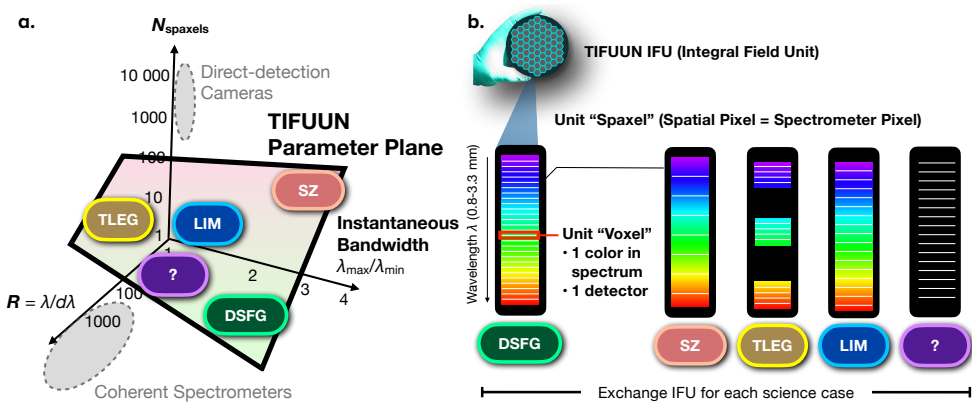
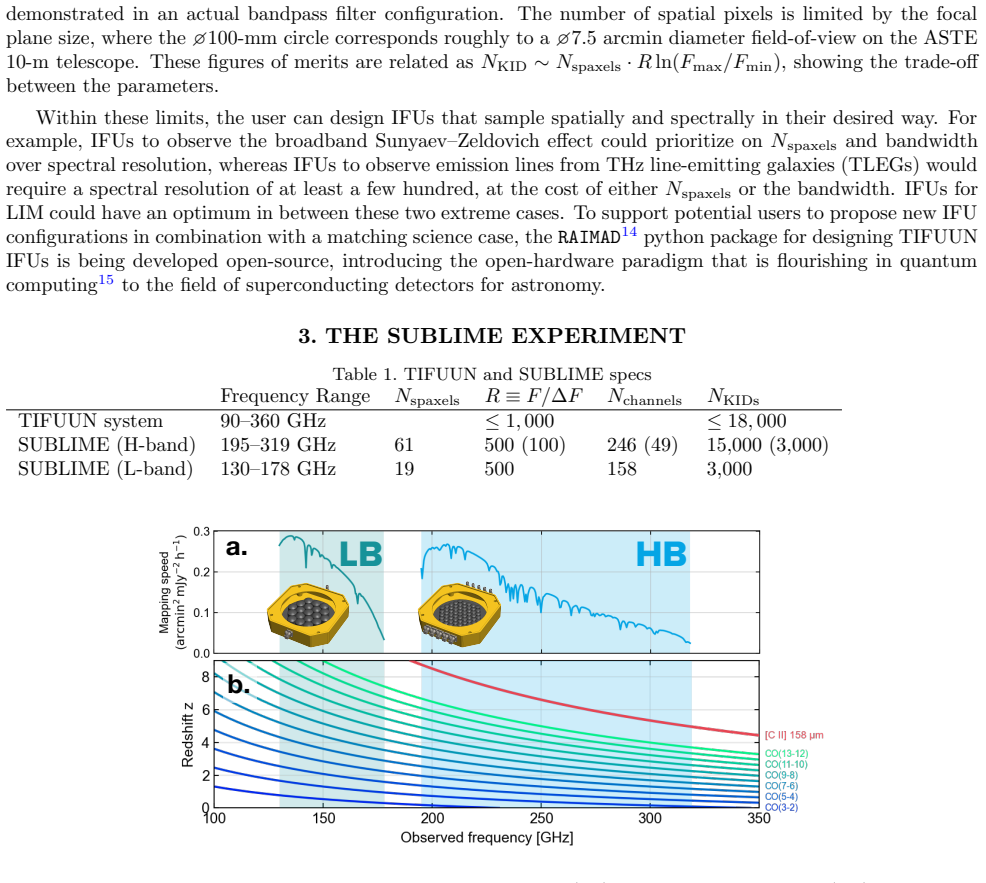
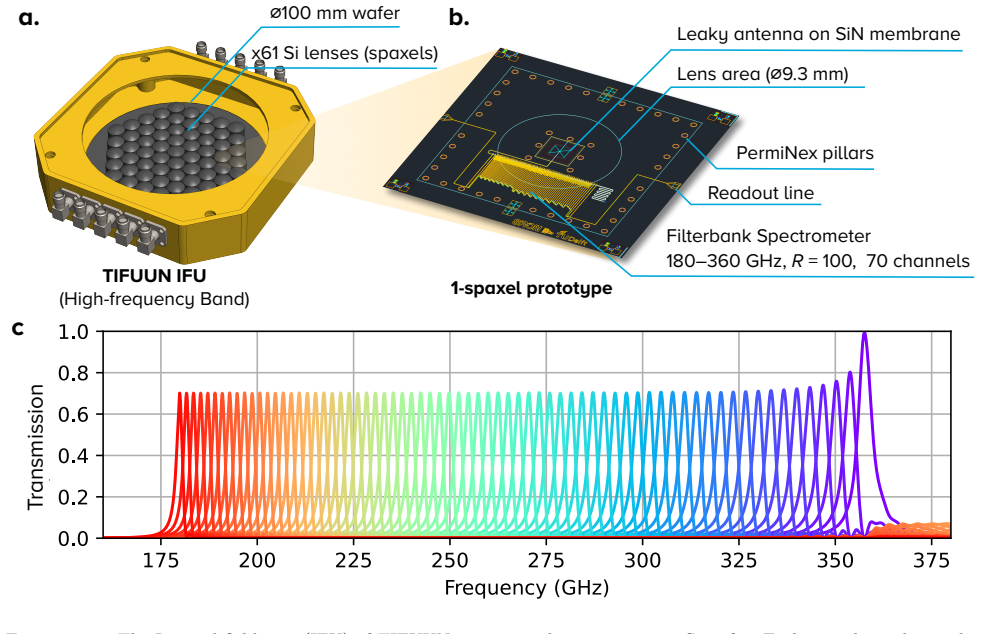
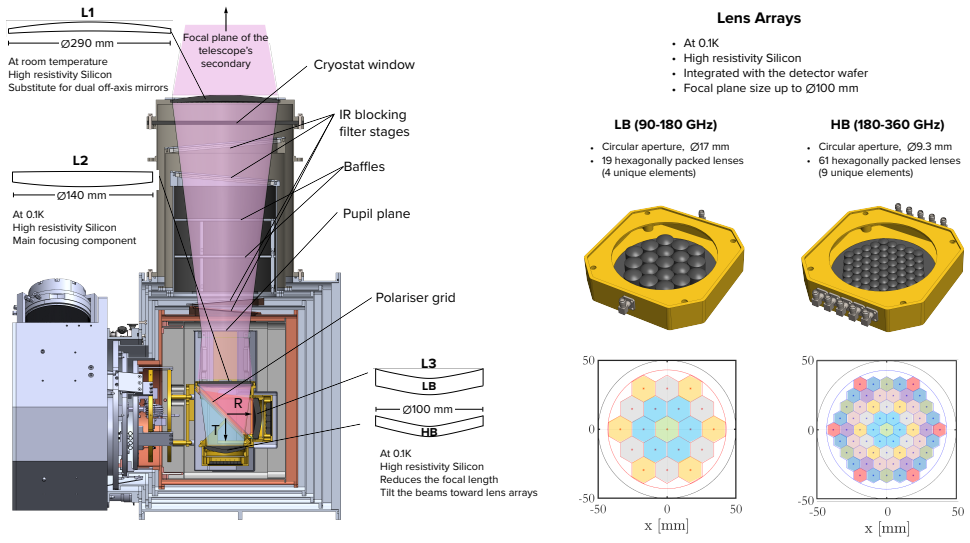
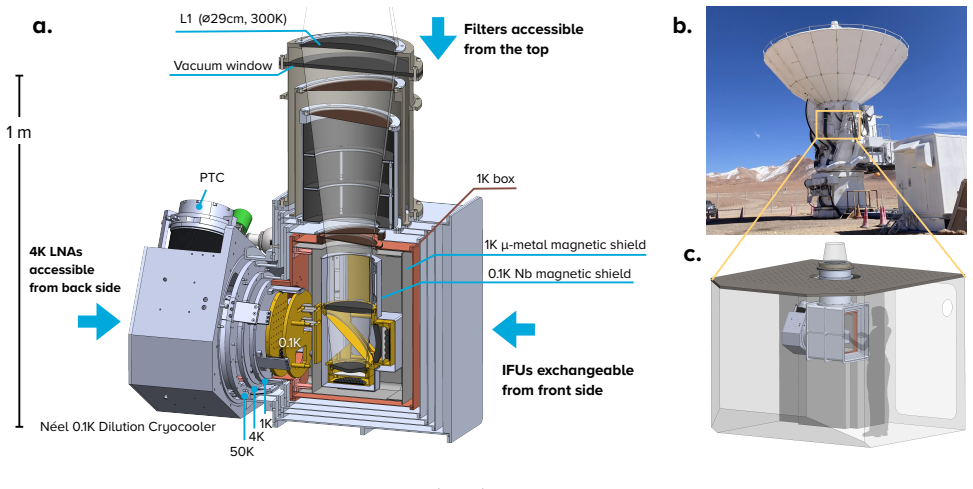
TIFUUN (THz Integral Field Units with Universal Nanotechnology) is an ultra-wideband mm-submm wave imaging spectrometer that capitalizes on the highly scalable integrated superconducting spectrometer technology. TIFUUN has two slots for integral field units (IFUs), which can jointly be optimized as open-hardware for each astronomical observation in terms of spatial and spectral coverage. These IFUs can have observation frequencies in the range of 90--360 GHz, with spectral resolution up to $R\equiv F/\Delta F \le 1,000$, with up to $\sim$18,000 kinetic inductance detectors (shared by the two IFUs with a flexible ratio). The ultra-wide 4:1 (2 octave) bandwidth optics fits in a remarkably compact volume, by means of thin silicon lenses and a high chief ray angle design. The first pair of IFUs are being developed for the SUBLIME (Study of the Universe By Line Intensity Mapping Experiments) experiment that aims to map CII emission at redshift $\sim$6 to trace the cosmic large-scale structure and the buildup of galaxies during reionization, using TIFUUN on the ASTE 10-m telescope. The scalability, flexibility and compactness makes TIFUUN a highly compatible and portable system suited also for upcoming telescope facilities in the vicinity, such as FYST and AtLAST/LST.
Editorial analysis
A structured set of objections, weighed in public.
Referee Report
Summary. The manuscript describes the development of TIFUUN, an ultra-wideband mm-submm imaging spectrometer based on scalable integrated superconducting spectrometer technology. It features two IFU slots that can be jointly optimized as open hardware for spatial and spectral coverage, operating in the 90-360 GHz range with R ≤ 1000 and up to ~18,000 shared KIDs. The design highlights compact ultra-wideband (4:1) optics using thin silicon lenses and high chief-ray-angle geometry, with initial deployment for the SUBLIME CII intensity-mapping experiment on the ASTE 10-m telescope and portability to facilities such as FYST and AtLAST.
Significance. If the performance targets are met, TIFUUN would offer a flexible, compact, and scalable platform for submillimeter integral-field spectroscopy and line-intensity mapping, enabling efficient use of existing and future telescopes for high-redshift large-scale structure studies. The open-hardware emphasis and detector-sharing approach represent practical strengths for community adoption.
major comments (1)
- [Abstract] Abstract (optics paragraph): The claim that the ultra-wide 4:1 (2-octave) bandwidth optics 'fits in a remarkably compact volume, by means of thin silicon lenses and a high chief ray angle design' is presented without ray-trace results, Strehl-ratio estimates, tolerance analysis, or cryogenic performance data. This assertion is load-bearing for the stated IFU frequency coverage, detector count, and overall instrument feasibility.
Simulated Author's Rebuttal
We thank the referee for their positive evaluation of TIFUUN's significance and for the constructive comment on the abstract. We address the major comment point by point below.
read point-by-point responses
-
Referee: [Abstract] Abstract (optics paragraph): The claim that the ultra-wide 4:1 (2-octave) bandwidth optics 'fits in a remarkably compact volume, by means of thin silicon lenses and a high chief ray angle design' is presented without ray-trace results, Strehl-ratio estimates, tolerance analysis, or cryogenic performance data. This assertion is load-bearing for the stated IFU frequency coverage, detector count, and overall instrument feasibility.
Authors: We agree that the abstract presents the optics claim without accompanying quantitative metrics. The manuscript body includes the supporting ray-trace results, Strehl-ratio estimates, and tolerance analysis for the thin-silicon-lens, high-chief-ray-angle design. Because TIFUUN remains in the pre-deployment development phase, no cryogenic performance data exist yet; such data will be reported after commissioning. We will revise the abstract to reference the relevant manuscript sections and to qualify the claim with respect to the current development status. revision: yes
Circularity Check
No derivations or self-referential predictions; purely descriptive instrument paper
full rationale
The manuscript is an instrument-development description with no equations, no fitted parameters, no predictions of derived quantities, and no load-bearing self-citations. The optics claim is presented as a design choice rather than the output of any derivation chain that could reduce to its own inputs. No patterns of self-definition, fitted-input-as-prediction, or ansatz smuggling appear. The paper is therefore self-contained against external benchmarks and receives the default non-circularity finding.
Axiom & Free-Parameter Ledger
Reference graph
Works this paper leans on
-
[1]
Snowmass 2021 Cosmic Frontier White Paper: Cosmology with Millimeter-Wave Line Intensity Mapping,
Karkare, K. S., Moradinezhad Dizgah, A., Keating, G. K., Breysse, P., and Chung, D. T., “Snowmass 2021 Cosmic Frontier White Paper: Cosmology with Millimeter-Wave Line Intensity Mapping,”arXiv e-prints, arXiv:2203.07258 (Mar. 2022)
arXiv 2021
-
[2]
Chang, T.-C. and Lidz, A., “Line-Intensity Mapping,”arXiv e-prints, arXiv:2602.03011 (Feb. 2026)
arXiv 2026
-
[3]
Astrophysics with the Spatially and Spectrally Resolved Sunyaev- Zeldovich Effects. A Millimetre/Submillimetre Probe of the Warm and Hot Universe,
Mroczkowski, T., Nagai, D., Basu, K., Chluba, J., Sayers, J., Adam, R., Churazov, E., Crites, A., Di Mascolo, L., Eckert, D., Macias-Perez, J., Mayet, F., Perotto, L., Pointecouteau, E., Romero, C., Ruppin, F., Scannapieco, E., and ZuHone, J., “Astrophysics with the Spatially and Spectrally Resolved Sunyaev- Zeldovich Effects. A Millimetre/Submillimetre P...
2019
-
[4]
Large format imaging spectrograph for the Large Submillimeter Telescope (LST),
Kohno, K., Kawabe, R., Tamura, Y., Endo, A., Baselmans, J. J. A., Karatsu, K., Inoue, A. K., Moriwaki, K., Hayatsu, N. H., Yoshida, N., Yoshimura, Y., Hatsukade, B., Umehata, H., Oshima, T., Takekoshi, T., Taniguchi, A., Klaassen, P. D., Mroczkowski, T., Cicone, C., Bertoldi, F., Dannerbauer, H., and Tosaki, T., “Large format imaging spectrograph for the ...
2020
-
[5]
Dusty star-forming galaxies at high redshift,
Casey, C. M., Narayanan, D., and Cooray, A., “Dusty star-forming galaxies at high redshift,”Physics Reports541, 45–161 (Aug. 2014)
2014
-
[6]
THz Low Resolution Spectroscopy for Astronomy,
Stacey, G. J., “THz Low Resolution Spectroscopy for Astronomy,”IEEE Transactions on Terahertz Science and Technology1, 241–255 (Sept. 2011)
2011
-
[7]
A wide field-of-view low-resolution spectrometer at APEX: Instrument design and scientific forecast,
CONCERTO Collaboration, Ade, P., Aravena, M., Barria, E., Beelen, A., Benoit, A., B´ ethermin, M., Bounmy, J., Bourrion, O., Bres, G., De Breuck, C., Calvo, M., Cao, Y., Catalano, A., D´ esert, F.-X., Dur´ an, C. A., Fasano, A., Fenouillet, T., Garcia, J., Garde, G., Goupy, J., Groppi, C., Hoarau, C., Lagache, G., Lambert, J.-C., Leggeri, J.-P., Levy-Bert...
2020
-
[8]
First light demonstration of the integrated superconducting spectrometer,
Endo, A., Karatsu, K., Tamura, Y., Oshima, T., Taniguchi, A., Takekoshi, T., Asayama, S., Bakx, T. J. L. C., Bosma, S., Bueno, J., Chin, K. W., Fujii, Y., Fujita, K., Huiting, R., Ikarashi, S., Ishida, T., Ishii, S., Kawabe, R., Klapwijk, T. M., Kohno, K., Kouchi, A., Llombart, N., Maekawa, J., Murugesan, V., Nakatsubo, S., Naruse, M., Ohtawara, K., Pascu...
2019
-
[9]
DESHIMA 2.0: A 200-400 GHz Ultra-wideband Integrated Superconducting Spectrometer,
Karatsu, K., Endo, A., Moerman, A., Yates, S. J. C., Huiting, R., Laguna, A. P., Dabironezare, S., Muruge- san, V., Thoen, D. J., Buijtendorp, B. T., Cray, S., Fujita, K., H¨ ahnle, S., Hanany, S., Kawabe, R., Kohno, K., Marting, L. H., Matsumura, T., Nakatsubo, S., Olde Scholtenhuis, L. G. G., Oshima, T., Rybak, M., Steenvoorde, F., Takaku, R., Takekoshi...
arXiv 2026
-
[10]
SuperSpec: On-Chip Spectrometer Design, Characterization, and Performance,
Redford, J., Barry, P. S., Bradford, C. M., Chapman, S., Glenn, J., Hailey-Dunsheath, S., Janssen, R. M. J., Karkare, K. S., LeDuc, H. G., Mauskopf, P., McGeehan, R., Shirokoff, E., Wheeler, J., and Zmuidzinas, J., “SuperSpec: On-Chip Spectrometer Design, Characterization, and Performance,”Journal of Low Temper- ature Physics209, 548–555 (Nov. 2022)
2022
-
[11]
Spectral characterization and performance of SPT-SLIM on-chip filterbank spectrometers,
Benson, C. S., Fichman, K., Adamic, M., Anderson, A. J., Barry, P. S., Benson, B. A., Brooks, E., Carlstrom, J. E., Cecil, T., Chang, C. L., Dibert, K. R., Dobbs, M., Karkare, K. S., Keating, G. K., Lapuente, A. M., Lisovenko, M., Marrone, D. P., Montgomery, J., Natoli, T., Pan, Z., Rahlin, A., Robson, G., Rouble, M., Smecher, G., Yefremenko, V., Young, M...
Pith/arXiv arXiv 2025
-
[12]
A kilo-pixel imaging system for future space based far-infrared observatories using microwave kinetic inductance detectors,
Baselmans, J. J. A., Bueno, J., Yates, S. J. C., Yurduseven, O., Llombart, N., Karatsu, K., Baryshev, A. M., Ferrari, L., Endo, A., Thoen, D. J., de Visser, P. J., Janssen, R. M. J., Murugesan, V., Driessen, E. F. C., Coiffard, G., Martin-Pintado, J., Hargrave, P., and Griffin, M., “A kilo-pixel imaging system for future space based far-infrared observato...
2017
-
[13]
Hydrogenated Amorphous Silicon Carbide: A Low-Loss Deposited Dielectric for Microwave to Submillimeter-Wave Superconducting Circuits,
Buijtendorp, B. T., Vollebregt, S., Karatsu, K., Thoen, D. J., Murugesan, V., Kouwenhoven, K., H¨ ahnle, S., Baselmans, J. J. A., and Endo, A., “Hydrogenated Amorphous Silicon Carbide: A Low-Loss Deposited Dielectric for Microwave to Submillimeter-Wave Superconducting Circuits,”Physical Review Applied18, 064003 (Dec. 2022)
2022
-
[14]
RAIMAD: Astronomical instrument mask designer
Soshnin, N., “RAIMAD: Astronomical instrument mask designer.”https://github.com/tifuun/raimad. Accessed: 2026-06-15
2026
-
[15]
Open hardware solutions in quantum technology,
Shammah, N., Saha Roy, A., Almudever, C. G., Bourdeauducq, S., Butko, A., Cancelo, G., Clark, S. M., Heinsoo, J., Henriet, L., Huang, G., Jurczak, C., Kotilahti, J., Landra, A., LaRose, R., Mari, A., Nowrouzi, K., Ockeloen-Korppi, C., Prawiroatmodjo, G., Siddiqi, I., and Zeng, W. J., “Open hardware solutions in quantum technology,”APL Quantum1, 011501 (03 2024)
2024
-
[16]
Concept integral field unit spectrometer instru- ment for the next-generation millimeter-wave cosmological surveys,
Kov´ acs, A., Keating, G. K., Greve, T. R., and Norton, T., “Concept integral field unit spectrometer instru- ment for the next-generation millimeter-wave cosmological surveys,”Journal of Astronomical Telescopes, Instruments, and Systems11, 045007 (Oct. 2025)
2025
-
[17]
Marting, L. H., Karatsu, K., Olde Scholtenhuis, L. G. G., Dabironezare, S. O., Laguna, A. P., Moerman, A., Thoen, D. J., J., A., der Linden, v., Endo, A., and Baselmans, J. J. A., “A High Efficiency Superconducting On-chip Filterbank with Directional Filters for Integral Field Units in the Sub-millimeter Regime,”arXiv e-prints, arXiv:2603.06334 (Mar. 2026)
arXiv 2026
-
[18]
Lossless matching layer for silicon lens arrays at 500 ghz using laser ablated structures,
Bueno, J., Bosma, S., Bußkamp-Alda, T., Alonso-delPino, M., and Llombart, N., “Lossless matching layer for silicon lens arrays at 500 ghz using laser ablated structures,”IEEE Transactions on Terahertz Science and Technology12(6), 667–672 (2022)
2022
-
[19]
AMKID: A large KID-based camera at the APEX telescope,
Reyes, N., Weiss, A., Yates, S. J. C., Baryshev, A. M., C´ amara-Mayorga, I., Dabironezare, S., Endo, A., Ferrari, L., G¨ orlitz, A., Grutzeck, G., G¨ usten, R., Heiter, C., Heyminck, S., Hochg¨ urtel, S., Hoevers, H., Jorquera, S., Kov´ acs, A., Koopmans, D., K¨ onig, C., Llombart, N., Menten, K. M., Murugesan, V., Ridder, M., Schmitz, A., Thoen, D. J., ...
2026
-
[20]
Low-frequency noise performance of microstrip-coupled lumped-element aluminum kids using hydrogenated amorphous silicon parallel-plate capacitors for new-music,
Hempel-Costello, S., Golwala, S. R., Beyer, A. D., Cunnane, D., Day, P. K., Defrance, F., Frez, C. F., Gavidia, A., Kim, J., Martin, J.-M., Sadou, Y., Sayers, J., Shu, S., and Yu, S., “Low-frequency noise performance of microstrip-coupled lumped-element aluminum kids using hydrogenated amorphous silicon parallel-plate capacitors for new-music,”IEEE Transa...
2026
-
[21]
Vibrational modes as the origin of dielectric loss at 0.27-100 THz in a-SiC:H,
Buijtendorp, B. T., Endo, A., Jellema, W., Karatsu, K., Kouwenhoven, K., Lamers, D., van der Linden, A. J., Rostem, K., Veen, H. M., Wollack, E. J., Baselmans, J. J. A., and Vollebregt, S., “Vibrational modes as the origin of dielectric loss at 0.27-100 THz in a-SiC:H,”Physical Review Applied23, 014035 (Jan. 2025)
2025
-
[22]
A multi-lens quasi-optical system with two octave of instantaneous bandwidth and wide field-of-view for (sub)-mm wave astronomy,
Dabironezare, S. O., Gregoor, W., Meijneke, C., and Endo, A., “A multi-lens quasi-optical system with two octave of instantaneous bandwidth and wide field-of-view for (sub)-mm wave astronomy,” in [Proceedings of the 20th edition of the European Conference on Antennas and Propagation (EuCAP)], (2026). Paper ID: 4.33
2026
-
[23]
Large-aperture wide-bandwidth antireflection-coated silicon lenses for millimeter wavelengths,
Datta, R., Munson, C. D., Niemack, M. D., McMahon, J. J., Britton, J., Wollack, E. J., Beall, J., Devlin, M. J., Fowler, J., Gallardo, P., Hubmayr, J., Irwin, K., Newburgh, L., Nibarger, J. P., Page, L., Qui- jada, M. A., Schmitt, B. L., Staggs, S. T., Thornton, R., and Zhang, L., “Large-aperture wide-bandwidth antireflection-coated silicon lenses for mil...
2013
-
[24]
Silicon-based vacuum window for millimeter- and submillimeter-wave astrophysics,
Takaku, R., Cray, S., Aizawa, K., Endo, A., Hanany, S., Karatsu, K., Koch, J., Konishi, K., Matsumura, T., and Sakurai, H., “Silicon-based vacuum window for millimeter- and submillimeter-wave astrophysics,” Applied Optics65, 4579 (May 2026)
2026
-
[25]
Design, Fabrication and Measurement of Pyramid-Type Antireflective Structures on Columnar Crystal Silicon Lens for Millimeter-Wave Astronomy,
Nitta, T., Sekimoto, Y., Hasebe, T., Noda, K., Sekiguchi, S., Nagai, M., Hattori, S., Murayama, Y., Matsuo, H., Dominjon, A., Shan, W., Naruse, M., Kuno, N., and Nakai, N., “Design, Fabrication and Measurement of Pyramid-Type Antireflective Structures on Columnar Crystal Silicon Lens for Millimeter-Wave Astronomy,” Journal of Low Temperature Physics193, 9...
2018
-
[26]
Moerman, A., Soshnin, N., Brackenhoff, S. A., Dabironezare, S. O., Karatsu, K., Marting, L. H., de Rooij, S. A. H., Roos, M., Brandl, B. R., and Endo, A., “gateau: an observation simulator for ground- based submillimeter astronomy with integral field units and kinetic inductance detectors,”arXiv e-prints, arXiv:2604.23305 (Apr. 2026)
Pith/arXiv arXiv 2026
-
[27]
gateau: the gpu-accelerated time-dependent observation simulator
Moerman, A., “gateau: the gpu-accelerated time-dependent observation simulator.”https://github.com/ tifuun/gateau. doi:10.5281/zenodo.19737797
-
[28]
CCAT-prime Collaboration: Science Goals and Forecasts with Prime-Cam on the Fred Young Submillimeter Telescope,
CCAT-Prime Collaboration, Aravena, M., Austermann, J. E., Basu, K., Battaglia, N., Beringue, B., Bertoldi, F., Bigiel, F., Bond, J. R., Breysse, P. C., Broughton, C., Bustos, R., Chapman, S. C., Charmetant, M., Choi, S. K., Chung, D. T., Clark, S. E., Cothard, N. F., Crites, A. T., Dev, A., Douglas, K., Duell, C. J., D¨ unner, R., Ebina, H., Erler, J., Fi...
2023
-
[29]
The conceptual design of the 50-meter Atacama Large Aperture Submillimeter Telescope (AtLAST),
Mroczkowski, T., Gallardo, P. A., Timpe, M., Kiselev, A., Groh, M., Kaercher, H., Reichert, M., Cicone, C., Puddu, R., Dubois-dit-Bonclaude, P., Bok, D., Dahl, E., Macintosh, M., Dicker, S., Viole, I., Sartori, S., Valenzuela Venegas, G. A., Zeyringer, M., Niemack, M., Poppi, S., Olguin, R., Hatziminaoglou, E., De Breuck, C., Klaassen, P., Montenegro-Mont...
2025
-
[30]
The atacama large aperture submillimeter telescope (atlast): enabling large-scale sub-mm science beyond 2030,
Cicone, C., Mroczkowski, T., Reichert, M., Hatziminaoglou, E., Montenegro, F., Saintonge, A., Klaassen, P., Sartori, S., Stander, T., Kohno, K., Poppi, S., Tamura, Y., Kiselev, A., Thoms, S., K¨ archer, H. J., Timpe, M., Wedemeyer, S., Attoli, A., Molyneux, S., Breuck, C. D., Pizarro, P., van Kampen, E., Silva, B., Venegas, G. V., Herrejon, P. V., Zeyring...
2030
-
[31]
Large format imaging spectrograph for the Large Submillimeter Telescope (LST),
Kohno, K., Kawabe, R., Tamura, Y., Endo, A., Baselmans, J. J. A., Karatsu, K., Inoue, A. K., Moriwaki, K., Hayatsu, N. H., Yoshida, N., Yoshimura, Y., Hatsukade, B., Umehata, H., Oshima, T., Takekoshi, T., Taniguchi, A., Klaassen, P. D., Mroczkowski, T., Cicone, C., Bertoldi, F., Dannerbauer, H., and Tosaki, T., “Large format imaging spectrograph for the ...
2020
-
[32]
Atlast sensitivity calculator
AtLAST Collaboration, “Atlast sensitivity calculator.”https://www.atlast.uio.no/ sensitivity-calculator/(n.d.). Accessed: 2026-06-12
2026
-
[33]
2023 Astrophotonics Roadmap: pathways to realizing multi-functional integrated astrophotonic instruments,
Jovanovic, N., Gatkine, P., Anugu, N., Amezcua-Correa, R., Basu Thakur, R., Beichman, C., Bender, C. F., Berger, J.-P., Bigioli, A., Bland-Hawthorn, J., Bourdarot, G., Bradford, C. M., Broeke, R., Bryant, J., Bundy, K., Cheriton, R., Cvetojevic, N., Diab, M., Diddams, S. A., Dinkelaker, A. N., Duis, J., Eikenberry, S., Ellis, S., Endo, A., Figer, D. F., F...
2023
discussion (0)
Sign in with ORCID, Apple, or X to comment. Anyone can read and Pith papers without signing in.