REVIEW 4 major objections 5 minor 70 references
Risk-sensitive Actor-Critic with Static Spectral Risk Measures for Online and Offline Reinforcement Learning
T0 review · 4 major / 5 minor · reviewed 2026-08-06 · deepseek-v4-flash
Pith's one-line read A dual-loop actor-critic optimizes static spectral risk measures directly, in both online and offline reinforcement learning, with convergence guarantees in finite MDPs.
desk verdict A real algorithmic extension of static-SRM RL to actor-critic and offline settings, but the headline convergence theorem does not cover the implemented approximate algorithm and the abstract oversells the experiments. read the letter →
The pith
A machine-rendered reading of the paper's core claim, the machinery that carries it, and where it could break.
The reading
What carries the argument
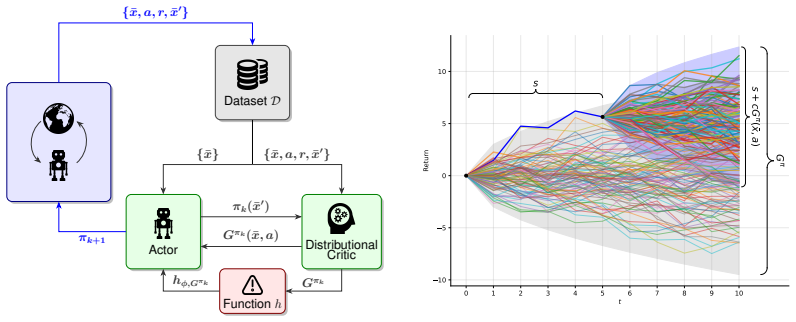
The load-bearing object is the supremum representation of a Spectral Risk Measure: $\mathrm{SRM}_\varphi(Z) = \sup_{h \in H}\left(\mathbb{E}[h(Z)] + \int_0^1 \hat{h}(\varphi(u))\,du\right)$, with the supremum attained at $h_{\varphi,Z}(z) = \int_0^1 \left(F_Z^{-1}(\alpha) + \frac{1}{\alpha}(z - F_Z^{-1}(\alpha))^-\right)\mu(d\alpha)$. Proposition 4.1 approximates this $h$ by a piecewise-linear function built from $N$ quantiles with weights $w_i = \hat{\tau}_i(\varphi(\tau_{i-1}) - \varphi(\tau_i))$, so the risk preference is re-expressed as a deterministic, action-independent function of the return. This $h$ is then used to define $Q$-values on an extended state space (accumulated reward $s$ and discount $c$), which is what lets the same global risk spectrum act on returns from different time steps. The risk-sensitive Performance Difference Lemma converts the advantage function into policy improvement and is the engine behind both the inner convergence theorem and the offline advantage-weighted update.
What would settle it
Run AC-SRM or TD3-SRM on a small finite MDP where $J(\pi) = \mathrm{SRM}_\varphi(G^\pi)$ can be computed exactly by enumerating all trajectories, and record $J(\pi_k)$ at each outer iteration. A single decrease $J(\pi_{k+1}) < J(\pi_k)$, or a computed gradient sequence whose norm does not approach zero, would falsify Theorem 4.3 as stated. The toy setting needs only two states, two actions, a small horizon, and a fixed spectrum such as CVaR with $\alpha = 0.2$.
Extended reading notes
Core claim
The central claim is that $J(\pi) = \mathrm{SRM}_\varphi(G^\pi)$, the spectral risk measure of the return distribution from the initial state, can be optimized by alternating two steps instead of embedding the risk measure into every Bellman update. For a fixed concave function $h$, the inner loop maximizes $J(\pi, h) = \mathbb{E}[h(G^\pi)] + \int_0^1 \hat{h}(\varphi(u))\,du$ via a risk-sensitive policy gradient with $Q_h^\pi(\bar{x}, a) = \mathbb{E}[h(s + c G^\pi(\bar{x}, a))]/c$; the outer loop sets $h_{k+1} = \tilde{h}_{\varphi, G^{\pi_k}}$, a piecewise-linear quantile approximation of the exact maximizer from Proposition 4.1. Theorem 4.2 establishes that the inner natural-policy-gradient updates converge to the optimal softmax policy for fixed $h$, and Theorem 4.3 establishes that the alternating scheme monotonically improves $J(\pi)$, converges, and has $\liminf_k \|\nabla_\theta J(\pi_{\theta_k})\| = 0$. The authors also derive an advantage-weighted update for the offline constraint setting. If correct, this gives an actor-critic family that optimizes static SRM directly, covering CVaR and Mean-CVaR as special cases, and avoids the time-inconsistency of iterative risk measures.
Load-bearing premise
The convergence proofs assume the exact outer maximizer $h_{\varphi, G^{\pi_k}}$ and a compact parameter sublevel set, while the implemented algorithm uses a piecewise-linear approximation $\tilde{h}$ and finitely many inner policy updates; the monotonic-improvement guarantee does not strictly follow for the implemented approximation unless its error is controlled.
Editorial extensions
If this is right
- Policies can be matched to a user's true risk preference: the risk measure is applied once to the whole return, not step by step, so CVaR- or Mean-CVaR-optimizing policies are no longer distorted by local risk decisions.
- For offline RL, one fixed dataset yields a whole family of risk-tuned policies: changing the spectrum parameter (e.g., $\omega$ in Mean-CVaR) gives different risk-return profiles without further environment interaction.
- The same bi-level scheme works for stochastic actors (AC-SRM, OAC-SRM) and deterministic actors (TD3-SRM, TD3BC-SRM), so discrete and continuous control can share the static-SRM objective.
- In the finite tabular case, the inner policy search converges to the optimal softmax policy for the fixed $h$, and the overall loop monotonically improves the static SRM objective.
- Iterative risk baselines such as DSAC-iCVaR and CODAC-iMC are consistently outperformed in the reported trading, portfolio, HIV, and MuJoCo experiments.
Reading between the lines
- Our inference: the framework should extend to any coherent distortion risk measure with an absolutely continuous distortion function, since the SRM representation covers those; experiments with Wang or proportional-hazard spectra would test this directly.
- Our inference: the time-inconsistency advantage should grow with horizon length and tail severity, so longer-horizon stochastic MuJoCo tasks or rare-disaster reward models should show larger margins over iterative-risk baselines.
- Our inference: the paper's observation about entropy-based critics suggests a decoupled risk-sensitive SAC where entropy is not risk-adjusted; this modification is not implemented in the paper but is a natural testable extension.
- Our inference: if the approximate $\tilde{h}$ is replaced by an exact or better-quantized $h$ in the outer loop, Theorem 4.3's monotonicity could be brought closer to the implemented algorithm; comparing the two on a finite MDP would quantify the approximation gap.
Editorial analysis
A structured set of objections, weighed in public.
Referee Report
Summary. The paper proposes actor-critic algorithms (AC-SRM, OAC-SRM, TD3-SRM, TD3BC-SRM) for directly optimizing static spectral risk measures (SRM) of the return distribution in both online and offline reinforcement learning. The method is based on a bi-level reformulation of the SRM via its supremum representation, alternating an inner policy optimization for a fixed risk function h and an outer update of h using quantiles of the current return distribution. The authors prove convergence of the inner policy optimization in the finite tabular setting (Theorem 4.2), monotonic improvement and stationarity of the overall procedure (Theorem 4.3), and derive a risk-sensitive advantage-weighted update for the offline setting (Theorem 4.4). They report empirical results on trading, portfolio allocation, HIV treatment, and stochastic MuJoCo environments, comparing against risk-neutral and iterative-risk baselines.
Significance. If the convergence claims were fully supported, this would be a useful contribution: static SRM objectives are known to be poorly served by per-step iterative risk measures, and an actor-critic method that directly optimizes a static SRM with guarantees would fill a real gap in risk-sensitive RL, especially for offline policy tailoring. The supremum-representation reformulation is conceptually clean, the empirical study is broad and includes a compelling portfolio-allocation demonstration, and the authors provide code and detailed hyperparameters. However, the main theoretical results currently rest on a performance-difference lemma whose proof has a dimensional inconsistency, and the implemented algorithms use an approximate risk function and finite inner-loop updates that are not covered by the stated monotonicity theorem. These issues are load-bearing for the paper's central claim, so the contribution is not yet established as written.
major comments (4)
- [Appendix C, Lemma 1 (Eq. 16)]
- [Theorem 4.3 and Algorithm 1 (also Algorithms 2–4)]
- [Appendix D, compactness assumption in Theorem 4.3]
- [Equation (9) and Lemma 1 interplay]
minor comments (5)
- [Equation (15)]
- [Algorithms 2–4]
- [Section 3.3]
- [Section 5.5 / Figure 1]
- [Appendix C, Eq. (17)]
Circularity Check
No circularity: the SRM bi-level formulation is a true variational identity, and the self-citations are attribution rather than load-bearing.
full rationale
The derivation is self-contained. The central reformulation max_pi SRM_phi(G_pi) = max_pi max_h J(pi,h) is the exact supremum (convex-conjugate) representation of a spectral risk measure (Eq. 3, via Pichler), so the inner h-update is a legitimate dual block, not a parameter fitted to the quantity being predicted. The closed-form h_phi,G and its piecewise-linear approximation tilde h are derived in Eqs. (4)-(5) and Proposition 4.1 with proof in Appendix B, so the citation to the authors' earlier ICML paper is attribution rather than load-bearing; no uniqueness or convergence fact is imported from that self-citation. Theorem 4.2's policy-gradient convergence is proved with the risk-sensitive performance-difference lemma proved in Appendix C, and Theorem 4.3 is a block-coordinate-ascent argument using standard external results (Tseng 2001, Wright 2015, Zhang et al. 2021). The genuine weakness, that Algorithm 1 uses approximate tilde h and finite T_inner while Theorem 4.3 assumes exact maximization in both blocks, is a rigor/coverage gap rather than a circular reduction: the theorem's conclusion is not identical to its assumptions. Empirical evaluation is against external baselines and held-out data, so no fitted input is relabeled as a prediction.
Assumptions & free parameters
free parameters (3)
- Lambda (Lagrange multiplier) =
1.0 for OAC-SRM; 2.5 for TD3BC-SRM
- Risk spectrum parameters (alpha, omega) =
alpha=0.2 or 0.1, omega in [0,1] in experiments
- Number of quantiles N =
50
assumptions (4)
- standard math The supremum representation of SRM (Equation 3) holds and is attained by h_{phi,Z} (Equation 4).
- ad hoc to paper The quantile-based tilde h in Proposition 4.1 approximates the exact maximizer h closely enough for the convergence guarantees.
- ad hoc to paper The sublevel set Theta_bar = {theta,q | J(pi_theta, h_q) >= J(pi_theta0)} is compact.
- domain assumption Rewards are bounded with Rmin >= 0 and phi(0) is finite.
Cite this review
Pith. "Pith review of Risk-sensitive Actor-Critic with Static Spectral Risk Measures for Online and Offline Reinforcement Learning." pith.science (2026). https://pith.science/paper/J5K4MKQK
@misc{pith2026250703900,
  author       = {Pith},
  title        = {Pith review of: Risk-sensitive Actor-Critic with Static Spectral Risk Measures for Online and Offline Reinforcement Learning},
  year         = {2026},
  howpublished = {\url{https://pith.science/paper/J5K4MKQK}},
  note         = {Machine review of arXiv:2507.03900}
}
read the original abstract
The development of Distributional Reinforcement Learning (DRL) has introduced a natural way to incorporate risk sensitivity into value-based and actor-critic methods by employing risk measures other than expectation in the value function. While this approach is widely adopted in many online and offline RL algorithms due to its simplicity, the naive integration of risk measures often results in suboptimal policies. This limitation can be particularly harmful in scenarios where the need for effective risk-sensitive policies is critical and worst-case outcomes carry severe consequences. To address this challenge, we propose a novel framework for optimizing static Spectral Risk Measures (SRM), a flexible family of risk measures that generalizes objectives such as CVaR and Mean-CVaR, and enables the tailoring of risk preferences. Our method is applicable to both online and offline RL algorithms. We establish theoretical guarantees by proving convergence in the finite state-action setting. Moreover, through extensive empirical evaluations, we demonstrate that our algorithms consistently outperform existing risk-sensitive methods in both online and offline environments across diverse domains.
Figures


Figures from the paper (4 more)



Reference graph
Works this paper leans on
-
[1]
Spectral measures of risk: A coherent representation of subjective risk aversion
Carlo Acerbi. Spectral measures of risk: A coherent representation of subjective risk aversion. Journal of Banking and Finance, 26 0 (7): 0 1505--1518, 2002. doi:10.1016/S0378-4266(02)00281-9
-
[2]
Alekh Agarwal, Sham M. Kakade, Jason D. Lee, and Gaurav Mahajan. On the Theory of Policy Gradient Methods : Optimality , Approximation , and Distribution Shift . Journal of Machine Learning Research, 22 0 (98): 0 1--76, 2021. URL http://jmlr.org/papers/v22/19-736.html
work page 2021
-
[3]
An Optimistic Perspective on Offline Reinforcement Learning
Rishabh Agarwal, Dale Schuurmans, and Mohammad Norouzi. An Optimistic Perspective on Offline Reinforcement Learning . In Proceedings of the 37th International Conference on Machine Learning , pages 104--114. PMLR, 2020. URL https://proceedings.mlr.press/v119/agarwal20c.html
work page 2020
-
[4]
Saud Almahdi and Steve Y. Yang. An adaptive portfolio trading system: A risk-return portfolio optimization using recurrent reinforcement learning with expected maximum drawdown. Expert Systems with Applications, 87: 0 267--279, 2017. doi:10.1016/j.eswa.2017.06.023
-
[5]
Monotonic Quantile Network for Worst-Case Offline Reinforcement Learning
Chenjia Bai, Ting Xiao, Zhoufan Zhu, Lingxiao Wang, Fan Zhou, Animesh Garg, Bin He, Peng Liu, and Zhaoran Wang. Monotonic Quantile Network for Worst-Case Offline Reinforcement Learning . IEEE Transactions on Neural Networks and Learning Systems, pages 1--15, 2022. doi:10.1109/TNNLS.2022.3217189
-
[6]
Gabriel Barth-Maron , Matthew W. Hoffman, David Budden, Will Dabney, Dan Horgan, Dhruva Tb, Alistair Muldal, Nicolas Heess, and Timothy Lillicrap. Distributed Distributional Deterministic Policy Gradients . In International Conference on Learning Representations , 2018. URL https://openreview.net/forum?id=SyZipzbCb
work page 2018
-
[7]
Minimizing spectral risk measures applied to Markov decision processes
Nicole B \"a uerle and Alexander Glauner. Minimizing spectral risk measures applied to Markov decision processes. Mathematical Methods of Operations Research, 94 0 (1): 0 35--69, 2021. doi:10.1007/s00186-021-00746-w
-
[8]
Markov Decision Processes with Average-Value-at-Risk criteria
Nicole B \"a uerle and Jonathan Ott. Markov Decision Processes with Average-Value-at-Risk criteria. Mathematical Methods of Operations Research, 74 0 (3): 0 361--379, 2011. doi:10.1007/s00186-011-0367-0
Show all 70 references
-
[9]
More Risk-Sensitive Markov Decision Processes
Nicole B \"a uerle and Ulrich Rieder. More Risk-Sensitive Markov Decision Processes . Mathematics of Operations Research, 39 0 (1): 0 105--120, 2014. doi:10.1287/moor.2013.0601
2014
-
[10]
Bellemare, Will Dabney, and R \'e mi Munos
Marc G. Bellemare, Will Dabney, and R \'e mi Munos. A Distributional Perspective on Reinforcement Learning . In Proceedings of the 34th International Conference on Machine Learning , pages 449--458. PMLR, 2017. URL https://proceedings.mlr.press/v70/bellemare17a.html
2017
-
[11]
Bellemare, Will Dabney, and Mark Rowland
Marc G. Bellemare, Will Dabney, and Mark Rowland. Distributional Reinforcement Learning . The MIT Press, 2023. ISBN 978-0-262-37402-6. doi:10.7551/mitpress/14207.001.0001
2023 doi
-
[12]
Ziebart, and Marcello Restelli
Lorenzo Bisi, Davide Santambrogio, Federico Sandrelli, Andrea Tirinzoni, Brian D. Ziebart, and Marcello Restelli. Risk-averse policy optimization via risk-neutral policy optimization. Artificial Intelligence, 311 0 (Complete), 2022. doi:10.1016/j.artint.2022.103765
2022
-
[13]
JAX : Composable transformations of Python + NumPy programs, 2018
James Bradbury, Roy Frostig, Peter Hawkins, Matthew James Johnson, Chris Leary, Dougal Maclaurin, George Necula, Adam Paszke, Jake VanderPlas, Skye Wanderman-Milne , and Qiao Zhang. JAX : Composable transformations of Python + NumPy programs, 2018. URL https://github.com/jax-ml/jax
2018
-
[14]
Stochastic optimal control with dynamic, time-consistent risk constraints
Yinlam Chow and Marco Pavone. Stochastic optimal control with dynamic, time-consistent risk constraints. In 2013 American Control Conference , pages 390--395, 2013. doi:10.1109/ACC.2013.6579868
2013
-
[15]
Risk- Sensitive and Robust Decision-Making : A CVaR Optimization Approach
Yinlam Chow, Aviv Tamar, Shie Mannor, and Marco Pavone. Risk- Sensitive and Robust Decision-Making : A CVaR Optimization Approach . In Advances in Neural Information Processing Systems , volume 28. Curran Associates, Inc., 2015. URL https://proceedings.neurips.cc/paper/2015/ha...
2015
-
[16]
Risk- Constrained Reinforcement Learning with Percentile Risk Criteria
Yinlam Chow, Mohammad Ghavamzadeh, Lucas Janson, and Marco Pavone. Risk- Constrained Reinforcement Learning with Percentile Risk Criteria . Journal of Machine Learning Research, 18 0 (167): 0 1--51, 2018. URL http://jmlr.org/papers/v18/15-636.html
2018
-
[17]
Reinforcement learning with dynamic convex risk measures
Anthony Coache and Sebastian Jaimungal. Reinforcement learning with dynamic convex risk measures. Mathematical Finance, 2023. doi:10.1111/mafi.12388
2023 doi
-
[18]
Implicit Quantile Networks for Distributional Reinforcement Learning
Will Dabney, Georg Ostrovski, David Silver, and Remi Munos. Implicit Quantile Networks for Distributional Reinforcement Learning . In Proceedings of the 35th International Conference on Machine Learning , pages 1096--1105. PMLR, 2018 a . URL https://proceedings.mlr.press/v80/d...
2018
-
[19]
Distributional Reinforcement Learning With Quantile Regression
Will Dabney, Mark Rowland, Marc Bellemare, and R \'e mi Munos. Distributional Reinforcement Learning With Quantile Regression . Proceedings of the AAAI Conference on Artificial Intelligence, 32 0 (1), 2018 b . doi:10.1609/aaai.v32i1.11791
2018 doi
-
[20]
Clinical data based optimal STI strategies for HIV : A reinforcement learning approach
Damien Ernst, Guy-Bart Stan, Jorge Goncalves, and Louis Wehenkel. Clinical data based optimal STI strategies for HIV : A reinforcement learning approach. In Proceedings of the 45th IEEE Conference on Decision and Control , pages 667--672, 2006. doi:10.1109/CDC.2006.377527
2006
-
[21]
D4RL : Datasets for Deep Data-Driven Reinforcement Learning , 2021
Justin Fu, Aviral Kumar, Ofir Nachum, George Tucker, and Sergey Levine. D4RL : Datasets for Deep Data-Driven Reinforcement Learning , 2021. Preprint
2021
-
[22]
A Minimalist Approach to Offline Reinforcement Learning
Scott Fujimoto and Shixiang Gu. A Minimalist Approach to Offline Reinforcement Learning . In Advances in Neural Information Processing Systems , 2021. URL https://openreview.net/forum?id=Q32U7dzWXpc
2021
-
[23]
Addressing Function Approximation Error in Actor-Critic Methods
Scott Fujimoto, Herke Hoof, and David Meger. Addressing Function Approximation Error in Actor-Critic Methods . In Proceedings of the 35th International Conference on Machine Learning , pages 1587--1596. PMLR, 2018. URL https://proceedings.mlr.press/v80/fujimoto18a.html
2018
-
[24]
Off- Policy Deep Reinforcement Learning without Exploration
Scott Fujimoto, David Meger, and Doina Precup. Off- Policy Deep Reinforcement Learning without Exploration . In Proceedings of the 36th International Conference on Machine Learning , pages 2052--2062. PMLR, 2019. URL https://proceedings.mlr.press/v97/fujimoto19a.html
2019
-
[25]
Klein, William Dabney, and Jonathan P
Alborz Geramifard, Christoph Dann, Robert H. Klein, William Dabney, and Jonathan P. How. RLPy : A Value-Function-Based Reinforcement Learning Framework for Education and Research . Journal of Machine Learning Research, 16 0 (46): 0 1573--1578, 2015. URL http://jmlr.org/papers/...
2015
-
[26]
Efficient Risk-Averse Reinforcement Learning
Ido Greenberg, Yinlam Chow, Mohammad Ghavamzadeh, and Shie Mannor. Efficient Risk-Averse Reinforcement Learning . In Advances in Neural Information Processing Systems , 2022. URL https://openreview.net/forum?id=LdAxczs3m0
2022
-
[27]
Soft Actor-Critic : Off-Policy Maximum Entropy Deep Reinforcement Learning with a Stochastic Actor
Tuomas Haarnoja, Aurick Zhou, Pieter Abbeel, and Sergey Levine. Soft Actor-Critic : Off-Policy Maximum Entropy Deep Reinforcement Learning with a Stochastic Actor . In Proceedings of the 35th International Conference on Machine Learning , pages 1861--1870. PMLR, 2018. URL http...
2018
-
[28]
Double Q-learning
Hado Hasselt. Double Q-learning . In Advances in Neural Information Processing Systems , volume 23. Curran Associates, Inc., 2010. URL https://papers.nips.cc/paper_files/paper/2010/hash/091d584fced301b442654dd8c23b3fc9-Abstract.html
2010
-
[29]
On a relationship between distorted and spectral risk measures
Gzyl Henryk and Mayoral Silvia. On a relationship between distorted and spectral risk measures. 2006. URL https://mpra.ub.uni-muenchen.de/1940/
2006
-
[30]
Shengyi Huang, Rousslan Fernand Julien Dossa, Chang Ye, Jeff Braga, Dipam Chakraborty, Kinal Mehta, and Jo \ a o G. M. Ara \'u jo. CleanRL : High-quality Single-file Implementations of Deep Reinforcement Learning Algorithms . Journal of Machine Learning Research, 23 0 (274): 0...
2022
-
[31]
Peter J. Huber. Robust Estimation of a Location Parameter . In Samuel Kotz and Norman L. Johnson, editors, Breakthroughs in Statistics : Methodology and Distribution , pages 492--518. Springer, New York, NY, 1992. ISBN 978-1-4612-4380-9. doi:10.1007/978-1-4612-4380-9_35
1992 doi
-
[32]
Approximately Optimal Approximate Reinforcement Learning
Sham Kakade and John Langford. Approximately Optimal Approximate Reinforcement Learning . In Proceedings of the Nineteenth International Conference on Machine Learning , ICML '02, pages 267--274, San Francisco, CA, USA, 2002. Morgan Kaufmann Publishers Inc. ISBN 978-1-55860-873-3
2002
-
[33]
A Natural Policy Gradient
Sham M Kakade. A Natural Policy Gradient . In Advances in Neural Information Processing Systems , volume 14. MIT Press, 2001. URL https://proceedings.neurips.cc/paper_files/paper/2001/hash/4b86abe48d358ecf194c56c69108433e-Abstract.html
2001
-
[34]
Being Optimistic to Be Conservative : Quickly Learning a CVaR Policy
Ramtin Keramati, Christoph Dann, Alex Tamkin, and Emma Brunskill. Being Optimistic to Be Conservative : Quickly Learning a CVaR Policy . Proceedings of the AAAI Conference on Artificial Intelligence, 34 0 (04): 0 4436--4443, 2020. doi:10.1609/aaai.v34i04.5870
2020 doi
-
[35]
Spectral- Risk Safe Reinforcement Learning with Convergence Guarantees
Dohyeong Kim, Taehyun Cho, Seungyub Han, Hojun Chung, Kyungjae Lee, and Songhwai Oh. Spectral- Risk Safe Reinforcement Learning with Convergence Guarantees . In The Thirty-eighth Annual Conference on Neural Information Processing Systems , 2024. URL https://openreview.net/foru...
2024
-
[36]
Offline Reinforcement Learning with Implicit Q-Learning
Ilya Kostrikov, Ashvin Nair, and Sergey Levine. Offline Reinforcement Learning with Implicit Q-Learning . In International Conference on Learning Representations , 2021. URL https://openreview.net/forum?id=68n2s9ZJWF8
2021
-
[37]
Conservative Q-Learning for Offline Reinforcement Learning
Aviral Kumar, Aurick Zhou, George Tucker, and Sergey Levine. Conservative Q-Learning for Offline Reinforcement Learning . In Advances in Neural Information Processing Systems , volume 33, pages 1179--1191. Curran Associates, Inc., 2020. URL https://papers.neurips.cc/paper_file...
2020
-
[38]
Offline Reinforcement Learning : Tutorial , Review , and Perspectives on Open Problems , 2020
Sergey Levine, Aviral Kumar, George Tucker, and Justin Fu. Offline Reinforcement Learning : Tutorial , Review , and Perspectives on Open Problems , 2020. Preprint
2020
-
[39]
Distributional Reinforcement Learning for Risk-Sensitive Policies
Shiau Hong Lim and Ilyas Malik. Distributional Reinforcement Learning for Risk-Sensitive Policies . In Advances in Neural Information Processing Systems , 2022. URL https://openreview.net/forum?id=wSVEd3Ta42m
2022
-
[40]
DSAC : Distributional Soft Actor Critic for Risk-Sensitive Reinforcement Learning , 2020
Xiaoteng Ma, Li Xia, Zhengyuan Zhou, Jun Yang, and Qianchuan Zhao. DSAC : Distributional Soft Actor Critic for Risk-Sensitive Reinforcement Learning , 2020. Preprint
2020
-
[41]
Conservative Offline Distributional Reinforcement Learning
Yecheng Ma, Dinesh Jayaraman, and Osbert Bastani. Conservative Offline Distributional Reinforcement Learning . In Advances in Neural Information Processing Systems , volume 34, pages 19235--19247. Curran Associates, Inc., 2021. URL https://proceedings.neurips.cc/paper/2021/has...
2021
-
[42]
On the Global Convergence Rates of Softmax Policy Gradient Methods
Jincheng Mei, Chenjun Xiao, Csaba Szepesvari, and Dale Schuurmans. On the Global Convergence Rates of Softmax Policy Gradient Methods . In Proceedings of the 37th International Conference on Machine Learning , pages 6820--6829. PMLR, 2020. URL https://proceedings.mlr.press/v11...
2020
-
[43]
Rusu, Joel Veness, Marc G
Volodymyr Mnih, Koray Kavukcuoglu, David Silver, Andrei A. Rusu, Joel Veness, Marc G. Bellemare, Alex Graves, Martin Riedmiller, Andreas K. Fidjeland, Georg Ostrovski, Stig Petersen, Charles Beattie, Amir Sadik, Ioannis Antonoglou, Helen King, Dharshan Kumaran, Daan Wierstra, ...
2015 doi
-
[44]
Beyond CVaR : Leveraging Static Spectral Risk Measures for Enhanced Decision-Making in Distributional Reinforcement Learning
Mehrdad Moghimi and Hyejin Ku. Beyond CVaR : Leveraging Static Spectral Risk Measures for Enhanced Decision-Making in Distributional Reinforcement Learning . In Forty-Second International Conference on Machine Learning , 2025. URL https://openreview.net/forum?id=WeMpvGxXMn
2025
-
[45]
Nonparametric return distribution approximation for reinforcement learning
Tetsuro Morimura, Masashi Sugiyama, Hisashi Kashima, Hirotaka Hachiya, and Toshiyuki Tanaka. Nonparametric return distribution approximation for reinforcement learning. In Proceedings of the 27th International Conference on International Conference on Machine Learning , ICML '...
2010
-
[46]
AWAC : Accelerating Online Reinforcement Learning with Offline Datasets , 2021
Ashvin Nair, Abhishek Gupta, Murtaza Dalal, and Sergey Levine. AWAC : Accelerating Online Reinforcement Learning with Offline Datasets , 2021. Preprint
2021
-
[47]
An intelligent financial portfolio trading strategy using deep Q-learning
Hyungjun Park, Min Kyu Sim, and Dong Gu Choi. An intelligent financial portfolio trading strategy using deep Q-learning . Expert Systems with Applications, 158: 0 113573, 2020. doi:10.1016/j.eswa.2020.113573
2020
-
[48]
Pendharkar and Patrick Cusatis
Parag C. Pendharkar and Patrick Cusatis. Trading financial indices with reinforcement learning agents. Expert Systems with Applications, 103: 0 1--13, 2018. doi:10.1016/j.eswa.2018.02.032
2018 doi
-
[49]
Advantage- Weighted Regression : Simple and Scalable Off-Policy Reinforcement Learning , 2019
Xue Bin Peng, Aviral Kumar, Grace Zhang, and Sergey Levine. Advantage- Weighted Regression : Simple and Scalable Off-Policy Reinforcement Learning , 2019. Preprint
2019
-
[50]
Pflug and Alois Pichler
Georg Ch. Pflug and Alois Pichler. Time- Consistent Decisions and Temporal Decomposition of Coherent Risk Functional . Mathematics of Operations Research, 41 0 (2): 0 682--699, 2016. doi:10.1287/moor.2015.0747
2016
-
[51]
Premiums and reserves, adjusted by distortions
Alois Pichler. Premiums and reserves, adjusted by distortions. Scandinavian Actuarial Journal, 2015 0 (4): 0 332--351, 2015. doi:10.1080/03461238.2013.830228
2015
-
[52]
Optimizing Return Distributions with Distributional Dynamic Programming , 2025
Bernardo \'A vila Pires, Mark Rowland, Diana Borsa, Zhaohan Daniel Guo, Khimya Khetarpal, Andr \'e Barreto, David Abel, R \'e mi Munos, and Will Dabney. Optimizing Return Distributions with Distributional Dynamic Programming , 2025. Preprint
2025
-
[53]
Rafael Figueiredo Prudencio, Marcos R. O. A. Maximo, and Esther Luna Colombini. A Survey on Offline Reinforcement Learning : Taxonomy , Review , and Open Problems . IEEE Transactions on Neural Networks and Learning Systems, pages 1--0, 2023. doi:10.1109/TNNLS.2023.3250269
2023
-
[54]
One Risk to Rule Them All : A Risk-Sensitive Perspective on Model-Based Offline Reinforcement Learning
Marc Rigter, Bruno Lacerda, and Nick Hawes. One Risk to Rule Them All : A Risk-Sensitive Perspective on Model-Based Offline Reinforcement Learning . Advances in Neural Information Processing Systems, 36: 0 77520--77545, 2023. URL https://proceedings.neurips.cc/paper_files/pape...
2023
-
[55]
Trust Region Policy Optimization
John Schulman, Sergey Levine, Pieter Abbeel, Michael Jordan, and Philipp Moritz. Trust Region Policy Optimization . In Proceedings of the 32nd International Conference on Machine Learning , pages 1889--1897. PMLR, 2015. URL https://proceedings.mlr.press/v37/schulman15.html
2015
-
[56]
Ruszczy \'n ski
Alexander Shapiro, Darinka Dentcheva, and Andrzej P. Ruszczy \'n ski. Lectures on Stochastic Programming: Modeling and Theory. MOS-SIAM Series on Optimization. Society for Industrial and Applied Mathematics : Mathematical Optimization Society , Philadelphia, Pennsylvania, seco...
2014
-
[57]
Deterministic Policy Gradient Algorithms
David Silver, Guy Lever, Nicolas Heess, Thomas Degris, Daan Wierstra, and Martin Riedmiller. Deterministic Policy Gradient Algorithms . In Proceedings of the 31st International Conference on Machine Learning , pages 387--395. PMLR, 2014. URL https://proceedings.mlr.press/v32/s...
2014
-
[58]
Sutton and Andrew G
Richard S. Sutton and Andrew G. Barto. Reinforcement Learning: An Introduction. Adaptive Computation and Machine Learning Series. The MIT Press, Cambridge, Massachusetts, second edition edition, 2018. ISBN 978-0-262-03924-6
2018
-
[59]
Policy Gradient Methods for Reinforcement Learning with Function Approximation
Richard S Sutton, David McAllester, Satinder Singh, and Yishay Mansour. Policy Gradient Methods for Reinforcement Learning with Function Approximation . In Advances in Neural Information Processing Systems , volume 12. MIT Press, 1999. URL https://papers.nips.cc/paper_files/pa...
1999
-
[60]
Policy gradients with variance related risk criteria
Aviv Tamar, Dotan Di Castro, and Shie Mannor. Policy gradients with variance related risk criteria. In Proceedings of the 29th International Coference on International Conference on Machine Learning , ICML '12, pages 1651--1658, Madison, WI, USA, 2012. Omnipress. ISBN 978-1-45...
2012
-
[61]
Optimizing the CVaR via Sampling
Aviv Tamar, Yonatan Glassner, and Shie Mannor. Optimizing the CVaR via Sampling . Proceedings of the AAAI Conference on Artificial Intelligence, 29 0 (1), 2015. doi:10.1609/aaai.v29i1.9561
2015 doi
-
[62]
Sequential Decision Making With Coherent Risk
Aviv Tamar, Yinlam Chow, Mohammad Ghavamzadeh, and Shie Mannor. Sequential Decision Making With Coherent Risk . IEEE Transactions on Automatic Control, 62 0 (7): 0 3323--3338, 2017. doi:10.1109/TAC.2016.2644871
2017
-
[63]
MuJoCo : A physics engine for model-based control
Emanuel Todorov, Tom Erez, and Yuval Tassa. MuJoCo : A physics engine for model-based control. In 2012 IEEE / RSJ International Conference on Intelligent Robots and Systems , pages 5026--5033, 2012. doi:10.1109/IROS.2012.6386109
2012
-
[64]
P. Tseng. Convergence of a Block Coordinate Descent Method for Nondifferentiable Minimization . Journal of Optimization Theory and Applications, 109 0 (3): 0 475--494, 2001. doi:10.1023/A:1017501703105
2001 doi
-
[65]
Risk- Averse Offline Reinforcement Learning
N \'u ria Armengol Urp \'i , Sebastian Curi, and Andreas Krause. Risk- Averse Offline Reinforcement Learning . In International Conference on Learning Representations , 2021. URL https://openreview.net/forum?id=TBIzh9b5eaz
2021
-
[66]
Risk-sensitive policies for portfolio management
Mingfu Wang and Hyejin Ku. Risk-sensitive policies for portfolio management. Expert Systems with Applications, 198: 0 116807, 2022. doi:10.1016/j.eswa.2022.116807
2022
-
[67]
Insurance pricing and increased limits ratemaking by proportional hazards transforms
Shaun Wang. Insurance pricing and increased limits ratemaking by proportional hazards transforms. Insurance: Mathematics and Economics, 17 0 (1): 0 43--54, 1995. doi:10.1016/0167-6687(95)00010-P
1995 doi
-
[68]
Shaun S. Wang. A Class of Distortion Operators for Pricing Financial and Insurance Risks . The Journal of Risk and Insurance, 67 0 (1): 0 15--36, 2000. doi:10.2307/253675
-
[69]
Stephen J. Wright. Coordinate descent algorithms. Mathematical Programming, 151 0 (1): 0 3--34, 2015. doi:10.1007/s10107-015-0892-3
2015 doi
-
[70]
Mean- Variance Policy Iteration for Risk-Averse Reinforcement Learning
Shangtong Zhang, Bo Liu, and Shimon Whiteson. Mean- Variance Policy Iteration for Risk-Averse Reinforcement Learning . Proceedings of the AAAI Conference on Artificial Intelligence, 35 0 (12): 0 10905--10913, 2021. doi:10.1609/aaai.v35i12.17302
2021 doi
Reviewed August 6, 2026 · model on record in the stance chip above.
Discussion (0). Continue with ORCID to comment.