REVIEW 6 major objections 4 minor 1 cited by
Quantum and Material Effects in Undulator-Based LSW Searches for Dark Photons
T0 review · 6 major / 4 minor · reviewed 2026-08-06 · deepseek-v4-flash
Pith's one-line read A detector placed outside a synchrotron's shielding could probe dark photons orders of magnitude below current laboratory limits, once wave-packet, source, and wall effects are treated properly.
desk verdict A careful QFT treatment of undulator LSW that shows the naive oscillation formula fails and identifies a cheap parasitic geometry, but the headline reach still leans on an idealized detector response and an internal air-pressure inconsistency. read the letter →
The pith
A machine-rendered reading of the paper's core claim, the machinery that carries it, and where it could break.
The reading
What carries the argument
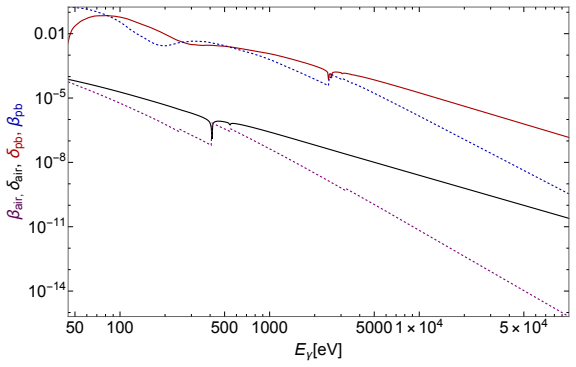
The argument runs on three objects. (1) Source amplitudes: the undulator electron current, Fourier-transformed with the finite-width delta function $\delta_L(\Delta q) = (e^{iqL}-1)/(iq)$ (exponentially regulated at the magnet boundaries), which gives the spectra of both mass eigenstates with a finite energy spread $\Delta k_{\gamma'} \sim k_{\gamma'}/(kL)$ that later drives wave-packet decoherence. (2) The kinetic equation $\dot{\rho} = -i[H,\rho] - \frac{1}{2}\{\Gamma,\rho\}$ in the mass basis, with $H$ built from the vacuum splitting $m_{\gamma'}^2/(2k_{\gamma'})$ and the medium's plasma-mass matrix, and $\Gamma = \mu$ times the mixing matrix; the medium parameters come from the transverse polarization $\Pi_T = E_\gamma^2(1-n^2) = m_{\gamma,\mathrm{p}}^2 - iE_\gamma\mu$, evaluated with tabulated complex refractive indices for lead and air. (3) The propagation mode: in each medium the surviving state $\varphi_{\gamma',\mathrm{eff}}$ is nearly pure dark-photon flavor, and its photon overlap at the detector is the effective mixing $\chi^2_{\mathrm{eff}} = \chi^2 m_{\gamma'}^4 / [(m_{\gamma'}^2 - m_{\gamma,\mathrm{p}}^2)^2 + k_{\gamma'}^2\mu^2]$, the single formula that produces the quantum-Zeno suppression at small $m_{\gamma'}$ and the resonances at $m_{\gamma'} \simeq m_{\gamma,\mathrm{p}}$.
What would settle it
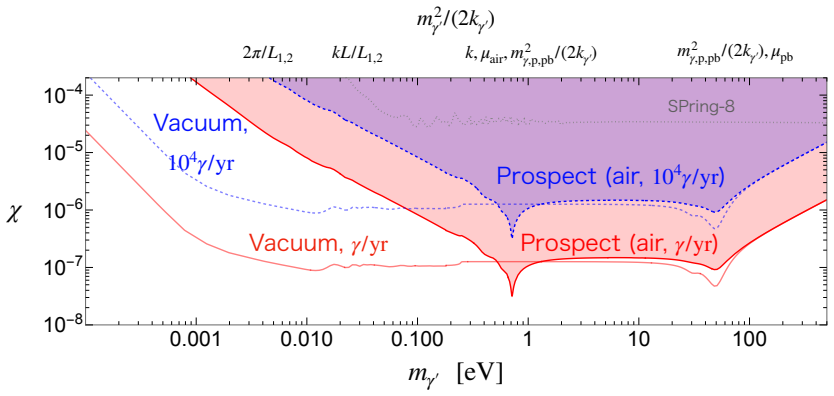
Measure the detection probability of a real keV-scale photon detector (for example a silicon sensor or Geiger counter) against an incident massive eigenstate as a function of mass: if it scales differently from the assumed $\chi^2$, the projected curves in Figs. 5 and 13 move. Alternatively, operate the parasitic setup for one year behind a synchrotron shield and count photons at the resonant masses (near $\sim 1$ eV in air, near $\sim 50$ eV in lead), where the paper predicts $10^2$–$10^4$ signal photons per year at the benchmark couplings; the photons would appear or be excluded, settling the claimed reach.
Extended reading notes
Core claim
The central claim, stated on the paper's own terms, is that an undulator-based LSW search must be treated as one quantum system spanning source, wall, and medium, and that doing so overturns conclusions drawn from the naive formula $P_{\gamma\to\gamma} = 16\chi^4[\sin(\Delta k L_1/2)\sin(\Delta k L_2/2)]^2$. Working in the mass-eigenstate basis, the paper derives the production spectra of the massless and massive eigenstates from the undulator current, keeps the finite energy spread of the emitted wave packet, and propagates the states through the lead wall and the air with the kinetic equation $\dot{\rho} = -i[H,\rho] - \frac{1}{2}\{\Gamma,\rho\}$, where the complex refractive index of wall and air enters through the plasma mass $m_{\gamma,\mathrm{p}}$ and the attenuation coefficient $\mu$. Three features distinguish the result: wave-packet averaging suppresses the naive oscillation signal for heavy dark photons; production of the heavy eigenstate is kinematically impeded for $m_{\gamma'} \gtrsim k\gamma$, with the massless state regenerating the signal; and the medium produces a quantum-Zeno suppression at low mass together with resonant enhancement at $m_{\gamma'} \simeq m_{\gamma,\mathrm{p}}$ (near $\sim 1$ eV in air, near $\sim 50$ eV in lead). With these effects included, a detector placed outside the shielding along the beamline, using the primary flux of about $2 \times 10^{27}$ photons per year, yields projected sensitivities (Figs. 5 and 13) that exceed existing laboratory limits by orders of magnitude in the mass range $\sim 0.01$–$100$ eV; in the air-filled case the reach near the $\sim 1$ eV resonance even beats the vacuum configuration.
Load-bearing premise
The sensitivity curves assume an idealized detector response, namely that the detector registers the massless eigenstate with probability $1$ and the massive eigenstate with probability $\chi^2$; the paper itself flags this as the caveat deferred to future work, so a realistic detector that responds differently would shift every projected limit.
Editorial extensions
If this is right
- A detector placed outside the shielding of an existing synchrotron undulator beamline, using only the primary undulator flux, would provide an economical parasitic LSW search whose projected sensitivity exceeds all current laboratory dark-photon limits across roughly $0.01$–$100$ eV.
- Sensitivity is environment-dependent rather than universal: wall material, air pressure, and detector-side path length change the reach at a given mass, so these choices are part of the experimental design, not secondary details.
- For $m_{\gamma'} \gtrsim 50$ eV the lead wall's attenuation suppresses the signal, but the wall resonance at $m_{\gamma'} \simeq m_{\gamma,\mathrm{p,pb}}$ partially restores the reach, and in air the quantum-Zeno suppression affects only masses well below $\sim 1$ eV.
- Filling the detector side with air instead of vacuum loses little above $\sim 1$ eV and even improves the reach near the air resonance, so evacuating the detector volume is not required for a first search.
- The same quantum treatment transfers to axion-like-particle searches in the same geometry, because the source-amplitude machinery and the medium effects apply equally to ALP–photon conversion.
Reading between the lines
- An optimization the paper leaves implicit: since the sensitive mass window is set by the baselines $L_1, L_2$ and the undulator length $L$ (the scale hierarchy of Eq. (28)), shortening the baselines or lengthening the undulator should shift the decoherence and low-mass thresholds, letting a facility tune which dark-photon mass slice it probes.
- The wall-resonance effect points to a material-scanning strategy: because the reach peaks where $m_{\gamma'}$ matches the plasma mass of the shield, a sequence of shield materials would map out the mass range in overlapping resonant windows rather than relying on one lead wall.
- The paper's idealized detector assumption (probability $\chi^2$ for the heavy eigenstate) is flagged as conservative; a real detector that absorbs the photon-like component at its surface while the weakly-mixed component reconverts deeper would raise the detection probability, so a detector-level study is the most likely route to strengthening the projected reach at heavy masses.
- The benchmark curves assume backgrounds near those reported for an occupied experimental hutch (about $10^4$ photons per year); because the actual radiation environment behind a facility shield is unmeasured, a background survey at a concrete beamline would decide which of the paper's two benchmarks a real parasitic search achieves.
Editorial analysis
A structured set of objections, weighed in public.
Referee Report
Summary. This paper revisits the standard light-shining-through-a-wall (LSW) formula for dark photons and argues that for undulator sources the naive oscillation formula is inadequate. It develops a QFT treatment of undulator production of mass and massless eigenstates, includes finite wave-packet effects, and uses a density-matrix/kinetic equation with complex refractive indices to model propagation through a lead wall and through air. The central quantitative result is a projected sensitivity in the (m_γ', χ) plane, for vacuum and air-filled detector sides, that exceeds existing laboratory limits by orders of magnitude in the ~0.01–100 eV range. The author explicitly flags caveats, especially the idealized detector response and the deferred background analysis, and promises a future detector-level study.
Significance. If the projections hold, the proposed parasitic detector outside the shielding of an operating undulator beamline would be a very economical way to probe dark photons beyond current laboratory bounds, and the paper's systematic inclusion of source kinematics, wave-packet decoherence, and material resonances is a useful methodological step beyond the one-dimensional oscillation formula. The analytic cross-checks (Eq. (44) vs Fig. 9, Eq. (50) vs Fig. 11) and the use of tabulated refractive-index data are strengths; no parameters are fitted to data. However, the load-bearing idealizations, namely Eq. (27)'s detector response, the assumed background, and the inconsistent air-pressure specification, mean the quantitative reach is not yet fully established.
major comments (6)
- [Eq. (31)] Equation (31) defines the photon-production amplitude as \tildeΦ(ϵ, γ, k_γ') = ⟨1, ϵ, k_γ'|0_j⟩ ≃ ⟨2, ϵ, k_γ'|0_j⟩/χ². This contradicts Eq. (25), which implies |⟨1|0_j⟩|² = |⟨2|0_j⟩|²/χ² and hence a factor 1/χ, not 1/χ². If Eq. (31) is used literally, the χ^4 prefactor in Eq. (34) produces a χ² scaling instead of the expected χ^4, so the normalization of the light-mass sensitivity curves in Figs. 5 and 13 must be rechecked.
- [Sec. 3, Eq. (27)] The assumed detector response P_det=1 for the massless eigenstate and P_det=χ² for the massive eigenstate controls the heavy-mass parts of Figs. 5 and 13. The paper itself lists this as caveat 4 and defers a detector-level analysis to future work; because a real detector has finite thickness and energy-dependent efficiency, the projected reach could change. Please compute the response for a concrete technology or clearly present the curves as conditional on Eq. (27).
- [Sec. 3.4, Eq. (38)] The scale m_γ' ~30 eV sqrt[µ/(2×10^-4 cm^-1) (k_γ'/keV)] is inconsistent with the lead attenuation coefficient µ_pb ≈ 2×10^4 cm^-1 quoted earlier in Sec. 3. With µ_pb=2×10^4 cm^-1, the argument of the square root is 10^8, moving the attenuation-loss scale many orders of magnitude above 30 eV. Please correct the units or reference value and verify that the scale labels in Figs. 5 and 13 are consistent with the numerical inputs.
- [Sec. 4 / Fig. 8] The caption of Fig. 8 specifies air at 1 Pa and 295 K, while the text of Sec. 4 specifies standard atmospheric pressure and 293 K. The attenuation coefficient µ_air and plasma mass m_{γ,p,air} used in Eqs. (52) and (53), and hence the quantum-Zeno suppression and the ~1 eV resonance in Fig. 13, depend directly on this choice. Please state the actual pressure used in the calculation and make the caption and text consistent.
- [Sec. 3, background paragraph] The sensitivity curves in Figs. 5 and 13 use benchmark signal rates of 1/yr and 10^4/yr and assume a background comparable to O(10^4)/yr from Ref. [11], but no background model is given for a detector placed outside the shielding. Since the radiation environment there is not the same as inside the SPring-8 hutch, the projected reach should either be accompanied by a concrete background estimate or explicitly labelled as a signal-sensitivity curve requiring a background at the assumed level.
- [Sec. 3.5] The assertion that Eqs. (34) and (46) coincide in the intermediate region is not demonstrated; no plot shows both expressions in the claimed overlap. A mismatch at the switch point would alter the shape of the sensitivity curves in Figs. 5 and 13, so please show the two formulas together over the overlap interval and state the switch value.
minor comments (4)
- [Sec. 3, text after Eq. (28)] The phrase 'the typical photon energy is kγ ~ keV' should read kγ² ~ 1.5 keV (or 2kγ² at θ=0); the current phrasing is off by a factor γ and is inconsistent with Eq. (18).
- [Eq. (15)] The regulator ϵ=1/20 is chosen by hand; because the high-mass production tail and the kink in Fig. 5 can depend on the boundary treatment, an ϵ scan (or an analytic estimate of the ϵ sensitivity) would help substantiate the regulator choice.
- [Throughout] The text contains several typographical and encoding artifacts: 'reflective index' should be 'refractive index', 'enhancent' should be 'enhancement', and 'na¨ıve' appears as a broken ligature in several places.
- [Fig. 8 caption] The sentence 'They are estimated from [24]' should identify which curves correspond to lead and which to air; as printed the sentence is ambiguous.
Circularity Check
No significant circularity: the sensitivity curves follow from QFT production amplitudes, a kinetic equation, and tabulated refractive indices; the detector response Eq. (27) is an explicit assumption, not a fitted input.
full rationale
The paper's derivation chain does not reduce to its inputs. The undulator production amplitudes in Sec. 2 are obtained from a QFT current calculation, with the finite-width delta function kept explicitly; the wall and air transmission probabilities in Secs. 3.3-3.4 and 4.1 follow from the kinetic equation Eq. (39) with the Hamiltonian and damping matrix built from tabulated complex refractive indices via Eq. (41). No parameter is fitted to the sensitivity target, and the comparison with the existing SPring-8 limit in Figs. 5 and 13 is an external benchmark. Equation (27), which assigns detection probabilities P_det = 1 and chi^2, is an explicit modeling assumption rather than a derived prediction; the paper itself flags it as caveat 4 and defers a detector-level analysis. The self-citations to Refs. [19] and [30] are not load-bearing in a circular way: the production formulas from [19] are reproduced in Eqs. (9)-(16), and the quantum-Zeno suppression is re-derived by diagonalizing the complex Hamiltonian leading to Eq. (50). The central claim is therefore self-contained against explicit assumptions and external refractive-index data, with only minor self-citation that does not force the results.
Assumptions & free parameters
free parameters (2)
- eps (exponential regulator) =
1/20
- Benchmark signal rates =
1/yr and 10^4/yr
assumptions (5)
- domain assumption Dark photon Lagrangian with kinetic mixing chi and mass m_gamma' (Eq. 1)
- domain assumption Undulator electron trajectory given by Eq. (4) with K <= 1, neglecting O(K^2, gamma^-2)
- standard math Matter effects described by complex refractive index n = 1 - delta + i beta with Pi_T ~ m_gamma,p^2 - i E_gamma mu (Eq. 41)
- ad hoc to paper Detector response P_det = 1 (massless eigenstate) and P_det = chi^2 (massive eigenstate)
- ad hoc to paper Background rate comparable to 10^4/yr from Ref. [11]
Cite this review
Pith. "Pith review of Quantum and Material Effects in Undulator-Based LSW Searches for Dark Photons." pith.science (2026). https://pith.science/paper/J5N7KGZK
@misc{pith2026250722055,
  author       = {Pith},
  title        = {Pith review of: Quantum and Material Effects in Undulator-Based LSW Searches for Dark Photons},
  year         = {2026},
  howpublished = {\url{https://pith.science/paper/J5N7KGZK}},
  note         = {Machine review of arXiv:2507.22055}
}
read the original abstract
The dark photon is one of the simplest extensions of the Standard Model and provides a minimal laboratory for quantum-mechanical phenomena. Light-shining-through-a-wall (LSW) searches often adopt the dark photon-photon oscillation formula as if the sensitivity were independent of the light source, the wall, and the surrounding medium. In this paper, I revisit an LSW experiment whose light source is an undulator and systematically include various quantum effects: finite wave packets, kinematical suppression due to the microscopic structure of the source, and mixing suppression/enhancement in the wall and the air. We find that the resulting sensitivities deviate significantly from those obtained with the na\"{i}ve oscillation formula, especially depending on the mass of the dark photon, relevant to reflective index of the medium or walls, there can be resonance effects enhancing the sensitivity significantly. Accounting for these effects, we show that placing a photon detector outside the shielding along the beamline of a synchrotron facility enables an economical, parasitic LSW search for dark photons.
Figures


Figures from the paper (12 more)






Forward citations
Cited by 1 Pith paper
-
Deep Reinforcement Learning Based Routing for Heterogeneous Multi-Hop Wireless Networks
A DQN routing scheme with channel-based neighbor selection is claimed to match optimal end-to-end rates, but the full text is about dark photon searches, not wireless routing.
Reference graph
Works this paper leans on
- [11]
-
[1]
Holdom,Two U(1)’s and Epsilon Charge Shifts,Phys
B. Holdom,Two U(1)’s and Epsilon Charge Shifts,Phys. Lett. B166(1986) 196–198
1986
-
[2]
S. A. Abel, J. Jaeckel, V. V. Khoze and A. Ringwald,Illuminating the Hidden Sector of String Theory by Shining Light through a Magnetic Field,Phys. Lett. B666(2008) 66–70, [hep-ph/0608248]
arXiv 2008
-
[3]
S. L. Adler, J. Gamboa, F. Mendez and J. Lopez-Sarrion,Axions and ’Light Shining Through a Wall’: A Detailed Theoretical Analysis,Annals Phys.323 (2008) 2851–2872, [0801.4739]
work page Pith review arXiv 2008
- [4]
-
[5]
J. Redondo and A. Ringwald,Light shining through walls,Contemp. Phys.52 (2011) 211–236, [1011.3741]
arXiv 2011
-
[6]
R. B¨ ahre et al.,Any light particle search II —Technical Design Report,JINST 8(2013) T09001, [1302.5647]
arXiv 2013
-
[7]
M. D. Ortiz et al.,Design of the ALPS II optical system,Phys. Dark Univ.35 (2022) 100968, [2009.14294]
arXiv 2022
Show all 29 references
-
[8]
Seong, C
H. Seong, C. Sun and S. Yun,Axion magnetic resonance: A novel enhancement in axion-photon conversion,Phys. Rev. D110(2024) 015018, [2308.10925]
2024 arXiv
-
[9]
S. Hoof, J. Jaeckel and G. Lucente,Ultimate light-shining-through-a-wall experiments to establish QCD axions as the dominant form of dark matter, Phys. Rev. D111(2025) 015003, [2407.04772]
2025 arXiv
-
[10]
Ehret et al.,New ALPS Results on Hidden-Sector Lightweights,Phys
K. Ehret et al.,New ALPS Results on Hidden-Sector Lightweights,Phys. Lett. B689(2010) 149–155, [1004.1313]
2010 arXiv
-
[12]
M. Betz, F. Caspers, M. Gasior, M. Thumm and S. W. Rieger,First results of the CERN Resonant Weakly Interacting sub-eV Particle Search (CROWS), Phys. Rev. D88(2013) 075014, [1310.8098]
2013 arXiv
-
[13]
J. W. D. Halliday et al.,Bounds on Heavy Axions with an X-Ray Free Electron Laser,Phys. Rev. Lett.134(2025) 055001, [2404.17333]
2025 arXiv
-
[14]
Battesti, M
R. Battesti, M. Fouche, C. Detlefs, T. Roth, P. Berceau, F. Duc et al.,A Photon Regeneration Experiment for Axionlike Particle Search using X-rays, Phys. Rev. Lett.105(2010) 250405, [1008.2672]
2010 arXiv
-
[15]
Della Valle, A
F. Della Valle, A. Ejlli, U. Gastaldi, G. Messineo, E. Milotti, R. Pengo et al., The PVLAS experiment: measuring vacuum magnetic birefringence and dichroism with a birefringent Fabry–Perot cavity,Eur. Phys. J. C76(2016) 24, [1510.08052]
2016 arXiv
-
[16]
Inada et al.,Search for Two-Photon Interaction with Axionlike Particles Using High-Repetition Pulsed Magnets and Synchrotron X Rays,Phys
T. Inada et al.,Search for Two-Photon Interaction with Axionlike Particles Using High-Repetition Pulsed Magnets and Synchrotron X Rays,Phys. Rev. Lett.118(2017) 071803, [1609.05425]. 31 [17]OSQARcollaboration, R. Ballou et al.,New exclusion limits on scalar and pseudoscalar ax...
2017 arXiv
-
[18]
Sikivie, D
P. Sikivie, D. B. Tanner and K. van Bibber,Resonantly enhanced axion-photon regeneration,Phys. Rev. Lett.98(2007) 172002, [hep-ph/0701198]
2007 arXiv
-
[19]
Yin and J
W. Yin and J. Yoshida,Undulators are ALP factories,Phys. Rev. D111 (2025) 036020, [2408.17451]
2025 arXiv
-
[20]
E. W. Lemmon, M. L. Huber, M. O. McLinden et al.,Nist standard reference database 23,Reference fluid thermodynamic and transport properties (REFPROP), version9(2010)
2010
-
[21]
Redondo,Helioscope Bounds on Hidden Sector Photons,JCAP07(2008) 008, [0801.1527]
J. Redondo,Helioscope Bounds on Hidden Sector Photons,JCAP07(2008) 008, [0801.1527]
2008 arXiv
-
[22]
Frerick, F
J. Frerick, F. Kahlhoefer and K. Schmidt-Hoberg,A’ view of the sunrise: boosting helioscopes with angular information,JCAP03(2023) 001, [2211.00022]
2023 arXiv
-
[23]
Sigl and G
G. Sigl and G. Raffelt,General kinetic description of relativistic mixed neutrinos,Nucl. Phys. B406(1993) 423–451
1993
-
[24]
B. L. Henke, E. M. Gullikson and J. C. Davis,X-ray interactions: photoabsorption, scattering, transmission, and reflection at e= 50-30,000 ev, z= 1-92,Atomic data and nuclear data tables54(1993) 181–342
1993
-
[25]
C. T. Chantler,Theoretical form factor, attenuation, and scattering tabulation for z= 1–92 from e= 1–10 ev to e= 0.4–1.0 mev,Journal of Physical and Chemical Reference Data24(1995) 71–643
1995
-
[26]
C. T. Chantler,Detailed tabulation of atomic form factors, photoelectric absorption and scattering cross section, and mass attenuation coefficients in the vicinity of absorption edges in the soft x-ray (z= 30–36, z= 60–89, e= 0.1 kev–10 kev), addressing convergence issues of e...
2000
-
[27]
Caputo, A
A. Caputo, A. J. Millar, C. A. J. O’Hare and E. Vitagliano,Dark photon limits: A handbook,Phys. Rev. D104(2021) 095029, [2105.04565]
2021 arXiv
-
[28]
H. An, M. Pospelov and J. Pradler,Dark Matter Detectors as Dark Photon Helioscopes,Phys. Rev. Lett.111(2013) 041302, [1304.3461]. 32
2013 arXiv
-
[29]
H. An, M. Pospelov, J. Pradler and A. Ritz,Direct Detection Constraints on Dark Photon Dark Matter,Phys. Lett. B747(2015) 331–338, [1412.8378]
2015 arXiv
-
[30]
quantum Zeno effect
K. Sakurai and W. Yin,Suppression of Higgs mixing by “quantum Zeno effect”,Eur. Phys. J. C83(2023) 498, [2204.01739]. 33
2023 arXiv
Reviewed August 6, 2026 · model on record in the stance chip above.
Discussion (0). Sign in to comment.