REVIEW 4 major objections 6 minor 23 references
HyperZero: A Customized End-to-End Auto-Tuning System for Recommendation with Hourly Feedback
T0 review · 4 major / 6 minor · reviewed 2026-08-10 · deepseek-v4-flash
Pith's one-line read The paper claims that recommendation-system value-model hyperparameters can be tuned end-to-end in 2-3 days instead of weeks by using an hourly ratio-delta signal that cancels shared fluctuation patterns, with Gaussian-process estimation…
desk verdict Solid industrial auto-tuning system for recommendation value models, but the hourly-decorrelation assumption is asserted rather than verified — conditional accept. read the letter →
The pith
A machine-rendered reading of the paper's core claim, the machinery that carries it, and where it could break.
The reading
What carries the argument
The load-bearing object is the semi-i.i.d. delta signal ΔX(θ) = X(θ)/X(θ₀) − 1, the ratio of the test group's hourly metric to the control group's hourly metric minus one, which the paper argues removes the hourly correlation present in raw metrics. The system couples a Gaussian process that models each delta's unknown distribution (using Taylor-derived mean and variance estimates) with Thompson sampling that repeatedly draws deltas from the GP, filters candidates by the constraints, and selects the best objective value, producing multiple candidate hyperparameters per round. An asynchronous parallel loop applies several candidates at once and aggregates only over rounds with available feedback, tolerating delays of several hours.
What would settle it
Compute the autocorrelation of the hourly delta signals from a production A/B test over at least three days; if the autocorrelation at lags of 1 to 24 hours is significantly outside the 95% confidence band for white noise, the semi-i.i.d. assumption fails and the GP variance estimates used by HyperZero will be overconfident, allowing the optimizer to chase hourly noise rather than genuine hyperparameter effects.
Extended reading notes
Core claim
HyperZero's central claim is that the ratio delta ΔX(θ)=X(θ)/X(θ₀)−1 between a test hyperparameter and a fixed base hyperparameter is approximately independent across hours (semi-i.i.d.) even though the raw hourly metrics are heavily correlated, because user groups share the same hourly fluctuation pattern. This decorrelation lets the system treat each hour as an independent observation, estimate the mean and variance of the delta with a Taylor-series approximation, and run a Gaussian-process/Thompson-sampling zeroth-order optimizer over generic objectives and constraints. In a 3-day industrial test on four value-model hyperparameters, HyperZero reported a 1.2% view-count gain versus 0.8% for a leading open-source Bayesian optimizer baseline, and the framework reduces the tuning cycle from weeks to days.
Load-bearing premise
The entire speedup rests on the claim that the hourly ratio of test to control metrics is effectively independent from hour to hour, an assertion supported by visual inspection of fluctuation patterns rather than by statistical verification of the deltas' autocorrelation.
Editorial extensions
If this is right
- Value-model weight tuning can be completed in 2-3 days rather than 2-3 weeks, allowing rapid response to changing business requirements.
- The same Gaussian-process plus Thompson-sampling machinery handles arbitrary objectives and constraints, including nonlinear forms, without requiring gradients or Hessians.
- Asynchronous parallel exploration keeps convergence nearly unchanged even when feedback is delayed by up to six hours.
- Adding the candidate-proposal subroutine roughly doubles the achieved performance gain in the industrial view-count task compared to using only the initial candidate bucket.
Reading between the lines
- The ratio-delta idea is essentially a common-mode rejection or control-variate technique, so it should transfer to any system where test and control groups share periodic fluctuations, such as ads, search, or app engagement metrics, not just recommendation value models.
- The paper never statistically verifies the delta's serial independence; a prudent extension is to check the autocorrelation of hourly deltas before trusting the GP posterior, or to use a log-delta signal whose variance approximation is more stable for positive metrics.
- The conclusion's assertion that roughly half of performance improvements come from the value-model stage is stated without evidence; if HyperZero's production gains generalize, a natural follow-up is an audit of past launches to quantify that share.
Signed reviews
Editorial analysis
A structured set of objections, weighed in public.
Referee Report
Summary. The paper proposes HyperZero, an end-to-end auto-tuning system for value-model hyperparameters in large-scale recommendation systems. The system targets three practical challenges: non-i.i.d. hourly metrics, multi-objective constrained zeroth-order optimization, and delayed system feedback. The core technical idea is a "semi-i.i.d." delta signal ΔX(θ) = X(θ)/X(θ0) − 1 formed by ratioing test-group metric readings against a control group, with mean and variance estimated via Taylor expansion. Optimization is performed by Gaussian-process regression combined with Thompson sampling over a candidate bucket, together with asynchronous parallel exploration. The authors validate the approach on a synthetic environment and in a production deployment, reporting a 1.2% view-count gain versus 0.8% for a Botorch baseline over a 3-day experiment.
Significance. If the claims hold, the paper would be a valuable applied contribution: value-model hyperparameters are typically tuned on daily feedback over weeks, and a system that reliably works on hourly feedback in 2–3 days would address a real production need. The paper has clear strengths: a concrete end-to-end system design, a simple and intuitive delta-normalization idea, a synthetic ablation showing each component helps, and a production comparison against a mainstream open-source optimizer. However, the key semi-i.i.d. assumption is asserted rather than verified, the variance estimator in Eq. (3.2) appears to swap group sizes, and the production comparison lacks error bars. These issues are fixable, but until they are addressed the central claims about hourly speedup and improvement over baselines are not fully established.
major comments (4)
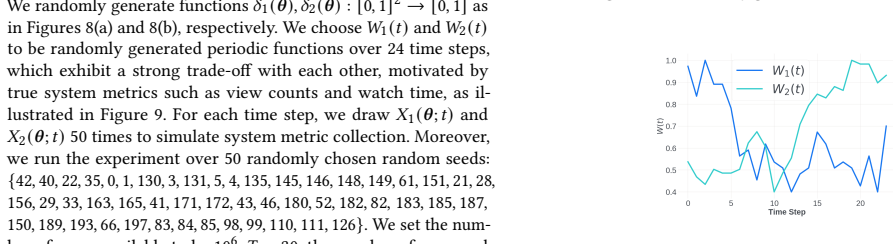
- [Section 3.1, Eq. (3.1)] The semi-i.i.d. property of ΔX is load-bearing for the entire hourly tuning speedup, but the paper verifies it only by plotting raw hourly levels and asserting that shared fluctuation patterns decorrelate the ratio. No autocorrelation function, Ljung-Box test, or split-sample check is reported, nor is there a test of whether time-of-day effects are fully shared by the control group. If hourly deltas remain serially correlated, the variance aggregation in Eq. (3.2) treats dependent estimates as independent and understates σ²(ΔX; θ) by roughly a factor of 1 + 2Σρ_lag; the GP posteriors in Algorithm 1 then become overconfident and Thompson sampling can chase noise. The synthetic ablation in Section 4.1 does not resolve this concern because the simulated metrics share the same periodic W_i(t) across test and control by construction, so ΔX is exactly decorrelated by design. Please add autocorrelation diagnostics on real hourly deltas (e.g., ACF and effective sample size) and, if the correlation is non-negligible, adjust the variance estimator or temper the claimed convergence speed.
- [Eq. (3.2)] The variance formula appears to swap the test and control group sizes. In the numerator of σ_t²(ΔX; θ), the first term divides the test-group variance σ_t²(X; θ) by the control-group size N'_t, and the second term divides the control-group variance σ_t²(X; θ0) by the test-group size N_t. The second-order delta method for the ratio X(θ)/X(θ0) gives σ_t²(X; θ) / (μ_t²(X; θ0) N_t) + μ_t²(X; θ) σ_t²(X; θ0) / (μ_t⁴(X; θ0) N'_t). With unequal group sizes, the current formula biases the uncertainty estimates and hence the GP/TS acquisition. Please correct the allocation and rerun the synthetic and production analyses to check whether the conclusions change.
- [Section 4.2.2, Figure 7] The headline production comparison reports 1.2% vs. 0.8% mean gain, but no error bars, confidence intervals, or significance test are provided for these point estimates. The experiment is a single 3-day run in a noisy environment, so a 0.4 percentage-point difference may be within the hourly noise band. Please report the distribution of gains across time points or candidates (for example, per-hour bootstrap intervals), the number of users per arm, and a significance test for the difference. Without this, the claim that HyperZero outperforms a strong open-source baseline is not statistically grounded.
- [Algorithm 1, Section 3.2.2, Table 1] The paper states the optimization problem with expected-value constraints, but Algorithm 1 enforces feasibility by sampling ΔX and checking whether g_i of the sampled value exceeds c_i. This is a sample-path filter, not an expected-constraint guarantee; with non-negligible variance it can select candidates that violate the constraint in expectation, which matters for guardrail metrics. The synthetic results in Table 1 report an average violation of 0.001 but not the worst-case violation or the frequency with which the constraint is violated across seeds. Please clarify the interpretation of the constraints (e.g., chance-constrained or heuristic) and report the empirical distribution of violations, or modify the algorithm to handle expected feasibility.
minor comments (6)
- [Section 3.2] Typo: "assort to certain zeroth-order optimization techniques" should be "resort to."
- [Algorithm 2, line 7] The proposal probability p is described as "usually set to 1"; if p = 1, the stochastic branch in Algorithm 2 is deterministic, so the role of p as a tunable parameter should be clarified.
- [Figure 7] The caption says "the color indicates the recency of each candidate's proposal," but neither the figure nor the text explains the color scale or provides a legend; please make this readable.
- [Appendix A] The statement "the number of proposed new candidates to be 600, and the number of testing candidates to be 1000" is hard to map to Algorithm 2, which proposes one candidate per round and submits A ∪ A′ for online tests; please specify how these counts correspond to the algorithm parameters (N, K, initial bucket size).
- [Section 4.1.2] The penalized BO variant's regularization parameter is said to be "manually tuned to be optimal," but the search range and criterion are not reported; please state these details so the comparison is reproducible.
- [References] References [1] and [2] contain malformed author fields ("authors, T. E." and "authors, T. G."); these should be corrected.
Circularity Check
No significant circularity: the delta-signal construction, Taylor estimators, GP+TS optimizer, and Botorch comparison form a self-contained derivation chain.
full rationale
HyperZero's claims do not reduce to their own inputs. The semi-i.i.d. delta signal in Eq. (3.1) is defined as a ratio of observed hourly metrics between test and control groups; the mean and variance estimators in Eq. (3.2) are Taylor/delta-method expansions of that ratio, not fitted parameters. The GP+TS optimizer (Algorithms 1-3) is external statistical machinery applied to the estimated deltas, not a construction that presupposes the conclusion. The production comparison against Botorch is an independent benchmark, and the reported 1.2% vs 0.8% gains are direct online measurements rather than quantities recovered from the model's own parameters. The evaluation metric Gain(theta) = f(theta)/f(theta0) - 1 coincides with the optimized objective, but this is a consistent formulation choice rather than circular reasoning: the paper does not claim to derive the delta signal from the gain or to predict a quantity that was used as input. The paper contains no load-bearing self-citations; all references are to external datasets, tools, and prior work by other authors. The semi-i.i.d. assumption is asserted from a qualitative plot (Figure 2) and not statistically verified, and Eq. (3.2)'s placement of N_t and N'_t appears questionable; these are correctness and validation risks, not circularity. No step equates a prediction to a fitted input by construction, so the appropriate circularity score is 0.
Assumptions & free parameters
free parameters (6)
- initial_bucket_size =
100 (typical)
- proposal_probability_p =
1 (default)
- number_of_solution_candidates_K =
1000 in synthetic
- number_of_proposed_samples_N =
600 in synthetic
- GP_kernel_and_hyperparameters =
not specified
- penalized_BO_regularization =
manually tuned to be optimal
assumptions (6)
- domain assumption Hourly metrics follow an unknown, time-varying distribution D_X.
- domain assumption The ratio delta ΔX = X(θ)/X(θ0) - 1 is semi-i.i.d. across hours.
- standard math Taylor (delta method) approximations for the mean and variance of a ratio are accurate for these metrics.
- domain assumption Each metric delta is Gaussian for the purpose of the GP/TS surrogate.
- domain assumption The tuning problem is low-dimensional, with fewer than 10 hyperparameters.
- domain assumption Asynchronous updates over delayed feedback remain convergent.
Cite this review
Pith. "Pith review of HyperZero: A Customized End-to-End Auto-Tuning System for Recommendation with Hourly Feedback." pith.science (2026). https://pith.science/paper/J64QYEIT
@misc{pith2026250118126,
  author       = {Pith},
  title        = {Pith review of: HyperZero: A Customized End-to-End Auto-Tuning System for Recommendation with Hourly Feedback},
  year         = {2026},
  howpublished = {\url{https://pith.science/paper/J64QYEIT}},
  note         = {Machine review of arXiv:2501.18126}
}
read the original abstract
Modern recommendation systems can be broadly divided into two key stages: the ranking stage, where the system predicts various user engagements (e.g., click-through rate, like rate, follow rate, watch time), and the value model stage, which aggregates these predictive scores through a function (e.g., a linear combination defined by a weight vector) to measure the value of each content by a single numerical score. Both stages play roughly equally important roles in real industrial systems; however, how to optimize the model weights for the second stage still lacks systematic study. This paper focuses on optimizing the second stage through auto-tuning technology. Although general auto-tuning systems and solutions - both from established production practices and open-source solutions - can address this problem, they typically require weeks or even months to identify a feasible solution. Such prolonged tuning processes are unacceptable in production environments for recommendation systems, as suboptimal value models can severely degrade user experience. An effective auto-tuning solution is required to identify a viable model within 2-3 days, rather than the extended timelines typically associated with existing approaches. In this paper, we introduce a practical auto-tuning system named HyperZero that addresses these time constraints while effectively solving the unique challenges inherent in modern recommendation systems. Moreover, this framework has the potential to be expanded to broader tuning tasks within recommendation systems.
Figures


Figures from the paper (5 more)


Reference graph
Works this paper leans on
-
[1]
authors, T. E. Emukit: Emulation and uncertainty quantification for decision making. https://github.com/amzn/emukit, 2018
work page 2018
-
[2]
authors, T. G. Gpyopt: A bayesian optimization framework in python. http: //github.com/SheffieldML/GPyOpt, 2016
work page 2016
-
[3]
R., Daulton, S., Letham, B., Wilson, A
Balandat, M., Karrer, B., Jiang, D. R., Daulton, S., Letham, B., Wilson, A. G., and Bakshy, E. Botorch: A framework for efficient monte-carlo bayesian optimization. In Proceedings of Advances in Neural Information Processing Systems (2020)
work page 2020
-
[4]
Deep neural networks for youtube recommendations
Covington, P., Adams, J., and Sargin, E. Deep neural networks for youtube recommendations. In Proceedings of the 10th ACM Conference on Recommender Systems (2016)
work page 2016
-
[5]
arXiv preprint arXiv:1612.04858 (2016)
Dewancker, I., McCourt, M., and Clark, S.Bayesian optimization for machine learning: A practical guidebook. arXiv preprint arXiv:1612.04858 (2016)
arXiv 2016
-
[6]
Frazier, P. I. Bayesian optimization. In Recent Advances in Optimization and Modeling of Contemporary Problems . INFORMS, 2018, pp. 255–278
work page 2018
-
[7]
G., Giordani, I., Candelieri, A., Perego, R., and Archetti, F
Galuzzi, B. G., Giordani, I., Candelieri, A., Perego, R., and Archetti, F. Hyperparameter optimization for recommender systems through bayesian opti- mization. Computational Management Science 17 (2020), 495–515
work page 2020
-
[8]
Gao, C., Li, S., Zhang, Y., Chen, J., Li, B., Lei, W., Jiang, P., and He, X.Kuairand: An unbiased sequential recommendation dataset with randomly exposed videos. In Proceedings of the 31st ACM International Conference on Information and Knowl- edge Management (2022)
work page 2022
Show all 23 references
-
[9]
A., and Hunt, N.The netflix recommender system: Algorithms, business value, and innovation
Gomez-Uribe, C. A., and Hunt, N.The netflix recommender system: Algorithms, business value, and innovation. ACM Transactions on Management Information Systems (TMIS) 6, 4 (2015), 1–19
2015
-
[10]
Social recommender systems
Groh, G., Birnkammerer, S., and Köllhofer, V. Social recommender systems. Recommender Systems for the Social Web 32 (2012), 1
2012
-
[11]
Head, T., MechCoder, Louppe, G., Shcherbatyi, I., fcharras, Vinícius, Z., cmmalone, Schröder, C., nel215, Campos, N., Young, T., Cereda, S., Fan, T., rene rex, Shi, K. K., Schwabedal, J., carlosdanielcsantos, Hvass-Labs, Pak, M., SoManyUsernamesTaken, Callaway, F., Estève, L.,...
2018
-
[12]
R., Li, C., Chen, M., Xu, T., Wang, X., Adams, J
Joglekar, M. R., Li, C., Chen, M., Xu, T., Wang, X., Adams, J. K., Khaitan, P., Liu, J., and Le, Q. V. Neural input search for large scale recommendation models. In Proceedings of the 26th ACM SIGKDD International Conference on Knowledge Discovery & Data Mining (2020)
2020
-
[13]
R., Neiswanger, W., Paria, B., Collins, C
Kandasamy, K., Vysyaraju, K. R., Neiswanger, W., Paria, B., Collins, C. R., Schneider, J., Poczos, B., and Xing, E. P.Tuning hyperparameters without grad students: Scalable and robust bayesian optimisation with dragonfly. Journal of Machine Learning Research 21 , 81 (2020), 1–27
2020
-
[14]
Robo: A flexible and robust bayesian optimization framework in python
Klein, A., Falkner, S., Mansur, N., and Hutter, F. Robo: A flexible and robust bayesian optimization framework in python. In NIPS 2017 Bayesian Optimization Workshop (2017)
2017
-
[15]
T., Kottke, D., and Spiliopoulou, M.A comparative study on hyperparameter optimization for recommender systems
Matuszyk, P., Castillo, R. T., Kottke, D., and Spiliopoulou, M.A comparative study on hyperparameter optimization for recommender systems. In Workshop on Recommender Systems and Big Data Analytics (2016)
2016
-
[16]
On the impact of data sampling on hyper-parameter optimisation of recommendation algorithms
Montanari, M., Bernardis, C., and Cremonesi, P. On the impact of data sampling on hyper-parameter optimisation of recommendation algorithms. In Proceedings of the 37th ACM/SIGAPP Symposium on Applied Computing (2022)
2022
-
[17]
D., and Schedl, M
Moscati, M., Deldjoo, Y., Carparelli, G. D., and Schedl, M. Multiobjective hyperparameter optimization of recommender systems. In Perspectives@ RecSys (2023)
2023
-
[18]
P., and De Freitas, N.Taking the human out of the loop: A review of bayesian optimization
Shahriari, B., Swersky, K., W ang, Z., Adams, R. P., and De Freitas, N.Taking the human out of the loop: A review of bayesian optimization. Proceedings of the IEEE 104, 1 (2015), 148–175
2015
-
[19]
Snoek, J., Larochelle, H., and Adams, R. P. Practical bayesian optimization of machine learning algorithms. In Proceedings of Advances in Neural Information Processing Systems (2012)
2012
-
[20]
P., Nikolic, I., De Bona, F., and Krause, A.Explore-exploit in top-n recommender systems via gaussian processes
V anchinathan, H. P., Nikolic, I., De Bona, F., and Krause, A.Explore-exploit in top-n recommender systems via gaussian processes. In Proceedings of the 8th ACM Conference on Recommender Systems (2014)
2014
-
[21]
Hyperparameter learning for deep learning- based recommender systems
Wu, D., Sun, B., and Shang, M. Hyperparameter learning for deep learning- based recommender systems. IEEE Transactions on Services Computing 16 , 4 (2023), 2699–2712
2023
-
[22]
The parallel knowledge gradient method for batch bayesian optimization
Wu, J., and Frazier, P. The parallel knowledge gradient method for batch bayesian optimization. Proceedings of Advances in Neural Information Processing Systems 29 (2016)
2016
-
[23]
Automl for deep recommender systems: A survey
Zheng, R., Qu, L., Cui, B., Shi, Y., and Yin, H. Automl for deep recommender systems: A survey. ACM Transactions on Information Systems 41 , 4 (2023), 1–38. A Experiment Details In this section, we provide the experiment details on the synthetic environment in Section 4.1. We ...
2023
Reviewed August 10, 2026 · model on record in the stance chip above.
Discussion (0). Continue with ORCID to comment.