REVIEW 2 major objections 5 minor 75 references
Additivity of quantum relative entropies as a single-copy criterion
T0 review · 2 major / 5 minor · reviewed 2026-08-06 · deepseek-v4-flash
Pith's one-line read A single-copy identity decides whether many-copy relative entropy is additive
desk verdict Single-copy additivity criterion for optimized relative entropy is real and largely sound, but the sufficiency direction leans on an unrefereed Stein lemma and the delayed-violation example rests on numerics. read the letter →
The pith
A machine-rendered reading of the paper's core claim, the machinery that carries it, and where it could break.
The reading
What carries the argument
The load-bearing mechanism has two parts. First, the first-order condition for a convex minimizer: $\sigma_0$ minimizes $D(\rho\|\cdot)$ over $\mathcal{F}$ if and only if $\sup_{\tau\in\mathcal{F}} \operatorname{Tr}[\tau \Xi(\rho,\sigma_0)] = 1$, where $\Xi(\rho,\sigma)=\int_{\mathbb{R}} \sigma^{-(1+it)/2}\rho\,\sigma^{-(1-it)/2}\beta_0(t)\,dt$ is obtained from the Frechet derivative of the logarithm (Lemma 6). Second, the polar-set condition $\mathcal{F}_m^{\circ}\otimes \mathcal{F}_n^{\circ}\subseteq \mathcal{F}_{m+n}^{\circ}$, which Lemma 1 shows is equivalent to submultiplicativity of the support functions $h_{\mathcal{F}}(X)=\sup_{\sigma\in\mathcal{F}}\operatorname{Tr}(\sigma X)$. That multiplicativity is what turns tensor-product directions into products of single-copy suprema, driving the sufficiency direction of the main theorem.
What would settle it
Take any state in the Rains or mana family, compute a single-copy optimizer $\sigma_0$ numerically, and evaluate $\sup_{t\in\mathbb{R},\tau\in\mathcal{F}_1} \operatorname{Tr}[\tau \sigma_0^{-(1+it)/2}\rho\sigma_0^{-(1-it)/2}]$. The paper predicts additivity for all $n$ if and only if this quantity equals 1; a value strictly above 1 must produce a violation of additivity at some finite number of copies, and a value exactly 1 must not.
Extended reading notes
Core claim
The paper establishes a single-copy criterion for additivity of the minimized Umegaki relative entropy. For a family $\{\mathcal{F}^{(n)}\}_{n\in\mathbb{N}}$ of convex compact sets of positive operators whose polars are closed under tensor products (Assumptions 1 and 4), Theorem 10 shows that $D(\bigotimes_{j=1}^k \rho_j^{\otimes m_j}) = \sum_{j=1}^k m_j D(\rho_j)$ for all integers $m_j$ if and only if, for every $j$, the single-copy optimizer $\sigma_{0,j}\in\arg\min_{\sigma\in\mathcal{F}^{(1)}} D(\rho_j\|\sigma)$ satisfies $\sup_{t\in\mathbb{R},\tau\in\mathcal{F}^{(1)}} \operatorname{Tr}[\tau \sigma_{0,j}^{-(1+it)/2} \rho_j \sigma_{0,j}^{-(1-it)/2}]=1$. If the identity fails, additivity fails for some number of copies. Corollary 8 translates this into the Stein exponent: the generalized Stein exponent equals the one-copy value $D(\rho\|\sigma_0)$ if and only if the same condition holds. The paper extends the criterion to Petz and sandwiched Renyi divergences, and to Chernoff and Hoeffding exponents with the condition evaluated at a single-copy saddle point.
Load-bearing premise
The argument collapses if the allowed alternative sets do not have polar sets that are closed under tensor products (equivalently, if their support functions are not submultiplicative), which is why separable and PPT sets are outside the theorem.
Editorial extensions
If this is right
- For any family satisfying the polar-tensor-product assumption, deciding whether regularization is needed becomes a finite single-copy computation.
- For the Rains set and the subnormalized non-positive-mana set, the regularized relative entropy is strongly additive, giving new additive monotones that bound entanglement and magic distillation.
- For Werner, isotropic, and noisy strange states, the optimizer commutes with the state, so additivity holds and the regularized value equals the single-copy value.
- The Stein exponent is single-letter exactly when the single-copy optimizer condition holds, and the Chernoff and Hoeffding exponents have analogous saddle-point additivity criteria.
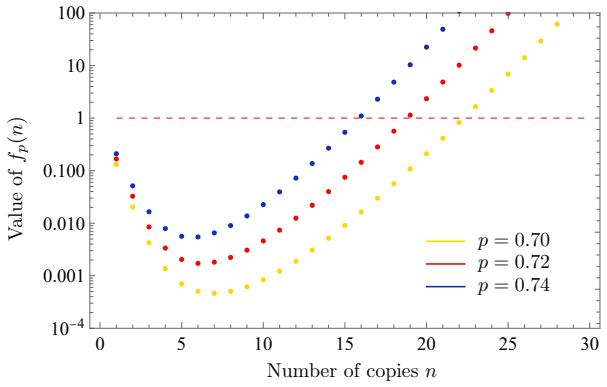
- There are qubit arbitrarily-varying-source examples in which additivity holds for any prescribed finite number of copies but fails later, so finite-copy checks cannot certify additivity.
Reading between the lines
- This suggests a practical testbed for resource theories with semidefinite-representable sets: compute the single-copy optimizer once, evaluate the supremum, and classify additivity without multi-copy computation.
- Because separable and PPT sets violate the polar closure condition, the long-open additivity of the regularized relative entropy of entanglement remains untouched; a polar-preserving approximation of those sets is what would settle it.
- The same single-copy stationarity pattern may extend to other convex resource monotones beyond relative entropies, wherever the optimizer admits an integral representation for its derivative.
Signed reviews
Editorial analysis
A structured set of objections, weighed in public.
Referee Report
Summary. The paper studies the minimization of the Umegaki relative entropy, and of the α-z-Rényi divergences, over convex compact families {F_n} of positive operators on n-fold tensor products, subject to Assumption 1: convexity/compactness, closure under tensor products, and closure of the polar sets under tensor products. The central result is a single-copy criterion for additivity: weak additivity D(ρ^{⊗n}) = n D(ρ∥σ_0) for all n holds if and only if sup_{t∈R, τ∈F_1} Tr[τ σ_0^{-(1+it)/2} ρ σ_0^{-(1-it)/2}] = 1, where σ_0 is a single-copy optimizer (Theorem 7); a multi-state version is given in Theorem 10. The proofs are built on a Fréchet-derivative optimality condition (Lemma 6), integral representations for the logarithm and power functions (Lemmas 6 and 11), and multiplicativity of support functions derived from the polar-set assumption (Lemma 1). The criterion is then applied to the Stein, Chernoff, and Hoeffding exponents, with partial results for the strong converse exponent, and illustrated on arbitrarily varying sources, the Rains set, and non-positive-mana sets.
Significance. If the main results are accepted, this is a conceptually valuable contribution: it reduces the question of whether regularization is needed in a broad class of generalized hypothesis-testing and resource-theory problems to a property of a single-copy optimizer. The paper also provides new additive monotones for the Rains and mana-based resource theories, and explicit qubit examples where additivity holds for an arbitrarily large finite number of copies and then fails. The internal arguments are mostly careful: Lemma 6 and Appendix A address support degeneracies in the derivative condition; Lemma 11 gives a self-contained derivation of the needed integral representation; and the tensor-test/Fekete arguments in Proposition 9 and Theorem 22 are clean. The main caveat is that the sufficiency of the central characterization inherits the status of the generalized Stein lemma from the unreviewed preprint [20].
major comments (2)
- [III.C, Proposition 9 and Theorem 10] The sufficiency direction of the central characterization depends on Theorem 5, the generalized Stein lemma quoted from [20, Theorem 33], and no proof is given in this manuscript. Theorem 5 is used exactly once but crucially in the proof of Proposition 9 to obtain the superadditivity regD(⊗_j ρ_j) ≥ Σ_j regD(ρ_j); without that lower bound, the chain D(⊗_j ρ_j^{⊗m_j}) ≥ regD(...) = Σ_j m_j regD(ρ_j) = Σ_j m_j D(ρ_j) in Theorem 10 has no route from the single-copy condition (71). Please either include a self-contained proof of Theorem 5, or of the needed superadditivity, or explicitly state Theorem 10 and Corollary 8 as conditional on [20, Theorem 33]. In the same comment, please confirm that [20, Theorem 33] applies under the normalization conventions used here, since the Rains and mana families contain unnormalized positive operators and the polar set is intersected with the positive semidefinite cone.
- [I and III.A, statement of the single-copy criterion] The criterion (52)/(71) is called a single-copy criterion, but its verification involves a supremum over a continuum of parameters t∈R and over the whole set F_1. No algorithm or complexity bound is given for this optimization, and the problem is not obviously convex in (t,τ). The claim in the abstract that the criterion 'opens the door to an efficiently computable characterization' should therefore be qualified: the criterion removes the many-copy regularization, but it is not shown to be efficiently decidable except in the symmetric or commuting cases where the supremum over t simplifies.
minor comments (5)
- [I and II.A] The notation D(ρ) is used for both the Umegaki relative entropy D(ρ∥σ) and its minimization over F; please introduce a distinct notation, such as D_F(ρ), to avoid confusion in statements like (2) and (15).
- [III.D, Eq. (79)] In the expression for f_p(n), the sums over k and ℓ appear to run from 1 to n, but the binomial expansion of (|−⟩⟨−|)^{⊗n} suggests the sums should run from 0 to n; please check the indexing and the normalization factor.
- [III.B, Corollary 8] The notation s(ρ∥F) is used without being defined; earlier the Stein exponent is denoted s(ρ∥{F_n}_{n∈N}). Please use a consistent notation.
- [V.A, Lemma 21] The line labeled (161) in the proof of Lemma 21 is garbled: the 'standard minimax inequality' should be written as sup_α inf_σ φ(α,σ) ≤ inf_σ sup_α φ(α,σ), and the presentation should be corrected so that the chain of inequalities leading to equality is readable.
- [II.D, Theorem 5] The statement of Theorem 5 says 'A proof for this setting can be found in [20]', but the appendix does not restate the precise assumptions or the exact statement of [20, Theorem 33]. Since this theorem is load-bearing, at least a precise statement of the imported result should be included, even if the proof is not reproduced.
Circularity Check
No circularity: the additivity criterion is derived from first-order optimality and support-function multiplicativity, not assumed.
full rationale
The central claim, Theorem 10 (with the single-copy criterion in (71)), is established by an ordinary biconditional proof rather than by definitional equivalence. The 'if' direction uses Lemma 6 (a first-order optimality condition for the relative-entropy minimizer), the submultiplicativity of support functions certified by Lemma 1 under Assumption 1.(1.C), and Proposition 9 for strong additivity of the regularized quantity; the 'only if' direction converts failure of the criterion into a concrete n-copy violation via Theorem 7. The paper's own equations show that the criterion (52)/(71) is strictly stronger than the bare optimality condition (40), because the latter averages over the probability density beta_0(t) while the former takes the supremum over t before averaging; hence the criterion is not merely a restatement of the definition of sigma_0. Assumption 1.(1.C) is explicitly a scope restriction and is used transparently in Lemma 1, which the paper proves; the failure of (1.C) for SEP/PPT is acknowledged and does not make the argument circular. The main imported result is the generalized Stein lemma, Theorem 5, cited to [20]; this is an external unrefereed preprint, so its correctness is a verification risk but not a circularity — the present authors do not rely on their own prior work to justify it. The self-citations to [55] and [57] are used for the optimizer characterization and the logarithmic integral representation, respectively; both are published, independent, and do not assume the additivity statements proved here, and the integral representation is in fact re-proved in Lemma 11. No fitted parameter is relabeled as a prediction, and no known result is merely renamed. The manuscript is therefore self-contained in its derivation chain apart from external, non-self-citational inputs.
Assumptions & free parameters
assumptions (6)
- domain assumption Assumption 1: each F_n is convex and compact; F_m ⊗ F_n ⊆ F_{m+n}; and the polar sets satisfy F^∘_m ⊗ F^∘_n ⊆ F^∘_{m+n}.
- domain assumption Assumption 2: there exists σ ∈ F_1 whose support contains the support of ρ.
- domain assumption Assumption 3 and Assumption 4.E: each F_n is invariant under permutations of subsystems.
- domain assumption Generalized Stein lemma for polar-closed families (Theorem 5, imported from [20]).
- standard math Minimizer characterization: σ_0 ∈ argmin D(ρ||·) iff sup_τ Tr[τ Ξ(ρ,σ_0)] = 1 (Lemma 6 and Theorem 13, re-derived from [24] and [55]).
- standard math Minimax theorems (Lemma 19), Fekete's lemma, Hölder's inequality, and operator convexity of x^α for 1 < α ≤ 2.
Cite this review
Pith. "Pith review of Additivity of quantum relative entropies as a single-copy criterion." pith.science (2026). https://pith.science/paper/J6DT7F5H
@misc{pith2026250705696,
  author       = {Pith},
  title        = {Pith review of: Additivity of quantum relative entropies as a single-copy criterion},
  year         = {2026},
  howpublished = {\url{https://pith.science/paper/J6DT7F5H}},
  note         = {Machine review of arXiv:2507.05696}
}
read the original abstract
The fundamental goal of information theory is to characterize complex operational tasks using efficiently computable information quantities, Shannon's capacity formula being the prime example of this. However, many tasks in quantum information can only be characterized by regularized entropic measures that are often not known to be computable and for which efficient approximations are scarce. It is thus of fundamental importance to understand when regularization is not needed, opening the door to an efficiently computable characterization based on additive quantities. Here, we demonstrate that for a large class of problems, the question of whether regularization is needed or not can be determined at the single-copy level. Specifically, we demonstrate that regularization of the Umegaki relative entropy, along with related quantities such as the Petz and sandwiched relative entropies, is not needed if and only if a single-copy optimizer satisfies a certain property. These problems include hypothesis testing with arbitrarily varying hypotheses as well as quantum resource theories used to derive fundamental bounds for entanglement and magic state distillation. We derive the Stein, Chernoff, and Hoeffding exponents for these problems and establish necessary and sufficient conditions for their additivity, while also presenting partial results for the strong converse exponent.
Figures
Reference graph
Works this paper leans on
-
[20]
E. Chitambar and G. Gour.“Quantum resource theories”. Reviews of Modern Physics91: 025001 (2019)
work page 2019
-
[1]
The conditional entropy As an example to illustrate an application of the above results, we show that the conditional entropy is weakly additive. Fix some bipartite stateρ AB as the null hypothesis and let the alternative hypothesis be deter- mined byF n = π⊗n A ⊗σ (n) B :σ (n) B is a state , whereπ A =I A/dA is the fully mixed state. It is not hard to ve...
-
[2]
Comparisons between quantum state distinguishability measures
K. M. Audenaert.“Comparisons between quantum state distinguishability measures”. Quantum Infor- mation and Computation14(1-2): 31–38 (2014)
work page 2014
-
[3]
Additivity for noisy strange states We consider the class of qutrit strange states subject to depolarizing noise ρ(p) =pS+ (1−p) I 3 ,(82) 19 whereS=|S⟩ ⟨S|is the strange state with|S⟩= (|1⟩ − |2⟩)/ √ 2 (see, e.g., [61]). This class of states is invariant under stabilizer operations (see, e.g., [58, proof of Proposition 14] as well as the operation [61, S...
-
[4]
Asymptotic relative entropy of entanglement for orthogonally invariant states
K. Audenaert, B. De Moor, K. G. H. Vollbrecht, and R. F. Werner.“Asymptotic relative entropy of entanglement for orthogonally invariant states”. Physical Review A66(3): 032310 (2002). 41
work page 2002
-
[5]
Discriminating States: The Quantum Chernoff Bound
K. M. Audenaert, J. Calsamiglia, R. Munoz-Tapia, E. Bagan, L. Masanes, A. Acin, and F. Verstraete. “Discriminating States: The Quantum Chernoff Bound”. Physical Review Letters98(16): 160501 (2007)
work page 2007
-
[6]
α-z-R´ enyi relative entropies
K. M. Audenaert and N. Datta.“α-z-R´ enyi relative entropies”. Journal of Mathematical Physics 56(2): 022202 (2015)
work page 2015
-
[7]
Asymptotic error rates in quantum hypothesis testing
K. M. Audenaert, M. Nussbaum, A. Szko la, and F. Verstraete.“Asymptotic error rates in quantum hypothesis testing”. Communications in Mathematical Physics279: 251–283 (2008)
work page 2008
Show all 75 references
-
[8]
Some properties and applications of the new quantumf- divergences
S. Beigi, C. Hirche, and M. Tomamichel.“Some properties and applications of the new quantumf- divergences”. arXiv preprint arXiv:2501.03799 (2025)
2025 arXiv
-
[9]
Purification of noisy entanglement and faithful teleportation via noisy channels
C. H. Bennett, G. Brassard, S. Popescu, B. Schumacher, J. A. Smolin, and W. K. Wootters.“Purification of noisy entanglement and faithful teleportation via noisy channels”. Physical Review Letters76(5): 722 (1996)
1996
-
[10]
Bergh and J
J. Bergh and J. L¨ ofstr¨ om.Interpolation spaces. Springer Berlin, Heidelberg (1976)
1976
-
[11]
D. S. Bernstein.Matrix mathematics: theory, facts, and formulas. Princeton university press (2009)
2009
-
[12]
On composite quantum hypothesis testing
M. Berta, F. G. Brandao, and C. Hirche.“On composite quantum hypothesis testing”. Communications in Mathematical Physics385(1): 55–77 (2021)
2021
-
[13]
Bertsekas.Convex optimization theory
D. Bertsekas.Convex optimization theory. volume 1, Athena Scientific (2009)
2009
-
[14]
Bhatia.Positive Definite Matrices
R. Bhatia.Positive Definite Matrices. Princeton University Press (2007)
2007
-
[15]
Bhatia.Matrix analysis
R. Bhatia.Matrix analysis. volume 169, Springer Science & Business Media (2013)
2013
-
[16]
Information theoretic parameters of noncommutative graphs and convex corners
G. Boreland, I. G. Todorov, and A. Winter.“Information theoretic parameters of noncommutative graphs and convex corners”. Illinois Journal of Mathematics66(2): 123–187 (2022)
2022
-
[17]
Adversarial Hypothesis Testing and a Quantum Stein ’s Lemma for Restricted Measurements
F. G. Brand˜ ao, A. W. Harrow, J. R. Lee, and Y. Peres.“Adversarial Hypothesis Testing and a Quantum Stein ’s Lemma for Restricted Measurements”. IEEE Transactions on Information Theory66(8): 5037– 5054 (2020)
2020
-
[18]
Reversible framework for quantum resource theories
F. G. Brandao and G. Gour.“Reversible framework for quantum resource theories”. Physical Review Letters115(7): 070503 (2015)
2015
-
[19]
Bounds on the error exponents of composite state discrimination via matrix geometric means
G. Bunth, M. Mosonyi, and P. Vrana.“Bounds on the error exponents of composite state discrimination via matrix geometric means”. Unpublished
-
[21]
“Squashed entanglement
M. Christandl and A. Winter.““Squashed entanglement”: an additive entanglement measure”. Journal of Mathematical Physics45(3): 829–840 (2004)
2004
-
[22]
Generalized quantum asymptotic equipartition
K. Fang, H. Fawzi, and O. Fawzi.“Generalized quantum asymptotic equipartition ”. preprint arXiv:2411.04035 (2024)
2024 arXiv
-
[23]
Hypothesis testing for arbitrarily varying source
F. Fangwei and S. Shiyi.“Hypothesis testing for arbitrarily varying source”. Acta Mathematica Sinica 12(1): 33–39 (1996)
1996
-
[24]
Potential theoretic approach to rendezvous numbers
B. Farkas and S. G. R´ ev´ esz.“Potential theoretic approach to rendezvous numbers”. Monatshefte f¨ ur Mathematik148: 309–331 (2006)
2006
-
[25]
Semidefinite approximations of the matrix logarithm
H. Fawzi, J. Saunderson, and P. A. Parrilo.“Semidefinite approximations of the matrix logarithm”. Foundations of Computational Mathematics19: 259–296 (2019)
2019
-
[26]
An explicit expression for the relative entropy of entanglement in all dimensions
S. Friedland and G. Gour.“An explicit expression for the relative entropy of entanglement in all dimensions”. Journal of Mathematical Physics52(5) (2011)
2011
-
[27]
On convex optimization problems in quantum information theory
M. W. Girard, G. Gour, and S. Friedland.“On convex optimization problems in quantum information theory”. Journal of Physics A: Mathematical and Theoretical47(50): 505302 (2014)
2014
-
[28]
Superadditivity of communication capacity using entangled inputs
M. B. Hastings.“Superadditivity of communication capacity using entangled inputs”. Nature Physics 5(4): 255–257 (2009)
2009
-
[29]
Error exponent in asymmetric quantum hypothesis testing and its application to classical- quantum channel coding
M. Hayashi.“Error exponent in asymmetric quantum hypothesis testing and its application to classical- quantum channel coding”. Physical Review A76(6): 062301 (2007). 42
2007
-
[30]
Correlation detection and an operational interpretation of the R´ enyi mutual information
M. Hayashi and M. Tomamichel.“Correlation detection and an operational interpretation of the R´ enyi mutual information ”. Journal of Mathematical Physics57(10) (2016)
2016
-
[31]
Generalized Quantum Stein ’s Lemma and Second Law of Quantum Resource Theories
M. Hayashi and H. Yamasaki.“Generalized Quantum Stein ’s Lemma and Second Law of Quantum Resource Theories”. Nature Physics21: 1988–1993 (2025)
2025
-
[32]
The proper formula for relative entropy and its asymptotics in quantum proba- bility
F. Hiai and D. Petz.“The proper formula for relative entropy and its asymptotics in quantum proba- bility”. Communications in Mathematical Physics143: 99–114 (1991)
1991
-
[33]
The additivity problem in quantum information theory
A. S. Holevo.“The additivity problem in quantum information theory”. InProceedings of the Interna- tional Congress of Mathematicians, pages 999–1018, (2006)
2006
-
[34]
Limits for entanglement measures
M. Horodecki, P. Horodecki, and R. Horodecki.“Limits for entanglement measures”. Physical Review Letters84(9): 2014 (2000)
2000
-
[35]
(Quantumness in the context of ) resource theories
M. Horodecki and J. Oppenheim.“(Quantumness in the context of ) resource theories”. International Journal of Modern Physics B27(01n03): 1345019 (2013)
2013
-
[36]
Quantum hypothesis testing and non-equilibrium statistical mechanics
V. Jakˇ si´ c, Y. Ogata, C.-A. Pillet, and R. Seiringer.“Quantum hypothesis testing and non-equilibrium statistical mechanics”. Reviews in Mathematical Physics24(06): 1230002 (2012)
2012
-
[37]
A solution of the generalised quantum Stein ’s lemma
L. Lami.“A solution of the generalised quantum Stein ’s lemma”. IEEE Transactions on Information Theory71(6): 4454–4484 (2025)
2025
-
[38]
Continuity of the relative entropy of resource
L. Lami and M. Shirokov.“Continuity of the relative entropy of resource”. International Journal of Quantum Information22(05): 2440009 (2024)
2024
-
[39]
Attainability and Lower Semi-continuity of the Relative Entropy of Entanglement and Variations on the Theme
L. Lami and M. E. Shirokov.“Attainability and Lower Semi-continuity of the Relative Entropy of Entanglement and Variations on the Theme”. Annales Henri Poincar´ e24(12): 4069–4137 (2023)
2023
-
[40]
Investigating properties of a family of quantum R´ enyi divergences
S. M. Lin and M. Tomamichel.“Investigating properties of a family of quantum R´ enyi divergences”. Quantum Information Processing14(4): 1501–1512 (2015)
2015
-
[41]
Geometric relative entropies and barycentric R´ enyi divergences
M. Mosonyi, G. Bunth, and P. Vrana.“Geometric relative entropies and barycentric R´ enyi divergences”. Linear Algebra and its Applications699: 159–276 (2024)
2024
-
[42]
Some continuity properties of quantum R´ enyi divergences
M. Mosonyi and F. Hiai.“Some continuity properties of quantum R´ enyi divergences”. IEEE Transactions on Information Theory70(4): 2674–2700 (2024)
2024
-
[43]
Quantum hypothesis testing and the operational interpretation of the quantum R´ enyi relative entropies
M. Mosonyi and T. Ogawa.“Quantum hypothesis testing and the operational interpretation of the quantum R´ enyi relative entropies”. Communications in Mathematical Physics334: 1617–1648 (2015)
2015
-
[44]
Two approaches to obtain the strong converse exponent of quantum hypothesis testing for general sequences of quantum states
M. Mosonyi and T. Ogawa.“Two approaches to obtain the strong converse exponent of quantum hypothesis testing for general sequences of quantum states”. IEEE Transactions on Information Theory 61(12): 6975–6994 (2015)
2015
-
[45]
On the Error Exponents of Binary State Discrimination With Composite Hypotheses
M. Mosonyi, Z. Szil´ agyi, and M. Weiner.“On the Error Exponents of Binary State Discrimination With Composite Hypotheses”. IEEE Transactions on Information Theory68(2): 1032–1067 (2022)
2022
-
[46]
On quantum R´ enyi entropies: A new generalization and some properties
M. M¨ uller-Lennert, F. Dupuis, O. Szehr, S. Fehr, and M. Tomamichel.“On quantum R´ enyi entropies: A new generalization and some properties”. Journal of Mathematical Physics54(12): 122203 (2013)
2013
-
[47]
The converse part of the theorem for quantum Hoeffding bound
H. Nagaoka.“The converse part of the theorem for quantum Hoeffding bound”. arXiv preprint quant- ph/0611289 (2006)
2006
-
[48]
The Chernoff lower bound for symmetric quantum hypothesis testing
M. Nussbaum and A. Szko la.“The Chernoff lower bound for symmetric quantum hypothesis testing”. Annals of Statistics37(2): 1040–1057 (2009)
2009
-
[49]
Strong converse and Stein ’s lemma in quantum hypothesis testing
T. Ogawa and H. Nagaoka.“Strong converse and Stein ’s lemma in quantum hypothesis testing”. IEEE Transactions on Information Theory46(7): 2428–2433 (2000)
2000
-
[50]
Quasi-entropies for finite quantum systems
D. Petz.“Quasi-entropies for finite quantum systems”. Reports on Mathematical Physics23(1): 57–65 (1986)
1986
-
[51]
Logarithmic negativity: a full entanglement monotone that is not convex
M. B. Plenio.“Logarithmic negativity: a full entanglement monotone that is not convex”. Physical Review Letters95(9): 090503 (2005)
2005
-
[52]
Bound on distillable entanglement
E. M. Rains.“Bound on distillable entanglement”. Physical Review A60(1): 179 (1999)
1999
-
[53]
One-shot entanglement distillation beyond local operations and classical communication
B. Regula, K. Fang, X. Wang, and M. Gu.“One-shot entanglement distillation beyond local operations and classical communication ”. New Journal of Physics21(10): 103017 (2019)
2019
-
[54]
Rellich.Perturbation Theory of Eigenvalue Problems
F. Rellich.Perturbation Theory of Eigenvalue Problems. Gordon and Breach (1969)
1969
-
[55]
Quantum conditional entropies from convex trace functionals
R. Rubboli, M. M. Goodarzi, and M. Tomamichel.“Quantum conditional entropies from convex trace functionals”. arXiv:2410.21976 (2024). 43
2024 arXiv
-
[56]
Mixed-state additivity properties of magic monotones based on quantum relative entropies for single-qubit states and beyond
R. Rubboli, R. Takagi, and M. Tomamichel.“Mixed-state additivity properties of magic monotones based on quantum relative entropies for single-qubit states and beyond”. Quantum8: 1492 (2024)
2024
-
[57]
New additivity properties of the relative entropy of entanglement and its generalizations
R. Rubboli and M. Tomamichel.“New additivity properties of the relative entropy of entanglement and its generalizations”. Communications in Mathematical Physics405(7): 162 (2024)
2024
-
[58]
Additivity of the classical capacity of entanglement-breaking quantum channels
P. W. Shor.“Additivity of the classical capacity of entanglement-breaking quantum channels”. Journal of Mathematical Physics43(9): 4334–4340 (2002)
2002
-
[59]
Multivariate trace inequalities
D. Sutter, M. Berta, and M. Tomamichel.“Multivariate trace inequalities”. Communications in Math- ematical Physics352: 37–58 (2017)
2017
-
[60]
One-shot yield-cost relations in general quantum resource theories
R. Takagi, B. Regula, and M. M. Wilde.“One-shot yield-cost relations in general quantum resource theories”. PRX Quantum3(1): 010348 (2022)
2022
-
[61]
Tomamichel.Quantum information processing with finite resources: Mathematical foundations
M. Tomamichel.Quantum information processing with finite resources: Mathematical foundations. volume 5, Springer (2015)
2015
-
[62]
Quantifying entanglement
V. Vedral, M. B. Plenio, M. A. Rippin, and P. L. Knight.“Quantifying entanglement”. Physical Review Letters78(12): 2275 (1997)
1997
-
[63]
The resource theory of stabilizer quantum computation
V. Veitch, S. H. Mousavian, D. Gottesman, and J. Emerson.“The resource theory of stabilizer quantum computation ”. New Journal of Physics16(1): 013009 (2014)
2014
-
[64]
Computable measure of entanglement
G. Vidal and R. F. Werner.“Computable measure of entanglement”. Physical Review A65(3): 032314 (2002)
2002
-
[65]
Entanglement measures under symmetry
K. G. H. Vollbrecht and R. F. Werner.“Entanglement measures under symmetry”. Physical Review A 64(6): 062307 (2001)
2001
-
[66]
Nonadditivity of Rains’ bound for distillable entanglement
X. Wang and R. Duan.“Nonadditivity of Rains’ bound for distillable entanglement”. Physical Review A95(6): 062322 (2017)
2017
-
[67]
Efficiently computable bounds for magic state distillation
X. Wang, M. M. Wilde, and Y. Su.“Efficiently computable bounds for magic state distillation ”. Physical Review Letters124(9): 090505 (2020)
2020
-
[68]
Quantum states with Einstein-Podolsky-Rosen correlations admitting a hidden-variable model
R. F. Werner.“Quantum states with Einstein-Podolsky-Rosen correlations admitting a hidden-variable model”. Physical Review A40(8): 4277 (1989)
1989
-
[69]
Strong converse for the classical capacity of entanglement- breaking and Hadamard channels via a sandwiched R´ enyi relative entropy
M. M. Wilde, A. Winter, and D. Yang.“Strong converse for the classical capacity of entanglement- breaking and Hadamard channels via a sandwiched R´ enyi relative entropy”. Communications in Math- ematical Physics331: 593–622 (2014)
2014
-
[70]
Rellich’s Perturbation Theorem on Hermitian Matrices of Holomorphic Functions
H. K. Wimmer.“Rellich’s Perturbation Theorem on Hermitian Matrices of Holomorphic Functions”. Journal of Mathematical Analysis and Applications114: 52–54 (1986)
1986
-
[71]
Operational resource theory of coherence
A. Winter and D. Yang.“Operational resource theory of coherence”. Physical Review Letters 116(12): 120404 (2016)
2016
-
[72]
Conditional entanglement
D. Yang, M. Horodecki, and Z. Wang.“Conditional entanglement”. arXiv preprint quant-ph/0701149 (2007)
2007 arXiv
-
[73]
An Additive and Operational Entanglement Measure: Condi- tional Entanglement of Mutual Information
D. Yang, M. Horodecki, and Z. Wang.“An Additive and Operational Entanglement Measure: Condi- tional Entanglement of Mutual Information ”. Physical Review Letters101(14): 140501 (2008)
2008
-
[74]
From Wigner-Yanase-Dyson conjecture to Carlen-Frank-Lieb conjecture
H. Zhang.“From Wigner-Yanase-Dyson conjecture to Carlen-Frank-Lieb conjecture”. Advances in Mathematics365: 107053 (2020)
2020
-
[75]
Additivity and non-additivity of multipartite entanglement mea- sures
H. Zhu, L. Chen, and M. Hayashi.“Additivity and non-additivity of multipartite entanglement mea- sures”. New Journal of Physics12(8): 083002 (2010). Appendix A: Support condition in computing derivatives This appendix is devoted to proving a lemma about the derivative of certa...
2010
Reviewed August 6, 2026 · model on record in the stance chip above.
Discussion (0). Continue with ORCID to comment.