Correlated photon-pair generation in a liquid-filled microcavity
Pith reviewed 2026-05-24 18:21 UTC · model grok-4.3
The pith
Liquid-filled microcavity boosts photon-pair generation rate by over 1000 times.
A machine-rendered reading of the paper's core claim, the machinery that carries it, and where it could break.
Core claim
By employing a liquid as the nonlinear optical medium completely filling the microcavity, photon-pair generation by spontaneous four-wave mixing yields more than a factor of 10^3 increase of the pair correlation rate per unit pump power and a factor of 1.7 improvement in the coincidence/accidental ratio as compared to previous measurements, with a photon bandwidth of ~300 MHz and tunable emission wavelength between 770 and 800 nm.
What carries the argument
A microcavity completely filled with a liquid nonlinear optical medium for spontaneous four-wave mixing.
If this is right
- The pair correlation rate per unit pump power increases by more than a factor of 1000.
- The coincidence to accidental ratio improves by a factor of 1.7.
- Emission wavelength tunes continuously between 770 and 800 nm.
- The bandwidth of emitted photons is approximately 300 MHz.
Where Pith is reading between the lines
- Liquids could simplify uniform filling of microcavities compared to solid nonlinear materials.
- The higher generation efficiency might allow operation at lower pump powers in quantum optics setups.
- The approach may extend to other nonlinear processes such as second-harmonic generation in similar cavities.
Load-bearing premise
The observed performance gains result specifically from the liquid completely filling the microcavity and serving as the nonlinear medium.
What would settle it
Repeating the experiment with the same cavity and pump but without the liquid fill or with a non-liquid medium to test whether the 10^3 rate increase and 1.7 ratio improvement remain.
Figures
read the original abstract
We report on the realization of a liquid-filled optical microcavity and demonstrate photon-pair generation by spontaneous four-wave mixing. The bandwidth of the emitted photons is $\sim 300$ MHz and we demonstrate tuning of the emission wavelength between 770 and 800 nm. Moreover, by employing a liquid as the nonlinear optical medium completely filling the microcavity, we observe more than a factor $10^3$ increase of the pair correlation rate per unit pump power and a factor of 1.7 improvement in the coincidence/accidental ratio as compared to our previous measurements.
Editorial analysis
A structured set of objections, weighed in public.
Referee Report
Summary. The manuscript reports the experimental realization of a liquid-filled optical microcavity for generating correlated photon pairs via spontaneous four-wave mixing. It claims a photon bandwidth of ~300 MHz, wavelength tuning between 770 and 800 nm, and—by using a liquid as the nonlinear medium completely filling the cavity—a factor of more than 10^3 increase in pair correlation rate per unit pump power together with a 1.7-fold improvement in coincidence-to-accidental ratio relative to the authors' prior measurements.
Significance. If the reported performance gains are robustly attributable to the liquid-filled geometry and the measurements are fully characterized, the work would constitute a useful experimental advance in compact, tunable sources of correlated photons for quantum optics. The approach could enable higher pair rates in microscale devices while retaining narrow bandwidths.
major comments (2)
- [Abstract] Abstract: the headline claim of a >10^3 increase in pair correlation rate per unit pump power (and 1.7 CAR improvement) is presented solely as a comparison to 'our previous measurements' without any table, figure, or explicit statement confirming that cavity length, mirror reflectivity, pump focusing, collection solid angle, and detection efficiency were held fixed; absent such controls the normalization per unit pump power cannot be validated.
- [Abstract] Abstract: the reported bandwidth of ~300 MHz, tuning range, and numerical improvement factors are stated without error bars, uncertainties, raw count rates, or statistical details on data acquisition, rendering it impossible to assess whether the central performance claims are robust.
minor comments (1)
- A dedicated methods or experimental-details section is needed to describe the liquid-filling procedure, cavity alignment protocol, and how the liquid is confirmed to be the sole nonlinear medium.
Simulated Author's Rebuttal
We thank the referee for their careful reading and constructive comments. We address the two major comments on the abstract below and will revise the manuscript to improve clarity and robustness of the presented claims.
read point-by-point responses
-
Referee: [Abstract] Abstract: the headline claim of a >10^3 increase in pair correlation rate per unit pump power (and 1.7 CAR improvement) is presented solely as a comparison to 'our previous measurements' without any table, figure, or explicit statement confirming that cavity length, mirror reflectivity, pump focusing, collection solid angle, and detection efficiency were held fixed; absent such controls the normalization per unit pump power cannot be validated.
Authors: We acknowledge that the abstract does not explicitly confirm the fixed parameters. The main text describes the setup and states that the comparison uses the same microcavity geometry and detection system as our prior work, with the only change being the liquid filling the cavity. To address the concern directly, we will add an explicit statement in a revised abstract (or a short methods note) confirming that cavity length, mirror reflectivity, pump focusing, collection solid angle, and detection efficiency were identical, thereby validating the per-unit-pump-power normalization. revision: yes
-
Referee: [Abstract] Abstract: the reported bandwidth of ~300 MHz, tuning range, and numerical improvement factors are stated without error bars, uncertainties, raw count rates, or statistical details on data acquisition, rendering it impossible to assess whether the central performance claims are robust.
Authors: The abstract uses approximate values for brevity. The full manuscript already reports the bandwidth with supporting spectra, tuning data, raw coincidence rates, acquisition times, and statistical details in the results and methods sections. We will revise the abstract to include approximate uncertainties (e.g., bandwidth of ~300 MHz with typical variation noted) and add a parenthetical reference to the main text for full error analysis and raw data, making the claims more robust at the abstract level. revision: partial
Circularity Check
No circularity: experimental report with no derivations or self-referential reductions
full rationale
This is a pure experimental paper reporting measured photon-pair generation rates, bandwidths, tuning ranges, and ratios in a liquid-filled microcavity. The central claims rest on direct observations and a comparison to prior experimental data points; there are no equations, first-principles derivations, fitted parameters renamed as predictions, ansatzes, or uniqueness theorems that reduce to the paper's own inputs by construction. The self-citation to previous measurements serves only as a baseline for reported improvement and does not bear the load of any mathematical result.
Axiom & Free-Parameter Ledger
Reference graph
Works this paper leans on
-
[1]
Introduction Nonclassical states of light, such as correlated photon pairs [1, 2] or anti-bunched photons, have contributed significantly to the tests of fundamental quantum mechanics and to interconnect remote quantum systems [3]. One particular challenge when coupling different quantum systems is to match their wavelengths [4, 5] or to bridge wavelength g...
-
[2]
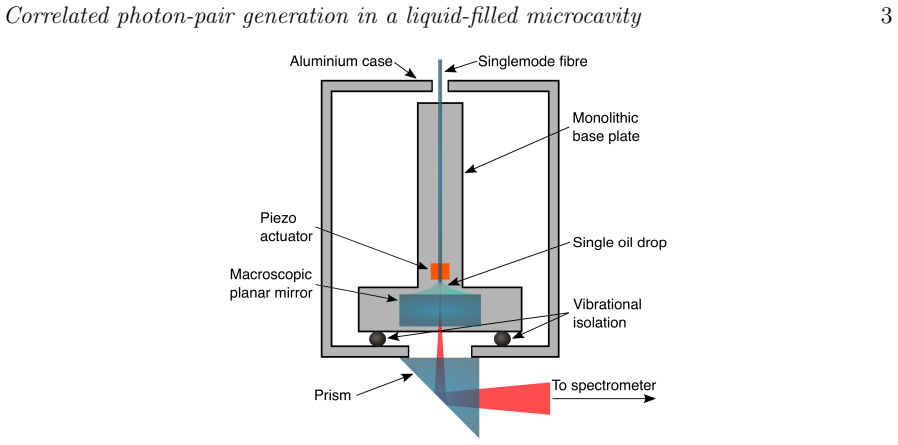
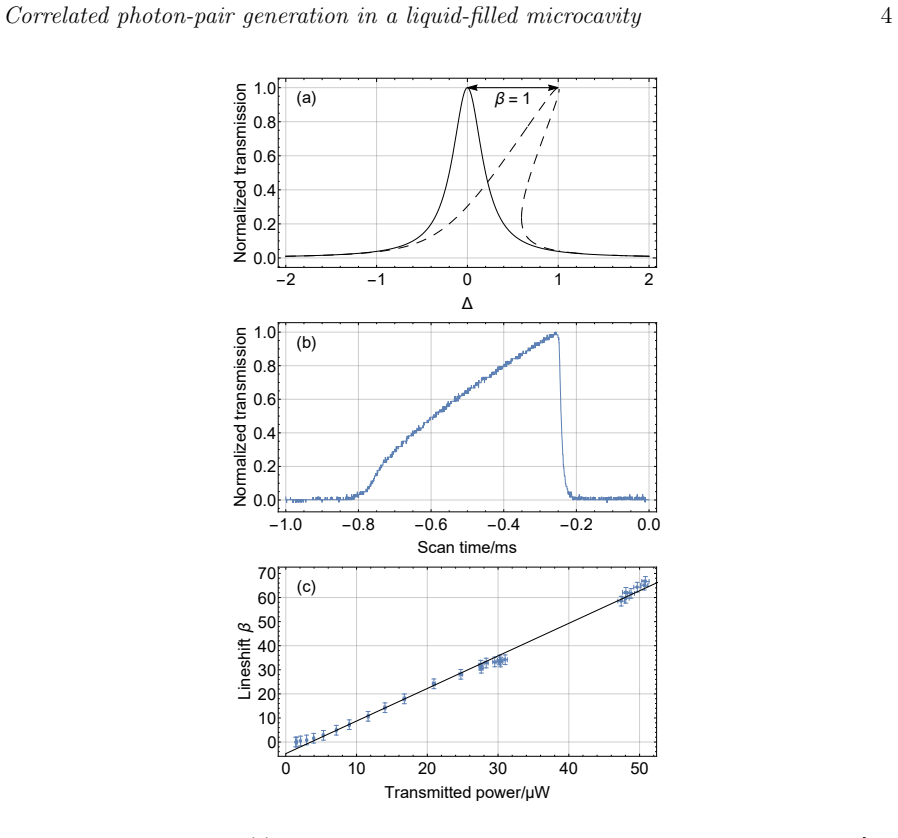
Experiment We have constructed a Fabry-Perot microcavity composed of a micromachined and coated endfacet of an optical fiber as one mirror [15, 16, 17, 18, 19, 20, 21, 22, 11] and a conventional planar mirror with identical coating as the second mirror (see Figure 1). The length of the cavity is L = 38.4 µm and the finesse is F = π/(T +L) = 12500± 500 with ...
-
[3]
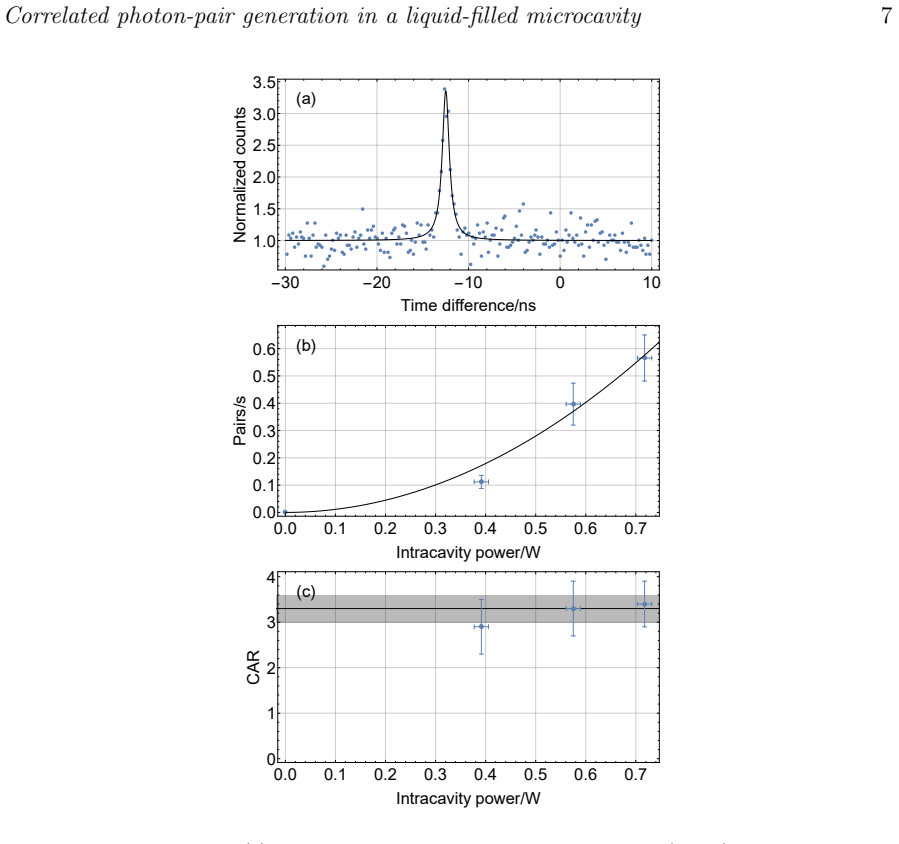
Results In Figure 2a we show a typical two-photon correlation measurement of ordern = 2, i.e., with photon frequencies ofω2,− = 2π×377.155 THz andω2,+ = 2π×387.155 THz for an intracavity power of 0.58 W. The correlation signal shows a coincidence-to-accidental ratio (CAR) of 3.4± 0.5 and thus clearly signals the nonclassical nature of the emitted photon p...
-
[4]
by the mechanisms discussed in the introduction. In principle, the integral over the Kerr coupling would even include the non-linear effects arising from the mirror coating [30, 11], however, they are approximately two orders of magnitude smaller and can be neglected. Comparing the theoretically expected flux Γ to the experimentally determined rate coefficien...
work page 2004
-
[5]
C. K. Hong, Z. Y. Ou, and L. Mandel. Measurement of subpicosecond time intervals between two photons by interference. Phys. Rev. Lett., 59:2044–2046, Nov 1987
work page 2044
-
[6]
Experimental quantum teleportation
Dik Bouwmeester, Jian-Wei Pan, Klaus Mattle, Manfred Eibl, Harald Weinfurter, and Anton Zeilinger. Experimental quantum teleportation. Nature, 390:575–579, 1997
work page 1997
-
[7]
H. J. Kimble. The quantum internet. Nature, 453:1023–1030, 2008
work page 2008
-
[8]
Molecular photons interfaced with alkali atoms
Petr Siyushev, Guilherme Stein, J¨ org Wrachtrup, and Ilja Gerhardt. Molecular photons interfaced with alkali atoms. Nature, 509:66, Apr 2014
work page 2014
-
[9]
H. M. Meyer, R. Stockill, M. Steiner, C. Le Gall, C. Matthiesen, E. Clarke, A. Ludwig, J. Reichel, M. Atat¨ ure, and M. K¨ ohl. Direct photonic coupling of a semiconductor quantum dot and a trapped ion. Phys. Rev. Lett., 114:123001, Mar 2015
work page 2015
-
[10]
M. Fiorentino, P.L. Voss, J.E. Sharping, and P. Kumar. All-fiber photon-pair source for quantum communications. IEEE Photonics Technology Letters, 14(7):983–985, jul 2002
work page 2002
-
[11]
J. Fan, A. Migdall, and L. J. Wang. Efficient generation of correlated photon pairs in a microstructure fiber. Opt. Lett., 30(24):3368–3370, Dec 2005
work page 2005
-
[12]
Photon pair generation from compact silicon microring resonators using microwatt-level pump powers
Marc Savanier, Ranjeet Kumar, and Shayan Mookherjea. Photon pair generation from compact silicon microring resonators using microwatt-level pump powers. Opt. Express, 24(4):3313–3328, Feb 2016
work page 2016
-
[13]
M Barbier, I Zaquine, and P Delaye. Spontaneous four-wave mixing in liquid-core fibers: towards fibered raman-free correlated photon sources. New Journal of Physics , 17(5):053031, may 2015
work page 2015
-
[14]
A. Sommer, E. M. Bothschafter, S. A. Sato, C. Jakubeit, T. Latka, O. Razskazovskaya, H. Fattahi, M. Jobst, W. Schweinberger, V. Shirvanyan, V. S. Yakovlev, R. Kienberger, K. Yabana, N. Karpowicz, M. Schultze, and F. Krausz. Attosecond nonlinear polarization and light-matter energy transfer in solids. Nature, 534:86, May 2016
work page 2016
-
[15]
Thorsten F. Langerfeld, Hendrik M. Meyer, and Michael K¨ ohl. Correlated-photon-pair emission from a cw-pumped fabry-perot microcavity. Phys. Rev. A , 97:023822, Feb 2018
work page 2018
-
[16]
C. J. F. B¨ ottcher and P. Bordewijk. Theory of electric polarization, Vol. II . Elsevier, 1996
work page 1996
-
[17]
Ultrafast optical kerr effect in liquids and solids
Roberto Righini. Ultrafast optical kerr effect in liquids and solids. Science, 262(5138):1386–1390, 1993
work page 1993
-
[18]
Peng Zhao, Matthew Reichert, Sepehr Benis, David J. Hagan, and Eric W. Van Stryland. Temporal and polarization dependence of the nonlinear optical response of solvents. Optica, 5(5):583–594, May 2018
work page 2018
-
[19]
A fiber fabryperot cavity with high finesse
D Hunger, T Steinmetz, Y Colombe, C Deutsch, T W Hnsch, and J Reichel. A fiber fabryperot cavity with high finesse. New Journal of Physics , 12(6):065038, 2010
work page 2010
-
[20]
Andreas Muller, Edward B. Flagg, John R. Lawall, and Glenn S. Solomon. Ultrahigh-finesse, low-mode-volume fabry–perot microcavity. Opt. Lett., 35(13):2293–2295, Jul 2010
work page 2010
-
[21]
Meyer, Christian Deutsch, Jakob Reichel, and Michael K¨ ohl
Matthias Steiner, Hendrik M. Meyer, Christian Deutsch, Jakob Reichel, and Michael K¨ ohl. Single ion coupled to an optical fiber cavity. Phys. Rev. Lett., 110:043003, Jan 2013
work page 2013
-
[22]
B. Brandst¨ atter, A. McClung, K. Sch¨ uppert, B. Casabone, K. Friebe, A. Stute, P. O. Schmidt, C. Deutsch, J. Reichel, R. Blatt, and T. E. Northup. Integrated fiber-mirror ion trap for strong ion-cavity coupling. Review of Scientific Instruments , 84(12):123104, 2013
work page 2013
-
[23]
Novel laser machining of optical fibers for long cavities with low birefringence
Hiroki Takahashi, Jack Morphew, Fedja Oruˇ cevi´ c, Atsushi Noguchi, Ezra Kassa, and Matthias Keller. Novel laser machining of optical fibers for long cavities with low birefringence. Opt. Express, 22(25):31317–31328, Dec 2014
work page 2014
-
[24]
Frequency splitting of polarization eigenmodes in microscopic fabryperot cavities
Manuel Uphoff, Manuel Brekenfeld, Gerhard Rempe, and Stephan Ritter. Frequency splitting of polarization eigenmodes in microscopic fabryperot cavities. New Journal of Physics , 17(1):013053, 2015
work page 2015
-
[25]
J. Gallego, S. Ghosh, S. K. Alavi, W. Alt, M. Martinez-Dorantes, D. Meschede, and Correlated photon-pair generation in a liquid-filled microcavity 9 L. Ratschbacher. High-finesse fiber Fabry– Perot cavities: stabilization and mode matching analysis. Applied Physics B , 122(3):47, Mar 2016
work page 2016
-
[26]
High mechanical bandwidth fiber-coupled fabry-perot cavity
Erika Janitz, Maximilian Ruf, Yannik Fontana, Jack Sankey, and Lilian Childress. High mechanical bandwidth fiber-coupled fabry-perot cavity. Opt. Express, 25(17):20932–20943, Aug 2017
work page 2017
-
[27]
https://www.gelest.com/product/phenylmethylsiloxane-oligomer/
Gelest Inc. https://www.gelest.com/product/phenylmethylsiloxane-oligomer/. Accessed: 18-07- 2019
work page 2019
- [28]
-
[29]
P. Dub´ e, L.-S. Ma, J. Ye, P. Jungner, and J. L. Hall. Thermally induced self-locking of an optical cavity by overtone absorption in acetylene gas. J. Opt. Soc. Am. B , 13(9):2041–2054, Sep 1996
work page 2041
-
[30]
T. L. Van Raalte. Measurement of the refractive index of silicone oils for the u.k.a.e.a. J. Opt. Soc. Am., 50(1):86, Jan 1960
work page 1960
- [31]
-
[32]
Motion induced radiation from a vibrating cavity
Astrid Lambrecht, Marc-Thierry Jaekel, and Serge Reynaud. Motion induced radiation from a vibrating cavity. Phys. Rev. Lett., 77:615–618, Jul 1996
work page 1996
-
[33]
Kerr constants of some mineral and silicone oils
R Ledzion, K Bondarczuk, P Gorski, and W Kucharczyk. Kerr constants of some mineral and silicone oils. Quantum Electronics, 29(8):739–741, 1999
work page 1999
-
[34]
Kerr effect in multilayer dielectric coatings
Elena Fedulova, Michael Trubetskov, Tatiana Amotchkina, Kilian Fritsch, Peter Baum, Oleg Pronin, and Vladimir Pervak. Kerr effect in multilayer dielectric coatings. Opt. Express , 24(19):21802–21817, Sep 2016
work page 2016
discussion (0)
Sign in with ORCID, Apple, or X to comment. Anyone can read and Pith papers without signing in.