REVIEW 3 major objections 5 minor 79 references
Semileptonic kaon decays and the precise determination of $V_{us}$
T0 review · 3 major / 5 minor · reviewed 2026-08-08 · deepseek-v4-flash
Pith's one-line read A hybrid calculation pins $K_{\ell3}$ radiative corrections to $10^{-4}$, sharpening the Cabibbo anomaly.
desk verdict Useful overview of the hybrid K_l3 radiative correction framework, but the printed Table 3 has an order-of-magnitude typo; use the cited papers for actual numbers. read the letter →
The pith
A machine-rendered reading of the paper's core claim, the machinery that carries it, and where it could break.
The reading
What carries the argument
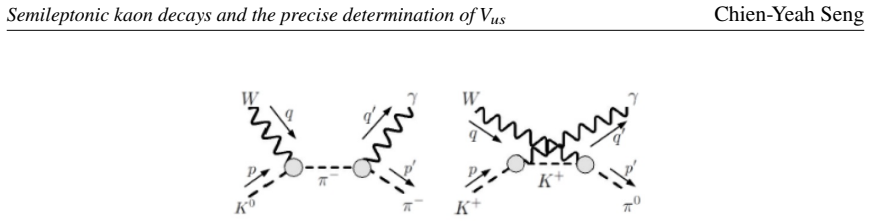
The central object is Sirlin's representation, built on the exact current-algebra identity $[J^{0\dagger}_W(\vec x,t), J^{\mu}_{\rm em}(\vec y,t)] = J^{\mu\dagger}_W(\vec x,t)\delta^{(3)}(\vec x-\vec y)$ and on splitting the photon propagator into a heavy-$M_W$ piece and a massless Pauli-Villars piece. This isolates the non-perturbative hadronic content of the radiative correction in the generalized Compton tensor $T^{\mu\nu}(q';p_f,p_i) = \int d^4x\, e^{iq'\cdot x}\langle \pi | T\{J^{\mu}_{\rm em}(x) J^{\nu\dagger}_W(0)\}| K\rangle$, packaged as a residual integral. The calculation then assigns each piece to a calculable source: experimental $K/\pi$ form factors saturate the pole contributions and effectively resum the largest $O(e^2 p^n)$ chiral corrections; lattice QCD supplies the forward-limit axial $\gamma W$ box, matched to perturbative QCD at high loop momentum; and the residual three-point function is handled in chiral perturbation theory with the infrared-divergent part resummed exactly through bremsstrahlung. This division is what converts the previous $10^{-3}$ chiral uncertainty into a $10^{-4}$ result.
What would settle it
Perform a dispersive evaluation of the inelastic (multi-particle) contributions to the residual integral in Eq. (31), using measured $K\pi$ scattering phases, and compare with the 'inel' entries in Table 3; a shift larger than the quoted uncertainty would break the $10^{-4}$ claim. The decisive independent check is a full lattice QCD calculation of the $K_{\ell3}$ decay rate including QED, which the paper estimates is about ten years away—if it disagrees with the hybrid $\delta^{K\ell}_{EM}$ by more than the combined error, the central claim is falsified.
Extended reading notes
Core claim
On its own terms, the paper establishes that the $O(G_F \alpha)$ long-distance electromagnetic correction to $K_{\ell3}$ decays can be computed without the full machinery of fixed-order chiral perturbation theory. Starting from Sirlin's representation, the correction is split into a residual integral dominated by single-particle pole diagrams built from measured kaon and pion form factors, an axial $\gamma W$ box integral whose forward part is taken from lattice QCD and whose high-momentum part from perturbative QCD, and a three-point function whose infrared-divergent part is known exactly and whose finite part is a small chiral correction. The resulting $\delta^{K\ell}_{EM}$ agrees with the older chiral perturbation theory values while reducing the uncertainty from $10^{-3}$ to $10^{-4}$. Combining this with the lattice value of $f_+^{K^0\pi^-}(0)$ yields $|V_{us}| = 0.22308(39)(39)(3)$ for $N_f = 2+1+1$, with good consistency among all six $K_{\ell3}$ channels. The paper concludes that missing $K_{\ell3}$ radiative corrections are not the source of the $K_{\mu2}/K_{\ell3}$ discrepancy, and that the first-row CKM unitarity deficit is sharpened to about $2.8\sigma$.
Load-bearing premise
The claimed $10^{-4}$ precision rests on one assumption: the contributions the calculation treats as small—multi-particle intermediate states, effects away from the forward limit, and higher-order chiral terms—are genuinely as small as the error bars in Table 3 say they are.
Editorial extensions
If this is right
- The radiative-correction contribution to $V_{us}$ from $K_{\ell3}$ drops to the $10^{-4}$ level, so the extraction is no longer limited by long-distance electromagnetic theory but by the lattice value of $f_+^{K^0\pi^-}(0)$.
- The consistency of the new $\delta^{K\ell}_{EM}$ across all six $K_{\ell3}$ channels and with the older chiral perturbation theory values removes a leading candidate explanation for the $K_{\mu2}/K_{\ell3}$ discrepancy.
- The first-row CKM unitarity test retains a $2.8\sigma$ deficit after the improved correction, making the deficit a more credible low-energy hint of new physics such as right-handed quark couplings.
- The improved $K_{\ell3}$ result consolidates the global $V_{us}$ fit and sharpens the comparison between $V_{us}$ determined from $K_{\ell3}$ and from $K_{\mu2}/\pi_{\mu2}$ plus nuclear $V_{ud}$.
Reading between the lines
- Beyond kaons, the same division into pole-saturated residual integrals, lattice box diagrams, and resummed infrared pieces could be applied to other precision semileptonic processes (pion beta decay, hyperon decays) where long-distance radiative corrections dominate the error budget.
- After the electromagnetic correction is sharpened, the largest remaining theory tension in the charged-kaon channels is the isospin-breaking factor $\delta^{K^+\pi^0}_{SU(2)}$, where lattice results and $\eta\to 3\pi$ phenomenology still disagree; resolving that discrepancy is the natural next step.
- A dispersive evaluation of the inelastic contributions to the residual integral, using measured $K\pi$ scattering phases, would provide a direct test of the small 'inel' error budget the $10^{-4}$ claim depends on.
- The paper's own timeline of roughly ten years for a full lattice QCD calculation of $K_{\ell3}$ with QED suggests the hybrid result is a high-precision intermediate step rather than the final word.
Editorial analysis
A structured set of objections, weighed in public.
Referee Report
Summary. This proceedings contribution (PoS CD2024) summarizes the theory inputs for extracting V_us from K_l3 decays, with emphasis on the long-distance electromagnetic correction δ_EM^{Kℓ}. The author reviews the previous chiral perturbation theory (ChPT) evaluation, introduces Sirlin's representation as an alternative framework, and presents a hybrid scheme that combines the Sirlin representation with lattice QCD inputs for the γW-box diagram and experimental form factors for pole contributions. The manuscript reports an order-of-magnitude improvement in the precision of δ_EM^{Kℓ} (from 10^-3 to 10^-4), quotes a new value |V_us| = 0.22308(39)(39)(3), and argues that this sharpens the so-called Cabibbo angle anomaly.
Significance. If correct, the claimed improvement in the electromagnetic correction to K_l3 decays is significant: it would reduce a leading theory uncertainty in V_us and make the first-row CKM unitarity test more incisive. The hybrid Sirlin-plus-lattice approach is a novel and potentially powerful strategy, and the underlying published work (JHEP 2020-2022) has already received attention. The proceedings itself, however, does not stand alone as a reliable source for the new numbers because of an internal inconsistency between the central Table 3 and the text. Credit is due for clearly listing the SM inputs and for explicitly identifying the residual theory uncertainties (inelastic states, non-forward effects, chiral truncation), but the document as printed does not substantiate its central precision claim.
major comments (3)
- [5.4, Table 3] The printed entries in Table 3 are incompatible with Table 2 by an order of magnitude, yet the text immediately below the table states that 'The results in Table 2 and 3 are in good agreement.' For K0_e3, Table 3 gives 11.6(2)%, while Table 2 gives 0.99(19)(11)%; the K+_e3, K0_mu3, and K+_mu3 rows show the same factor-of-ten pattern. The central values differ by roughly a factor of ten and the quoted uncertainties do not reconcile them. If the intended values are approximately 1.16(2)%, 0.21(2)%, 1.54(2)%, and 0.05(2)%, then the table is missing decimal points and must be corrected. As printed, the agreement claim is false, the claimed improvement from 10^-3 to 10^-4 cannot be verified, and the resulting V_us in Eq. (37) inherits the error.
- [2.4 and Table 4] Equation (10) lists two values for the isospin-breaking correction δ_SU(2)^{K+π0}: 0.0457(20) from lattice and 0.0522(34) from phenomenology, a difference of 0.0065. The text does not state which of these is used in the K+ rows of Table 4. The difference is roughly 30 times the quoted δ_SU(2) uncertainty (21 × 10^-5) and would shift |V_us f_+(0)| for K+_e3 by about 1.4 × 10^-3, far outside the quoted total error. Since the K+ channels contribute to the average in Table 4 and to Eq. (37), the final result depends on an input whose value the reader cannot determine from this manuscript.
- [5.4 and Table 3] The central claim of an order-of-magnitude improvement in precision rests on the uncertainty budget in Table 3, but the entries labeled 'inel' and 'NF' are presented as labels only; no numerical values, derivations, or direct references to specific equations or tables in Refs. [62,66-70] are provided. For example, the residual integral in Eq. (31) is asserted to be saturated by the pole diagrams in Fig. 4, yet the size of the neglected inelastic contributions is not quantified, and the non-forward correction to the lattice box diagram is said to be 'estimated with chiral power counting' without giving the estimate. Without these numbers, the reader cannot assess whether the quoted 10^-4 precision is credible. The author should either quote the central values and uncertainties for 'inel' and 'NF' or explicitly state that they are taken from the cited papers and indicate where.
minor comments (5)
- [Tables 2 and 3] The units of the uncertainty subscripts in Table 3 are not specified; the reader must infer that they are in units of 10^-4 relative to the central values. Please state this explicitly in the table caption or in the text.
- [Table 3 vs Table 4] Table 3 lists only four modes (K0_e3, K+_e3, K0_mu3, K+_mu3), whereas Table 4 separates K_L and K_S channels. It should be clarified whether the K0 entries in Table 3 apply equally to both K_L and K_S, since the two neutral-kaon states have different experimental environments and the δ_EM correction could in principle differ by isospin-breaking or final-state effects.
- [Eq. (31)] The notation 'T^mu_mu' in the integrand is ambiguous; it should be written as a trace, e.g., g_{muν} T^{muν}, or with explicit contracted indices, to avoid confusion with a tensor component.
- [References] Reference [69] is cited as a preprint without a journal or DOI; if a published version exists now, it should be updated.
- [Section 6] The summary bullet points are useful, but they do not mention the Table 3/Table 4 discrepancy in the isospin-breaking input; the final summary would benefit from a sentence stating which δ_SU(2) value is adopted.
Circularity Check
No circularity: V_us is extracted from measured rates using independently computed corrections; the Table 2/Table 3 mismatch is a correctness issue, not a circular reduction.
full rationale
The derivation chain is not circular. The long-distance electromagnetic correction delta_EM is defined in Sec. 2.5 as the remaining electroweak correction after G_F and S_EW, and is computed in Secs. 4-5 from Sirlin's representation (Eq. 29) using the exact current-algebra relation (Eq. 19), experimental K/pi form factors, and lattice-QCD box-diagram inputs. None of these inputs is fitted to the target value of V_us. The final V_us in Eq. (37) is extracted from measured K_l3 partial rates via the master formula Eq. (4), so it is an output rather than an input by construction. The extensive citation of the author's prior papers [62,66-70] is a normal proceedings-style reference to detailed derivations; those calculations are externally checkable and do not assume the target V_us, so the self-citations constitute real evidence rather than circular support. One internal-consistency problem is flagged: in Sec. 5.4, the printed Table 3 central values are an order of magnitude larger than the ChPT results in Table 2 (e.g., 11.6(2)% vs 0.99(19)% for K0_e3), while the text states that the results are in good agreement. This is a serious correctness or typographical concern that prevents verification of the 10^-4 precision claim from this document alone, but it is not circularity: no equation reduces to its input by definition, and no fitted parameter is renamed as a prediction.
Assumptions & free parameters
free parameters (3)
- Inelastic contribution to the residual integral =
quoted uncertainty of 0.0002 in delta_EM (Table 3)
- Non-forward correction to the lattice box diagram =
quoted uncertainty 0.0001 to 0.0004 in delta_EM (Table 3)
- O(e^2 p^4) chiral truncation uncertainty =
quoted uncertainty 0.0001 to 0.0002 in delta_EM (Table 3)
assumptions (5)
- standard math Equal-time current algebra relation [J0_W, J_em] = J_W delta^3 (Eq. 19)
- domain assumption The generalized Compton tensor is saturated by pole diagrams with experimental form factors in the residual integral (Sec. 5.1)
- domain assumption Lattice QCD results for the forward electroweak box diagram (Refs. [74,75]) are accurate
- domain assumption Chiral power counting estimates of non-forward and O(e^2 p^4) corrections are valid
- domain assumption FLAG average f_+(0) (Eq. 7) is reliable
Cite this review
Pith. "Pith review of Semileptonic kaon decays and the precise determination of $V_{us}$." pith.science (2026). https://pith.science/paper/J7QG62DC
@misc{pith2026250204721,
  author       = {Pith},
  title        = {Pith review of: Semileptonic kaon decays and the precise determination of $V_us$},
  year         = {2026},
  howpublished = {\url{https://pith.science/paper/J7QG62DC}},
  note         = {Machine review of arXiv:2502.04721}
}
abstract
I will give a brief overview of the Standard Model theory inputs needed for the precise determination of the Cabibbo-Kobayashi-Maskawa matrix element $V_{us}$ from semileptonic kaon decays, focusing on the long-distance electromagnetic corrections. I will then describe our recent effort to pin down this correction at sub-permille level, which further sharpens the so-called ``Cabibbo angle anomaly'', an interesting observation which may point towards new physics.
Figures


Figures from the paper (2 more)

Reference graph
Works this paper leans on
-
[1]
Cabibbo,Unitary Symmetry and Leptonic Decays, Phys
N. Cabibbo,Unitary Symmetry and Leptonic Decays, Phys. Rev. Lett.10(1963) 531
work page 1963
-
[2]
M. Kobayashi and T. Maskawa,CP Violation in the Renormalizable Theory of Weak Interaction,Prog. Theor. Phys.49 (1973) 652. 13 Semileptonic kaon decays and the precise determination of𝑉𝑢𝑠 Chien-Yeah Seng
work page 1973
-
[3]
Particle Data Groupcollaboration, Review of particle physics, Phys. Rev. D110 (2024) 030001
2024
-
[4]
J.C. Hardy and I.S. Towner,Superallowed 0+→ 0+ nuclear𝛽 decays: 2020 critical survey, with implications for V𝑢𝑑 and CKM unitarity,Phys. Rev. C102(2020) 045501
work page 2020
-
[5]
KLOE collaboration, Measurements of the absolute branching ratios for the dominant K(L) decays, the K(L) lifetime, and V(us) with the KLOE detector,Phys. Lett. B632 (2006) 43 [hep-ex/0508027]
arXiv 2006
-
[6]
KLOEcollaboration,Measurement of the K(L) meson lifetime with the KLOE detector,Phys. Lett. B626 (2005) 15 [hep-ex/0507088]
arXiv 2005
-
[7]
K.G. Vosburgh, T.J. Devlin, R.J. Esterling, B. Goz, D.A. Bryman and W.E. Cleland, Measurement of the k0(l) mean life, Phys. Rev. D6 (1972) 1834
work page 1972
-
[8]
KTeV collaboration, Measurements of K(L) branching fractions and the CP violation parameter |eta+-|, Phys. Rev. D70(2004) 092006 [hep-ex/0406002]
work page Pith review arXiv 2004
Show all 79 references
-
[9]
KTeV collaboration, Precise Measurements of Direct CP Violation, CPT Symmetry, and Other Parameters in the Neutral Kaon System, Phys. Rev. D83(2011) 092001 [1011.0127]
2011 arXiv
-
[10]
KLOE collaboration, Precision Measurement of𝐾𝑆 Meson Lifetime with the KLOE detector, Eur. Phys. J. C71(2011) 1604 [1011.2668]
2011 arXiv
-
[11]
NA48collaboration, A Measurement of the K(S) lifetime,Phys. Lett. B537 (2002) 28 [hep-ex/0205008]
2002 arXiv
-
[12]
Bertanza et al.,Measurement of the K(S) mean lifetime from pi+ pi- and pi0 pi0 decays using K(L) decays to determine the acceptance, Z
L. Bertanza et al.,Measurement of the K(S) mean lifetime from pi+ pi- and pi0 pi0 decays using K(L) decays to determine the acceptance, Z. Phys. C73(1997) 629
1997
-
[13]
Schwingenheuer et al.,CPT Tests in the Neutral Kaon System, Phys
B. Schwingenheuer et al.,CPT Tests in the Neutral Kaon System, Phys. Rev. Lett.74(1995) 4376
1995
-
[14]
L.K.Gibbonsetal., NewMeasurementsoftheNeutralKaonParameters Δm,𝜏𝑠,𝜙00−𝜙00+−, and𝜙+−,Phys. Rev. Lett.70 (1993) 1199
1993
-
[15]
Batley et al.,Determination of the relative decay rate K(S) —> pi e nu / K(L) —> pi e nu, Phys
J.R. Batley et al.,Determination of the relative decay rate K(S) —> pi e nu / K(L) —> pi e nu, Phys. Lett. B653 (2007) 145
2007
-
[16]
KLOE collaboration, Study of the branching ratio and charge asymmetry for the decay 𝐾(𝑠)→ 𝜋𝑒𝜈 with the KLOE detector, Phys. Lett. B636 (2006) 173 [hep-ex/0601026]
2006 arXiv
-
[17]
KLOE collaboration, Measurement of the branching fraction for the decay𝐾(𝑆)→ 𝜋𝑒𝜈, Phys. Lett. B535 (2002) 37 [hep-ph/0203232]
2002 arXiv
-
[18]
14 Semileptonic kaon decays and the precise determination of𝑉𝑢𝑠 Chien-Yeah Seng
KLOE collaboration, Measurement of the charged kaon lifetime with the KLOE detector, JHEP 01 (2008) 073 [0712.1112]. 14 Semileptonic kaon decays and the precise determination of𝑉𝑢𝑠 Chien-Yeah Seng
2008 arXiv
-
[19]
Koptev et al.,Measurement of the lifetimes of pi+ and K+ mesons, JETP Lett.61 (1995) 877
V.P. Koptev et al.,Measurement of the lifetimes of pi+ and K+ mesons, JETP Lett.61 (1995) 877
1995
-
[20]
R.J.OttandT.W.Pritchard, Precisemeasurementofthek+lifetime ,Phys.Rev.D 3(1971)52
1971
-
[21]
Lobkowicz, A.C
F. Lobkowicz, A.C. Melissinos, Y. Nagashima, S. Tewksbury, H. Von Briesen and J.D. Fox, Precise measurement of the k+/k- lifetime ratio, Phys. Rev.185 (1969) 1676
1969
-
[22]
Fitch, C.A
V.L. Fitch, C.A. Quarles and H.C. Wilkins,Study of the K+ Decay Probability,Phys. Rev. 140 (1965) B1088
1965
-
[23]
KLOE collaboration, Measurement of the absolute branching ratios for semileptonic𝐾± decays with the KLOE detector,JHEP 02 (2008) 098 [0712.3841]
2008 arXiv
-
[24]
Chiang, J.L
I.H. Chiang, J.L. Rosen, S. Shapiro, R. Handler, S. Olsen and L. Pondrom,𝐾+ Decay in Flight,Phys. Rev. D6(1972) 1254
1972
-
[25]
MuLan collaboration, Detailed Report of the MuLan Measurement of the Positive Muon Lifetime and Determination of the Fermi Constant, Phys. Rev. D87 (2013) 052003 [1211.0960]
2013 arXiv
-
[26]
Cirigliano, G
V. Cirigliano, G. Ecker, H. Neufeld, A. Pich and J. Portoles,Kaon Decays in the Standard Model,Rev. Mod. Phys.84(2012) 399 [1107.6001]
2012 arXiv
-
[27]
Marciano and A
W.J. Marciano and A. Sirlin,Radiative corrections to pi(lepton 2) decays,Phys. Rev. Lett.71 (1993) 3629
1993
-
[28]
Erler,Electroweak radiative corrections to semileptonic tau decays,Rev
J. Erler,Electroweak radiative corrections to semileptonic tau decays,Rev. Mex. Fis.50 (2004) 200 [hep-ph/0211345]
2004 arXiv
-
[29]
Flavour Lattice A veraging Group (FLAG)collaboration, FLAG Review 2024, 2411.04268
2024 arXiv
-
[30]
Carrasco, P
N. Carrasco, P. Lami, V. Lubicz, L. Riggio, S. Simula and C. Tarantino,𝐾→𝜋 semileptonic form factors with𝑁𝑓 = 2+ 1+ 1 twisted mass fermions,Phys. Rev. D93 (2016) 114512 [1602.04113]
2016 arXiv
-
[31]
Rev.D99(2019) 114509 [1809.02827]
Fermilab Lattice, MILC collaboration,|𝑉𝑢𝑠| from𝐾ℓ3 decay and four-flavor lattice QCD, Phys. Rev.D99(2019) 114509 [1809.02827]
2019 arXiv
-
[32]
Bazavov et al.,Kaon semileptonic vector form factor and determination of|𝑉𝑢𝑠| using staggered fermions,Phys
A. Bazavov et al.,Kaon semileptonic vector form factor and determination of|𝑉𝑢𝑠| using staggered fermions,Phys. Rev. D87 (2013) 073012 [1212.4993]
2013 arXiv
-
[33]
RBC/UKQCD collaboration, The kaon semileptonic form factor in N𝑓 = 2 + 1 domain wall lattice QCD with physical light quark masses, JHEP 06(2015) 164 [1504.01692]
2015 arXiv
-
[34]
FlaviaNet Working Group on Kaon Decayscollaboration, An Evaluation of|𝑉𝑢𝑠| and precise tests of the Standard Model from world data on leptonic and semileptonic kaon decays, Eur. Phys. J. C69(2010) 399 [1005.2323]. 15 Semileptonic kaon decays and the precise determination of𝑉𝑢𝑠...
2010 arXiv
-
[35]
Moulson,𝑉𝑢𝑠 from kaon decays,11th International Workshop on the CKM Unitarity Triangle (CKM 2021)
M. Moulson,𝑉𝑢𝑠 from kaon decays,11th International Workshop on the CKM Unitarity Triangle (CKM 2021)
2021
-
[36]
Hill,Constraints on the form factors for K —> pi l nu and implications for |V(us)|,Phys
R.J. Hill,Constraints on the form factors for K —> pi l nu and implications for |V(us)|,Phys. Rev. D74(2006) 096006 [hep-ph/0607108]
2006 arXiv
-
[37]
Lichard,Some implications of meson dominance in weak interactions,Phys
P. Lichard,Some implications of meson dominance in weak interactions,Phys. Rev. D55 (1997) 5385 [hep-ph/9702345]
1997 arXiv
-
[38]
Bernard, M
V. Bernard, M. Oertel, E. Passemar and J. Stern,K(mu3)**L decay: A Stringent test of right-handed quark currents,Phys. Lett.B638(2006) 480 [hep-ph/0603202]
2006 arXiv
-
[39]
Bernard, M
V. Bernard, M. Oertel, E. Passemar and J. Stern,Dispersive representation and shape of the K(l3) form factors: Robustness, Phys. Rev.D80 (2009) 034034 [0903.1654]
2009 arXiv
-
[40]
KTeV collaboration, Dispersive analysis of K (L mu3) and K (L e3) scalar and vector form factors using KTeV data, Phys. Rev. D81(2010) 052001 [0912.1291]
2010 arXiv
-
[41]
RBC, UKQCD collaboration,Domain wall QCD with physical quark masses, Phys. Rev. D 93(2016) 074505 [1411.7017]
2016 arXiv
-
[42]
S. Durr, Z. Fodor, C. Hoelbling, S.D. Katz, S. Krieg, T. Kurth et al.,Lattice QCD at the physical point: light quark masses,Phys. Lett. B701 (2011) 265 [1011.2403]
2011 arXiv
-
[43]
S. Durr, Z. Fodor, C. Hoelbling, S.D. Katz, S. Krieg, T. Kurth et al.,Lattice QCD at the physical point: Simulation and analysis details,JHEP 08 (2011) 148 [1011.2711]
2011 arXiv
-
[44]
MILCcollaboration, MILC results for light pseudoscalars,PoS CD09 (2009) 007 [0910.2966]
2009 arXiv
-
[45]
Fodor, C
Z. Fodor, C. Hoelbling, S. Krieg, L. Lellouch, T. Lippert, A. Portelli et al.,Up and down quark masses and corrections to Dashen’s theorem from lattice QCD and quenched QED, Phys. Rev. Lett.117 (2016) 082001 [1604.07112]
2016 arXiv
-
[46]
Bazavov et al.,𝐵- and𝐷-meson leptonic decay constants from four-flavor lattice QCD, Phys
A. Bazavov et al.,𝐵- and𝐷-meson leptonic decay constants from four-flavor lattice QCD, Phys. Rev. D98 (2018) 074512 [1712.09262]
2018 arXiv
-
[47]
European Twisted Mass collaboration, Up, down, strange and charm quark masses with N𝑓 = 2+1+1 twisted mass lattice QCD,Nucl. Phys. B887(2014) 19 [1403.4504]
2014 arXiv
-
[48]
Fermilab Lattice, MILC collaboration, Charmed and Light Pseudoscalar Meson Decay Constants from Four-Flavor Lattice QCD with Physical Light Quarks, Phys. Rev. D90 (2014) 074509 [1407.3772]
2014 arXiv
-
[49]
Giusti, V
D. Giusti, V. Lubicz, C. Tarantino, G. Martinelli, F. Sanfilippo, S. Simula et al.,Leading isospin-breaking corrections to pion, kaon and charmed-meson masses with Twisted-Mass fermions, Phys. Rev. D95(2017) 114504 [1704.06561]. 16 Semileptonic kaon decays and the precise dete...
2017 arXiv
-
[50]
Colangelo, S
G. Colangelo, S. Lanz, H. Leutwyler and E. Passemar,Dispersive analysis of𝜂→ 3𝜋,Eur. Phys. J. C78(2018) 947 [1807.11937]
2018 arXiv
-
[51]
C.-Y. Seng, D. Galviz, W.J. Marciano and U.-G. Meißner,Update on|𝑉𝑢𝑠| and|𝑉𝑢𝑠/𝑉𝑢𝑑| from semileptonic kaon and pion decays, Phys. Rev. D105 (2022) 013005 [2107.14708]
2022 arXiv
-
[52]
Gasser and H
J. Gasser and H. Leutwyler,Chiral Perturbation Theory: Expansions in the Mass of the Strange Quark, Nucl. Phys.B250 (1985) 465
1985
-
[53]
Urech,Virtual photons in chiral perturbation theory,Nucl
R. Urech,Virtual photons in chiral perturbation theory,Nucl. Phys.B433(1995) 234 [hep-ph/9405341]
1995 arXiv
-
[54]
Knecht, H
M. Knecht, H. Neufeld, H. Rupertsberger and P. Talavera,Chiral perturbation theory with virtual photons and leptons, Eur. Phys. J.C12(2000) 469 [hep-ph/9909284]
2000 arXiv
-
[55]
Ananthanarayan and B
B. Ananthanarayan and B. Moussallam,Four-point correlator constraints on electromagnetic chiral parameters and resonance effective Lagrangians, JHEP 06(2004) 047 [hep-ph/0405206]
2004 arXiv
-
[56]
Descotes-Genon and B
S. Descotes-Genon and B. Moussallam,Radiative corrections in weak semi-leptonic processes at low energy: A Two-step matching determination, Eur. Phys. J.C42 (2005) 403 [hep-ph/0505077]
2005 arXiv
-
[57]
Cirigliano, M
V. Cirigliano, M. Knecht, H. Neufeld and H. Pichl,The Pionic beta decay in chiral perturbation theory,Eur. Phys. J. C27(2003) 255 [hep-ph/0209226]
2003 arXiv
-
[58]
Cirigliano, M
V. Cirigliano, M. Giannotti and H. Neufeld,Electromagnetic effects in K(l3) decays, JHEP 11 (2008) 006 [0807.4507]
2008 arXiv
-
[59]
Giusti, V
D. Giusti, V. Lubicz, G. Martinelli, C.T. Sachrajda, F. Sanfilippo, S. Simula et al.,First lattice calculation of the QED corrections to leptonic decay rates,Phys. Rev. Lett.120 (2018) 072001 [1711.06537]
2018 arXiv
-
[60]
Boyle et al.,High-precision determination of𝑉𝑢𝑠 and𝑉𝑢𝑑 from lattice QCD, SnowMass 2021
P. Boyle et al.,High-precision determination of𝑉𝑢𝑠 and𝑉𝑢𝑑 from lattice QCD, SnowMass 2021
2021
-
[61]
Sirlin,Current Algebra Formulation of Radiative Corrections in Gauge Theories and the Universality of the Weak Interactions, Rev
A. Sirlin,Current Algebra Formulation of Radiative Corrections in Gauge Theories and the Universality of the Weak Interactions, Rev. Mod. Phys.50(1978) 573
1978
-
[62]
C.-Y. Seng, D. Galviz and U.-G. Meißner,A New Theory Framework for the Electroweak Radiative Corrections in𝐾𝑙3 Decays, JHEP 02(2020) 069 [1910.13208]
2020 arXiv
-
[63]
Seng,Radiative Corrections to Semileptonic Beta Decays: Progress and Challenges, Particles 4 (2021) 397 [2108.03279]
C.-Y. Seng,Radiative Corrections to Semileptonic Beta Decays: Progress and Challenges, Particles 4 (2021) 397 [2108.03279]
2021 arXiv
-
[64]
Brown,Perturbation theory and selfmass insertions, Phys
L.S. Brown,Perturbation theory and selfmass insertions, Phys. Rev.187 (1969) 2260
1969
-
[65]
Meister and D
N. Meister and D. Yennie,Radiative Corrections to High-Energy Scattering Processes,Phys. Rev. 130 (1963) 1210. 17 Semileptonic kaon decays and the precise determination of𝑉𝑢𝑠 Chien-Yeah Seng
1963
-
[66]
C.-Y. Seng, X. Feng, M. Gorchtein, L.-C. Jin and U.-G. Meißner,New method for calculating electromagnetic effects in semileptonic beta-decays of mesons,JHEP 10 (2020) 179 [2009.00459]
2020 arXiv
-
[67]
C.-Y. Seng, D. Galviz, M. Gorchtein and U.G. Meißner,High-precision determination of the Ke3 radiative corrections, Phys. Lett. B820 (2021) 136522 [2103.00975]
2021 arXiv
-
[68]
C.-Y. Seng, D. Galviz, M. Gorchtein and U.-G. Meißner,Improved𝐾𝑒3 radiative corrections sharpen the𝐾𝜇2–K𝑙3 discrepancy,JHEP 11(2021) 172 [2103.04843]
2021 arXiv
-
[69]
Seng, W.J
C.-Y. Seng, W.J. Marciano and U.-G. Meißner,Electron Mass Singularities in Semileptonic Kaon Decays, 2206.01513
-
[70]
C.-Y. Seng, D. Galviz, M. Gorchtein and U.-G. Meißner,Complete theory of radiative corrections to Kℓ3 decays and the V𝑢𝑠 update,JHEP 07 (2022) 071 [2203.05217]
2022 arXiv
-
[71]
Amendolia et al.,A Measurement of the Kaon Charge Radius,Phys
S. Amendolia et al.,A Measurement of the Kaon Charge Radius,Phys. Lett. B178 (1986) 435
1986
-
[72]
NA7collaboration,A Measurement of the Space - Like Pion Electromagnetic Form-Factor, Nucl. Phys. B277 (1986) 168
1986
-
[73]
NA48/2collaboration, Measurement of the form factors of charged kaon semileptonic decays,JHEP 10 (2018) 150 [1808.09041]
2018 arXiv
-
[74]
X. Feng, M. Gorchtein, L.-C. Jin, P.-X. Ma and C.-Y. Seng,First-principles calculation of electroweak box diagrams from lattice QCD,Phys. Rev. Lett.124 (2020) 192002 [2003.09798]
2020 arXiv
-
[75]
P.-X. Ma, X. Feng, M. Gorchtein, L.-C. Jin and C.-Y. Seng,Lattice QCD calculation of the electroweak box diagrams for the kaon semileptonic decays,Phys. Rev. D103(2021) 114503 [2102.12048]
2021 arXiv
-
[76]
Cirigliano, A
V. Cirigliano, A. Crivellin, M. Hoferichter and M. Moulson,Scrutinizing CKM unitarity with a new measurement of the K𝜇3/K𝜇2 branching fraction, Phys. Lett. B838(2023) 137748 [2208.11707]
2023 arXiv
-
[77]
A case study of first-row CKM unitarity, JHEP 03(2024) 033 [2311.00021]
V.Cirigliano,W.Dekens,J.deVries,E.MereghettiandT.Tong, AnomaliesinglobalSMEFT analyses. A case study of first-row CKM unitarity, JHEP 03(2024) 033 [2311.00021]
2024 arXiv
-
[78]
C.-Y. Seng, M. Gorchtein, H.H. Patel and M.J. Ramsey-Musolf,Reduced Hadronic Uncertainty in the Determination of𝑉𝑢𝑑, Phys. Rev. Lett.121 (2018) 241804 [1807.10197]
2018 arXiv
-
[79]
C.Y. Seng, M. Gorchtein and M.J. Ramsey-Musolf,Dispersive evaluation of the inner radiative correction in neutron and nuclear𝛽 decay,Phys. Rev.D100(2019) 013001 [1812.03352]. 18
2019 arXiv
Reviewed August 8, 2026 · model on record in the stance chip above.
Discussion (0). Continue with ORCID to comment.