REVIEW 2 major objections 5 minor 1 cited by
On long-duration storage, weather uncertainty and limited foresight
T0 review · 2 major / 5 minor · reviewed 2026-08-15 · deepseek-v4-flash
Pith's one-line read Limited weather foresight changes long-duration storage from arbitrageur to defensive hedge.
desk verdict Solid first application of full multi-stage SDDP to capacity expansion with LDES; the limited-foresight vs perfect-foresight comparison is well-designed, but the storage-target terminal penalty contaminates the headline stockpiling and bidding-curve results, so the magnitudes need a continuation-value treatment before they can be taken at face value. read the letter →
The pith
A machine-rendered reading of the paper's core claim, the machinery that carries it, and where it could break.
The reading
What carries the argument
The load-bearing object is the marginal storage value (MSV), the derivative of the expected future cost-to-go with respect to the storage level at the end of a dispatch stage. The recursive identity $\lambda^{\mathrm{MSV}}_{s,t,h} = \sum_{j=h}^{H(t)}(\mu^e_{s,t,j}-\bar\mu^e_{s,t,j}) + \mathbb{E}[\lambda^{\mathrm{MSV}}_{s,t+1,1}]$ expresses the MSV in a given month and hour as current-period storage-bound effects plus the conditional expectation of next month's MSV, so today's value of stored energy already contains the weather-dependent probability of all future scarcity events. At the margin, discharging sets the electricity price at $\lambda_{t,h}=(\eta^f_s)^{-1}\lambda^{\mathrm{MSV}}_{s,t,h}$ and charging at $\lambda_{t,h}=\eta^h_s\lambda^{\mathrm{MSV}}_{s,t,h}$. The model approximates the expected cost-to-go functions with a cutting-plane algorithm, then evaluates their slopes over the storage domain in steps of 10 GWh to produce monthly bidding curves; those curves are concave in autumn, convex in spring, and their height is set by the cost of the outside option (load shedding or hydrogen imports).
What would settle it
Re-solve the UK No-Imports case with a discounted infinite-horizon stochastic formulation (or with two linked weather years) and compare the storage-level distributions and bidding curves. If the October-to-full stockpiling and the convex spring bidding curves persist, the limited-foresight mechanism is robust; if they flatten or shift, the paper's headline results are driven by the terminal target rather than by weather uncertainty.
Extended reading notes
Core claim
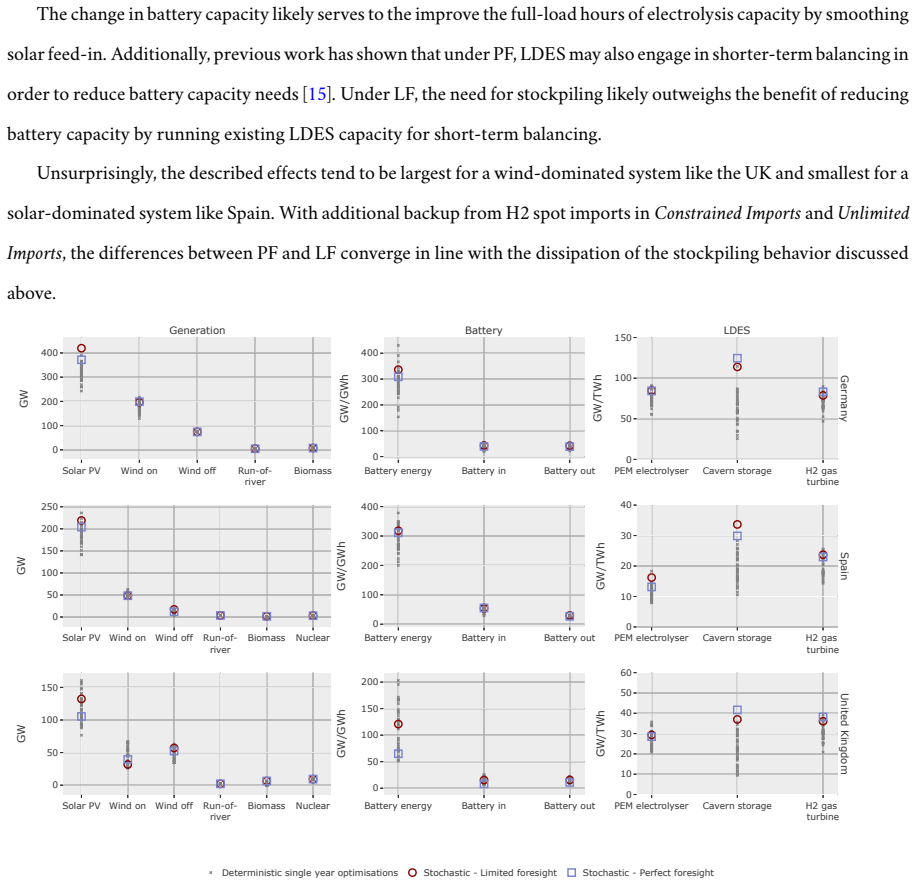
The central claim is that weather uncertainty changes both the operation and the system value of long-duration storage. In a fully renewable, sector-coupled system with limited foresight, the optimal LDES policy is defensive: the storage builds toward full capacity by October, holds high levels through winter, and only then returns to its target level, so that the distribution of storage trajectories lies well above the perfect-foresight distribution. The bidding logic that produces this behavior is the marginal storage value: a storage unit at the margin bids the efficiency-adjusted expected value of stored energy, and that expectation is the probability of future extreme scarcity (when storage would be empty and load must be shed or hydrogen imported) times the cost of that state. Perfect foresight removes the probability term, allowing aggressive, year-specific dispatch that perfect-foresight models mistake for optimal operation. The paper's quantitative claims include up to 25% higher solar PV capacity and 20% lower onshore wind in the United Kingdom under limited foresight, little change in LDES capacities, and smoother price duration curves because LDES bids vary continuously with storage level and season.
Load-bearing premise
The load-bearing premise is that the value of storage beyond the modeled year can be represented by a single end-of-June target level chosen by the planner, with any shortfall penalized at the value of lost load; if that artificial target is replaced by a proper continuation value, the stockpiling pattern and the spring and summer bidding curves could change, and with them the headline capacity results.
Editorial extensions
If this is right
- Capacity-expansion studies that assume perfect foresight likely overestimate onshore wind and underestimate solar PV; in the wind-dominated UK case, limited foresight raises solar capacity by about 25% and cuts onshore wind by about 20%.
- Limited-foresight LDES trajectories are systematically higher in autumn and early winter than perfect-foresight trajectories, and the stockpiling difference is largest in wind-dominated systems and nearly disappears when cheap hydrogen imports provide backup.
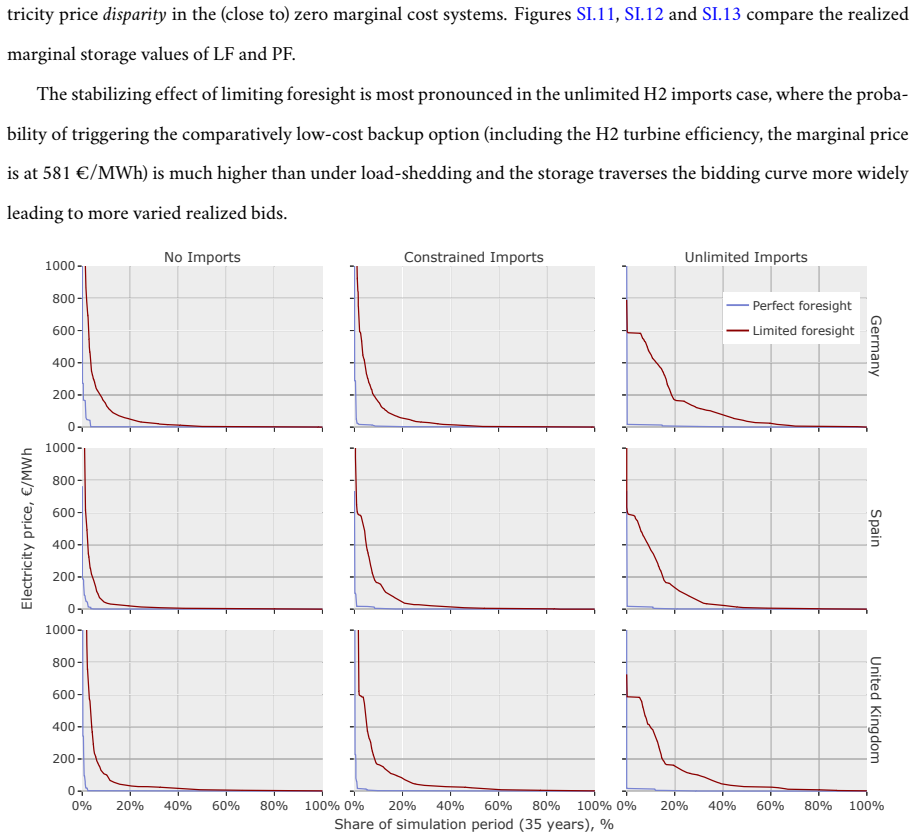
- When LDES sets the electricity price, its bid is the efficiency-adjusted expected marginal storage value, so prices embed the weather-dependent probability of extreme states and price duration curves are smoother than in perfect-foresight models.
- LDES capacities themselves change little between the two models; the main adjustments are more solar, less onshore wind, and more battery energy capacity (about 86% more in the UK).
- The derived monthly bidding curves give a concrete starting point for heuristic LDES bidding rules in large-scale planning models that cannot solve a full stochastic program.
Reading between the lines
- Editorial extension: because the paper's operator minimizes expected cost and is risk-neutral, the smoothing of price duration curves is a central-case result; a risk-averse operator would weight tail states more heavily, so the hedging and price-smoothing effects would likely be stronger, not weaker.
- Editorial extension: the results imply that the system value of a generation technology under limited foresight depends on the predictability of its output in the storage-filling season, not only on its annual energy; technologies with narrow weather variance should command a premium in planning models.
- Editorial extension: the bidding-curve framework could be reused to value interconnectors, demand response, or firm low-carbon backup, since each lowers the effective cost of the outside option and should flatten the autumn bidding curves.
- Editorial extension: a testable prediction is that systems with higher wind variance and weaker interconnection will show larger solar-for-wind substitution and higher optimal autumn storage levels; comparing weather-year variances across countries would give a direct check.
Signed reviews
Editorial analysis
A structured set of objections, weighed in public.
Referee Report
Summary. The paper develops a multi-stage stochastic capacity expansion model of a fully renewable, sector-coupled energy system with long-duration hydrogen storage, solved with Stochastic Dual Dynamic Programming (SDDP), and compares it against a two-stage perfect-foresight benchmark. The central methodological contribution is a KKT-based derivation that represents LDES dispatch as bidding the efficiency-adjusted expected marginal storage value (MSV), conditional on storage level and time of year. The case study covers Germany, Spain, and the UK under three backup-availability scenarios. The headline findings are that, under limited weather foresight, LDES operates defensively and stockpiles to hedge extreme future states; solar PV gains capacity (up to about 25% in the UK) at the expense of onshore wind; and energy-only price duration curves become smoother because LDES bids reflect the weather-dependent probability of scarce states. The paper is transparent about its simplifications and provides code and data.
Significance. If the results hold, the paper makes a significant contribution to capacity expansion modeling for very high renewable shares: it moves from weather variability to weather uncertainty, gives a clean analytical bridge between stochastic dynamic programming and storage bidding behavior, and produces concrete, testable claims about capacity mixtures and price formation. The derivation in Section 2.4 (Equations 2a-2e) is a genuine strength, and the comparison of model types C and D is a well-designed natural experiment for isolating the role of foresight. The availability of open-source code and data is another positive element. The main residual risk is that the headline stockpiling and bidding-curve results are partly generated by the artificial terminal storage target, a limitation the paper itself identifies.
major comments (2)
- [Section 2.3, SI.1p-q, Section 4.3] The storage-target terminal condition is load-bearing for the central claims, not a neutral modeling detail. Under Eq. SI.1p-q, any end-of-June storage shortfall relative to the endogenously chosen initial level is penalized at the value of lost load (100,000 EUR/MWh). Section 4.3 states that in June the MSV is 100,000 EUR/MWh below the target and 0 above it, and that even in earlier months MSVs 'increase rapidly as a shortfall against the storage target becomes more likely.' This means the spring/summer shape of the bidding curves in Figure 6 and the stockpiling trajectories in Figure 4 are driven in part by an artificial terminal cliff, not purely by limited foresight about winter scarcity. The paper itself concedes in Section 5.3 that under an infinite-horizon or continuation-value treatment 'seasonal differences between bidding curves would likely be less pronounced.' Because the perfect-foresight model can meet the same target without the same precautionary margin, the LF-PF differences in storage behavior and the resulting capacity shifts (up to +25% solar, -20% wind in the UK) are inflated by the terminal penalty. A sensitivity analysis with a reduced terminal penalty, or better a continuation-value/infinite-horizon treatment along the lines of the cited Hole et al. work [37], is needed before the headline effects can be attributed to limited foresight itself rather than to the end-of-horizon construction.
- [Section 3.4 and SI.3, Table SI.1] The SDDP runs are stopped by iteration (15,000) or wall-clock (54 h) limits, with only an ex-post inspection of the lower bound and of capacity trajectories as a convergence guarantee. Table SI.1 shows that two specifications actually stop on the time limit, and SI.3 reports a rolling mean of forward-pass simulations rather than a confidence interval for the upper bound. The paper presents the resulting capacity differences as model outputs, so the absence of a quantitative convergence diagnostic is a concern for the magnitude of the headline shifts. The statement that capacity decisions stabilize after about 3,000 iterations is encouraging, but the refining of the policy for another 12,000 iterations could still change the marginal storage values used in the bidding curves of Section 4.3. At minimum, please report the lower-bound/upper-bound gap or a sensitivity check showing that the capacity results and bidding curves do not materially change if training is extended or restarted with a different random seed.
minor comments (5)
- [Section 2.4, Eq. (2c)] The notation H(t)\{H} in Equation (2c) is confusing: H(t) is a set of periods, and writing '\{H}' suggests a single period. Please write H(t)\setminus\{H(t)\}, or define H as the last period of the stage.
- [SI.2, Eq. (SI.3c)] The phrase 'fishing constraint' appears to be a typo for 'fixing constraint' or 'coupling constraint'. Please correct it.
- [Figure 6 and Section 4.3] The example of '127 EUR/MWh at 80% storage in August' should state explicitly that it refers to the No Imports scenario in Germany and to the MSV in EUR/MWh_H2. The y-axis break makes cross-scenario comparison difficult; consider a log-scale inset for the high-MSV range.
- [Section 2.2 and Section 5.3] The claim that one-month foresight likely produces a lower bound on the effect of limited foresight is plausible but not demonstrated. A short-horizon sensitivity (e.g., two-week stages for one country) would substantially strengthen this argument, even if only for a subset of scenarios.
- [Section 4.1] The statement that under perfect foresight 'the maximum dispatch event across all weather years defines the storage size' is a useful intuition but is stated more strongly than the evidence shown. Consider phrasing it as a tendency observed in the simulations.
Circularity Check
No significant circularity: the LDES bidding curves are derived from the model's KKT conditions, and the storage-target caveat is a stated modeling limitation rather than a circular input.
full rationale
I walked the derivation chain from the multi-stage stochastic capacity expansion program (Eq. 1) through the SDDP solution method to the KKT-based derivation of marginal storage values and LDES bidding curves (Eqs. 2a-2e). The bidding curves are derived, not fitted: Eq. 2e defines the MSV recursively as the sum of current-period storage-bound duals plus the expected next-stage MSV, and the paper explicitly frames this as a derivation ('We derive the LDES bidding behavior in the Limited foresight model') rather than as an independent empirical prediction. No parameter is fitted to reproduce the headline stockpiling behavior or the capacity shifts; the storage target level e_ini is an endogenous optimization variable, and the terminal penalty is an exogenous modeling device that is present in both the Limited Foresight and Perfect Foresight models. Thus the LF-PF difference in storage trajectories is not enforced by the input. The paper candidly admits in Section 5.3 that the storage target creates an end-of-horizon effect and that seasonal bidding-curve differences would be less pronounced under an infinite horizon; this is a clearly disclosed limitation affecting the interpretation of magnitudes, but it does not make the derivation circular because the storage target is not defined in terms of the predicted stockpiling. The self-citations ([26] for trust-region stabilization, [81] for a limitation about thermal storage) are not load-bearing for the central claim, and no uniqueness theorem or ansatz is smuggled in via self-citation. Overall, the central results are consequences of the model's stated assumptions and derivations, not equivalences to the inputs by construction.
Assumptions & free parameters
free parameters (5)
- Value of lost load (VOLL) =
100,000 EUR/MWh_el
- H2 spot import price =
250 EUR/MWh_H2
- H2 spot import limit =
5.5 GWh_H2/h
- Monthly stage length =
1 month, 168 to 186 four-hourly periods
- Storage target penalty =
VOLL applied to any deviation below the endogenous target level
assumptions (8)
- domain assumption Stagewise independence of monthly weather vectors
- domain assumption Risk neutrality of the system operator
- standard math Relatively complete recourse
- standard math Finite weather sample space and sample average approximation
- ad hoc to paper Storage target terminal condition approximates steady-state marginal storage value
- domain assumption No electricity or hydrogen trade with neighboring countries
- domain assumption Technology costs and potentials are taken from external projections
- domain assumption Perfect foresight within each monthly stage
Cite this review
Pith. "Pith review of On long-duration storage, weather uncertainty and limited foresight." pith.science (2026). https://pith.science/paper/JANVHKMH
@misc{pith2026250512538,
  author       = {Pith},
  title        = {Pith review of: On long-duration storage, weather uncertainty and limited foresight},
  year         = {2026},
  howpublished = {\url{https://pith.science/paper/JANVHKMH}},
  note         = {Machine review of arXiv:2505.12538}
}
read the original abstract
Long-duration energy storage (LDES) is a key component for fully renewable, sector-coupled energy systems based on wind and solar. While capacity expansion planning has begun to take into account interannual weather variability, it often ignores weather uncertainty and limited foresight in capacity and operational decisions. We build a stochastic capacity expansion model for fully decarbonized energy systems with LDES in Europe accounting for weather uncertainty - isolating the effect of limited foresight by comparing it to a perfect foresight benchmark. Under limited foresight, LDES acts as a hedge against extreme system states operating defensively and exhibiting a stockpiling effect absent under perfect foresight. Solar PV gains in system value for its higher predictability with up to 25% higher capacities versus the benchmark while onshore wind capacities are lower. We shed light on the underlying mechanisms by deriving implicit LDES bidding curves. We show that LDES bids reflect the costs and the weather-dependent probability of extreme system states conditional on the current system state. This has important implications for the price formation on renewable electricity markets, as a wide and continuous range of probabilistic LDES bids alleviates concerns of extreme price disparity at high renewable shares.
Figures


Figures from the paper (4 more)


Forward citations
Cited by 1 Pith paper
-
A mix of long-duration hydrogen and thermal storage enables large-scale electrified heating in a renewable European energy system
Electrified heating more than quadruples optimal long-duration electricity storage in a renewable European system, mostly because winter heat demand amplifies renewable scarcity, and long-duration thermal storage cuts...
Reference graph
Works this paper leans on
-
[37]
Capacity planning of renewable energy systems using stochastic dual dy- namic programming
J. Hole, A.B. Philpott, and O. Dowson. “Capacity planning of renewable energy systems using stochastic dual dy- namic programming”. In:European Journal of Operational Research322.2 (Apr. 2025), pp. 573–588. issn: 03772217. doi: 10.1016/j.ejor.2024.12.031
-
[1]
Net Zero Roadmap: A Global Pathway to Keep the 1.5°C Goal in Reach - 2023 Update
International Energy Agency. Net Zero Roadmap: A Global Pathway to Keep the 1.5°C Goal in Reach - 2023 Update. 2024
2023
-
[2]
“Technical Summary”. In: Climate Change 2022 - Mitigation of Climate Change . Ed. by Intergovernmental Panel On Climate Change (Ipcc). 1st ed. Cambridge University Press, Aug. 2023, pp. 51–148. isbn: 978-1-009-15792-6. doi: 10.1017/9781009157926.002
-
[3]
D. P. Schlachtberger et al. “Cost optimal scenarios of a future highly renewable European electricity system: Exploring the influence of weather data, cost parameters and policy constraints”. In: Energy 163 (Nov. 2018), pp. 100–114. issn: 0360-5442. doi: 10.1016/j.energy.2018.08.070. 23
-
[5]
T. W. Brown et al. “Response to ‘Burden of proof: A comprehensive review of the feasibility of 100% renewable- electricity systems’”. In: Renewable and Sustainable Energy Reviews 92 (Sept. 2018), pp. 834–847. issn: 1364-0321. doi: 10.1016/j.rser.2018.04.113
-
[6]
On the History and Future of 100% Renewable Energy Systems Research
Christian Breyer et al. “On the History and Future of 100% Renewable Energy Systems Research”. In: IEEE Access 10 (2022), pp. 78176–78218. issn: 2169-3536. doi: 10.1109/ACCESS.2022.3193402
arXiv 2022
-
[7]
Impact of declining renewable energy costs on electrification in low-emission scenarios
Gunnar Luderer et al. “Impact of declining renewable energy costs on electrification in low-emission scenarios”. In: Nature Energy 7.1 (Jan. 2022), pp. 32–42. issn: 2058-7546. doi: 10.1038/s41560-021-00937-z
-
[8]
Status and perspectives on 100% renewable energy sys- tems
Kenneth Hansen, Christian Breyer, and Henrik Lund. “Status and perspectives on 100% renewable energy sys- tems”. In: Energy 175 (May 2019), pp. 471–480. issn: 0360-5442. doi: 10.1016/j.energy.2019.03.092
Show all 92 references
-
[9]
Review of energy system flexibility measures to enable high levels of variable renewable electricity
Peter D. Lund et al. “Review of energy system flexibility measures to enable high levels of variable renewable electricity”. In: Renewable and Sustainable Energy Reviews 45 (May 2015), pp. 785–807. issn: 1364-0321. doi: 10. 1016/j.rser.2015.01.057
2015
-
[10]
Energy storage solutions to decarbonize electricity through enhanced capacity expansion modelling
Todd Levin et al. “Energy storage solutions to decarbonize electricity through enhanced capacity expansion modelling”. In: Nature Energy 8.11 (Sept. 2023), pp. 1199–1208. issn: 2058-7546. doi:10.1038/s41560-023- 01340-6
2023 doi
-
[11]
The Economics of Variable Renewable Energy and Electricity Storage
Javier L ´opez Prol and Wolf-Peter Schill. “The Economics of Variable Renewable Energy and Electricity Storage”. In: Annual Review of Resource Economics 13.1 (Oct. 2021), pp. 443–467. issn: 1941-1340, 1941-1359. doi: 10 . 1146/annurev-resource-101620-081246
2021
-
[12]
Role of Long-Duration Energy Storage in Variable Renewable Electricity Systems
Jacqueline A. Dowling et al. “Role of Long-Duration Energy Storage in Variable Renewable Electricity Systems”. In: Joule 4.9 (Sept. 2020), pp. 1907–1928. issn: 2542-4785, 2542-4351. doi:10.1016/j.joule.2020.07.007
2020 doi
-
[13]
Storage requirements in a 100% renewable electricity system: extreme events and inter-annual variability
Oliver Ruhnau and Staffan Qvist. “Storage requirements in a 100% renewable electricity system: extreme events and inter-annual variability”. In:Environmental Research Letters17.4 (Mar. 2022), p. 044018. issn: 1748-9326. doi: 10.1088/1748-9326/ac4dc8
2022 doi
-
[14]
The design space for long-duration energy storage in decarbonized power systems
Nestor A. Sepulveda et al. “The design space for long-duration energy storage in decarbonized power systems”. In: Nature Energy 6.5 (Mar. 2021), pp. 506–516. issn: 2058-7546. doi: 10.1038/s41560-021-00796-8
2021 doi
-
[15]
Coping with the Dunkelflaute: Power system implications of variable renewable energy droughts in Europe
Martin Kittel, Alexander Roth, and Wolf-Peter Schill. Coping with the Dunkelflaute: Power system implications of variable renewable energy droughts in Europe. Jan. 2025. doi: 10.48550/arXiv.2411.17683
-
[17]
Long-duration energy storage for reliable renewable electricity: The realistic possibilities
Jacqueline A. Dowling and Nathan S. Lewis. “Long-duration energy storage for reliable renewable electricity: The realistic possibilities”. In:Bulletin of the Atomic Scientists77.6 (Nov. 2021), pp. 281–284. issn: 0096-3402. doi: 10.1080/00963402.2021.1989191
2021
-
[18]
Long-Duration Electricity Storage Applications, Eco- nomics, and Technologies
Paul Albertus, Joseph S. Manser, and Scott Litzelman. “Long-Duration Electricity Storage Applications, Eco- nomics, and Technologies”. In:Joule 4.1 (Jan. 2020), pp. 21–32. issn: 25424351. doi:10.1016/j.joule.2019. 11.009
2020 doi
-
[19]
Ultra-long-duration energy storage anywhere: Methanol with carbon cy- cling
Tom Brown and Johannes Hampp. “Ultra-long-duration energy storage anywhere: Methanol with carbon cy- cling”. In: Joule (Oct. 2023), S2542435123004075. issn: 25424351. doi: 10.1016/j.joule.2023.10.001
2023 doi
-
[20]
Weißbuch Wasserstoffspeicher (White paper on hydrogen storage)
Federal Ministry for Economic Affairs and Climate Action of Germany. Weißbuch Wasserstoffspeicher (White paper on hydrogen storage). Tech. rep. Apr. 2025
2025
-
[21]
Erweiterungsprojekt RWE Epe-H2 - RWE Gas Storage West GmbH
RWE. Erweiterungsprojekt RWE Epe-H2 - RWE Gas Storage West GmbH. Aug. 2024
2024
-
[22]
Press Release - Uniper to develop hydrogen stroage capacities by 2030
Uniper. Press Release - Uniper to develop hydrogen stroage capacities by 2030. July 2024
2024
-
[23]
Impacts of Inter-annual Wind and Solar Variations on the European Power System
Se ´an Collins et al. “Impacts of Inter-annual Wind and Solar Variations on the European Power System”. In:Joule 2.10 (Oct. 2018), pp. 2076–2090. issn: 2542-4785, 2542-4351. doi: 10.1016/j.joule.2018.06.020
2018 doi
-
[24]
The increasing impact of weather on electricity supply and demand
Iain Staffell and Stefan Pfenninger. “The increasing impact of weather on electricity supply and demand”. In: Energy 145 (Feb. 2018), pp. 65–78. issn: 0360-5442. doi: 10.1016/j.energy.2017.12.051
2018 doi
-
[25]
Designing a sector-coupled European energy system robust to 60 years of historical weather data
Ebbe Kyhl Gøtske et al. “Designing a sector-coupled European energy system robust to 60 years of historical weather data”. In: Nature Communications 15.1 (Dec. 2024), p. 10680. issn: 2041-1723. doi: 10.1038/s41467- 024-54853-3
2024 doi
-
[26]
Stabilized Benders decomposition for energy planning under climate uncertainty
Leonard G ¨oke, Felix Schmidt, and Mario Kendziorski. “Stabilized Benders decomposition for energy planning under climate uncertainty”. In: European Journal of Operational Research 316.1 (2024), pp. 183–199
2024
-
[27]
Intersecting near-optimal spaces: European power systems with more resilience to weather variability
Aleksander Grochowicz et al. “Intersecting near-optimal spaces: European power systems with more resilience to weather variability”. In: Energy Economics 118 (Feb. 2023), p. 106496. issn: 0140-9883. doi: 10 . 1016 / j . eneco.2022.106496
2023
-
[28]
A computationally efficient Benders decomposition for energy systems planning problems with detailed operations and time-coupling constraints
Anna Jacobson et al. “A computationally efficient Benders decomposition for energy systems planning problems with detailed operations and time-coupling constraints”. In: INFORMS Journal on Optimization 6.1 (Jan. 2024), pp. 32–45. issn: 2575-1484, 2575-1492. doi: 10.1287/ijoo.2023.0005
2024
-
[29]
Designing low-carbon power systems for Great Britain in 2050 that are robust to the spatiotemporal and inter-annual variability of weather
Marianne Zeyringer et al. “Designing low-carbon power systems for Great Britain in 2050 that are robust to the spatiotemporal and inter-annual variability of weather”. In:Nature Energy 3.5 (Apr. 2018), pp. 395–403. issn: 2058-7546. doi: 10.1038/s41560-018-0128-x
2018 doi
-
[30]
Generation Expansion Planning
Antonio J. Conejo et al. “Generation Expansion Planning”. In: Investment in Electricity Generation and Transmis- sion: Decision Making under Uncertainty. Ed. by Antonio J. Conejo et al. Cham: Springer International Publishing, 2016, pp. 61–114. doi: 10.1007/978-3-319-29501-5_3 . 25
2016 doi
-
[31]
Towards a Decarbonized Energy System in Europe in 2050 : Impact of Vector Cou- pling and Renewable Deployment Limits
Marie-Alix Dupr ´e la Tour. “Towards a Decarbonized Energy System in Europe in 2050 : Impact of Vector Cou- pling and Renewable Deployment Limits”. These de doctorat. Paris, EHESS, Feb. 2023
2023
-
[32]
Price formation without fuel costs: The interaction of demand elasticity with storage bidding
Tom Brown, Fabian Neumann, and Iegor Riepin. “Price formation without fuel costs: The interaction of demand elasticity with storage bidding”. In:Energy Economics 147 (June 2025), p. 108483. issn: 0140-9883. doi:10.1016/ j.eneco.2025.108483
2025
-
[33]
Modelling Hydro Reservoir Operation in a Deregulated Electricity Market
T.j. Scott and E.g. Read. “Modelling Hydro Reservoir Operation in a Deregulated Electricity Market”. In: Interna- tional Transactions in Operational Research 3.3-4 (1996), pp. 243–253. issn: 1475-3995. doi: 10.1111/j.1475- 3995.1996.tb00050.x
1996
-
[34]
Optimal Bidding Strategies for Hydro-Electric Producers: A Literature Survey
Gregory Steeger, Luiz Augusto Barroso, and Steffen Rebennack. “Optimal Bidding Strategies for Hydro-Electric Producers: A Literature Survey”. In: IEEE Transactions on Power Systems 29.4 (July 2014), pp. 1758–1766. issn: 1558-0679. doi: 10.1109/TPWRS.2013.2296400
2014
-
[35]
Strategic investments: Electrolysis vs. storage for Europe’s energy security in the hydrogen era
Ange Blanchard. “Strategic investments: Electrolysis vs. storage for Europe’s energy security in the hydrogen era”. In: Energy Policy 195 (Dec. 2024), p. 114371. issn: 0301-4215. doi: 10.1016/j.enpol.2024.114371
2024
-
[36]
Multi-stage stochastic optimization applied to energy planning
M. V. F. Pereira and L. M. V. G. Pinto. “Multi-stage stochastic optimization applied to energy planning”. In:Math- ematical Programming52.1-3 (May 1991), pp. 359–375. issn: 0025-5610, 1436-4646. doi:10.1007/BF01582895
1991 doi
-
[38]
The new merit order: The viability of energy-only electricity markets with only intermittent renewable energy sources and grid-scale storage
Werner Antweiler and Felix Muesgens. “The new merit order: The viability of energy-only electricity markets with only intermittent renewable energy sources and grid-scale storage”. In: Energy Economics 145 (May 2025), p. 108439. issn: 0140-9883. doi: 10.1016/j.eneco.2025.108439
2025
-
[39]
Stefan Pfenninger. “Dealing with multiple decades of hourly wind and PV time series in energy models: A com- parison of methods to reduce time resolution and the planning implications of inter-annual variability”. In: Applied Energy 197 (July 2017), pp. 1–13. issn: 0306-2619. ...
2017 doi
-
[40]
Quantifying the sensitivity of european power systems to energy scenarios and climate change projections
H. C. Bloomfield et al. “Quantifying the sensitivity of european power systems to energy scenarios and climate change projections”. In: Renewable Energy 164 (Feb. 2021), pp. 1062–1075. issn: 0960-1481. doi: 10.1016/j. renene.2020.09.125
2021 doi
-
[41]
Overcoming the disconnect between energy system and climate modeling
Michael T. Craig et al. “Overcoming the disconnect between energy system and climate modeling”. In: Joule 6.7 (2022), pp. 1405–1417
2022
-
[42]
Using power system modelling outputs to identify weather-induced extreme events in highly renewable systems
Aleksander Grochowicz, Koen van Greevenbroek, and Hannah C. Bloomfield. “Using power system modelling outputs to identify weather-induced extreme events in highly renewable systems”. In: Environmental Research Letters 19.5 (2024), p. 054038. 26
2024
-
[43]
Conejo, Miguel Carri ´on, and Juan M
Antonio J. Conejo, Miguel Carri ´on, and Juan M. Morales.Decision Making Under Uncertainty in Electricity Markets. Vol. 153. International Series in Operations Research & Management Science. Boston, MA: Springer US, 2010. isbn: 978-1-4419-7420-4 978-1-4419-7421-1. doi: 10.1007...
2010 doi
-
[44]
Lectures on Stochastic Programming: Modeling and Theory
Alexander Shapiro, Darinka Dentcheva, and Andrzej Ruszczy ´nski. Lectures on Stochastic Programming: Modeling and Theory. Society for Industrial and Applied Mathematics, Jan. 2009. isbn: 978-0-89871-687-0 978-0-89871- 875-1. doi: 10.1137/1.9780898718751
2009 doi
-
[45]
Planning reliable wind- and solar-based electricity systems
Tyler H. Ruggles et al. “Planning reliable wind- and solar-based electricity systems”. In:Advances in Applied Energy 15 (Sept. 2024), p. 100185. issn: 26667924. doi: 10.1016/j.adapen.2024.100185
2024
-
[46]
Generation expansion planning under uncertainty with emissions quotas
Steffen Rebennack. “Generation expansion planning under uncertainty with emissions quotas”. In: Electric Power Systems Research 114 (Sept. 2014), pp. 78–85. issn: 0378-7796. doi: 10.1016/j.epsr.2014.04.010
2014 doi
- [47]
-
[48]
Exploring European Hydrogen Demand Variations Under Tactical Uncertainty with Sea- sonal Hydrogen Storage
Sebastian Hummelen et al. Exploring European Hydrogen Demand Variations Under Tactical Uncertainty with Sea- sonal Hydrogen Storage. June 2024. doi: 10.2139/ssrn.4879862
2024 doi
-
[49]
Power systems optimization under uncertainty: A review of methods and applications
Line A. Roald et al. “Power systems optimization under uncertainty: A review of methods and applications”. In: Electric Power Systems Research 214 (Jan. 2023), p. 108725. issn: 0378-7796. doi: 10 . 1016 / j . epsr . 2022 . 108725
2023
-
[50]
On the Theory of Dynamic Programming
Richard Bellman. “On the Theory of Dynamic Programming”. In: Proceedings of the National Academy of Sciences of the United States of America 38.8 (1952), pp. 716–719. issn: 0027-8424
1952
-
[51]
Analysis of stochastic dual dynamic programming method
Alexander Shapiro. “Analysis of stochastic dual dynamic programming method”. In: European Journal of Opera- tional Research 209.1 (Feb. 2011), pp. 63–72. issn: 03772217. doi: 10.1016/j.ejor.2010.08.007
2011 doi
-
[52]
The quiet revolution of numerical weather prediction
Peter Bauer, Alan Thorpe, and Gilbert Brunet. “The quiet revolution of numerical weather prediction”. In:Nature 525.7567 (Sept. 2015), pp. 47–55. issn: 1476-4687. doi: 10.1038/nature14956
2015 doi
-
[53]
The Transition from Practical to Intrinsic Predictability of Midlatitude Weather
Tobias Selz, Michael Riemer, and George C. Craig. “The Transition from Practical to Intrinsic Predictability of Midlatitude Weather”. In: (Aug. 2022). doi: 10.1175/JAS-D-21-0271.1
2022 doi
-
[54]
How scientists are aiming to forecast weather one month in advance
National Centre for Atmospheric Science. How scientists are aiming to forecast weather one month in advance. Mar. 2024
2024
-
[55]
Risk neutral and risk averse Stochastic Dual Dynamic Programming method
Alexander Shapiro et al. “Risk neutral and risk averse Stochastic Dual Dynamic Programming method”. In: Eu- ropean Journal of Operational Research 224.2 (Jan. 2013), pp. 375–391. issn: 0377-2217. doi: 10.1016/j.ejor. 2012.08.022
2013 doi
-
[56]
Modeling time-dependent randomness in stochastic dual dynamic pro- gramming
Nils L ¨ohndorf and Alexander Shapiro. “Modeling time-dependent randomness in stochastic dual dynamic pro- gramming”. In: European Journal of Operational Research 273.2 (Mar. 2019), pp. 650–661. issn: 0377-2217. doi: 10.1016/j.ejor.2018.08.001. 27
2019 doi
-
[57]
European Commission. Commission Implementing Regulation (EU) 2024/2995 of 29 November 2024 setting the filling trajectory with intermediary targets for 2025 for each Member State with underground gas storage facilities on its territory and directly interconnected to its market...
2024
-
[58]
Periodical Multistage Stochastic Programs
Alexander Shapiro and Lingquan Ding. “Periodical Multistage Stochastic Programs”. In: SIAM Journal on Opti- mization 30.3 (Jan. 2020), pp. 2083–2102. issn: 1052-6234. doi: 10.1137/19M129406X
2020 doi
-
[59]
The policy graph decomposition of multistage stochastic programming problems
Oscar Dowson. “The policy graph decomposition of multistage stochastic programming problems”. In: Networks 76.1 (July 2020), pp. 3–23. issn: 0028-3045, 1097-0037. doi: 10.1002/net.21932
2020 doi
-
[60]
Stochastic programming for optimizing bidding strategies of a Nordic hydropower producer
Stein-Erik Fleten and Trine Krogh Kristoffersen. “Stochastic programming for optimizing bidding strategies of a Nordic hydropower producer”. In: European Journal of Operational Research 181.2 (Sept. 2007), pp. 916–928. issn: 0377-2217. doi: 10.1016/j.ejor.2006.08.023
2007 doi
-
[61]
Does risk aversion affect transmission and generation planning? A Western North America case study
Francisco D. Munoz et al. “Does risk aversion affect transmission and generation planning? A Western North America case study”. In: Energy Economics 64 (May 2017), pp. 213–225. issn: 01409883. doi: 10 . 1016 / j . eneco.2017.03.025
2017
-
[62]
Generation Capacity Expansion in a Risky Environment: A Stochastic Equilibrium Analysis
Andreas Ehrenmann and Yves Smeers. “Generation Capacity Expansion in a Risky Environment: A Stochastic Equilibrium Analysis”. In: Operations Research 59.6 (Dec. 2011), pp. 1332–1346. issn: 0030-364X, 1526-5463. doi: 10.1287/opre.1110.0992
2011 arXiv
-
[63]
Consequences of the missing risk market problem for power system emissions
Emil Dimanchev et al. “Consequences of the missing risk market problem for power system emissions”. In: Energy Economics 136 (Aug. 2024), p. 107639. issn: 01409883. doi: 10.1016/j.eneco.2024.107639
2024
-
[64]
Risk neutral reformulation approach to risk averse stochastic program- ming
Rui Peng Liu and Alexander Shapiro. “Risk neutral reformulation approach to risk averse stochastic program- ming”. In: European Journal of Operational Research286.1 (Oct. 2020), pp. 21–31. issn: 0377-2217. doi:10.1016/ j.ejor.2020.01.060
2020
-
[65]
Long-run power storage requirements for high shares of renewables: review and a new model
Alexander Zerrahn and Wolf-Peter Schill. “Long-run power storage requirements for high shares of renewables: review and a new model”. In: Renewable and Sustainable Energy Reviews 79 (Nov. 2017), pp. 1518–1534. issn: 1364-0321. doi: 10.1016/j.rser.2016.11.098
2017 doi
-
[66]
Long-run power storage requirements for high shares of renewables: Results and sensitivities
Wolf-Peter Schill and Alexander Zerrahn. “Long-run power storage requirements for high shares of renewables: Results and sensitivities”. In: Renewable and Sustainable Energy Reviews 83 (Mar. 2018), pp. 156–171. issn: 1364-
2018
-
[67]
On the economics of electrical storage for variable renewable energy sources
Alexander Zerrahn, Wolf-Peter Schill, and Claudia Kemfert. “On the economics of electrical storage for variable renewable energy sources”. In: European Economic Review 108 (Sept. 2018), pp. 259–279. issn: 0014-2921. doi: 10.1016/j.euroecorev.2018.07.004
2018 doi
-
[68]
Electricity Storage and the Renewable Energy Transition
Wolf-Peter Schill. “Electricity Storage and the Renewable Energy Transition”. In: Joule 4.10 (Oct. 2020), pp. 2059–
2020
-
[69]
Geographical balancing of wind power decreases storage needs in a 100% renewable European power sector
Alexander Roth and Wolf-Peter Schill. “Geographical balancing of wind power decreases storage needs in a 100% renewable European power sector”. In: iScience 26.7 (July 2023), p. 107074. issn: 2589-0042. doi: 10.1016/j. isci.2023.107074
2023
-
[70]
Power sector benefits of flexible heat pumps in 2030 scenarios
Alexander Roth et al. “Power sector benefits of flexible heat pumps in 2030 scenarios”. In: Communications Earth & Environment 5.1 (Nov. 2024), pp. 1–12. issn: 2662-4435. doi: 10.1038/s43247-024-01861-2
2024 doi
-
[71]
Impacts of electric carsharing on a power sector with variable renewables
Adeline Gu ´eret, Wolf-Peter Schill, and Carlos Gaete-Morales. “Impacts of electric carsharing on a power sector with variable renewables”. In: Cell Reports Sustainability 1.11 (Nov. 2024). issn: 2949-7906. doi: 10.1016/j. crsus.2024.100241
2024
-
[72]
Technology Catalogues\textbar Energistyrelsen
Danish Energy Agency. Technology Catalogues\textbar Energistyrelsen. Dec. 2024
2024
-
[73]
Home-made or imported: On the possibility for renew- able electricity autarky on all scales in Europe
Tim Tr ¨ondle, Stefan Pfenninger, and Johan Lilliestam. “Home-made or imported: On the possibility for renew- able electricity autarky on all scales in Europe”. In:Energy Strategy Reviews 26 (Nov. 2019), p. 100388. issn: 2211- 467X. doi: 10.1016/j.esr.2019.100388
2019
-
[74]
TYNDP 2024 - Scenarios Methodology Report
ENTSO-E and ENTSO-G. TYNDP 2024 - Scenarios Methodology Report. Tech. rep. May 2024
2024
-
[75]
European Resource Adequacy Assessment – 2021 Edition
ENTSO-E. European Resource Adequacy Assessment – 2021 Edition. Tech. rep. ENTSO-E, Nov. 2021
2021
-
[76]
Technical potential of salt caverns for hydrogen storage in Europe
Dilara Gulcin Caglayan et al. “Technical potential of salt caverns for hydrogen storage in Europe”. In:International Journal of Hydrogen Energy 45.11 (Feb. 2020), pp. 6793–6805. issn: 0360-3199. doi: 10.1016/j.ijhydene. 2019.12.161
2020 doi
-
[77]
ENTSO-E Pan-European Climatic Database (PECD 2021.3) in Parquet format
Matteo De Felice. ENTSO-E Pan-European Climatic Database (PECD 2021.3) in Parquet format . Oct. 2022. doi: 10.5281/zenodo.7224854
2021 doi
-
[78]
PECD consistent heat demand and COP time series from when2heat
Leonard G ¨oke. PECD consistent heat demand and COP time series from when2heat . Oct. 2024. doi: 10 . 5281 / zenodo.13962246
2024
-
[79]
SDDP.jl : A Julia Package for Stochastic Dual Dynamic Programming
Oscar Dowson and Lea Kapelevich. “SDDP.jl : A Julia Package for Stochastic Dual Dynamic Programming”. In: INFORMS Journal on Computing 33.1 (Jan. 2021), pp. 27–33. issn: 1091-9856, 1526-5528. doi:10.1287/ijoc. 2020.0987
2021
-
[80]
On the convergence of stochastic dual dynamic programming and related methods
A.B. Philpott and Z. Guan. “On the convergence of stochastic dual dynamic programming and related methods”. In: Operations Research Letters 36.4 (July 2008), pp. 450–455. issn: 01676377. doi: 10.1016/j.orl.2008.01. 013
2008 doi
-
[81]
A mix of long-duration hydrogen and thermal storage enables large-scale electrified heating in a renewable European energy system
Felix Schmidt, Alexander Roth, and Wolf-Peter Schill. A mix of long-duration hydrogen and thermal storage enables large-scale electrified heating in a renewable European energy system . May 2025. doi: 10.48550/arXiv.2505. 21516
2025 doi
-
[82]
The impact of climate change on a cost-optimal highly renewable European electricity network
Markus Schlott et al. “The impact of climate change on a cost-optimal highly renewable European electricity network”. In: Applied Energy 230 (Nov. 2018), pp. 1645–1659. issn: 0306-2619. doi: 10.1016/j.apenergy. 2018.09.084. 29
2018 doi
-
[83]
Electricity Pricing Problems in Future Renewables-Dominant Power Systems
Dharik Mallapragada et al. Electricity Pricing Problems in Future Renewables-Dominant Power Systems . Feb. 2022. doi: 10.2139/ssrn.4037741
2022 doi
-
[84]
Pricing electricity in constrained networks dominated by stochastic renewable generation and electric energy storage
Per Aaslid et al. “Pricing electricity in constrained networks dominated by stochastic renewable generation and electric energy storage”. In: Electric Power Systems Research 197 (Aug. 2021), p. 107169. issn: 0378-7796. doi: 10.1016/j.epsr.2021.107169
2021
-
[85]
Reviewing the complexity of endogenous technological learning for energy system mod- eling
Johannes Behrens et al. “Reviewing the complexity of endogenous technological learning for energy system mod- eling”. In: Advances in Applied Energy 16 (Dec. 2024), p. 100192. issn: 2666-7924. doi: 10.1016/j.adapen. 2024.100192
2024
-
[86]
Linear Decision Rules for Hydropower Scheduling Under Uncertainty
Ruud Egging et al. “Linear Decision Rules for Hydropower Scheduling Under Uncertainty”. In: IEEE Transactions on Power Systems 32.1 (Jan. 2017), pp. 103–113. issn: 1558-0679. doi: 10.1109/TPWRS.2016.2555360
2017
-
[87]
Solving multistage stochastic linear programming via regularized linear decision rules: An application to hydrothermal dispatch planning
Felipe Nazare and Alexandre Street. “Solving multistage stochastic linear programming via regularized linear decision rules: An application to hydrothermal dispatch planning”. In: European Journal of Operational Research 309.1 (Aug. 2023), pp. 345–358. issn: 0377-2217. doi: 10...
2023 doi
-
[88]
Contract design for storage in hybrid electricity markets
Farhad Billimoria and Paul Simshauser. “Contract design for storage in hybrid electricity markets”. In: Joule 7.8 (Aug. 2023), pp. 1663–1674. issn: 2542-4785, 2542-4351. doi: 10.1016/j.joule.2023.07.002
2023 doi
-
[89]
min {gr,1,h,fs,1,h,hs,1,h,ginf 1,h,es,1,h} ∈O1(Gr,Fs,Hs,Es,ξ1) X h∈H(1)
Alexander Shapiro, Darinka Dentcheva, and Andrzej Ruszczynski. Lectures on Stochastic Programming: Modeling and Theory, Third Edition. MOS-SIAM Series on Optimization. Society for Industrial and Applied Mathematics, July 2021. doi: 10.1137/1.9781611976595. 30 Supplemental Info...
2020 doi
-
[92]
Relatively complete recourse: We assume that regardless of decisions in stages 1,...,t − 1 and of the realization ofξt, there exists a feasible solution in staget, i.e.Ot̸=∅
-
[93]
That is, the distribution ofξt does not depend onξs fors = 1,...,t − 1
Stagewise independence: As in the main text, we assume that the stochastic process is stagewise independent. That is, the distribution ofξt does not depend onξs fors = 1,...,t − 1
-
[94]
One can think of the solution to our problem as a sample average approximation of the true problem over the true continuous weather variables
Finite state space: We assume that the data process Ξ is finite. One can think of the solution to our problem as a sample average approximation of the true problem over the true continuous weather variables. 33 Assuming that each stage has a number of samples Nt, the total num...
2000
-
[321]
doi: 10.1016/j.rser.2017.05.205
2017 doi
-
[2064]
doi: 10.1016/j.joule.2020.07.022
issn: 2542-4785, 2542-4351. doi: 10.1016/j.joule.2020.07.022. 28
2020 doi
Reviewed August 15, 2026 · model on record in the stance chip above.
Discussion (0). Continue with ORCID to comment.