REVIEW 2 major objections 6 minor 73 references
Exploring a Large Language Model for Transforming Taxonomic Data into OWL: Lessons Learned and Implications for Ontology Development
T0 review · 2 major / 6 minor · reviewed 2026-08-16 · deepseek-v4-flash
Pith's one-line read A ChatGPT-designed Python pipeline converts species lists into OWL ontology classes, handling 74 plant species in about 2.5 minutes.
desk verdict Useful, honest case study of LLM-assisted ontology building in a narrow domain, but the load-bearing correctness claim for the 74-species run is not actually verified. read the letter →
The pith
A machine-rendered reading of the paper's core claim, the machinery that carries it, and where it could break.
The reading
What carries the argument
The mechanism that carries the argument is the five-function Python pipeline the paper calls Taxonomy OWLizer: fetch_gbif_data pulls a taxon's classification from the GBIF API; fetch_synonyms asks GBIF for synonym records and locates the accepted name; accumulate_taxa folds each name's seven-level hierarchy into a shared dictionary so that a taxon such as Animalia appears only once; validate_accepted_name filters out deprecated names; and generate_owl emits the OWL/XML file with rdfs:subClassOf edges between the GBIF-URI classes. The same four-part prompting recipe, instruction, context, input data, output indicator, drives both of the paper's approaches; in the successful approach the prompt's 'output indicator' is a complete runnable and debuggable script rather than a direct answer.
What would settle it
Load the generated plantae.xml into an OWL reasoner and check for unsatisfiable classes; then query the GBIF API's parent records for each taxon's URI and compare every rdfs:subClassOf edge in the file against the API-reported parent. If even a few of the 74 species have a mismatched parent, the claim that the pipeline preserved the taxonomic hierarchy correctly is refuted.
Extended reading notes
Core claim
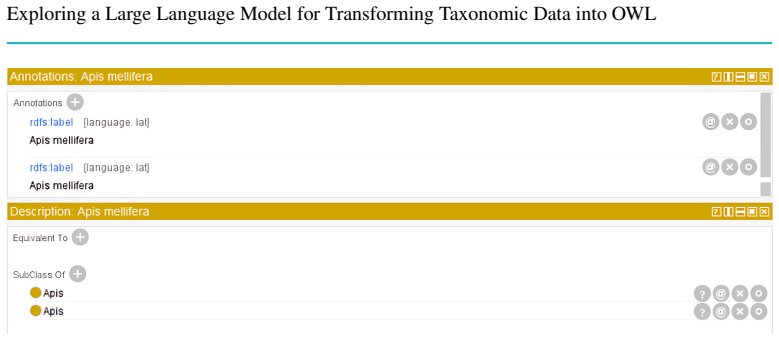
On the paper's own account, the central discovery is that an LLM-generated Python algorithm, named Taxonomy OWLizer, can act as a reliable transformer of taxonomic data into OWL, solving the scalability failure of the direct-chatbot approach. Given a list of species names, the script fetches the GBIF classification for each name, checks whether the name is accepted or a synonym, accumulates each unique taxon once, and writes OWL/XML in which every class carries a GBIF URI and an RDF label, with higher taxonomic levels defined once and reused through rdfs:subClassOf relationships. The demonstration run on 74 plant species completed in 2 minutes and 31 seconds, and inspection in Protégé showed a consistent hierarchy with no duplicated classes. The paper is candid that the script stumbles on typographical errors, one misspelled epithet in Semaprochilodus taeniurus crashed the run until ChatGPT corrected it, and that hybrid names like Triticum × Secale require manual pre-processing or an explicit 'is a hybrid of' modeling step.
Load-bearing premise
The load-bearing premise is that the OWL files the script emits faithfully encode the GBIF Backbone Taxonomy, since the authors verified the result only by visually inspecting the class hierarchy in Protégé and did not run a formal consistency check or compare each generated edge against the API's own parent records.
Editorial extensions
If this is right
- Ontology maintainers can re-run the pipeline against the latest GBIF Backbone Taxonomy to refresh species names and accepted-synonym mappings in a matter of minutes, replacing slow manual name verification.
- Species lists much larger than the 74-plant test become tractable: the script's per-name cost is dominated by one API call per name, so the approach scales with the length of the list rather than with the session limits and hallucination risk of a chatbot conversation.
- Deprecated and regional names no longer need to be resolved by hand: the algorithm's synonym check automatically swaps names like Prochilodus cearensis for their current GBIF-accepted equivalents in the generated ontology.
- Hybrid taxa require explicit ontological handling: the paper models them with an 'is a hybrid of' object property and warns that hybrid name formatting must be normalized to one of the formats the GBIF API accepts.
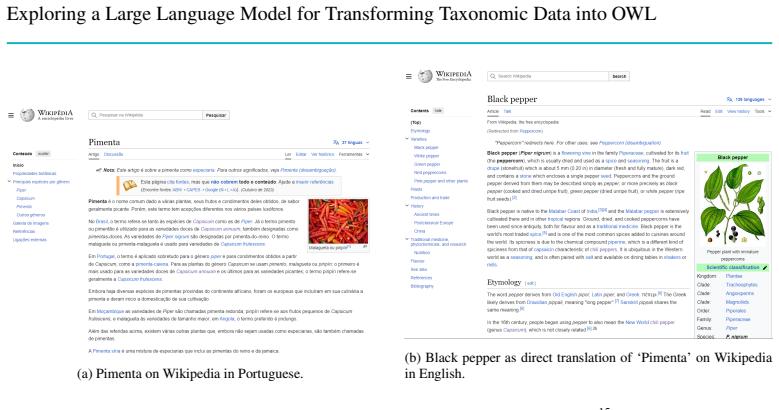
- Integrating the generated OWL into APTO lets product types be tied to biological species through 'member of taxon' restrictions, which the paper uses to disentangle region-specific terms such as Brazilian 'Pimenta' (chili pepper) from 'black pepper' (Piper nigrum).
Reading between the lines
- Inference: Because the paper's validation is visual inspection in Protégé, a stronger test of the central claim would be to run each generated file through an OWL reasoner and to compare every subClassOf edge against the parent records returned by the GBIF API; the paper does not report such a check.
- Inference: The pipeline's dependence on GBIF's URL scheme and API shape is incidental, so the same script structure should transfer to other taxonomic backbones such as NCBI Taxonomy or the World Register of Marine Species; a cross-backbone test would show whether the approach generalizes beyond agriculture.
- Inference: The typo-induced failure suggests an easy robustness upgrade the paper does not implement: preprocessing input names by lowercasing epithets, stripping authority strings, and fuzzy-matching against GBIF's name-usage search, which would remove the one documented source of silent failure.
- Inference: The 2.5-minute runtime for 74 species is not a controlled benchmark but a single demonstration against API latency; a fair comparison of the two approaches would need matched network conditions and repeated runs, and any deployment should expect throughput to vary with GBIF rate limits.
Signed reviews
Editorial analysis
A structured set of objections, weighed in public.
Referee Report
Summary. The paper investigates using ChatGPT-4 to convert taxonomic data from the GBIF Backbone Taxonomy API into OWL for the Organism module of the Agricultural Product Types Ontology (APTO). Two approaches are compared: a BrowserOp plugin-based chat workflow (Approach 1) and a ChatGPT-generated Python script called Taxonomy OWLizer (Approach 2). Approach 1 is reported to suffer from scalability and reproducibility problems, while Approach 2 processed a list of 74 plant species in about 2.5 minutes, with one hybrid species (Triticum × Secale) excluded. The authors conclude that combining ChatGPT for name validation with a scripted pipeline is a viable workflow, and they discuss ontology modeling lessons around synonyms, hybrids, and culturally specific terms such as 'Pimenta' and 'Cheiro verde'. The paper releases its data, code, and a web application.
Significance. If the empirical claims hold, the paper provides a useful, reproducible case study for semi-automated ontology population from authoritative taxonomic APIs, with practical lessons about LLM reliability, typo handling, hybrid name formatting, and the need for human oversight. The authors' transparency about the acknowledged Euterpe edulis misidentification and the non-reproducibility of Approach 1 is commendable, and the release of the script and data on Zenodo supports reuse. The main limitation is that the central correctness claim for the 74-species output is not directly verified, so the significance currently rests on an inference from a smaller, separately inspected example.
major comments (2)
- [§6.1.1 and §6.1.2] The correctness half of the central claim is not established for plantae.xml. Section 6.1.1 states that 'subsequent inspection of this file in Protégé revealed a well-structured class hierarchy' (Fig. 4), but that file is the output of the 14-animal example in Listing 5, not the 74-species plantae.xml. Section 6.1.2 reports only that the algorithm generated OWL code for nearly all listed species in 2 minutes 31 seconds; no programmatic check, reasoner run, or even visual inspection of plantae.xml is reported. Given the failure modes the paper itself documents (Triticum × Secale silently excluded, Euterpe edulis misidentified by ChatGPT, and the possibility of genus-level fuzzy matches or retained synonym parent edges in validate_accepted_name), the abstract and Section 8 claim that Approach 2 maintains 'consistent class-subclass relationships' over the 74-species list is unsupported. Please add a verification of plantae.xml (e.g., check every rdfs:subClassOf edge against GBIF parent-child relations, confirm each usage key resolves to the expected taxon, assert no duplicate class IRIs, and confirm the species count matches inputs) or explicitly restrict the correctness claim to the inspected animal example and report the hybrid exclusion as a known failure.
- [Abstract and §8 vs §6.1.2] The abstract and Section 8 state that Approach 2 'successfully handled a list of 74 plant species,' but Section 6.1.2 says the algorithm generated OWL code for 'nearly all the listed species (except for Triticum x Secale).' This is a factual discrepancy in the paper's headline claim. Please either revise the abstract and conclusions to state 73 of 74 species, or add handling for the hybrid name and then report 74 of 74.
minor comments (6)
- [§5.2 and §6.1.2] The scalability comparison rests on single runs with no repetition or variance reporting: 37 seconds for one species, 2 minutes 5 seconds for three species (Approach 1, §5.2), and 2 minutes 31 seconds for 74 species (Approach 2, §6.1.2). Because both API latency and ChatGPT generation are stochastic, the precise timings are anecdotal; the qualitative direction is likely robust, but the paper should either report repeated runs or frame the timing explicitly as an illustrative observation.
- [§6.1.2] The recommendation to use ChatGPT to pre-verify species names is undermined by the Euterpe edulis misidentification reported in the same section; please add a caveat that ChatGPT's internal-knowledge checks are unreliable and should be validated against an authoritative source such as GBIF or Plants of the World Online.
- [Table 3] Table 3 contains 'Semaprochilodus taeniunes' and 'Arapauma gigas', which appear to be typos for 'Semaprochilodus taeniurus' and 'Arapaima gigas'; the text later corrects the former, but the typos in the table may confuse readers.
- [§6.1.3, Listing 6] The term 'manualy' is a typo, and the is_a_hybrid_of object property is used in Listing 6 without a formal OWL declaration of the property, so the snippet is incomplete as a standalone OWL representation; please provide the property declaration or state that it is defined elsewhere in APTO.
- [Fig. 4 caption] The caption of Fig. 4 does not state which OWL file was visualized; adding this information would help readers connect the verification to the 14-animal list rather than to the 74-plant list.
- [§5.1] The claim that ChatGPT demonstrated 'advanced learning capabilities' from the single 'Colossoma mitrei' correction overstates the evidence; a single in-session correction is more plausibly explained by prompt context than by generalizable learning.
Circularity Check
No significant circularity: the empirical evaluation is anchored to an external benchmark (GBIF Backbone Taxonomy) and observable runtime measurements.
full rationale
The paper makes no closed-loop derivation in which an output is defined in terms of the thing it claims to predict. Approach 2 retrieves taxonomic classifications from the GBIF Backbone Taxonomy API, a source external to the authors' own modeling choices, and then mechanically converts those API responses into OWL class-subclass statements. The claimed successes, such as generating OWL code for 74 plant species in 2 minutes and 31 seconds while avoiding duplicated higher taxon levels, are directly checkable against the API output and the generated plantae.xml artifact; they do not depend on any fitted parameter or on a theorem imported from the authors' prior work. The paper's own reported failure cases, including the misclassification of Euterpe edulis as a synonym of Euterpe oleracea and the dropping of Triticum × Secale, further demonstrate that the results are not forced by construction: the pipeline is fallible and was evidently not tuned to reproduce its own conclusions. The reviewer-flagged concern that only the 14-animal example, rather than the 74-species output, was visually inspected in Protégé is a genuine validation gap, but it is a correctness-risk issue, not a circularity issue. Similarly, the dependence on ChatGPT to generate and debug the Python script is a reproducibility and trust concern, but the resulting OWL content is sourced from the external GBIF API rather than from an assumption equivalent to the paper's conclusion. No self-citation is load-bearing: the only self-referential artifacts are the authors' own APTO ontology, Zenodo deposits, and the Taxonomy OWLizer application, and none of these is invoked as a substitute for evidence about taxonomic correctness. Accordingly, no circular step meeting the required evidentiary standard was found.
Assumptions & free parameters
assumptions (3)
- domain assumption The GBIF Backbone Taxonomy is an authoritative source for accepted scientific names and synonyms for the agricultural species in APTO.
- domain assumption A seven-tier hierarchy (kingdom, phylum, class, order, family, genus, species) is the correct structure for the Organism module.
- domain assumption rdfs:subClassOf relationships derived from the GBIF parent-child taxon pairs preserve the intended biological classification semantics.
invented entities (1)
-
is_a_hybrid_of object property
Cite this review
Pith. "Pith review of Exploring a Large Language Model for Transforming Taxonomic Data into OWL: Lessons Learned and Implications for Ontology Development." pith.science (2026). https://pith.science/paper/JAO4PF7E
@misc{pith2026250418651,
  author       = {Pith},
  title        = {Pith review of: Exploring a Large Language Model for Transforming Taxonomic Data into OWL: Lessons Learned and Implications for Ontology Development},
  year         = {2026},
  howpublished = {\url{https://pith.science/paper/JAO4PF7E}},
  note         = {Machine review of arXiv:2504.18651}
}
read the original abstract
Managing scientific names in ontologies that represent species taxonomies is challenging due to the ever-evolving nature of these taxonomies. Manually maintaining these names becomes increasingly difficult when dealing with thousands of scientific names. To address this issue, this paper investigates the use of ChatGPT-4 to automate the development of the :Organism module in the Agricultural Product Types Ontology (APTO) for species classification. Our methodology involved leveraging ChatGPT-4 to extract data from the GBIF Backbone API and generate OWL files for further integration in APTO. Two alternative approaches were explored: (1) issuing a series of prompts for ChatGPT-4 to execute tasks via the BrowserOP plugin and (2) directing ChatGPT-4 to design a Python algorithm to perform analogous tasks. Both approaches rely on a prompting method where we provide instructions, context, input data, and an output indicator. The first approach showed scalability limitations, while the second approach used the Python algorithm to overcome these challenges, but it struggled with typographical errors in data handling. This study highlights the potential of Large language models like ChatGPT-4 to streamline the management of species names in ontologies. Despite certain limitations, these tools offer promising advancements in automating taxonomy-related tasks and improving the efficiency of ontology development.
Figures


Figures from the paper (3 more)


Reference graph
Works this paper leans on
-
[1]
Formal contexts in ontologies,
S. Yu, X. Youming, and Z. Li, “Formal contexts in ontologies,” in 2011 6th International Conference on Computer Science and Education (ICCSE), 2011, pp. 214–217
work page 2011
-
[2]
Knowledge representation with ontology tools & methodology,
J. Sarika and M. Sanju, “Knowledge representation with ontology tools & methodology,” International Journal of Computer Applications, pp. 1–5, 2014
work page 2014
-
[3]
An ontology-based framework for heterogeneous data sources integration,
V . M. P. Vidal, J. a. C. Pinheiro, E. R. Sacramento, J. A. Fernandes De Mac ˆedo, and B. F. L ´oscio, “An ontology-based framework for heterogeneous data sources integration,”Revista de Inform´ atica Te´ orica e Aplicada, vol. 16, no. 2, pp. 61–64, Mar. 2010. [Online]. Available: https://seer.ufrgs.br/rita/article/view/rita v16 n2 p61
work page 2010
-
[4]
E. Femi Aminu, I. O. Oyefolahan, M. Bashir Abdullahi, and M. T. Salaudeen, “A review on ontology development methodologies for developing ontological knowledge representation systems for various domains,” International Journal of Information Engineering and Electronic Business, vol. 12, no. 2, p. 28–39, Apr. 2020
work page 2020
-
[5]
M. L. D. A. Campos, M. L. M. Campos, A. M. R. D ´avila, H. E. Gomes, L. M. Campos, and L. Lira, “Methodological aspects concerning the reuse of ontologies: a study based on genomic annotations in the domain of trypanosomatides,” RECIIS, vol. 3, no. 1, p. 243 /257, Mar. 2009. [Online]. Available: https://www.reciis.icict.fiocruz.br/index.php/reciis/article...
work page 2009
-
[6]
Ontological research and its applications to the biomed- ical domain,
M. E. Ruiz, O. Bodenreider, E. Little, and P. Srinivasan, “Ontological research and its applications to the biomed- ical domain,” Proceedings of the American Society for Information Science and Technology , vol. 42, no. 1, p. meet.14504201198, Jan. 2006
work page 2006
-
[7]
Gillott, Taxonomy and Systematics
C. Gillott, Taxonomy and Systematics. Dordrecht: Springer Netherlands, 1995, p. 91–112. [Online]. Available: http://link.springer.com/10.1007/978-94-017-4380-8 4
-
[8]
Advances in plant taxonomy and systematics,
L. Peruzzi, “Advances in plant taxonomy and systematics,” Biology, vol. 12, no. 4, p. 570, Apr. 2023. [Online]. Available: https://www.mdpi.com/2079-7737/12/4/570
work page 2023
Show all 73 references
-
[9]
Are the linnean and phylogenetic nomenclatural systems combinable? recommendations for biological nomenclature,
M. Kuntner and I. Agnarsson, “Are the linnean and phylogenetic nomenclatural systems combinable? recommendations for biological nomenclature,” Systematic Biology , vol. 55, no. 5, p. 774–784, Oct. 2006. [Online]. Available: https://academic.oup.com/sysbio/article/55/5/774/1664874
2006
-
[10]
Rouhan and M
G. Rouhan and M. Gaudeul, Plant Taxonomy: A Historical Perspective, Current Challenges, and Perspectives. New York, NY: Springer US, 2021, vol. 2222, p. 1–38. [Online]. Available: https: //link.springer.com/10.1007/978-1-0716-0997-2 1
2021 doi
-
[11]
Food and A. O. of the United Nations, AGROVOC 4: AGROVOC editorial guidelines. FAO, Feb. 2023. [Online]. Available: http://www.fao.org/documents/card/en/c/cc0647en
2023
-
[12]
Streamlining foodon seafood nomenclature using a semi-automated robot template-driven approach,
A. Sehar, D. M. Dooley, A. Windsor, and W. L. Hsiao, “Streamlining foodon seafood nomenclature using a semi-automated robot template-driven approach,” in Proceedings of the International Food Ontology Workshop (IFOW), 2021. [Online]. Available: https://ceur-ws.org/V ol-2969/pa...
2021
-
[13]
Ontology-grounded automatic knowledge graph construction by llm under wikidata schema,
X. Feng, X. Wu, and H. Meng, “Ontology-grounded automatic knowledge graph construction by llm under wikidata schema,” in Proceedings of the KDD Workshop on Human-Interpretable AI 2024 (HI-AI 2024), co-located with 30th ACM SIGKDD Conference on Knowledge Discovery and Data Mini...
2024
-
[14]
M. J. Saeedizade and E. Blomqvist, Navigating Ontology Development with Large Language Models . Cham: Springer Nature Switzerland, 2024, vol. 14664, p. 143–161. [Online]. Available: https: //link.springer.com/10.1007/978-3-031-60626-7 8
2024 doi
-
[15]
Large language models for scholarly ontology generation: An extensive analysis in the engineering field,
T. Aggarwal, A. Salatino, F. Osborne, and E. Motta, “Large language models for scholarly ontology generation: An extensive analysis in the engineering field,” arXiv, 2024. [Online]. Available: https://arxiv.org/abs/2412.08258 26 Preprint submitted to Data Intelligence Explorin...
2024 arXiv
-
[16]
Can large language models augment a biomedical ontology with missing concepts and relations?
A. Zaitoun, T. Sagi, S. Wilk, and M. Peleg, “Can large language models augment a biomedical ontology with missing concepts and relations?” arXiv, 2023. [Online]. Available: https://arxiv.org/abs/2311.06858
2023 arXiv
-
[17]
Enhancing knowledge graph construction using large language models,
M. Trajanoska, R. Stojanov, and D. Trajanov, “Enhancing knowledge graph construction using large language models,” arXiv, 2023. [Online]. Available: https://arxiv.org/abs/2305.04676
2023 arXiv
-
[18]
Generating e-commerce related knowledge graph from text: Open challenges and early results using llms,
J. C. dos Reis and A. G. Regino, “Generating e-commerce related knowledge graph from text: Open challenges and early results using llms,” in Joint Proceedings of the 3rd International Workshop on Knowledge Graph Generation from Text (TEXT2KG) and Data Quality meets Machine Lea...
2024
-
[19]
Towards complex ontology alignment using large language models,
R. Amini, S. S. Norouzi, P. Hitzler, and R. Amini, “Towards complex ontology alignment using large language models,” arXiv, 2024. [Online]. Available: https://arxiv.org/abs/2404.10329
2024 arXiv
-
[20]
Mappergpt: Large language models for linking and mapping entities,
N. Matentzoglu, J. H. Caufield, H. B. Hegde, J. T. Reese, S. Moxon, H. Kim, N. L. Harris, M. A. Haendel, and C. J. Mungall, “Mappergpt: Large language models for linking and mapping entities,” arXiv, 2023. [Online]. Available: https://arxiv.org/abs/2310.03666
2023 arXiv
-
[21]
Ontology extension by online clustering with large language model agents,
G. Wu, C. Ling, I. Graetz, and L. Zhao, “Ontology extension by online clustering with large language model agents,” Frontiers in Big Data , vol. 7, p. 1463543, Oct. 2024. [Online]. Available: https://www.frontiersin.org/articles/10.3389/fdata.2024.1463543/full
2024
-
[22]
Exploring the utility of large language models for achieving semantic interoperability in data ecosystems,
L. van Hees, “Exploring the utility of large language models for achieving semantic interoperability in data ecosystems,” Master Thesis, Utrecht University, 2024. [Online]. Available: https: //studenttheses.uu.nl/handle/20. 500.12932/48039
2024
-
[23]
Automated mining of structured knowledge from text in the era of large language models,
Y . Zhang, M. Zhong, S. Ouyang, Y . Jiao, S. Zhou, L. Ding, and J. Han, “Automated mining of structured knowledge from text in the era of large language models,” in Proceedings of the 30th ACM SIGKDD Conference on Knowledge Discovery and Data Mining , ser. KDD ’24. New York, N...
2024
-
[24]
Construction of knowledge graphs: Current state and challenges,
M. Hofer, D. Obraczka, A. Saeedi, H. K ¨opcke, and E. Rahm, “Construction of knowledge graphs: Current state and challenges,” Information, vol. 15, no. 8, p. 509, Aug. 2024. [Online]. Available: https://www.mdpi.com/2078-2489/15/8/509
2024
-
[25]
Knowledge Graphs for the Life Sciences: Recent Developments, Challenges and Opportunities,
J. Chen, H. Dong, J. Hastings, E. Jim ´enez-Ruiz, V . L ´opez, P. Monnin, C. Pesquita, P. ˇSkoda, and V . Tamma, “Knowledge Graphs for the Life Sciences: Recent Developments, Challenges and Opportunities,” Transactions on Graph Data and Knowledge , vol. 1, no. 1, pp. 5:1–5:33,...
2023 doi
-
[26]
Llm-driven ontology evaluation: Verifying ontology restrictions with chat- gpt,
S. Tsaneva, S. Vasic, and M. Sabou, “Llm-driven ontology evaluation: Verifying ontology restrictions with chat- gpt,” inData Quality meets Machine Learning and Knowledge Graphs: DQMLKG Workshop at ESWC 2024, 2024, in press
2024
-
[27]
Exploring large language models for ontology learning,
O. Perera and J. Liu, “Exploring large language models for ontology learning,” Issues in Information Systems , vol. 25, no. 4, pp. 299–310, 2024. [Online]. Available: https://doi.org/10.48009/4 iis 2024 124
2024 doi
-
[28]
Large language models for the creation and use of semantic ontologies in buildings: Requirements and challenges,
O. B. Mulayim, L. Paul, M. Pritoni, A. K. Prakash, M. Sudarshan, and G. Fierro, “Large language models for the creation and use of semantic ontologies in buildings: Requirements and challenges,” in Proceedings of the 11th ACM International Conference on Systems for Energy-E ff...
2024
-
[29]
Ontologies in the era of large language models – a perspective,
F. Neuhaus, “Ontologies in the era of large language models – a perspective,” Applied Ontology, vol. 18, no. 4, p. 399–407, Dec. 2023. [Online]. Available: https://journals.sagepub.com/doi/full/10.3233/AO-230072
2023 doi
-
[30]
Agrovoc: The linked data concept hub for food and agriculture,
I. Subirats-Coll, K. Kolshus, A. Turbati, A. Stellato, E. Mietzsch, D. Martini, and M. Zeng, “Agrovoc: The linked data concept hub for food and agriculture,” Computers and Electronics in Agriculture, vol. 196, p. 105965, 2022
2022
-
[31]
Embrapa’s contributions to integrate brazilian agricultural vocabularies: Agrotermos in AgroPortal,
M. Ambrosio Telles, C. Jonquet, B. Teixeira de Almeida, J. Daltio, C. Maki Takemura, L. Henrique Mendonc ¸a de Oliveira, and M. d. C. F. Alencar, “Embrapa’s contributions to integrate brazilian agricultural vocabularies: Agrotermos in AgroPortal,” in CEUR Workshop Proceedings,...
2024
-
[32]
The agrovoc linked dataset,
C. Caracciolo, A. Stellato, A. Morshed, G. Johannsen, S. Rajbhandari, Y . Jaques, and J. Keizer, “The agrovoc linked dataset,” Semantic Web, vol. 4, no. 3, p. 341–348, 2013
2013
-
[33]
Pierozzi J ´unior, M
I. Pierozzi J ´unior, M. C. Visoli, M. I. F. Souza, L. M. S. Cunha, I. Vacari, and T. Z. Torres, Engenharia da informa¸ c˜ ao: contribui¸ c˜ oes para a agricultura digital. Bras ´ılia, DF: Embrapa, 2020, ch. 8, pp. 192–217. [Online]. Available: http://www.alice.cnptia.embrapa....
2020
-
[35]
Sabio: Systematic approach for building ontologies,
R. d. A. Falbo, “Sabio: Systematic approach for building ontologies,” Onto. Com/odise@ Fois, vol. 1301, 2014
2014
-
[36]
Ontologies for knowledge graphs?
M. Kr ¨otzsch, “Ontologies for knowledge graphs?” in Proceedings of the 30th International Workshop 27 Preprint submitted to Data Intelligence Exploring a Large Language Model for Transforming Taxonomic Data into OWL on Description Logics (DL 2017) , ser. CEUR Workshop Proceed...
2017
-
[37]
Kr ¨otzsch and V
M. Kr ¨otzsch and V . Thost,Ontologies for Knowledge Graphs: Breaking the Rules. Cham: Springer International Publishing, 2016, vol. 9981, p. 376–392. [Online]. Available: https://link.springer.com/10.1007/978-3-319-46523 -4 23
2016 doi
-
[38]
Mihindukulasooriya, S
N. Mihindukulasooriya, S. Tiwari, C. F. Enguix, and K. Lata, Text2KGBench: A Benchmark for Ontology-Driven Knowledge Graph Generation from Text . Cham: Springer Nature Switzerland, 2023, vol. 14266, p. 247–265. [Online]. Available: https://link.springer.com/10.1007/978-3-031-4...
2023 doi
-
[39]
Knowledge graphs,
A. Hogan, E. Blomqvist, M. Cochez, C. D’amato, G. D. Melo, C. Gutierrez, S. Kirrane, J. E. L. Gayo, R. Navigli, S. Neumaier, A.-C. N. Ngomo, A. Polleres, S. M. Rashid, A. Rula, L. Schmelzeisen, J. Sequeda, S. Staab, and A. Zimmermann, “Knowledge graphs,” ACM Comput. Surv., vol...
2021 doi
-
[40]
Unifying large language models and knowledge graphs: A roadmap,
S. Pan, L. Luo, Y . Wang, C. Chen, J. Wang, and X. Wu, “Unifying large language models and knowledge graphs: A roadmap,” IEEE Transactions on Knowledge and Data Engineering, pp. 1–20, 2024
2024
-
[41]
Building knowledge graph using pre-trained language model for learning entity-aware relationships,
A. Kumar, A. Pandey, R. Gadia, and M. Mishra, “Building knowledge graph using pre-trained language model for learning entity-aware relationships,” in 2020 IEEE International Conference on Computing, Power and Communi- cation Technologies (GUCON), 2020, pp. 310–315
2020
-
[42]
Comet: Commonsense transformers for automatic knowledge graph construction,
A. Bosselut, H. Rashkin, M. Sap, C. Malaviya, A. Celikyilmaz, and Y . Choi, “Comet: Commonsense transformers for automatic knowledge graph construction,” in Proceedings of the 57th Annual Meeting of the Association for Computational Linguistics . Florence, Italy: Association f...
2019
-
[43]
Cepea agricultural prices,
Center for Advanced Studies on Applied Economics (CEPEA), “Cepea agricultural prices,” https://cepea.esalq.usp.br/en, 2024, accessed: 2024-06-13
2024
-
[44]
Ipeadata: indicadores macroeconomicos,
Instituto de Pesquisa Econ ˆomica Aplicada (IPEA), “Ipeadata: indicadores macroeconomicos,” http://www.ipeadata.gov.br/Default.aspx, 2024, accessed: 2024-06-13
2024
-
[45]
Conab - prec ¸os agropecu ´arios,
Companhia Nacional de Abastecimento (CONAB), “Conab - prec ¸os agropecu ´arios,” https://www.conab.gov.br/info-agro/precos, 2024, accessed: 2024-06-13
2024
-
[46]
Gbif home page,
Global Biodiversity Information Facility, “Gbif home page,” https: //www.gbif.org/, 2024, accessed: 28-04-2024
2024
-
[47]
Unified and pluralistic ideals for data sharing and reuse in biodiversity,
B. Sterner, S. Elliott, E. E. Gilbert, and N. M. Franz, “Unified and pluralistic ideals for data sharing and reuse in biodiversity,” Database, vol. 2023, p. baad048, Jul. 2023. [Online]. Available: https://academic.oup.com/database/article/doi/10.1093/database/baad048/7226274
2023 doi
-
[48]
Big data for biodiversity: Global biodiversity information facility surpasses one billion records,
Convention on Biological Diversity and Global Biodiversity Information Facility, “Big data for biodiversity: Global biodiversity information facility surpasses one billion records,” https://www.cbd.int/doc/press/2018/pr-2018-07-09- cbd-gbif-en.pdf, 2018, accessed: 28-04-2024
2018
-
[49]
Gbif backbone taxonomy,
GBIF Secretariat, “Gbif backbone taxonomy,” https: //doi.org/10.15468/39omei, 2023, accessed via GBIF.org on 2024-03-04
2023 doi
-
[50]
Gbif api reference,
——, “Gbif api reference,” https: //techdocs.gbif.org/en/openapi/, accessed via GBIF.org on 2024-03-04
2024
-
[51]
Towards a global list of accepted species vi: The catalogue of life checklist,
D. Hobern, S. K. Barik, L. Christidis, S. T.Garnett, P. Kirk, T. M. Orrell, T. Pape, R. L. Pyle, K. R. Thiele, F. E. Zachos, and O. B ´anki, “Towards a global list of accepted species vi: The catalogue of life checklist,” Organisms Diversity and Evolution , vol. 21, no. 4, p. ...
2021 doi
-
[52]
Draft biocode (1997): The prospective international rules for the scientific names of organisms,
W. Greuter, D. L. Hawksworth, J. McNeill, M. A. Mayo, A. Minelli, P. H. A. Sneath, B. J. Tindall, P. Trehane, and P. Tubbs, “Draft biocode (1997): The prospective international rules for the scientific names of organisms,”Taxon, vol. 47, no. 1, pp. 127–150, 1998
1997
-
[53]
Twenty-First Century Biological Nomenclature—The Enduring Power of Names,
J. E. Winston, “Twenty-First Century Biological Nomenclature—The Enduring Power of Names,” Integrative and Comparative Biology, vol. 58, no. 6, pp. 1122–1131, 09 2018
2018
-
[54]
Species and classification,
S. Okasha, “Species and classification,” in Philosophy of Biology: A Very Short Introduction. Oxford University Press, 11 2019
2019
-
[55]
Prompt engineering with chatgpt: A guide for academic writers,
L. Giray, “Prompt engineering with chatgpt: A guide for academic writers,” Annals of Biomedical Engineering , vol. 51, no. 12, p. 2629–2633, Dec. 2023
2023
-
[56]
Meet browserop: our chatgpt plugin that lets you search up-to-date information smoothly and e fficiently,
OpenAI, “Meet browserop: our chatgpt plugin that lets you search up-to-date information smoothly and e fficiently,” https: //community.openai.com/t/meet-browserop-our-chatgpt-plugin-that-lets-you-search-up-to- date-information-smoothly-and-efficiently/304018, 2023, accessed: 0...
2023
-
[57]
W. Ride, H. Cogger, C. Dupuis, O. Kraus, A. Minelli, F. Thompson, and P. Tubbs, Eds., International Code of Zoological Nomenclature, 4th ed. London: The International Trust for Zoological Nomenclature, 2012. [Online]. Available: https://www.iczn.org/the-code/the-code-online/
2012
-
[58]
N. J. Turland, J. H. Wiersema, F. R. Barrie, W. Greuter, D. L. Hawksworth, P. S. Herendeen, S. Knapp, W.-H. Kusber, D.-Z. Li, K. Marhold, T. W. May, J. McNeill, A. M. Monro, J. Prado, M. J. Price, and G. F. Smith, 28 Preprint submitted to Data Intelligence Exploring a Large La...
2018
-
[59]
Interactive natural language processing,
Z. Wang, G. Zhang, K. Yang, N. Shi, W. Zhou, S. Hao, G. Xiong, Y . Li, M. Y . Sim, X. Chen, Q. Zhu, Z. Yang, A. Nik, Q. Liu, C. Lin, S. Wang, R. Liu, W. Chen, K. Xu, D. Liu, Y . Guo, and J. Fu, “Interactive natural language processing,” 2023. [Online]. Available: https://arxiv...
2023 arXiv
-
[60]
The review of natural language processing applications with emphasis on machine learning implementations,
T. P. Nagarhalli, S. Mhatre, S. Patil, and P. Patil, “The review of natural language processing applications with emphasis on machine learning implementations,” in 2022 International Conference on Electronics and Renewable Systems (ICEARS) . Tuticorin, India: IEEE, Mar. 2022, ...
2022
-
[61]
A review of the trends and challenges in adopting natural language processing methods for education feedback analysis,
T. Shaik, X. Tao, Y . Li, C. Dann, J. McDonald, P. Redmond, and L. Galligan, “A review of the trends and challenges in adopting natural language processing methods for education feedback analysis,” IEEE Access , vol. 10, p. 56720–56739, 2022. [Online]. Available: https://ieeex...
2022
-
[62]
Feedback generation through artificial intelligence,
O. Bulut and T. Wongvorachan, “Feedback generation through artificial intelligence,” The Open/Technology in Education, Society, and Scholarship Association Conference, vol. 2, no. 1, p. 1–9, Dec. 2022. [Online]. Available: https://conference.otessa.org/index.php/conference/art...
2022
-
[63]
Plants of the World Online,
Royal Botanic Gardens, Kew, “Plants of the World Online,” http: //www.plantsoftheworldonline.org /, 2024, retrieved 14 March 2024
2024
-
[64]
Chapter H: Names of Hybrids,
N. J. Turland, J. H. Wiersema, F. R. Barrie, W. Greuter, D. L. Hawksworth, P. S. Herendeen, S. Knapp, W.-H. Kusber, D.-Z. Li, K. Marhold, T. W. May, J. McNeill, A. M. Monro, J. Prado, M. J. Price, and G. F. Smith, “Chapter H: Names of Hybrids,” in International Code of Nomencl...
2019
-
[65]
Food and Agriculture Organization of the United Nations, 2011, created 11 /20/11, last modified 8 /28/23
Food and Agriculture Organization of the United Nations, “Pepper,” in Agrovoc. Food and Agriculture Organization of the United Nations, 2011, created 11 /20/11, last modified 8 /28/23. [Online]. Available: http://aims.fao.org/aos/agrovoc/c 25495
2011
-
[66]
Pimenta,
Embrapa, “Pimenta,” in Agrotermos: Espa¸ co conceitual da Embrapa . Embrapa, 2017. [Online]. Available: https://sistemas.sede.embrapa.br/agrotermos/resources/bcf87c03ae11d3d7a749a75c87b4649a
2017
-
[67]
Chillies,
Food and A. O. of the United Nations, “Chillies,” in Agrovoc. FAO, 2012, accessed: 2024-08-18. [Online]. Available: http://aims.fao.org/aos/agrovoc/c 9795
2012
-
[68]
Condimento picante,
Embrapa, “Condimento picante,” in Agrotermos: Espa¸ co conceitual da Embrapa. Embrapa, 2017, accessed: 2024-08-18. [Online]. Available: https: //sistemas.sede.embrapa.br/agrotermos/resources/22538a47e4cb9e2ca6a5 ed5d3fc59ce3
2017
-
[69]
Minist ´erio da Sa ´ude
Brasil. Minist ´erio da Sa ´ude. Secretaria de Pol ´ıticas de Sa ´ude. Coordenac ¸˜ao-Geral da Pol ´ıtica de Alimentac ¸˜ao e Nutric ¸˜ao, Alimentos regionais brasileiros, ser. S´erie F. Comunicac ¸˜ao e Educac ¸˜ao em Sa´ude. Bras ´ılia: Minist ´erio da Sa´ude, 2002, no. 21
2002
-
[70]
Cheiro-verde ´e coentro? entenda a combinac ¸˜ao de temperos,
G. Menezes, “Cheiro-verde ´e coentro? entenda a combinac ¸˜ao de temperos,” September 2021. [Online]. Available: https://www.uol.com.br/nossa/noticias/redacao/2021/09/17/cheiro-verde-e-coentro-entenda-o-que-e-o-tempero.h tm?cmpid=copiaecola
2021
-
[71]
F. E. K ¨ohler, Petroselinum crispum. WikiMedia Commons, 1897. [Online]. Available: https: //commons.wikime dia.org/wiki/File:Petroselinum crispum - K%C3%B6hler%E2%80%93s Medizinal-Pflanzen-103.jpg
-
[72]
WikiMedia Commons, 1897
——, Coriandrum sativum. WikiMedia Commons, 1897. [Online]. Available: https: //commons.wikimedia.org/ wiki/File:Coriandrum sativum - K%C3%B6hler%E2%80%93s Medizinal-Pflanzen-193.jpg
-
[73]
C. A. M. Lindman, Allium schoenoprasum L. Stockholm: WikiMedia Commons, 1917–1926. [Online]. Available: https://commons.wikimedia.org/wiki/File:386 Allium schoenoprasum.jpg
1917
-
[74]
Cayngotau,
DXLINH, “Cayngotau,” 2022. [Online]. Available: https: //commons.wikimedia.org/wiki/File:Cayngotau.jpg 29 Preprint submitted to Data Intelligence Exploring a Large Language Model for Transforming Taxonomic Data into OWL Filipi Miranda Soares, M.Sc. (Knowledge Management), is a...
2011
Reviewed August 16, 2026 · model on record in the stance chip above.
Discussion (0). Continue with ORCID to comment.