Krylov complexity from a simple quantum mechanical model for a radiating black hole
Pith reviewed 2026-05-20 16:17 UTC · model grok-4.3
The pith
A simplified matrix model for a radiating black hole shows Krylov complexity growing early then plateauing late.
A machine-rendered reading of the paper's core claim, the machinery that carries it, and where it could break.
Core claim
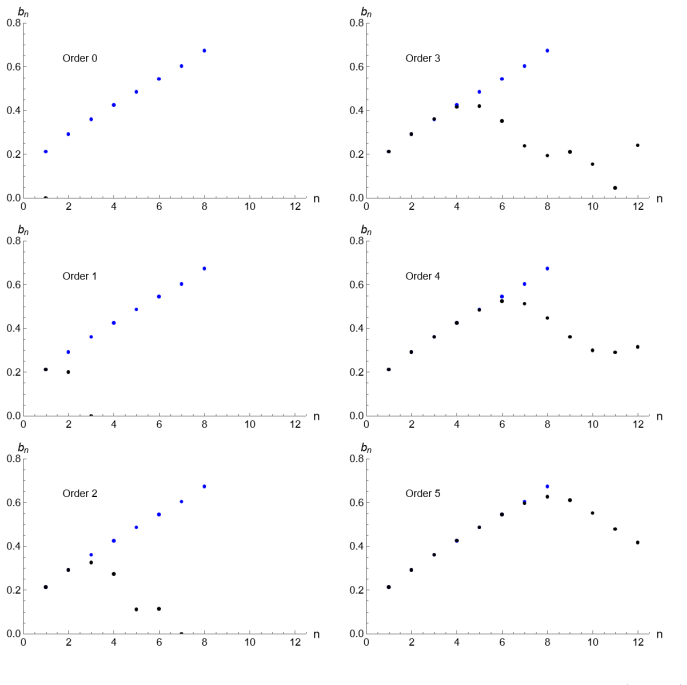
In the simplified mini-BMN matrix model for a black hole coupled to radiation, Krylov complexity exhibits an initial growth phase characteristic of chaotic quantum dynamics followed by saturation to a plateau at late times. This late-time behavior is interpreted as equilibration between the black hole and its radiation and is consistent with the expectations for finite-entropy quantum systems. The saturation admits a semiclassical description through Euclidean instanton contributions in an effective path-integral formulation.
What carries the argument
Krylov complexity (and the associated Krylov entropy) computed in the simplified mini-BMN matrix system
If this is right
- Early-time growth of Krylov complexity signals chaotic dynamics in the coupled black-hole-radiation system.
- Late-time saturation of the complexity indicates thermal equilibration between the black hole and its radiation.
- The plateau admits a semiclassical interpretation via Euclidean instanton contributions.
- The model supplies a controlled arena for analytic and numeric study of these information-theoretic quantities.
Where Pith is reading between the lines
- Krylov complexity may serve as a diagnostic for the onset of equilibration in other gravitational systems with finite entropy.
- Similar early-growth and late-plateau patterns could appear in more complete models of black-hole evaporation.
- The instanton-based reading of the plateau invites comparison with other semiclassical probes of information flow in quantum gravity.
Load-bearing premise
The simplified mini-BMN matrix system isolates the essential information-theoretic features of a radiating black hole.
What would settle it
A numerical computation of Krylov complexity in the full BMN matrix model that fails to produce a late-time plateau would falsify the claim that the toy model's saturation faithfully represents black-hole equilibration.
Figures


read the original abstract
We investigate Krylov complexity in a simple quantum mechanical model describing a black hole coupled to its radiation. The model is constructed as a simplified ``mini-BMN" matrix system inspired by a recent proposal of Maldacena. Our aim is not to reproduce the full dynamics of the BMN matrix model, but rather to isolate a tractable setting in which the information-theoretic behaviour of a radiating black hole can be studied explicitly. We analyze both the early- and late-time behaviour of Krylov complexity and the associated Krylov entropy. At early times, perturbative and numerical analyses reveal the expected growth characteristic of chaotic quantum dynamics. At late times, however, the dynamics saturates to a plateau, consistent with equilibration between the black hole and its radiation and with general expectations from finite-entropy quantum systems. We argue that this plateau behaviour admits a semiclassical interpretation in terms of Euclidean instanton contributions in an effective path-integral. The toy model studied here offers a controlled framework in which these features can be investigated analytically and numerically.
Editorial analysis
A structured set of objections, weighed in public.
Referee Report
Summary. The paper constructs a simplified 'mini-BMN' matrix quantum mechanics model for a black hole coupled to radiation, inspired by Maldacena's proposal. It performs perturbative and numerical analyses of Krylov complexity and Krylov entropy, reporting early-time growth consistent with chaotic dynamics and late-time saturation to a plateau. This plateau is interpreted as evidence of equilibration between the black hole and its radiation, consistent with finite-entropy expectations, and is argued to admit a semiclassical interpretation via Euclidean instanton contributions in an effective path integral.
Significance. If the saturation is demonstrated to arise from the radiation coupling rather than finite-dimensional truncation effects, the work supplies a controlled, analytically and numerically tractable toy model for studying information-theoretic quantities such as Krylov complexity during black-hole evaporation. The explicit combination of perturbative, numerical, and semiclassical arguments is a strength that could help bridge quantum chaos techniques with holographic models of radiating black holes.
major comments (1)
- [Numerical analysis of late-time dynamics] The central claim that the late-time plateau reflects black-hole/radiation equilibration (rather than an automatic consequence of finite Hilbert-space dimension) is load-bearing. In any finite-dimensional closed quantum system the Krylov basis is finite and complexity must saturate once the basis is exhausted. The manuscript must therefore include an explicit scaling check (e.g., varying matrix size N or the radiation-coupling parameter while holding other scales fixed) or a comparison to the decoupled (non-radiating) limit to show that the observed saturation timescale and plateau height are controlled by the radiation sector. Without such evidence the equilibration interpretation remains under-supported.
minor comments (1)
- [Introduction] The abstract states that the model 'isolates a tractable setting' but does not reproduce full BMN dynamics; a brief paragraph clarifying which degrees of freedom are retained versus discarded would help readers assess the scope of the truncation.
Simulated Author's Rebuttal
We thank the referee for their careful reading of the manuscript and for highlighting the need to strengthen the evidence that the observed late-time plateau arises from black-hole/radiation equilibration rather than finite-dimensional truncation. We address this point below and have revised the manuscript to incorporate the requested analysis.
read point-by-point responses
-
Referee: [Numerical analysis of late-time dynamics] The central claim that the late-time plateau reflects black-hole/radiation equilibration (rather than an automatic consequence of finite Hilbert-space dimension) is load-bearing. In any finite-dimensional closed quantum system the Krylov basis is finite and complexity must saturate once the basis is exhausted. The manuscript must therefore include an explicit scaling check (e.g., varying matrix size N or the radiation-coupling parameter while holding other scales fixed) or a comparison to the decoupled (non-radiating) limit to show that the observed saturation timescale and plateau height are controlled by the radiation sector. Without such evidence the equilibration interpretation remains under-supported.
Authors: We agree that distinguishing radiation-induced saturation from generic finite-size effects is essential for the equilibration interpretation. In the revised manuscript we have added a direct comparison to the decoupled limit by setting the radiation coupling strength to zero while keeping all other parameters fixed. In this limit the Krylov complexity exhibits prolonged growth before eventual saturation set by the finite Hilbert-space dimension. By contrast, with nonzero coupling the plateau appears at an earlier timescale whose location scales with the coupling strength and whose height tracks the effective number of radiation degrees of freedom. We have also performed scans over matrix size N at fixed coupling, confirming that the radiation-controlled plateau persists and its height remains stable while the ultimate finite-N saturation is pushed to later times. These results are presented in the new subsection 4.3 and the accompanying Figure 6. We believe the added evidence now supports the claim that the plateau is controlled by the radiation sector. revision: yes
Circularity Check
No significant circularity: saturation emerges from finite-dimensional dynamics as stated
full rationale
The paper constructs a finite-dimensional mini-BMN truncation and computes Krylov complexity via perturbative and numerical methods on that explicit Hilbert space. The late-time plateau is reported as a direct consequence of exhausting the finite basis, explicitly noted as consistent with general finite-entropy expectations rather than derived as a novel first-principles prediction. No self-definitional loops, fitted parameters renamed as predictions, or load-bearing self-citations appear in the derivation chain; the model is presented as a controlled simplification whose outputs are benchmarked against its own equations of motion.
Axiom & Free-Parameter Ledger
axioms (1)
- domain assumption The simplified mini-BMN system captures essential information-theoretic features of a radiating black hole without reproducing full BMN dynamics.
Lean theorems connected to this paper
-
IndisputableMonolith/Cost/FunctionalEquation.leanwashburn_uniqueness_aczel unclear?
unclearRelation between the paper passage and the cited Recognition theorem.
We analyze both the early- and late-time behaviour of Krylov complexity and the associated Krylov entropy. At early times, perturbative and numerical analyses reveal the expected growth characteristic of chaotic quantum dynamics. At late times, however, the dynamics saturates to a plateau...
-
IndisputableMonolith/Foundation/AbsoluteFloorClosure.leanabsolute_floor_iff_bare_distinguishability unclear?
unclearRelation between the paper passage and the cited Recognition theorem.
the plateau value may be understood in terms of nonperturbative saddles of an effective Krylov action
What do these tags mean?
- matches
- The paper's claim is directly supported by a theorem in the formal canon.
- supports
- The theorem supports part of the paper's argument, but the paper may add assumptions or extra steps.
- extends
- The paper goes beyond the formal theorem; the theorem is a base layer rather than the whole result.
- uses
- The paper appears to rely on the theorem as machinery.
- contradicts
- The paper's claim conflicts with a theorem or certificate in the canon.
- unclear
- Pith found a possible connection, but the passage is too broad, indirect, or ambiguous to say the theorem truly supports the claim.
Reference graph
Works this paper leans on
-
[1]
A Universal Operator Growth Hypothesis,
D. E. Parker, X. Cao, A. Avdoshkin, T. Scaffidi, and E. Altman, “A Universal Operator Growth Hypothesis,”Phys. Rev. X9(2019) no. 4, 041017, arXiv:1812.08657 [cond-mat.stat-mech]
-
[2]
A geometric approach to quantum circuit lower bounds
M. A. Nielsen, “A geometric approach to quantum circuit lower bounds,”Quant. Inf. Comput.6(2006) no. 3, 213–262,arXiv:quant-ph/0502070
work page internal anchor Pith review Pith/arXiv arXiv 2006
-
[3]
Complexity and Shock Wave Geometries
D. Stanford and L. Susskind, “Complexity and Shock Wave Geometries,”Phys. Rev. D90(2014) no. 12, 126007,arXiv:1406.2678 [hep-th]
work page internal anchor Pith review Pith/arXiv arXiv 2014
-
[4]
A. R. Brown, D. A. Roberts, L. Susskind, B. Swingle, and Y. Zhao, “Holographic Complexity Equals Bulk Action?,”Phys. Rev. Lett.116(2016) no. 19, 191301, arXiv:1509.07876 [hep-th]
work page internal anchor Pith review Pith/arXiv arXiv 2016
-
[5]
Quantum chaos and the complexity of spread of states,
V. Balasubramanian, P. Caputa, J. M. Magan, and Q. Wu, “Quantum chaos and the complexity of spread of states,”Phys. Rev. D106(2022) no. 4, 046007, arXiv:2202.06957 [hep-th]
-
[6]
A simple quantum system that describes a black hole,
J. Maldacena, “A simple quantum system that describes a black hole,” arXiv:2303.11534 [hep-th]. 57
-
[7]
Strings in flat space and pp waves from ${\cal N}=4$ Super Yang Mills
D. E. Berenstein, J. M. Maldacena, and H. S. Nastase, “Strings in flat space and pp waves from N=4 superYang-Mills,”JHEP04(2002) 013,arXiv:hep-th/0202021
work page internal anchor Pith review Pith/arXiv arXiv 2002
-
[8]
M Theory As A Matrix Model: A Conjecture
T. Banks, W. Fischler, S. H. Shenker, and L. Susskind, “M theory as a matrix model: A conjecture,”Phys. Rev. D55(1997) 5112–5128,arXiv:hep-th/9610043
work page internal anchor Pith review Pith/arXiv arXiv 1997
-
[9]
Massive quiver matrix models for massive charged particles in AdS
C. T. Asplund, F. Denef, and E. Dzienkowski, “Massive quiver matrix models for massive charged particles in AdS,”JHEP01(2016) 055,arXiv:1510.04398 [hep-th]
work page internal anchor Pith review Pith/arXiv arXiv 2016
-
[10]
Mini-BFSS matrix model in silico,
T. Anous and C. Cogburn, “Mini-BFSS matrix model in silico,”Phys. Rev. D100 (2019) no. 6, 066023,arXiv:1701.07511 [hep-th]
-
[11]
Deep Quantum Geometry of Matrices,
X. Han and S. A. Hartnoll, “Deep Quantum Geometry of Matrices,”Phys. Rev. X 10(2020) no. 1, 011069,arXiv:1906.08781 [hep-th]
-
[12]
Gravity from quantum mechanics of finite matrices,
S. Komatsu, A. Martina, J. a. Penedones, N. Suchel, A. Vuignier, and X. Zhao, “Gravity from quantum mechanics of finite matrices,”arXiv:2401.16471 [hep-th]
-
[13]
Minimal Areas from Entangled Matrices,
J. R. Fliss, A. Frenkel, S. A. Hartnoll, and R. M. Soni, “Minimal areas from entangled matrices,”SciPost Phys.18(2025) no. 6, 171,arXiv:2408.05274 [hep-th]
-
[14]
Krylov complexity, path integrals, and instantons,
C. Beetar, E. L. Graef, J. Murugan, H. Nastase, and H. J. R. Van Zyl, “Krylov complexity, path integrals, and instantons,”arXiv:2507.13226 [hep-th]
-
[15]
Supergravity and The Large N Limit of Theories With Sixteen Supercharges
N. Itzhaki, J. M. Maldacena, J. Sonnenschein, and S. Yankielowicz, “Supergravity and the large N limit of theories with sixteen supercharges,”Phys. Rev. D58(1998) 046004,arXiv:hep-th/9802042
work page internal anchor Pith review Pith/arXiv arXiv 1998
-
[16]
Anti-de Sitter Space, Thermal Phase Transition, And Confinement In Gauge Theories
E. Witten, “Anti-de Sitter space, thermal phase transition, and confinement in gauge theories,”Adv. Theor. Math. Phys.2(1998) 505–532,arXiv:hep-th/9803131
work page internal anchor Pith review Pith/arXiv arXiv 1998
-
[17]
Thermodynamics of the BMN matrix model at strong coupling
M. S. Costa, L. Greenspan, J. Penedones, and J. Santos, “Thermodynamics of the BMN matrix model at strong coupling,”JHEP03(2015) 069,arXiv:1411.5541 [hep-th]
work page internal anchor Pith review Pith/arXiv arXiv 2015
-
[18]
Krylov complexity for Jacobi coherent states,
S. S. Haque, J. Murugan, M. Tladi, and H. J. R. Van Zyl, “Krylov complexity for Jacobi coherent states,”JHEP05(2024) 220,arXiv:2212.13758 [hep-th]
-
[19]
Spread complexity as classical dilaton solutions,
A. Chattopadhyay, A. Mitra, and H. J. R. van Zyl, “Spread complexity as classical dilaton solutions,”Phys. Rev. D108(2023) no. 2, 025013,arXiv:2302.10489 [hep-th]
-
[20]
A Matrix Model for Black Hole Thermalization
N. Iizuka and J. Polchinski, “A Matrix Model for Black Hole Thermalization,”JHEP 10(2008) 028,arXiv:0801.3657 [hep-th]. 58
work page internal anchor Pith review Pith/arXiv arXiv 2008
-
[21]
Krylov complexity in the IP matrix model,
N. Iizuka and M. Nishida, “Krylov complexity in the IP matrix model,”JHEP11 (2023) 065,arXiv:2306.04805 [hep-th]
-
[22]
Matrix Models for the Black Hole Information Paradox
N. Iizuka, T. Okuda, and J. Polchinski, “Matrix Models for the Black Hole Information Paradox,”JHEP02(2010) 073,arXiv:0808.0530 [hep-th]
work page internal anchor Pith review Pith/arXiv arXiv 2010
-
[23]
Exact Correlators of Giant Gravitons from dual N=4 SYM
S. Corley, A. Jevicki, and S. Ramgoolam, “Exact correlators of giant gravitons from dual N=4 SYM theory,”Adv. Theor. Math. Phys.5(2002) 809–839, arXiv:hep-th/0111222
work page internal anchor Pith review Pith/arXiv arXiv 2002
-
[24]
A Schwinger-Keldysh Formulation of Semiclassical Operator Dynamics,
J. Murugan and H. J. R. van Zyl, “A Schwinger-Keldysh Formulation of Semiclassical Operator Dynamics,”arXiv:2602.02106 [quant-ph]
-
[25]
Stochastic Krylov Dynamics: Revisiting Operator Growth in Open Quantum Systems
A. Bhattacharyya, S. S. Haque, J. Murugan, M. Tladi, and H. J. R. Van Zyl, “Stochastic Krylov Dynamics: Revisiting Operator Growth in Open Quantum Systems,”arXiv:2604.20619 [hep-th]. 59
work page internal anchor Pith review Pith/arXiv arXiv
discussion (0)
Sign in with ORCID, Apple, or X to comment. Anyone can read and Pith papers without signing in.