REVIEW 4 major objections 5 minor 34 references
An End-to-End Collaborative Learning Approach for Connected Autonomous Vehicles in Occluded Scenarios
T0 review · 4 major / 5 minor · reviewed 2026-08-11 · deepseek-v4-flash
Pith's one-line read This paper claims that a MAPPO-based policy sharing compressed LiDAR features over V2V networks lowers collisions in occluded intersections to roughly 2-3%, outperforming independent RL and early fusion while staying within bandwidth…
desk verdict A plausible MARL+V2V feature-sharing pipeline with a real novelty story, but the headline comparisons lack the statistical and training-detail support to back 'consistent superiority.' read the letter →
The pith
A machine-rendered reading of the paper's core claim, the machinery that carries it, and where it could break.
The reading
What carries the argument
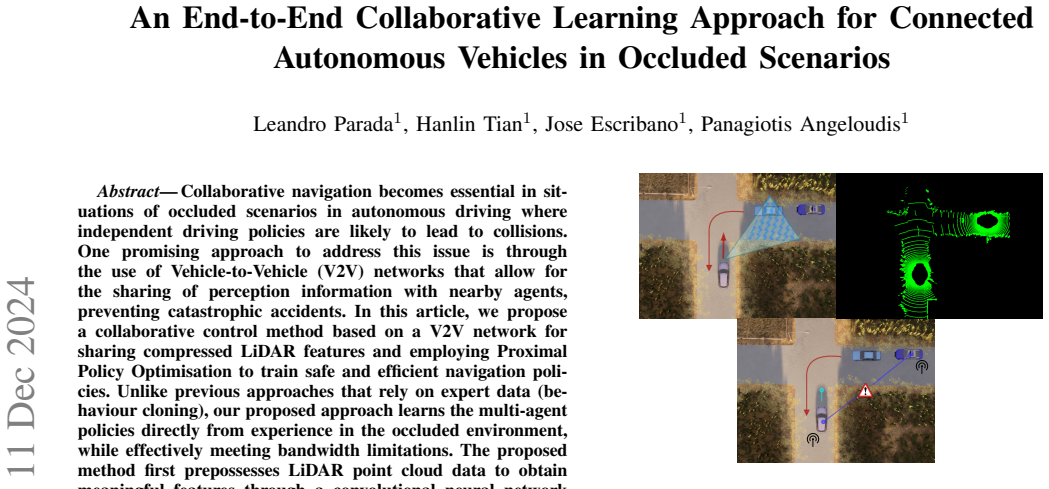
The central mechanism is the compressed LiDAR feature message. Raw LiDAR points are preprocessed into ego-vehicle coordinates and passed through a two-layer convolutional network to produce a (4, 128, 128) feature tensor; this tensor is compressed for broadcast, decompressed by receiving vehicles, transformed into the receiver's perspective, and aggregated with the ego vehicle's own features. The aggregated tensor, together with metadata such as speed and dimensions, is the input to a MAPPO actor network, so the message strikes an intermediate-fusion balance: richer than object-level summaries, far smaller than raw point clouds. MAPPO supplies centralized training with decentralized execution, letting a common critic stabilize learning while each vehicle acts only on local observations plus received features.
What would settle it
Retrain the independent-RL and early-fusion baselines with the same number of episodes, random seeds, and reward coefficients as the collaborative method in the two occluded scenarios; if their collision rates fall to the 2-3% range, the claimed advantage is an artifact of training effort rather than of sharing compressed LiDAR features.
Extended reading notes
Core claim
On the paper's own terms, the central discovery is that intermediate-fusion collaborative control trained end-to-end with MAPPO yields safer policies in occluded scenarios than both independent learning and early fusion, while remaining bandwidth-feasible. In the occluded-intersection scenario the proposed method achieves a collision rate of 2.12% and success rate of 85.34%; in the blind-summit scenario, 3.07% and 94.14%. The relevant comparisons are independent RL at 10.43% and 12.15% collision and early fusion at 5.12% and 4.24% collision, with the ground-truth baseline at 4.87% and 1.91%. The authors also calibrate the communication cost: after 3D compression the shared feature messages use approximately 1.075 Mbps at 20 fps, within DSRC and C-V2X throughput, whereas transmitting the raw LiDAR point cloud would require roughly 80 Mbps.
Load-bearing premise
The load-bearing premise is that the independent-RL and early-fusion baselines were given the same training budget and random seeds as the proposed method, so the reported gap in collision and success rates reflects the architecture itself; the experiments section shows learning curves only for the proposed method and the ground-truth baseline, not for the comparison baselines.
Editorial extensions
If this is right
- In the two tested scenarios the method reduces collision rates by about 70% on average relative to independent reinforcement learning, indicating that collaborative feature sharing is a viable safety mechanism for occluded intersections.
- The compressed feature message uses roughly 1.075 Mbps at 20 fps, remaining below DSRC (2.0 Mbps) and C-V2X (7.2 Mbps) throughput, so the approach is deployable under current V2X bandwidth constraints.
- The collaborative policy stays competitive with a ground-truth baseline that sees exact vehicle locations, suggesting the shared LiDAR features recover most of the value of full observability without requiring those locations to be known.
- Performance tolerates up to roughly 20% LiDAR point dropout, indicating the approach is robust to realistic sensor degradation below that threshold.
Reading between the lines
- Because the policy only receives features from agents within a 70-meter range, a natural follow-up is to vary the communication radius and measure the collision rate, predicting a sharp rise once occluded vehicles fall outside that radius.
- The reported 20-30% dropout threshold suggests the learned policy depends on feature continuity; a future variant could make the transmission schedule itself learned, deciding when to broadcast, which would further reduce bandwidth but would need its own dropout robustness analysis.
- The fully cooperative shared-reward setup means the method targets fleets of cooperative vehicles; applying it to mixed traffic with human-driven vehicles would require adding prediction of non-communicating agents or changing the reward structure.
Editorial analysis
A structured set of objections, weighed in public.
Referee Report
Summary. The paper proposes an end-to-end collaborative control method for connected autonomous vehicles in occluded driving scenarios. The method extracts LiDAR features with a CNN, compresses them with Draco, shares them over a V2V network, and trains the resulting multi-agent policy with MAPPO. The authors introduce a CARLA-based occluded intersection gym environment and evaluate the method on two scenarios against rule-based, independent RL, early-fusion MAPPO, and ground-truth MAPPO baselines. They report lower collision rates and higher success rates for the proposed method than for independent RL and early fusion, along with a bandwidth analysis showing that the compressed features fit within DSRC/C-V2X limits. A robustness experiment examines performance under LiDAR point dropout.
Significance. If the reported results are reliable, the paper makes a useful contribution: it demonstrates that compressed intermediate LiDAR feature sharing can improve safety in occluded intersections within realistic bandwidth budgets, without relying on expert demonstrations. The proposed environment and pipeline are concrete and could serve as a testbed for future collaborative-driving work. However, the strength of the evidence is currently limited by overlapping standard deviations, the absence of significance tests, and a baseline design that conflates V2V feature sharing with changes in the learning objective. These issues are central to the paper's main claim, so the contribution is not yet established at the level required for publication.
major comments (4)
- [Table I and Section V-A] The central claim of 'consistent superiority' over early fusion is not statistically supported. In the Occluded Intersection scenario, the proposed method's collision rate is 2.12 ± 4.48 versus 5.12 ± 4.44 for early fusion; the difference is well within one standard deviation. In the Blind Summit scenario, the corresponding rates are 3.07 ± 3.15 versus 4.24 ± 2.22, also overlapping. No significance tests, confidence intervals, or effect sizes are reported, and the number of training seeds used to produce these test statistics is not stated. The authors should report paired or unpaired significance tests across multiple seeds, confidence intervals, or at least the per-seed distributions. Without this, the abstract's claim of 'consistent superiority' overstates what the data show.
- [Section V, Baseline description; Eq. (4)] The comparison against Independent RL does not isolate the effect of sharing compressed LiDAR features. The proposed method uses a fully cooperative shared reward (Eq. 4: 'agents share the same reward'), while the Independent RL baseline 'try to maximise an independent reward function.' Thus the lower collision rate could be due to cooperative credit assignment or MAPPO's centralized critic rather than the shared LiDAR features. The baseline description states that 'the MAPPO structure is the same for the multi-agent case, except for the message compression and sharing phase,' but it is ambiguous whether the independent baseline retains the shared reward and centralized critic. To support the causal claim, the authors should include an ablation that keeps all training components (shared reward, centralized critic, communication protocol) identical and varies only the presence or type of shared features, or at minimum report whether the independent baseline uses the same reward and critic structure.
- [Section V-A and Figure 4] The baselines' training is not sufficiently documented. Figure 4 shows learning curves only for the proposed method and the ground-truth baseline; no training curves, episode counts, or seed counts are given for Independent RL or Early Fusion. As a result, it is impossible to verify that the baselines were trained to convergence with comparable compute budgets, and the performance gap might reflect unequal training effort rather than the method itself. The authors should report all learning curves, the number of seeds, and the training hyperparameters for every baseline, and ideally show that each baseline has converged.
- [Section V-A and Table I caption] There is a direct inconsistency in the reported number of test runs: the text states 'the average and standard deviation of 100 independent testing runs,' while Table I's caption says the results are 'the average over 1000 independent test runs.' This discrepancy affects the interpretation of the reported standard deviations and must be corrected. The authors should also clarify whether the standard deviations are over episodes, over seeds, or over the mean across seeds, and report the corresponding quantities consistently.
minor comments (5)
- [Abstract and Section IV-A] The word 'prepossesses' should be 'preprocesses' in both the abstract and the method description.
- [Section II-B, reference [20]] The citation to 'Vedaldi et al.' for V2VNet is mis-attributed; the V2VNet paper is by Wang et al. and appears in the ECCV proceedings edited by Vedaldi et al. Please correct the citation.
- [Table II] The environment parameter 'LiDAR points per second 16points/s' is implausibly low and likely a typo; please specify the intended point rate (e.g., number of points per scan or per second).
- [Section V] There is a duplicated phrase: 'such as such as DSRC and C-V2X' should read 'such as DSRC and C-V2X.'
- [Section IV-C, Step 2] The use of the Draco 3D compression library for (4,128,128) feature tensors is unusual, since Draco is designed for meshes; please clarify how it is applied to the feature map and how the '40 times' reduction factor is measured.
Circularity Check
No circularity; the performance claims are measured empirical outcomes rather than reductions of predicted quantities to fitted inputs.
full rationale
This is an empirical paper whose central claims are measured experimental outcomes (collision rate, success rate, average speed in Table I) obtained from a custom CARLA-based simulator. The MAPPO objective in Eqs. (1)-(3) and the shared reward in Eq. (4) are inputs to the training procedure, and the reported metrics are test-set measurements, so no predicted quantity is derived by construction from a parameter fitted to those same quantities. The proposed method is compared against externally defined baselines (rule-based car following, independent RL, MAPPO with ground truth locations, and early fusion) rather than against a quantity that is equivalent to an input assumption of the method. The ambiguity about whether the Independent RL baseline retains the shared reward and centralized critic is a legitimate experimental-validity concern, not circularity, because it does not make the claimed superiority equivalent to its own definition. There is no load-bearing self-citation chain, no imported uniqueness theorem, and no ansatz smuggled in via citation; the cited external works provide algorithms, simulators, codecs, and standards, but the paper's safety/efficiency results are direct simulator measurements. Therefore no circular step can be exhibited, and the appropriate score is 0.
Assumptions & free parameters
free parameters (5)
- Reward weights (rcol, rdest, rspeed, rstep) =
-5, +5, +1, -0.01
- CNN architecture and feature size =
two conv layers, output (4,128,128)
- Communication range =
70 m
- LiDAR configuration =
32 channels, 50 m range
- MAPPO hyperparameters =
not reported
assumptions (5)
- domain assumption The CARLA/OpenCDA simulation with SUMO traffic accurately models real occluded intersection driving dynamics and sensor noise.
- domain assumption V2V communication delivers compressed features within 70 m without packet loss or meaningful latency.
- domain assumption DRACO compression and decompression preserve enough information in the LiDAR features for the downstream policy to act safely.
- domain assumption All agents optimize a fully cooperative shared reward, justifying the shared-reward MAPPO formulation.
- ad hoc to paper The baselines are trained to convergence with comparable resources.
Cite this review
Pith. "Pith review of An End-to-End Collaborative Learning Approach for Connected Autonomous Vehicles in Occluded Scenarios." pith.science (2026). https://pith.science/paper/JAWG6DGC
@misc{pith2026241208562,
  author       = {Pith},
  title        = {Pith review of: An End-to-End Collaborative Learning Approach for Connected Autonomous Vehicles in Occluded Scenarios},
  year         = {2026},
  howpublished = {\url{https://pith.science/paper/JAWG6DGC}},
  note         = {Machine review of arXiv:2412.08562}
}
read the original abstract
Collaborative navigation becomes essential in situations of occluded scenarios in autonomous driving where independent driving policies are likely to lead to collisions. One promising approach to address this issue is through the use of Vehicle-to-Vehicle (V2V) networks that allow for the sharing of perception information with nearby agents, preventing catastrophic accidents. In this article, we propose a collaborative control method based on a V2V network for sharing compressed LiDAR features and employing Proximal Policy Optimisation to train safe and efficient navigation policies. Unlike previous approaches that rely on expert data (behaviour cloning), our proposed approach learns the multi-agent policies directly from experience in the occluded environment, while effectively meeting bandwidth limitations. The proposed method first prepossesses LiDAR point cloud data to obtain meaningful features through a convolutional neural network and then shares them with nearby CAVs to alert for potentially dangerous situations. To evaluate the proposed method, we developed an occluded intersection gym environment based on the CARLA autonomous driving simulator, allowing real-time data sharing among agents. Our experimental results demonstrate the consistent superiority of our collaborative control method over an independent reinforcement learning method and a cooperative early fusion method.
Figures


Figures from the paper (2 more)


Reference graph
Works this paper leans on
-
[1]
D. Kamran, C. F. Lopez, M. Lauer, and C. Stiller, “Risk-Aware High-level Decisions for Automated Driving at Occluded Intersections with Reinforcement Learning,” Apr. 2020, arXiv:2004.04450 [cs]. [Online]. Available: http://arxiv.org/abs/2004.04450
work page Pith review arXiv 2020
-
[2]
Navigating Occluded Intersections with Autonomous Vehicles using Deep Reinforcement Learning,
D. Isele, R. Rahimi, A. Cosgun, K. Subramanian, and K. Fujimura, “Navigating Occluded Intersections with Autonomous Vehicles using Deep Reinforcement Learning,” Feb. 2018, arXiv:1705.01196 [cs]. [Online]. Available: http://arxiv.org/abs/1705.01196
arXiv 2018
-
[3]
O. Tonguz, N. Wisitpongphan, F. Bai, P. Mudalige, and V . Sadekar, “Broadcasting in V ANET,” in 2007 Mobile Networking for Vehicular Environments, May 2007, pp. 7–12
work page 2007
-
[4]
R. Xu, H. Xiang, X. Xia, X. Han, J. Li, and J. Ma, “OPV2V: An Open Benchmark Dataset and Fusion Pipeline for Perception with Vehicle-to-Vehicle Communication,” June 2022, arXiv:2109.07644 [cs]. [Online]. Available: http://arxiv.org/abs/2109.07644
work page Pith review arXiv 2022
-
[5]
V2X-ViT: Vehicle-to-Everything Cooperative Perception with Vision Transformer,
R. Xu, H. Xiang, Z. Tu, X. Xia, M.-H. Yang, and J. Ma, “V2X-ViT: Vehicle-to-Everything Cooperative Perception with Vision Transformer,” Aug. 2022, arXiv:2203.10638 [cs]. [Online]. Available: http://arxiv.org/abs/2203.10638
arXiv 2022
-
[6]
COOPERNAUT: End- to-End Driving with Cooperative Perception for Networked Vehicles,
J. Cui, H. Qiu, D. Chen, P. Stone, and Y . Zhu, “COOPERNAUT: End- to-End Driving with Cooperative Perception for Networked Vehicles,” in 2022 IEEE/CVF Conference on Computer Vision and Pattern Recognition (CVPR), June 2022, pp. 17 231–17 241, arXiv:2205.02222 [cs]. [Online]. Available: http://arxiv.org/abs/2205.02222
arXiv 2022
-
[7]
Exploring the Limitations of Behavior Cloning for Autonomous Driving,
F. Codevilla, E. Santana, A. M. L ´opez, and A. Gaidon, “Exploring the Limitations of Behavior Cloning for Autonomous Driving,” Apr. 2019, arXiv:1904.08980 [cs]. [Online]. Available: http://arxiv.org/abs/ 1904.08980
arXiv 2019
-
[8]
The Surprising Effectiveness of PPO in Cooperative, Multi-Agent Games,
C. Yu, A. Velu, E. Vinitsky, Y . Wang, A. Bayen, and Y . Wu, “The Surprising Effectiveness of PPO in Cooperative, Multi-Agent Games,” arXiv:2103.01955 [cs] , July 2021. [Online]. Available: http://arxiv.org/abs/2103.01955
arXiv 2021
Show all 34 references
-
[9]
Autonomous vehicle control systems for safe crossroads,
J. Alonso, V . Milan ´es, J. P ´erez, E. Onieva, C. Gonz ´alez, and T. de Pe- dro, “Autonomous vehicle control systems for safe crossroads,” Trans- portation Research Part C: Emerging Technologies, vol. 19, no. 6, pp. 1095–1110, Dec. 2011
2011
-
[10]
Intersection management for autonomous vehicles using iCACC,
I. H. Zohdy, R. K. Kamalanathsharma, and H. Rakha, “Intersection management for autonomous vehicles using iCACC,” in 2012 15th International IEEE Conference on Intelligent Transportation Systems , Sept. 2012, pp. 1109–1114, iSSN: 2153-0017
2012
-
[11]
Cooperative Collision Avoidance at Intersections: Algorithms and Ex- periments,
M. R. Hafner, D. Cunningham, L. Caminiti, and D. Del Vecchio, “Cooperative Collision Avoidance at Intersections: Algorithms and Ex- periments,” IEEE Transactions on Intelligent Transportation Systems , vol. 14, no. 3, pp. 1162–1175, Sept. 2013, conference Name: IEEE Transactio...
2013
-
[12]
Autonomous Intersection Manage- ment For Semi-Autonomous Vehicles,
T.-C. Au, S. Zhang, and P. Stone, “Autonomous Intersection Manage- ment For Semi-Autonomous Vehicles,” in The Routledge Handbook of Transportation. Routledge, 2015, num Pages: 17
2015
-
[13]
A Market-Inspired Approach for Intersection Management in Urban Road Traffic Networks,
M. Vasirani and S. Ossowski, “A Market-Inspired Approach for Intersection Management in Urban Road Traffic Networks,” Journal of Artificial Intelligence Research , vol. 43, pp. 621– 659, Apr. 2012, arXiv:1401.5851 [cs]. [Online]. Available: http: //arxiv.org/abs/1401.5851
2012 arXiv
-
[14]
Analysis and Modeled Design of One State-Driven Autonomous Passing-Through Algorithm for Driverless Vehicles at Intersections,
K. Zhang, A. De La Fortelle, D. Zhang, and X. Wu, “Analysis and Modeled Design of One State-Driven Autonomous Passing-Through Algorithm for Driverless Vehicles at Intersections,” in 2013 IEEE 16th International Conference on Computational Science and Engineering , Dec. 2013, p...
2013
-
[15]
Batch-Light: An adaptive intelligent intersection control policy for autonomous vehicles,
X. Wei, G. Tan, and N. Ding, “Batch-Light: An adaptive intelligent intersection control policy for autonomous vehicles,” in 2014 IEEE International Conference on Progress in Informatics and Computing , May 2014, pp. 98–103
2014
-
[16]
Extended time-to-collision measures for road traffic safety assessment,
M. M. Minderhoud and P. H. L. Bovy, “Extended time-to-collision measures for road traffic safety assessment,” Accident Analysis & Prevention, vol. 33, no. 1, pp. 89–97, Jan. 2001
2001
-
[17]
TIME-TO-COLLISION AND COLLISION A VOIDANCE SYSTEMS,
R. van der horst and J. Hogema, “TIME-TO-COLLISION AND COLLISION A VOIDANCE SYSTEMS,” Jan. 1994
1994
-
[18]
Intelligent Intersection Management Systems Considering Autonomous Vehicles: A Systematic Literature Review,
E. Namazi, J. Li, and C. Lu, “Intelligent Intersection Management Systems Considering Autonomous Vehicles: A Systematic Literature Review,” IEEE Access , vol. 7, pp. 91 946–91 965, 2019, conference Name: IEEE Access
2019
-
[19]
Learning Negotiating Behavior Between Cars in Intersections using Deep Q-Learning,
T. Tram, A. Jansson, R. Gr ¨onberg, M. Ali, and J. Sj ¨oberg, “Learning Negotiating Behavior Between Cars in Intersections using Deep Q-Learning,” Oct. 2018, arXiv:1810.10469 [cs, stat]. [Online]. Available: http://arxiv.org/abs/1810.10469
2018 arXiv
-
[20]
V2VNet: Vehicle-to-Vehicle Communication for Joint Perception and Prediction,
T.-H. Wang, S. Manivasagam, M. Liang, B. Yang, W. Zeng, and R. Urtasun, “V2VNet: Vehicle-to-Vehicle Communication for Joint Perception and Prediction,” in Computer Vision – ECCV 2020 , A. Vedaldi, H. Bischof, T. Brox, and J.-M. Frahm, Eds. Cham: Springer International Publishi...
2020 doi
-
[21]
Who2com: Collaborative Perception via Learnable Handshake Communication,
Y .-C. Liu, J. Tian, C.-Y . Ma, N. Glaser, C.-W. Kuo, and Z. Kira, “Who2com: Collaborative Perception via Learnable Handshake Communication,” Mar. 2020, arXiv:2003.09575 [cs]. [Online]. Available: http://arxiv.org/abs/2003.09575
2020 arXiv
-
[22]
When2com: Multi- Agent Perception via Communication Graph Grouping,
Y .-C. Liu, J. Tian, N. Glaser, and Z. Kira, “When2com: Multi- Agent Perception via Communication Graph Grouping,” June 2020, arXiv:2006.00176 [cs]. [Online]. Available: http://arxiv.org/abs/2006. 00176
2020 arXiv
-
[23]
Cooperative Perception with Deep Reinforcement Learning for Connected Vehicles,
S. Aoki, T. Higuchi, and O. Altintas, “Cooperative Perception with Deep Reinforcement Learning for Connected Vehicles,” Apr. 2020, arXiv:2004.10927 [cs, eess]. [Online]. Available: http: //arxiv.org/abs/2004.10927
2020 arXiv
-
[24]
Cooper: Cooperative Perception for Connected Autonomous Vehicles based on 3D Point Clouds,
Q. Chen, S. Tang, Q. Yang, and S. Fu, “Cooper: Cooperative Perception for Connected Autonomous Vehicles based on 3D Point Clouds,” May 2019, arXiv:1905.05265 [cs]. [Online]. Available: http://arxiv.org/abs/1905.05265
2019 arXiv
-
[25]
Collaborative Automated Driving: A Machine Learning-based Method to Enhance the Accuracy of Shared Information,
Z. Y . Rawashdeh and Z. Wang, “Collaborative Automated Driving: A Machine Learning-based Method to Enhance the Accuracy of Shared Information,” in 2018 21st International Conference on Intelligent Transportation Systems (ITSC) , Nov. 2018, pp. 3961–3966, iSSN: 2153-0017
2018
-
[26]
Smarts: Scalable multi-agent reinforcement learning training school for autonomous driving,
M. Zhou, J. Luo, J. Villella, Y . Yang, D. Rusu, J. Miao, W. Zhang, M. Alban, I. Fadakar, Z. Chen, A. C. Huang, Y . Wen, K. Hassanzadeh, D. Graves, D. Chen, Z. Zhu, N. Nguyen, M. Elsayed, K. Shao, S. Ahilan, B. Zhang, J. Wu, Z. Fu, K. Rezaee, P. Yadmellat, M. Rohani, N. P. Nie...
2020 arXiv
-
[27]
An environment for autonomous driving decision- making,
E. Leurent, “An environment for autonomous driving decision- making,” https://github.com/eleurent/highway-env, 2018
2018
-
[28]
Multi-agent connected autonomous driving using deep reinforcement learning,
P. Palanisamy, “Multi-agent connected autonomous driving using deep reinforcement learning,” 2019
2019
-
[29]
OpenDRIVE 2010 and Beyond – Status and Future of the de facto Standard for the Description of Road Networks,
M. Dupuis, M. Strobl, and H. Grezlikowski, “OpenDRIVE 2010 and Beyond – Status and Future of the de facto Standard for the Description of Road Networks,” p. 12, 2010
2010
-
[30]
OpenCDA:An Open Cooperative Driving Automation Framework Integrated with Co-Simulation,
R. Xu, Y . Guo, X. Han, X. Xia, H. Xiang, and J. Ma, “OpenCDA:An Open Cooperative Driving Automation Framework Integrated with Co-Simulation,” Aug. 2021, arXiv:2107.06260 [cs]. [Online]. Available: http://arxiv.org/abs/2107.06260
2021 arXiv
-
[31]
Intelligent Transport Systems (ITS); Vehicular Communica- tions; Basic Set of Applications; Part 2: Specification of Cooperative Awareness Basic Service
ETSI, “Intelligent Transport Systems (ITS); Vehicular Communica- tions; Basic Set of Applications; Part 2: Specification of Cooperative Awareness Basic Service.” 2014
2014
-
[32]
Draco 3d data compression,
“Draco 3d data compression,” Patent, 2019. [Online]. Available: https://github.com/google/draco
2019
-
[33]
LiDAR Data Noise Models and Methodology for Sim-to-Real Domain Generaliza- tion and Adaptation in Autonomous Driving Perception,
J. Espadinha, I. Lebedev, L. Lukic, and A. Bernardino, “LiDAR Data Noise Models and Methodology for Sim-to-Real Domain Generaliza- tion and Adaptation in Autonomous Driving Perception,” in2021 IEEE Intelligent Vehicles Symposium (IV) , July 2021, pp. 797–803
2021
-
[34]
Dedicated Short-Range Communications (DSRC) Stan- dards in the United States,
J. B. Kenney, “Dedicated Short-Range Communications (DSRC) Stan- dards in the United States,” Proceedings of the IEEE, vol. 99, no. 7, pp. 1162–1182, July 2011, conference Name: Proceedings of the IEEE
2011
Reviewed August 11, 2026 · model on record in the stance chip above.
Discussion (0). Continue with ORCID to comment.