Enhanced superconductivity in atomically thin noble metals: From quantum confinement to interface-induced Lifshitz transition
Pith reviewed 2026-06-28 08:00 UTC · model grok-4.3
The pith
B-bonded h-BN/Cu interface triggers Lifshitz transition that raises Tc to 7 K
A machine-rendered reading of the paper's core claim, the machinery that carries it, and where it could break.
Core claim
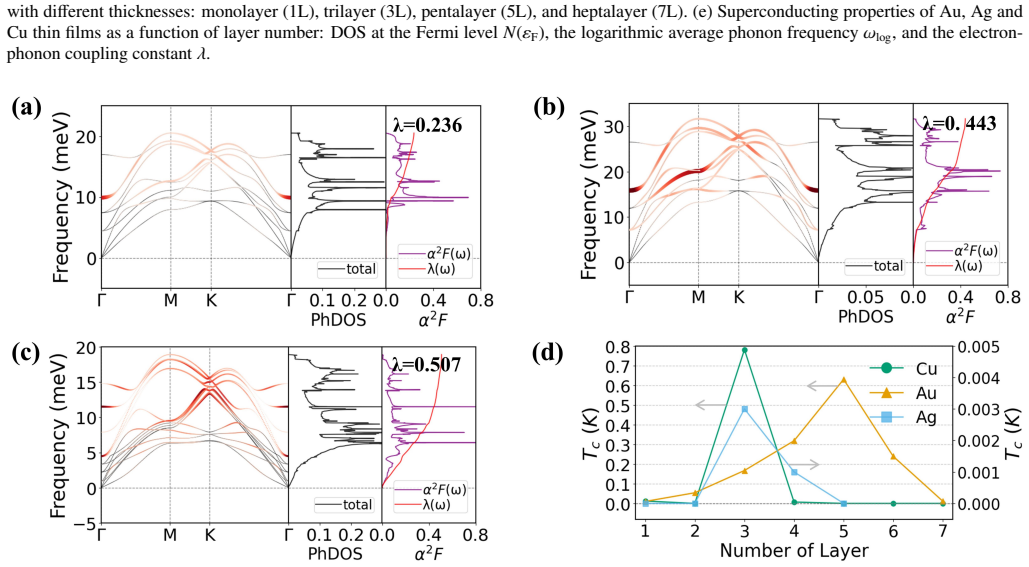
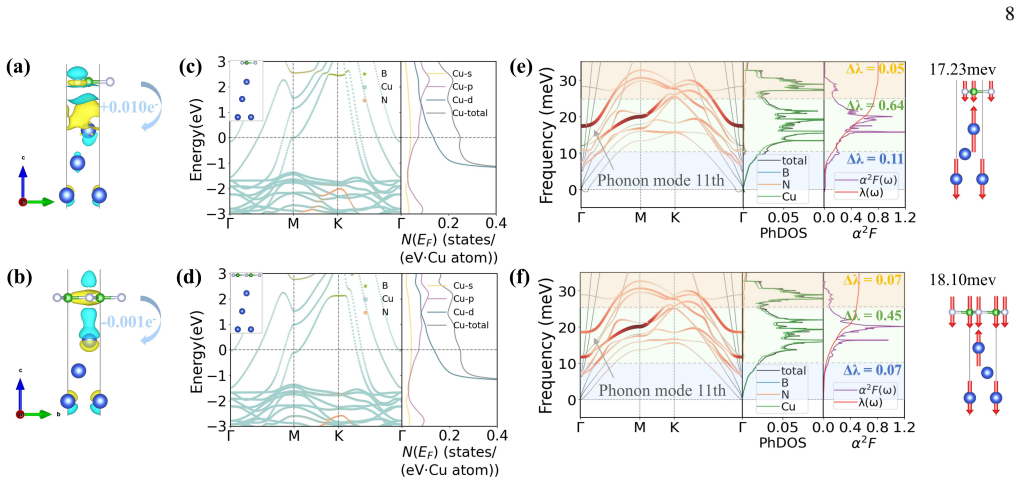
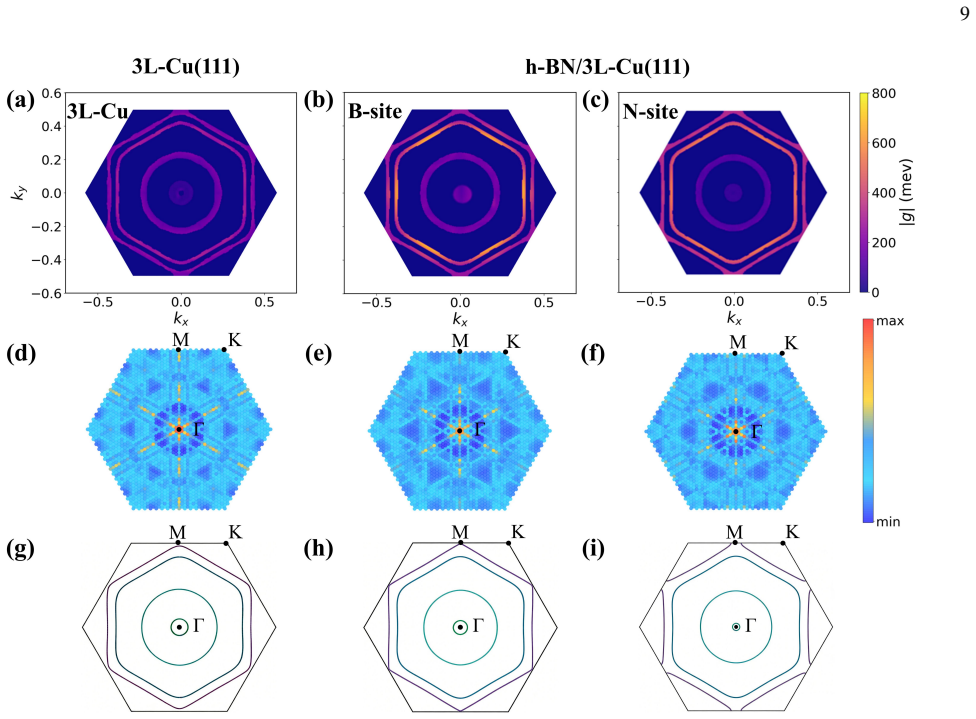
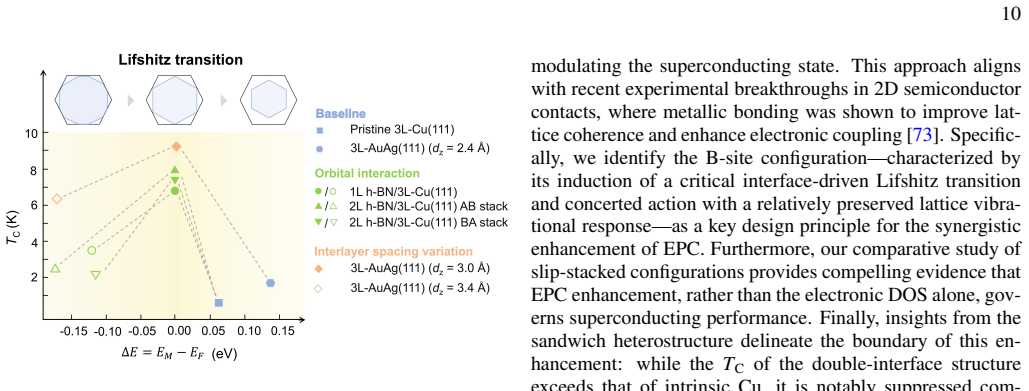
In h-BN/Cu(111) heterostructures the B-bonded interface triggers a Lifshitz transition at the M point that enhances electron-phonon coupling beyond DOS effects, producing Tc ≈ 7.00 K, while the stable N-bonded interface gives Tc ≈ 3.23 K; intrinsic confinement alone gives Tc ≈ 0.78 K in trilayer Cu and Tc ≈ 0.63 K in pentalayer Au.
What carries the argument
The B-bonded-induced Lifshitz transition at the M point, where the Fermi surface forms a tangential contact with the Brillouin zone boundary and thereby enhances electron-phonon coupling beyond density-of-states effects.
If this is right
- Trilayer Cu films exhibit Tc of approximately 0.78 K driven by confinement-induced density-of-states enhancement.
- Pentalayer Au films exhibit Tc of approximately 0.63 K driven by phonon softening.
- The thermodynamically stable N-bonded h-BN/Cu interface yields Tc of approximately 3.23 K.
- The metastable B-bonded configuration raises Tc to 7 K specifically through the Lifshitz transition at the M point.
Where Pith is reading between the lines
- The same interface-stacking strategy could be tested in other noble-metal or transition-metal heterostructures to check whether analogous Lifshitz transitions appear.
- Device fabrication routes might deliberately stabilize the higher-Tc metastable interface if growth kinetics can be controlled.
- Fermi-surface topology changes induced by interfaces could be explored as a general tuning knob for superconductivity in other 2D systems.
Load-bearing premise
The first-principles framework accurately captures the Lifshitz transition and its quantitative effect on Tc without large errors from exchange-correlation functional choice or neglected anharmonic effects.
What would settle it
Experimental measurement of a superconducting Tc in a fabricated h-BN/Cu heterostructure with controlled B-bonded stacking that deviates substantially from 7 K would falsify the predicted enhancement.
Figures
read the original abstract
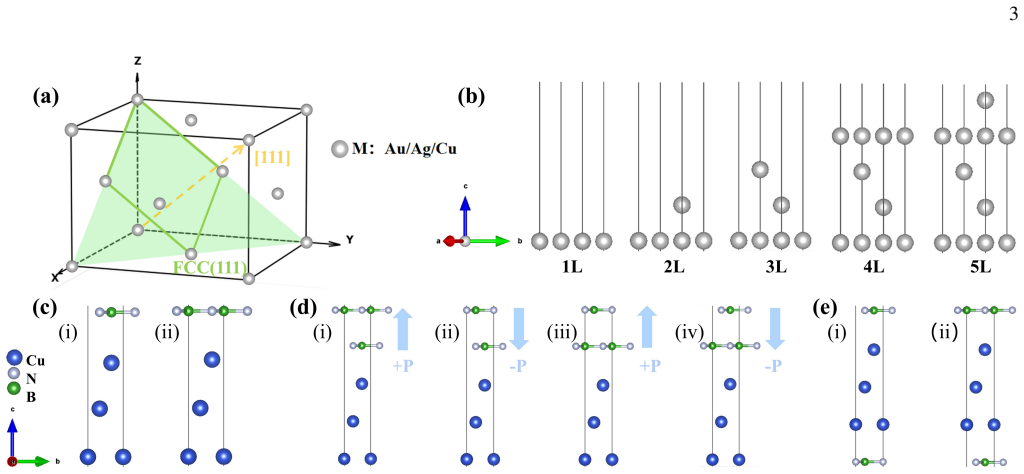
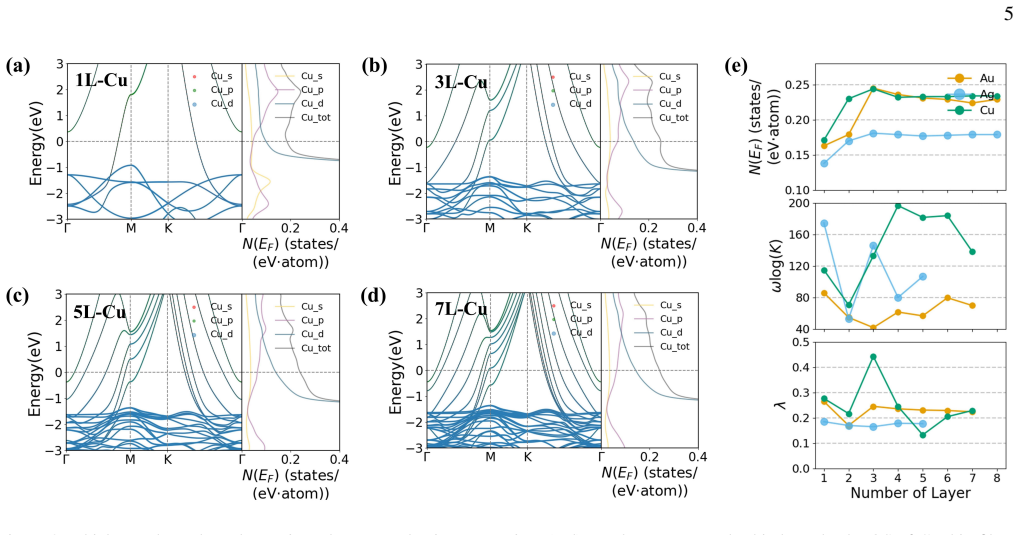
Unlocking superconductivity in intrinsically non-superconducting noble metals (Au, Ag, Cu) represents a fundamental challenge in low-dimensional physics. While quantum confinement in the atomically thin limit is known to trigger emergent superconductivity, strategies to amplify this marginal effect to experimentally accessible temperatures remain a key open question. Using first-principles calculations, we establish a unified framework linking intrinsic confinement effects with interface engineering in noble metal films. We reveal that intrinsic superconductivity is element-specific: it is suppressed in Ag by a stiff phonon spectrum, but emerges in trilayer Cu ($T_{\rm C} \approx 0.78$ K) and pentalayer Au ($0.63$ K) driven by confinement-induced density-of-states (DOS) enhancement and phonon softening, respectively. In h-BN/Cu(111) heterostructures, $T_{\rm C}$ is critically dictated by the interfacial stacking configuration. We identify the thermodynamically stable N-bonded interface as a reliable platform for accessible superconductivity ($T_{\rm C} \approx 3.23$ K), whereas manipulating the system into a metastable B-bonded configuration boosts $T_{\rm C}$ to $7.00$ K. This enhancement originates from a B-bonded-induced Lifshitz transition, where the Fermi surface forms a tangential contact with the Brillouin zone boundary at the M point, enhancing electron-phonon coupling beyond DOS effects. Our work unifies the understanding of intrinsic two-dimensional superconductivity with atomistic interface design, offering a blueprint for functionalizing noble metals as emergent superconductors.
Editorial analysis
A structured set of objections, weighed in public.
Referee Report
Summary. The manuscript uses first-principles calculations to study emergent superconductivity in atomically thin noble-metal films. It reports element-specific intrinsic Tc values arising from quantum confinement (trilayer Cu at ≈0.78 K; pentalayer Au at ≈0.63 K) and shows that h-BN/Cu(111) heterostructures exhibit stacking-dependent Tc, with the metastable B-bonded interface reaching Tc≈7.00 K via a Lifshitz transition at the M point that enhances electron-phonon coupling beyond density-of-states effects, while the stable N-bonded interface yields Tc≈3.23 K.
Significance. If the quantitative predictions hold, the work supplies a concrete, atomistic route to functionalize non-superconducting noble metals as 2D superconductors by combining confinement with interface stacking control. The explicit link between a stacking-induced Lifshitz transition and an increase in λ supplies a falsifiable mechanism that goes beyond generic DOS arguments and could guide experimental searches in related van-der-Waals heterostructures.
major comments (1)
- [heterostructure results] Heterostructure results paragraph: the central claim that the B-bonded stacking produces a tangential Fermi-surface contact at M that boosts λ (and thus Tc to 7.00 K) beyond any DOS change rests on the DFT+electron-phonon pipeline correctly locating the Lifshitz transition. No functional-variation tests, k-mesh convergence data for the M-point band extrema, or anharmonic renormalization of the soft modes are reported; standard semi-local functionals are known to shift such extrema by tens of meV in Cu/h-BN systems, which can erase or reverse the reported enhancement.
Simulated Author's Rebuttal
We thank the referee for the careful reading and constructive criticism. We agree that the robustness of the Lifshitz transition requires additional validation and will revise the manuscript to include the requested tests.
read point-by-point responses
-
Referee: [heterostructure results] Heterostructure results paragraph: the central claim that the B-bonded stacking produces a tangential Fermi-surface contact at M that boosts λ (and thus Tc to 7.00 K) beyond any DOS change rests on the DFT+electron-phonon pipeline correctly locating the Lifshitz transition. No functional-variation tests, k-mesh convergence data for the M-point band extrema, or anharmonic renormalization of the soft modes are reported; standard semi-local functionals are known to shift such extrema by tens of meV in Cu/h-BN systems, which can erase or reverse the reported enhancement.
Authors: We agree that the absence of these checks leaves the central claim vulnerable. In the revised manuscript we will add: (1) explicit k-mesh convergence plots for the M-point band extrema under both stackings, (2) a comparison of the Fermi-surface topology obtained with PBE and PBEsol (or HSE06 where computationally feasible) to quantify any shift in the Lifshitz transition, and (3) a short discussion of the harmonic approximation together with an estimate of the expected anharmonic correction based on the mode Grüneisen parameters already computed in our phonon calculations. These additions will either confirm or qualify the reported Tc enhancement. revision: yes
Circularity Check
No circularity: Tc values are direct outputs of first-principles DFT+electron-phonon pipeline
full rationale
The paper presents all reported Tc values (0.78 K for trilayer Cu, 0.63 K for pentalayer Au, 3.23 K and 7.00 K for the two h-BN/Cu interfaces) as computed results from standard first-principles methods. No equations, fitted parameters, or self-citations are shown that would make these Tc numbers reduce to the input structures by construction. The Lifshitz-transition claim is likewise framed as an observed outcome of the band-structure calculation rather than a self-defined or renamed input. The derivation chain therefore remains self-contained against external benchmarks and receives the default non-circularity finding.
Axiom & Free-Parameter Ledger
axioms (1)
- domain assumption Density-functional theory plus linear-response electron-phonon calculations are adequate to predict Tc in these confined and heterostructure systems
Reference graph
Works this paper leans on
-
[1]
over-softened
(a–d)]. In the monolayer limit [Figure 2. (a)], the extreme quantum confinement—arising from the complete absence of interlayer coupling—results in bands with large curvature and steep dispersion crossing the Fermi level, indicative of a small effective electron mass. While thed-band DOS exhib- its a sharp onset at approximately−0.50 eV , the Fermi-level ...
-
[2]
more” always “better
(c, d)]. These minimal variations confirm that the dramatic TC enhancement cannot be ascribed to simple doping or DOS effects. In marked contrast to the nearly constantN(ε F), the EPC constantλexhibits strong configuration dependence across in- terfacial arrangements. Notably,λreaches 0.80 for the B-site configuration, significantly higher than for the N-...
-
[3]
X. Zhan, C. Shen, Z. Zhu, and D. Zhu, New Precision Electro- forming Process for the Simultaneous Improvement of Thick- ness Uniformity and Microstructure Homogeneity of Wafer- Scale Nanotwinned Copper Arrays, Int. J. Mach. Tools Manuf. 187, 104006 (2023)
2023
-
[4]
Yao and Y
S. Yao and Y . Zhu, Nanomaterial-Enabled Stretchable Conduct- ors: Strategies, Materials and Devices, Adv. Mater.27, 1480 (2015)
2015
-
[5]
Walther, D
M. Walther, D. G. Cooke, C. Sherstan, M. Hajar, M. R. Free- man, and F. A. Hegmann, Terahertz Conductivity of Thin Gold Films at the Metal-Insulator Percolation Transition, Phys. Rev. B76, 125408 (2007)
2007
-
[6]
Takakuwa, K
M. Takakuwa, K. Yamagishi, S. Lee, Y . Tagawa, T. Someya, and T. Yokota, Device integration technology for practical flex- ible electronics systems, Adv. Funct. Mater.36, e14330 (2025)
2025
-
[7]
Ielmini and G
D. Ielmini and G. Pedretti, Resistive switching random-access memory (rram): Applications and requirements for memory and computing, Chem. Rev.125, 5584 (2025)
2025
-
[8]
J. Cao, X. Liu, J. Qiu, Z. Yue, Y . Li, Q. Xu, Y . Chen, J. Chen, H. Cheng, G. Xing, E. Song, M. Wang, Q. Liu, and M. Liu, Anti-friction gold-based stretchable electronics enabled by in- terfacial diffusion-induced cohesion, Nat. Commun.15, 1116 (2024)
2024
-
[9]
A. Koya, R. Krahne, W.-C. Shih, and D. Garoli, Nanoporous metals: From plasmonic properties to applications in enhanced spectroscopy and photocatalysis, ACS Nano15, 6038 (2021)
2021
-
[10]
S. Zhao, H. Zhang, M. Zhu, L. Jiang, and Y . Zheng, Electrical conductivity of goldene, Phys. Rev. B110, 085111 (2024)
2024
-
[11]
H. Fu, X. Zhou, H. Xue, X. Li, and K. Lu, Breaking the purity- stability dilemma in pure Cu with grain boundary relaxation, Mater. Today55, 66 (2022)
2022
-
[12]
Grimvall, The electron-phonon interaction in normal metals, Physica Scripta14, 63 (1976)
G. Grimvall, The electron-phonon interaction in normal metals, Physica Scripta14, 63 (1976)
1976
-
[13]
J. J. Paggel, T. Miller, and T.-C. Chiang, Temperature depend- ent complex band structure and electron-phonon coupling in Ag, Phys. Rev. Lett.83, 1415 (1999)
1999
-
[14]
Ji and Y
P. Ji and Y . Zhang, Ab initio determination of effective electron– phonon coupling factor in copper, Phys. Lett. A380, 1551 (2016)
2016
-
[15]
Holst, V
B. Holst, V . Recoules, S. Mazevet, M. Torrent, A. Ng, Z. Chen, S. E. Kirkwood, V . Sametoglu, M. Reid, and Y . Y . Tsui, Ab ini- tio model of optical properties of two-temperature warm dense matter, Phys. Rev. B90, 035121 (2014)
2014
-
[16]
Kumar and R
S. Kumar and R. Moudgil, Coherent Transport and Thermoelec- tric Effects in Pristine and Binary Alloyed Noble Metals Nan- oribbons Using First Principles, Physica E154, 115790 (2023)
2023
-
[17]
C. Liu, A. Ballard, D. Olaya, D. Schmidt, J. Biesecker, T. Lu- cas, J. Ullom, S. Patel, O. Rafferty, A. Opremcak, K. Dodge, V . Iaia, T. McBroom, J. DuBois, P. Hopkins, S. Benz, and B. Plourde, Single Flux Quantum-Based Digital Control of Su- perconducting Qubits in a Multichip Module, PRX Quantum4, 030310 (2023)
2023
-
[18]
De Franceschi, L
S. De Franceschi, L. Kouwenhoven, C. Sch ¨onenberger, and W. Wernsdorfer, Hybrid superconductor–quantum dot devices, Nat. Nanotechnol.5, 703 (2010)
2010
-
[19]
Z. Zhou, H. Zhang, R. Huang, F. He, D. Xu, X. Yan, and L. Li, Advancements in research and current applications of ”quantum sensor: Superconducting quantum interference device”, Eur. Phys. J. Spec. Top.234, 9985–10013 (2025)
2025
-
[20]
C. L. Degen, F. Reinhard, and P. Cappellaro, Quantum sensing, Rev. Mod. Phys.89, 035002 (2017)
2017
-
[21]
Wang, T.-W
L.-M. Wang, T.-W. Yang, C.-Y . Wang, L.-S. Guo, L.-Y . Hsiung, and Y .-S. Huang, Fabrication and Characteristics of High- Tc Superconducting/Magnetoresistive Mixed Sensors, IEEE Trans. Appl. Supercond.26(2016)
2016
-
[22]
Y .-E. Liu, X. Shi, T. Yokoyama, S. Inoue, Y . Sunaba, T. Oshikiri, Q. Sun, M. Tamura, H. Ishihara, K. Sasaki, and H. Misawa, Quantum-Coherence-Enhanced Hot-Electron In- jection under Modal Strong Coupling, ACS Nano17, 8315 (2023)
2023
-
[23]
Kumbhakar, T
S. Kumbhakar, T. K. Maji, B. Tongbram, S. Mandal, S. H. Soundararaj, B. Debnath, P. S. T, M. Jain, H. R. Krishnamurthy, A. Pandey, and A. Ghosh, Engineering Ultra-Strong Electron- Phonon Coupling and Nonclassical Electron Transport in Crys- talline Gold with Nanoscale Interfaces, Nat. Commun.16, 61 (2025)
2025
-
[24]
Tomanic, M
T. Tomanic, M. Schackert, W. Wulfhekel, C. S¨urgers, and H. v. L¨ohneysen, Two-band superconductivity of bulk and surface states in Ag thin films on Nb, Phys. Rev. B94, 220503 (2016)
2016
-
[25]
Guo, Y .-F
Y . Guo, Y .-F. Zhang, X.-Y . Bao, T.-Z. Han, Z. Tang, L.-X. Zhang, W.-G. Zhu, E. G. Wang, Q. Niu, Z. Q. Qiu, J.-F. Jia, Z.-X. Zhao, and Q.-K. Xue, Superconductivity Modulated by Quantum Size Effects, Science306, 1915 (2004)
1915
-
[26]
Travaglino and A
R. Travaglino and A. Zaccone, Extended Analytical BCS The- ory of Superconductivity in Thin Films, J. Appl. Phys.133, 033901 (2023)
2023
-
[27]
Nguyen, C.-M
D.-L. Nguyen, C.-M. Wei, and M.-Y . Chou, Theoretical study of quantum size effects in thin al(100), al(110), and al(111) films, Phys. Rev. B99, 205401 (2019)
2019
-
[28]
Zaccone and V
A. Zaccone and V . M. Fomin, Theory of superconductivity in thin films under an external electric field, Phys. Rev. B109, 144520 (2024)
2024
-
[29]
Jing, Z.-Y
T.-Y . Jing, Z.-Y . Han, Z.-H. He, M.-X. Shao, P. Li, and Z.-Q. Li, Quantum phase transition in nbn superconducting thin films, Phys. Rev. B107, 184515 (2023)
2023
-
[30]
T. Han, S. Y . Wang, B. Han, Y . Liu, F. Li, and L. Wang, Two- dimensional potassium borides with hidden kagome-like lat- tice: Topological semimetals, van Hove singularities, and su- perconductivity, Phys. Rev. B107, 235154 (2023)
2023
-
[31]
Chandrasekaran, L
A. Chandrasekaran, L. C. Rhodes, E. A. Morales, C. A. Marques, P. D. C. King, P. Wahl, and J. J. Betouras, On the Engineering of Higher-Order Van Hove Singularities in Two Dimensions, Nat. Commun.15, 9521 (2024)
2024
-
[32]
P. Wei, S. Manna, M. Eich, P. Lee, and J. Moodera, Supercon- ductivity in the Surface State of Noble Metal Gold and Its Fermi Level Tuning by EuS Dielectric, Phys. Rev. Lett.122, 247002 (2019)
2019
-
[33]
G. A. Ummarino and A. Zaccone, Can the Noble Metals (Au, Ag, and Cu) be Superconductors?, Phys. Rev. Mater.8, L101801 (2024)
2024
-
[34]
Alberto Ummarino and A
G. Alberto Ummarino and A. Zaccone, Turning non- superconducting elements into superconductors by quantum confinement and proximity, Journal of Physics: Condensed Matter38, 143003 (2026)
2026
-
[35]
Y . Liu, Q. Meng, P. Mahmoudi, Z. Wang, J. Zhang, J. Yang, W. Li, D. Wang, Z. Li, C. C. Sorrell, and S. Li, Advancing superconductivity with interface engineering, Adv. Mater.36, 2405009 (2024)
2024
-
[36]
H. Ji, Y . Liu, C. Ji, and J. Wang, Two-dimensional and interface superconductivity in crystalline systems, Acc. Mater. Res.5, 1146 (2024). 12
2024
-
[37]
Zhang, J.-Q
Y .-M. Zhang, J.-Q. Fan, W.-L. Wang, D. Zhang, L. Wang, W. Li, K. He, C.-L. Song, X.-C. Ma, and Q.-K. Xue, Ob- servation of interface superconductivity in a SnSe 2/epitaxial graphene van der waals heterostructure, Phys. Rev. B98, 220508 (2018)
2018
-
[38]
B. Li, Z. W. Xing, G. Q. Huang, and D. Y . Xing, Electron- phonon coupling enhanced by the FeSe/SrTiO 3 interface, J. Appl. Phys.115, 193907 (2014)
2014
-
[39]
P. Dong, X. Hou, J. He, Y . Zhang, Y . Ding, X. Zeng, J. Wang, Y . Wu, K. Watanabe, T. Taniguchi, W. Xia, Y . Guo, Y . Chen, X. Zhou, W. Li, and J. Li, Proximity-effect-induced supercon- ductivity in a van der waals heterostructure consisting of a mag- netic topological insulator and a conventional superconductor, Phys. Rev. B109, L140503 (2024)
2024
-
[40]
Z. Zhou, F. Hou, X. Huang, G. Wang, Z. Fu, W. Liu, G. Yuan, X. Xi, J. Xu, J. Lin, and L. Gao, Stack growth of wafer-scale van der waals superconductor heterostructures, Nature621, 499 (2023)
2023
-
[41]
J.-H. Nie, T. Xie, G. Chen, W. Zhang, and Y .-S. Fu, Moir´e en- hanced two-band superconductivity in a MnTe/NbSe 2 hetero- junction, Nano Lett.23, 8370 (2023)
2023
-
[42]
J. Chen, W. Qin, P. Cui, and Z. Zhang, Enhanced stability and superconductivity of IrTe2/In2Se3 heterobilayers with ferroelec- trically switchable band topology, Phys. Rev. B108, 085408 (2023)
2023
-
[43]
J. Chen, W. Qin, P. Cui, and Z. Zhang, Ferroelectric tuning of superconductivity and band topology in a two-dimensional het- erobilayer, Phys. Rev. B108, L060501 (2023)
2023
-
[44]
A. Das, B. Weber, and S. Mukherjee, Role of interface hybridiz- ation on induced superconductivity in 1T′-WTe2 and 2H-NbSe2 heterostructures, Phys. Rev. B108, 075410 (2023)
2023
-
[45]
C. R. Dean, A. F. Young, I. Meric, C. Lee, L. Wang, S. Sor- genfrei, K. Watanabe, T. Taniguchi, P. Kim, K. L. Shepard, and J. Hone, Boron nitride substrates for high-quality graphene electronics, Nat. Nanotechnol.5, 722 (2010)
2010
-
[46]
Pakdel, Y
A. Pakdel, Y . Bando, and D. Golberg, Nano boron nitride flat- land, Chem. Soc. Rev.43, 934 (2014)
2014
-
[47]
Jiang, C
W. Jiang, C. Liu, X. Ma, X. Yu, S. Hu, X. Li, L. A. Bur- ton, M. S. Dresselhaus, and W. Ren, Anomalous ferroelectricity and double-negative effects in bilayer hexagonal boron nitride, Phys. Rev. B106, 054104 (2022)
2022
-
[49]
See Supplemental Material for detailed structural, electronic, phonon, and superconducting properties of Ag, Cu, and Au (111) thin films with varying thicknesses; phonon dis- persion and dynamical stability of h-BN/noble-metal hetero- structures; interface-dependent electronic structures, electron– phonon coupling, and superconductivity in h-BN/Cu(111), h...
-
[50]
Giannozzi, S
P. Giannozzi, S. Baroni, N. Bonini, M. Calandra, R. Car, C. Cavazzoni, D. Ceresoli, G. L. Chiarotti, M. Cococ- cioni, I. Dabo, A. Dal Corso, S. de Gironcoli, S. Fab- ris, G. Fratesi, R. Gebauer, U. Gerstmann, C. Gougoussis, A. Kokalj, M. Lazzeri, L. Martin-Samos, N. Marzari, F. Mauri, R. Mazzarello, S. Paolini, A. Pasquarello, L. Paulatto, C. Sbrac- cia, ...
2009
-
[51]
J. P. Perdew, K. Burke, and M. Ernzerhof, Generalized Gradient Approximation Made Simple, Phys. Rev. Lett.77, 3865 (1996)
1996
-
[52]
Grimme, Semiempirical GGA-Type Density Functional Constructed with a Long-Range Dispersion Correction, J
S. Grimme, Semiempirical GGA-Type Density Functional Constructed with a Long-Range Dispersion Correction, J. Com- put. Chem.27, 1787 (2006)
2006
-
[53]
J. P. Perdew and Y . Wang, Accurate and simple analytic repres- entation of the electron-gas correlation energy, Phys. Rev. B45, 13244 (1992)
1992
-
[54]
Baroni, S
S. Baroni, S. de Gironcoli, A. Dal Corso, and P. Giannozzi, Phonons and related crystal properties from density-functional perturbation theory, Rev. Mod. Phys.73, 515 (2001)
2001
-
[55]
Grimme, Density Functional Theory with London Dispersion Corrections, WIREs Comput
S. Grimme, Density Functional Theory with London Dispersion Corrections, WIREs Comput. Mol. Sci.1, 211 (2011)
2011
-
[56]
Souza, N
I. Souza, N. Marzari, and D. Vanderbilt, Maximally localized Wannier functions for entangled energy bands, Phys. Rev. B 65, 035109 (2001)
2001
-
[57]
Marzari and D
N. Marzari and D. Vanderbilt, Maximally localized generalized Wannier functions for composite energy bands, Phys. Rev. B 56, 12847 (1997)
1997
-
[58]
A. A. Mostofi, J. R. Yates, Y .-S. Lee, I. Souza, D. Vanderbilt, and N. Marzari, Wannier90: A Tool for Obtaining Maximally- Localised Wannier Functions, Comput. Phys. Commun.178, 685 (2008)
2008
-
[59]
Ponc ´e, E
S. Ponc ´e, E. Margine, C. Verdi, and F. Giustino, EPW: Electron–Phonon Coupling, Transport and Superconducting Properties Using Maximally Localized Wannier Functions, Comput. Phys. Commun.209, 116 (2016)
2016
-
[60]
J. E. Inglesfield, The electron–phonon interaction in metals, Phys. Bull.33, 101 (1982)
1982
-
[61]
Giustino, Electron-phonon interactions from first principles, Rev
F. Giustino, Electron-phonon interactions from first principles, Rev. Mod. Phys.89, 015003 (2017)
2017
-
[62]
P. B. Allen and R. C. Dynes, Transition Temperature of Strong- Coupled Superconductors Reanalyzed, Phys. Rev. B12, 905 (1975)
1975
-
[63]
W. L. McMillan, Transition Temperature of Strong-Coupled Superconductors, Phys. Rev.167, 331 (1968)
1968
-
[64]
P. B. Allen and R. C. Dynes, Transition temperature of strong- coupled superconductors reanalyzed, Phys. Rev. B12, 905 (1975)
1975
-
[66]
Momma and F
K. Momma and F. Izumi, VESTA3 for Three-Dimensional Visualization of Crystal, V olumetric and Morphology Data, J. Appl. Crystallogr.44, 1272 (2011)
2011
-
[67]
A. Giri, M. Tokina, O. Prezhdo, and P. Hopkins, Electron– phonon coupling and related transport properties of metals and intermetallic alloys from first principles, Mater. Today Phys.12, 100175 (2020)
2020
-
[68]
B. Tian, J. Li, Q. Wang, A. Samad, Y . Yuan, M. N. Hedhili, A. Jangir, M. Gruenewald, M. Lanza, U. Schwingenschl ¨ogl, T. Fritz, X. Zhang, and Z. Liu, Ultraflat Cu(111) foils by sur- face acoustic wave-assisted annealing, Nat. Commun.15, 9488 (2024)
2024
-
[69]
Z.-Q. Liu, J. Dong, and F. Ding, The geometry of hexagonal boron nitride clusters in the initial stages of chemical vapor deposition growth on a Cu(111) surface, Nanoscale11, 13366 (2019)
2019
-
[70]
Yakovkin, Quantum Confinement in Free Cu(111), Ag(111), and Au(111) Layers and Apparent Splitting of Surface Bands, Surface Science691, 121501 (2020)
I. Yakovkin, Quantum Confinement in Free Cu(111), Ag(111), and Au(111) Layers and Apparent Splitting of Surface Bands, Surface Science691, 121501 (2020)
2020
-
[71]
L. Wang, M. Liu, J. Li, R. Li, H. Ma, and X.-Q. Chen, To- pological nodal line and superconductivity of highly thermally 13 stable two-dimensional TiB4, Phys. Rev. B104, 195123 (2021)
2021
-
[72]
T. K. Maji, K. Vaibhav, R. Hawaldar, K. V . Adarsh, S. K. Pal, and D. Karmakar, Intriguing electronic and optical prospects of fcc bimetallic two-dimensional heterostructures: epsilon near- zero behavior in UV-Vis range, Phys. Chem. Chem. Phys.22, 16314 (2020)
2020
-
[73]
Zhang, L
Q. Zhang, L. Yang, C. Zeng, J. Lv, J. Yang, and W. Hu, High- Throughput First-Principles Design of van Der Waals Stabilized Two-Dimensional Metals in Hexagonal Boron Nitride Sand- wich Heterostructures, Nano Letters25, 15107 (2025)
2025
-
[74]
J. Zhao, L. Li, P. Li, L. Dai, J. Dong, L. Zhou, Y . Wang, P. Zhang, K. Ji, Y . Zhang, H. Yu, Z. Wei, J. Li, X. Li, Z. Huang, B. Wang, J. Liu, Y . Chen, X. Zhang, S. Wang, N. Li, W. Yang, D. Shi, J. Pan, S. Du, L. Du, and G. Zhang, Realization of 2D Metals at the Ångstr ¨om Thickness Limit, Nature639, 354 (2025)
2025
-
[75]
L. Gao, Z. Chen, Z. Fang, S. Lu, X. Wei, H. Jiang, K. Chen, X. He, C. Chen, W. Shangguan, J. Shang, H. Yu, M. Hong, Y . He, X. Zhang, Z. Zhang, and Y . Zhang, Atomic layer bonding contacts in two-dimensional semiconductors, Science390, 813 (2025)
2025
discussion (0)
Sign in with ORCID, Apple, or X to comment. Anyone can read and Pith papers without signing in.