REVIEW 3 major objections 6 minor 35 references
Measuring Top Yukawa Coupling through $2\rightarrow 3$ VBS at Muon Collider
T0 review · 3 major / 6 minor · reviewed 2026-08-08 · deepseek-v4-flash
Pith's one-line read At a 30 TeV muon collider, the $2\to 3$ vector-boson-scattering processes $W^+W^-\to t\bar t h$ and $W^+W^-\to t\bar t Z$ can measure the anomalous top Yukawa coupling to roughly one percent.
desk verdict Solid amplitude argument and a genuinely new channel, but the headline limits depend on an unvalidated spin-tagging assumption. read the letter →
The pith
A machine-rendered reading of the paper's core claim, the machinery that carries it, and where it could break.
The reading
What carries the argument
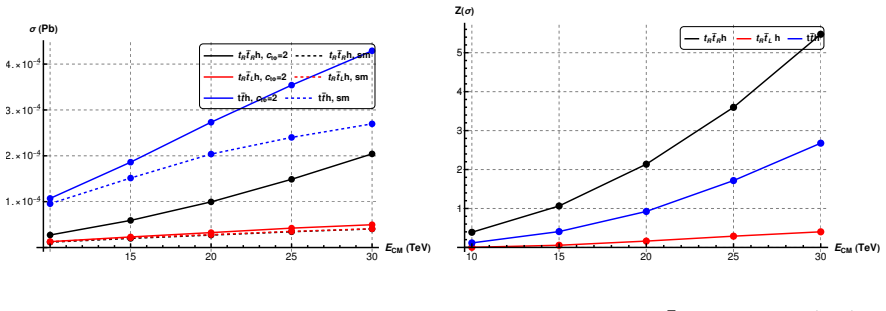
The load-bearing object is the dimension-six SMEFT operator $O_{t\Phi}=\frac{c_{t\phi}}{\Lambda^2}Q t_R \tilde\Phi(\Phi^\dagger\Phi)$, which gives both the anomalous top Yukawa coupling and a five-point contact vertex for $\phi^+\phi^-\to t\bar t h$ (and the analogous $Z_L$ vertex). By Goldstone equivalence, longitudinal-vector-boson scattering at high energy is described by these Goldstone amplitudes; the contact diagram stays constant while Standard Model diagrams are suppressed by $m_W^2/E^2$. Helicity selection of the final tops and $Z$ isolates exactly the chirality structure of the contact term, turning a small signal-to-background ratio into a detectable one.
What would settle it
A detector-level simulation of boosted $t\bar t$ and $Z$ decays at 10--30 TeV that measures achievable spin-tagging efficiencies would settle the claim; if the efficiency falls below about 0.6, the paper's own scans show the $\delta y_t$ limits degrade noticeably. A second test would be measuring the hard process $W^+W^-\to t\bar t h$ with helicity tagging and checking whether the $t_L\bar t_L+t_R\bar t_R$ final state is indeed enhanced relative to the mixed-helicity states as the contact-diagram argument predicts.
Extended reading notes
Core claim
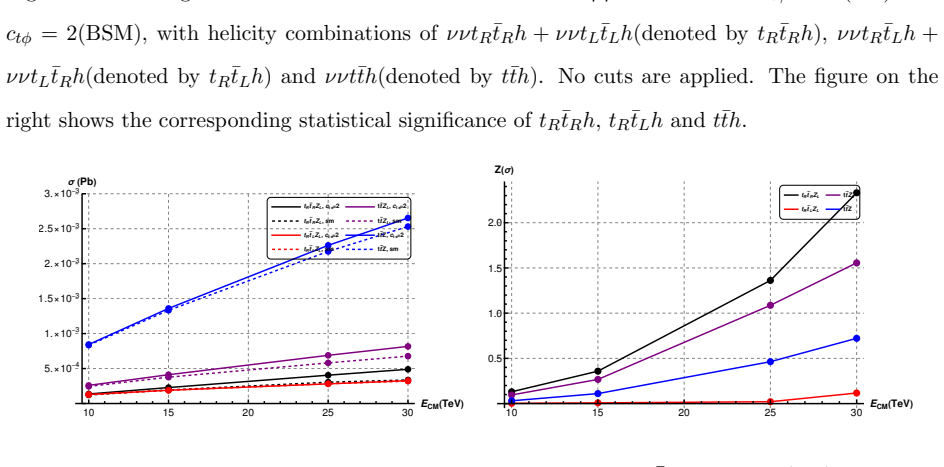
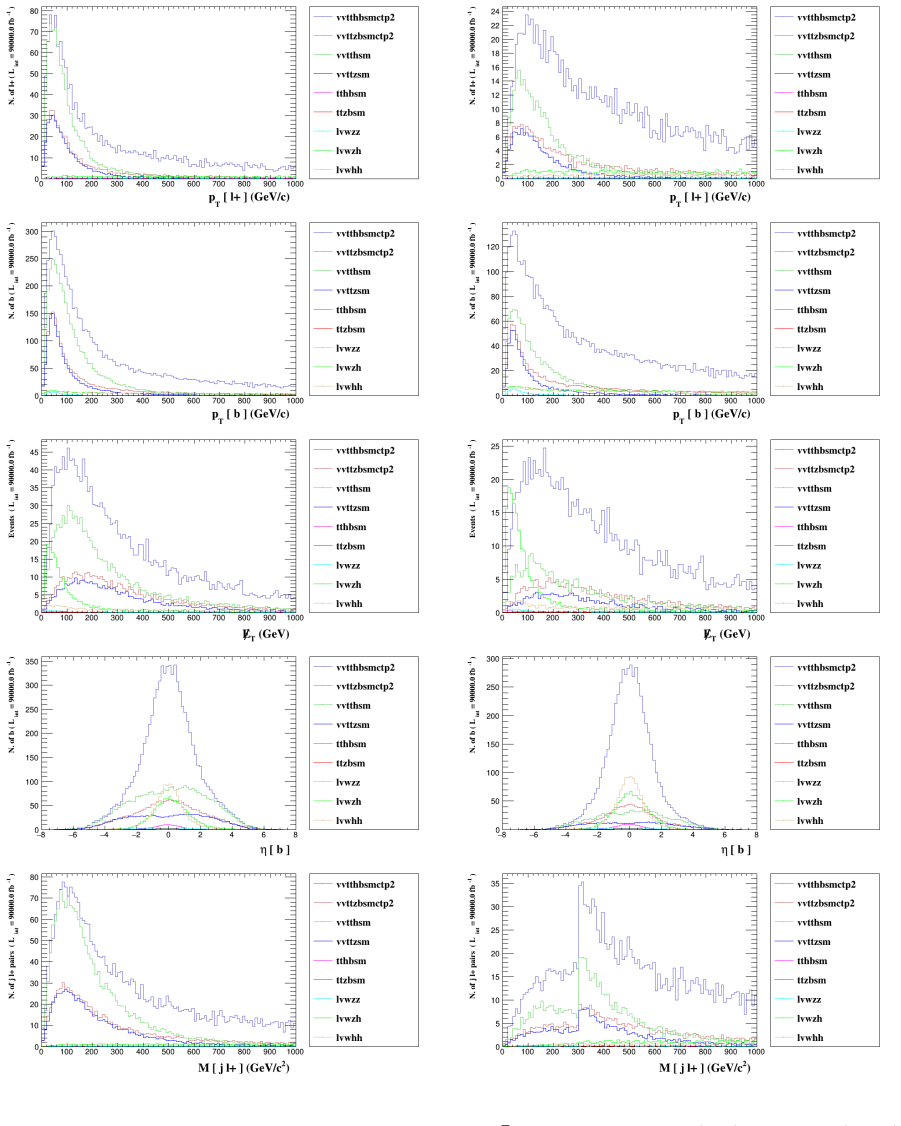
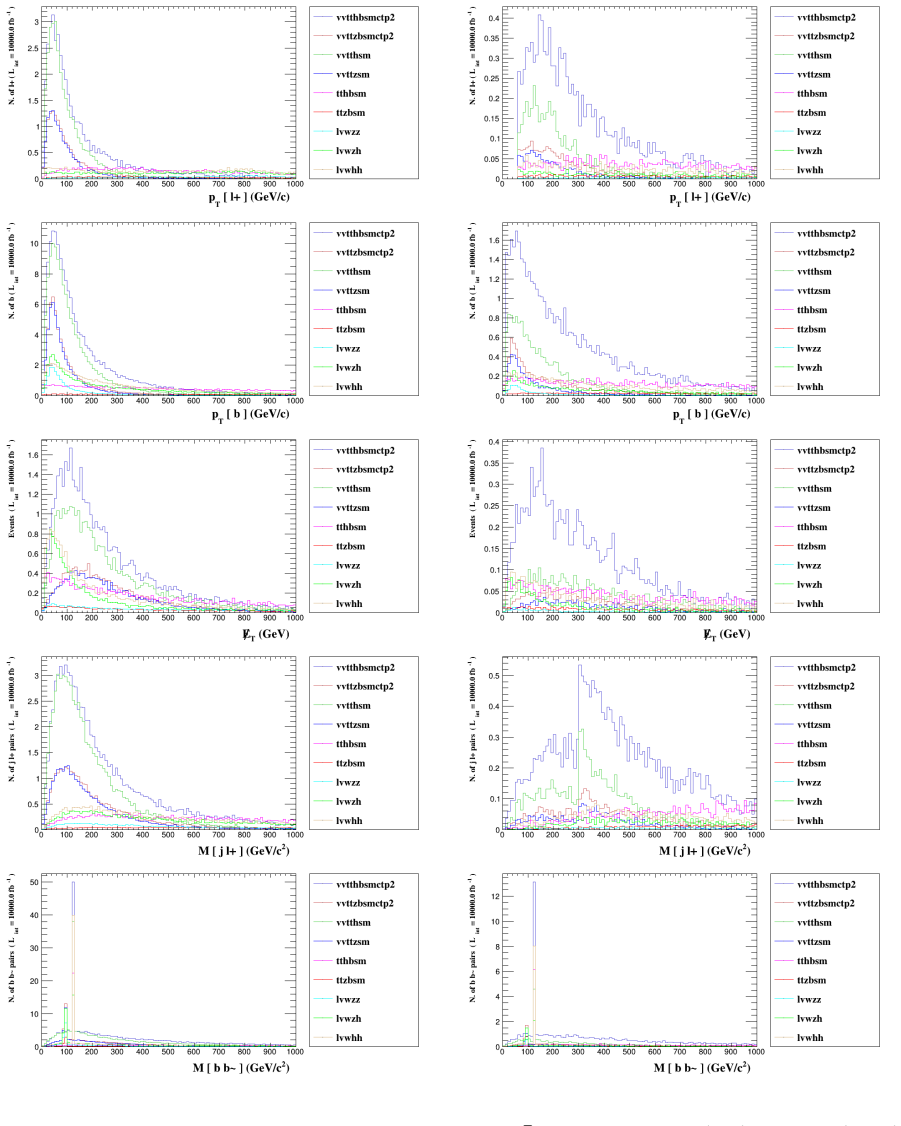
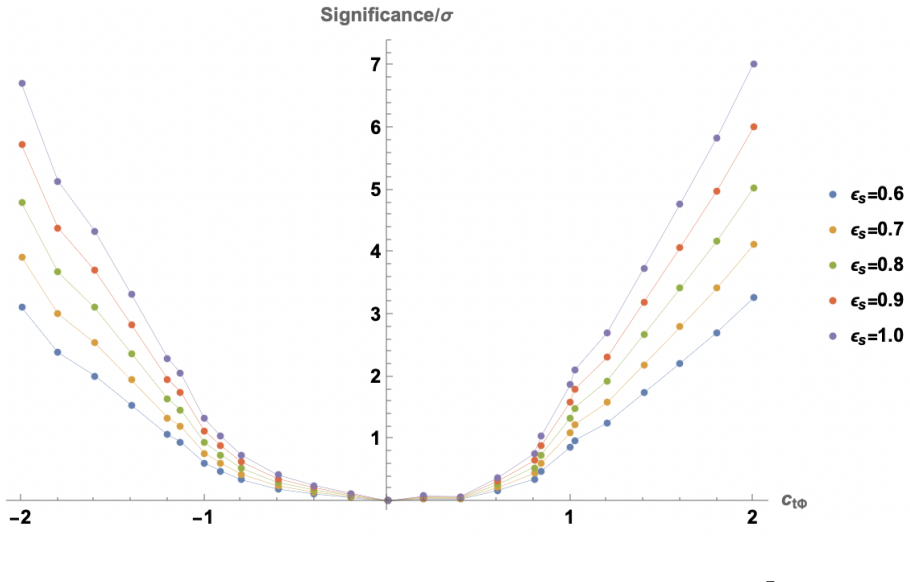
The central claim is that $\nu\nu t\bar t h$ and $\nu\nu t\bar t Z$ from $W^+W^-$ fusion are far more sensitive to the anomalous top Yukawa coupling than their modest cross sections suggest, and that the sensitivity can be extracted by helicity selection rather than a full differential fit. The argument uses Goldstone equivalence: at high energy the longitudinal $W$ bosons behave as Goldstone modes, so the operator $O_{t\Phi}$ contributes a five-point contact vertex $\phi^+\phi^-\to t\bar t h$ that is constant in energy while every Standard Model diagram falls as $m_W^2/E^2$. Because $O_{t\Phi}$ has a $\bar t_L t_R$ chiral structure, only the helicity combinations $t_L\bar t_L$ and $t_R\bar t_R$ (together with longitudinal $Z$) receive the growing contribution, which is why selecting those helicities enhances the significance by about $\sqrt{2}$ for $t\bar t h$ and by roughly a factor of three for $t\bar t Z$. The paper quantifies this at parton level and after decays, obtaining limits listed in Table VIII, with the strongest bound, $[-1.6\%,1.8\%]$ at $1\sigma$, from the 30 TeV semi-leptonic $\nu\nu t\bar t h$ channel at spin-tagging efficiency $\epsilon_s=0.9$.
Load-bearing premise
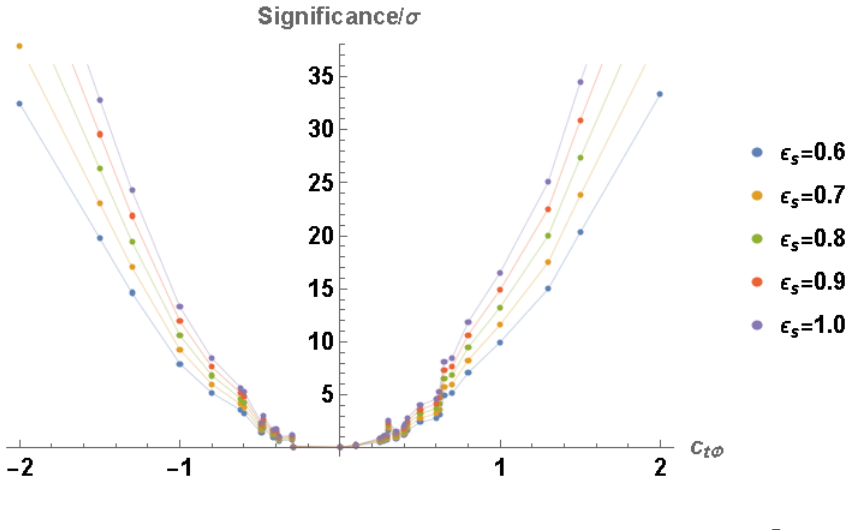
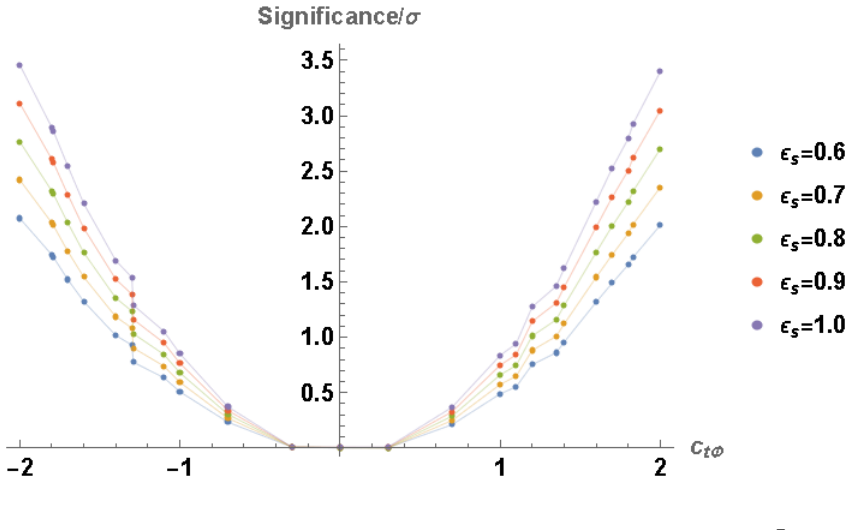
The projected sensitivity depends on a real detector being able to tag the helicities of the final top, anti-top, and $Z$ with efficiency around 0.9 (the paper scans down to 0.6); no concrete spin-tagging algorithm is demonstrated.
Editorial extensions
If this is right
- If the helicity-selected 2-to-3 VBS analysis works, a 30 TeV muon collider with 90 ab$^{-1}$ can determine the anomalous top Yukawa coupling to roughly $\pm 1\%$, an order of magnitude beyond current LHC precision.
- $\nu\nu t\bar t Z$ is competitive with $\nu\nu t\bar t h$ and should be included in future top-Yukawa projections; the paper shows the combined channel improves the limits to $[-0.36\%,0.92\%]$.
- Helicity selection can replace bin-by-bin shape analysis for an initial sensitivity estimate, which makes the projection faster and simpler while still matching more elaborate fitting approaches.
- The same method transfers to other 2-to-3 VBS final states and can be combined with bin-by-bin or machine-learning analyses to further improve the limits.
- At 10 TeV the limits weaken to the 7\%--10\% range, so the collider energy, not luminosity alone, is what buys the percent-level precision.
Reading between the lines
- A concrete spin tagger is the missing piece: the paper's efficiency scan does not establish that top/$Z$ helicities can actually be tagged at 0.6--0.9 in the relevant boosted regime, so a detector-level study of the $t_L\bar t_L+t_R\bar t_R$ and $Z_L$ selection will decide whether the projected limits hold.
- The same contact-diagram logic should apply to the CP-violating phase of the top Yukawa, where helicity-correlation asymmetries in $t\bar t h/Z$ could give a complementary probe; the paper explicitly leaves the CP phase for future work.
- Hadronic channels, which the paper excludes, have the largest cross sections and could push the limits further if jet substructure tools can tag the final-state helicities.
- Because the paper deliberately avoids bin-by-bin analysis, a natural next step is to combine helicity selection with a full shape fit or a machine-learning classifier; the gap between the parton-level limits and the cut-based limits is a rough measure of what such a combination could reclaim.
Editorial analysis
A structured set of objections, weighed in public.
Referee Report
Summary. The paper proposes using the 2->3 VBS processes W+W- -> t tbar h and W+W- -> t tbar Z, realized at a muon collider through nu nu t tbar h / nu nu t tbar Z, to measure the anomalous top Yukawa coupling delta y_t. The authors argue via Goldstone equivalence that the SMEFT operator O_tPhi produces an energy-independent contact diagram in W_L W_L -> t tbar h/Z, while the SM amplitude is energy-suppressed, giving high sensitivity to delta y_t. They then simulate the hard processes with MadGraph and SMEFTatNLO, select the helicity combinations t_L tbar_L + t_R tbar_R and Z_L as the 'default and core' setting, and compute projected limits first at parton level (Table I) and then after decays and simple cuts for lepton and semi-lepton channels at 10 and 30 TeV (Table VIII). The best quoted limit is [-1.6%, 1.8%] at 1 sigma for the 30 TeV semi-lepton nu nu t tbar h channel with spin-tagging efficiency epsilon_s = 0.9.
Significance. If the projected limits were robust, the paper would be a useful contribution: it draws attention to 2->3 VBS channels that have received less attention than the 2->2 nu nu t tbar channel, gives a clean energy-growth argument for the O_tPhi contact diagram, provides transparent cut-flow tables for signal and background, and uses standard public tools (MadGraph, SMEFTatNLO) with explicit scans over tagging efficiencies. The manuscript is also honest in listing its own limitations in Sec. V. However, the quantitative claims are conditional on an unvalidated spin-tagging capability and on parton-level simulation, so the numerical limits should be read as idealized projections rather than realistic measurement projections.
major comments (3)
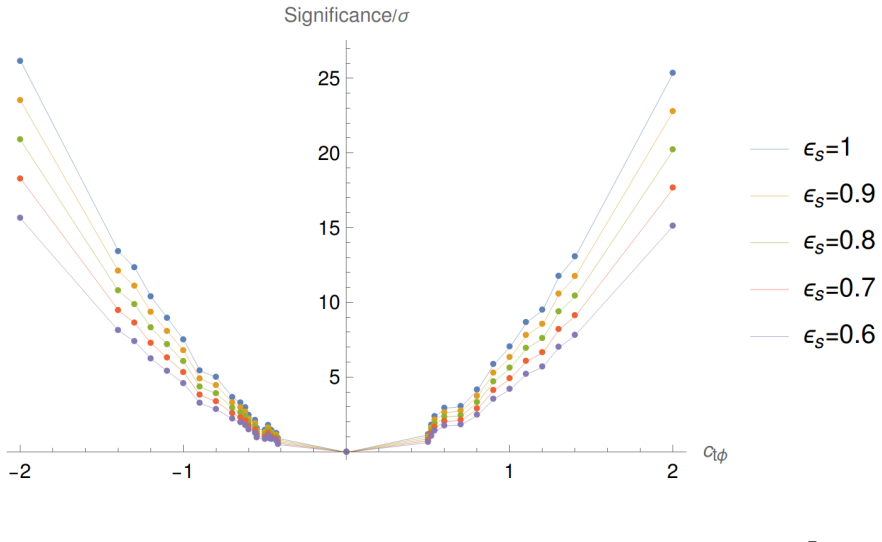
- [Sec. III A 1, Sec. III B 1, Sec. IV, Table VIII] The default and core setting is the selection of t_L tbar_L + t_R tbar_R and Z_L helicities, and all quoted limits in Table VIII are computed for epsilon_s = 0.9 (or 0.7). The scan, however, treats epsilon_s as a per-event multiplicative efficiency and contains no mistag probability for the unselected helicity states. The wrong-helicity SM cross sections are not small: Eq. (12) gives full-to-selected cross-section ratios of roughly 2 for nu nu t tbar h and 5 for nu nu t tbar Z. A tagger with 90% signal efficiency and even a few percent mistag probability would admit a sizable fraction of these larger backgrounds and degrade S/sqrt(B). The cited references [30,31] concern W/Z polarization tagging at the LHC, not top-quark helicity tagging at a 10-30 TeV muon collider, and the text itself states that the technique is 'not yet mature' (Sec. III A 1). Please add a concrete spin-tagging model, ideally a 2x2 signal/mistag matrix, and recompute the limits with pessimistic mistag rates, or explicitly relabel the quoted limits as conditional on near-perfect helicity identification.
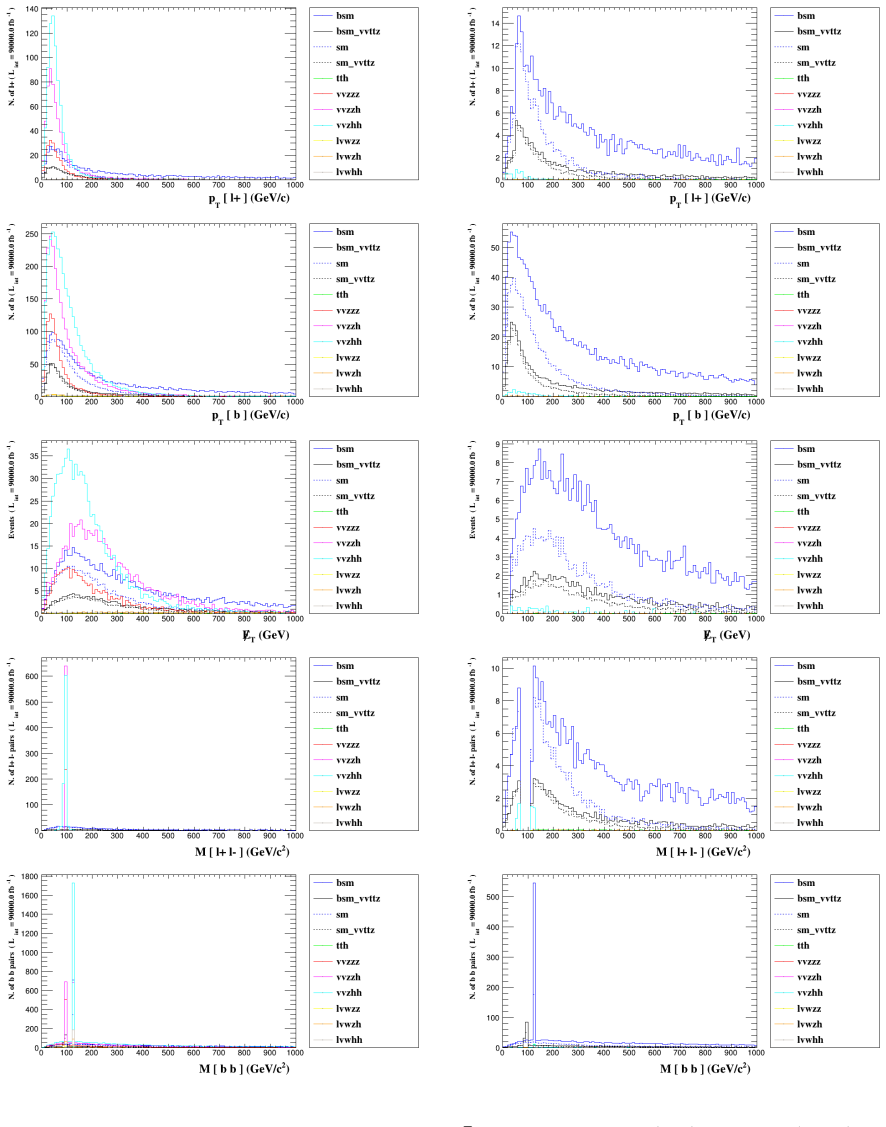
- [Sec. III (analysis setup) and Sec. V (limitations)] The full-channel analysis is performed at parton level: there is no parton shower or hadronization, no jet clustering, no detector simulation, no lepton isolation, and no MET smearing; b-tagging is modeled as a single multiplicative efficiency epsilon_b = 0.9. The paper argues this is acceptable because muon colliders are not yet built, but the abstract and Table VIII present the resulting limits (for example, [-1.6%, 1.8%] at 1 sigma for the 30 TeV semi-lepton channel) as concrete measurement projections. The signal final states contain multiple b-jets plus jets and large MET, so acceptances and background rejections are sensitive to jet and MET effects, and fake or mistagged jets cannot be modeled at parton level. Please either add a fast detector simulation with hadronization and jet reconstruction, or qualify all numerical limits as idealized parton-level projections and estimate the expected degradation from showering and detector effects.
- [Sec. II A, Eq. (8), Sec. V] The interpretation of the projected limits as limits on the top Yukawa coupling delta y_t assumes that the deviation of the tth vertex is generated solely by the single SMEFT operator O_tPhi. Equation (8) relates delta y_t to c_tphi / Lambda^2, and the contact-diagram analysis is specific to O_tPhi. Other dimension-six operators that modify top electroweak or Yukawa interactions, for example top dipoles such as O_tW or O_tB, can contribute to the same VV -> t tbar h/Z amplitudes and can interfere with or mimic the contact-diagram signal. The conclusion frames the results as a measurement of 'the top Yukawa coupling' without stating this single-operator assumption. Please add an explicit discussion of the EFT truncation and the most relevant competing operators, or consistently report the results as limits on c_tphi / Lambda^2 under the stated single-operator assumption.
minor comments (6)
- [Sec. V] The conclusion states that the semi-lepton channels constrain delta y_t at [-1.8%, 1.6%] and [-5.6%, 6.0%], but the corresponding entries in Table VIII and the abstract read [-1.6%, 1.8%] and [-5.6%, 6.0%]; the sign order in the first interval appears to be a typo.
- [Sec. III B 2] Cut 1 in the 10 TeV semi-lepton channel requests 'Select M_{l+l-} > 300 GeV', but this final state contains only a single charged lepton (l^+- + jets + 4b + MET), so M_{l+l-} is undefined; this appears to be a copy-paste error from the lepton-channel analysis.
- [Sec. IV A] Cut 2 says 'Reject pT(l) > 40 GeV; Reject pT(b) > 40 GeV', which contradicts the preliminary cuts pT(l) > 40 GeV and pT(b) > 40 GeV and would remove all events; the cut-flow table shows a non-zero passage at this stage, so the written cut must be misstated.
- [Eq. (11) and Eq. (13)] The symbol S is used both for the statistical significance in Eq. (11) and for the signal event count in Eqs. (13)-(14); renaming one of them would remove ambiguity.
- [Sec. III A 1 and Table VIII] The text says the spin-tagging efficiency is scanned over 1, 0.9, 0.8, 0.7, 0.6, but Table VIII reports only epsilon_s = 0.9 and 0.7; adding the other columns (or stating why they are omitted) would make the scan transparent.
- [Sec. II A, Eq. (8)] The relation delta y_t * y_t^SM = - c_tphi v^2 / Lambda^2 is stated without derivation; since all numerical limits are converted through this relation, please give the explicit Feynman rule for the tth vertex after electroweak symmetry breaking and define the sign convention for c_tphi.
Circularity Check
No load-bearing circularity: the δyt–VBS connection is a genuine one-operator EFT relation, and the helicity-selection enhancement is derived and simulated rather than fitted; the score reflects only minor non-load-bearing self-citation.
full rationale
The paper's derivation chain is self-contained rather than circular. The central claim — that W_L W_L → t tbar h/Z_L is highly sensitive to the anomalous top Yukawa δyt — follows from identifying the SMEFT operator OtΦ as the gauge-invariant source of both the tth coupling modification and the 5-point contact diagram that dominates the high-energy VBS amplitude. This is a standard one-operator EFT relation (Eqs. 7–10), not a fit of the predicted quantity to the input; the VBS cross sections are generated independently with Madgraph/SMEFTatNLO at ctφ=2 and then converted to δyt limits via the algebraic relation in Eq. (8). The helicity selection t_L tbar_L + t_R tbar_R, Z_L is derived from the chiral structure of OtΦ and the helicity-chirality correspondence, and the enhancement factors are computed from simulated cross-section ratios (Eq. 12), so the selection is not an ansatz that already contains the result. The spin-tagging efficiency scan in Section III is an acknowledged instrumental assumption, and the admitted lack of a mature tagger is a limitation rather than a circular step. The only rubric-relevant feature is the citation of the authors' earlier 2→3 VBS papers [26,27] for the method analogy; this is not load-bearing, because the present derivation is carried out in the paper. Therefore no circular step is exhibited, and the score is set to 2 for the minor non-load-bearing self-citation.
Assumptions & free parameters
free parameters (3)
- spin tagging efficiency epsilon_s =
0.9 (default), scanned 0.6-1.0
- b-tagging efficiency epsilon_b =
0.9
- integrated luminosity benchmark =
L = (sqrt(s)/10 TeV)^2 * 10 ab^-1, giving 90 ab^-1 at 30 TeV
assumptions (4)
- standard math Equivalence theorem: longitudinal W and Z behave as Goldstone bosons at high energy
- domain assumption SMEFT truncation at dimension-6, with O_tPhi as the only relevant operator for this process
- domain assumption Chirality equals helicity for high-energy fermions, and t_L chirality maps to t_L helicity, tbar_L to tbar_R
- ad hoc to paper Parton-level simulation without shower/hadronization is sufficient for reliable estimates
Cite this review
Pith. "Pith review of Measuring Top Yukawa Coupling through $2\rightarrow 3$ VBS at Muon Collider." pith.science (2026). https://pith.science/paper/JBKJ4SY6
@misc{pith2026250208310,
  author       = {Pith},
  title        = {Pith review of: Measuring Top Yukawa Coupling through $2\rightarrow 3$ VBS at Muon Collider},
  year         = {2026},
  howpublished = {\url{https://pith.science/paper/JBKJ4SY6}},
  note         = {Machine review of arXiv:2502.08310}
}
abstract
We study the measurement of top Yukawa coupling through $2\rightarrow 3$ VBS at future muon colliders, focusing on the lepton and semi-lepton channels of $\nu\nu tth/z$. First, analyzing the partonic amplitudes of $W_LW_L\rightarrow t\bar t h/Z_L$ and simulating the full processes of $\nu\nu tth/z$ without decaying, we find they are highly sensitive to the anomalous top Yukawa $\delta y_t$. This sensitivity is enhanced by selecting helicities of the final $t\bar t$ and $Z$ to be $t_L\bar t_L+t_R\bar t_R$ and $Z_L$, which serves as the default and core setting of our analysis. We then obtain the limits on $\delta y_t$ with this setting, giving $[-1.0\%, 1.1\%]$ for $\nu\nu tth$ only and $[-0.36\%, 0.92\%]$ for $\nu\nu tth$ and $\nu\nu ttz$ combined at $30$ TeV and $1\sigma$. Second, we proceed to analyze the processes after decaying and with background processes. To enhance the sensitivity to $\delta y_t$, our settings include selecting the helicities of the final particles, as well as applying suitable cuts. However, we don't do bin-by-bin analysis. We obtain the limits on $\delta y_t$ for those channels at $10/30$ TeV and $1\sigma/2 \sigma$. The best limit is from the semi-lepton channel of $\nu\nu tth$. With spin tagging efficiency at $\epsilon_s=0.9$, it gives $[-1.6\% , 1.8\%]$ at $1\sigma$ and $ [-2.4\%, 2.7\% ]$ at $2\sigma$ at $30$ TeV; $[-7.0\%, 6.7\%]$ at $1\sigma$ and $[-9.8\%, 9.8\%]$ at $2\sigma$ at $10$ TeV.
Figures
Figures from the paper (9 more)

Reference graph
Works this paper leans on
-
[1]
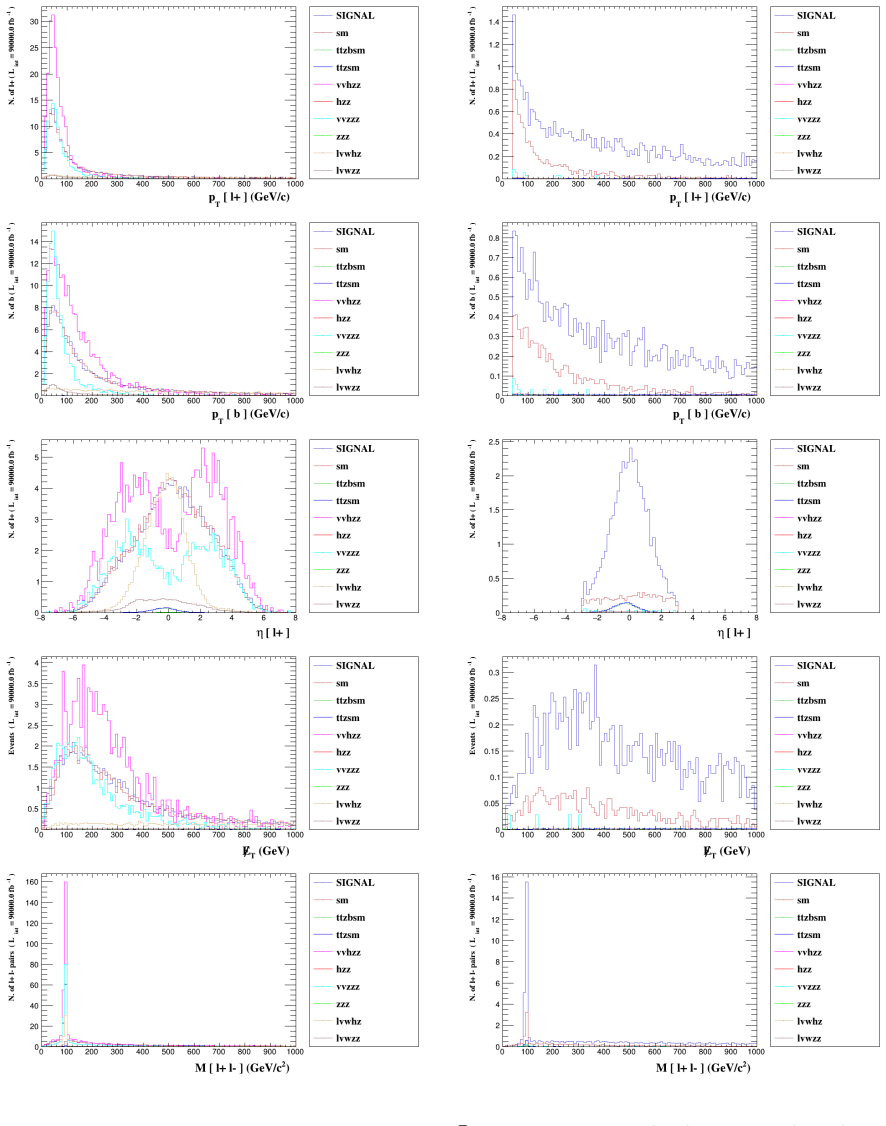
30 TeV We first study 30 TeV for the lepton channel from ννt ¯th. For all the processes, we implement a set of preliminary cuts: pT (b) > 20 GeV, p T (l) > 30 GeV (18) with b = b/¯b and l = l+/l−. We emphasize again that the crucial setting of our analysis is specifying helicities of final particles. To accommodate collider environment, we will scan over ...
-
[2]
10 TeV We now turn to 10 TeV for the lepton channel from ννt ¯th. We impose the following cuts to reduce background: • Cut 1: Reject 70 GeV < Ml+l− < 115 GeV, reject MET > 650 GeV • Cut 2: Select pT (b) > 50 GeV, select pT (l) > 50 GeV. with b = b/¯b and l = l+/l−. The cuts on 10 TeV is modified slightly relative to 30 TeV of the same channel: Cut 1 is to...
-
[3]
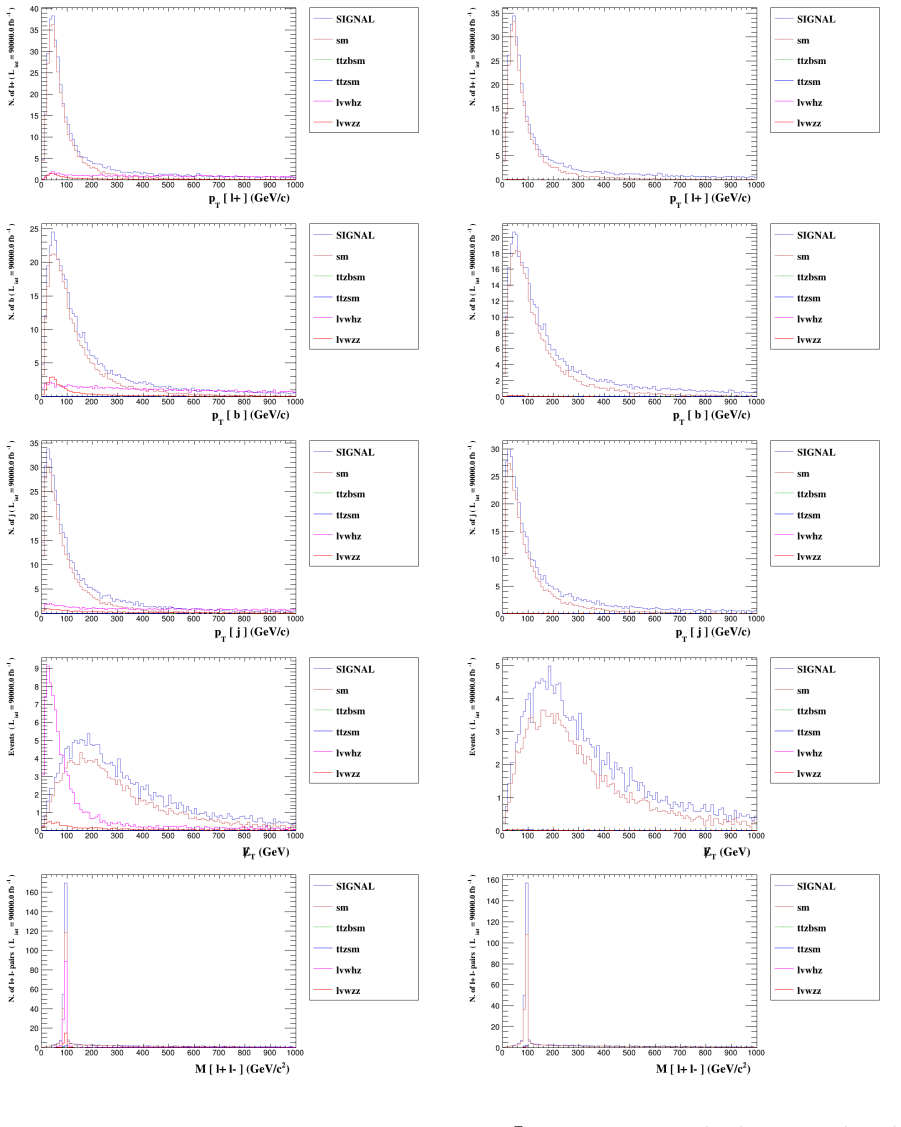
30 TeV We start with c.m. energy of 30 TeV. The semi-lepton channel has a much larger cross- section than lepton channel due to the larger branching ratio of W → jj . With the increase of luminosity and smaller number of background processes, we expect a high significance and stringent limit on δyt. As summarized as below, we apply the following cuts to r...
work page 2025
-
[4]
10 TeV We then proceed to 10 TeV for the semi-lepton channel of ννt ¯th. The cuts we applied to reduce background and increase statistical significance are summarized as follows: • Cut 1: Select −2 < η(b) < 2, Select Ml+l− > 300 GeV, Select Mbj > 200 GeV. The purpose of this cut is to reduce the SM part of signal processes ν ¯νtR¯tRh/ZL and ν ¯νtL¯tLh/ZL....
- [5]
- [6]
- [7]
-
[8]
Trodden, Electroweak baryogenesis, Rev
M. Trodden, Electroweak baryogenesis, Rev. Mod. Phys. 71 (1999) 1463 [ hep-ph/9803479]
arXiv 1999
Show all 35 references
-
[9]
Zhang, S.K
X. Zhang, S.K. Lee, K. Whisnant and B.L. Young, Phenomenology of a nonstandard top quark Yukawa coupling, Phys. Rev. D 50 (1994) 7042 [ hep-ph/9407259]
1994 arXiv
-
[10]
H. Baer, V. Barger, J. Dutta, D. Sengupta and K. Zhang, Top squarks from the landscape at high luminosity LHC , Phys. Rev. D 108 (2023) 075027 [ 2307.08067]
2023 arXiv
-
[11]
ATLAS collaboration, Search for R-parity violating supersymmetric decays of the top squark to a b-jet and a lepton in s=13 TeV pp collisions with the ATLAS detector , Phys. Rev. D 110 (2024) 092004 [ 2406.18367]
2024 arXiv
-
[12]
ATLAS collaboration, A search for top-squark pair production, in final states containing a top quark, a charm quark and missing transverse momentum, using the 139 fb –1 of pp collision data collected by the ATLAS detector , JHEP 07 (2024) 250 [ 2402.12137]
2024 arXiv
-
[13]
ATLAS collaboration, Probing the CP nature of the top–Higgs Yukawa coupling in tt ¯H and tH events with H →bb¯ decays using the ATLAS detector at the LHC , Phys. Lett. B 849 (2024) 138469 [ 2303.05974]
2024 arXiv
-
[14]
CMS collaboration, Measurements of t¯tH Production and the CP Structure of the Yukawa Interaction between the Higgs Boson and Top Quark in the Diphoton Decay Channel , Phys. Rev. Lett. 125 (2020) 061801 [ 2003.10866]
2020 arXiv
-
[15]
CMS collaboration, Measurement of the top quark Yukawa coupling from t¯t kinematic distributions in the dilepton final state in proton-proton collisions at √s = 13 TeV, Phys. Rev. D 102 (2020) 092013 [ 2009.07123]
2020 arXiv
-
[16]
Delahaye, M
J.P. Delahaye, M. Diemoz, K. Long, B. Mansouli´ e, N. Pastrone, L. Rivkin et al., Muon Colliders, 1901.06150
1901 arXiv
-
[17]
K. Long, D. Lucchesi, M. Palmer, N. Pastrone, D. Schulte and V. Shiltsev, Muon colliders to expand frontiers of particle physics , Nature Phys. 17 (2021) 289 [ 2007.15684]
2021 arXiv
-
[18]
Buttazzo, D
D. Buttazzo, D. Redigolo, F. Sala and A. Tesi, Fusing Vectors into Scalars at High Energy Lepton Colliders , JHEP 11 (2018) 144 [ 1807.04743]. 32
2018 arXiv
-
[19]
Costantini, F
A. Costantini, F. De Lillo, F. Maltoni, L. Mantani, O. Mattelaer, R. Ruiz et al., Vector boson fusion at multi-TeV muon colliders , JHEP 09 (2020) 080 [ 2005.10289]
2020 arXiv
-
[20]
T. Han, D. Liu, I. Low and X. Wang, Electroweak couplings of the Higgs boson at a multi-TeV muon collider , Phys. Rev. D 103 (2021) 013002 [ 2008.12204]
2021 arXiv
-
[21]
Chiesa, F
M. Chiesa, F. Maltoni, L. Mantani, B. Mele, F. Piccinini and X. Zhao, Measuring the quartic Higgs self-coupling at a multi-TeV muon collider , JHEP 09 (2020) 098 [ 2003.13628]
2020 arXiv
-
[22]
Whisnant, B.-L
K. Whisnant, B.-L. Young and X. Zhang, Unitarity and anomalous top quark Yukawa couplings, Phys. Rev. D 52 (1995) 3115 [ hep-ph/9410369]
1995 arXiv
-
[23]
Henning, D
B. Henning, D. Lombardo, M. Riembau and F. Riva, Measuring Higgs Couplings without Higgs Bosons , Phys. Rev. Lett. 123 (2019) 181801 [ 1812.09299]
2019 arXiv
-
[24]
Maltoni, L
F. Maltoni, L. Mantani and K. Mimasu, Top-quark electroweak interactions at high energy , JHEP 10 (2019) 004 [ 1904.05637]
2019 arXiv
-
[25]
Chen and D
M. Chen and D. Liu, Top Yukawa coupling measurement at the muon collider , Phys. Rev. D 109 (2024) 075020 [ 2212.11067]
2024 arXiv
-
[26]
Liu, K.-F
Z. Liu, K.-F. Lyu, I. Mahbub and L.-T. Wang, Top Yukawa coupling determination at high energy muon collider , Phys. Rev. D 109 (2024) 035021 [ 2308.06323]
2024 arXiv
-
[27]
Barman et al., Directly Probing the CP-structure of the Higgs-Top Yukawa at HL-LHC and Future Colliders , in Snowmass 2021 , 3, 2022 [ 2203.08127]
R.K. Barman et al., Directly Probing the CP-structure of the Higgs-Top Yukawa at HL-LHC and Future Colliders , in Snowmass 2021 , 3, 2022 [ 2203.08127]
2021 arXiv
-
[28]
Cassidy, Z
M.E. Cassidy, Z. Dong, K. Kong, I.M. Lewis, Y. Zhang and Y.-J. Zheng, Probing the CP structure of the top quark Yukawa at the future muon collider , JHEP 05 (2024) 176 [2311.07645]
2024 arXiv
-
[29]
Dedes, W
A. Dedes, W. Materkowska, M. Paraskevas, J. Rosiek and K. Suxho, Feynman rules for the Standard Model Effective Field Theory in R ξ -gauges, JHEP 06 (2017) 143 [ 1704.03888]
2017 arXiv
-
[30]
Chen, C.-T
J. Chen, C.-T. Lu and Y. Wu, Measuring Higgs boson self-couplings with 2 → 3 VBS processes, JHEP 10 (2021) 099 [ 2105.11500]
2021 arXiv
-
[31]
J. Chen, T. Li, C.-T. Lu, Y. Wu and C.-Y. Yao, Measurement of Higgs boson self-couplings through 2→3 vector bosons scattering in future muon colliders , Phys. Rev. D 105 (2022) 053009 [2112.12507]
2022 arXiv
-
[32]
Alwall, R
J. Alwall, R. Frederix, S. Frixione, V. Hirschi, F. Maltoni, O. Mattelaer et al., The automated computation of tree-level and next-to-leading order differential cross sections, and their matching to parton shower simulations , JHEP 07 (2014) 079 [ 1405.0301]. 33
2014 arXiv
-
[33]
Degrande, G
C. Degrande, G. Durieux, F. Maltoni, K. Mimasu, E. Vryonidou and C. Zhang, Automated one-loop computations in the SMEFT , 2008.11743
2008 arXiv
-
[34]
Ballestrero, E
A. Ballestrero, E. Maina and G. Pelliccioli, Different polarization definitions in same-sign W Wscattering at the LHC , Phys. Lett. B 811 (2020) 135856 [ 2007.07133]
2020 arXiv
-
[35]
S. De, V. Rentala and W. Shepherd, Measuring the polarization of boosted, hadronic W bosons with jet substructure observables , 2008.04318. 34
2008 arXiv
Reviewed August 8, 2026 · model on record in the stance chip above.
Discussion (0). Continue with ORCID to comment.