REVIEW 3 major objections 10 minor 17 references
Learning-Based Interface for Semantic Communication with Bit Importance Awareness
T0 review · 3 major / 10 minor · reviewed 2026-08-06 · deepseek-v4-flash
Pith's one-line read Learned bit-importance interface lifts wireless image PSNR
desk verdict Incremental but promising extension of Split DeepJSCC, undermined by an unfair baseline comparison: the proposed model is trained over 5–20 dB while Split DeepJSCC is trained only at 20 dB. read the letter →
The pith
A machine-rendered reading of the paper's core claim, the machinery that carries it, and where it could break.
The reading
What carries the argument
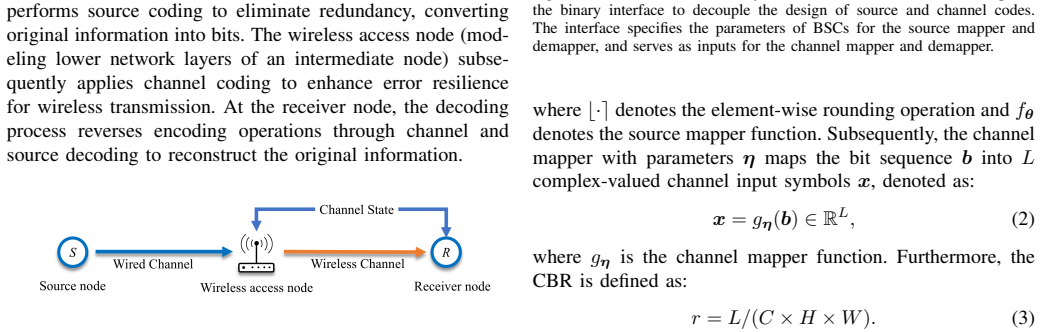
The load-bearing object is the trainable binary interface: an array of M binary symmetric channels with parameters {ϵ_n}, each describing the flip probability of one bit produced by the source mapper. The source stage maximizes variational mutual information between image s and noisy bits b̂ through the noise distribution q_noisy, with straight-through estimation for gradients; the regularization term λΣ(ϵ_n−0.5)² prevents collapse to error-free bits. The learned ϵ values then double as bit-importance scores, mapped to attention weights through 1−2ϵ in the Importance-Aware Net, which combines interface attention with a squeeze-and-excitation block inside the channel mapper and demapper. This chain links the source code's quality view to the channel code's resource allocation without joint training.
What would settle it
Inspect the learned bit-flip probabilities after stage one and compare them against an empirical sensitivity map: corrupt each bit of the frozen source encoder's output over the real AWGN and Rayleigh channels and measure the PSNR drop. If the bits the interface ranks most important are not the bits whose corruption hurts reconstruction most, the transfer premise fails and the Importance-Aware Net would be attending to the wrong positions.
Extended reading notes
Core claim
The core claim is that the binary interface—the shared bit-level agreement between source and network sides—should be learned, not fixed. The paper trains an array of binary symmetric channels with per-bit flip probabilities ϵ_n during the source stage, so the source mapper learns which bit positions the noisy pipe will respect; a regularizer keeps the flipping probabilities away from zero. After freezing the source code, the fixed ϵ values are transformed to 1−2ϵ and injected into the channel mapper and demapper through an Importance-Aware Net, telling the channel code which bits are most valuable for reconstruction. The reported result is that this two-stage split training with learned importance outperforms Split DeepJSCC in PSNR over AWGN and Rayleigh channels across four datasets and all tested bandwidth ratios and signal-to-noise ratios.
Load-bearing premise
The learned ranking of bit importance, produced while training the source code through simple binary symmetric channels, must remain meaningful when the actual transmission path is an AWGN or Rayleigh wireless channel, since that ordering is what steers the channel code.
Editorial extensions
If this is right
- Source and channel codes can be trained separately and frozen at different times, while the learned interface keeps them coordinated—a property needed when source and network are operated by different entities.
- Performance gains grow with channel bandwidth ratio, so the scheme exploits available bandwidth better than a fixed interface that saturates as the bandwidth ratio rises.
- Under Rayleigh fading, the method degrades more slowly at low SNR and gains more at high SNR, making it suited to time-varying wireless conditions.
- The model trained only on CIFAR-10 still improves PSNR on CIFAR-100, suggesting the learned interface is not overtuned to a single dataset.
- Each deployed pair of source and channel codes still fits the layered network architecture, so no joint end-to-end retraining is required.
Reading between the lines
- The learned ϵ values could be exported as an explicit unequal-error-protection profile, letting a standard channel code allocate stronger protection to the top-ranked bits without retraining the source side.
- If the bit-importance ordering is stable across images, the same interface could be trained once on generic data and reused for unseen sources, making the split design closer to a drop-in network feature.
- The importance signal might extend to other modalities, such as text or video, where the same two-stage interface could define which bits carry semantic weight.
- A testable next step is to vary the regularizer strength and measure the trade-off: weaker regularization should sharpen the importance ranking but may make the source bits less error-resilient.
Editorial analysis
A structured set of objections, weighed in public.
Referee Report
Summary. The paper proposes a learning-based binary interface for the Split DeepJSCC framework in wireless image transmission. The interface is parameterized by bit-flipping probabilities {epsilon_n} of an array of BSCs, which are trained jointly with the source mapper and demapper in a first stage via a variational mutual-information objective with a regularization term. In a second stage, the trained epsilon values are used as bit-importance features in an Importance-Aware Net (IAN) that conditions the channel mapper and demapper on bit importance. The authors report PSNR improvements over Split DeepJSCC across four datasets, four channel bandwidth ratios, and AWGN/Rayleigh channels. The claimed contribution is a trainable interface that eliminates prescribed reliability configurations and provides useful importance information to the channel code.
Significance. If the reported gains are robust, the paper is a useful incremental step toward making DeepJSCC compatible with existing layered network architectures. The formulation is clean: the variational MI objective with BSC noise and Straight-Through Estimator is standard, the regularization is sensible, and the IAN is a reasonable way to inject bit-importance information. The code is made publicly available, which supports reproducibility. The main significance currently rests on the experimental comparison to Split DeepJSCC, which is compromised by an asymmetric training protocol (see major comments). The internal ablation study is better controlled and provides some evidence that the IAN contributes positively, but it covers only one dataset and one CBR.
major comments (3)
- [Section III-A.4 and Figs. 5-6] The ablation study in Section III-C does not remove this confound, because it does not include a matched-training Split DeepJSCC baseline; all four schemes in the ablation use the proposed training SNR distribution, so the comparison to Split DeepJSCC in Fig. 7 inherits the same asymmetry.
- [Figs. 5-6 (Section III-B)] At SNR = 20 dB, the comparison is fair because the baseline is trained at its operating point; the confound primarily affects the lower and middle SNR range. A matched-SNR-distribution baseline would clarify the magnitude of the true improvement.
- [Section II-A and Section II-C] This issue does not invalidate the empirical results, but it affects the practical decoupling motivation that is central to the paper's framing.
minor comments (10)
- [Section II-A] Typo: 'wirelss access nodes' should be 'wireless access nodes'.
- [Section II-A] The phrase 'In particularly' should be 'In particular'.
- [Section II-B] The textual description in Eq. (8) says 'reprensented' instead of 'represented'.
- [Section II-B] Eq. (13) writes 'max I(s; b_hat) = E[log p(s|b_hat)] + const'; this is a variational lower bound approach, and the equality should be stated as 'maximizing a lower bound on I' to be precise. The subsequent claim that this is 'equivalent to minimizing MSE' is standard in the VAE literature, but the bound nature should be acknowledged.
- [Section II-B] The regularization in Eq. (9) is described as preventing collapse to error-free solutions (epsilon_n -> 0), but the term (epsilon_n - 0.5)^2 actually pushes epsilon toward 0.5, the maximum-entropy point. The stated purpose is better phrased as encouraging a spread of bit-flipping probabilities rather than merely avoiding zero.
- [Section II-B] In the sentence following Eq. (12), 'q_noise' should be 'q_noisy' for consistency with Eq. (10).
- [Section III-B] Typo: 'our porposed model' should be 'our proposed model'.
- [Section III-C] The sentence 'This further confirms that the best performance is achieved only when both the Interface Attention Module and the SE Block (i.e., the complete IAN) are used' is confusing because the previous sentence says that removing only the Interface Attention Module (retaining SE Block) degrades performance compared to removing both; this seems to imply the SE Block alone hurts. The authors likely mean that the SE Block helps only when combined with the Interface Attention Module, but the text should be rephrased for clarity.
- [Section III-A.4] The choice of lambda = 1 in Eq. (15) is not justified or studied. A sensitivity analysis over lambda would strengthen the paper, though it is not essential for the main claim.
- [Section III-A.1] The description of model training per dataset is ambiguous: the text says 'we train the model using the training samples from CIFAR10' but later implies separate training for SVHN and ImageNet32. Please clarify which models are trained on which datasets and which results correspond to cross-dataset generalization.
Circularity Check
No significant circularity; the learned interface is an empirical design validated by ablation, not a derivation that reduces to its inputs.
full rationale
The paper contains no equation-level circularity. The first stage trains the source mapper/demapper and the interface parameters {epsilon_n} by maximizing a variational lower bound on I(s; b_hat) (Eqs. 10-15), using BSC noise as a stand-in for the end-to-end channel. The second stage freezes the source mapper/demapper and the interface, then trains the channel mapper/demapper against the same squared-error reconstruction loss (Eq. 16); the same epsilon values are imported as 1-2epsilon features into the IAN. This is a learned-feature transfer, not a prediction that reduces to a fitted value: the paper nowhere claims to derive reconstruction PSNR from epsilon, and the IAN contribution is tested by an ablation that removes the interface attention module (Section III-C). No load-bearing self-citation appears: references [6], [9]-[13] are external. No uniqueness theorem is invoked to force the interface form. The use of 1-2epsilon as an importance score is a stated design choice, not a renamed known result presented as unification. The asymmetric training SNR between the proposed model (uniform 5-20 dB) and Split DeepJSCC (fixed 20 dB) is a real experimental confound that threatens the headline comparison, but it is a fairness/correctness issue and not a circularity of the derivation, so it does not raise the circularity score under the rubric.
Assumptions & free parameters
free parameters (3)
- bit-flipping probabilities {epsilon_n} =
not reported
- regularization coefficient lambda =
1
- training SNR distribution =
uniform 5-20 dB
assumptions (4)
- domain assumption The composition of channel mapper, wireless channel, and channel demapper can be modeled as a bank of independent binary symmetric channels for source code training.
- standard math The variational approximation p_phi(s|b_hat) with a Gaussian output reduces MI maximization to MSE minimization.
- standard math Straight-Through Estimator provides usable gradients through the non-differentiable binary sampling.
- domain assumption The learned 1-2 epsilon importance weights transfer to the real channel mapper and demapper training.
Cite this review
Pith. "Pith review of Learning-Based Interface for Semantic Communication with Bit Importance Awareness." pith.science (2026). https://pith.science/paper/JBRPBWZX
@misc{pith2026250712850,
  author       = {Pith},
  title        = {Pith review of: Learning-Based Interface for Semantic Communication with Bit Importance Awareness},
  year         = {2026},
  howpublished = {\url{https://pith.science/paper/JBRPBWZX}},
  note         = {Machine review of arXiv:2507.12850}
}
read the original abstract
Joint source-channel coding (JSCC) is an effective approach for semantic communication. However, current JSCC methods are difficult to integrate with existing communication network architectures, where application and network providers are typically different entities. Recently, a novel paradigm termed Split DeepJSCC has been under consideration to address this challenge. Split DeepJSCC employs a bit-level interface that enables separate design of source and channel codes, ensuring compatibility with existing communication networks while preserving the advantages of JSCC in terms of semantic fidelity and channel adaptability. In this paper, we propose a learning-based interface design by treating its parameters as trainable, achieving improved end-to-end performance compared to Split DeepJSCC. In particular, the interface enables specification of bit-level importance at the output of the source code. Furthermore, we propose an Importance-Aware Net that utilizes the interface-derived bit importance information, enabling dynamical adaptation to diverse channel bandwidth ratios and time-varying channel conditions. Experimental results show that our method improves performance in wireless image transmission tasks. This work provides a potential solution for realizing semantic communications in existing wireless networks.
Figures


Figures from the paper (5 more)


Reference graph
Works this paper leans on
-
[9]
Y . Oh, J. Park, J. Choi, J. Park, and Y .-S. Jeon, “Digital deep joint source-channel coding with blind training for adaptive modulation and power control,” arXiv preprint arXiv:2501.02273 , 2025
arXiv 2025
-
[13]
Witt: A wireless image transmission transformer for semantic communications,
K. Yang, S. Wang, J. Dai, K. Tan, K. Niu, and P. Zhang, “Witt: A wireless image transmission transformer for semantic communications,” in 2023 IEEE International Conference on Acoustics, Speech and Signal Processing (ICASSP), 2023, pp. 1–5
work page 2023
-
[1]
C. E. Shannon and W. Weaver, The Mathematical Theory of Communi- cation. University of Illinois press, 1962
work page 1962
-
[2]
Deep learning enabled semantic communication systems,
H. Xie, Z. Qin, G. Y . Li, and B.-H. Juang, “Deep learning enabled semantic communication systems,” IEEE Transactions on Signal Pro- cessing, vol. 69, pp. 2663–2675, 2021
2021
-
[3]
Deep joint source- channel coding for wireless image transmission,
E. Bourtsoulatze, D. B. Kurka, and D. G ¨und¨uz, “Deep joint source- channel coding for wireless image transmission,” IEEE Transactions on Cognitive Communications and Networking , vol. 5, no. 3, pp. 567–579, 2019
2019
-
[4]
Deepwive: Deep-learning-aided wireless video transmission,
T.-Y . Tung and D. G ¨und¨uz, “Deepwive: Deep-learning-aided wireless video transmission,” IEEE Journal on Selected Areas in Communica- tions, vol. 40, no. 9, pp. 2570–2583, 2022
work page 2022
-
[5]
Semantic communication systems for speech transmission,
Z. Weng and Z. Qin, “Semantic communication systems for speech transmission,” IEEE Journal on Selected Areas in Communications , vol. 39, no. 8, pp. 2434–2444, 2021
2021
-
[6]
Multi- level reliability interface for semantic communications over wireless networks,
T.-Y . Tung, H. Esfahanizadeh, J. Du, and H. Viswanathan, “Multi- level reliability interface for semantic communications over wireless networks,” IEEE Transactions on Communications , 2025
work page 2025
Show all 17 references
-
[7]
An image is worth 16x16 words: Transformers for image recognition at scale,
A. Dosovitskiy, L. Beyer, A. Kolesnikov, D. Weissenborn, X. Zhai, T. Unterthiner, M. Dehghani, M. Minderer, G. Heigold, and S. Gelly, “An image is worth 16x16 words: Transformers for image recognition at scale,” arXiv preprint arXiv:2010.11929 , 2020
2010 arXiv
-
[8]
Swin transformer: Hierarchical vision transformer using shifted windows,
Z. Liu, Y . Lin, Y . Cao, H. Hu, Y . Wei, Z. Zhang, S. Lin, and B. Guo, “Swin transformer: Hierarchical vision transformer using shifted windows,” in Proceedings of the IEEE/CVF International Conference on Computer Vision, 2021, pp. 10 012–10 022
2021
-
[10]
Neural joint source-channel coding,
K. Choi, K. Tatwawadi, A. Grover, T. Weissman, and S. Ermon, “Neural joint source-channel coding,” in International Conference on Machine Learning. PMLR, 2019, pp. 1182–1192
2019
-
[11]
Joint source-channel coding for channel-adaptive digital semantic communications,
J. Park, Y . Oh, S. Kim, and Y .-S. Jeon, “Joint source-channel coding for channel-adaptive digital semantic communications,” IEEE Transactions on Cognitive Communications and Networking , pp. 75–89, 2024
2024
-
[12]
Estimating or propagating gradients through stochastic neurons for conditional computation,
Y . Bengio, N. L ´eonard, and A. Courville, “Estimating or propagating gradients through stochastic neurons for conditional computation,” arXiv preprint arXiv:1308.3432, 2013
2013 arXiv
-
[14]
Squeeze-and-excitation networks,
J. Hu, L. Shen, and G. Sun, “Squeeze-and-excitation networks,” in Proceedings of the IEEE Conference on Computer Vision and Pattern Recognition, 2018, pp. 7132–7141
2018
-
[15]
Learning multiple layers of features from tiny images,
A. Krizhevsky and G. Hinton, “Learning multiple layers of features from tiny images,” Handbook of Systemic Autoimmune Diseases , vol. 1, no. 4, 2009
2009
-
[16]
Reading digits in natural images with unsupervised feature learning,
Y . Netzer, T. Wang, A. Coates, A. Bissacco, B. Wu, and A. Y . Ng, “Reading digits in natural images with unsupervised feature learning,” in NIPS Workshop on Deep Learning and Unsupervised Feature Learning , vol. 2011, no. 2. Granada, 2011, p. 4
2011
-
[17]
A downsampled variant of imagenet as an alternative to the cifar datasets,
P. Chrabaszcz, I. Loshchilov, and F. Hutter, “A downsampled variant of imagenet as an alternative to the cifar datasets,” arXiv preprint arXiv:1707.08819, 2017
2017 arXiv
Reviewed August 6, 2026 · model on record in the stance chip above.
Discussion (0). Continue with ORCID to comment.